

France Digital Education Market Size & Forecast:
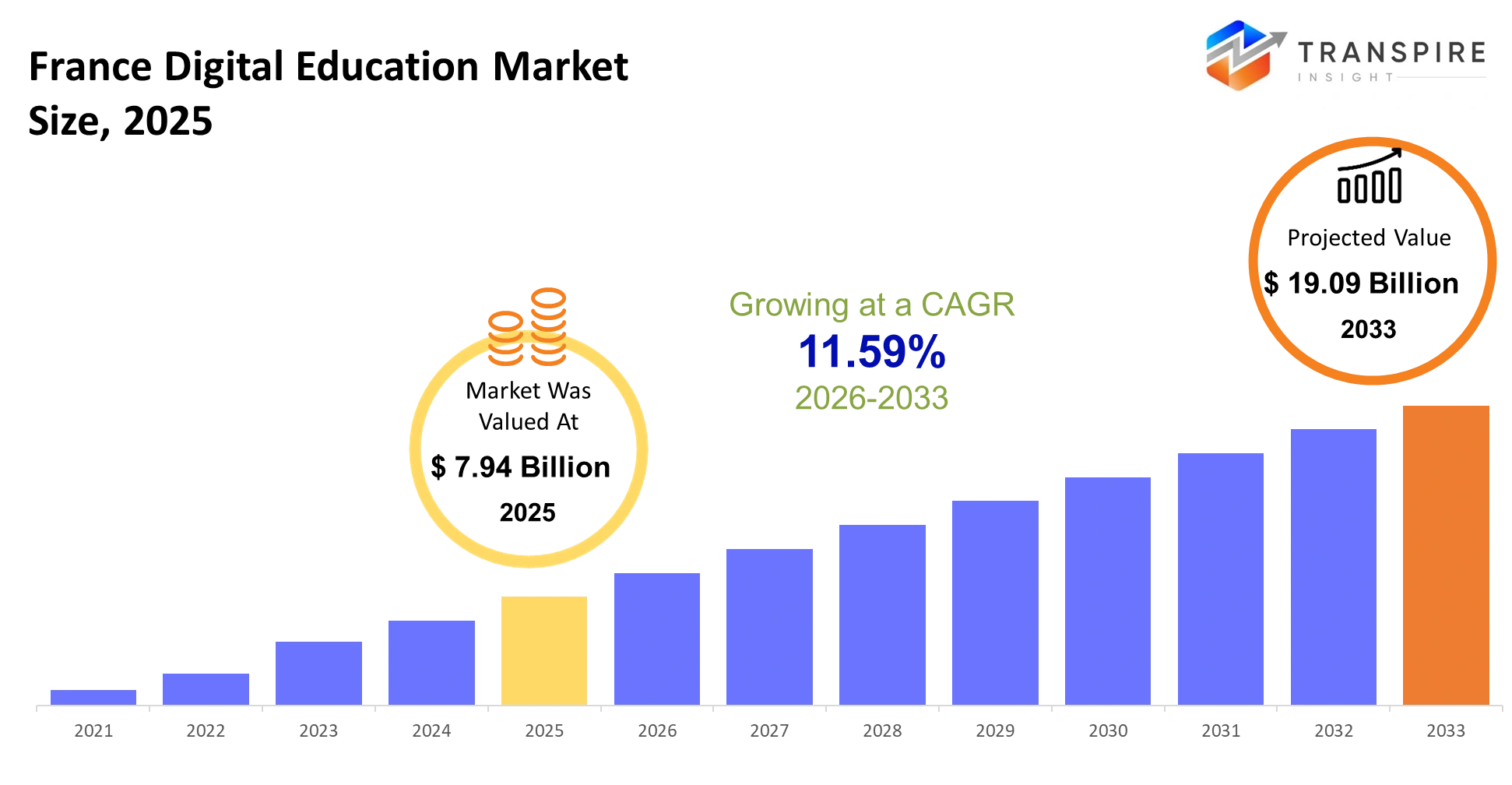
- France Digital Education Market Size 2025: USD 7.94 Billion
- France Digital Education Market Size 2033: USD 19.09 Billion
- France Digital Education Market CAGR: 11.59%
- France Digital Education Market Segments: By Type (E-learning Platforms, Learning Management Systems, Virtual Classrooms, Others); By Application (K-12, Higher Education, Corporate Training, Skill Development, Others); By End-User (Students, Enterprises, Institutions, Government, Others); By Deployment (Cloud, On-premise, Hybrid, Others)
To learn more about this report,  Download Free Sample Report
France Digital Education Market Summary
The France Digital Education Market was valued at USD 7.94 Billion in 2025. It is forecast to reach USD 19.09 Billion by 2033. That is a CAGR of 11.59% over the period.
In practice, the France digital education market helps schools, universities, and enterprises deliver structured learning via cloud-based platforms, kind of swapping rigid classroom-only training for something more adaptable, scalable, and also trackable. It allows real time content delivery, skill certification, and workforce upskilling across both corporate and academic settings. Over the last 3–5 years, the market changed in a more structural way, moving away from standalone e-learning software toward integrated AI-enabled learning ecosystems where analytics, personalization, and mobile-first access are tied together.
A big catalyst that sped up take-up was the COVID-19 disruption, it forced quick digital migration across French educational institutions, and it made infrastructure gaps in older learning systems very visible. Once that happened, there was a lasting change in behavior, organizations kept investing digitally so they could boost accessibility, lower training costs, and standardize learning outcomes. So now, adoption is being pushed more by long-term efficiency gains, and measurable performance results rather than short-lived digitization requirements, which in turn strengthens recurring revenue patterns for platform providers.
Key Market Insights
- Île-de-France is leading the France Digital Education Market, taking up more than 35% share, mostly due to there being a dense cluster of universities, EdTech firms, plus corporate training hubs.
- Southern France meanwhile, is set to show the quickest CAGR, around 14.1% through 2033, backed by university digitization programs and skill-building initiatives aimed at SMEs.
- When it comes to segments, Learning Management Systems (LMS) hold roughly 38% of the market , pulled by big institution rollouts and centralized needs for digital learning management.
- Content delivery platforms are close behind at nearly 24% share, driven by the growing appetite for modular learning, mobile-friendly delivery, and video-based experiences.
- AI-driven adaptive learning tools are projected to expand at more than 16% CAGR through 2033, largely because personalization requirements keep rising and learning efficiency outcomes are getting better.
- On the application side, academic learning applications lead with about 45% share, supported by public education modernization and national digital classroom pushes.
- Corporate training seems like the fastest-moving application category too, growing at close to 15% CAGR, mainly because workforce reskilling is happening more and more, plus there is steady need for remote training, and enterprise digital transformation plays along.
- Meanwhile key players and institutions such as OpenClassrooms, 360Learning, Docebo, Coursera, and Microsoft are also keeping their advantage, by mixing in AI, pushing cloud based learning platforms, doing strategic collaborations and driving more adaptive learning innovation.
What are the Key Drivers, Restraints, and Opportunities in the France Digital Education Market?
The main driver for the France digital education market seems to be that ongoing institutional shift, toward mixed and remote learning models, which got even more momentum after COVID-19, mainly due to those big digital infrastructure investments. Public universities, and also corporate training departments, have been leaning into cloud-based learning systems more and more, partly to lower day to day training costs, and to keep the skill delivery pretty consistent for people who are spread out. So, this change has bumped up subscription type revenue for platform providers, because many organizations now prefer scalable digital ecosystems rather than those one-time training programs.
The biggest holdback, in practice, is still that uneven digital infrastructure across rural areas and semi-urban regions in France. Even if metropolitan zones have fast connectivity and stronger institutional funding, smaller educational institutions can run into integration delays, often tied to tight IT budgets and older legacy systems. That structural mismatch slows adoption across the country, and it can lead to uneven learning outcomes, which then limits the market’s full potential.
A noticeable opportunity shows up with AI-powered adaptive learning systems that can personalize education pathways in real time. French universities, along with EdTech providers, are putting more money into machine-learning driven platforms that adjust content difficulty based on learner performance. And with reskilling needs growing across sectors like healthcare, IT, and manufacturing, these adaptive systems may open up new monetization routes, while also expanding enterprise education contracts quite substantially.
What Has the Impact of Artificial Intelligence Been on the France Digital Education Market?
Artificial intelligence is, kinda transforming the France digital education market, by taking over parts of the admin heavy stuff like attendance tracking, course scheduling, and learner performance evaluation. Educational platforms are more and more leaning on AI‑powered recommendation engines, to line up learners with more tailored content pathways, and that seems to boost engagement plus completion rates. In corporate training setups, machine learning is being used to detect skill gaps in a rather direct way, then automatically link people with the most relevant learning modules, so HR has less manual intervention.
At the same time, predictive analytics tools are getting rolled out to estimate learner drop-off risk and to tune course structures, before interest starts sliding. These systems help institutions raise retention metrics and improve platform efficiency since content delivery keeps getting refined using user behavior patterns. On the operational side, AI integration has also sped things up by shortening content development cycles and enabling real‑time assessment feedback, which tends to improve certification accuracy and shrink evaluation delays.
Still, there is a notable downside : the cost can be high when it comes to integrating advanced AI systems into older educational infrastructure. A lot of French institutions still depend on outdated LMS platforms, so smooth AI deployment becomes, not only hard, but also resource intensive. Also, data fragmentation between institutions keeps model accuracy limited, because training datasets often don’t match up well and they lack consistent standards across academic and corporate environments.
Key Market Trends
- Since 2024, AI powered personalization tools have kind of been rolled out across French universities and corporate training setups for adaptive learning delivery and engagement boost, maybe a bit more than people first expected.
- Cloud based learning platforms replaced over 60% of the old, more traditional legacy education systems between 2024 and 2025, and this also helped with scalability and more collaborative digital teaching too.
- In 2025, more than 70% of learners in France were using online courses through smartphones and tablets, and yeah that honestly sped up the need for mobile optimized learning apps and platforms , quite quickly.
- Also, corporate upskilling demand bumped up sharply after 2024 because automation pressures kind of pushed employers to expand digital skills training initiatives across manufacturing as well as services.
- By 2025, subscription based EdTech models moved ahead of the old one-time licensing structures, which helps providers keep steadier recurring revenue streams throughout France.
- Government backed digital education initiatives also accelerated LMS adoption across public universities nationwide , especially where institutions were trying to modernize outdated teaching infrastructure.
- Learning analytics dashboards started getting deeper integration after 2024, letting universities monitor student performance and fine tune curriculum planning using measurable insights.
- And from 2023 to 2025, partnerships between EdTech providers and universities expanded quite a lot , strengthening certification credibility as well as aligning learning paths with industry skill needs.
- Hybrid learning environments became more common in French universities, with schools mixing classroom teaching alongside digital coursework, plus remote collaboration tools
- Lastly, cybersecurity investments in digital education platforms have been rising steadily since 2024, as institutions focused on stronger protection for academic systems, and student data network safety.
France Digital Education Market Segmentation
By Type
E-learning platforms have this solid market position, because organizations start to really push for scalable, content-heavy digital learning systems, you know. A lot of universities and enterprises already use them so their dominance keeps on sticking, mainly because it is easy to deploy, plus the content libraries are large and ready. Learning Management Systems sit right beside them too, mostly because institutions want structured course delivery, along with performance monitoring. Virtual classrooms are still needed, but they stay more on the smaller side, mostly for real-time teaching sessions and those hybrid learning setups that everyone is talking about.
When this segment grows, it’s often tied to the move toward centralized digital education infrastructure, both across colleges and within companies. Add AI-based personalization and analytics, and adoption gets a boost, since learner engagement tends to rise and completion improves. Virtual classrooms also profit from hybrid learning becoming the norm, while LMS platforms get more pull from compliance-driven corporate training. Through the forecast period, E-learning Platforms and AI-enhanced LMS solutions should keep consolidating demand, and that will push vendors toward ecosystem-style offerings and integrated learning stacks.
By Application
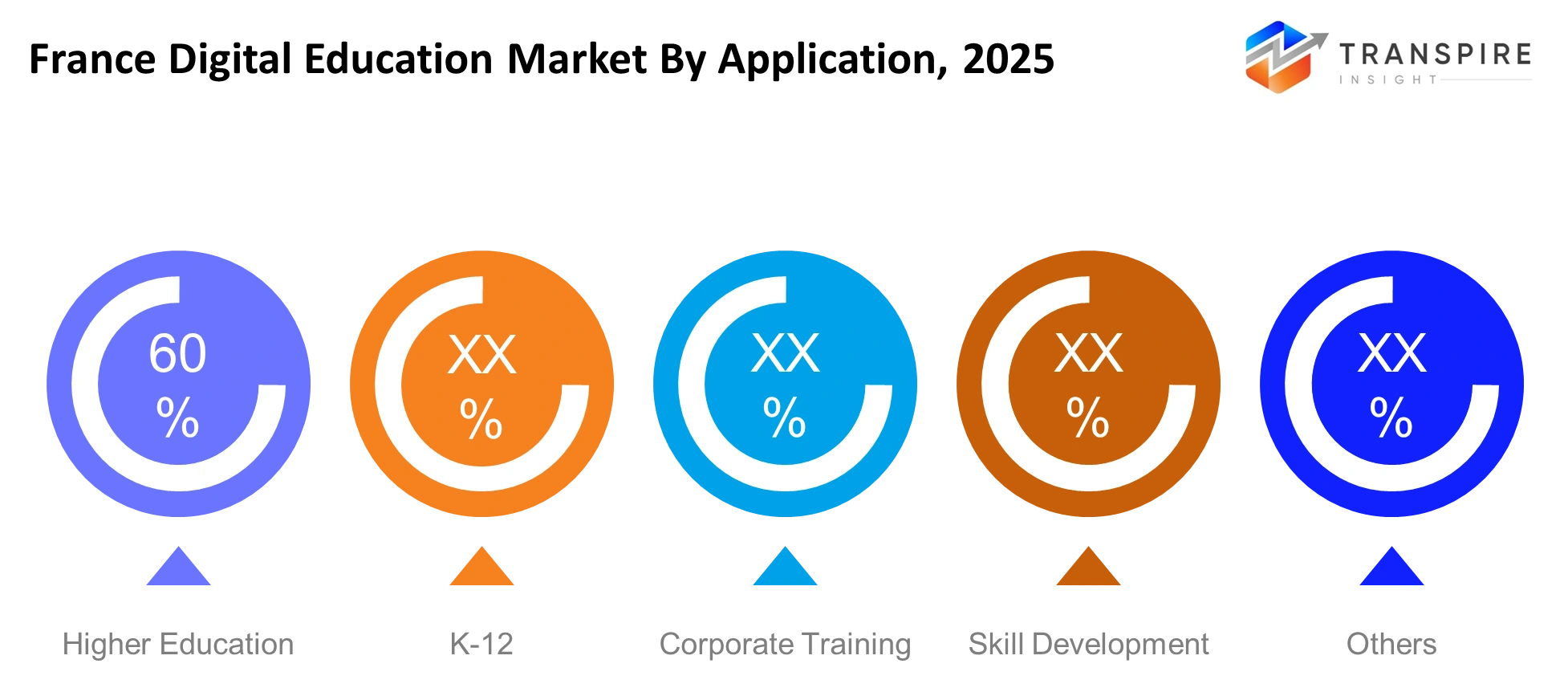
Higher education kind of holds the dominant position, because digitization runs deep across universities, plus there’s still strong public funding pushing digital learning transformation. K-12 adoption is still very meaningful but it stays more managed, not as loose, mostly due to curriculum standardization and regulatory oversight. Corporate training however, feels like it’s a rapidly expanding segment, since enterprises keep investing heavily into workforce upskilling. And skill development applications, they help cover vocational and professional training needs across technical as well as service industries.
For the “why,” corporate training seems to have the strongest growth logic, driven by automation pressure, and also by that whole continuous reskilling requirement across sectors like IT , and manufacturing. Higher education growth is more tied to hybrid learning integration and international collaboration programs. Meanwhile, skill development gains more momentum through government-supported employment initiatives and digital certification programs. In the future, expansion will likely center around corporate and skill-based learning platforms, which means providers will probably design modular, certification-oriented content ecosystems, more or less like building blocks you can reconfigure.
By End-User
To learn more about this report, Download Free Sample Report
Institutions take a leading role because digital learning systems are deployed everywhere, in universities, colleges, and training centers, it’s kind of the big driver. Students are a huge user group, but they are kinda tied to institutional adoption choices and whether the platform is actually available when they need it. Enterprises make up a high-value segment, since companies keep investing in employee training and compliance related programs. Government use feels pretty stable too, mostly it supports public education modernization, and workforce development efforts.
Enterprise demand is the main engine for growth, since digital transformation keeps moving and the skills gap keeps showing up across industries. Institutional adoption continues to grow in a steady way, through curriculum digitization, and hybrid education setups that are more flexible. Government initiatives help with foundational infrastructure expansion, though the rollout speed stays policy dependent, in execution terms. In the long run, the enterprise plus institutional sides will dominate revenue streams, so providers will likely shift attention toward scalable licensing and enterprise grade learning solutions.
By Deployment
Cloud deployment kind of keeps the lead, because it scales so well, usually costs less for the basic infrastructure, and also it fits nicely with digital learning ecosystems. Meanwhile on-premise solutions are still around in legacy institutions and in regulated settings where they want higher control over the data , and honestly that matters. Hybrid deployment is moving forward pretty steadily too, organizations are constantly trying to mix security needs with the flexibility you get from cloud. Other deployment approaches are still pretty limited and mostly experimental , they show up only in some niche education setups where the requirements are unusual.
Cloud adoption is being pulled along by fast digital transformation and the stronger need for remote accessibility across both education and corporate areas. Hybrid models are gaining traction especially in places that handle sensitive academic data but still need scalable learning capabilities. On-premise systems see a slow decline, however they’re not going away, they still fit in organizations with strict compliance rules or constraints from older infrastructure. Looking ahead, the biggest growth will likely cluster around cloud-native platforms, which nudges vendors toward SaaS-based learning architectures and deployment ecosystems that can interoperate.
What are the Key Use Cases Driving the France Digital Education Market?
In France, the digital education market, the dominant use case, stays with structured academic delivery via LMS platforms, so universities can handle coursework, assessments and even hybrid classrooms in a more efficient way. That creates strong demand because it scales pretty well and it keeps standardized learning outcomes across big numbers of students.
Then you see expanding applications too, especially corporate workforce training, plus certification programs. It is mostly in IT, healthcare, and manufacturing where continuous upskilling is needed, almost like a constant rhythm. These kinds of use cases are slowly getting more traction with enterprises, mainly because they see them as a cost-effective alternative to in person training and those compliance programs.
On the emerging side you get AI driven career path mapping, plus immersive learning through simulation based environments. They are being tested in vocational institutes and also in advanced engineering programs, where practical skill replication matters and real-time feedback is critical. The goal there is more future workforce readiness, rather than just finishing modules.
|
Report Metrics |
Details |
|
Market size value in 2025 |
USD 7.94 Billion |
|
Market size value in 2026 |
USD 8.86 Billion |
|
Revenue forecast in 2033 |
USD 19.09 Billion |
|
Growth rate |
CAGR of 11.59% from 2026 to 2033 |
|
Base year |
2025 |
|
Historical data |
2021 - 2024 |
|
Forecast period |
2026 - 2033 |
|
Report coverage |
Revenue forecast, competitive landscape, growth factors, and trends |
|
Regional scope |
France |
|
Key company profiled |
Google Classroom, Microsoft Teams, Zoom, Coursera, Udemy, edX, Blackboard, Moodle, SAP Litmos, Oracle, Adobe, LinkedIn Learning, Skillsoft, Byju’s, Unacademy |
|
Customization scope |
Free report customization (country, regional & segment scope). Avail customized purchase options to meet your exact research needs. |
|
Report Segmentation |
By Type (E-learning Platforms, Learning Management Systems, Virtual Classrooms, Others); By Application (K-12, Higher Education, Corporate Training, Skill Development, Others); By End-User (Students, Enterprises, Institutions, Government, Others); By Deployment (Cloud, On-premise, Hybrid, Others) |
Which Regions are Driving the France Digital Education Market Growth?
Île-de-France remains the most dominant hub within the France Digital Education Market, mostly because it has that dense concentration of universities, grandes écoles and corporate headquarters all in one place. It also benefits from strong public investment in digital learning infrastructure, plus an early adoption of national EdTech initiatives, which kind of keeps it ahead. The region hosts major enterprise training centers as well, and that helps speed up platform integration across both academic and corporate sides. In the end, its leadership is reinforced by a mature ecosystem made of cloud providers, EdTech startups, and government supported digital transformation programs.
Auvergne-Rhône-Alpes plays a stable and also structurally important role in the France Digital Education Market, largely due to its strong industrial backbone and diversified economy. Unlike Île-de-France, this region is less about administrative concentration and more about consistent investment from manufacturing and engineering firms into workforce training systems. It maintains steady uptake of digital learning platforms to support technical education, and also vocational reskilling. Its resilience looks less like a quick jump and more like long term enterprise learning contracts, rather than policy led expansion happening overnight. So, it acts as a dependable and predictable contributor to national EdTech revenues
Southern France is emerging as the fastest-growing region in the France Digital Education Market, driven by rapid digitization in universities plus the SME ecosystem around them. Recently, Southern France has gained from regional government backed digital transformation programs focused on higher education modernization. Better broadband penetration and campus digitization projects have improved access to cloud based learning platforms by a lot. This change is generating new demand from smaller institutions, that previously leaned on traditional models, but now want digital solutions and managed learning services more frequently
Who are the Key Players in the France Digital Education Market and How Do They Compete?
The France Digital Education Market is kind of moderately consolidated at the platform level, but in practice it stays pretty highly competitive across service delivery , and the whole learning models side too. On one hand there are Global EdTech and enterprise software providers who go head to head with open-source LMS ecosystems and smaller regional education platforms. For the most part, the rivalry is moved by technology depth, AI-enabled personalization, plus integration ability with institutional systems. Pricing flexibility also matters a lot, especially for large-scale deployments and that sort of thing.
Meanwhile incumbents try to defend their market share by sliding in AI features and widening enterprise partnerships, though new entrants are also moving in, more like they target niche skill-based learning segments that can be overlooked otherwise.
Microsoft Teams shows up as a competitor through ecosystem integration, it bundles collaboration tools together with enterprise learning workflows, and that keeps users around longer inside corporate environments. Google Classroom, on the other hand , differentiates via lightweight cloud-first deployment and tight integration with Google Workspace , so it ends up being widely adopted across public education systems. Coursera leans hard on university-grade certifications and global partnerships, then it grows by using accredited programs and by working with institutions more directly. Moodle competes through open-source flexibility, so institutions can customize learning environments with lower cost , and that tends to feel attractive, especially for public universities. LinkedIn Learning uses workforce analytics along with professional networking data to tailor corporate upskilling pathways, and that helps it hold a stronger position in enterprise training.
Company List
- Google Classroom
- Microsoft Teams
- Zoom
- Coursera
- Udemy
- edX
- Blackboard
- Moodle
- SAP Litmos
- Oracle
- Adobe
- LinkedIn Learning
- Skillsoft
- Byju’s
- Unacademy
Recent Development News
"In January 2026, OECD released the Digital Education Outlook 2026 publication focusing on generative AI integration in education systems. The report highlights how AI tools are being embedded into classroom learning, assessment systems, and personalized tutoring frameworks, accelerating digital transformation across France’s education ecosystem.http://www.oecd.org
"In January 2026, UNESCO expanded its Digital Learning Week initiative discussions around AI-driven education policy frameworks. The initiative emphasized ethical deployment of AI in learning systems and strengthened collaboration between governments and EdTech providers influencing France’s digital education strategy.http://www.unesco.org
What Strategic Insights Define the Future of the France Digital Education Market?
France’s Digital Education Market is, pretty clearly, shifting in a sort of steady way toward an AI-first, skills centered learning ecosystem where schools and other institutions lean more into measurable outcomes than sheer content volume. The momentum seems to come from a tighter connection between learning platforms and workforce analytics systems, and it’s changing how “learning value” gets understood, and then priced. Over the next 5–7 years, you can expect consolidation around just a few dominant cloud ecosystems, which also nudges institutions toward greater dependency on integrated digital infrastructure.
There’s also a less obvious risk, kind of in the background, platform concentration. If institutions depend too much on a small set of global EdTech providers, their flexibility can shrink, and switching later can become more expensive and painful over time. But alongside that, there’s an opportunity that’s still developing: AI driven micro credentialing systems that match EU-wide skills standardization frameworks. If that lands well, it could help qualifications move across borders with more consistent recognition.
For market participants, the smart move is to prioritize interoperability, and an API-first architecture, so vendor lock in doesn’t creep up unnoticed. That way, organizations can stay enterprise-ready, especially for certification driven learning demand which is only likely to grow.
France Digital Education Market Report Segmentation
By Type
- E-learning Platforms
- Learning Management Systems
- Virtual Classrooms
- Others
By Application
- K-12
- Higher Education
- Corporate Training
- Skill Development
- Others
By End-User
- Students
- Enterprises
- Institutions
- Government
- Others
By Deployment
- Cloud
- On-premise
- Hybrid
- Others
Frequently Asked Questions
Find quick answers to common questions.
The approximate France Digital Education Market size for the market will be USD 19.09 Billion in 2033.
Key segments for the France Digital Education Market are By Type (E-learning Platforms, Learning Management Systems, Virtual Classrooms, Others); By Application (K-12, Higher Education, Corporate Training, Skill Development, Others); By End-User (Students, Enterprises, Institutions, Government, Others); By Deployment (Cloud, On-premise, Hybrid, Others).
Major France Digital Education Market players are Google Classroom, Microsoft Teams, Zoom, Coursera, Udemy, edX, Blackboard, Moodle, SAP Litmos, Oracle, Adobe, LinkedIn Learning, Skillsoft, Byju’s, Unacademy.
The France Digital Education Market size is USD 7.94 Billion in 2025.
The France Digital Education Market CAGR is 11.59% from 2026 to 2033.
- Google Classroom
- Microsoft Teams
- Zoom
- Coursera
- Udemy
- edX
- Blackboard
- Moodle
- SAP Litmos
- Oracle
- Adobe
- LinkedIn Learning
- Skillsoft
- Byju’s
- Unacademy
Recently Published Reports
-
Apr 2026
3D Optical Profiler Market
3D Optical Profiler Market Size, Share & Analysis Report By Type (Desktop 3D Optical Profiler, and Portable 3D Optical Profiler), By Technology (Confocal Technology, and White Light Interference), By End-Use Industry (Manufacturing, Research Institutions, Automotive, Aerospace and Defense, Medical Devices, and Other), and Geography (North America, Europe, Asia-Pacific, Middle East and Africa, South and Central America), 2021 - 2031
-
Apr 2026
Depth Sensor Market
Depth Sensor Market Size, Share & Analysis Report By Type (Infrared Depth Sensors, Time-of-Flight (ToF) Sensors, Stereo Vision Sensors, Structured Light Sensors, Ultrasonic Depth Sensors), By Application (Automotive, Robotics, Gaming, Consumer Electronics, Industrial Automation, Healthcare, Security & Surveillance, Others), By End Users (Automotive Manufacturers, Consumer Electronics Companies, Healthcare Providers, Industrial Companies, Security Agencies, Gaming Companies, Robotics Companies, Others), and Geography (North America, Europe, Asia-Pacific, Middle East and Africa, South and Central America), 2021 – 2031
-
Apr 2026
Digital Manufacturing Market
Digital Manufacturing Market Size, Share & Analysis Report By Component (Hardware, Software, and Services), By Technology (Robotics, 3D Printing, Internet of Things (IoT), and Others), By Application (Automotive and Transportation, Aerospace and Defense, Consumer Electronics, Industrial Machinery, and Others), By Process Type (Computer-Based Designing, Computer-Based Simulation, Computer 3D Visualization, Analytics, and Others), and Geography (North America, Europe, Asia-Pacific, Middle East and Africa, South and Central America), 2021 – 2031
-
Apr 2026
Digital Visa Services Market
Digital Visa Services Market Size, Share & Analysis Report By Type (Individual Travelers, Group Travelers), By Application (Tourism, Business Travel, Others), and Geography (North America, Europe, Asia-Pacific, Middle East and Africa, South and Central America), 2021 – 2031