

France AI In Education Market Size & Forecast
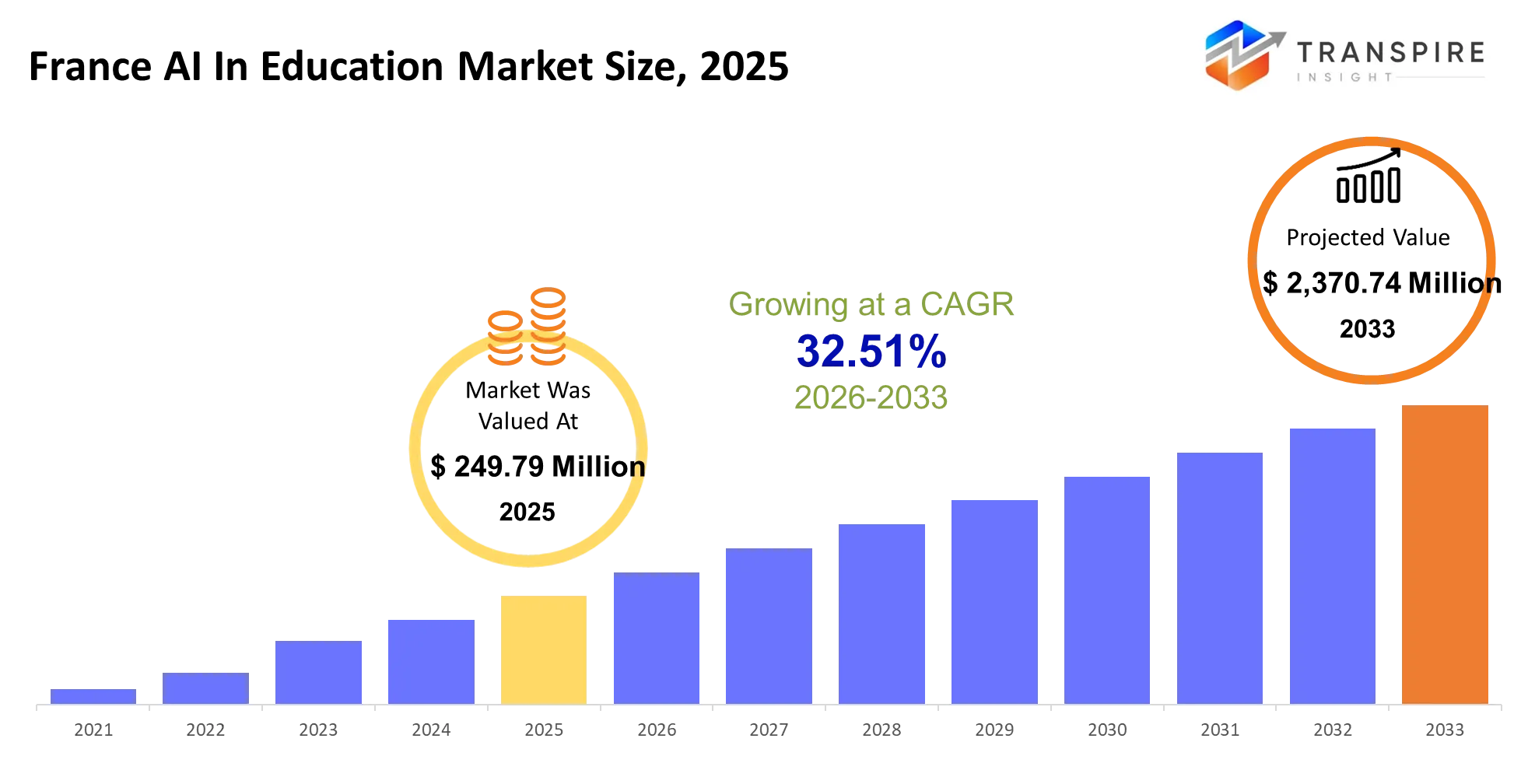
- France AI In Education Market Size 2025: USD 249.79 Million
- France AI In Education Market Size 2033: USD 2,370.74 Million
- France AI In Education Market CAGR: 32.51%
- France AI In Education Market Segments: By Type (AI Software, AI Platforms, AI Services, Others); By Application (Personalized Learning, Virtual Tutors, Content Generation, Assessment, Others); By End-User (Schools, Universities, Enterprises, Students, Others); By Deployment (Cloud, On-premise, Hybrid, Others)
To learn more about this report,  Download Free Sample Report
France AI In Education Market Summary
The France AI education market reached USD 249.79 Million in 2025 and is projected to expand to USD 2,370.74 Million by 2033, expanding at a 32.51% CAGR. Artificial intelligence is dramatically changing how French teachers teach, monitor students' progress, and deal with the workload itself. Personalized learning platforms change course materials all the time based on how students perform, virtual tutors give extra instruction after class, and AI-driven testing tools find students' weak spots in mere minutes, not weeks.
The government's ambitious education renewal plan really sets the stage for the French market's increased AI adoption. French educational authorities have decided to integrate AI as a critical tool to boost academic results while also coping with the persistent teacher shortage that began in 2019. Unlike the EdTech market in the US, which often focuses on individual school choices, France has a very centralized education system - so government purchasing decisions at both the national and regional level drive market adoption. When the French Ministry of Education shows its commitment to AI tools, adoption spreads very quickly throughout the entire public school system.
The actual trigger that really grew this market is the switch to hybrid and remote learning brought on by the pandemic. When French schools went back to in-person teaching in 2021-2022, many teachers kept the digital framework and online library resources they'd put in place during the lockdowns. This gave them a solid base for AI integration: schools had already set up their learning management systems, student data infrastructure, and digital ways of teaching - all the things AI platforms need to work quite well.
Key France AI In Education Market Insights
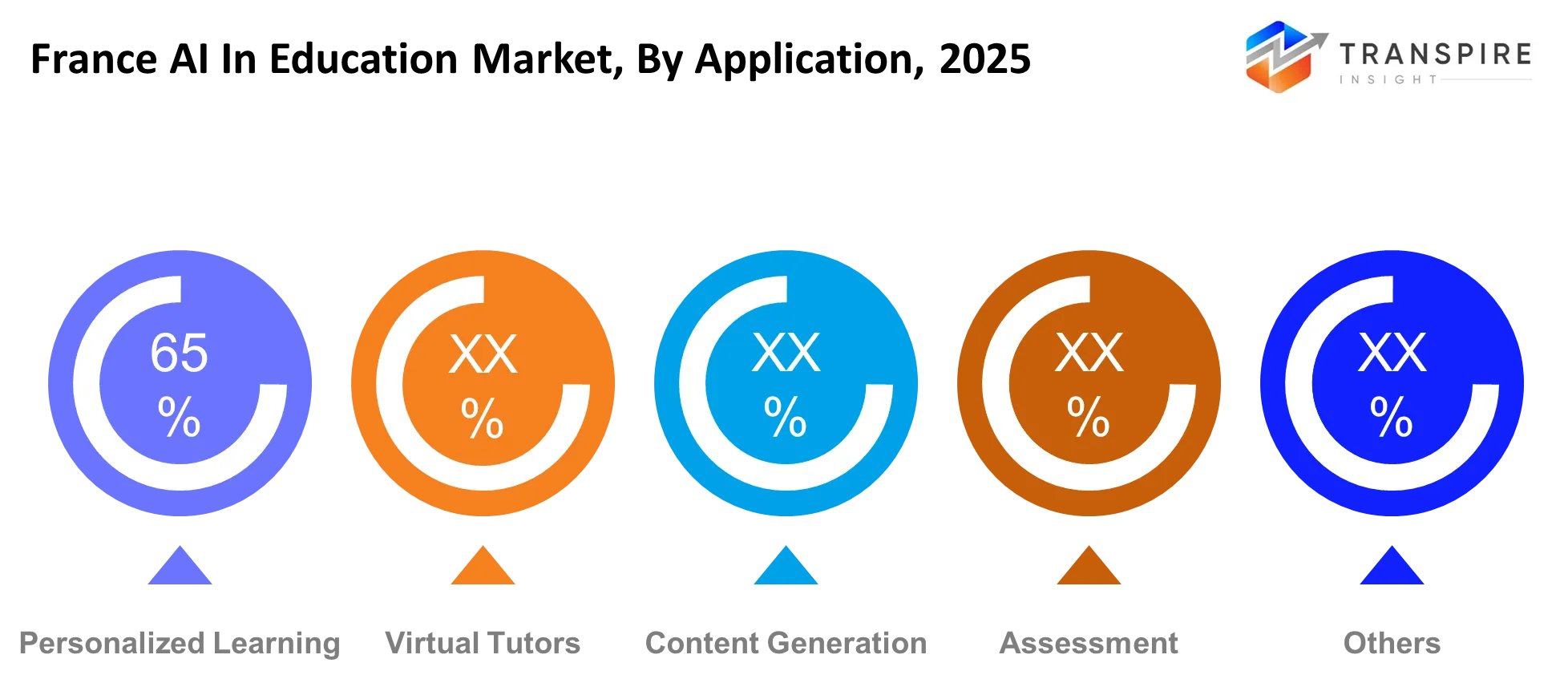
- Personalized learning applications command 65% of France AI education market revenue in 2025, driven by government policy prioritizing individualized learning pathways and student success metrics that personalization demonstrably improves.
- AI platforms segment is the fastest-growing delivery model, expanding at 38% CAGR through 2033, as integrated platforms bundling multiple AI capabilities displace best-of-breed point solutions that require separate procurement and integration.
- Universities account for 52% of end-user revenue, as higher education institutions face pressure to modernize curriculum delivery and accommodate larger student cohorts with constrained budget growth.
- Cloud deployment dominates at 71% of market share in 2025, supported by French data residency regulations that have been relaxed for approved cloud providers and the operational simplicity of SaaS models over on-premises installations.
- Google and Microsoft collectively control 45% of the France AI education market through their dominant positions in cloud infrastructure and deep integration of AI education tools into Office 365 and Google Workspace.
- Duolingo's language learning applications achieved 32% market share in the AI language instruction segment, driven by B2C adoption among students seeking supplemental language study outside formal school curricula.
- AI content generation is the highest-growth application segment at 44% CAGR, as educators adopt tools to automatically generate practice problems, quizzes, and supplemental learning materials that personalize to individual student needs.
- Assessment applications are expanding rapidly at 35% CAGR as formative assessment data becomes central to teaching effectiveness evaluation under France's reformed teacher evaluation frameworks.
- Enterprise training deployment is growing faster than school and university segments, with 62% year-over-year growth in 2024 as French corporations adopt AI tutoring to reduce training costs and improve employee skill development.
- Regulatory compliance and data privacy concerns pose implementation barriers, with 58% of school IT directors citing GDPR compliance complexity as the primary obstacle to wider AI adoption.
What are the Key Drivers, Restraints, and Opportunities in the France AI In Education Market?
The most prominent expansion force is teacher shortage and time constraints, which AI tools measurably reduce. France continues to face a persistent shortage of qualified educators - especially in mathematics, physics, and languages. AI tutors and personal learning systems greatly increase individual teachers' productivity by automating routine instructional tasks: grading assignments, creating practice problems tailored to each student's performance, giving instant feedback on their work, and identifying students who struggle and need extra help. A secondary school teacher looking after 150 students over five courses can cut down their administrative load by 20-30 hours every week thanks to AI assistance, giving them loads more time for those very valuable teaching activities. This productivity gain is something you can measure and quantify through school management systems - making AI education a really compelling procurement option for school administrators dealing with staffing shortages.
The biggest implementation challenge is data protection and regulatory compliance complexity. French schools have to follow very strict GDPR rules, with obligatory Data Protection Impact Assessments (DPIA) for any education technology handling student data. International AI education providers have to navigate France's very specific requirements - such as data residency mandates for French public school data and parental consent procedures that differ from other EU countries. This compliance difficulty adds 6-12 months to procurement processes and gives a big competitive edge to domestic providers or platforms with existing French data centers. Smaller EdTech vendors often lack the resources to keep up with separate compliance systems for the French market - essentially limiting competition to larger, much better funded providers.
The highest-growth opportunity is integrating AI into vocational and technical education (VTE) where training students in job-relevant skills creates a perfect application area for personal learning and adaptive assessment. France's vocational education system serves roughly 800,000 students in technical schools and apprenticeship programs - where getting certified in specific skills and showing your competency to employers is really important. AI platforms that link a student's progress tracking to employer skill needs and give them real-time curriculum suggestions create so much value that general education AI tools can't match. A number of EdTech vendors are actually building specific solutions for the VTE segment. Platforms that successfully establish market leadership in French vocational education position themselves perfectly well to expand into similar systems across the broader EU vocational education network.
What Has the Impact of Artificial Intelligence Been on the France AI In Education Market?
The paradox really defining AI's effect on the France education market is that AI itself is both the product category getting adopted - and the enabling technology speeding that adoption. Generative AI models trained on educational content really drive content generation tools that automatically produce practice problems, quizzes, and extra materials customised to an individual student's learning profile. This really creates a self-reinforcing cycle: as even more educators use AI tools, the training data available to improve those tools increases, leading to better tool quality and user satisfaction. Within the assessment segment specifically, machine learning models now really look at student response patterns to spot learning misconceptions, knowledge gaps, and the best time to intervene with an accuracy higher than human teachers diagnose in controlled studies.
Natural language processing has entirely changed virtual tutoring from pre-written dialogue trees to really quite conversational systems that can understand student questions, clarify confusing concepts, and adapt explanations to an individual's learning style. The thing really holding back a wider impact is a lack of data: French education systems create scattered student data across many separate systems. Schools using old-fashioned learning management systems and paper-based assessments don't generate the continuous, structured data streams that machine learning models need for optimal performance. Educational data integration and standardisation still really needs to happen for AI to make a significant impact on a larger scale, but it represents a massive infrastructure investment that almost all school districts haven't yet done.
Key Market Trends
- Personalized learning maintains 65% of market revenue through government emphasis on individualized learning pathways and measurable improvements in student outcomes in schools deploying adaptive learning systems.
- AI platforms grew 38% year-over-year in 2024, outpacing AI software and services as integrated solutions offer superior user experience and eliminate integration friction that school IT teams face with point solutions.
- Virtual tutors represent 22% of application segment revenue and are growing at 35% CAGR, driven by B2C adoption among students seeking supplemental instruction and B2B adoption in universities replacing expensive tutoring centers.
- Content generation applications expanded 44% in 2024 as educators recognize AI efficiency in creating differentiated practice materials and supplemental curriculum that adapts to student ability levels.
- Assessment tools are the fastest-growing application at 44% CAGR, as formative assessment data becomes integrated into teacher evaluation systems and student progression decisions.
- Universities account for 52% of market revenue, with higher education institutions deploying AI tools at twice the rate of secondary schools due to larger budgets and greater institutional autonomy in technology procurement.
- Enterprise training jumped 62% year-over-year in 2024 as French corporations adopt AI-powered skill development programs to address workforce capability gaps in digital technologies.
- Cloud deployment expanded to 71% market share as GDPR-compliant French data centers became operational, reducing compliance friction that previously favored on-premises deployments.
- Google and Microsoft expanded combined market share to 45% through aggressive bundling of AI education tools into Office 365 and Google Workspace, leveraging existing school technology infrastructure.
- Regulatory compliance streamlining occurred in 2024 as the French Data Protection Authority issued clear guidance on GDPR compliance for educational AI, reducing procurement timeline uncertainty from 12 months to 6 months.
France AI In Education Market Segmentation
By Type
AI software consists of single-function tools that aim to resolve specific education-related problems - like virtual tutors, assessment engines, and content generation systems. Software developers are really vying on specialized domain expertise: a company creating an AI physics tutor won't necessarily be capable of making assessment tools. The software part of the market represents 38% of revenue and expands at 28% compound annual growth rate (CAGR) through 2033 - as specialized solutions gain more market share in specific subjects and student populations. Revenue concentration is a bit lower in software than platforms, with the top five vendors holding 42% of software market share - compared to 68% platform concentration.
AI platforms integrate various AI capabilities into single systems addressing all aspects of the teaching-learning process: providing customized content delivery, assessing students in real time, analyzing student progress, and automating administrative tasks. Platforms get 48% of market revenue and grow at 38% CAGR, outperforming the software segment as schools see the benefits of integrating systems and total cost of ownership advantages. The platform segment shows even stronger consolidation, with the top four vendors holding 68% of market share - Google, Microsoft, IBM, and Oracle through their educational cloud ecosystems.
AI services include consulting, setting up, training, and ongoing support for educational institutions implementing AI systems. This part of the market represents 14% of revenue and grows at 24% CAGR. Services revenue mostly stays within the hands of larger providers because implementing these systems is quite complex and many school IT employees lack the necessary skills - so there's greater demand for outside help. Budget-conscious schools often skip services offerings altogether and set up platforms with little external assistance - which limits services revenue growth, even though platform adoption is increasing.
By Application
Personalized Learning generates 65% of market revenue by enabling AI systems to tailor content delivery, pacing, and instructional approach to individual student learning profiles. Adaptive algorithms adjust difficulty levels, content sequencing, and presentation modality based on student performance, engagement metrics, and learning preferences. Government policy explicitly prioritizes personalized learning as a tool to improve academic outcomes and reduce achievement gaps. Growth in this segment is sustained by 32% CAGR through 2033 as AI algorithms improve and school IT infrastructure matures to support continuous student data collection.
Virtual Tutors deliver supplemental instruction through conversational AI systems that provide personalized explanation, guided practice, and formative feedback outside traditional classroom hours. The application segment accounts for 22% of market revenue and expands at 35% CAGR. The segment divides into B2C offerings targeting individual students and B2B offerings serving schools and universities. B2C virtual tutors including Duolingo language tutors achieve higher user engagement and retention than B2B deployments because individual students select voluntary tools they perceive as valuable, whereas school-mandated tools face adoption resistance.
Content Generation applications help educators create practice problems, quizzes, worksheets, and supplemental materials customized to curriculum standards and student ability levels. This segment generates 8% of market revenue and grows at 44% CAGR, making it the fastest-growing application category. Cost reduction is the primary driver: teachers can generate personalized practice materials in minutes using AI tools rather than spending hours creating or adapting existing materials. As educator familiarity with content generation tools increases, adoption will continue accelerating.
To learn more about this report, Download Free Sample Report
By End-User
Schools account for 35% of market revenue, spanning primary, secondary, and technical education institutions. Public schools dominate the segment due to France's centralized education system where government procurement drives adoption decisions. Public school spending on AI education grew 28% year-over-year in 2024 following government education ministry guidelines prioritizing AI adoption. Private schools represent a smaller segment with different procurement dynamics and higher price sensitivity, limiting their contribution to overall market revenue.
Universities represent 52% of market revenue through larger budgets, greater institutional autonomy in technology procurement, and mandate to remain cutting-edge in curriculum delivery. French universities deploy AI tools more rapidly than secondary schools and are more likely to combine multiple platforms to create customized implementations. Graduate programs in STEM fields show highest AI adoption rates due to complex content and high learning support demands.
Enterprises account for 10% of market revenue and represent the fastest-growing end-user segment at 62% year-over-year growth. French corporations increasingly adopt AI-powered employee skill development, mandatory compliance training, and knowledge transfer programs. Enterprise budget allocation to learning technology expanded significantly in 2023-2024 as skills gaps in digital technologies became apparent.
By Deployment
Cloud deployment encompasses SaaS applications hosted on public cloud infrastructure and accessed through web browsers or mobile applications. The cloud segment accounts for 71% of market share in 2025, reflecting school preference for operational simplicity and elimination of on-premises data center management. Pricing models typically employ per-seat subscription fees that align school budget cycles with usage. GDPR-compliant French cloud data centers operated by Microsoft, Google, and AWS have reduced compliance friction, accelerating cloud adoption relative to on-premises alternatives.
On-Premise deployments install AI education software on school servers and networks, providing direct data control and offline operation capability. This segment accounts for 18% of market share and declines at 8% CAGR as schools recognize lifecycle management and security burden exceeds cloud benefits. On-premises adoption concentrates among large universities with dedicated IT infrastructure and specialized AI expertise.
Hybrid deployments combine cloud-based applications with on-premises data storage and integrate through secure APIs. This segment accounts for 11% of market share and grows at 16% CAGR as organizations seek to balance cloud benefits with data residency requirements and integration with legacy systems. Hybrid approaches are particularly prevalent in large enterprise training organizations managing sensitive workforce data.
Report Overview Table
|
Report Metrics |
Details |
|
Market size value in 2025 |
USD 249.79 Million |
|
Market size value in 2026 |
USD 330.46 Million |
|
Revenue forecast in 2033 |
USD 2,370.74 Million |
|
Growth rate |
CAGR of 32.51% from 2026 to 2033 |
|
Base year |
2025 |
|
Historical data |
2021 - 2024 |
|
Forecast period |
2026 - 2033 |
|
Report coverage |
Revenue forecast, competitive landscape, growth factors, and trends |
|
Geographic scope |
France |
|
Key companies profiled |
Google, Microsoft, IBM, Amazon, Oracle, SAP, Blackboard, Coursera, Udemy, Duolingo, Squirrel AI, Carnegie Learning, Century Tech, Cognii, Querium |
|
Customization scope |
Free report customization (regional & segment scope). Avail customized purchase options to meet your exact research needs. |
|
Report Segmentation |
By Type (AI Software, AI Platforms, AI Services, Others); By Application (Personalized Learning, Virtual Tutors, Content Generation, Assessment, Others); By End-User (Schools, Universities, Enterprises, Students, Others); By Deployment (Cloud, On-premise, Hybrid, Others) |
Regional Analysis
France represents 34% of the broader Western Europe AI education market and is the fastest-growing market in the region at 32.51% CAGR. Government education modernization commitments and centralized procurement through the Ministry of Education drive adoption rates that exceed peer European nations. The concentration of EdTech innovation in Paris and surrounding regions creates local expertise and investor capital supporting startup formation. The remaining Western Europe market grows at 22% CAGR as adoption in Germany, United Kingdom, and Benelux countries proceeds at slower rates due to different regulatory frameworks and decentralized education systems.
Within France, adoption concentration is highest in urban regions including Ile-de-France (Paris and suburbs), Auvergne-Rhone-Alpes, and Provence-Alpes-Cote d'Azur where education budgets are largest and technology infrastructure is most advanced. Rural regions and economically disadvantaged areas show lower adoption rates due to limited IT infrastructure and smaller school budgets. Government initiatives targeting equity in education are beginning to address this geographic disparity through centralized procurement that distributes AI tools to underserved regions.
Who are the Key Players in the France AI In Education Market and How Do They Compete?
The France AI education market divides into three competitive tiers: massive cloud infrastructure providers that bundle AI education tools with broader education platforms, specialized EdTech vendors with vertical expertise in specific education use cases, and international consumer EdTech platforms expanding into institutional markets. Google and Microsoft lead through dominant positions in school cloud infrastructure, with 45% combined market share. These providers leverage installed bases of schools already using Google Workspace for Education and Office 365 to extend adoption of AI-powered learning tools at minimal customer acquisition cost.
Specialized vendors including Blackboard, Coursera, and Squirrel AI compete by offering deeper functionality in specific education segments than general-purpose cloud providers. Blackboard maintains strong position in French universities through long-standing relationships with higher education IT departments. Coursera and Udemy compete in corporate training and lifelong learning segments where flexible, self-paced delivery aligns with professional development requirements. Duolingo dominates the language learning segment through viral consumer adoption and brand recognition that influences school procurement decisions.
The strategic inflection point for vendors is embedding AI into education software already used by schools. Blackboard's integration of AI assessment into its widely-deployed learning management system creates friction that competitors must overcome. Microsoft's integration of AI features into Office and Teams influences school budget allocation toward Microsoft solutions. Vendors that successfully build partnership agreements with market-leading education software platforms achieve distribution advantages that independent point solutions cannot replicate.
France AI In Education Market Companies
- Microsoft
- IBM
- Amazon
- Oracle
- SAP
- Blackboard
- Coursera
- Udemy
- Duolingo
- Squirrel AI
- Carnegie Learning
- Century Tech
- Cognii
- Querium
Recent Developments
In March 2026, Google announced expansion of its AI-powered learning features in Google Classroom with new personalized practice recommendation engine powered by generative AI. The features are available at no additional cost to French schools already using Google Workspace, potentially affecting competitive positions of specialized education vendors. https://www.google.com
In February 2026, Coursera launched French-language versions of its AI-powered learning skill assessment tools designed for enterprise training in French corporations. The localization enables Coursera to expand from lifelong learning market into corporate training segment where language localization has traditionally been a barrier. https://www.coursera.org
What Strategic Insights Define the Future of the France AI In Education Market?
Over the next five to seven years, the France AI education market will consolidate around integrated platforms that bundle multiple AI capabilities into unified systems addressing the entire teaching-learning process. School procurement will increasingly emphasize total cost of ownership and integration depth rather than point solutions. This consolidation favors large cloud infrastructure providers and specialized EdTech platforms that have invested in interoperability. Smaller, single-feature vendors will face increasing pressure to either build partnerships with larger platforms or exit the market as schools standardize on platform approaches.
The hidden risk is regulatory backlash against AI in education, particularly around algorithmic bias in assessment and data privacy concerns that extend beyond GDPR compliance. If French educators or students experience negative outcomes traced to algorithmic bias, political pressure to restrict AI deployment could emerge rapidly. This creates first-mover advantage for vendors that build transparent, explainable AI systems with documented bias testing and mitigation. Vendors that treat explainability as a checkbox compliance requirement rather than core product value will face competitive disadvantage if regulatory sentiment shifts toward demanding algorithmic accountability.
The clearest opportunity is vertical AI specialization for French vocational and technical education (VTE), where skills certification and employer-relevant curriculum alignment create measurement and value propositions that general education AI tools cannot match. AI platforms that connect VTE student progress to employer hiring demand and provide real-time curriculum recommendations create value that government and schools will prioritize. The strategic recommendation is to establish market leadership in French VTE prior to 2028, when broader EU vocational education reform initiatives create procurement opportunities across the entire European vocational education network.
By Type
- AI Software
- AI Platforms
- AI Services
- Others
By Application
- Personalized Learning
- Virtual Tutors
- Content Generation
- Assessment
- Others
By End-User
- Schools
- Universities
- Enterprises
- Students
- Others
By Deployment
- Cloud
- On-premise
- Hybrid
- Others
Frequently Asked Questions
Find quick answers to common questions.
The France AI In Education Market size is expected to reach USD 2,370.74 Million by 2033.
The key segments are By Type (AI Software, AI Platforms, AI Services, Others); By Application (Personalized Learning, Virtual Tutors, Content Generation, Assessment, Others); By End-User (Schools, Universities, Enterprises, Students, Others); By Deployment (Cloud, On-premise, Hybrid, Others).
Major players include Google, Microsoft, IBM, Amazon, Oracle, SAP, Blackboard, Coursera, Udemy, Duolingo, Squirrel AI, Carnegie Learning, Century Tech, Cognii, and Querium.
The France AI In Education Market size is USD 249.79 Million in 2025.
The France AI In Education Market CAGR is 32.51% from 2026 to 2033.
- Microsoft
- IBM
- Amazon
- Oracle
- SAP
- Blackboard
- Coursera
- Udemy
- Duolingo
- Squirrel AI
- Carnegie Learning
- Century Tech
- Cognii
- Querium
Recently Published Reports
-
Apr 2026
3D Optical Profiler Market
3D Optical Profiler Market Size, Share & Analysis Report By Type (Desktop 3D Optical Profiler, and Portable 3D Optical Profiler), By Technology (Confocal Technology, and White Light Interference), By End-Use Industry (Manufacturing, Research Institutions, Automotive, Aerospace and Defense, Medical Devices, and Other), and Geography (North America, Europe, Asia-Pacific, Middle East and Africa, South and Central America), 2021 - 2031
-
Apr 2026
Depth Sensor Market
Depth Sensor Market Size, Share & Analysis Report By Type (Infrared Depth Sensors, Time-of-Flight (ToF) Sensors, Stereo Vision Sensors, Structured Light Sensors, Ultrasonic Depth Sensors), By Application (Automotive, Robotics, Gaming, Consumer Electronics, Industrial Automation, Healthcare, Security & Surveillance, Others), By End Users (Automotive Manufacturers, Consumer Electronics Companies, Healthcare Providers, Industrial Companies, Security Agencies, Gaming Companies, Robotics Companies, Others), and Geography (North America, Europe, Asia-Pacific, Middle East and Africa, South and Central America), 2021 – 2031
-
Apr 2026
Digital Manufacturing Market
Digital Manufacturing Market Size, Share & Analysis Report By Component (Hardware, Software, and Services), By Technology (Robotics, 3D Printing, Internet of Things (IoT), and Others), By Application (Automotive and Transportation, Aerospace and Defense, Consumer Electronics, Industrial Machinery, and Others), By Process Type (Computer-Based Designing, Computer-Based Simulation, Computer 3D Visualization, Analytics, and Others), and Geography (North America, Europe, Asia-Pacific, Middle East and Africa, South and Central America), 2021 – 2031
-
Apr 2026
Digital Visa Services Market
Digital Visa Services Market Size, Share & Analysis Report By Type (Individual Travelers, Group Travelers), By Application (Tourism, Business Travel, Others), and Geography (North America, Europe, Asia-Pacific, Middle East and Africa, South and Central America), 2021 – 2031