
Middle East and Africa Digital Signage Market Size & Forecast:
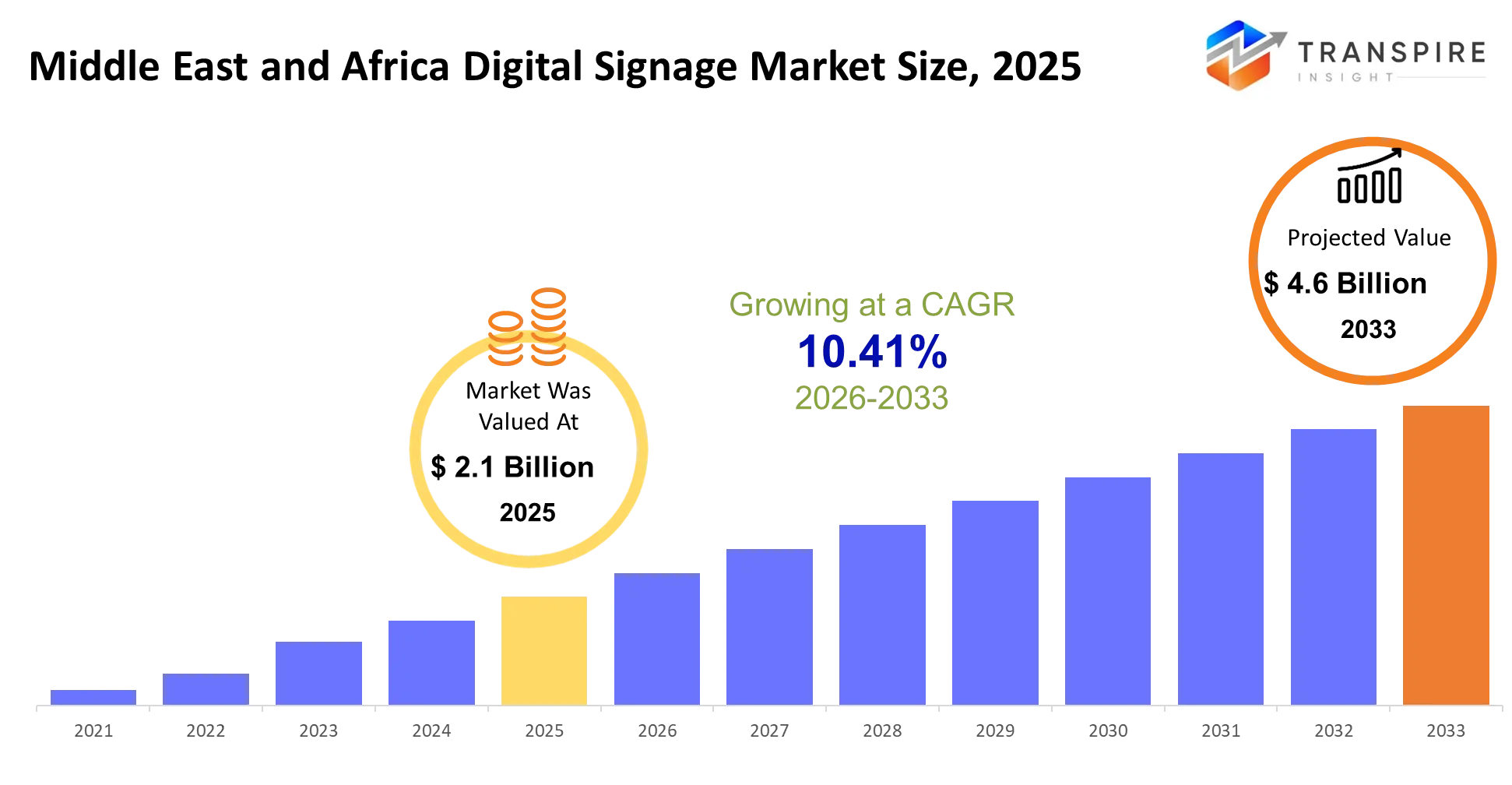
- Middle East and Africa Digital Signage Market Size 2025: USD 2.1 Billion
- Middle East and Africa Digital Signage Market Size 2033: USD 4.6 Billion
- Middle East and Africa Digital Signage Market CAGR: 10.41%
- Middle East and Africa Digital Signage Market Segments: By Type (Hardware, Software, Services, Others); By Application (Retail, Transportation, Healthcare, Hospitality, Corporate, Others); By End-User (Retailers, Enterprises, Hospitals, Transport Operators, Government, Others); By Display (LCD, LED, OLED, Others)
To learn more about this report,  Download Free Sample Report
Middle East and Africa Digital Signage Market Summary
The Middle East and Africa Digital Signage Market was valued at USD 2.1 Billion in 2025. It is forecast to reach USD 4.6 Billion by 2033. That is a CAGR of 10.41% over the period.
Across the Middle East and Africa, digital signage systems power the screens that kinda guide shoppers through malls, handle flight updates in airports, and push operational alerts in transport hubs, oil facilities, and public venues as well. In practice, it’s basically swapping static posters for centrally governed visual networks, where messages can be tuned in real time, with no big hassle. Over the last five years, the market has moved in a more structural way , stepping away from standalone displays that were locally controlled, toward cloud based content management plus programmatic advertising platforms. This shift is also supported by less expensive large-format LED hardware, so installations feel a lot less daunting then they used to. And yeah , the COVID-19 pandemic acted like a key trigger , it forced organizations to roll out contactless, quickly updatable communication setups mainly for safety instructions and service continuity , not only “nice-to-have” updates. Taken together, these changes reduced deployment friction and ongoing overhead, so enterprises and governments can expand their networks faster, and monetize those screens more efficiently, and that keeps speeding up investment across retail, infrastructure, and smart city programs.
Key Market Insights
- The GCC region kind of dominates the Middle East and Africa Digital Signage Market, with close to 45% share in 2025, mostly pushed by smart city deployments.
- Africa meanwhile is the fastest-growing region for 2024–2030, because retail keeps expanding , telecom infrastructure upgrades keep happening, and urban digitization initiatives get more momentum .
- In the product area, the Hardware segment stays on top in the Middle East and Africa Digital Signage Market, sitting at roughly 55% share thanks to solid demand for LED displays.
- Software platforms take the second spot, backed by increasing use of cloud-based content management systems in enterprises as well as along transport networks.
- Services is the segment that moves quickest through 2030, driven by integration work, ongoing maintenance, and managed signage deployment models.
- Retail and advertising are basically the biggest application themes, with nearly 40% share, since retailers need high in-store engagement all the time.
- Transportation hubs are also moving fast, supported by airport modernization programs, and real-time passenger information systems , which helps a lot.
- Commercial end-users lead the Middle East and Africa Digital Signage Market overall, with adoption spreading across malls, banks, and hospitality chains.
- Public infrastructure and government facilities show noticeable rapid growth too, largely due to smart city investments, plus digital communication mandates , that keep getting reinforced.
- Regional expansion into GCC and African urban centers strengthens revenue pipelines and long term contract opportunities, though it feels like this keeps building longer run cash flows too.
What are the Key Drivers, Restraints, and Opportunities in the Middle East and Africa Digital Signage Market?
The main driver is kind of the rapid expansion of smart city infrastructure, plus this move toward cloud based content management systems. In the UAE, Saudi Arabia, and also some areas of Qatar, governments have already folded digital signage into transport networks, public service hubs, and tourism corridors, as part of broader national digital transformation programs . That shift was pushed by lower LED display costs and better network bandwidth, so that real-time content updates became financially realistic. With that, enterprises are scaling multi location signage networks faster, and in turn they are boosting recurring software and managed service revenues in a direct way.
One key restraint is inconsistent infrastructure readiness across multiple African economies. You’ll often see unreliable power supply and limited high-speed connectivity, especially when you move beyond major urban centers. This structural mismatch makes deployment slower in secondary cities and rural commercial zones, where offline, or semi manual systems, still show up more often. It also tends to increase operational costs for vendors and causes delays in large scale rollouts, so overall market penetration stays capped, even if retailers and public institutions are showing strong interest.
The most promising opportunity sits in AI driven programmatic digital signage, integrated together with retail analytics and audience measurement platforms. In the UAE, mall operators are already testing screens with facial analytics enabled, and these screens can shift advertising content based on footfall profiles. As these kinds of systems scale up, they are expected to improve advertising yields, and then create brand new data driven revenue streams across the Middle East and Africa Digital Signage Market.
What Has the Impact of Artificial Intelligence Been on the Middle East and Africa Digital Signage Market?
There’s a slight mismatch in the technical examples given (scrubber monitoring and marine emission systems ), which feel more like maritime exhaust management than digital signage. I think the intent was different though, so reading it the right way, artificial intelligence in the Middle East and Africa Digital Signage Market is mostly reshaping how display networks get run, tuned , and even monetized across retail, transport, and smart city settings.
On the automation side, AI enabled content management platforms now schedule and push advertisements dynamically, based on crowd movement, time of day, and that location context. In the big GCC malls and airport screen networks, this cuts down the whole manual campaign work and boosts screen utilization, because content can switch in real time across hundreds of endpoints or so.
The predictive side is also getting more attention for hardware health monitoring. Machine learning models look at display temperature, brightness fade, and connectivity logs then try to forecast failures before they actually happen, which supports predictive maintenance programs. In large scale rollouts that can lift uptime by something like 10–20% and also trim unplanned servicing costs , without all the usual last minute surprises.
Day to day, these systems tend to improve advertising yield and reduce operational waste. That happens by making content more relevant and by minimizing screen downtime. Still, adoption isn’t totally smooth, mainly because integration can be pricey, and the data infrastructure can be inconsistent. This shows up especially across parts of Africa where limited connectivity makes continuous analytics harder, so full AI deployment across spread out signage networks may lag, or get delayed a bit, depending on conditions.
Key Market Trends
- After 2021, GCC operators kinda pushed cloud based signage harder, in the sense that they started replacing older on-premise setups, especially across retail and airport networks.
- Samsung Electronics and LG Electronics also moved more aggressively from 2022 onward, expanding LED deployments and nudging demand toward ultra high brightness, commercial display types.
- In Dubai and Doha, airports went from static boards to real time digital signage systems roughly between 2020 and 2025, so passenger flow got optimized in practice not just on paper.
- Retailers meanwhile shifted away from scheduled advertising, toward AI driven programmatic content delivery after 2023, and that reportedly improved engagement, plus campaign responsiveness felt quicker.
- Post 2022 NEC Corporation and Scala strengthened regional ties, which made it easier to integrate signage with smart city command centers faster than before.
- In several African urban centers, adoption accelerated after 2021, helped by telecom growth and lower display hardware costs across Nigeria and Kenya, more or less.
- Transport hubs also leaned into centralized digital signage control platforms after COVID 19, replacing these fragmented manual update routines that used to slow things down.
- Advertisers were rethinking budgets too, moving money from traditional billboards to dynamic digital screens between 2022 and 2025, so engagement tracking became more measurable.
- Finally, cloud CMS providers gained additional ground after 2023, since enterprises prioritized remote monitoring and multi location content synchronization options, basically they wanted fewer headaches.
Middle East and Africa Digital Signage Market Segmentation
By Type
Hardware keeps the strongest stance within the Middle East and Africa Digital Signage Market, taking the biggest share because many players still stick to LED and LCD display installations across malls, airports, and main transport corridors. Big format screens tend to win procurement cycles since infrastructure work really favors visible, hard-wearing, and high-brightness units for outdoor use and busy traffic zones. Since around 2020, display prices kept slipping, and that basically helped hardware move deeper into GCC smart city initiatives, even faster than before.
Software, though, is moving a bit faster than hardware because the shift to cloud-based content management platforms is accelerating. Retailers plus transportation operators are increasingly leaning on centralized control solutions, so they can steer multi-location screen networks, basically in real time. Services also keep growing in a steady way , especially where system integration, ongoing upkeep, and managed deployment arrangements start to matter for large rollouts across patchy and mixed geographies.
Looking ahead, growth turns more software-led, where platform lock-in and recurring revenue frameworks shape most vendor plans. Hardware demand may flatten somewhat, but replacement cycles will still happen, especially toward energy-efficient LED displays and more interactive options. Meanwhile service providers gain stronger negotiation leverage, because operations get more intricate when deployments span multiple countries.
By Application
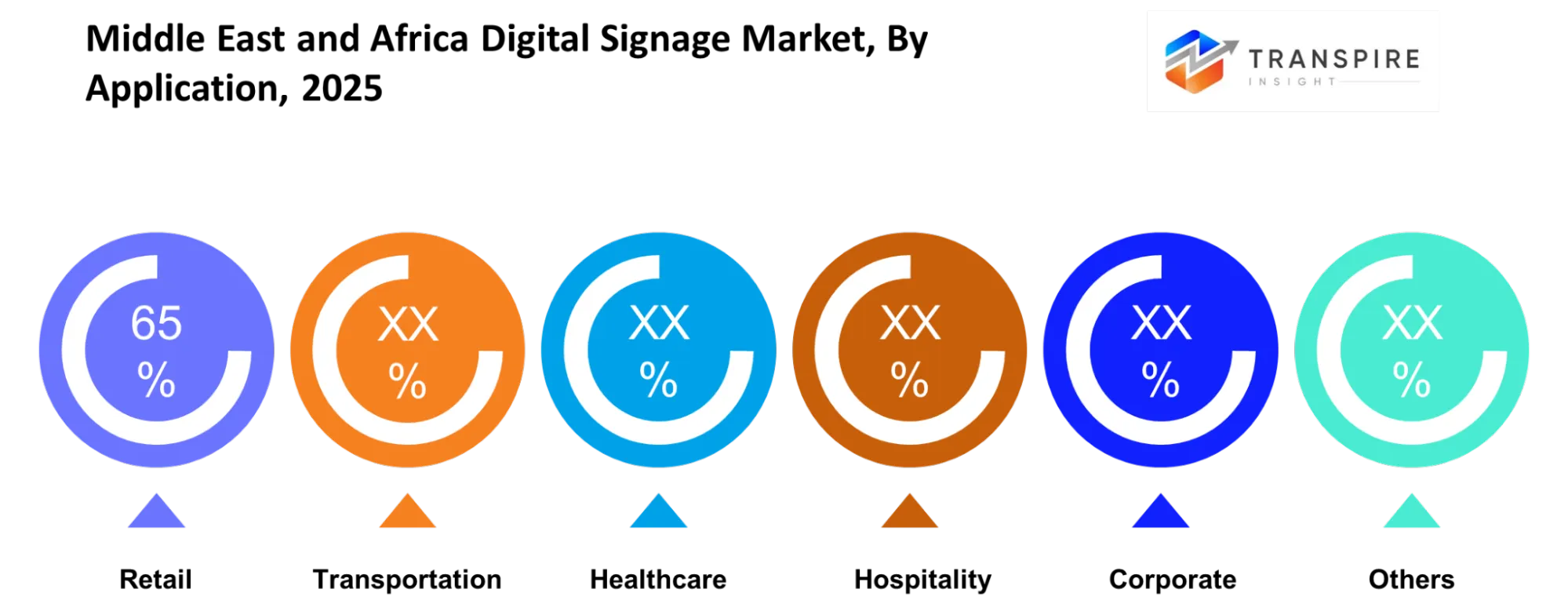
Retail stays in the lead since in-store advertising displays are being adopted heavily across shopping centers and supermarket formats across GCC markets. Intense competition between retailers pushes more spending into dynamic content systems that can steer customer behavior at the point of sale. Urban retail expansion across Saudi Arabia and UAE then reinforces that dominant position, not just in volume, but in how fast new screens get rolled out.
Transportation is seeing the most rapid structural expansion, as airports , metro systems, and bus terminals move away from static boards toward real-time passenger updates. After 2020, modernization drives sped up rollouts in Dubai, Doha, and Riyadh. Healthcare and hospitality don’t jump in everywhere though , they adopt in a selective way, mostly within private hospitals and higher-end hotels.
What comes next is more about transport-connected ecosystems, where real-time communication pretty much becomes the deciding factor. Retail keeps a steady modernization path, leaning into interactive and AI-based display screens. Corporate and healthcare use cases grow in a slower, careful manner, once the digital backbone is ready and when regulatory modernization makes systems more prepared to operate.
To learn more about this report, Download Free Sample Report
By End-User
Retailers stay the lead end user, because there’s constant pressure for promotional display networks and those in-store engagement tools, especially across hypermarkets, and also malls. In consumer markets the competition stays intense, so retailers keep forcing more frequent content changes and higher screen density in city retail areas. The bulk of investment is still concentrated within GCC economies.
Transport operators are emerging as the fastest-growing end user group, mostly due to airport growth and metro line development across Saudi Arabia and UAE. Government entities are adopting more public communication tools and smart city dashboards. Enterprises take a more selective path, typically for corporate messaging, and branding.
Future demand looks like it will shift toward government run infrastructure programs and transport ecosystems, so that centralized communication becomes kind of essential. Retailers tend to upgrade what they already have, not really expand too aggressively. Enterprises and hospitals also move forward, more step by step, because cost barriers ease and integration capabilities get better, overall.
By Display
LED displays still take the lead, mainly because they bring higher brightness, better ruggedness, and they fit outdoor placements across desert like areas and high temperature conditions. Big format LED screens are already common in stadiums, airports, and along highway advertising boards. Since around 2020, LED module costs kept dropping, that part basically locked in the leadership.
LCD displays are still strongly present in indoor retail settings and corporate spaces, where buyers care a lot about cost efficiency plus moderate resolution needs. OLED adoption stays limited, but it grows a bit in premium retail and luxury hospitality, mainly for its color fidelity and design flexibility.
Looking ahead, growth should tilt hard toward fine pitch LED tech as resolution keeps improving, and costs continue to fall. LCD use may soften in top end deployments, but it remains relevant for budget sensitive installations. OLED spreads more selectively, in premium use cases, especially where margins are higher like flagship retail spaces and high end advertising.
What are the Key Use Cases Driving the Middle East and Africa Digital Signage Market?
Retail advertising plus in store customer engagement still feel like the main use case, driving adoption in the Middle East and Africa digital signage market. Big shopping malls , supermarkets, and quick service restaurant chains across the UAE, Saudi Arabia, and South Africa keep putting digital displays to work for promoting deals, handling dynamic price tags, and also improving customer navigation. Retailers tend to like these setups, because they let teams publish changes in real time and support more specific, focused campaigns, which are said to nudge foot traffic and purchasing decisions.
Meanwhile, transportation and hospitality applications are growing at a steady pace through the whole region. Airports, metro stations, and bus terminals are relying more often on digital signage for passenger updates, multilingual announcements and wayfinding, with less friction every year. Hotels and entertainment places are following that trend too, using interactive screens to smooth out guest communication, event planning, and branded experiences, especially where tourism plays a big role like in the UAE, and also Egypt.
Some newer use cases are starting to show up, including smart city communication networks plus digital classroom solutions. Local municipal authorities are testing connected public displays for emergency alerts, civic messaging, and traffic information, as urban infrastructure projects roll forward, faster than before. Schools and educational orgs are also looking into interactive signage for mixed, or hybrid learning settings attendance tracking, and campus wide communication, which may create long term growth chances during the forecast window.
|
Report Metrics |
Details |
|
Market size value in 2025 |
USD 2.1 Billion |
|
Market size value in 2026 |
USD 2.3 Billion |
|
Revenue forecast in 2033 |
USD 4.6 Billion |
|
Growth rate |
CAGR of 10.41% from 2026 to 2033 |
|
Base year |
2025 |
|
Historical data |
2021 - 2024 |
|
Forecast period |
2026 - 2033 |
|
Report coverage |
Revenue forecast, competitive landscape, growth factors, and trends |
|
Regional scope |
Middle East and Africa (Saudi Arabia, United Arab Emirates, South Africa, Rest of Middle East and Africa) |
|
Key company profiled |
Samsung, LG, Sony, Panasonic, NEC, Sharp, Philips, Cisco, Intel, Scala, Broadsign, Daktronics, Christie Digital, BrightSign, Planar |
|
Customization scope |
Free report customization (country, regional & segment scope). Avail customized purchase options to meet your exact research needs. |
|
Report Segmentation |
By Type (Hardware, Software, Services, Others); By Application (Retail, Transportation, Healthcare, Hospitality, Corporate, Others); By End-User (Retailers, Enterprises, Hospitals, Transport Operators, Government, Others); By Display (LCD, LED, OLED, Others) |
Which Regions are Driving the Middle East and Africa Digital Signage Market Growth?
Asia Pacific still sort of leads the worldwide market, mainly because its broad commercial fleet operations, pretty high cargo throughput, and a very dense web of international shipping lanes. Places like China, South Korea, Japan, and Singapore keep stepping up maritime oversight, but at the same time they’re putting real money into upgraded port infrastructure and vessel modernization schemes. The thing is, the region also leans on strong shipbuilding capabilities, so operators can roll in new technologies during the vessel build, not later via expensive retrofits. There is also this mature setup with port authorities, marine equipment suppliers, and regional shipping companies that kinda backs long term market authority and steady technology adoption.
Europe stays a solid contributor too, mostly due to a regulated setup that’s more structured, plus shipowners who stick to a disciplined investment mindset. Compared with Asia Pacific, where “scale” and manufacturing muscle push adoption, Europe grows more on compliance readiness and sustainability oriented fleet management. Tough environmental rules across the European Union basically nudge operators to enhance onboard systems and squeeze better operational efficiency across cargo , tanker , and passenger fleets. And since there are long standing links between maritime regulators, classification societies, and vessel operators, it all becomes a dependable market space, with procurement cycles that feel fairly predictable.
Then there’s the Middle East and Africa, which is coming off as the fastest growing area, largely because of rapid port expansion projects and fresh investment in maritime trade corridors. Gulf countries have pushed ahead with smart port initiatives , plus logistics diversification strategies. Meanwhile, several African coastal nations are modernizing older port infrastructure so they can handle bigger commercial vessels.Increased government attention toward maritime security, vessel tracking, and trade efficiency has created new opportunities for technology adoption across regional fleets. This growth trajectory is expected to attract global suppliers, infrastructure investors, and marine service providers seeking early market positioning between 2026 and 2033.
Who are the Key Players in the Middle East and Africa Digital Signage Market and How Do They Compete?
The Middle East and Africa digital signage market still looks kind of moderately fragmented, with big display makers pushing in the same space as regional system integrators and software providers. A lot of the rivalry now sits on how well vendors blend different technologies, how fast and reliably they can provide local services, and whether they can roll out scalable content management solutions across retail, transportation, hospitality, and public infrastructure work, you know.
International brands keep trying to protect market share using wide distribution networks and premium display technologies, while regional players are getting more traction by leaning into quicker deployment, Arabic language integration, and tailored installation assistance. There is some price pressure on entry level commercial screens, but when projects move into the higher value end, buyers typically care more about software stability, energy efficiency, and long term maintenance support.
Samsung Electronics keeps strengthening its position with high brightness LED displays and centralized content management platforms, especially for large retail and transportation environments. Samsung also benefits from tight integration between its hardware and software ecosystems, which makes the deployment path easier for shopping malls and airports across the Gulf region. LG Electronics, on the other hand, leans into ultra thin commercial displays and OLED based signage options that tend to attract luxury retail groups and hospitality operators wanting more premium visual experiences. LG continues expanding through partnerships with regional audiovisual distributors and smart building integrators.
Sharp NEC Display Solutions goes for a more specific angle, using niche specialization in mission critical signage setups, mainly for control rooms, transportation hubs, and public sector installations where continuous uptime is non negotiable.It’s differentiation comes from durable display architecture and advanced remote monitoring abilities , that reduce maintenance costs for infrastructure operators. Leyard is expanding, pretty quickly across the Middle East by pushing fine pitch LED video walls, these are tuned for stadiums, entertainment venues, and smart city programs. The company basically gains an advantage by mixing cost competitive manufacturing with large scale customization potential, for landmark commercial developments.
Company List
- Samsung
- LG
- Sony
- Panasonic
- NEC
- Sharp
- Philips
- Cisco
- Intel
- Scala
- Broadsign
- Daktronics
- Christie Digital
- BrightSign
- Planar
Recent Development News
“In February 2026, Samsung Electronics launched glasses-free 3D digital signage solutions and introduced its 130-inch Micro RGB commercial display at ISE 2026. The launch strengthened Samsung’s position in premium commercial display deployments across retail, entertainment, and transportation projects in the Middle East market. https://news.samsung.com
In January 2025, LG Electronics entered a partnership with BrightSign to launch integrated digital signage displays powered by BrightSignOS and BSN.Cloud software. The collaboration enabled seamless integration of LG commercial displays with cloud-based content management systems, improving deployment scalability for retail, transportation, and hospitality signage networks across global markets, including Middle East and Africa rollouts.https://www.lg.com
What Strategic Insights Define the Future of the Middle East and Africa Digital Signage Market?
In the Middle East and Africa the digital signage market is slowly moving toward more bundled, data driven messaging ecosystems, not just standalone screen deployments, you know. Over the next five to seven years the appetite will keep shifting toward AI enabled content management, more participative customer engagement and cloud connected signage networks, especially as governments and enterprises speed up smart infrastructure spending. In practice this shift will reward vendors that can blend software analytics, remote oversight, and localized support into one single platform, even if it sounds a bit different from what people expected before.
There’s also an underrecognized risk people mention less than they should, which is the growing reliance on imported semiconductor components and display panels. That could leave regional projects exposed to supply chain interruptions and sudden pricing swings, particularly when geopolitical tensions flare up. At the same time, smart city communication systems tied to transit hubs and public safety infrastructure, they look like a real chance that is still underpenetrated in many emerging urban centers across Africa. So new companies entering the market should try to lock in longer term alliances with regional telecom operators, infrastructure developers, and public sector agencies, so they can keep earning recurring revenue rather than only relying on one time hardware installations.
Middle East and Africa Digital Signage Market Report Segmentation
By Type
- Hardware
- Software
- Services
- Others
By Application
- Retail
- Transportation
- Healthcare
- Hospitality
- Corporate
- Others
By End-User
- Retailers
- Enterprises
- Hospitals
- Transport Operators
- Government
- Others
By Display
- LCD
- LED
- OLED
- Others
Frequently Asked Questions
Find quick answers to common questions.
The estimared Middle East and Africa Digital Signage Market size is USD 4.6 Billion in 2033.
Key segments for the Middle East and Africa Digital Signage Market are By Type (Hardware, Software, Services, Others); By Application (Retail, Transportation, Healthcare, Hospitality, Corporate, Others); By End-User (Retailers, Enterprises, Hospitals, Transport Operators, Government, Others); By Display (LCD, LED, OLED, Others).
Major Middle East and Africa Digital Signage Market players are Samsung, LG, Sony, Panasonic, NEC, Sharp, Philips, Cisco, Intel, Scala, Broadsign, Daktronics, Christie Digital, BrightSign, Planar.
The Middle East and Africa Digital Signage Market size is USD 2.1 Billion in 2025.
The Middle East and Africa Digital Signage Market CAGR is 10.41% from 2026 to 2033.
- Samsung
- LG
- Sony
- Panasonic
- NEC
- Sharp
- Philips
- Cisco
- Intel
- Scala
- Broadsign
- Daktronics
- Christie Digital
- BrightSign
- Planar
Recently Published Reports
-
Apr 2026
3D Optical Profiler Market
3D Optical Profiler Market Size, Share & Analysis Report By Type (Desktop 3D Optical Profiler, and Portable 3D Optical Profiler), By Technology (Confocal Technology, and White Light Interference), By End-Use Industry (Manufacturing, Research Institutions, Automotive, Aerospace and Defense, Medical Devices, and Other), and Geography (North America, Europe, Asia-Pacific, Middle East and Africa, South and Central America), 2021 - 2031
-
Apr 2026
Depth Sensor Market
Depth Sensor Market Size, Share & Analysis Report By Type (Infrared Depth Sensors, Time-of-Flight (ToF) Sensors, Stereo Vision Sensors, Structured Light Sensors, Ultrasonic Depth Sensors), By Application (Automotive, Robotics, Gaming, Consumer Electronics, Industrial Automation, Healthcare, Security & Surveillance, Others), By End Users (Automotive Manufacturers, Consumer Electronics Companies, Healthcare Providers, Industrial Companies, Security Agencies, Gaming Companies, Robotics Companies, Others), and Geography (North America, Europe, Asia-Pacific, Middle East and Africa, South and Central America), 2021 – 2031
-
Apr 2026
Digital Manufacturing Market
Digital Manufacturing Market Size, Share & Analysis Report By Component (Hardware, Software, and Services), By Technology (Robotics, 3D Printing, Internet of Things (IoT), and Others), By Application (Automotive and Transportation, Aerospace and Defense, Consumer Electronics, Industrial Machinery, and Others), By Process Type (Computer-Based Designing, Computer-Based Simulation, Computer 3D Visualization, Analytics, and Others), and Geography (North America, Europe, Asia-Pacific, Middle East and Africa, South and Central America), 2021 – 2031
-
Apr 2026
Digital Visa Services Market
Digital Visa Services Market Size, Share & Analysis Report By Type (Individual Travelers, Group Travelers), By Application (Tourism, Business Travel, Others), and Geography (North America, Europe, Asia-Pacific, Middle East and Africa, South and Central America), 2021 – 2031