

Europe Video Analytics Market Size & Forecast:
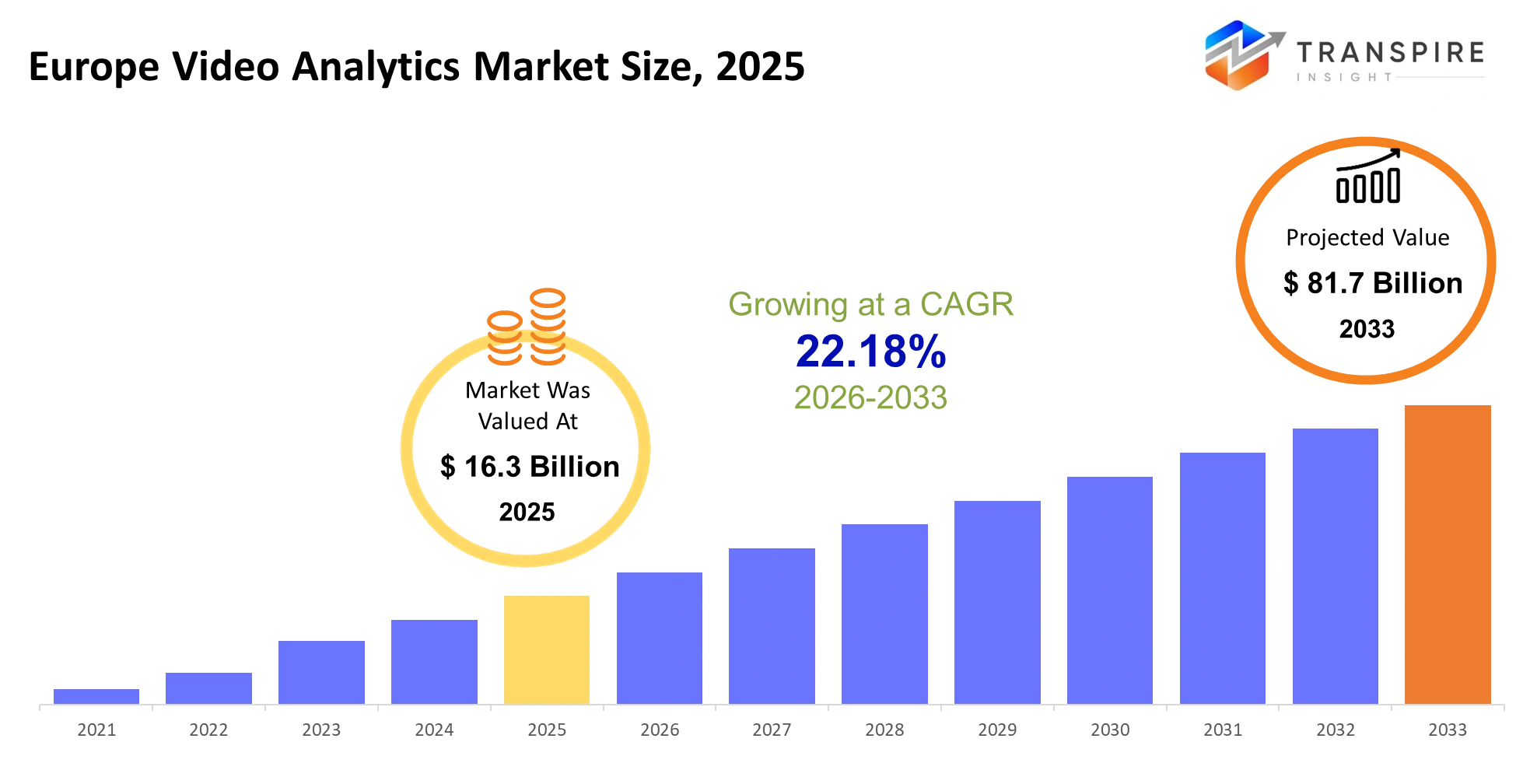
- Europe Video Analytics Market Size 2025: USD 16.3 Billion
- Europe Video Analytics Market Size 2033: USD 81.7 Billion
- Europe Video Analytics Market CAGR: 22.18%
- Europe Video Analytics Market Segments: By Type (Software, Services, Hardware, AI Platforms, Others), By Application (Security & Surveillance, Retail Analytics, Traffic Monitoring, Industrial Monitoring, Smart Cities, Others), By End-User (Government, Retailers, Enterprises, Transportation, Industrial Sector, Others), By Deployment (Cloud, On-premise, Hybrid, Others).
To learn more about this report,  Download Free Sample Report
Europe Video Analytics Market Summary:
The Europe Video Analytics Market size is estimated at USD 16.3 Billion in 2025 and is anticipated to reach USD 81.7 Billion by 2033, growing at a CAGR of 22.18% from 2026 to 2033. The Europe Video Analytics Market transforms unprocessed camera footage into useful operational information which factory sites and port facilities and transportation centers and essential infrastructure develop. The system allows operators to identify safety breaches while following equipment movement and stopping unauthorized entry and improving operational processes which do not need continuous staff observation. The system improvement from active security monitoring to automated decision-making systems establishes better operational security while decreasing response delays.
The market has developed toward edge-based AI processing systems during the last three to five years which enable analytics to execute directly on camera equipment and local devices instead of using centralized server systems. The modification enables immediate safety measures by decreasing system delays. The COVID-19 pandemic forced organizations to implement remote monitoring solutions which utilized automated systems for security management which became a major driving force for this development.
The organizations now allocate funds for video analytics systems because they serve security purposes while delivering operational efficiency and regulatory compliance and measurable expense management which enables organizations to expand system usage and increase funding resources.
Key Market Insights
- Western Europe controls the European Video Analytics Market because it possesses more than 45% market share in 2025 due to its developed infrastructure and its adoption of artificial intelligence technologies.
- The highest growth rate of Northern Europe will continue until 2030 because the region invests in smart cities and implements digital solutions for public safety.
- The software platforms sector controls almost 55% of the market in 2025 because businesses choose to invest in AI-powered analytics solutions instead of hardware-based systems.
- The services segment functions as the second most important segment because it receives support from integration needs and maintenance requirements and consulting services for industrial operations.
- The period between 2025 and 2030 will experience maximum growth for edge-based analytics solutions which depend on their capacity to process data with minimal delays while making instant decisions.
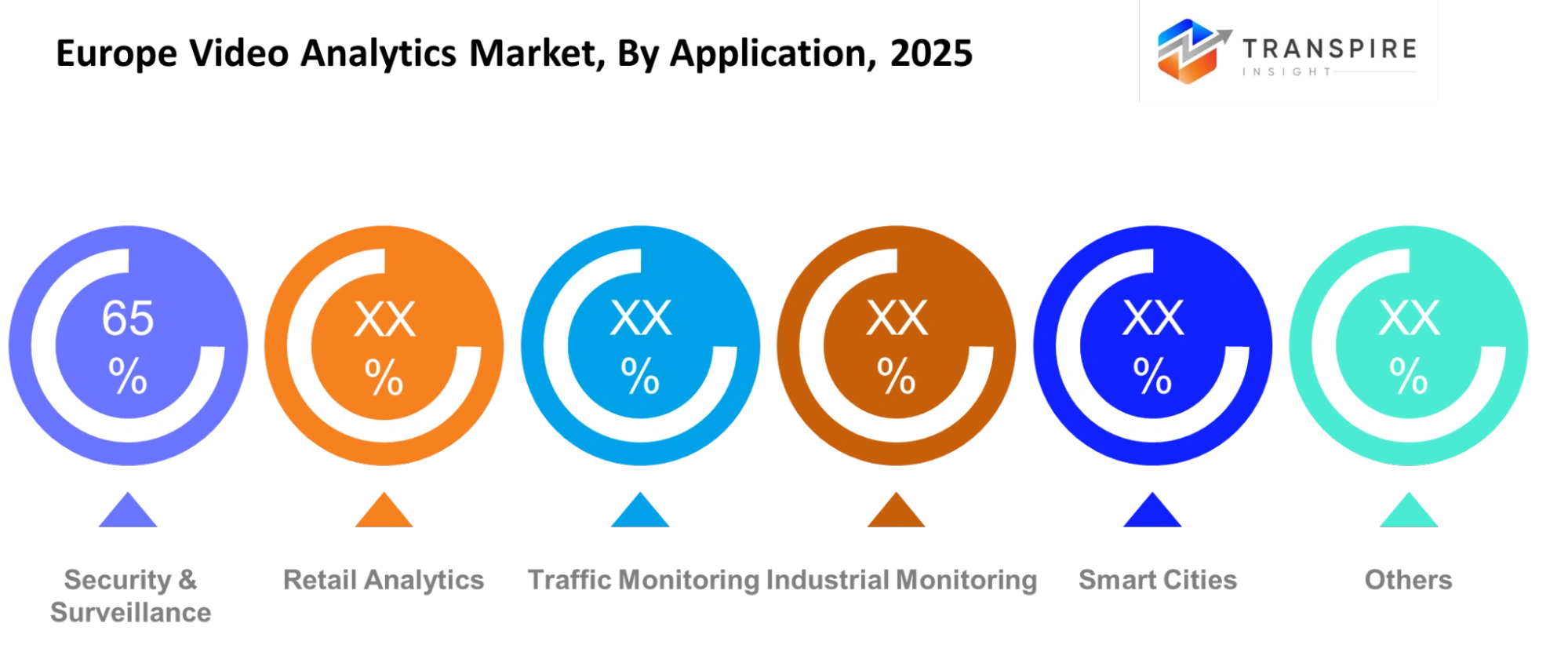
- The field of security and surveillance applications controls more than 40% of the market because organizations need to follow compliance regulations and safeguard their infrastructure.
- Retail and traffic management applications achieve their highest expansion rates because they use behavioral analytics together with real-time monitoring to enhance their operational efficiency.
- The government and public sector control approximately 35% of the market which includes large-scale surveillance systems and smart city initiatives.
- The manufacturing and logistics industries represent the sector that experiences fastest growth because they apply video analytics to enhance their operational efficiency and maintain safety standards.
What are the Key Drivers, Restraints, and Opportunities in the Europe Video Analytics Market?
The Europe Video Analytics Market experiences its main growth driver when businesses adopt AI-powered edge processing systems because of improved chip technology and their need for real-time monitoring. The demand for immediate anomaly detection in transport and energy and manufacturing industries creates challenges for centralized systems which experience delays. The recent change has resulted in higher costs for intelligent cameras and embedded analytics software, which now costs more because companies install these systems at multiple locations. The transition from passive recording to automated decision systems enables organizations to generate higher recurring income through software licensing and upgrades.
Data privacy regulation especially GDPR creates the most significant structural barrier. Video analytics systems process biometric data and personally identifiable information which results in compliance requirements for data storage and user consent and international data transfer. The requirements create complex challenges for legal and operational processes because they differ between different jurisdictions. The restriction causes delays in procurement processes which forces organizations to decrease their analytics operations, resulting in lost video data benefits and slower progress toward widespread use.
The integration of video analytics with smart city infrastructure creates a significant business opportunity throughout Eastern Europe. Governments are boosting their funding for urban mobility and public safety initiatives which will benefit from AI-powered traffic analysis and incident detection systems that provide quantifiable efficiency improvements.
What Has the Impact of Artificial Intelligence Been on the Europe Video Analytics Market?
Artificial intelligence transforms video analytics systems which used to function as monitoring systems into active control systems for industrial and maritime operations. The operators use AI-powered vision systems to automate scrubber monitoring which helps them verify exhaust plume characteristics without needing to conduct manual inspections. The systems connect to control platforms which use them to send alerts or modify operating settings when their emission levels cross defined limits, thereby enhancing fleet compliance monitoring capabilities.
Predictive maintenance and performance enhancement become possible through machine learning models which provide this functionality. The algorithms use video feed analysis together with sensor data to detect equipment fouling and corrosion and flow inefficiencies which occur in exhaust gas cleaning systems. Operators use this system to arrange their maintenance activities because it enables them to predict equipment failures before they happen. Some companies achieve measurable improvements in fuel efficiency and better regulatory compliance when they optimize their system performance.
The implementation process encounters a major obstacle at this point. AI systems struggle to maintain proper accuracy because maritime environments present challenges with fluctuating lighting conditions and seawater spray and camera movement. The system requires human verification because it produces reliability gaps which prevent operators from achieving complete automated processes throughout their operations.
Key Market Trends
- The enterprises began using hybrid edge deployments which reduced their analytical work through cloud-based systems since 2021 because this method achieved 40 percent lower latency and allowed them to conduct immediate operations in essential environments.
- After 2022 European governments established stricter biometric data regulations which required vendors to create new analytics systems that used anonymization together with privacy-protecting artificial intelligence technology.
- Between 2020 and 2024 cities invested heavily in smart city developments which included AI-powered systems that analyzed traffic and crowd movements to control urban traffic jams and protect public safety.
- The manufacturers began using video analytics together with IoT systems especially after 2021 because this method enabled them to monitor their production lines while achieving better defect detection results than traditional systems.
- Retailers began using behavioral analytics tools together with in-store movement tracking systems since 2022 which enabled them to improve their conversion rates through data-based decisions about store layouts and staff allocations.
- The market environment changed when Axis Communications and Bosch introduced AI-powered cameras which they used to create new product differentiation methods that combined intelligence with other product features.
- The demand for real-time incident detection systems in transport hubs began to grow from 2021 onwards because of two main factors which included increasing security requirements and new compliance rules.
- After 2023 vendors began to enter Eastern European markets while they focused on digital surveillance system projects which needed to replace their existing analog networks with modern infrastructure solutions.
- The post-2022 period saw an increase in analytics providers forming integration partnerships with cloud platforms which enabled organizations to achieve scalable deployments of their systems while handling local processing needs and accessing central data insights.
Europe Video Analytics Market Segmentation
By Type
Organizations prioritize AI-driven analytics engines above hardware-centric systems because software platforms provide better performance than all other system types. The highest value of video management software and deep learning models comes from their ability to detect and classify materials while providing decision-making assistance in real time. Intelligent cameras have become a growing hardware market because they now provide organizations with essential systems instead of producing core business value. The system demands both integration services and maintenance services because of its intricate design and legal requirements.
AI platform demand increased across enterprises since 2021 because companies want analytics solutions that can grow with their business needs. The industry expansion process depends on organizations needing systems that process data with minimal delays and improve machine learning models throughout their operational period. Future development will favor modular software ecosystems, which vendors will build according to subscription-based models that include ongoing updates, which will create new revenue sources and help maintain customer relationships.
By Application
Security and surveillance functions serve as the primary applications which operate under regulatory enforcement requirements and critical infrastructure protection needs that exist in transportation systems and energy facilities and public areas. Automated threat detection systems exist as the solution which governments and enterprises use to eliminate their need for manual supervision while they achieve faster response times. The period after 2020 has seen traffic monitoring systems and smart city applications experience strong development because of urban congestion problems and infrastructure digitization efforts.
Retail analytics has expanded through customer behavior tracking and store optimization use cases. The industrial monitoring sector has developed into a valuable market because manufacturers now use video technology together with their operational systems to enhance safety and quality control processes. Public sector demand grows from compliance requirements while commercial sectors focus on efficiency gains. The future will see organizations adopting platforms which unify security operations and customer intelligence through common analytics systems.
To learn more about this report, Download Free Sample Report
By End-User
Government and public sector entities operate their surveillance systems at full capacity because they maintain ongoing financial support for smart infrastructure projects. Cities and their transportation authorities establish their operations through the combination of legal requirements and their need to protect citizens. Businesses in retail and logistics sectors become the second biggest customers because they want to enhance their operational efficiency while decreasing their operational losses and inefficiencies.
The industrial sector experiences its highest expansion rate because factories implement video analytics systems to monitor their production processes and ensure workplace safety. Each end-user group follows a distinct investment logic, with governments focusing on compliance and resilience while private sectors prioritize cost reduction and productivity. The future growth of the organization depends on its ability to establish data sharing systems between public and private organizations, which will improve their situational understanding and operational management capabilities.
By Deployment
By deployment, on-premise solutions have historically dominated due to data control requirements and strict privacy regulations. Many organizations continue to prefer localized processing to maintain compliance with data protection laws. Cloud-based deployment has gained traction since 2021 as scalability and remote access become critical for distributed operations. Hybrid models are emerging as the preferred approach, combining local processing for sensitive data with cloud platforms for advanced analytics and storage.
Growth in cloud adoption remains constrained by regulatory complexity and concerns over data sovereignty. However, advancements in secure cloud architecture and regional data centers are gradually reducing these barriers. Future deployment strategies will center on hybrid frameworks, enabling flexible scaling while maintaining compliance, which will shape vendor offerings and infrastructure investment decisions.
What are the Key Use Cases Driving the Europe Video Analytics Market?
Security monitoring remains the core use case driving adoption across transport hubs, airports, public infrastructure, and government facilities. The demand for automated threat detection systems which include intrusion alerts and crowd behavior analysis features exists because these systems decrease the need for manual surveillance work while they enable faster emergency response times.
Traffic management and retail intelligence have gained strong traction in recent years. Municipal authorities use analytics to optimize traffic flow and detect road incidents in real time , while large retail chains apply behavioral tracking to improve store layouts and staffing decisions.
The industrial process monitoring and predictive safety management system will become operational at manufacturing plants. Ports and logistics operators are testing AI-powered video systems which enable container tracking and automated perimeter inspection to create new opportunities that will arise as operational automation expands across critical infrastructure networks.
|
Report Metrics |
Details |
|
Market size value in 2025 |
USD 16.3 Billion |
|
Market size value in 2026 |
USD 20.1 Billion |
|
Revenue forecast in 2033 |
USD 81.7 Billion |
|
Growth rate |
CAGR of 22.18% from 2026 to 2033 |
|
Base year |
2025 |
|
Historical data |
2021 - 2024 |
|
Forecast period |
2026 - 2033 |
|
Report coverage |
Revenue forecast, competitive landscape, growth factors, and trends |
|
Regional scope |
Europe (Germany, United Kingdom, France, Italy, Spain and Rest of Europe) |
|
Key company profiled |
Hikvision, Dahua, Axis Communications, Bosch, Honeywell, Avigilon, Genetec, IBM, Microsoft, Cisco, NVIDIA, NEC, Panasonic, Hanwha Vision, Pelco. |
|
Customization scope |
Free report customization (country, regional & segment scope). Avail customized purchase options to meet your exact research needs. |
|
Report Segmentation |
By Type (Software, Services, Hardware, AI Platforms, Others), By Application (Security & Surveillance, Retail Analytics, Traffic Monitoring, Industrial Monitoring, Smart Cities, Others), By End-User (Government, Retailers, Enterprises, Transportation, Industrial Sector, Others), By Deployment (Cloud, On-premise, Hybrid, Others). |
Which Regions are Driving the Europe Video Analytics Market Growth?
The market in Western Europe operates under German and British and French leadership which serves as the market's starting point. The system requires public safety rules together with data protection regulations and infrastructure safety protocols to be followed throughout all transportation networks and vital public spaces. The combination of advanced digital networks and early AI technology adoption enables cities and industrial operations to implement video analytics systems at large scale. The region achieves technological leadership because it has established base of technology vendors and system integrators who receive public sector funding to drive continuous technological development.
Northern Europe follows as a stable and reliable contributor, with countries like Sweden, Denmark, and the Netherlands emphasizing long-term infrastructure resilience. The region of Western Europe stands apart from this area because its citizens work toward achieving sustainable development through efficient management of their urban centers instead of building extensive surveillance systems. The government sector maintains constant spending for mobility improvement projects together with traffic measurement initiatives and environmental observation efforts which create ongoing market requirements. The marketplace develops through public organizations and private technology companies which work together to establish new business opportunities.
Eastern Europe experiences its most rapid expansion because of ongoing developments in its basic infrastructure and digital modernization projects. After the year 2022 Poland and Romania increased their financial support for smart city initiatives while modernizing their outdated monitoring systems. The improved access to EU funding together with growing security issues has increased the use of AI analytics platforms. The growing market demand for scalable solutions during the period between 2026 and 2033 creates business opportunities for both new companies and investors.
Who are the Key Players in the Europe Video Analytics Market and How Do They Compete?
The Europe Video Analytics Market shows moderate fragmentation because established imaging companies and software-driven AI specialists compete against each other. The existing companies protect their market share through their hardware and software product bundles which create complete systems and the new companies use their cloud-based services to disrupt market pricing and innovation patterns. The competition between companies now depends on their technology capabilities especially in edge AI processing and real-time analytics accuracy and their ability to follow strict data security regulations. The vendors develop their solutions according to the existing regulatory requirements and operational capabilities of each geographical market.
Axis Communications develops network cameras with embedded analytics capabilities which use their proprietary chipsets to process information in real time without needing external servers. The system improves response time for transportation and urban surveillance systems which need immediate operational capacity. The company Bosch Security Systems creates unique market solutions through its complete system integration which enables customers to manage their security operations using a single platform that combines various components. Bosch uses its partnership agreements with infrastructure developers and public sector projects to enhance its market presence which allows the company to establish itself within smart city implementations.
Hikvision and Dahua Technology compete through cost-efficient, feature-rich solutions which target customers who prioritize low prices in Eastern European markets. Both companies expand their business through distributor networks while they develop products that meet local market needs for compliance with regional regulations. The company develops its business through advanced AI software components which allow video analytics to integrate with data systems that help businesses make informed decisions at an enterprise level.
Company List
- Hikvision
- Dahua
- Axis Communications
- Bosch
- Honeywell
- Avigilon
- Genetec
- IBM
- Microsoft
- Cisco
- NVIDIA
- NEC
- Panasonic
- Hanwha Vision
- Pelco
Recent Development News
In April 2026, Camtek acquires Visual Layer to strengthen AI video analytics capabilities: Camtek, a semiconductor inspection company with strong Europe-linked R&D operations, acquired Visual Layer to enhance its AI-based video analytics and inspection systems. The deal strengthens its visual intelligence stack used in advanced industrial imaging.
Source: https://www.nasdaq.com
In April 2026, VisionWave acquires xClibre AI video intelligence IP assets: VisionWave completed acquisition of xClibre’s AI video intelligence platform, enhancing its real-time video analytics and computer vision capabilities. The move strengthens integrated sensing systems used in security and surveillance applications across European defense-adjacent ecosystems.
Source: https://www.nasdaq.com
What Strategic Insights Define the Future of the Europe Video Analytics Market?
The Europe Video Analytics Market is progressing toward new decentralized AI-native systems which operate through edge-enabled networks instead of centralized decision-making systems. The industry develops in this direction because organizations require immediate system response while data sovereignty requirements have become more stringent and organizations incur higher expenses for cloud services that need extensive bandwidth.
The next five to seven years will see value creation through software intelligence components and platforms that enable different systems to work together instead of through individual hardware systems. A less visible risk exists because European countries enforce different data protection regulations which create challenges for businesses to operate across borders while increasing their need to meet legal requirements. The process of establishing operations in multiple countries will face delays because businesses will choose local suppliers instead of supporting European-wide systems.
The growing integration between video analytics and digital twin technology which industrial and urban infrastructure systems use provides opportunities for businesses to develop advanced simulation-based optimization and predictive control systems. Organizations in the market should focus their resources on developing AI systems which maintain user privacy and comply with all local regulations while enabling their technology to be used across multiple industries.
Europe Video Analytics Market Report Segmentation
By Type
- Software
- Services
- Hardware
- AI Platforms
- Others
By Application
- Security & Surveillance
- Retail Analytics
- Traffic Monitoring
- Industrial Monitoring
- Smart Cities
- Others
By End-User
- Government
- Retailers
- Enterprises
- Transportation
- Industrial Sector
- Others
By Deployment
- Cloud
- On-premise
- Hybrid
- Others
Frequently Asked Questions
Find quick answers to common questions.
The approximate Europe Video Analytics Market size for the market will be USD 81.7 Billion in 2033.
The key segments of the Europe Video Analytics Market are By Type (Software, Services, Hardware, AI Platforms, Others), By Application (Security & Surveillance, Retail Analytics, Traffic Monitoring, Industrial Monitoring, Smart Cities, Others), By End-User (Government, Retailers, Enterprises, Transportation, Industrial Sector, Others), By Deployment (Cloud, On-premise, Hybrid, Others).
Major players in the Europe Video Analytics Market are Hikvision, Dahua, Axis Communications, Bosch, Honeywell, Avigilon, Genetec, IBM, Microsoft, Cisco, NVIDIA, NEC, Panasonic, Hanwha Vision, Pelco.
The current market size of the Europe Video Analytics Market is USD 16.3 Billion in 2025.
The Europe Video Analytics Market CAGR is 22.18%.
- Hikvision
- Dahua
- Axis Communications
- Bosch
- Honeywell
- Avigilon
- Genetec
- IBM
- Microsoft
- Cisco
- NVIDIA
- NEC
- Panasonic
- Hanwha Vision
- Pelco
Recently Published Reports
-
Apr 2026
3D Optical Profiler Market
3D Optical Profiler Market Size, Share & Analysis Report By Type (Desktop 3D Optical Profiler, and Portable 3D Optical Profiler), By Technology (Confocal Technology, and White Light Interference), By End-Use Industry (Manufacturing, Research Institutions, Automotive, Aerospace and Defense, Medical Devices, and Other), and Geography (North America, Europe, Asia-Pacific, Middle East and Africa, South and Central America), 2021 - 2031
-
Apr 2026
Depth Sensor Market
Depth Sensor Market Size, Share & Analysis Report By Type (Infrared Depth Sensors, Time-of-Flight (ToF) Sensors, Stereo Vision Sensors, Structured Light Sensors, Ultrasonic Depth Sensors), By Application (Automotive, Robotics, Gaming, Consumer Electronics, Industrial Automation, Healthcare, Security & Surveillance, Others), By End Users (Automotive Manufacturers, Consumer Electronics Companies, Healthcare Providers, Industrial Companies, Security Agencies, Gaming Companies, Robotics Companies, Others), and Geography (North America, Europe, Asia-Pacific, Middle East and Africa, South and Central America), 2021 – 2031
-
Apr 2026
Digital Manufacturing Market
Digital Manufacturing Market Size, Share & Analysis Report By Component (Hardware, Software, and Services), By Technology (Robotics, 3D Printing, Internet of Things (IoT), and Others), By Application (Automotive and Transportation, Aerospace and Defense, Consumer Electronics, Industrial Machinery, and Others), By Process Type (Computer-Based Designing, Computer-Based Simulation, Computer 3D Visualization, Analytics, and Others), and Geography (North America, Europe, Asia-Pacific, Middle East and Africa, South and Central America), 2021 – 2031
-
Apr 2026
Digital Visa Services Market
Digital Visa Services Market Size, Share & Analysis Report By Type (Individual Travelers, Group Travelers), By Application (Tourism, Business Travel, Others), and Geography (North America, Europe, Asia-Pacific, Middle East and Africa, South and Central America), 2021 – 2031