
United States Light-Emitting Diode (LED) Digital Signage Market Size & Forecast:
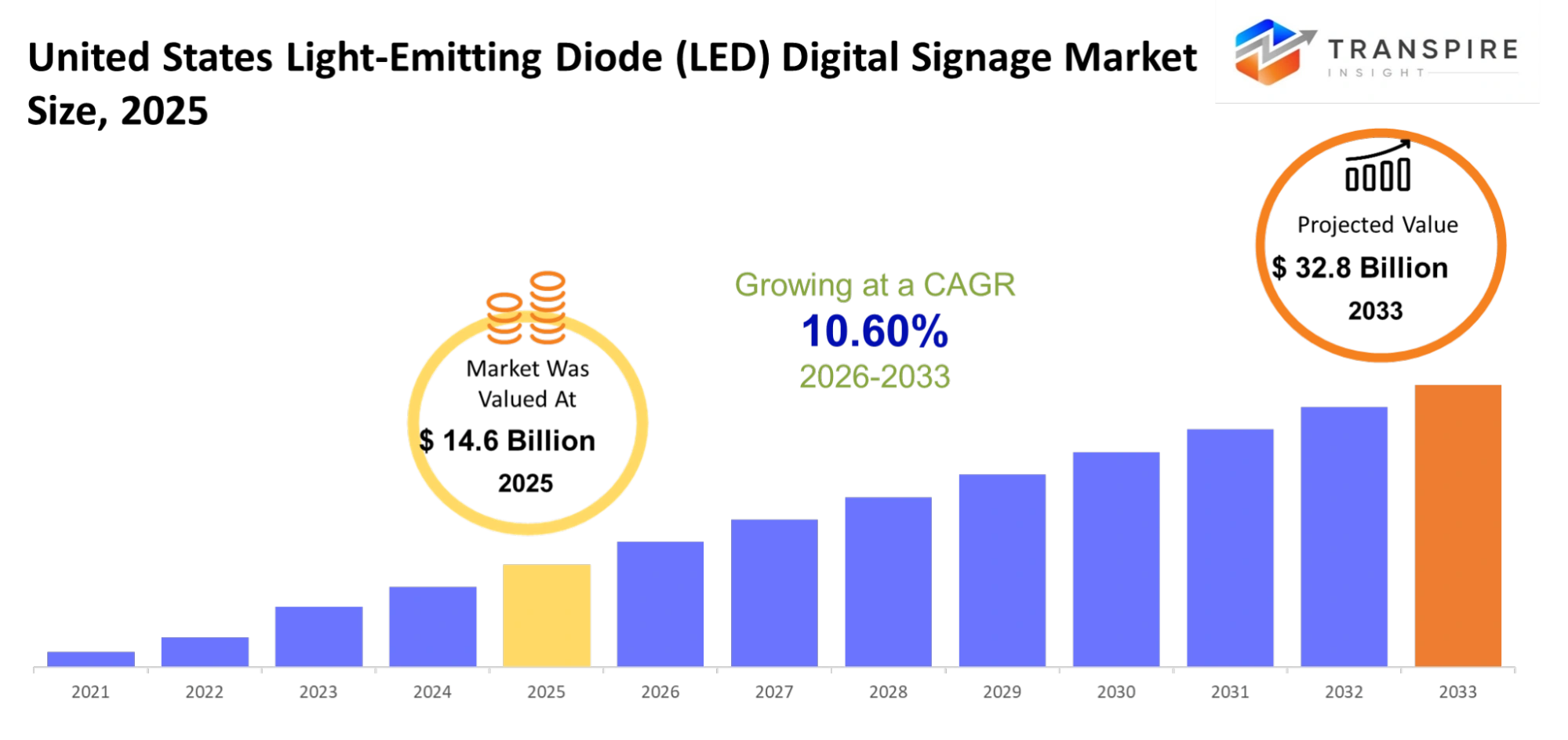
- United States Light-Emitting Diode (LED) Digital Signage Market Size 2025: USD 14.6 Billion
- United States Light-Emitting Diode (LED) Digital Signage Market Size 2033: USD 32.8 Billion
- United States Light-Emitting Diode (LED) Digital Signage Market CAGR: 10.60%
- United States Light-Emitting Diode (LED) Digital Signage Market Segments:By Type (Video Walls, LED Billboards, Transparent LED, OLED Displays, Indoor LED, Outdoor LED, Interactive Displays), By Application (Retail, Transportation, Corporate, Healthcare, Hospitality, Education, Entertainment), By Component (Hardware, Software, Services, Media Players, Displays, Controllers, Content), By Installation (Fixed, Mobile, Rental, Temporary, Permanent, Smart, Modular), By End-User (Retailers, Enterprises, Govt, Healthcare, Media, Transport, Education).
To learn more about this report,  Download Free Sample Report
United States Light-Emitting Diode (LED) Digital Signage Market Summary:
The United States Light-Emitting Diode (LED) Digital Signage Market size is estimated at USD 14.6 billion in 2025 and is anticipated to reach USD 32.8 billion by 2033, growing at a CAGR of 10.60% from 2026 to 2033. The United States light-emitting diode (LED) digital signage market continues its expansion because businesses require improved methods to connect with their intended audience. Digital displays for real-time updates and engaging content are being adopted at higher rates by retail and transportation and corporate sectors. The operational efficiency improvements together with cost-saving advantages result from technology upgrades that include energy-efficient screens and advanced content delivery systems. The market will experience continuous growth because people demand products while companies bring forth new technologies after they overcome their initial funding challenges.
What Has the Impact of Artificial Intelligence Been on the United States Light-Emitting Diode (LED) Digital Signage Market?
The United States light-emitting diode digital signage industry undergoes complete transformation through artificial intelligence, which changes how businesses conduct data analysis and audience interaction and operational efficiency. The United States light-emitting diode digital signage market integrates artificial intelligence to provide businesses with advanced market research capabilities and real-time data analysis tools which help them analyse customer purchasing patterns and content effectiveness.
Artificial intelligence technology improves demand forecasting and production efficiency in US LED digital signage market operations. AI-powered smart automation solutions enable manufacturers to improve their design process and their assembly process and their quality control process, which results in lower mistakes and lower operating expenses. The digital signage networks operate continuously because machine learning-based predictive maintenance systems decrease operational downtime.
The United States light-emitting diode (LED) digital signage industry experiences supply chain optimisation transformation through AI technology, which also provides customised solutions for different clients. The advanced analytics tools of companies enable them to predict their inventory requirements while they achieve logistics optimisation and waste reduction that leads to decreased operational costs.
Businesses use AI content personalisation technology to develop customised messages which target specific audience groups that share common demographic and geographic and behaviour patterns. The United States light-emitting diode (LED) digital signage market uses AI technology to drive innovation and sustainable advancement while the industry develops into a data-analytics-based operation that achieves exceptional flexibility.
Key Market Trends & Insights:
- The united states LED digital signage market will be mostly controlled by urban business districts which will generate more than 65% of market share in 2025.
- The period between 2026 and 2033 will see rapid development in tier-2 and suburban areas because retail businesses will expand and infrastructure development will occur.
- The market for indoor LED displays will reach its highest point in 2025 when 58% of display installations will take place in malls and offices and airports.
- The outdoor LED signage market holds second place because public advertising networks and billboards become more popular among consumers.
- Fine-pitch LED displays will grow into the fastest expanding market segment because their demand for high-resolution visuals will increase until 2033.
- Retail advertising leads the united states light-emitting diode (LED) digital signage market with over 40% share because personalized promotions help businesses interact with their customers.
- The two fastest expanding sectors for smart city development are transportation systems and smart city solutions because both depend on real-time information systems and digital infrastructure development.
- The retail and commercial markets together hold 45% of the market share because customers strongly demand digital branding and in-store experiences.
- Healthcare facilities and corporate environments represent two of the fastest growing user groups who use signage to improve their communication and navigation and operational efficiency.
- Businesses use product innovation to develop AI-driven displays and ultra-fine pixel pitch display technology which improves their visual capabilities.
- The United States light-emitting diode digital signage market shows rapid growth because smart city projects and retail media networks develop through their strategic partnerships.
United States Light-Emitting Diode (LED) Digital Signage Market Segmentation
By Type
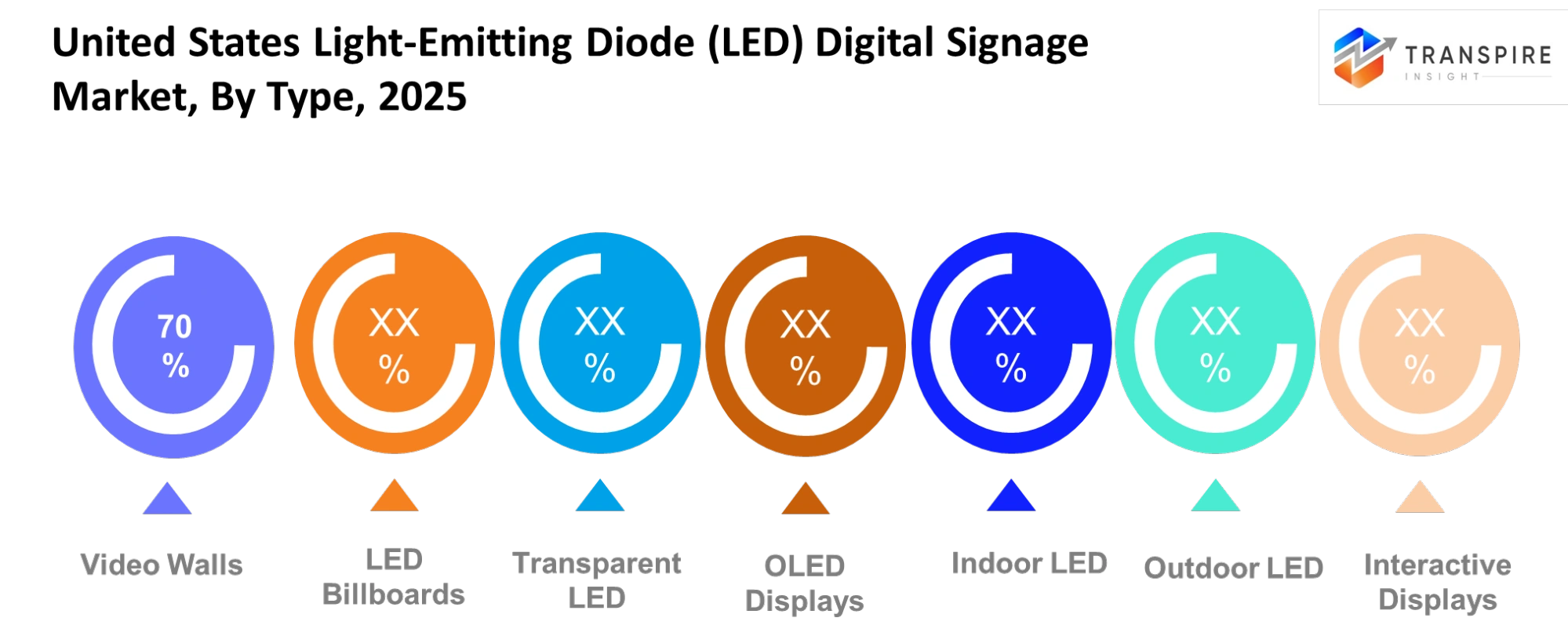
This segment explains the variety of display formats used across industries. Video walls provide control rooms and event spaces with their ability to display large images through seamless panel technology. Outdoor advertising will use LED billboards which deliver bright outdoor displays that withstand harsh weather conditions. Transparent LED and OLED displays will support modern design needs through their ability to show content while displaying images with high quality.
Indoor LED and outdoor LED displays will serve different environmental needs based on brightness and weather resistance. Interactive displays will add touch and motion features that will improve customer engagement in both retail and corporate environments. The segment will experience growth because customers want high-resolution visuals and flexible display solutions. The introduction of new display types will enable different industries to use them for their operations.
To learn more about this report, Download Free Sample Report
By Application
The section demonstrates how various industries utilize digital signage to establish communication channels and conduct promotional activities. The retail sector will experience growth because customers want to see personalized advertisements that update in real time. The transportation industry will implement display systems to provide passengers with live updates at airports and railways and bus stations. Corporations will use displays to communicate with employees and establish their internal brand identity.
Healthcare institutions will implement display systems to provide patients with essential information and assistance in navigating their facilities. The hospitality industry will gain advantages from implementing digital menus and systems that enable guest communication. The education and entertainment industries will expand their use of interactive technologies to foster learning and enhance audience participation. The growth of applications will depend on the increasing demand for real-time information and better customer experiences that various industries require.
By Component
The section establishes essential components which digital signage systems need to function. The system's hardware component consists of physical elements which include displays and controllers that handle operational functions. The software system will manage content scheduling together with analytics and system integration functions. The media players will enable users to watch visual content without interruptions on different screens.
The services will provide installation together with maintenance and technical support to maintain system functionality. Content will remain a key element which drives engagement through visual elements and messaging. The growing interest in cloud-based solutions together with AI-powered software will enhance operational efficiency. The component demand will increase as companies spend money on complete signage solutions which include all parts of the system.
By Installation
The section examines the ways locations establish their signage systems. Retail stores and corporate offices will continue to use permanent fixed installations because of their extended operational requirements. The installation of mobile and rental systems will provide support for events and exhibitions and short-term marketing initiatives. The organization of temporary setups will enable businesses to adapt their seasonal promotions and marketing efforts.
The implementation of permanent installations will establish reliable communication methods which operate continuously. The smart modular installation system enables businesses to upgrade their systems and customize them according to their specific requirements. The demand for flexible installation methods which provide cost-effective solutions will show continuous growth. Businesses will choose modular systems because they enable easy system expansion and straightforward system upkeep.
By End-User
The section identifies the main users who create demand for products. Retailers will dominate because they require effective methods to connect with customers and showcase their brands. Enterprises will use signage to transmit messages and enhance their operational performance. Government agencies will implement digital displays to share public information and support their smart city initiatives.
The three sectors of healthcare media and transport will experience sustained growth because they have essential operational requirements. Educational institutions will increase their use of digital learning resources and campus communication tools. The end-user market will depend on the requirement for instant information updates and better communication technologies. The United States Light-Emitting Diode (LED) Digital Signage Market will grow steadily as adoption increases across these sectors.
What are the Main Challenges for the United States Light-Emitting Diode (LED) Digital Signage Market Growth?
The digital signage market in the United States which uses light-emitting diodes (LEDs) faces various technical challenges and operational problems which stop the system from reaching its highest operational performance and consistent operational reliability. LED display systems face long-term reliability problems because of three main factors which include pixel degradation and heat management and power consumption issues.
The United States light-emitting diode (LED) digital signage market experiences slow growth because manufacturing and commercialisation hurdles prevent progress. The high production costs of fine-pitch LED displays and advanced panels create financial barriers which prevent small and medium businesses from using these technologies. The process of product development becomes longer and more expensive because companies must meet both regulatory requirements and quality certification standards.
The United States LED digital advertising market faces major restrictions because of difficulties in adopting new technologies. The combination of inadequate infrastructure found in specific areas and the requirement for high upfront costs prevents smaller businesses from implementing solutions. The process of implementing systems becomes more difficult because there are not enough workers who can handle installation and content creation and system upkeep.
The United States LED digital signage market faces additional market competition together with upcoming dangers which create extra business uncertainties. Multiple display technologies, which include LCD and projection systems, create pricing difficulties because they provide customers with less expensive display options. Organizations experience rising operational costs because they need to continuously upgrade their technologies in order to match the rapid progress of the industry.
Country Insights
The market experiences consistent development because of increasing demand for digital advertising and smart display systems. Businesses will invest in advanced screens to improve customer engagement and communication. The main issue will involve high installation costs and ongoing maintenance requirements, yet innovation will drive sustained business growth in the future.
Market conditions will reflect a balance between cost and performance. Companies will focus on improving display quality and energy efficiency to stay competitive. The market will expand when businesses implement solutions in retail outlets and transportation systems and corporate offices.
Demand will originate from major urban areas because of their active business environment and increased usage of digital technologies. Cities with established retail and transportation systems will continue to invest in advanced signage solutions. Regions that attract many consumers and spend heavily on advertising will experience ongoing demand.
The suburban and developing areas will experience gradual development because infrastructure systems undergo necessary improvements. The implementation of smart city initiatives will drive technology adoption in previously unserved areas. The region will expand when businesses decrease expenses and more people learn about the advantages of digital signage.
Recent Development News
In March 2026, Samsung Launches Glasses-Free 3D Digital Signage Globally at ISE 2026, Defining a New Direction in Immersive Commercial Displays: Samsung Electronics launched glasses-free 3D digital signage and received multiple awards at ISE 2026, highlighting advancements in immersive commercial display technology and AI-powered content solutions
Source: https://news.samsung.com
In April 2026, Samsung Electronics showcased new digital signage innovations: Samsung Electronics showcased new digital signage innovations, including colour e-paper displays designed for energy-efficient advertising and retail applications, thereby strengthening its product portfolio in commercial display solutions.
Source: https://news.samsung.com
|
Report Metrics |
Details |
|
Market size value in 2025 |
USD 14.6 Billion |
|
Market size value in 2026 |
USD 16.2 Billion |
|
Revenue forecast in 2033 |
USD 32.8 Billion |
|
Growth rate |
CAGR of 10.60% from 2026 to 2033 |
|
Base year |
2025 |
|
Historical data |
2021 – 2024 |
|
Forecast period |
2026 – 2033 |
|
Report coverage |
Revenue forecast, competitive landscape, growth factors, and trends |
|
Country scope |
United States |
|
Key company profiled |
Samsung, LG Electronics, Sony, Panasonic, NEC, Sharp, Daktronics, Leyard, Barco, Christie Digital, AUO, BOE, Philips, Toshiba, ViewSonic |
|
Customization scope |
Free report customization (country, regional & segment scope). Avail customized purchase options to meet your exact research needs. |
|
Report Segmentation |
By Type (Video Walls, LED Billboards, Transparent LED, OLED Displays, Indoor LED, Outdoor LED, Interactive Displays), By Application (Retail, Transportation, Corporate, Healthcare, Hospitality, Education, Entertainment), By Component (Hardware, Software, Services, Media Players, Displays, Controllers, Content), By Installation (Fixed, Mobile, Rental, Temporary, Permanent, Smart, Modular), By End-User (Retailers, Enterprises, Govt, Healthcare, Media, Transport, Education). |
How Can New Companies Establish a Strong Foothold in the United States Light-Emitting Diode (LED) Digital Signage Market?
New companies can build a strong position in the united states light-emitting diode (LED) digital signage market by focusing on niche targeting and solving specific industry pain points. Emerging companies should concentrate their efforts on specific industries which include Healthcare, smart cities, and transportation are sectors that currently require real-time communication and automation solutions.
Companies need to create innovation strategies while using technology differentiation to achieve their long-term business objectives. Startups that combine AI-based content management with predictive analytics and energy-efficient display solutions will create a competitive advantage in their market. Enplug has established its market presence by providing cloud-based content platforms, whereas Mvix has chosen to develop tailor-made solutions which can expand according to customer needs.
The United States light-emitting diode digital signage market will benefit from strategic partnerships and ecosystem collaboration as they strengthen the company's market position. The company uses partnerships with hardware manufacturers and software developers and system integrators to achieve faster deployment and reach more customers. Flexible pricing models combined with modular solutions and localised services will provide companies who invest in these elements with a competitive advantage.
Key United States Light-Emitting Diode (LED) Digital Signage Market Company Insights
The market entry process requires businesses to establish their strategic plans and demonstrate their core value propositions. The new companies will concentrate their efforts on specialised market segments which include healthcare displays and smart city solutions. Customers will begin to trust our brand because we will develop energy-efficient solutions and content management systems.
The company will need to make continuous technology upgrades together with equipment maintenance costs so it can develop its business. Businesses will be able to attract customers across different industries when they understand their customers' requirements. The market share of companies will grow when they provide dependable products that customers can buy at reasonable prices.
The industry will face high competition because both international companies and regional firms provide sophisticated display technologies. The existing companies will develop their market position through product enhancements, price adjustments, and their distribution networks. The new companies must create distinct market identities through their technological solutions and personalised services and delivery standards.
The company will use strategic collaborations to increase its market presence while it improves its product development capabilities. The company will achieve its long-term goals by focusing on both innovation and operational cost management. The company will establish its competitive edge through its capacity to satisfy customer needs while providing dependable service throughout different market periods.
Company List
- Samsung
- LG Electronics
- Sony
- Panasonic
- NEC
- Sharp
- Daktronics
- Leyard
- Barco
- Christie Digital
- AUO
- BOE
- Philips
- Toshiba
- ViewSonic
What are the Key Use-Cases Driving the Growth of the United States Light-Emitting Diode (LED) Digital Signage Market?
The United States light-emitting diode (LED) digital signage market experiences growth because retail spaces require dynamic advertising content which delivers personalized promotions to attract customers. Retailers implement LED displays to show current prices and deliver specific marketing messages and assist customers with store layout navigation which results in better sales performance and improved customer satisfaction.
The United States light-emitting diode (LED) digital signage market experiences growth because transportation infrastructure functions as a primary driver of technology adoption. Airports and railway stations and public transit systems depend on LED signage to deliver real-time information and train schedules and passenger announcements.
The healthcare system together with business organizations both create essential needs for their respective markets. The digital signage system at hospitals provides three functions which include guiding patients and delivering appointment information and supporting hospital staff communication, which leads to better service delivery.
Corporate offices use LED displays to communicate with their staff and display performance metrics and establish brand identity, which results in improved productivity across their workspaces. The united states light-emitting diode (LED) digital signage market shows its development from advertising uses toward becoming operational equipment through these particular applications.
The education and entertainment industries present new chances to create interactive displays that enhance both educational experiences and audience interaction. The implementation of scalable solutions together with AI-based content system integration will create new opportunities for applications. The united states light-emitting diode (LED) digital signage market will experience permanent growth through these applications, which will continue to develop.
United States Light-Emitting Diode (LED) Digital Signage Market Report Segmentation
By Type
- Video Walls
- LED Billboards,
- Transparent LED
- OLED Displays
- Indoor LED
- Outdoor LED
- Interactive Displays
By Application
- Retail
- Transportation
- Corporate
- Healthcare
- Hospitality
- Education
- Entertainment
By Component
- Hardware
- Software
- Services
- Media Players
- Displays
- Controllers
- Content
By Installation
- Fixed
- Mobile
- Rental
- Temporary
- Permanent
- Smart
- Modular
By End-User
- Retailers
- Enterprises
- Govt
- Healthcare
- Media
- Transport
- Education
Frequently Asked Questions
Find quick answers to common questions.
The approximate United States Light-Emitting Diode (LED) Digital Signage Market size for the market will be USD 32.8 Billion in 2033.
The key segments of the United States Light-Emitting Diode (LED) Digital Signage Market are By Type (Video Walls, LED Billboards, Transparent LED, OLED Displays, Indoor LED, Outdoor LED, Interactive Displays), By Application (Retail, Transportation, Corporate, Healthcare, Hospitality, Education, Entertainment), By Component (Hardware, Software, Services, Media Players, Displays, Controllers, Content), By Installation (Fixed, Mobile, Rental, Temporary, Permanent, Smart, Modular), By End-User (Retailers, Enterprises, Govt, Healthcare, Media, Transport, Education).
Major players in the United States Light-Emitting Diode (LED) Digital Signage Market are Samsung, LG Electronics, Sony, Panasonic, NEC, Sharp, Daktronics, Leyard, Barco, Christie Digital, AUO, BOE, Philips, Toshiba, ViewSonic.
The current market size of the United States Light-Emitting Diode (LED) Digital Signage Market is USD 14.6 Billion in 2025.
The United States Light-Emitting Diode (LED) Digital Signage Market CAGR is 10.60%.
- Samsung
- LG Electronics
- Sony
- Panasonic
- NEC
- Sharp
- Daktronics
- Leyard
- Barco
- Christie Digital
- AUO
- BOE
- Philips
- Toshiba
- ViewSonic
Recently Published Reports
-
Apr 2026
Fiber Optic Faceplates Market
Fiber Optic Faceplates Market Size, Share & Analysis Report By Type (< 300 mm2, 300-350 mm2, and > 350 mm2, By Application (Night Vision, Holographic Imaging, Medical, and Others), and Geography (North America, Europe, Asia-Pacific, Middle East and Africa, South and Central America), 2021 - 2031
-
Apr 2026
High Temperature Superconductors Market
High Temperature Superconductors Market Size, Share & Analysis Report By Type (1G HTS, and 2G HTS), By Application (Power Cable, Fault Current Limiter, and Transformer), and Geography (North America, Europe, Asia-Pacific, Middle East and Africa, South and Central America), 2021 - 2031
-
Apr 2026
Industrial Plugs and Socket Market
Industrial Plugs and Socket Market Size, Share & Analysis Report By Type (Industrial Plugs, Industrial Sockets), By Current (Up to 32 A, 32 to 125 A, Above 125 A), By Protection (Dustproof and Splash Proof, Waterproof, Explosion Proof), By End User (Heavy Industries, Oil and Gas, Chemicals and Pharmaceuticals, Power Generation, Others), and Geography (North America, Europe, Asia-Pacific, Middle East and Africa, South and Central America), 2021 - 2031
-
Apr 2026
InGaAs Avalanche Photodiodes Market
InGaAs Avalanche Photodiodes Market Size, Share & Analysis Report By Type (1100 - 1700 nm, and 1000 - 1600 nm), By Application (Missile Warning System, Muzzle Flash Detection, Wafer Defect Inspection, Laser Rangefinders, and Others), and Geography (North America, Europe, Asia-Pacific, Middle East and Africa, South and Central America), 2021 - 2031