

North America Electronic Design Automation Tools (EDA) Market Size & Forecast:
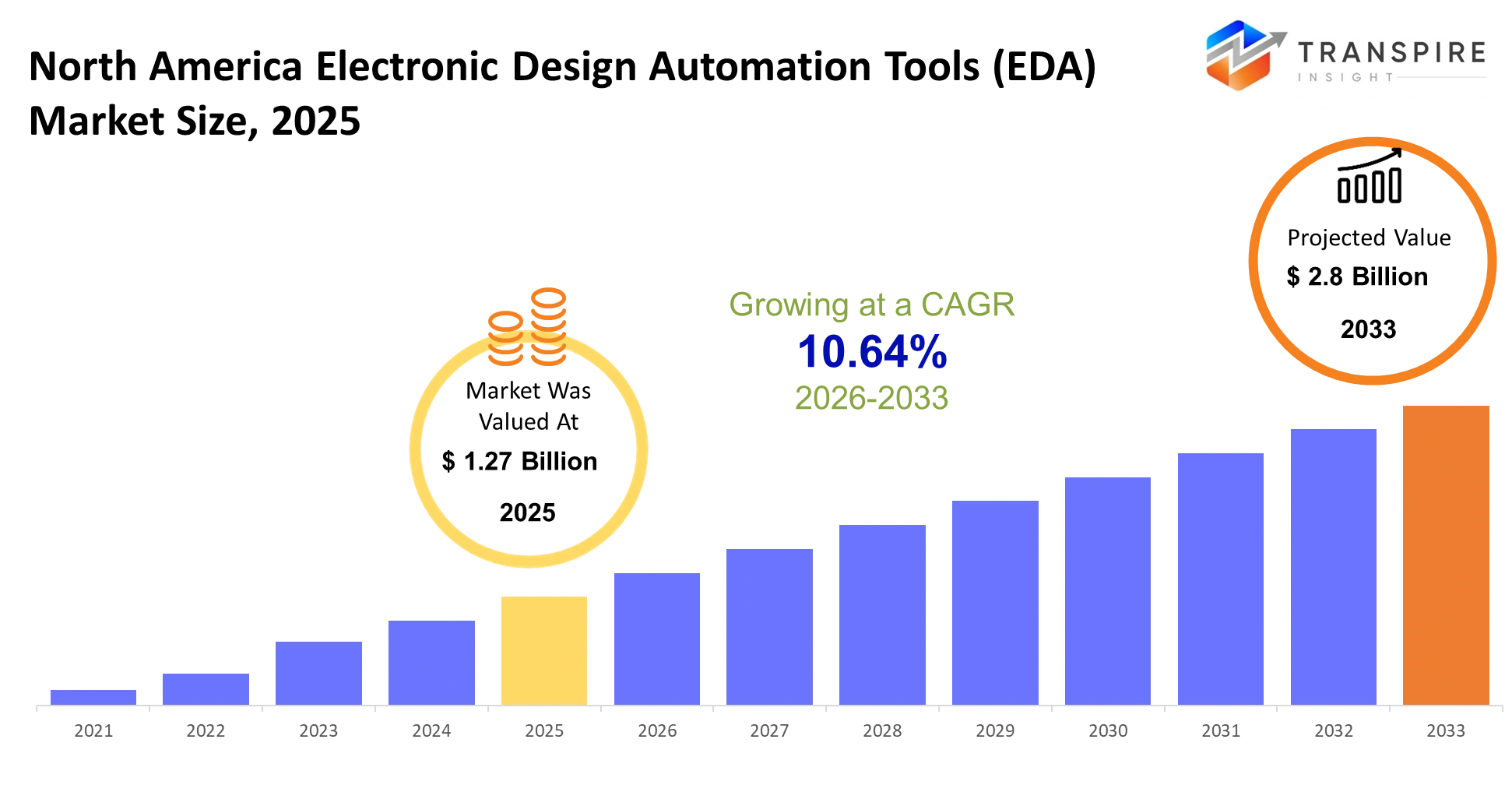
- North America Electronic Design Automation Tools (EDA) Market Size 2025: USD 1.27 Billion
- North America Electronic Design Automation Tools (EDA) Market Size 2033: USD 2.8 Billion
- North America Electronic Design Automation Tools (EDA) Market CAGR: 10.64%
- North America Electronic Design Automation Tools (EDA) Market Segments: By Tool (Simulation, Layout, Verification), By Application (IC, PCB), By End-User (Semiconductor)
To learn more about this report,  Download Free Sample Report
North America Electronic Design Automation Tools (EDA) Market Summary:
The North America Electronic Design Automation Tools (EDA) Market size is estimated at USD 1.27 Billion in 2025 and is anticipated to reach USD 2.8 Billion by 2033, growing at a CAGR of 10.64% from 2026 to 2033. The North American Electronic Design Automation Tools EDA Market which includes Canada and the United States and Mexico functions as the core of semiconductor and electronics design operations which depend on precise software to create and test chip designs. Designers will need to develop products at a faster pace because AI-driven devices and electric vehicles and advanced communication systems will create new market demands. Companies will expect tighter integration between hardware and software while regulatory pressure around data security will influence tool development. The need for engineering teams to develop next-generation electronic systems will drive users to demand automation systems that can scale and support real-time collaboration as design cycles shrink.
Key Market Trends & Insights:
The development of artificial intelligence-based chip designs will transform design tool usage throughout North America. Engineering teams will increasingly depend on machine learning-enabled automation to predict layout issues and optimize performance earlier in the cycle. The new system will use automatic processes to enhance operation while decreasing the need for human workers. Designers will choose tools which provide advanced performance capabilities but require minimal processing time, which shows that they are moving toward designing systems which learn from their experience.
The usage of cloud-based systems will grow as organizations seek to expand their design capabilities without needing to build extensive physical infrastructure. Distributed teams across Canada, the United States, and Mexico will work together through improved collaborative design systems which enable them to access shared platforms at the same time. Security concerns will push vendors to enhance encryption and compliance features. Companies will select flexible licensing options which allow them to control expenses while accessing their required high-performance computing capabilities as remote work becomes standard practice.
The increasing need for specialized computer chips in automotive electronics and Internet of Things devices will result in design software requirements that need customized solutions. The tools will provide increasing support for requirements which are specific to particular fields, including low-power operation and real-time processing capabilities. The capabilities of tools will depend on automotive safety standards and regional compliance requirements which impact autonomous and electric vehicle operations. Designers will search for solutions that provide complete verification and validation integration because these systems help them achieve regulatory compliance while working in various operational environments.
The design platforms will focus on achieving better interoperability as their primary development goal. Companies will require their systems to provide better integration between simulation, verification, and manufacturing processes because this will help them cut down on production delays. The importance of open ecosystems together with standardized data formats will increase because they enable different tools to share information with one another. Vendors will enhance their products by increasing system compatibility while decreasing the number of separate processes that customers must complete to work with their products. Organizations will achieve better process management and operational performance together with faster product development in order to compete successfully in the market.
North America Electronic Design Automation Tools (EDA) Market Segmentation
By Tool
Simulation- The process of design validation will depend on simulation tools which enable engineers to assess circuit performance before they start actual production work. The tools will develop new capabilities which enable them to handle more complicated chip designs that artificial intelligence and high-speed computing requirements bring. Designers will depend on advanced models which provide faster and better accuracy in their predictions to decrease their expensive mistakes. The increasing need for rapid product development will lead to more automated simulation processes which help teams find performance problems at an early stage while they work on developing their products.
Layout- The process of circuit design conversion into patterns that manufacturers can produce will depend on layout tools which serve this critical function. The industry requires complete accuracy because the smaller node sizes and greater transistor counts in modern technology designs. Engineers will take advantage of advanced placement automation in order to find solutions for routing challenges and optimize their space usage. Further advancements will be made in reducing power loss and increasing signal integrity, thus making it possible for the designs to fulfill all their intended purposes.
Verification- Verification tools will be essential for testing chip designs since they verify whether the designs operate correctly in all possible situations. The increasing design complexity will require verification systems to implement automated methods along with formal testing techniques which help identify minor design faults. Engineers need design solutions that can work with multiple design phases because this approach will decrease both project delays and the need for rework. The new verification standards will require testing tools to incorporate sophisticated testing features which verify that designs comply with industry standards and safety regulations.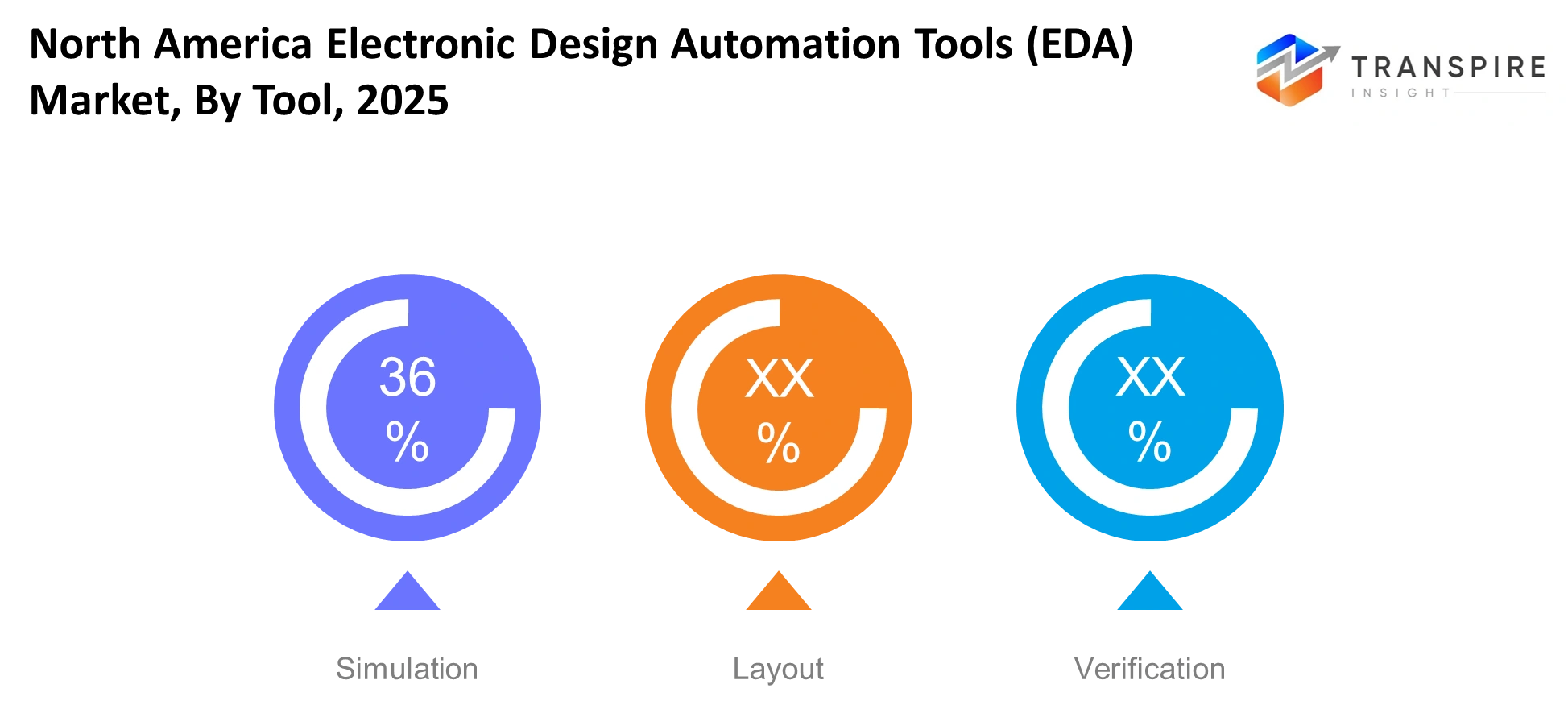
To learn more about this report, Download Free Sample Report
By Application
IC- The demand for more advanced and powerful tools for design purposes specific to integrated circuits design will increase due to continuous advancements made in the field of computing, telecommunication, and automotive electronics. Designers will be required to have very advanced software and tools to handle billions of transistors on one chip. These new design tools will come up with ways of making sure that power, speed, and size are optimized whenever the performance demands are high. There is a need for the industry to have good design methods and software to cater for the demand of efficient small-size chips.
PCB- The design of printed circuit boards creates the basics of connection that will be used by electronic parts in various industries. The evolution of the tools used in designing these boards will ensure the creation of more densely packed boards and improved heat dissipation capacity since the components are now smaller but performing more functions. There is a demand for tools to allow faster prototype designs and easy integration with the production process.
By End-User
Semiconductor- Semiconductor companies will be the primary users of advanced design tools, which they will use to design next-generation chips that serve multiple purposes. These organizations will require specialized solutions which can process their complex operational needs and handle their extensive design projects. The companies will focus on using tools which help them work faster while decreasing their time needed for product development as competition becomes more fierce. The ongoing progress of chip technology will create a demand for design software which needs to become more powerful and flexible to meet changing requirements in the industry.
Regional Insights
The United States will continue to lead design innovation because it has strong semiconductor companies which work with research institutions and venture-backed startups. The tool selection process will be determined by the market need for advanced chips which power artificial intelligence and defense systems and cloud infrastructure. The companies will spend money on advanced design environments which they need to achieve their performance goals. The design workflow system development will be impacted by regulatory requirements which focus on domestic manufacturing and data protection.
Canada will maintain a steady presence through its focus on research-driven development and niche expertise in electronics design. Universities and technology clusters will collaborate closely with industry to create new ideas which will improve specialized fields such as telecommunications and embedded systems. Designers will increasingly adopt flexible and cloud-enabled tools to solve their infrastructure challenges. The government will support digital innovation programs which will enhance the regional ecosystem that develops advanced design technologies.
The period of your training extends until the month of October in the year 2023. The electronics manufacturing sector of Mexico will drive its emergence as an expanding participant because of its location close to main supply chains. Companies will begin to use new production tools when their design abilities reach sufficient development to meet local manufacturing needs. The United States will serve as a cross-border partner for Mexico to facilitate the exchange of essential knowledge. Mexico will develop technical skills and enhance access to advanced design capabilities in response to the rising industrial demand.
North American countries will develop more interconnected systems that combine design, manufacturing, and supply chain operations. Companies will establish international partnerships to achieve better operational performance and quicker product development processes. The region will see increased adoption of cloud solutions and automated systems because organizations begin their digital transformation initiatives. Organizations will base their design methods on technology security regulations and intellectual property protection standards while they maintain a balance between innovative work and regulatory compliance.
Recent Development News
United States: AI-Driven Design Platforms and Industry Consolidation
Recent developments in the United States highlight a strong push toward AI-integrated design environments. Companies like Synopsys have introduced advanced tools that combine chip design with mechanical and thermal analysis, reflecting the increasing complexity of modern processors. This shift will reshape workflows by merging previously separate engineering domains into unified platforms. Additionally, large-scale acquisitions are strengthening end-to-end capabilities, enabling more efficient and integrated semiconductor design processes.
Canada: Research-Led Innovation and Market Expansion Signals
In Canada, recent updates point toward expanding influence through research and market participation. Industry data indicates that North America continues to hold a dominant share in design software adoption, supported by strong institutional research and collaboration networks. Canadian firms and academic partnerships are focusing on advanced chip design techniques, especially for AI and communication systems. This approach will reinforce the country’s position as a hub for specialized innovation within the regional ecosystem.
Mexico: Supply Chain Integration and Cross-Border Technology Flow
Mexico’s latest developments are closely tied to North American supply chain integration. As semiconductor and electronics manufacturing expand, the country is gradually aligning with advanced design practices used in the United States. Cross-border collaboration is enabling access to modern tools and expertise, strengthening local capabilities. At the same time, broader geopolitical shifts and export regulations are influencing how design technologies move across borders, indirectly shaping Mexico’s role in the regional design landscape.
|
Report Metrics |
Details |
|
Market size value in 2025 |
USD 1.27 Billion |
|
Market size value in 2026 |
USD 1.38 Billion |
|
Revenue forecast in 2033 |
USD 2.8 Billion |
|
Growth rate |
CAGR of 10.64% from 2026 to 2033 |
|
Base year |
2025 |
|
Historical data |
2021 – 2024 |
|
Forecast period |
2026 – 2033 |
|
Report coverage |
Revenue forecast, competitive landscape, growth factors, and trends |
|
Regional scope |
North America (Canada, The United States, and Mexico) |
|
Key company profiled |
Synopsys, Cadence, Siemens EDA, Ansys, Keysight, Altium, Zuken, Dassault, Autodesk, Silvaco, Altair, Empyrean, Intel, Arm, Xilinx |
|
Customization scope |
Free report customization (country, regional & segment scope). Avail customized purchase options to meet your exact research needs. |
|
Report Segmentation |
By Tool (Simulation, Layout, Verification), By Application (IC, PCB), By End-User (Semiconductor) |
Key North America Electronic Design Automation Tools (EDA) Market Company Insights
The Electronic Design Automation Tools EDA Market in North America which includes Canada the United States and Mexico will experience competitive changes because its main companies will keep developing new technologies and expanding their business operations. The companies Cadence Design Systems Synopsys and Siemens EDA will develop artificial intelligence systems to enhance design workflow accuracy and operational efficiency. The company will establish semiconductor manufacturing partnerships to create better ecosystem connections while its cloud-based solutions will enable wider user access. The company will dedicate resources to develop interoperability features and advanced verification technologies which will allow its products to handle upcoming design challenges. Companies will need to differentiate themselves from their competitors by demonstrating their products ability to deliver high performance and handle extensive workloads while supporting future chip design technologies.
Company List
- Synopsys
- Cadence
- Siemens EDA
- Ansys
- Keysight
- Altium
- Zuken
- Dassault
- Autodesk
- Silvaco
- Altair
- Empyrean
- Intel
- Arm
- Xilinx
North America Electronic Design Automation Tools (EDA) Market Report Segmentation
By Tool
- Simulation
- Layout
- Verification
By Application
- IC
- PCB
By End-User
- Semiconductor
Frequently Asked Questions
Find quick answers to common questions.
The Approximate North America Electronic Design Automation Tools (EDA) Market size for the Market will be USD 2.8 Billion in 2033.
Key Segments for the North America Electronic Design Automation Tools (EDA) Market By Tool (Simulation, Layout, Verification), By Application (IC, PCB), By End-User (Semiconductor).
Major Players in the North America Electronic Design Automation Tools (EDA) Market are Synopsys, Cadence, Siemens EDA, Ansys, Keysight, Altium, Zuken, Dassault, Autodesk, Silvaco, Altair, Empyrean, Intel, Arm, Xilinx.
The Current North America Electronic Design Automation Tools (EDA) Market size is USD 1.27 Billion in 2025.
The North America Electronic Design Automation Tools (EDA) Market CAGR is 10.64%.
- Synopsys
- Cadence
- Siemens EDA
- Ansys
- Keysight
- Altium
- Zuken
- Dassault
- Autodesk
- Silvaco
- Altair
- Empyrean
- Intel
- Arm
- Xilinx
Recently Published Reports
-
Apr 2026
Fiber Optic Faceplates Market
Fiber Optic Faceplates Market Size, Share & Analysis Report By Type (< 300 mm2, 300-350 mm2, and > 350 mm2, By Application (Night Vision, Holographic Imaging, Medical, and Others), and Geography (North America, Europe, Asia-Pacific, Middle East and Africa, South and Central America), 2021 - 2031
-
Apr 2026
High Temperature Superconductors Market
High Temperature Superconductors Market Size, Share & Analysis Report By Type (1G HTS, and 2G HTS), By Application (Power Cable, Fault Current Limiter, and Transformer), and Geography (North America, Europe, Asia-Pacific, Middle East and Africa, South and Central America), 2021 - 2031
-
Apr 2026
Industrial Plugs and Socket Market
Industrial Plugs and Socket Market Size, Share & Analysis Report By Type (Industrial Plugs, Industrial Sockets), By Current (Up to 32 A, 32 to 125 A, Above 125 A), By Protection (Dustproof and Splash Proof, Waterproof, Explosion Proof), By End User (Heavy Industries, Oil and Gas, Chemicals and Pharmaceuticals, Power Generation, Others), and Geography (North America, Europe, Asia-Pacific, Middle East and Africa, South and Central America), 2021 - 2031
-
Apr 2026
InGaAs Avalanche Photodiodes Market
InGaAs Avalanche Photodiodes Market Size, Share & Analysis Report By Type (1100 - 1700 nm, and 1000 - 1600 nm), By Application (Missile Warning System, Muzzle Flash Detection, Wafer Defect Inspection, Laser Rangefinders, and Others), and Geography (North America, Europe, Asia-Pacific, Middle East and Africa, South and Central America), 2021 - 2031