
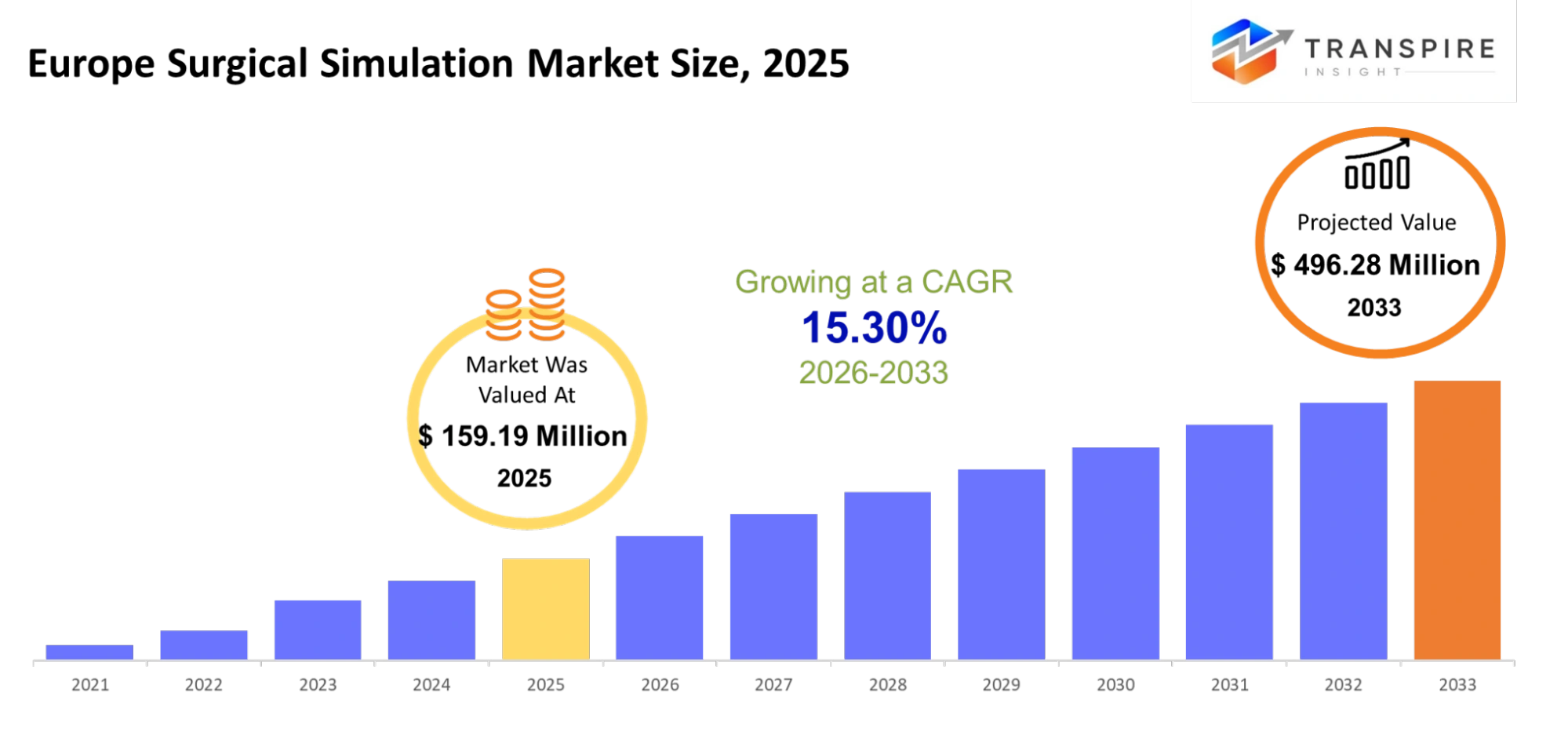
Europe Surgical Simulation Market Size & Forecast:
- Europe Surgical Simulation Market Size 2025: USD 159.19 Million
- Europe Surgical Simulation Market Size 2033: USD 496.28 Million
- Europe Surgical Simulation Market CAGR: 15.30%
- Europe Surgical Simulation Market Segments: By Product (Surgical Simulators, Software), By Application (Training & Education, Preoperative Planning), By End-User (Hospitals, Medical Schools)
To learn more about this report,  Download Free Sample Report
Europe Surgical Simulation Market Summary:
Europe Surgical Simulation Market size was estimated at USD 159.19 Millionin 2025 and is anticipated to reach USD 496.28 Million by 2033, growing at a CAGR of 15.30% from 2026 to 2033.
The European surgical simulation market operates within the larger healthcare education and medical technology sector which currently shifts training methods from traditional observation to risk-free hands-on practice. European hospitals and teaching institutions will continue to purchase simulation platforms that create surgical environments with high levels of authentic detail. Patients today expect medical procedures to become safer which requires hospitals to provide better training for their surgeons. Medical students will search for training methods that offer them real-world experience which will require educational institutions to update their current teaching methods.
This space will become established through the crucial impact of technology. Virtual reality and augmented reality and haptic feedback system development will enable users to experience realistic resistance and motion which will help create a more accurate surgical simulation experience. The European training standards will become more rigorous through new regulations which will require hospitals to implement structured simulation assessment processes before their staff works with real patients. Shared simulation platforms and standardized curricula will become common due to increased international cooperation between universities and healthcare providers which will create a uniform training system across the area that uses advanced technology.
Key Market Trends & Insights:
- The Europe Surgical Simulation Market will develop digital training environments through simulation-based learning as hospitals and academic centers use these systems to enhance surgical precision. The medical field will experience increased demand for practice tools that offer realistic yet safe training experiences throughout medical education because of enhanced patient safety measures.
- The Europe Surgical Simulation Market demonstrates strong demand for advanced technologies which include augmented visualization with haptic feedback and data-driven performance tracking systems. Medical institutions will prefer systems that provide measurable outcomes, enabling structured skill assessment and continuous improvement across different levels of surgical expertise.
- The Europe Surgical Simulation Market expands through the growth of medical education infrastructure which develops across European countries. Universities and training centers will invest in simulation labs to enhance curriculum quality. Simulation tools combined with standardized training methods will create uniform surgical education standards which multiple institutions can follow.
- The Europe Surgical Simulation Market supports the rise of minimally invasive surgeries, which require exact surgical methods. Simulation platforms will enable surgeons to learn complicated processes before they perform actual operations. Healthcare providers will choose to implement this trend because they want to decrease recovery times while achieving better surgical results.
- The Europe Surgical Simulation Market expands through supportive government regulations and funding programs which drive healthcare innovation development. Government and private organizations will invest in research and development projects which focus on simulation technology advancement. Funding programs will assist manufacturers and institutions in acquiring advanced systems and developing their training capabilities.
Europe Surgical Simulation Market Segmentation
By Product :
- Surgical Simulators: The European Surgical Simulation Market depends on surgical simulators because hospitals need safe learning methods which let students practice their skills through multiple training sessions. Physical and virtual models support skill-building across procedures, which helps people develop their skills to achieve better security results and their capacity to meet essential safety requirements while protecting their patients.
- Software: The Europe Surgical Simulation Market shows increasing interest in software solutions which digital platforms use to provide realistic visualization and scenario creation and performance tracking capabilities. The advanced programs use data analytics together with feedback systems to create personalized learning experiences for users. Hospitals and institutions prefer software for flexibility, remote access, and cost-effective training without heavy infrastructure requirements.

To learn more about this report, Download Free Sample Report
By Application :
- Training & Education: The Europe Surgical Simulation Market uses training and education as its main application because it needs secure organized educational settings. The educational system makes use of simulation by enabling students to practice their skills multiple times while their progress gets evaluated and their abilities improve without facing any risks to patients. Medical institutions depend on these systems to create uniform training standards which enable their personnel to acquire skills needed for advanced surgical operations.
- Preoperative Planning: Preoperative planning has gained significance in the Europe Surgical Simulation Market because technological advancements now allow complete surgical visualizations before actual surgery procedures begin. Surgeons can study patient-specific conditions, test approaches, and anticipate challenges. The process enables better decision making which shortens operation durations while achieving better results through reduced unexpected medical complications.
By End-User :
- Hospitals: European hospitals drive the growth of the Surgical Simulation Market because healthcare facilities need to enhance both their surgical accuracy and their patient protection methods. Simulation tools assist in staff training, procedure rehearsal, and skill enhancement.Continuous adoption leads to improved clinical performance and decreased errors while organizations achieve compliance with current healthcare standards which prioritize quality and efficiency.
- Medical Schools: Medical Schools The Europe Surgical Simulation Market receives vital support from medical schools which use simulation technologies in their academic programs. Students gain early exposure to surgical techniques in controlled settings, allowing gradual skill development. Institutions achieve benefits through structured curricula, enhanced learning outcomes, and their capacity to train larger student groups without needing actual clinical experiences.
Country Insights
- The hospitals and academic institutions require surgical simulation tools because their advanced medical training systems and strong healthcare infrastructure capabilities create continuous demand. The digital platforms of the hospital system gain traction because both patient safety requirements and precision-based learning methods need to be fulfilled. Research funding together with university-technology partner research partnerships creates an enduring effect which enhances development across educational space. The medical field has adopted simulation-based learning methods because they help improve clinical results which have become the main focus of medical education programs and hospital training initiatives. National health initiatives promote skill enhancement through controlled practice settings. The growing acceptance of virtual training modules receives institutional backing which leads to stable demand for simulation technologies.
- French government-funded healthcare modernization programs promote simulation use in surgical education and professional training. Medical schools and teaching hospitals show growing interest in improving practical exposure without clinical risk. Training centers experience gradual expansion and sustained adoption of new technology through partnerships that healthcare providers establish with technology developers.
- The increasing desire to achieve better surgical results while decreasing errors has created a need for simulation-based educational programs. Medical institutions invest in structured training environments that allow repeated practice. Educational reforms and practical digital training solutions create awareness about their advantages which help the company grow. The simulation technologies adoption process receives support from two factors which include expanded healthcare training programs and skill development initiatives. Hospitals and universities continue to integrate modern teaching tools for improving surgical performance. Public healthcare programs and training investments support ongoing progress in this field.
Recent Development News
Strategic collaboration to standardize robotic surgery training in Europe
- The European Society for Gynaecological Endoscopy (ESGE) partnered with simulation technology providers to develop standardized robotic surgery training frameworks.
Acquisition activity strengthening Europe’s simulation ecosystem
- Sweden-based Surgical Science acquired Intelligent Ultrasound, expanding capabilities in ultrasound simulation and AI-driven training tools.
|
Report Metrics |
Details |
|
Market size value in 2025 |
USD 159.19 Million |
|
Market size value in 2026 |
USD 183.23 Million |
|
Revenue forecast in 2033 |
USD 496.28 Million |
|
Growth rate |
CAGR of 15.30% from 2026 to 2033 |
|
Base year |
2025 |
|
Historical data |
2021 - 2024 |
|
Forecast period |
2026 - 2033 |
|
Report coverage |
Revenue forecast, competitive landscape, growth factors, and trends |
|
Country scope |
Europe (Germany, United Kingdom, France, Italy, Spain, Rest of Europe) |
|
Key company profiled |
3D Systems Corporation, CAE Inc., Laerdal Medical, Surgical Science Sweden AB, Mentice AB, Simbionix (3D Systems), VirtaMed AG, Gaumard Scientific Company Inc., Kyoto Kagaku Co. Ltd., Intuitive Surgical Inc., Medtronic plc, Johnson & Johnson (Ethicon), Siemens Healthineers AG, GE HealthCare Technologies Inc., OSSimTech Inc. |
|
Customization scope |
Free report customization (country, regional & segment scope). Avail customized purchase options to meet your exact research needs. |
|
Report Segmentation |
By Product (Surgical Simulators, Software), By Application (Training & Education, Preoperative Planning), By End-User (Hospitals, Medical Schools) |
Key Europe Surgical Simulation Company Insights
- The primary European Surgical Simulation Market organizations will develop training systems which provide realistic and easy-to-use medical education tools for healthcare workers. The team will concentrate on developing virtual reality and augmented reality systems which include tactile feedback to create surgical training experiences that imitate actual surgical conditions. The product development process will focus on three main objectives which include enhancing accuracy and developing better user interfaces and establishing system interoperability with hospital training facilities. Academic institutions and teaching hospitals will establish partnerships which drive simulation system adoption because structured learning environments need reliable and repeatable simulation systems.
- The Europe Surgical Simulation Market requires healthcare institutions to adopt solutions which balance their need for training results with their budget restrictions because they want to measure training outcomes without spending excessive money. The companies will develop systems which create standardized platforms to serve multiple surgical specialties thus enabling broader system deployment throughout various settings. The company will enter emerging European healthcare centers which are currently experiencing growing digital training adoption through their expansion plans. The company will build its reputation through customer support and software updates, and long-term service contracts because training systems need continuous improvement. The company will expand its market presence through product performance, regulatory compliance and its capacity to adapt to evolving surgical education requirements and patient safety standards.
Europe Surgical Simulation Market Companies:
- 3D Systems Corporation
- CAE Inc.
- Laerdal Medical
- Surgical Science Sweden AB
- Mentice AB
- Simbionix (3D Systems)
- VirtaMed AG
- Gaumard Scientific Company Inc.
- Kyoto Kagaku Co. Ltd.
- Intuitive Surgical Inc.
- Medtronic plc
- Johnson & Johnson (Ethicon)
- Siemens Healthineers AG
- GE HealthCare Technologies Inc.
- OSSimTech Inc
Europe Surgical Simulation Market Segmentation
By Product
- Surgical Simulators
- Software
By Application
- Training & Education
- Preoperative Planning
By End-User
- Hospitals
- Medical Schools
Frequently Asked Questions
Find quick answers to common questions.
The Approximate Europe Surgical Simulation Market size for the Market will be USD 496.28 Million in 2033.
Key Segments for the Europe Surgical Simulation Market are By Product (Surgical Simulators, Software), By Application (Training & Education, Preoperative Planning), By End-User (Hospitals, Medical Schools).
Major Europe Surgical Simulation Market Players are 3D Systems Corporation, CAE Inc., Laerdal Medical, Surgical Science Sweden AB, Mentice AB, Simbionix (3D Systems), VirtaMed AG, Gaumard Scientific Company Inc., Kyoto Kagaku Co. Ltd., Intuitive Surgical Inc., Medtronic plc, Johnson & Johnson (Ethicon), Siemens Healthineers AG, GE HealthCare Technologies Inc., OSSimTech Inc.
The Current Europe Surgical Simulation Market size is USD 159.19 Million in 2025.
The Europe Surgical Simulation Market CAGR is 15.30%.
- 3D Systems Corporation
- CAE Inc.
- Laerdal Medical
- Surgical Science Sweden AB
- Mentice AB
- Simbionix (3D Systems)
- VirtaMed AG
- Gaumard Scientific Company Inc.
- Kyoto Kagaku Co. Ltd.
- Intuitive Surgical Inc.
- Medtronic plc
- Johnson & Johnson (Ethicon)
- Siemens Healthineers AG
- GE HealthCare Technologies Inc.
- OSSimTech Inc
Recently Published Reports
-
Apr 2026
Biosimilars Market
Biosimilars Market By Product Type (Monoclonal Antibodies, Recombinant Hormones, Erythropoietin, G-CSF, Others), By Indication (Oncology, Autoimmune Diseases, Blood Disorders, Diabetes, Others), By Manufacturing Type (In-House Manufacturing, Contract Manufacturing), By Distribution Channel (Hospital Pharmacies, Retail Pharmacies, Online Pharmacies), By Industry Analysis, Size, Share, Growth, Trends, and Forecasts 2021-2033
-
Apr 2026
Gastrointestinal Endoscopy Market
Gastrointestinal Endoscopy Market By Type (Rigid Gastrointestinal Endoscope, Flexible Gastrointestinal Endoscopes, Disposable Gastrointestinal Endoscope), By Procedure Type (Colonoscopy, Gastroscopy, Duodenoscopy, Enteroscopy, Flexible Sigmoidoscopy, Others), By Application (Diagnosis, Treatment), By End-Users (Hospitals, Ambulatory Surgical Centers, Specialty Clinics, Laboratories, Others), By Industry Analysis, Size, Share, Growth, Trends, and Forecasts 2021-2033
-
Apr 2026
Rare Inherited Metabolic Disorder Drug Market
Rare Inherited Metabolic Disorder Drug Market By Drug Class (Enzyme Replacement Drugs, Gene Therapy Drugs, Substrate Reduction Drugs, Small Module Drugs, Protein Drugs), By Route of Administration(Parenteral, Oral, Intrathecal), By Clinical Development (Marketed Drugs, Late Stage Clinical Phase III, Early Stage Clinical Phase I-II, Preclinical Candidates), By Indication (Lysosomal Storage Disorders, Urea Cycle Disorders, Amino Acid Metabolic Disorders, organic Acidemias, Peroximal Disorders), By Industry Analysis, Size, Share, Growth, Trends, and Forecasts 2021-2033
-
Jan 2026
Pharmaceutical Cleanroom Technology Market
Pharmaceutical Cleanroom Technology Market By Product (Equipment, Consumables, Services); By Cleanroom Type (Standard Cleanrooms, Modular Cleanrooms); By End Use (Pharmaceutical Companies, Biotechnology Companies), By Industry Analysis, Size, Share, Growth, Trends, and Forecasts 2021-2033