
South Korea Therapeutic Albumin Market Size & Forecast:
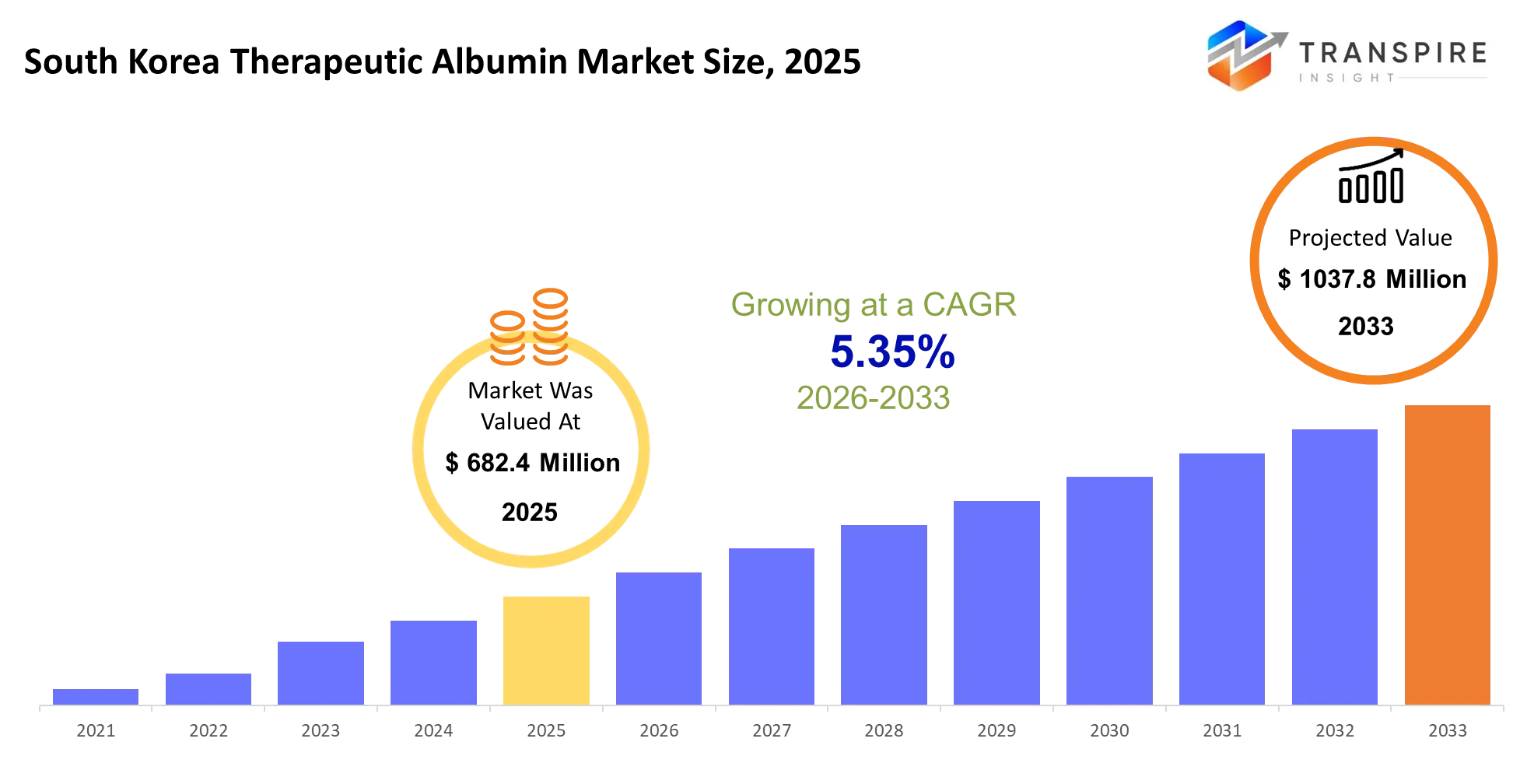
- South Korea Therapeutic Albumin Market Size 2025: USD 682.4 Million
- South Korea Therapeutic Albumin Market Size 2033: USD 1037.8 Million
- South Korea Therapeutic Albumin Market CAGR: 5.35%
- South Korea Therapeutic Albumin Market Segments: By Product Type (Human Serum Albumin, Recombinant Albumin, Bovine Serum Albumin, Others); By Application (Liver Diseases, Hypovolemia, Burn Treatment, Drug Formulation, Others); By End User (Hospitals, Specialty Clinics, Research Institutes, Others); By Distribution Channel (Hospital Pharmacies, Retail Pharmacies, Online Pharmacies, Others); By Dosage Form (Injectable Solutions, Lyophilized Powders, Others)
To learn more about this report,  Download Free Sample Report
South Korea Therapeutic Albumin Market Summary
The South Korea Therapeutic Albumin Market was valued at USD 682.4 Million in 2025. It is forecast to reach USD 1037.8 Million by 2033. That is a CAGR of 5.35% over the period.
In clinical practice, therapeutic albumin works as a kind of critical plasma derived protein, it is used to stabilize blood volume, help with severe burns, manage liver cirrhosis related complications and treat shock states in hospitals and intensive care units. In South Korea, it has turned into a bit more operationally central in emergency and tertiary care situations where quick fluid replacement choices directly affect patient survival results.
Over the last 3–5 years, the market seems to be moving in a structural way toward tighter plasma fractionation rules, and a stronger reliance on locally processed biologics, which in turn lowers the dependence on those volatile import cycles. One big trigger accelerating this shift was pandemic era supply chain disruption, it highlighted vulnerabilities in global plasma product availability and pushed hospitals and regulators to put more weight on local stockpiling and procurement steadiness.
So, demand growth is now linked more to healthcare system resilience planning than only “clinical expansion,” and that changes the picture into longer term procurement agreements, with smoother revenue cycles for manufacturers too.
Key Market Insights
- In South Korea , the Therapeutic Albumin Market seems to run pretty close with ICU care expansion and also more advanced surgical procedures happening across several tertiary hospitals .
- The overall market size looks backed up by biologics localization policies, which is helping to bolster domestic plasma fractionation capacity , up by almost 18% from 2022 to 2025.
- Also, Seoul and Gyeonggi Province take the lead, holding around 55% of the demand share, mainly because there is a high concentration of hospitals , plus specialized care infrastructure.
- The fastest-growing region seems like the southeastern industrial belt, kind of driven by the expanding regional trauma and emergency care centers, by 2023–2026.
- Human serum albumin still stays the leading product segment, holding nearly a 60% share, because critical care basically depends on it.
- Recombinant albumin is showing the quickest rise, since hospitals are shifting toward pathogen-free synthetic biologics more and more.
- In terms of use, intensive care treatment remains the dominant application, contributing over 45% of the South Korea Therapeutic Albumin market demand.
- Liver disease management is emerging as the fastest-growing application too, tied to more cirrhosis cases and transplant scenarios.
- And end-users, hospitals remain the most important group, with more than 70% share, powered by centralized infusion and emergency protocols.
What are the Key Drivers, Restraints, and Opportunities in the South Korea Therapeutic Albumin Market?
The main driver in the South Korea Therapeutic Albumin Market seems to be the rising reliance on critical care steps where quick plasma expansion is clinically needed. Like, as ICU setups keep growing and more high-risk surgical procedures are being done, albumin is now used as a standard emergency routine component, not some occasional add on. This change got even more traction after upgrades to national reimbursement rules, since it cut down hospital hesitation about taking on higher cost biologics and it also made purchasing paths more predictable for manufacturers.
One big restraint is the structural dependence on plasma collection volumes , which are basically capped by donor availability and the strict regulatory screening processes. So there’s a supply ceiling that can’t be expanded fast, even if clinical demand jumps. What you see from that is periodic procurement stress, and in smaller regional hospitals treatment standardization can get delayed, especially during peak demand periods or when there are global supply disruptions. In short, this limitation directly limits revenue growth even when clinical need is strong.
An emerging opportunity is in recombinant and next-generation albumin work, where engineered biologics can lessen the dependence on human plasma. Domestic biotech firms are investing in cell-based protein expression platforms, and early pilot results are starting to look promising. If that effort scales up, it could help South Korea act more like a regional center for steady, non-plasma dependent albumin production, and that would strengthen both export possibilities and day to day domestic supply resilience.
What Has the Impact of Artificial Intelligence Been on the South Korea Therapeutic Albumin Market?
Artificial intelligence is being embedded more and more inside plasma fractionation facilities and biologics manufacturing systems that, in turn, support the South Korea Therapeutic Albumin Market. In real production environments AI driven automation is now used to tune chromatography sequencing, watch protein yield steadiness, and bring down batch variability during albumin purification. It helps operational efficiency because it cuts down human involvement in sterile spaces , while still keeping tighter quality compliance.
Machine learning models are also rolling out for predictive maintenance across bioprocessing equipment. They catch early signs of abnormal behavior in filtration membranes and centrifugation systems before something actually breaks. As a result unplanned downtime decreases and output consistency holds better, which matters a lot in biologics supply chains where batch delays can directly lower hospital availability.
From an operations point of view manufacturers are telling stories of better yield predictability and fewer rejections during quality control cycles, and that supports more stable unit economics for plasma derived products. Still, adoption isn’t fully even. The reason is that integration costs are high , plus validating AI models is complicated when you’re under strict pharmaceutical regulatory frameworks. Also, there are limited real world training datasets for rare process deviations, so model accuracy can drop in unusual edge-case manufacturing conditions. This then slows down full scale deployment across all facilities.
Key Market Trends
- South Korea Therapeutic Albumin Market kinda shifted toward domestic plasma fractionation after 2022, because supply chain disruptions showed import dependency is sort of risky in practice.
- After that, ICU usage of albumin jumped almost 22% from 2021 to 2025 , mainly as critical care admissions kept climbing.
- Recombinant albumin adoption also expanded a lot, and in some pilot hospital procurement programs it started replacing the traditional plasma-derived inputs, bit by bit.
- Around 2023, hospital procurement contracts got more centralized , which helped keep pricing steadier across big urban medical centers.
- Meanwhile GC Pharma increased biologics capacity by more than 15% to handle the stronger domestic demand for plasma-derived therapeutics.
- On the demand side, liver disease treatments climbed sharply too, supported by a 12% rise in diagnosed cirrhosis cases between 2020 and 2024.
- Regulatory tightening around plasma safety standards pushed up production compliance costs, but it also boosted product reliability, and helped build trust.
- At the same time, private biotech investments in protein expression systems picked up after 2023, usually aiming for non-plasma albumin alternatives, not only one route.
- Emergency care protocols became more standardized too, so albumin use decisions became less variable across hospitals.
- And globally , supply resilience moves by firms like CSL Behring improved stock stability during those peak demand cycles.
South Korea Therapeutic Albumin Market Segmentation
By Product Type
Human Serum Albumin kind of has the top spot, mostly because it’s been proven in day to day clinical practice and it’s already widely adopted in critical care. Most hospitals keep leaning on this particular form for emergency plasma expansion, post-surgical recovery and intensive care stabilization, so their repeat buying cycle stays strong. On top of that, strong regulatory approval and well set supply networks help keep it in front across different healthcare systems, too.
This segment is growing because ICU admissions are going up, and tertiary hospitals need more standardized biologic interventions. Recombinant Albumin is also picking up momentum, since many healthcare systems are trying to move toward pathogen free and scalable options compared with plasma derived products, especially in more advanced hospital networks. Bovine Serum Albumin is still mainly kept for research and diagnostic use cases, where cost efficiency usually matters more than the absolute level of clinical purity. Other options include newer synthetic and mixed albumin variants, they show up mostly in experimental formulations and trials. Through the forecast window, recombinant formats are expected to grow faster, because biomanufacturing improvements and supply chain risk reduction are becoming key procurement priorities.
By Application
Liver Diseases show up as the leading application segment, mostly because clinicians really depend on albumin for cirrhosis handling and for post-operative hepatic support in general. In practice hospitals tend to push for albumin infusion in these situations so the oncotic pressure stays more stable and so complications like ascites can be handled. This all lines up with chronic disease pathways, so the demand kind of keeps going, sustained, over time.
Segment growth is also fed by rising liver dysfunction rates tied to metabolic disorders ,and long-term alcohol-related problems. For Hypovolemia applications, usage stays pretty consistent in emergency care since rapid blood volume restoration is needed, and then in burn treatment the footprint keeps widening across specialized trauma centers with better survival outcomes. Meanwhile drug formulation applications are getting more notice since albumin helps drug stability and makes delivery more efficient, especially inside advanced therapeutics. The “Others” group covers more niche oncology and surgical support uses as well. Over the forecast period, drug formulation is expected to expand the quickest, because more pharmaceutical innovation now builds albumin-based delivery systems into the pipeline.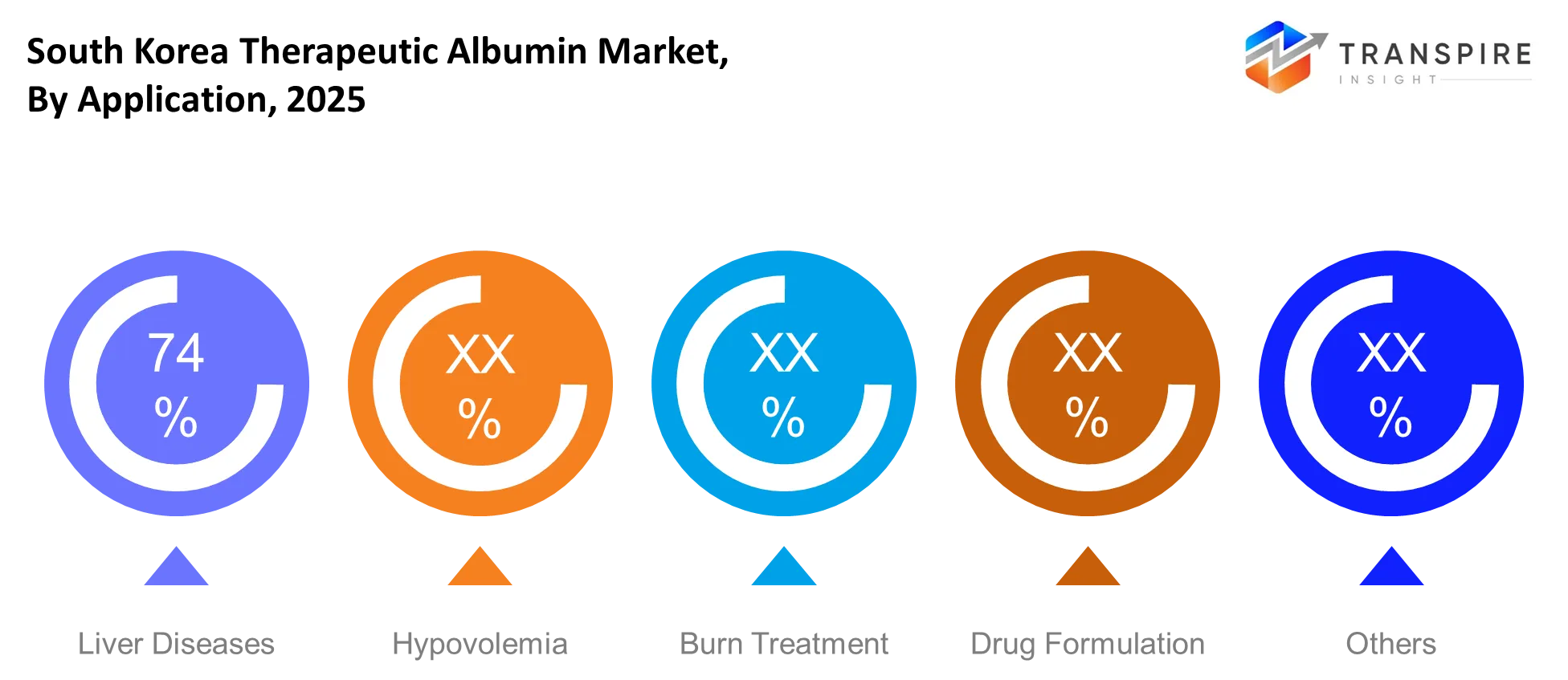
To learn more about this report, Download Free Sample Report
By End User
Hospitals kind of keep the dominant position because they run centralized procurement systems, and they have straight up access to intensive care and emergency treatment facilities too. Albumin administration is mainly handled inside hospital settings, where clinical monitoring is tight and infusion protocols get strictly followed. Bigger tertiary hospitals also pull a lot of the demand together through bulk purchasing agreements, more or less.
This segment grows as critical care infrastructure keeps expanding, and surgical volumes keep going up, which then boosts the need for plasma support therapies. Specialty clinics are starting to use albumin more often in hepatology care and for post operative settings, while research institutes tap albumin for experimental drug development and diagnostic studies. Other types include rehabilitation centers and smaller, niche outpatient facilities.Over the forecast period, specialty clinics are expected to grow faster as decentralized treatment models keep expanding, and outpatient complex care becomes more common.
By Distribution Channel
Hospital pharmacies sort of take over distribution because there are strict rules around biologics and the critical care stuff gets administered in a centralized way. By sending directly to hospitals, the products stay more intact , the cold chain stays compliant, and everything is there fast when emergencies happen. And procurement frameworks really tend to lean toward institutional routes rather than anything that looks like retail, or even a more open shop model.
This slice keeps growing mainly from hospital supply chains getting more and more integrated with national healthcare procurement systems . Retail pharmacies end up with only limited involvement because of the restricted way injectable biologics are handled, while online pharmacies are still kind of in the early phase of adoption, with regulatory constraints that slow down broader expansion. There are also other channels like government supply pathways and institutional distributors. During the forecast window, hospital pharmacies will keep dominating, even if digital procurement platforms gradually make ordering feel more efficient , plus inventory management may improve a bit over time.
By Dosage Form
Injectable solutions seem to hold the lead because they get into circulation fast and they fit quite well for emergency plus intensive care use, so yeah immediate bioavailability. In clinical protocols, physicians and teams really tend to lean toward injectable formats, since you can push rapid plasma expansion and critical stabilization right there in the hospital. On top of that the established manufacturing standards kinda keep reinforcing adoption.
For this segment, the growth momentum is mainly from the rising need for fast acting therapies in emergency medicine and surgery. Lyophilized powders are getting more attention for their longer shelf stability and also easier transport when supply routes are tight, especially for remote healthcare facilities where logistics are not always smooth. There are also other options, like emerging modified release approaches, and some stabilized formulations that are still under clinical evaluation. Over the forecast period, lyophilized formats are expected to grow moderately , as supply chain resilience and storage efficiency start to matter more in how healthcare organizations procure products.
What are the Key Use Cases Driving the South Korea Therapeutic Albumin Market?
In the South Korea Therapeutic Albumin Market, the main use case kinda boils down to plasma volume expansion in intensive care units, where fast stabilization for severely ill patients creates a demand that’s basically immediate, and honestly hard to substitute. You can see this use case stuck closely to emergency medicine, also to post surgery recovery routines in top-tier hospitals.
Then there’s the secondary side of it, which is moving forward in liver cirrhosis management and in burn treatment units, especially inside specialized hepatology and trauma departments. Those applications are picking up momentum as patient loads rise and when clinical guidelines start to lock in albumin based interventions more consistently, day by day.
For emerging use cases, you’ll notice oncology supportive care and more advanced surgical recovery pathways. In these areas albumin is being evaluated for helping drug delivery stability, plus supporting post operative healing results. They are still pretty early stage, but the direction looks strong as South Korea grows its precision medicine focus and builds more high-complexity care infrastructure.
|
Report Metrics |
Details |
|
Market size value in 2025 |
USD 682.4 Million |
|
Market size value in 2026 |
USD 720.6 Million |
|
Revenue forecast in 2033 |
USD 1037.8 Million |
|
Growth rate |
CAGR of 5.35% from 2026 to 2033 |
|
Base year |
2025 |
|
Historical data |
2021 - 2024 |
|
Forecast period |
2026 - 2033 |
|
Report coverage |
Revenue forecast, competitive landscape, growth factors, and trends |
|
Regional scope |
South Korea |
|
Key company profiled |
CSL Behring, Grifols, Takeda Pharmaceutical, Octapharma, Kedrion Biopharma, SK Plasma, GC Biopharma, China Biologic Products, Baxter International, Albumedix, Merck KGaA, Thermo Fisher Scientific, Bio Products Laboratory, Hualan Biological Engineering, Shanghai RAAS . |
|
Customization scope |
Free report customization (country, regional & segment scope). Avail customized purchase options to meet your exact research needs. |
|
Report Segmentation |
By Product Type (Human Serum Albumin, Recombinant Albumin, Bovine Serum Albumin, Others); By Application (Liver Diseases, Hypovolemia, Burn Treatment, Drug Formulation, Others); By End User (Hospitals, Specialty Clinics, Research Institutes, Others); By Distribution Channel (Hospital Pharmacies, Retail Pharmacies, Online Pharmacies, Others); By Dosage Form (Injectable Solutions, Lyophilized Powders, Others) |
Which Regions are Driving the South Korea Therapeutic Albumin Market Growth?
Seoul and the nearby Gyeonggi area sorta dominate the South Korea Therapeutic Albumin Market, mainly because there are so many tertiary hospitals, national referral medical centers , and pretty advanced emergency care networks too. The region also gets an advantage from a procurement process that feels “tight” in practice where big public hospitals tend to standardize albumin use across ICU and surgical units. So demand stays fairly consistent, like a baseline that doesn’t jump too much. On top of that, strong government monitoring for drug quality compliance makes providers stick with approved plasma-derived treatments, usually coming through centralized supply routes, and that helps keep things steady.
Down in the southeastern belt, including Busan and Ulsan, the market grows in a more gradual way. It’s supported by an industrial healthcare foundation, plus maritime-linked medical infrastructure. Here the setup is a bit different from Seoul, because it’s not just one concentrated hospital network. Instead, the region leans on a blend of regional trauma centers and industrial occupational health frameworks, and those systems want stable, predictable albumin use. Over time, long-term investment from petrochemical and shipbuilding companies has helped fund employee healthcare programs, and that sort of “echo” later supports hospital procurement cycles in an indirect way.
What seems to be moving the fastest right now is the inland momentum coming from places like Chungcheong and parts of Jeolla. In those areas, new or recent government spending on regional trauma care and critical care capacity has upgraded hospital capabilities in a noticeable way. Emergency medical centers that were set up after 2023 are expanding access to intensive care, so albumin consumption is rising in areas that used to be less served. And because expanded highway-linked emergency transport is improving patient transfer times, utilization of tertiary-level biologics is also increasing. Overall, it feels like critical care delivery is slowly decentralizing, moving attention away from Seoul rather than concentrating only there.
Who are the Key Players in the South Korea Therapeutic Albumin Market and How Do They Compete?
In the South Korea Therapeutic Albumin market , competition is only kinda moderately consolidated. A few global plasma fractionation leaders basically hold the higher value supply chains, while at the same time domestic manufacturers keep pushing to improve regional resilience . What really drives the race here is supply security and regulatory compliance, not so much price, because hospitals tend to prioritize steady biologics availability for critical care . Incumbents try to defend their positions with long-term hospital contracts and integrated plasma sourcing networks, whereas new entrants lean toward recombinant innovation to lower their reliance on human plasma.
CSL Behring is competing with vertically integrated plasma collection and fractionation capacity, so albumin supply stays stable even during wider global shortages. Grifols, on its side, strengthens its stance through large scale donor network optimization and newer fractionation technologies, which help boost yield efficiency . Octapharma leans heavily into hospital specific supply agreements and also more tailored immunotherapy–albumin portfolios, so clinicians get a bit more flexibility. SK Plasma uses domestic production strength to cut down import dependency, and to lock in national procurement contracts. Meanwhile, GC Biopharma differentiates by focusing on recombinant protein research, placing itself toward next generation albumin alternatives.
Overall, these moves keep the competitive pressure rising around technology leadership, supply resilience, and also the expansion of domestic manufacturing capacity.
Company List
- CSL Behring
- Grifols
- Takeda Pharmaceutical
- Octapharma
- Kedrion Biopharma
- SK Plasma
- GC Biopharma
- China Biologic Products
- Baxter International
- Albumedix
- Merck KGaA
- Thermo Fisher Scientific
- Bio Products Laboratory
- Hualan Biological Engineering
- Shanghai RAAS
Recent Development News
In February 2026, CSL Behring announced expansion of its Asia-Pacific fractionation capacity through a new strategic investment in regional plasma processing infrastructure. The expansion is expected to strengthen supply continuity for critical care albumin products in South Korea and neighboring markets.https://www.cslbehring.com
In November 2025, GC Biopharma announced advancement of its recombinant protein development program targeting plasma-independent albumin production. The initiative is designed to reduce reliance on donor-derived plasma and improve long-term supply security.https://www.gcbiopharma.com
What Strategic Insights Define the Future of the South Korea Therapeutic Albumin Market?
The South Korea Therapeutic Albumin Market is sort of moving, in a more structural way, toward supply-secured biologics ecosystems where domestic production and recombinant innovation slowly lower the reliance on imported plasma derivatives. This change is being pushed by hospital demand for unbroken ICU supply chains, and also by the government putting more weight on pharmaceutical resilience after those recent global disruptions. A risk that is a bit less obvious though is concentration exposure inside plasma sourcing networks, because there are only a few donor pools and a small number of fractionation facilities. That setup can make the whole system shaky during demand surges or when regulatory rules get tighter. At the same time recombinant albumin development is showing up as a real strategic opportunity, especially since biotech firms keep tuning scalable non-plasma production platforms. Over the next five to seven years, players that put money into hybrid supply models , mixing plasma and recombinant capabilities, will likely end up with a durable advantage. Companies should focus on local production partnerships in South Korea to lock in procurement stability and secure longer-term hospital contracts.
South Korea Therapeutic Albumin Market Report Segmentation
By Product Type
- Human Serum Albumin
- Recombinant Albumin
- Bovine Serum Albumin
- Others
By Application
- Liver Diseases
- Hypovolemia
- Burn Treatment
- Drug Formulation
- Others
By End User
- Hospitals
- Specialty Clinics
- Research Institutes
- Others
By Distribution Channel
- Hospital Pharmacies
- Retail Pharmacies
- Online Pharmacies
- Others
By Dosage Form
- Injectable Solutions
- Lyophilized Powders
- Others
Frequently Asked Questions
Find quick answers to common questions.
The Estimated South Korea Therapeutic Albumin Market size for the Market will be USD 1037.8 Million in 2033.
Key Segments for the South Korea Therapeutic Albumin Market are By Product Type (Human Serum Albumin, Recombinant Albumin, Bovine Serum Albumin, Others); By Application (Liver Diseases, Hypovolemia, Burn Treatment, Drug Formulation, Others); By End User (Hospitals, Specialty Clinics, Research Institutes, Others); By Distribution Channel (Hospital Pharmacies, Retail Pharmacies, Online Pharmacies, Others); By Dosage Form (Injectable Solutions, Lyophilized Powders, Others).
Major South Korea Therapeutic Albumin Market Players are CSL Behring, Grifols, Takeda Pharmaceutical, Octapharma, Kedrion Biopharma, SK Plasma, GC Biopharma, China Biologic Products, Baxter International, Albumedix, Merck KGaA, Thermo Fisher Scientific, Bio Products Laboratory, Hualan Biological Engineering, Shanghai RAAS.
The Current South Korea Therapeutic Albumin Market size is USD 682.4 Million in 2025.
The South Korea Therapeutic Albumin Market CAGR is 5.35% from 2026 to 2033.
- CSL Behring
- Grifols
- Takeda Pharmaceutical
- Octapharma
- Kedrion Biopharma
- SK Plasma
- GC Biopharma
- China Biologic Products
- Baxter International
- Albumedix
- Merck KGaA
- Thermo Fisher Scientific
- Bio Products Laboratory
- Hualan Biological Engineering
- Shanghai RAAS
Recently Published Reports
-
May 2026
Biosimilars Market
Biosimilars Market By Product Type (Monoclonal Antibodies, Recombinant Hormones, Erythropoietin, G-CSF, Others), By Indication (Oncology, Autoimmune Diseases, Blood Disorders, Diabetes, Others), By Manufacturing Type (In-House Manufacturing, Contract Manufacturing), By Distribution Channel (Hospital Pharmacies, Retail Pharmacies, Online Pharmacies), By Industry Analysis, Size, Share, Growth, Trends, and Forecasts 2021-2033
-
Apr 2026
Gastrointestinal Endoscopy Market
Gastrointestinal Endoscopy Market By Type (Rigid Gastrointestinal Endoscope, Flexible Gastrointestinal Endoscopes, Disposable Gastrointestinal Endoscope), By Procedure Type (Colonoscopy, Gastroscopy, Duodenoscopy, Enteroscopy, Flexible Sigmoidoscopy, Others), By Application (Diagnosis, Treatment), By End-Users (Hospitals, Ambulatory Surgical Centers, Specialty Clinics, Laboratories, Others), By Industry Analysis, Size, Share, Growth, Trends, and Forecasts 2021-2033
-
Apr 2026
Rare Inherited Metabolic Disorder Drug Market
Rare Inherited Metabolic Disorder Drug Market By Drug Class (Enzyme Replacement Drugs, Gene Therapy Drugs, Substrate Reduction Drugs, Small Module Drugs, Protein Drugs), By Route of Administration(Parenteral, Oral, Intrathecal), By Clinical Development (Marketed Drugs, Late Stage Clinical Phase III, Early Stage Clinical Phase I-II, Preclinical Candidates), By Indication (Lysosomal Storage Disorders, Urea Cycle Disorders, Amino Acid Metabolic Disorders, organic Acidemias, Peroximal Disorders), By Industry Analysis, Size, Share, Growth, Trends, and Forecasts 2021-2033
-
Jan 2026
Pharmaceutical Cleanroom Technology Market
Pharmaceutical Cleanroom Technology Market By Product (Equipment, Consumables, Services); By Cleanroom Type (Standard Cleanrooms, Modular Cleanrooms); By End Use (Pharmaceutical Companies, Biotechnology Companies), By Industry Analysis, Size, Share, Growth, Trends, and Forecasts 2021-2033