United States Sexually Transmitted Diseases (STD) Testing Market Size & Forecast:
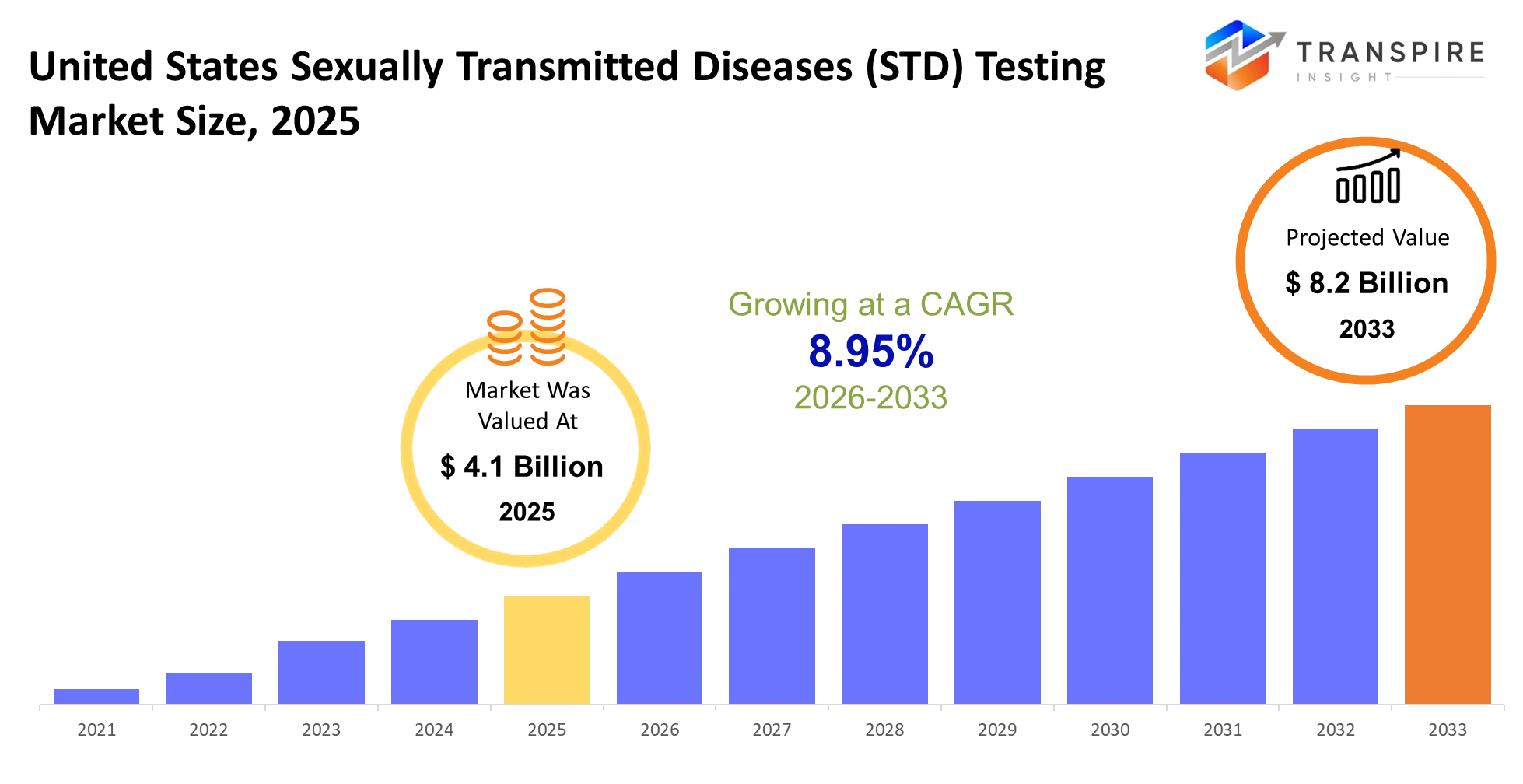
- United States Sexually Transmitted Diseases (STD) Testing Market Size 2025: USD 4.1 Billion
- United States Sexually Transmitted Diseases (STD) Testing Market Size 2033: USD 8.2 Billion
- United States Sexually Transmitted Diseases (STD) Testing Market CAGR: 8.95%
- United States Sexually Transmitted Diseases (STD) Testing Market Segments: By Test Type (Blood Tests, Urine Tests, Swab Tests, Rapid Diagnostic Tests, Molecular Diagnostic Tests, Others), By Disease Type (HIV, Chlamydia, Gonorrhea, Syphilis, HPV, Herpes Simplex Virus, Others), By End User (Hospitals, Diagnostic Laboratories, Clinics, Home Care Settings, Research Institutes, Others), By Technology (PCR Testing, Immunoassays, ELISA, Nucleic Acid Amplification Tests, Point-of-Care Testing, Others).
To learn more about this report,  Download Free Sample Report
United States Sexually Transmitted Diseases (STD) Testing Market Summary:
The United States Sexually Transmitted Diseases (STD) Testing Market size is estimated at USD 4.1 Billion in 2025 and is anticipated to reach USD 8.2 Billion by 2033, growing at a CAGR of 8.95% from 2026 to 2033.The United States Sexually Transmitted Diseases (STD) Testing Market plays this kind of frontline role in public health, helping hospitals , diagnostic laboratories , retail clinics , and digital health platforms notice infections early enough to avoid long term complications and also stop wider community spread. More or less, this market makes routine screening work, supports prenatal care, backs emergency diagnostics, and even helps with partner tracing initiatives, which in turn can reduce later healthcare spending and generally improve treatment outcomes.
Over the last five years, the whole landscape has been drifting away from only centralized laboratory work toward more decentralized, kind of semi-consumer guided testing models. Rapid molecular assays , at home collection kits, plus telehealth connected testing setups have altered how people access services, particularly for younger groups and underserved communities.The COVID 19 pandemic was also a big behavioral nudge, in a way it made self testing and digital healthcare routines feel like a normal thing, and then remote STD screening pathways got pulled along faster. Additionally, once reimbursement coverage expanded, and public health agencies got more serious about surveillance efforts, providers began rolling out more standardized screening protocols, kinda like a steadier cadence. This usually drives repeat testing volumes and more consistent revenue streams for diagnostic companies and laboratory networks , which kind of locks things in a bit longer.
Key Market Insights
- In 2025, the Southern United States pretty much dominated the United States Sexually Transmitted Diseases (STD) Testing Market, holding almost 38% market share, mostly because STI incidence rates were higher down there and the whole picture leaned that way.
- Meanwhile, Western states are showing up as the fastest growing regional market all the way through 2030, and that’s backed by digital healthcare infrastructure, plus more aggressive public health screening programs, kind of at the same time.
- For major growth, urban healthcare networks across California, Texas,and Florida keep pushing the STD testing industry size upward, largely via retail clinic penetration which is honestly easier for many patients.
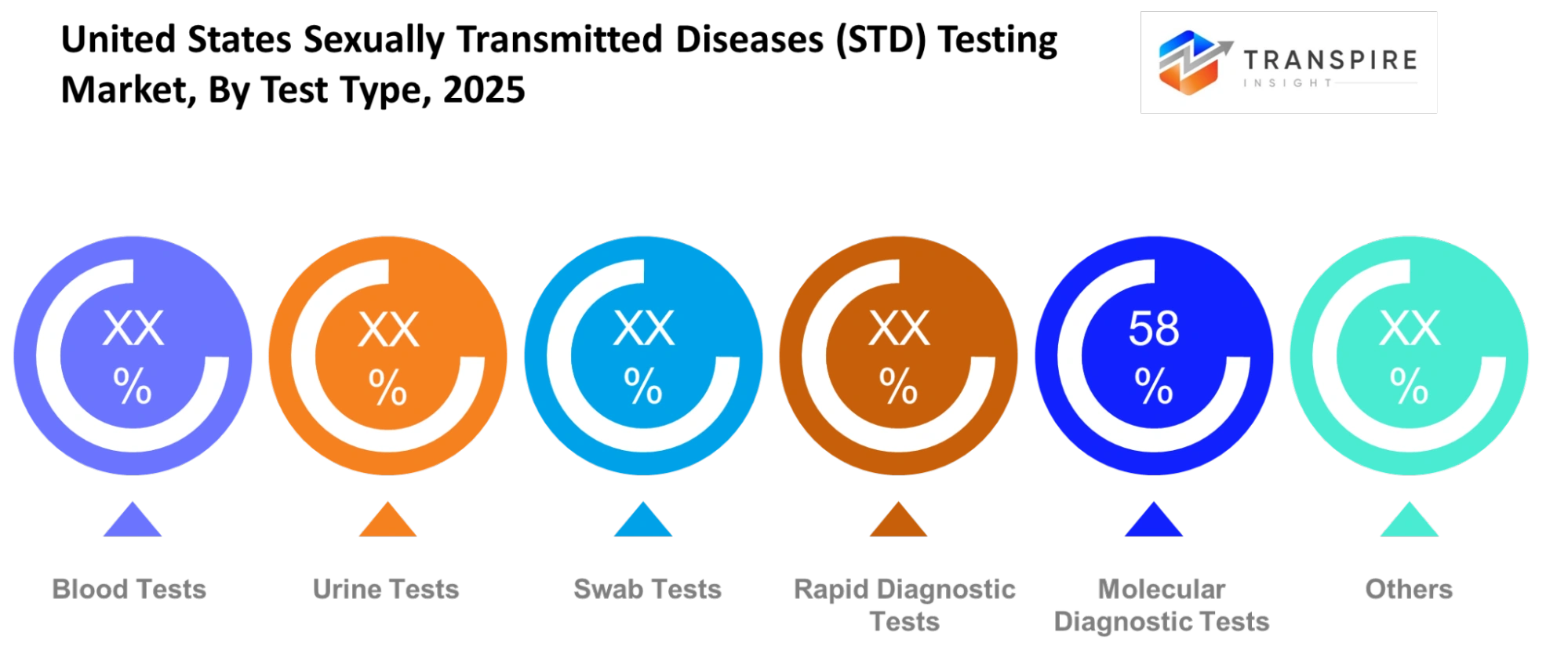
- In 2025, laboratory based molecular diagnostics still led the market, taking in over 46% of revenue share, mostly due to enhanced sensitivity and rapid, high throughput testing.
- Immunoassay together with rapid antigen testing stayed in the spot, because they’re more affordable and people keep adopting them in community health centers, where budget and speed matter.
- At-home STD testing kits are projected to be the fastest-growing segment between 2025 and 2030, driven by privacy focused consumer habits,and also through telemedicine integration that makes ordering and follow-ups feel simpler.
- Multiplex PCR platforms gained momentum too, since providers increasingly like a single panel approach for chlamydia, gonorrhea, syphilis, and HIV screening all in one workflow.
- On the level of specific conditions, chlamydia testing made up nearly 31% of the United States Sexually Transmitted Diseases (STD) Testing Market share in 2025, mostly connected to mandatory routine screening guidelines and other related drivers that kind of stick around.
- HIV diagnostic testing stayed as a dominant application category, because federal prevention programs expanded access to recurring screening services across the country.
- And syphilis testing, sort of surprising, emerged as the fastest-growing application segment after sharp infection increases, which then accelerated prenatal and emergency department screening protocols.
What are the Key Drivers, Restraints, and Opportunities in the United States Sexually Transmitted Diseases (STD) Testing Market?
The strongest force behind the United States Sexually Transmitted Diseases (STD) Testing Market really seems to be this pivot toward routine prevention-style screening that gets tucked into primary care , prenatal care , and public health reimbursement stuff. In other words it’s not just “testing when symptoms show up”, it’s more like ongoing, almost automatic checking. After federal agencies broadened screening guidance for chlamydia , gonorrhea, HIV ,and syphilis in high-risk groups plus people who look asymptomatic the whole thing picked up steam . At the same time molecular diagnostic platforms started moving quicker and becoming more cost-efficient , so labs can run larger testing batches while keeping reliability at a higher level. What you end up with is a kind of repeatable, recurring revenue approach for diagnostic providers, since many patients come back for another round instead of doing a one-time event test.
Still, the market’s biggest structural problem remains how uneven access to sexual healthcare is , especially across rural areas and among uninsured populations. Several states don’t have enough public clinic capacity, enough trained specialists for sexual health, and the reimbursement rules are not consistent for advanced molecular testing. And this isn’t something you fix in a short time because it relies on long-range health budgeting , workforce growth, and policy alignment at the state level. The downstream result is slower diagnosis timelines and a tendency to underuse the higher-value testing options, which then dents revenue expansion for lab operators plus manufacturers.
Looking forward, a major opportunity seems to be integrated at-home molecular STD testing that ties into telehealth treatment pathways. Venture capital money for digital diagnostic platforms has been climbing, which helped self-collection kits get commercialized, and those kits link patients straight to virtual physicians and then to pharmacy fulfillment networks .
What Has the Impact of Artificial Intelligence Been on the United States Sexually Transmitted Diseases (STD) Testing Market?
Artificial intelligence plus newer digital technologies are kind of reshaping the United States Sexually Transmitted Diseases (STD) Testing Market by speeding up laboratory automation, sharpening diagnostic accuracy, and smoothing patient management workflows. In practice, many clinical labs are now relying on AI-enabled imaging systems and automated molecular diagnostic platforms that can handle higher test volume with less manual effort . The same platforms can quietly flag abnormal findings, sort urgent samples first, and shorten reporting turn around times from multiple days down to under 24 hours in the biggest capacity sites. Bigger diagnostic networks also lean on digital workflow platforms, these help them watch testing demand, manage reagent inventory more steadily , and raise overall lab utilization rates.
Meanwhile, machine learning is being used to forecast infection hotspots, spot high-risk demographic pockets, and make screening allocation a bit more precise across public health organizations. Providers are combining electronic health record information with predictive analytics, which supports targeted repeat testing programs that run with more efficiency especially for HIV, syphilis, and chlamydia screening. With this sort of setup, fewer cases get missed, and treatment initiation can start sooner, so reimbursement capture improves along with lab productivity .
That said, AI uptake still hits a major wall because healthcare data infrastructure is fragmented. A lot of hospitals , clinics, and public health agencies are stuck on incompatible record systems, and that reduces both the amount of training data and its consistency, which in turn limits reliable predictive modeling plus automated diagnostic decision support.
Key Market Trends
- Since 2021, at-home STD testing kit adoption really started to speed up, mostly because telehealth platforms got more normal with remote diagnosis , and then the digital prescription part became smoother for younger patient groups.
- Diagnostic laboratories kind of moved away from only single-pathogen assays after syphilis and gonorrhea together started showing up more often across a few urban healthcare systems.
- Between 2020 and 2025, retail clinics expanded their STD screening offers by more than 30% . The goal was to ease the emergency department testing load, and honestly make it easier to access without so much friction.
- Public health agencies then increased prenatal syphilis screening requirements once congenital syphilis cases climbed, sharply across healthcare networks in the Southern United States.
- Hologic, Inc. and Abbott Laboratories also rolled out broader rapid molecular testing portfolios, to cut lab turnaround times , and to push outpatient testing adoption even further.
- Healthcare providers started folding in AI enabled lab workflow systems more often , mainly after staffing shortages raised operational costs and slowed down result reporting during 2021 to 2024.
- Insurance reimbursement rules gradually leaned more toward preventive STD screening coverage, which encouraged people to do recurring annual testing, instead of waiting until symptoms pushed them toward a diagnostic visit.
- Community clinics adopted self collection sampling programs after post pandemic patient behavior seemed to favor privacy focused testing routes , and fewer in person consults overall.
- Since 2022, venture capital investment has grown in digital sexual health startups , especially those offering subscription based testing, partner notification tools , and telemedicine driven treatment coordination.
- Big diagnostic chains like Quest Diagnostics and Labcorp expanded their regional lab automation so they could handle higher screening volumes , without matching workforce growth in the same way.
United States Sexually Transmitted Diseases (STD) Testing Market Segmentation
By Test Type
Molecular diagnostic tests, and the whole PCR based assays type of thing really stay in the front, you know, within the test category where healthcare providers seem to care most about high sensitivity, faster turnaround, and multi pathogen detection ability. Blood tests still keep pretty strong usage for HIV and syphilis screening , mostly because clinical guidelines already exist, plus there is broad reimbursement support. Meanwhile urine and swab tests keep gaining traction in outpatient and retail clinic settings because collecting the sample is relatively easy, and honestly it feels less invasive.
Rapid diagnostic tests expanded steadily after telehealth and community based screening programs started ramping up , so the demand for decentralized testing access went up too. Still, cost pressure and reimbursement limits keep stopping some smaller clinics and rural healthcare networks from adopting premium multiplex systems. For what comes next, growth will likely lean toward integrated self collection plus lab linked testing models that mix convenience with confirmatory diagnostics.
On the industry side, manufacturers increasingly focus on scalable rapid molecular platforms , and investors seem to go after companies building direct to consumer testing ecosystems, along with digital reporting infrastructure across preventive healthcare channels.
To learn more about this report, Download Free Sample Report
By Disease Type
HIV testing still sits as the dominant disease type segment, mainly because federal funding programs, mandatory prenatal screening protocols , and recurring monitoring requirements stay pretty steady across hospitals and laboratories, so the testing volumes are consistent, even when staffing changes. Chlamydia and gonorrhea testing keeps stretching upward too, driven by rising infection rates among younger demographics and more persuasive routine screening suggestions in primary care, not just one-off efforts. Syphilis testing also sped up quickly after congenital syphilis cases increased across several Southern states, which pushed healthcare systems to tighten prenatal screening and emergency catch programs, in a more organized way.
As for HPV and herpes simplex virus testing, demand seems stable overall, but adoption patterns can shift depending on insurance coverage and the way physicians decide when to test. Public health agencies are also leaning more into bundled sexually transmitted infection screening, instead of doing only single-disease diagnostics, this is creating stronger pull for multiplex testing solutions. Looking ahead, market positioning should favor diagnostic developers who can provide affordable, high-throughput panels that enable repeat preventive screening, and broader population-level disease surveillance strategies, all together.
By End-User
Diagnostic laboratories basically win the end user category, mostly because centralized testing sites run huge screening workloads using automated molecular systems and because the reimbursement structures are already in place. Hospitals still hold a meaningful share too, not just from routine care, but from emergency department testing, inpatient infectious disease management, and also prenatal workflows that require ongoing HIV and syphilis monitoring. Clinics and community healthcare centers keep pushing forward with more capacity, since public health programs are emphasizing wider reach for underserved groups.
Home care settings, though, seem to be the fastest-growing slice, mostly because patients like the privacy angle with self-collection kits and they pair those with telemedicine consultation, so the whole process feels more controlled. Research institutes meanwhile help move things along for biomarker discovery, resistance monitoring, and next-generation molecular diagnostics, even if their commercial contribution stays smaller than what we see across clinical environments.
In the long run, growth will hinge on better linkage between decentralized testing providers and the centralized lab backbone. Investors are also leaning toward digital sexual health platforms, while healthcare providers look for operational partnerships that make testing more accessible without forcing major new workforce growth or additional facility expansion costs.
By Technology
PCR testing and nucleic acid amplification technologies kind of lead the technology segment, because healthcare systems are increasingly prioritizing accurate detection of asymptomatic infections and even co-infection patterns. In general these approaches help with higher throughput, quicker processing, and stronger analytical sensitivity than conventional immunoassays, plus ELISA style methods. Still immunoassays keep showing up in cost sensitive environments where rapid screening and large scale population testing are basically a must.
Point of care testing technologies also gained real momentum after pandemic era healthcare disruptions showed how important decentralized diagnostics are, and how immediate results matter. But smaller clinics and rural providers often run into a few hurdles when they try to adopt advanced molecular systems, equipment costs and ongoing maintenance duties, plus laboratory staffing shortages all add up, and the whole thing becomes a practical obstacle.
Looking ahead, technology competition will probably revolve around portable molecular platforms, AI supported diagnostic workflows, and smartphone enabled reporting systems that improve patient engagement and result tracking. Manufacturers that manage to blend automation affordability, and digital connectivity will likely secure stronger market positioning across preventive and outpatient healthcare networks.
What are the Key Use Cases Driving the United States Sexually Transmitted Diseases (STD) Testing Market?
Routine preventive screening across hospitals, diagnostic laboratories, and even primary care clinics is still the biggest use case that really drives testing adoption. Prenatal HIV and syphilis screening, annual chlamydia checks, plus emergency department diagnostics keep creating repeat testing volumes because federal healthcare guidelines keep insisting on early detection, along with follow up monitoring for treatment. That’s kind of the loop that never fully stops, you know.
At the same time , retail clinics and telehealth-linked home testing services are growing quickly among younger consumers who want discreet and easy screening choices. Community health centers have also been moving toward multiplex testing more often, supporting public health surveillance efforts aimed at high risk urban groups, and other underserved areas.
Newer use cases are starting to show up too, like AI enabled population screening analytics, and smartphone connected self collection platforms that smooth out partner notification and digital treatment coordination. Universities, employer wellness efforts, and subscription based digital health providers are beginning to fold in ongoing sexual health monitoring as part of wider preventive healthcare services, sort of as a standard layer, not a special add on.
|
Report Metrics |
Details |
|
Market size value in 2025 |
USD 4.1 Billion |
|
Market size value in 2026 |
USD 4.5 Billion |
|
Revenue forecast in 2033 |
USD 8.2 Billion |
|
Growth rate |
CAGR of 8.95% from 2026 to 2033 |
|
Base year |
2025 |
|
Historical data |
2021 - 2024 |
|
Forecast period |
2026 - 2033 |
|
Report coverage |
Revenue forecast, competitive landscape, growth factors, and trends |
|
Geographic scope |
United States of America |
|
Key company profiled |
Abbott Laboratories, Roche Diagnostics, Hologic, Bio-Rad Laboratories, Siemens Healthineers, Thermo Fisher Scientific, BD, Danaher Corporation, OraSure Technologies, Quest Diagnostics, Labcorp, bioMérieux, Cepheid, Qiagen, Trinity Biotech. |
|
Customization scope |
Free report customization (country, regional & segment scope). Avail customized purchase options to meet your exact research needs. |
|
Report Segmentation |
By Test Type (Blood Tests, Urine Tests, Swab Tests, Rapid Diagnostic Tests, Molecular Diagnostic Tests, Others), By Disease Type (HIV, Chlamydia, Gonorrhea, Syphilis, HPV, Herpes Simplex Virus, Others), By End User (Hospitals, Diagnostic Laboratories, Clinics, Home Care Settings, Research Institutes, Others), By Technology (PCR Testing, Immunoassays, ELISA, Nucleic Acid Amplification Tests, Point-of-Care Testing, Others). |
Which Regions are Driving the United States Sexually Transmitted Diseases (STD) Testing Market Growth?
The Southern United States stays as the leading regional market , mainly because higher sexually transmitted infection rates keep pushing large scale screening volumes through hospitals, public clinics and diagnostic laboratories. States like Texas, Florida and Georgia keep wide public health testing networks, supported by federal prevention money and Medicaid backed screening initiatives. Good retail clinic presence plus wider community health center coverage also helps people get tested more easily in crowded urban zones. Big laboratory operators and telehealth providers are still rolling out regional alliances across the South , so the whole area feels like a mature ecosystem for repeat preventive testing and high throughput molecular diagnostics.
The Northeastern United States adds steady market revenue thanks to strong insurance coverage, more structured healthcare delivery systems, and the continued take up of advanced molecular diagnostics. Compared with the South , regional growth depends less on infection spikes and more on preventive healthcare getting built into primary care routines and academic hospital networks. States such as New York and Massachusetts keep investing in digital health infrastructure, which lets providers connect telemedicine, laboratory automation, and electronic reporting systems in a smooth way. Research centers and university hospitals also help with early adoption of multiplex testing technologies, giving the region a dependable market position that is also innovation oriented.
The Western United States is kinda emerging as the fastest-growing regional market because home-based testing is expanding quickly and sexual health services are becoming more digitally connected. In California, Washington, and Colorado, telehealth policy reforms and digital reimbursement frameworks sped up after the pandemic, so that remote diagnostic adoption had a really favorable runway. Venture capital money for direct to consumer health platforms, and smartphone-enabled self collection testing kits, went up pretty sharply after 2022 too. With that kind of momentum, there are strong chances for diagnostic manufacturers, AI-enabled laboratory providers, and digital health startups aiming for scalable expansion from 2026 into 2033.
Who are the Key Players in the United States Sexually Transmitted Diseases (STD) Testing Market and How Do They Compete?
The United States Sexually Transmitted Diseases (STD) Testing market shows moderate consolidation, kinda, where big diagnostic manufacturers and national laboratory networks hold a noticeable chunk of the testing volume. At the same time competition is drifting more toward molecular testing speed, digital integration and decentralized delivery, not just price… and honestly that shift feels pretty clear now. Big, established companies keep defending their market share using automation investments, plus payer relationships that are already baked in. Meanwhile digital health startups are nudging or disrupting the usual testing pathway by pushing direct-to-consumer platforms and telehealth-enabled care models. Also, geographic reach and laboratory turnaround time, plus the ability to pair diagnostics with virtual treatment services, they’ve become the real competitive levers across hospitals, retail clinics, and those home-based testing channels that keep growing.
On the company side Hologic, Inc. operates with high sensitivity molecular platforms aimed at large scale women’s health and sexually transmitted infection screening programs. They differentiate by means of multiplex testing systems ,which allow labs to run several infections from just one specimen, and that tends to improve day to day efficiency, especially for high volume providers. Abbott Laboratories, by contrast, seems to lean into fast diagnostic innovation and portable testing platforms aimed at supporting more decentralized screening at community clinics and retail healthcare spots . Their expansion strategies more and more include digital health partnerships, and integrated reporting systems that compress the diagnosis to treatment interval, so less time passes between results and care.
Quest Diagnostics seems to keep its market footing by leaning hard on lots of regional lab infrastructure, plus payer network coverage that helps deliver screening nationwide without too much friction. They also keep growing automation capabilities to handle these rising preventive testing volumes, and somehow keep labor costs from climbing at the same pace. Labcorp, for its part, stands out with broad physician connectivity and those integrated telehealth collaborations that make sample pickup, results delivery, and even prescription coordination feel more streamlined. F. Hoffmann-La Roche Ltd is more about advanced PCR technologies, and automated molecular workflows set up for high throughput work in hospitals and reference labs. On top of that, strategic investments in AI supported diagnostics and cloud linked lab systems keep improving how they’re positioned across preventive healthcare networks.
Company List
- Abbott Laboratories
- Roche Diagnostics
- Hologic
- Bio-Rad Laboratories
- Siemens Healthineers
- Thermo Fisher Scientific
- BD
- Danaher Corporation
- OraSure Technologies
- Quest Diagnostics
- Labcorp
- bioMérieux
- Cepheid
- Qiagen
- Trinity Biotech
Recent Development News
In April 2026, Quest Diagnostics Raises 2026 Outlook on Strong Diagnostic Testing Demand: Quest Diagnostics raised its full-year revenue and profit guidance after reporting stronger-than-expected quarterly results. The company cited resilient demand for routine laboratory testing, including infectious disease diagnostics, reinforcing expansion momentum across the U.S. diagnostic testing market.
Source: https://www.reuters.com
In February 2026, Quest Diagnostics Forecasts Higher 2026 Revenue Driven by Lab Test Demand: Quest Diagnostics projected annual profit and revenue above Wall Street expectations following strong quarterly performance. The company highlighted continued demand growth for diagnostic testing services, a key indicator for the expanding STD and infectious disease testing landscape in the United States.
Source: https://www.reuters.com
What Strategic Insights Define the Future of the United States Sexually Transmitted Diseases (STD) Testing Market?
The United States Sexually Transmitted Diseases (STD) Testing Market is kind of moving, in a structural way, toward a decentralized and always-on monitored care model where testing, diagnosis, treatment coordination, and follow up start to blend into digital healthcare ecosystems. The main push behind this change is that the focus is sliding from reactive infection management toward prevention and population health tactics, backed by telehealth reimbursement, AI- supported diagnostics, and recurring screening requirements. In the next five to seven years, the competitive edge will depend more on data connectivity and keeping patients engaged, not only on lab size or laboratory scale.
There’s also one less obvious risk, like a hidden one, involving market concentration around a limited group of national laboratory operators and molecular diagnostics suppliers. That kind of concentration can bring pricing pressure, make reagent supply chains more fragile, and even slow innovation cycles if the smaller providers can’t really keep up or compete. At the same time a real, emerging opportunity is taking shape with smartphone linked self-collection diagnostics paired with pharmacy based treatment fulfillment. This seems especially strong in digitally mature states like California and Washington. Market actors should lean into partnerships between diagnostic platforms, telehealth providers, and retail pharmacy networks, so they can lock in longer term recurring screening revenue ,and also build firmer patient engagement through the whole flow.
United States Sexually Transmitted Diseases (STD) Testing Market Report Segmentation
By Test Type
- Blood Tests
- Urine Tests
- Swab Tests
- Rapid Diagnostic Tests
- Molecular Diagnostic Tests
- Others
By Disease Type
- HIV
- Chlamydia
- Gonorrhea
- Syphilis
- HPV
- Herpes Simplex Virus
- Others
By End User
- Hospitals
- Diagnostic Laboratories
- Clinics
- Home Care Settings
- Research Institutes
- Others
By Technology
- PCR Testing
- Immunoassays
- ELISA
- Nucleic Acid Amplification Tests
- Point-of-Care Testing
- Others
Frequently Asked Questions
Find quick answers to common questions.
The approximate United States Sexually Transmitted Diseases (STD) Testing Market size for the market will be USD 8.2 Billion in 2033.
The key segments of the United States Sexually Transmitted Diseases (STD) Testing Market are By Test Type (Blood Tests, Urine Tests, Swab Tests, Rapid Diagnostic Tests, Molecular Diagnostic Tests, Others), By Disease Type (HIV, Chlamydia, Gonorrhea, Syphilis, HPV, Herpes Simplex Virus, Others), By End User (Hospitals, Diagnostic Laboratories, Clinics, Home Care Settings, Research Institutes, Others), By Technology (PCR Testing, Immunoassays, ELISA, Nucleic Acid Amplification Tests, Point-of-Care Testing, Others).
Major players in the United States Sexually Transmitted Diseases (STD) Testing Market are Abbott Laboratories, Roche Diagnostics, Hologic, Bio-Rad Laboratories, Siemens Healthineers, Thermo Fisher Scientific, BD, Danaher Corporation, OraSure Technologies, Quest Diagnostics, Labcorp, bioMérieux, Cepheid, Qiagen, Trinity Biotech.
The current market size of the United States Sexually Transmitted Diseases (STD) Testing Market is USD 4.1 Billion in 2025.
The United States Sexually Transmitted Diseases (STD) Testing Market CAGR is 8.95%.
- Abbott Laboratories
- Roche Diagnostics
- Hologic
- Bio-Rad Laboratories
- Siemens Healthineers
- Thermo Fisher Scientific
- BD
- Danaher Corporation
- OraSure Technologies
- Quest Diagnostics
- Labcorp
- bioMérieux
- Cepheid
- Qiagen
- Trinity Biotech
Recently Published Reports
-
Apr 2026
AI in Diabetic Retinopathy Market
AI in Diabetic Retinopathy Market Size, Share & Analysis Report By Type (Screening AI Systems, Diagnostic AI Systems, and Predictive AI Models), By Application Segment (Hospitals, Ophthalmology Clinics, Diagnostic Centers, and Research and Development), and Geography (North America, Europe, Asia-Pacific, Middle East and Africa, South and Central America), 2021 - 2031
-
Apr 2026
Psychometric Tests Market
Psychometric Tests Market Size, Share & Analysis Report By Type (Personality Tests, Ability/Aptitude Tests, Skill/Knowledge Tests, and Others), By Application (Talent Acquisition and Talent Management), and Geography (North America, Europe, Asia-Pacific, Middle East and Africa, South and Central America), 2021 – 2031
-
Apr 2026
Rare Biological Sample Collection Market
Rare Biological Sample Collection Market Size, Share & Analysis Report By Type (Isolation Kits & Reagent, Blood Collection Tubes, and Others), By Application (Oncology, Transcriptomics, Pharmacogenomics, and Others), and Geography (North America, Europe, Asia-Pacific, Middle East and Africa, South and Central America), 2021 – 2031
-
Apr 2026
Patient Lift Pendant Market
Patient Lift Pendant Market By Product Type (Wired Pendants, Wireless, Programmable), By Operation Type(Manual, Electric), By End-Users (Healthcare Professionals, Patients), By Application (Hospitals, Homecare, Rehabilitation Centers, Others), By Industry Analysis, Size, Share, Growth, Trends, and Forecasts 2021-2033
Our Clients
.jpg)