
South Korea Plastic Containers Market Size & Forecast:
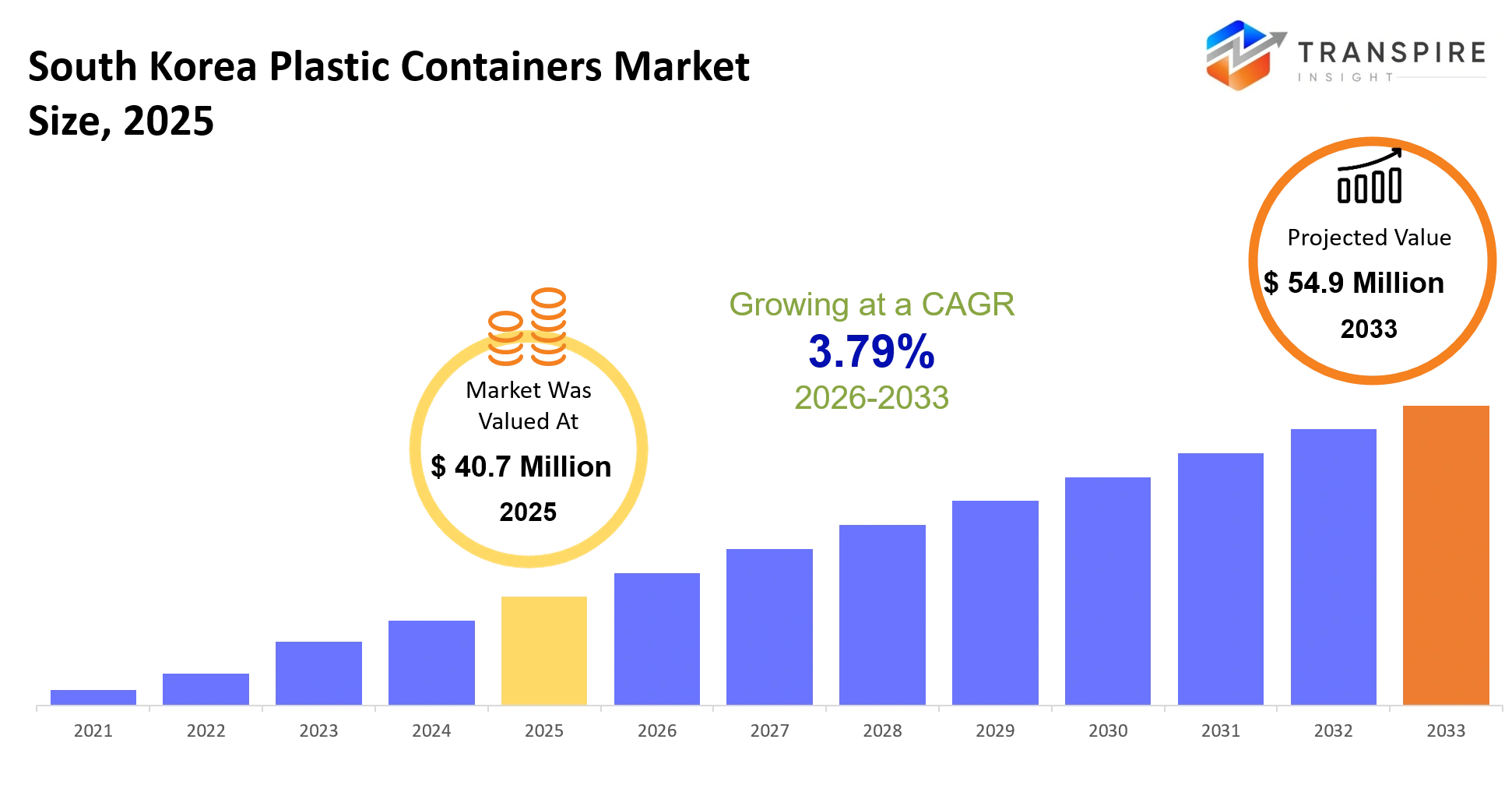
- South Korea Plastic Containers Market Size 2025: USD 40.7 Million
- South Korea Plastic Containers Market Size 2033: USD 54.9 Million
- South Korea Plastic Containers Market CAGR: 3.79%
- South Korea Plastic Containers Market Segments: By Product Type (Bottles, Jars, Drums, Intermediate Bulk Containers, Others); By Material (PET, HDPE, PP, PVC, Others); By End User (Food & Beverage, Chemicals, Pharmaceuticals, Personal Care, Others)
South Korea Plastic Containers Market Summary
The South Korea Plastic Containers Market was valued at USD 40.7 Million in 2025. It is forecast to reach USD 54.9 Million by 2033. That is a CAGR of 3.79% over the period.
More specifically, South Korea's plastic containers market plays a critical role in facilitating safe and easy handling, transit and storage, primarily within the food processing, chemicals, e-commerce logistics and export manufacturing sectors, where the main packaging features needed are strength, food safety, hygiene and efficiency in shipment by stackability rather than its design. This has been developing for the last 3-5 years, from solelyvirgin resin formats to alsorecycledand lightweight container types due to stricter circular economy regulation and various corporations’ goals on sustainability; the shift has especially involved the integration of recycled polyethylene and polypropylene to a much more mainstream supply chains, and was also aided by increases in the sorting and reprocessing facility capacity. Furthermore, the worldwide spike in resin price in 2022, owing to geopolitical risks and supply chain vulnerability, was another major boost driving the conversion to become more material-saving and thus dependent on local recycled materials. Consequently, these have moved beyond being an option based on cost-saving to becoming more of a compliance/export factor.
Key Market Insights
- The capital region (Seoul-Gyeonggi) holds the majority with a share of almost 55% in 2025, attributing to the concentration of manufacturing and logistics industries.
- Southern industrial belt to witness the fastest expansion in 2025-2031 attributed to export expansion and petro chemical clustering.
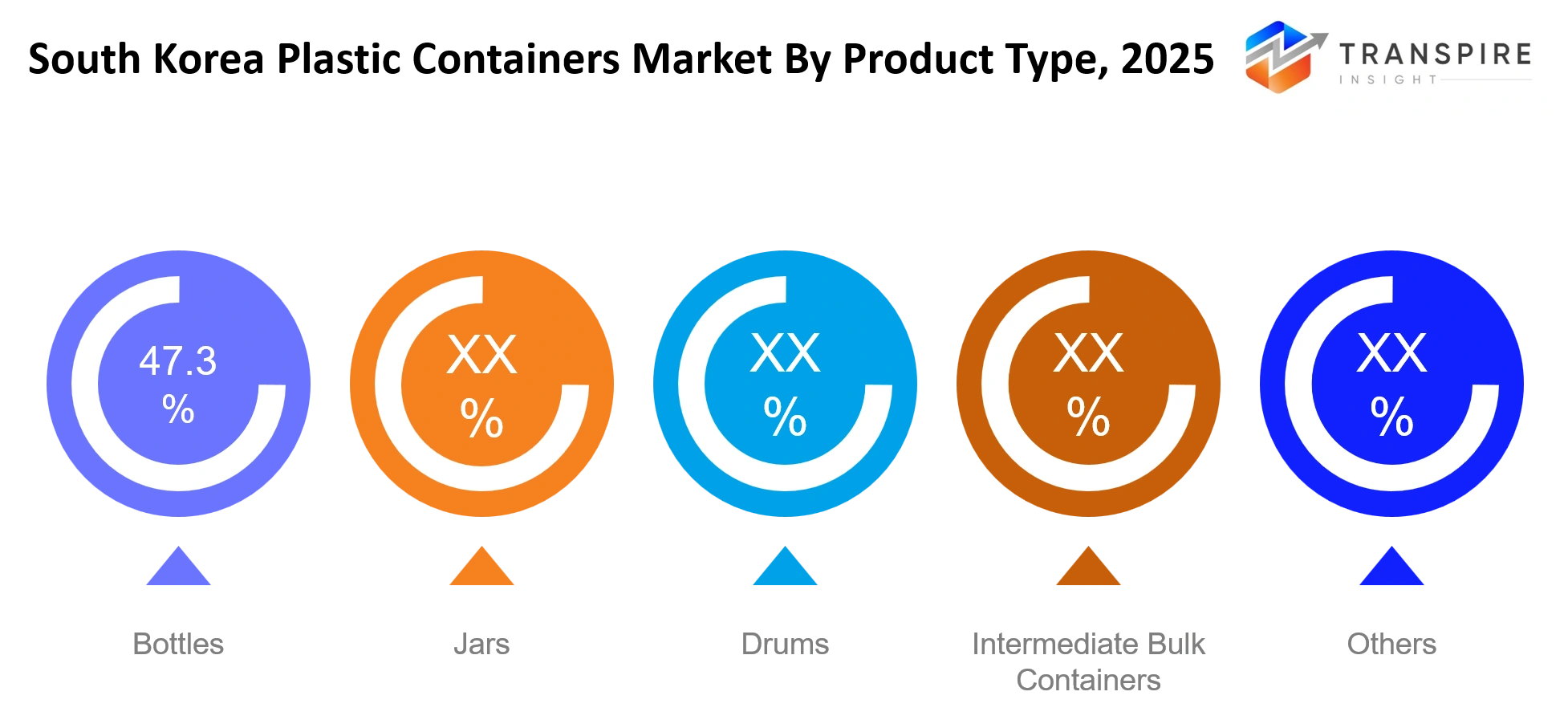
- Rigid plastic containers to hold about 48% in 2025, considering its use for food and industrial packaging.
- Bottles and Jars are the second highest categories, considering FMCG and pharmaceuticals applications.
- The recycled composite containers category to show the highest expansion till 2025-2030 due to strict eco friendly regulations.
- The food & beverages category to dominate in the 2025 South Korea Plastic Containers Market with a share of almost 40%, supported by increasing cold-chain logistics and ready to eat food market.
- The chemical and industrial sector will grow at the fastest pace due to robust manufacturing recovery led by export growth and safety compliance updates.
- FMCG manufacturers are expected to remain the dominant end-user sector with the share of approximately 35% in the South Korea Plastic Containers Market.
- The e-commerce logistics sector to be the fastest-growing segment, supported by increasing volumes and automating logistic operations.
What are the Key Drivers, Restraints, and Opportunities in the South Korea Plastic Containers Market?
The strongest influence over the South Korea Plastic Containers Market has been the regulatory and cost-incentivized integration of recycled polymer into entire packaging value chains. Stricter EPR regulation in 2023 added compliance burden upon both FMCG and industrial users, thereby mandating repackaging to incorporate design-for-recycled characteristics and a reduction in resin intensity. Coupled with fluctuating global petrochemical prices and resulting high input cost, this facilitated higher substitution rate toward recycled polyethylene and polypropylene and in turn expanded purchase orders for recycled-grade containers and investments into domestic processing capacities, boosting stable revenue streams for compliant converters.
Structural reliance on petrochemical feedstock cycle that closely correlates with global crude oil price movement and dependence upon imports remain the primary limitation on profit margin predictability and long term cost stability for manufacturers. Fragmented nature of recycling facility development outside of key industrial regions prevents uniform feedstock development, posing hurdles to a mature circulation phase and limit cost saving opportunities in the entire South Korea Plastic Containers Market.
The greatest opportunity for the market will be the adoption of high performance recycled composite packages for such export oriented sectors as electronics, and specialty chemicals. The companies pursuing investments into the newest sorts of technology (e.g. Sorting and pilot-scaled chemical recycling plants) in Ulsan and Gyeonggi will have the potential to supply premium quality recycled contents, facilitating export compliance (e.g.EU and US regulations) thereby opening additional streams of exports revenue and propelling subsequent phases of market development.
What Has the Impact of Artificial Intelligence Been on the South Korea Plastic Containers Market?
The South Korea Plastic Containers Market is beginning to see an increasing presence of AI within their production and quality control systems, primarily injection molding and extrusion-based manufacturing lines. AI powered vision systems are now used to automatically detect faults in real-time on the lines, decreasing the need for manual inspection on large run packaging and increasing product uniformity on lines. In more cutting-edge factories, ML models are now being used to fine tune the temperature, pressure, and timing on cycle, reducing material waste and improving efficiency in container creation.
Additionally, ML powered predictive maintenance is starting to be utilized in these high capacity lines to ensure that any machine wear is preempted before a total breakdown can occur, decreasing the unplanned downtime in these operations by estimated 10-15% in more mature facilities (these models typically monitor vibration, thermal, and throughput data from equipment to predict failure). This technology is working in tandem with AI based demand forecasting that enables companies to match their production rates to FMCG and logistics cycles, minimizing overstock.
The major bottleneck to this process however is the integration costs associated with these technologies and the variation in data standardization in older systems; older equipment often cannot integrate directly into these ML models due to a lack of sensors. Poor quality production data on existing lines also makes creating models that function in real world conditions quite difficult, and will slow the development of fully automated systems in the entire South Korea Plastic Containers Market.
Key Market Trends
- 2023 regulatory crackdowns drove packaging line reconfiguration, raising adoption rates of recycled polymers across the South Korea Plastic Containers Market ecosystem.
- The market transitioned away from reliance on virgin resins from 2022 to 2025 due to converters moving toward stable-priced recycled materials and volatile global petrochemical prices.
- New lightweighting technologies proliferated from post-2021, achieving 15-20% material savings in logistics-grade containers without compromising durability.
- From bulk purchasing contracts, FMCG customers are favoring sustainability-certified packaging suppliers, affecting competition and bidding strategy dynamics across the product life cycle.
- E-commerce ramp-up (2020-2025) fueled demand for easily stackable, damage-proof containers optimized for automated warehouses.
- QR code-labeled and RFID chip-equipped smart containers saw adoption rates climb from post-2023 onward, aiding visibility throughout export logistics supply chains.
- Automation-driven molding operations began proliferating in Gyeonggi manufacturing clusters, cutting production cycles and reliance on manual labor.
- SK Chemicals led efforts for pilot-stage investment in chemical recycling from post-2022 onwards, building up supply of high quality recycled raw material inputs.
- Export-oriented manufacturers are adapting container specifications in accordance with EU regulations for packaging, increasing standardization and certification demand.
- Strategic competition is moving away from price-based advantages to technology-led ones with increased investment in bio-based plastics and advanced molding systems.
South Korea Plastic Containers Market Segmentation
By Product Type :
Product type is a segment of the South Korea Plastic Containers Market, and demand for containers in this market is being shaped by the increasing and decreasing storage/transportation needs across various industries. Bottles and jars remain a primary product in use as they continue to cater to demands within the food, beverages, and personal care industry, being ideal in use, especially for transportation and storage of goods. There has been a trend towards lighter and tougher forms for the last few years.
Drums and Intermediate bulk containers are gaining firmer usage as they continue to cater to chemical and industrial logistics with increasing standards and for safe bulk movement of chemicals and industrial products. The other types of containers are also slowly moving on as the producers are developing forms to make them more stacked.
By Material :
Material type of the South Korea Plastic Containers Market is being dominated by the drive for efficiency and compliance in container use and development. PET is leading as the material of choice among producers for bottles due to its clarity and recyclability, whereas HDPE continues to lead in terms of the usage of the material in the industrial container sector on account of its high durability and chemical resistance.
There has been an increase in the use of the PP plastic among the manufacturers in recent years for creating plastic containers due to increasing demand for higher heat resistance and flexibility in designs, whereas usage of PVC is on a decline due to its environmental effects. Other materials are being considered and tested in order to fulfill recyclability goals and decrease the need for using virgin inputs.
By End User :
Food & Beverage remains the strongest end user of the plastic container market in South Korea, growing with increasing popularity of packaged food and development of cold chain logistics. Packaging requirements in this end-user segment has been consistently evolving to have a safer and more recyclable package format.
Chemical & Pharmaceutical end users demand safe, contamination-resistant packages due to the stringent regulations imposed by the Government and thus showing rising demand. Companies manufacturing personal care products have moved to use lighter package format, due to its branding as well as easier transport. The other end users are also changing package formats according to cost constraints and government regulations.
What are the Key Use Cases Driving the South Korea Plastic Containers Market?
Use cases of Food & Beverage Packaging hold the dominant position due to a significant amount of reliance on food safe, light weight and hygiene features in case of processed food, diary and Ready-to-Eat segments. The consistent demand is also driven by robust cold chain facilities available along with huge packaged food consumption along with increasing demand by retail segments for standardized and stackable containers to cut transportation losses.
Use cases such as storage and transportation of chemicals and medicines are growing as secondary use cases supported by stringent handling protocols along with growing export oriented production. The industrial segment largely depends on plastic containers due to contaminant proof features along with a requirement for transport security. Moreover, the personal care market is using plastic containers for creams and liquid packaging. This application requires easy handling, portability and identical features in retail as well.
Emerging use cases of smart containers, reuse of logistics containers in a closed-loop system are gaining considerable traction with e-commerce players, industrial distributors opting for testing of such tracking- enabled containers for better tracking of inventory, waste reducing reuse system to be developed with high interest by manufacturers.
|
Report Metrics |
Details |
|
Market size value in 2025 |
USD 40.7 Million |
|
Market size value in 2026 |
USD 42.3 Million |
|
Revenue forecast in 2033 |
USD 54.9 Million |
|
Growth rate |
CAGR of 3.79% from 2026 to 2033 |
|
Base year |
2025 |
|
Historical data |
2021 - 2024 |
|
Forecast period |
2026 - 2033 |
|
Report coverage |
Revenue forecast, competitive landscape, growth factors, and trends |
|
Country scope |
South Korea |
|
Key company profiled |
Berry Global, Amcor, ALPLA, Greif, IPL Plastics, Silgan, Mauser Packaging, Graham Packaging, Plastipak, Sonoco, Nampak, Time Technoplast, CKS Packaging, Alpha Packaging, Scholle IPN |
|
Customization scope |
Free report customization (country, regional & segment scope). Avail customized purchase options to meet your exact research needs. |
|
Report Segmentation |
By Product Type (Bottles, Jars, Drums, Intermediate Bulk Containers, Others); By Material (PET, HDPE, PP, PVC, Others); By End User (Food & Beverage, Chemicals, Pharmaceuticals, Personal Care, Others) |
Which Regions are Driving the South Korea Plastic Containers Market Growth?
Seoul Capital Area (including Gyeonggi Province) - Currently dominates the South Korea Plastic Containers Market due to high volume consumption coming from high concentration of FMCG manufacturers, numerous e-commerce fulfillment centers, as well as stringent implementation on packaging/recycling requirements. The market benefits manufacturers through readily available recycling facilities as well as massive scale of demand from retail and logistics operators, whereas government mandates are being imposed on waste segregation and use of recycled content with strong application compared to other regions pushing a swift switch of material flow. Therefore the Seoul Capital Area continues to demand a consistent stream of plastic containers with uniform quality and regulatory compliance.
Southeast industrial belt (Busan, Ulsan and Gyeongnam) - Plays a supportive but stable role in the South Korea Plastic Containers Market, its strength not coming from consumption concentration as much as from heavily industrialized nature of the region (bulk chemicals) and integration within the Petrochemical industry value chain. Manufacturers such as large chemical producers and exporters are highly dependent on robust containers to ensure material storage and bulk movement through well-established port systems. Long-term production and export contracts are ensuring a steady stream of orders from the manufacturing segment with less volatility than domestic consumption-dependent market segments.
Chungcheong region - This region is considered the region with fastest growing plastic container demand and market share driven by recent relocation of industries into Inland and establishment of new logistics links to connect these facilities with coastal ports. The number of facilities (recycling/manufacturing) is growing especially since 2023 due to government incentivized decentralization policies. Additionally, the number of e-commerce fulfillment centers is expanding at high speed within the Chungcheong region to fulfill the massive increase in online orders, pushing up the demand for plastic containers, mainly lightweight and stackable containers. The period of 2026-2033 will provide ample new opportunities to the packaging converters and material producers, targeting the new centers as a cost competitive manufacturing base.
Who are the Key Players in the South Korea Plastic Containers Market and How Do They Compete?
The South Korea Plastic Containers market is relatively consolidated with the large Petrochemical-linked firms competing equally with niche packaging manufacturers. Competition is based on material innovations and blend of recycled resins in formulations rather than on price alone. The major players are defending their share by vertical integration in resins while the smaller firms are growing on the basis of technical specifications and short turnaround catering to the FMCG and industrial customers.
Material innovation, notably recycled and bio-based polymers that lessen the downstream packaging converters' compliance risk, is the domain of companies like LG Chem and SK Chemicals. They draw their power from their integrated chemical production, which allows either of them to stabilize the supply of raw materials and enjoy long-term contracts with converters. Both go for membrane partnerships with recycling firms and investment in new depolymerization techniques.
Lotte Chemical and Hyosung are competing to improve cost competitiveness and increase production of polymers optimized for packaging applications requiring lightweighting. Lotte Chemical is using the scale of the company throughput to meet the needs of high volume container customers, while Hyosung is adopting quality and performance improvements for specific application material requirements. On the other hand, Samhwa Plastic and Dongwon Systems are aiming to differentiate themselves through downstream packaging design expertise combined with strong relationships with FMCG brand owners. These companies are pursuing growth in export packaging and retailer / logistics companies’ procurement.
Company List
- Berry Global
- Amcor
- ALPLA
- Greif
- IPL Plastics
- Silgan
- Mauser Packaging
- Graham Packaging
- Plastipak
- Sonoco
- Nampak
- Time Technoplast
- CKS Packaging
- Alpha Packaging
- Scholle IPN
Recent Development News
In April 2026, Yonwoo expanded its paper-based cosmetic packaging offerings amid raw material disruptions and rising plastic prices. The company’s shift toward paper tubes increased alternative packaging inquiries and reflected growing substitution pressure on plastic container demand in South Korea. Sourcehttps://www.reuters.com/
In December 2025, LG Chem submitted a petrochemical restructuring plan to the South Korean government. The move aligns with national capacity rationalization efforts and is expected to reshape feedstock supply stability for downstream plastic container manufacturers.
Source https://www.reuters.com/
What Strategic Insights Define the Future of the South Korea Plastic Containers Market?
The South Korea Plastic Containers Market is fundamentally shifting to a compliance-driven, material-innovation focused model in the coming 5-7 years, in which integration of recycled resin and engineering lightweight containers would lead to the next leap in competitive differentiation. This has been caused by the implementation of more stringent packaging waste regulation and, more crucially, purchase priorities adopted by the large FMCG manufacturers and exporters who increasingly prefer traceable, low carbon packaging feedstocks to traditional "price-only" sourcing practices.
An unseen risk is also found in a blind reliance on petrochemical based recycling feedstocks systems. Overconcentration in supply amongst few integrated players will cause distortions to pricing mechanisms and slow down scale-up of the circular economy by the constraints on availability once the total amount of industrial output tightens, although the "sustainability advantage" obscures this danger.
The key emerging opportunity is food grade container application of chemical recycling technology, which currently is still at early scaling phase but receives support from government policy in key industrial clusters in Korea. Early movers with localized depolymerization capacity will secure themselves access to high value export opportunities. The participants of the market are suggested to have investments in backwards integrated ownership to recycling operations to ensure supply security and improve compliance status ahead of the upcoming 2030 stringent mandate.
South Korea Plastic Containers Market Report Segmentation
By Product Type
- Bottles
- Jars
- Drums
- Intermediate Bulk Containers
By Material
- PET
- HDPE
- PP
- PVC
By End User
- Food & Beverage
- Chemicals
- Pharmaceuticals
- Personal Care
Frequently Asked Questions
Find quick answers to common questions.
The South Korea Plastic Containers Market size is USD 54.9 Million in 2033.
Key segments for the South Korea Plastic Containers Market are By Product Type (Bottles, Jars, Drums, Intermediate Bulk Containers, Others); By Material (PET, HDPE, PP, PVC, Others); By End User (Food & Beverage, Chemicals, Pharmaceuticals, Personal Care, Others).
Major South Korea Plastic Containers Market players are Berry Global, Amcor, ALPLA, Greif, IPL Plastics, Silgan, Mauser Packaging, Graham Packaging, Plastipak, Sonoco, Nampak, Time Technoplast, CKS Packaging, Alpha Packaging, Scholle IPN.
The South Korea Plastic Containers Market size is USD 40.7 Million in 2025.
The South Korea Plastic Containers Market CAGR is 3.79% from 2026 to 2033.
- Berry Global
- Amcor
- ALPLA
- Greif
- IPL Plastics
- Silgan
- Mauser Packaging
- Graham Packaging
- Plastipak
- Sonoco
- Nampak
- Time Technoplast
- CKS Packaging
- Alpha Packaging
- Scholle IPN
About the Authors

Kartik bhong
I am Kartik Bhong, a Senior Research Analyst at Transpire Insight, specializing in the Packaging, Manufacturing, and Construction industry. My work focuses on analyzing market trends, emerging technologies, industry regulations, and competitive landscapes to deliver accurate, data-driven insights. I am passionate about transforming complex industry information into clear, practical content that helps businesses, professionals, and decision-makers stay informed and make confident strategic decisions. Through continuous research and a strong commitment to accuracy, I strive to create reliable, well-researched content that reflects the latest developments across these dynamic industries and supports the vision of Transpire Insight in delivering valuable market intelligence.

Chakradhar Khansole
Chakradhar serves as the Research Director at Transpire Insight, bringing over 8 years of experience in technology, innovation, and strategic market intelligence. He specializes in transforming complex market data into actionable business insights that enable organizations to make informed, growth-oriented decisions. Recognized for his strategic vision and analytical expertise, Chakradhar leads high-impact research initiatives, delivering comprehensive market assessments, competitive intelligence, and forward-looking industry analysis.
Recently Published Reports
-
Apr 2026
Pharmaceutical Cold Chain Packaging Market
Pharmaceutical Cold Chain Packaging Market By Material (Plastic,(Polyethylene (PE), Polypropylene (PP), Polyethylene Terephthalate (PET), Expanded Polystyrene (EPS), Polyurethane (PU),Others), Paper, Metal, Others), By Product (Small Boxes, Pallets, Large Sized Pallet Containers, Others), By End Use (Biopharmaceutical Companies, Clinical Research Organizations, Hospitals, Research Institutes, Logistics and Distribution Companies, Others)”, By Industry Analysis, Size, Share, Growth, Trends, and Forecasts 2026-2033
-
Apr 2026
Active & Intelligent Packaging Market
Active & Intelligent Packaging Market By Type (Active Packaging, Smart Packaging), By Material (Polymer-Based, Paper & Board-Based, Metal-Based, Glass-Based), By Technology (Time-Temperature Indicators, Freshness Indicators, RFID, Antimicrobial Packaging, Modified Atmosphere Packaging), By Application (Food & Beverages, Pharmaceutical, Cosmetics & Personal Care, Electronics & Consumer Goods, Others), By Industry Analysis, Size, Share, Growth, Trends, and Forecasts 2026-2033
-
Apr 2026
Biodegradable Cut Flower Packaging Market
Biodegradable Cut Flower Packaging Market By Material Type (Paper & Paperboard, Biodegradable Plastics, Natural Fibers, Molded Pulp, Others), By Product Type (Sleeves, Wraps, Boxes & Cartons, Bags & Pouches, Inserts & Holders), By Application (Roses, Carnations, Tulips, Chrysanthemums, Mixed Flowers, Others) and By Distribution Channel (Direct Sales, Distributors & Wholesalers, Online Channels), By Industry Analysis, Size, Share, Growth, Trends, and Forecasts 2026-2033
-
May 2026
Pharmaceutical Packaging Market
Pharmaceutical Packaging Market By Material Type (Plastic, Glass, Metal, Paper & Paperboard, Others), By Packaging Type (Bottles, Blister Packs, Vials, Ampoules, Pouches & Sachets, Others) and By End User (Hospitals & Clinics, Retail Pharmacies, Online Pharmacies, Pharmaceutical Manufacturers), By Industry Analysis, Size, Share, Growth, Trends, and Forecasts 2026-2033