
Asia Pacific Bags And Containers Market Size & Forecast:
- Asia Pacific Bags And Containers Market Size 2025: USD 724.6 Million
- Asia Pacific Bags And Containers Market Size 2033: USD 1295.2 Million
- Asia Pacific Bags And Containers Market CAGR: 7.47%
- Asia Pacific Bags And Containers Market Segments: By Product Type (Bags, Pouches, Drums, Intermediate Bulk Containers, Bottles, Crates, Others); By Material (Plastic, Paper, Metal, Glass, Fabric, Others); By Application (Food & Beverage, Chemicals, Healthcare, Agriculture, Retail, Others); By End User (Manufacturers, Logistics, Retailers, Others)
Asia Pacific Bags And Containers Market Summary
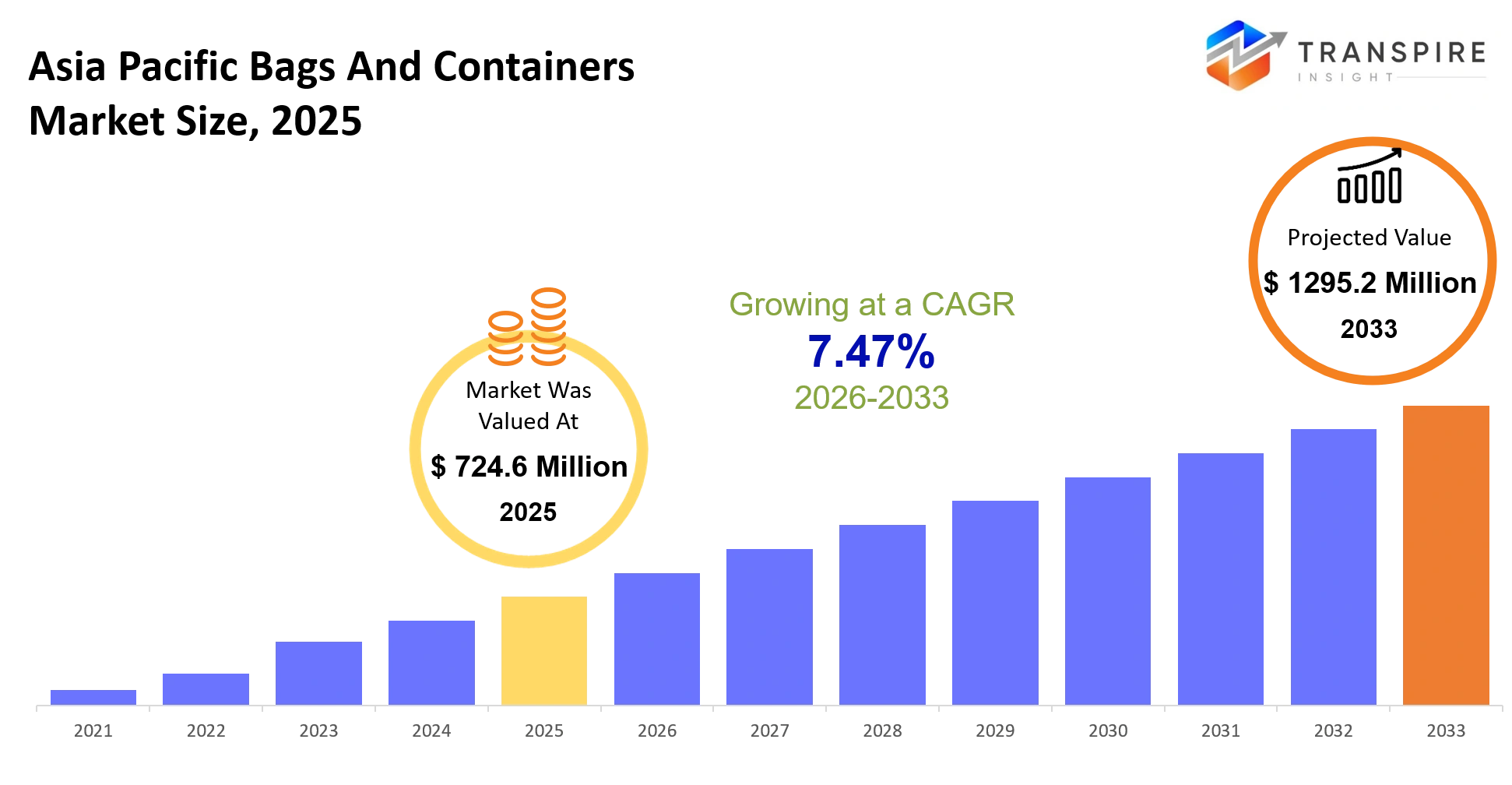
The Asia Pacific Bags And Containers Market was valued at USD 724.6 Million in 2025. It is forecast to reach USD 1295.2 Million by 2033. That is a CAGR of 7.47% over the period.
The packaging segment within the Asia Pacific bags and containers market is crucial for the transportation, storage, and safeguarding of materials across key industries such as manufacturing, agriculture, chemicals, food processing and the logistics infrastructure. Packaging is used in manufacturing processes, helping businesses to minimize product damage, increase handling speeds and meet ever-evolving regulations regarding health and safety, and transportation of goods. Over the recent past, there has been a transformation from standard commodity packaging to innovative high-performance and sustainable applications, spurred by stringent government regulations surrounding environmental protection and the desire to improve supply chain efficiency.
The COVID-19 crisis and resulting disruptions to the global supply chain brought about widespread concerns with regards to packaging availability and transportation efficiency, encouraging a rise in investments for long-lasting, light weight and re-usable packaging systems. As a result of increasing trade throughout the region and the growing need for efficiency in the workplace through automation and cost-savings measures, packaging is becoming a core asset in an enterprise's operational management structure, leading to opportunities for profit generation for supply providers, with advanced, custom made and sustainable packaging solutions.
Key Market Insights
- China leads the Asia Pacific Bags And Containers Market with an over 35% market share in 2025 owing to its extensive manufacturing and export infrastructure.
- India is the fastest-growing regional market till 2030 owing to its industry growth, food processing investments, and booming logistics infrastructure.
- South East Asia is registering massive share growth as firms increasingly decentralize supply chains and invest in regional manufacturing bases.
- Flexible Intermediate Bulk Containers held the dominant share of the market with almost 40% in 2025 owing to its usage for transporting chemicals, food, and industrial products.
- Plastic bags and rigid industrial containers are the second dominant segment owing to their diverse usage and lesser handling charges.
- The re-usable and sustainable packaging market is the fastest growing segment by 2030 with focus on eliminating waste and meeting circular economy requirements.
- Industrial and chemical packaging dominates the applications with over 30% share on account of rigorous demands for safety, handling and material characteristics.
- Food and beverage packaging is the fastest growing application on account of processors adopting advanced techniques for storage and transportation.
- The manufacturing sector holds the maximum end-user share of over 35% due to its large-scale application of industrial packaging throughout the value chain.
- E-commerce and logistics providers forms the fastest growing end-user category, with rising trade volumes at the regional level.
What are the Key Drivers, Restraints, and Opportunities in the Asia Pacific Bags And Containers Market?
An additional major growth driver for the Asia Pacific Bags and Containers market will be the changes happening in manufacturing networks and supply chains in the region. As businesses begin to decentralize, moving production closer to end consumers and reducing their dependence on single sources, it is likely that the movement of chemical and food additives, industrial products, and consumer goods throughout the region will rise. As these supply chains are reconfigured it is predicted there will be an increased demand for more robust and functional packaging, where investment in warehousing, logistics parks and export oriented production will fuel demand for industrial bags and containers.
Volatility of raw material prices continues to be the biggest structural constraint.Polyethylene, Polypropylene and commodity resin prices are directly linked to petro chemical markets and energy costs. Inability to push price hikes quickly down to the consumer due to longer supplier contracts means that manufacturers have to either accept lower profit margins or limit investments in capacity and technology, consequently restricting their investment in sophisticated packing systems and technologies.
The next most important growth area is smart and reusable packaging solutions. RFID chips and tracking technology enabled smart packaging systems will gain rapid momentum within industrial containers across China, Japan and South Korea. The increased inventory management efficiency and reduced spoilage provided by these new packing systems will enable vendors to secure more high value contracts within the decade and boost total logistical expenditures.
What Has the Impact of Artificial Intelligence Been on the Asia Pacific Bags And Containers Market?
AI and advanced digital technology are changing the Asia Pacific Bags And Containers Market through enhancing production productivity and the level of control and transparency that they introduce to quality and manufacturing processes. Companies that manufacture bags and containers employ vision systems powered by AI to examine bags, containers and the seals in real-time at production line speed, which aids factories in identifying defects more accurately while at the same time minimizing the scrap rate and the consumption of materials. Machine learning supported automated production lines have been enabling optimized speeds, minimized downtime, and higher outputs for manufacturers dealing with massive quantities of products.
Machine learning is being employed in predictive maintenance in order to maintain efficiency, and to keep equipment from failing, by predicting the need for maintenance before a break-down occurs. Predictive analytic algorithms examine machine sensor data collected from the filling systems, the molding systems, and the extrusion systems and will alert to the probable part failure, minimizing equipment downtime and cutting maintenance costs and time, and maintaining stable production schedules. The use of machine learning demand forecasting has helped suppliers to optimize inventory stock, and react accordingly to the movements in manufacturing activity and export orders.
Though advantages to AI have appeared in the market, problems in implementation have developed. A higher level of investment is required when adding advanced analytical capabilities to traditional manufacturing hardware; systems of fragmented data collection result in the reduction of machine learning accuracy. The required digital systems have not been adopted by the smaller manufacturers in the industry, and are lacking by the SMEs, preventing them from leveraging fully on AI enabled production lines.
Key Market Trends
Manufacturing players are speeding up uptake of reusable industrial packaging since 2021 with logistics expenses increasing by over 20% across key Asia Pacific trade lanes.
China, India, and Vietnam have redeployed packaging expenditure on local manufacturing, removing dependency on single country sourcing after supply disruptions encountered during the pandemic period.
Food and chemical companies are opting for lighter weight, high barrier packaging over traditional designs in a move to lower transportation costs and minimize product wastage.
Consumption of recycled resin has seen consistent uptake since 2022 as government bodies are imposing tighter restrictions on packaging waste and global buyers have tightened criteria for sustainability objectives.
Prominent companies including Amcor, Berry Global and Mondi are increasing investment on mono-material solutions to promote recycling whilst meeting stringent quality requirements.
Smart packaging featuring RFID and QR scanning features have moved from pilot tests to production scale deployment, especially for pharmaceutical and industrial packaging.
Smart automation in production lines with the utilization of AI for inspection have brought down defect rates and increased production throughput in massive manufacturing facilities.
The rising trend in cross-border e-commerce has influenced consumer behavior, driving manufacturers to invest in more durable and tamper-evident bags and containers for extended shipping routes.
Purchasing preferences have been influenced to consider life-cycle costs, moving from consideration of per-unit costs; hence leading packaging players are focusing on reusable and services-oriented packaging.
Companies are competing and expanding strategy in Southeast Asia, by building regional plants to shorten delivery time and improve supply security.
Asia Pacific Bags And Containers Market Segmentation
By Product Type:
Bags cover flexible packaging products and are applied for holding and shipping foodstuffs, chemicals, agricultural goods, and industrial products. As bag offer ease in using and carrying, as well as reduce transporting cost in multi industries so demand for them is high. Pouches also take significant place as light weight packages, offer a good seal and product protection for liquid and solid products.
Drums and Intermediate Bulk Containers are employed by industries which need safe, easy storing and transport a large amount of liquid, powder and hazard products. Bottles and crates are commonly utilized in the beverage, health care and retail industry by its strength and the reusability. Besides there are the other product classes which are specialty containers manufactured according to particular industrial and commercial applications.
By Material:
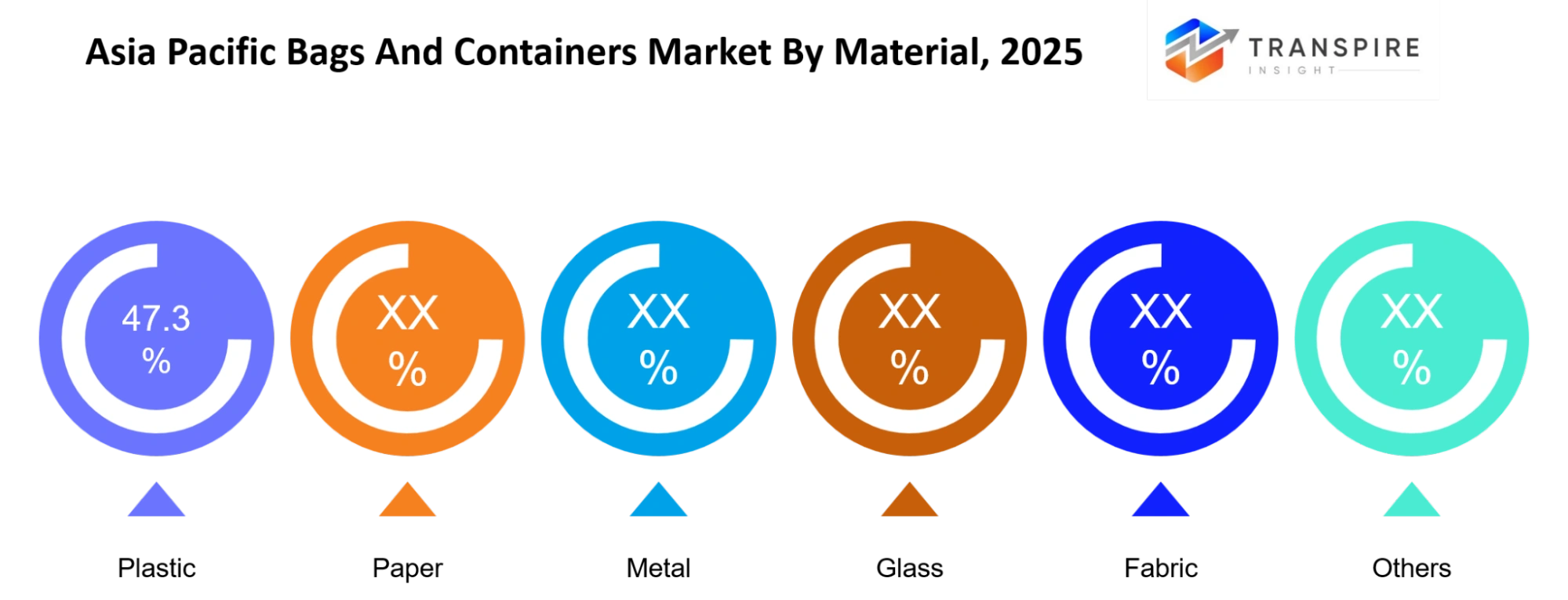
The plastics market remains the largest in the material segments due to its flexibility, rigidity, water resistance and low price. Various kinds of plastic bags, containers, and pouches are extensively used in food processing, health care, and industrial packaging. Paper materials come into favor among businessmen since recyclable and biodegradable package formats meet current environmental policies in Asia Pacific nations.
The metals and glass market are maintained due to their suitability in storing the product which has longer shelf life and higher safety and use widely in beverages industries. Fabric materials used for packaging in industries with products such as agro and chemical goods which are typically stored and transported in large quantities, meanwhile composite and specialty materials are utilized in various specific applications due to their higher strength, better barrier protection and efficiency for a specific application.
By Application:
Food and beverages applications utilize a large share of packaging products as they offer solutions to the issues of safe and convenient storage of packaged foods, ready to eat meals and beverages in containers, pouches, bags, bottles, etc which further enhance their quality and extend their shelf life. A changing consumer lifestyle and increasing organized retail continue to support packaging use in this segment.
Chemicals and health care require packaging products which ensure higher durability and provide good protection against contamination. The agriculture sector uses containers and bags to store seeds, fertilizers and various crops after harvest whereas the retail sector uses all types of packaging to supply products and improve customers' ease. Other sectors include industrial and commercial usages.
By End User:
Manufacturing is another significant end-user segment as manufacturing units require packaging products for storing the raw materials, the finished products, packaging of export consignments. Packaging products offer efficiency in storage and help in preventing damage of the products and smooth movement. Ongoing manufacturing developments in Asia Pacific regions are anticipated to pose a long term opportunity for the packaging product suppliers.
Logistics utilizes the packaging products like containers and bags which in turn increase the efficiency of transportation. Retailers use these products to enhance product appearance, to manage inventory and facilitate product convenience. The other significant end users are Agricultural cooperatives, health care industries and commercial organizations.
What are the Key Use Cases Driving the Asia Pacific Bags And Containers Market?
The leading application in the Asia Pacific Bags And Containers Market has been industrial packaging. A majority of the chemical producers, food producers and agricultural manufacturers utilize the range of products to safely store and transport their raw products. It contributes to the highest demand, due to the necessity of reducing product spillage and increasing product handling efficiency and ensuring long-distance distribution of products within the Asia Pacific region.
Secondary applications of packaging in the Asia Pacific market, like healthcare and retail packaging, have seen significant growth. Pharmaceutical producers use appropriate containers to maintain the shelf life of pharmaceutical products, while retailers use robust and lighter packaging, to assist e-fulfillment and last mile delivery operations.
The rising applications in smart packaging including the use of RFID enabled reusable packaging, and advanced recyclables are gaining a lot of interest due to manufacturers' focus on providing supply chain visibility and lower operational costs.
|
Report Metrics |
Details |
|
Market size value in 2025 |
USD 724.6 Million |
|
Market size value in 2026 |
USD 782.4 Million |
|
Revenue forecast in 2033 |
USD 1295.2 Million |
|
Growth rate |
CAGR of 7.47% from 2026 to 2033 |
|
Base year |
2025 |
|
Historical data |
2021 - 2024 |
|
Forecast period |
2026 - 2033 |
|
Report coverage |
Revenue forecast, competitive landscape, growth factors, and trends |
|
Regional scope |
Asia Pacific (India, China, Japan, Australia, South Korea, Rest of Asia Pacific) |
|
Key company profiled |
Amcor, Berry Global, Sonoco, Greif, Mauser Packaging, Mondi, DS Smith, Sealed Air, UFlex, Huhtamaki, Tetra Pak, Smurfit Westrock, ProAmpac, Coveris, Winpak |
|
Customization scope |
Free report customization (country, regional & segment scope). Avail customized purchase options to meet your exact research needs. |
|
Report Segmentation |
By Product Type (Bags, Pouches, Drums, Intermediate Bulk Containers, Bottles, Crates, Others); By Material (Plastic, Paper, Metal, Glass, Fabric, Others); By Application (Food & Beverage, Chemicals, Healthcare, Agriculture, Retail, Others); By End User (Manufacturers, Logistics, Retailers, Others) |
Which Regions are Driving the Asia Pacific Bags And Containers Market Growth?
China still occupies the leading position of Asia Pacific Bags And Containers Market due to immense manufacturing activity, enormous export business and integrated logistics network. Presence of major industrial zones results in stable demand for bags, drums, pouches and bulk containers for applications within the chemical, food processing and consumer products sectors. Presence of well-established port infrastructure and robust transportation network ensures the ability of packaging manufacturers to serve the markets at home and abroad within a shorter time. Support of the government on industrial upgradation and green manufacturing is helping the region to reinforce the business environment and maintain the lead.
Japan accounts for the second-most important market of Asia Pacific Bags And Containers Market; although the sources of demand growth are different from those for China. Demand in Japan's market can be attributed to its stable industrial base where quality, precision, reliability, and long-term vendor relations are favored over pure output volume. Stringent quality requirements within the health, specialty chemicals and food industries promote adoption of high-value packaging materials and advanced container design and technology. Constant investment in automation and packaging technologies has made Japan a consistent contributor to market revenue in the region despite modest economic growth rates.
India is experiencing the quickest growth rate within the Asia Pacific Bags And Containers Market as industrial production intensifies and supply chains are diversified through a wide array of sectors. Investments in logistical parks, warehouse space and food processing infrastructure have augmented the demand for efficient storage and packaging solutions. Manufacturers are incorporating lightweight and returnable packaging and containers to cut down on transit costs and increase operational efficiencies. These trends make the Indian market an appealing prospect for potential investors and market participants from 2026 to 2033, with substantial potential within industrial packaging and the development of sustainable packaging solutions.
Who are the Key Players in the Asia Pacific Bags And Containers Market and How Do They Compete?
The market for bags and containers in Asia Pacific is somewhat fragmented. The competition comes from global packaging manufacturers and specialized providers, as well as from regional producers. Price is a relevant factor but the competition is also based on technological innovation, material and sustainability, production efficiency and the presence on the market. Companies in established positions strive to defend their share by increasing production capacity at the local level and developing new packaging solutions able to meet evolving standards of environment friendliness and consumer demand.
Amcor develops technology innovation and sustainable packaging solutions. The company is investing a lot of capital in the creation of mono-material and recyclable packaging solutions that can allow its customers to minimize packaging and optimize the protection of their products. Berry Global competes by taking advantage of its massive production capabilities and broad product range, serving both food, medical and industrial sector customers through dedicated packaging solutions and countries.
Mondi distinguishes itself on the market by developing newspaper based and flexible packaging solutions, aiming to enhance the recyclability and the efficiency in resource utilization. Greif has found a niche in the industrial packaging products sector, specifically for drums and IBC's, where the durability of its products and its world-wide servicing network become real competitive advantages. These firms continue to grow through regional manufacturing developments, business alliances and a strengthened portfolio of products, building stronger ties to customers and securing a long term competitive market positioning.
Company List
- Amcor
- Berry Global
- Sonoco
- Greif
- Mauser Packaging
- Mondi
- DS Smith
- Sealed Air
- UFlex
- Huhtamaki
- Tetra Pak
- Smurfit Westrock
- ProAmpac
- Coveris
- Winpak
Recent Development News
In April 2026, Mondi entered a joint venture to expand its paper bags business in Southeast Asia. The investment strengthens Mondi's regional manufacturing footprint and increases access to fast-growing industrial and construction packaging markets across Asia Pacific.
Source https://www.mondigroup.com/
In March 2026, Amcor launched recycle-ready mono-PE fertilizer packaging with 35% post-consumer recycled content in partnership with DCM. The new packaging solution advances circular economy goals and expands the availability of sustainable industrial bags for agricultural applications. Source https://www.amcor.com/
What Strategic Insights Define the Future of the Asia Pacific Bags And Containers Market?
The Asia Pacific Bags and Containers Market will morph into a more tech-enabled, sustainable environment over the next 5 to 7 years due to ongoing reordering of supply chains in the region, forcing manufacturers to opt for light-weight, re-usable and digital-trackable packaging. Packaging is slowly becoming a tool for enabling effective logistics, minimizing wastage and complying with diverse regulations in a variety of sectors.
However, a blind spot of many packaging manufacturers may be their lack of diverse resin sources and fragmented recycling infrastructure; dependence on only a handful of resin suppliers coupled with the slow pace of commercializing circular models owing to disparity in collection and recycling system across the developing nations may put a constraint on profit margins. The opportunity in this market seems to arise in the creation of smart re-usable packaging (via RFID and sensors) in the emerging market of India and Southeast Asia, and manufacturers must start investing in digital packaging technologies and regional manufacturing partnerships early to gain a competitive edge over other market players who are focusing on only price and durability.
Asia Pacific Bags And Containers Market Report Segmentation
By Product Type
- Bags
- Pouches
- Drums
- Intermediate Bulk Containers
- Bottles
- Crates
By Material
- Plastic
- Paper
- Metal
- Glass
- Fabric
By Application
- Food & Beverage
- Chemicals
- Healthcare
- Agriculture
- Retail
By End User
- Manufacturers
- Logistics
- Retailers
Frequently Asked Questions
Find quick answers to common questions.
The Asia Pacific Bags And Containers Market size is USD 1295.2 Million in 2033.
Key segments for the Asia Pacific Bags And Containers Market are By Product Type (Bags, Pouches, Drums, Intermediate Bulk Containers, Bottles, Crates, Others); By Material (Plastic, Paper, Metal, Glass, Fabric, Others); By Application (Food & Beverage, Chemicals, Healthcare, Agriculture, Retail, Others); By End User (Manufacturers, Logistics, Retailers, Others).
Major Asia Pacific Bags And Containers Market players are Amcor, Berry Global, Sonoco, Greif, Mauser Packaging, Mondi, DS Smith, Sealed Air, UFlex, Huhtamaki, Tetra Pak, Smurfit Westrock, ProAmpac, Coveris, Winpak.
The Asia Pacific Bags And Containers Market size is USD 724.6 Million in 2025.
The Asia Pacific Bags And Containers Market CAGR is 7.47% from 2026 to 2033.
- Amcor
- Berry Global
- Sonoco
- Greif
- Mauser Packaging
- Mondi
- DS Smith
- Sealed Air
- UFlex
- Huhtamaki
- Tetra Pak
- Smurfit Westrock
- ProAmpac
- Coveris
- Winpak
About the Authors

Kartik bhong
I am Kartik Bhong, a Senior Research Analyst at Transpire Insight, specializing in the Packaging, Manufacturing, and Construction industry. My work focuses on analyzing market trends, emerging technologies, industry regulations, and competitive landscapes to deliver accurate, data-driven insights. I am passionate about transforming complex industry information into clear, practical content that helps businesses, professionals, and decision-makers stay informed and make confident strategic decisions. Through continuous research and a strong commitment to accuracy, I strive to create reliable, well-researched content that reflects the latest developments across these dynamic industries and supports the vision of Transpire Insight in delivering valuable market intelligence.

Chakradhar Khansole
Chakradhar serves as the Research Director at Transpire Insight, bringing over 8 years of experience in technology, innovation, and strategic market intelligence. He specializes in transforming complex market data into actionable business insights that enable organizations to make informed, growth-oriented decisions. Recognized for his strategic vision and analytical expertise, Chakradhar leads high-impact research initiatives, delivering comprehensive market assessments, competitive intelligence, and forward-looking industry analysis.
Recently Published Reports
-
Apr 2026
Pharmaceutical Cold Chain Packaging Market
Pharmaceutical Cold Chain Packaging Market By Material (Plastic,(Polyethylene (PE), Polypropylene (PP), Polyethylene Terephthalate (PET), Expanded Polystyrene (EPS), Polyurethane (PU),Others), Paper, Metal, Others), By Product (Small Boxes, Pallets, Large Sized Pallet Containers, Others), By End Use (Biopharmaceutical Companies, Clinical Research Organizations, Hospitals, Research Institutes, Logistics and Distribution Companies, Others)”, By Industry Analysis, Size, Share, Growth, Trends, and Forecasts 2026-2033
-
Apr 2026
Active & Intelligent Packaging Market
Active & Intelligent Packaging Market By Type (Active Packaging, Smart Packaging), By Material (Polymer-Based, Paper & Board-Based, Metal-Based, Glass-Based), By Technology (Time-Temperature Indicators, Freshness Indicators, RFID, Antimicrobial Packaging, Modified Atmosphere Packaging), By Application (Food & Beverages, Pharmaceutical, Cosmetics & Personal Care, Electronics & Consumer Goods, Others), By Industry Analysis, Size, Share, Growth, Trends, and Forecasts 2026-2033
-
Apr 2026
Biodegradable Cut Flower Packaging Market
Biodegradable Cut Flower Packaging Market By Material Type (Paper & Paperboard, Biodegradable Plastics, Natural Fibers, Molded Pulp, Others), By Product Type (Sleeves, Wraps, Boxes & Cartons, Bags & Pouches, Inserts & Holders), By Application (Roses, Carnations, Tulips, Chrysanthemums, Mixed Flowers, Others) and By Distribution Channel (Direct Sales, Distributors & Wholesalers, Online Channels), By Industry Analysis, Size, Share, Growth, Trends, and Forecasts 2026-2033
-
May 2026
Pharmaceutical Packaging Market
Pharmaceutical Packaging Market By Material Type (Plastic, Glass, Metal, Paper & Paperboard, Others), By Packaging Type (Bottles, Blister Packs, Vials, Ampoules, Pouches & Sachets, Others) and By End User (Hospitals & Clinics, Retail Pharmacies, Online Pharmacies, Pharmaceutical Manufacturers), By Industry Analysis, Size, Share, Growth, Trends, and Forecasts 2026-2033