
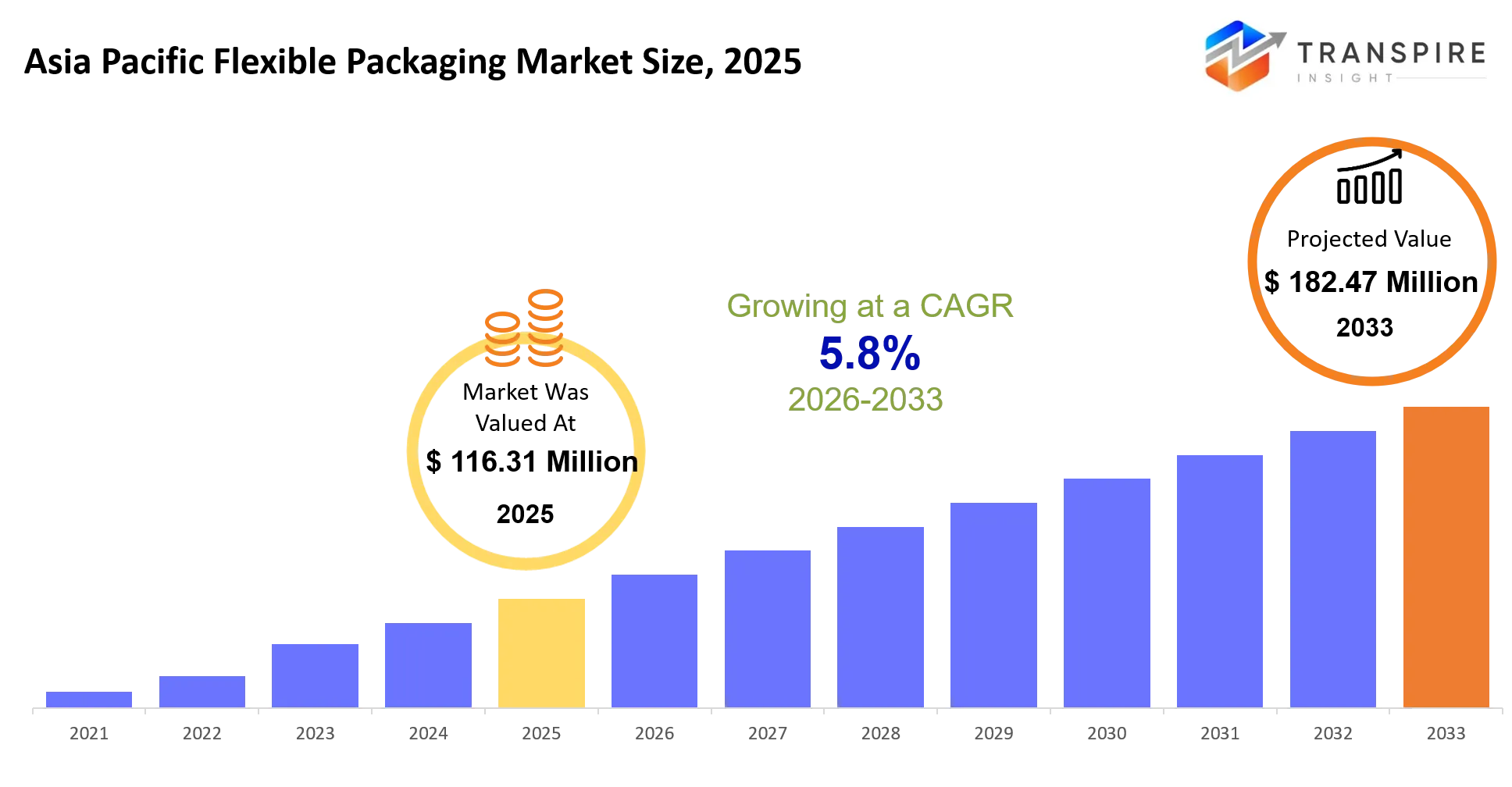
Asia Pacific Flexible Packaging Market Size & Forecast:
- Asia Pacific Flexible Packaging Market Size 2025: USD 116.31 Million
- Asia Pacific Flexible Packaging Market Size 2033: USD 182.47 Million
- Asia Pacific Flexible Packaging Market CAGR: 5.8%
- Asia Pacific Flexible Packaging Market Segments: By Material Type (Plastic Films, Paper, Aluminum Foil, Bioplastics, Cellulose Films, Polyethylene, Polypropylene, Others) By Product Type (Pouches, Bags, Wraps, Sachets, Films, Liners, Stick Packs, Others) By End-Use Industry (Food & Beverages, Pharmaceuticals, Personal Care, Home Care, Industrial Products, Pet Food, Agriculture, Others) By Printing Technology (Flexography, Rotogravure, Digital Printing, Offset Printing, Screen Printing, Lithography, Hybrid Printing, Others)
To learn more about this report,  Download Free Sample Report
Asia Pacific Flexible Packaging Market Summary
The Asia Pacific Flexible Packaging Market was valued at USD 116.31 million in 2025. It is forecast to reach USD 182.47 million by 2033. That is a CAGR of 5.8% over the period.
The Asia Pacific Flexible Packaging Market kind of plays a key role in protecting products, stretching shelf life, cutting transportation costs a bit, and generally helping the supply chain run smoother across food, pharmaceutical, personal care, as well as industrial segments. In real life, a lot of manufacturers lean on flexible formats like pouches, films, and wraps, because they can use less material, while still keeping product safety under control, plus it gives a more convenient experience for the people on the receiving end.
In the past five years, the market kinda moved in a more structural fashion toward recyclable mono material packaging, plus lighter weight designs too. It seems to be pushed along by governments and brand owners who are pushing firmer sustainability goals , and also by packaging waste regulations that just don’t let up. One trigger that stands out was the pandemic-era supply chain disruptions, and then right after that the rapid growth of e-commerce, which made it pretty obvious that packaging has to be both cost-efficient and resilient during transit. So, investments started moving quicker into high performance films, digital printing, and other barrier based innovations. Also, since consumer goods companies are trying to trim their logistics expenses while still fulfilling environmental commitments, flexible packaging is taking up a bigger slice of packaging budgets. That ends up driving wider adoption across sectors, plus steadier, more durable revenue options for converters and material suppliers.
Key Market Insights
- China is the player in the Asia Pacific Flexible Packaging Market. It will have around 38 to 42 percent of the market by 2025. This is because China has a lot of manufacturing and consumer goods sectors.
- India is growing fast in this market. This is happening because more people are buying packaged food and shopping at organized stores.
- Some countries in Southeast Asia are also using packaging a lot. This is because more people are moving to cities and there are factories that make things to sell to other countries.
- Japan and South Korea are spending money on packaging that can be recycled and is good quality. This is helping to make packaging that's premium.
- Pouches are the popular type of packaging. They will have around 35 to 40 percent of the market by 2025. People like pouches because they are easy to use do not waste material and look good on store shelves.
- Flexible films are the most popular type of packaging. They are used a lot to package food, medicine and other things.
- Packaging that can be recycled and is made from just one kind of material is becoming realy popular these days. And its mostly because companies want to look more sustainable, while helping the environment, in a way thats a little more responsible.
- Some packaging is special because it keeps food fresh for a time. Companies, like this type of packaging because it helps reduce waste.
- The Asia Pacific Flexible Packaging Market is mostly used for food and drinks. This is around 50 to 55 percent of the market. People are buying packaged food and ready-to-eat meals.
- The pharmaceutical industry is also using a lot of packaging. This is because companies are investing in healthcare and need to keep their products safe.
What are the Key Drivers, Restraints, and Opportunities in the Asia Pacific Flexible Packaging Market?
The Asia Pacific Flexible Packaging Market is being pushed forward by one main driver, namely the gradual move to lighter, high-performance packaging that helps lower overall supply chain expenses. It really started to pick up steam when consumer goods makers ran into higher transportation costs, extra storage needs, and material price pressure after pandemic-era logistics started acting irregular. Flexible packaging tends to use less raw material and it also takes up less physical space compared with rigid packaging options, so companies can cut freight charges while still keeping solid product safeguarding. On top of that, improvements in barrier films and digital printing, have made the formats more capable and better for branding, you know in a practical sense. Because of these shifts, food , pharmaceutical, and personal care brands are putting more of their packaging budgets toward flexible options, and that, in turn, supports stronger revenue growth across the market.
The biggest hitch is still the region’s fractured recycling setup for multi-layer materials. This is structural, because a lot of flexible products combine multiple polymers along with barrier layers, and the current waste systems usually can’t efficiently separate or process them. Setting up collection routes, sorting centers, and recycling capacity involves heavy upfront capital, plus timelines that often take a long while to land. As a consequence, manufacturers deal with regulatory uncertainty and compliance overheads, and some brand owners, just postpone wider rollout of certain packaging formats. That slows down the market’s expansion speed and it also dampens possible revenue gains.
There is a major opportunity sitting in the commercialization, of recyclable mono-material packaging solutions across a bunch of emerging Asian economies. Investments into polyethylene- and polypropylene- based mono-material structures are getting better at recyclability while also not really sacrificing product performance, or at least not in any obvious way. India, Indonesia and Vietnam are also ramping up packaged food production, and they’re building more modern retail networks, which makes it easier for fast deployment. And as technology costs start coming down, plus the regulatory frameworks get more clear and consistent , mono-material packaging may open the next phase of growth in the market, sort of by tying operational efficiency to circular economy aims.
What Has the Impact of Artificial Intelligence Been on the Asia Pacific Flexible Packaging Market?
Artificial intelligence and those advanced digital technologies are quietly ( but still ) reshaping the Asia Pacific flexible packaging industry, mostly by boosting manufacturing efficiency, sharpening quality control, and speeding up supply chain responsiveness. Packaging converters are now more and more putting AI enabled vision systems directly on their production lines, so they can check films, pouches, and printed materials in real time. The setup tends to automatically spot problems like misprints, uneven sealing, or other material blemishes, so waste drops and the need for manual checking is reduced , pretty noticeably.
Also, machine learning models are getting applied for predictive maintenance across extrusion, lamination, and printing equipment. They analyze vibration cues, temperature readings, and broader machine operating conditions, then point out likely failures before those issues start slowing the line. That tends to raise equipment uptime, bring down maintenance costs, and keep production timetables steadier. On top of that, AI driven forecasting tools help packaging firms anticipate material demand, tune inventory levels, and improve purchasing choices, even when resin markets get unpredictable.
Advanced analytics platforms are continuing to kind of sharpen operational results by tweaking material utilization and energy use. A lot of facilities say they see more directionally good changes in output efficiency, and lower amounts of raw material waste, mostly thanks to data driven process steering. Still, AI uptake has a big stumbling block. Putting AI platforms alongside legacy manufacturing equipment can end up needing a lot of capital spending , plus a long stretch of data gathering. A number of small to mid sized converters also don’t have consistent, standardized datasets, so it becomes difficult to train reliable models. As a result, getting quick payback on investment turns into a real problem.
Key Market Trends
- Since 2020 big companies that make things people buy have started to use packaging made from one material. This helps these companies meet the goals they have for recycling and avoid getting in trouble with the rules.
- Big companies want to be able to recycle their packaging so they are using single-material packaging structures. This is good for the environment. It also helps them follow the rules.
- Flexible packaging converters have also changed the way they do things. They are using printing often now instead of doing things the old way. This allows them to make batches of products and customize them faster. They can make products faster. This helps them sell more.
- Between 2021 and 2025 companies that make food started to focus on kinds of films that keep air out. They did this because they wanted their products to last longer especially since there were problems with getting things from one place to another. Food manufacturers want their products to stay fresh for a time so they are using high-barrier films.
- In China companies that make packaging are investing more in machines that can do things automatically. This helps them make products consistently and with help from people. Packaging producers in China are using automated lines to make their products. This helps them make more products with less labor.
- India has become a place for making things. This is because big brands are now getting things from countries, not just one. Many global brands are sourcing their products from India. This has made India a hub for manufacturing.
- There is a lot of attention on waste from plastic in countries in Asia. This is making companies that make things redesign their packaging to be more environmentally friendly. Companies are looking at their packaging. Trying to make it more circular so it can be reused or recycled.
- Companies like Amcor, Mondi and Huhtamaki are spending money on materials that can be recycled and are made from natural sources. This helps them stay competitive and be seen as good for the environment. These companies are using materials that're recyclable and made from bio-based sources and this helps them sell more products.
- The growth of shopping has changed what companies need from their packaging. Now brands are focusing on packaging that's still strong but also helps reduce the cost of shipping. Packaging needs to be strong. It also needs to be cheap to ship so brands are looking for new ways to package their products.
- Since 2022 the price of resin has been going up and down a lot. This has made companies that make packaging focus on using materials and planning better with data. Packaging converters are trying to use materials and plan better so they can save money and make more products.
Asia Pacific Flexible Packaging Market Segmentation
By Material Type:
Material selection keeps kind of drifting toward options that balance product shielding, cost effectiveness, and sustainability targets all in one go round. Plastic films are still, you know, very commonly used because they deliver pretty strong barrier performance , remain lightweight, and also mesh well with high volume packaging workflows. Polyethylene plus polypropylene keep a pretty steady role across food, personal care, and pharmaceutical packaging, mainly because they’re durable and processing flexibility is there too. Aluminum foil stays relevant where you truly need top notch moisture, oxygen, and light protection, no real shortcuts there.
Paper based packaging has also gained momentum lately, since regulatory rules usually push things that are recyclable and renewable. Bioplastics and cellulose films, which used to be more niche than anything, are now showing up in commercial packaging programs, because brand owners are looking for alternatives to the usual plastics. Meanwhile, investments in materials innovation have improved performance, so these alternatives are starting to manage more demanding packaging environments. Suppliers are still working on multilayer structures too , trying to marry functional requirements with better end of life handling.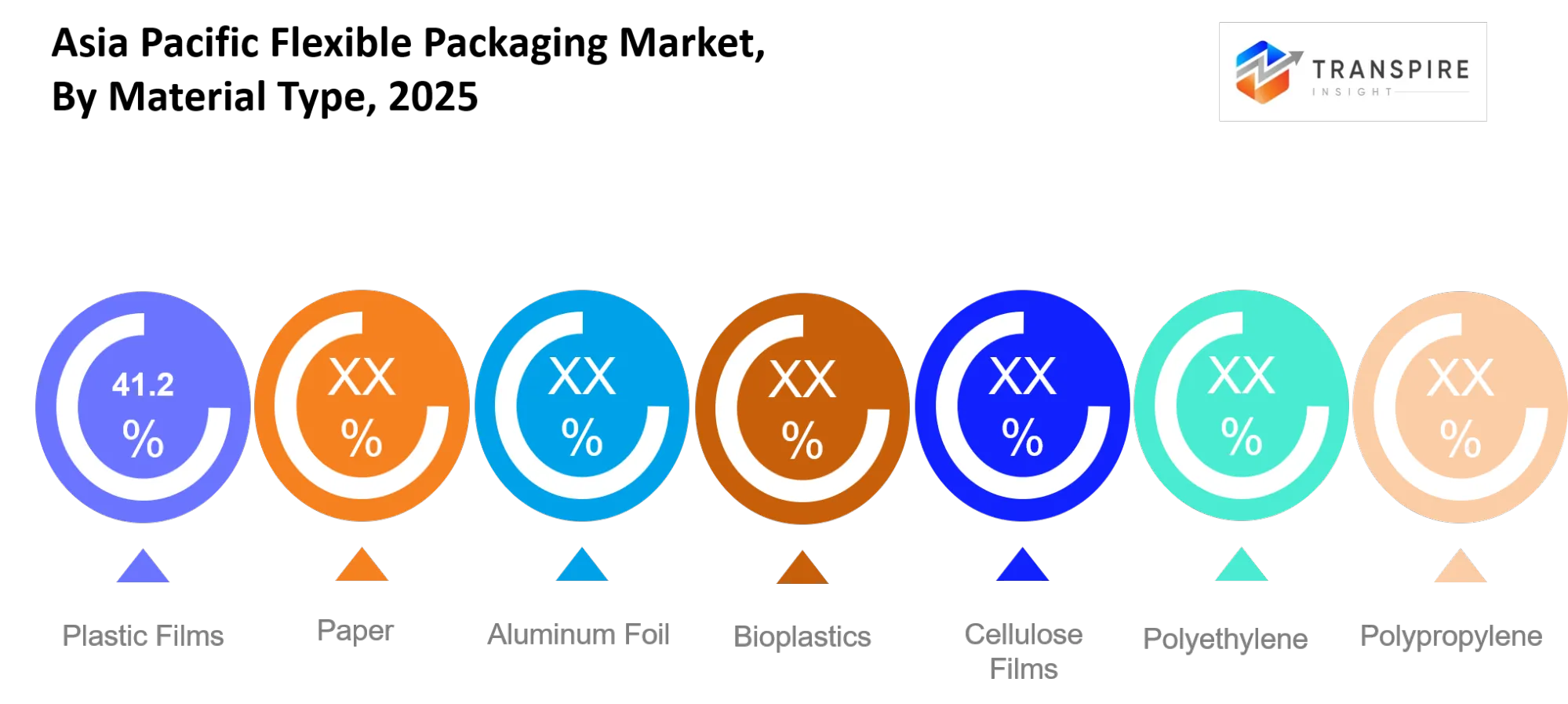
To learn more about this report, Download Free Sample Report
By Product Type:
Pouches have, pretty much, turned into a go-to packaging style because it feels convenient portable and, you know, it uses material in a more efficient way . Stand-up pouches, spouted ones, and designs that reseal have been spreading through food drinks and also household goods , across a bunch of product categories. The fact they look good on shelves, plus the lowered shipping bills, has helped more manufacturers pick them up. At the same time product developers keep rolling out new variations, aiming to make life easier for consumers while also trimming packaging weight a bit.
Meanwhile bags and wraps still play a major part in both retail and industrial settings, mainly because they’re flexible and generally cost effective. Flexible films keep showing up in high volume packing lines where safeguarding the contents and staying efficient during processing are basically the priorities. Interest in niche formats has gone up too , since brands are trying to stand out and improve the way the product is shown. Packaging converters are also working on stronger barrier abilities and extra durability, to line up with the newest customer expectations.
By End-Use Industry:
Food and beverage uses are taking up a big chunk of packaging demand across the region, basically. Things like processed foods, ready-to-eat meals, snacks and drinks all need some kind of packaging that stretches shelf life but still keeps the quality steady. Lately the barrier technology side of things has moved forward a lot which makes it easier for lighter, easier packaging formats to get used more often. At the same time, retail growth and those shifting habits in what people buy keep steering the choices that food producers end up making.
On top of that, the pharmaceutical, personal care, and industrial areas have also been leaning more into flexible packaging solutions, like, quite a bit. For pharma, the goal is to get packaging that helps preserve product integrity and supports safety, while still lining up with regulatory requirements and all that. In personal care, brands are adopting newer packaging styles to boost convenience, plus the shelf appeal, which is kind of a marketing win too. Meanwhile industrial customers often go for these options because they use less material, they store more efficiently , and it can translate into lower transport costs overall.
By Printing Technology:
Flexographic printing is still pretty much the go to option in the industry, mostly because of production efficiency, scalability, and how well it matches up with those big, high volume packaging needs. Over time, the printing quality keeps getting better, which makes it more competitive across food items and regular consumer products. The ability to run at lower operating costs, plus compatibility with a wide range of substrates, is still keeping the demand steady. Packaging converters often lean on flexographic systems, for a steady output, and for that reliable day to day production performance.
Digital printing is also getting more attention, mainly as product catalogs expand and customers want more personalized variations. With shorter production runs, quicker turnaround, and variable data printing capabilities, packaging manufacturers are finding more openings than before. Rotogravure printing keeps being used for premium work, where you need sharp visuals and consistent color balance. Meanwhile, continued technology investments across the printing segment should bring more operational flexibility, and better reaction to whatever the market is asking for next.
What are the Key Use Cases Driving the Asia Pacific Flexible Packaging Market?
Food and beverage packaging still seems like the main thing pushing market adoption across Asia Pacific, at least most manufacturers say so. A lot of them depend on flexible packaging to keep freshness around, stretch shelf life, and make distribution a bit more efficient for snacks, dairy products, frozen foods, beverages, and ready to eat meals. When storage and transportation performance are strong like this, then yeah, it ends up becoming the biggest driver for overall packaging demand.
On the other hand, pharmaceutical and personal care use cases are starting to pick up speed, mainly because product safety requirements are getting more strict. Drug manufacturers are using high barrier packaging more often to shield delicate formulations from moisture and contamination, and personal care brands are shifting toward lighter formats too, because those make day to day convenience better while cutting logistics costs. Also, e-commerce is growing , so durable packaging options across wider consumer categories are being pulled in as well.
There are also newer applications showing up, especially recyclable mono material packaging and bio based packaging formats. Food producers and consumer goods companies are trialing these approaches to match packaging waste rules and those sustainability commitments they’ve been talking about. Then there’s smart packaging, which kind of blends in digital tracking, authentication features, and extra ways to boost consumer engagement. That whole bundle looks promising over the forecast period too.
|
Report Metrics |
Details |
|
Market size value in 2025 |
USD 116.31 million |
|
Market size value in 2026 |
USD 122.99 million |
|
Revenue forecast in 2033 |
USD 182.47 million |
|
Growth rate |
CAGR of 5.8% from 2026 to 2033 |
|
Base year |
2025 |
|
Historical data |
2021 - 2024 |
|
Forecast period |
2026 - 2033 |
|
Report coverage |
Revenue forecast, competitive landscape, growth factors, and trends |
|
Regional scope |
Asia Pacific |
|
Key company profiled |
Amcor, Mondi, Sealed Air, Huhtamaki, Berry Global, Sonoco, Constantia Flexibles, Coveris, UFlex, ProAmpac, DS Smith, Winpak, Clondalkin Group, TC Transcontinental, Glenroy |
|
Customization scope |
Free report customization (country, regional & segment scope). Avail customized purchase options to meet your exact research needs. |
|
Report Segmentation |
By Material Type (Plastic Films, Paper, Aluminum Foil, Bioplastics, Cellulose Films, Polyethylene, Polypropylene, Others) By Product Type (Pouches, Bags, Wraps, Sachets, Films, Liners, Stick Packs, Others) By End-Use Industry (Food & Beverages, Pharmaceuticals, Personal Care, Home Care, Industrial Products, Pet Food, Agriculture, Others) By Printing Technology (Flexography, Rotogravure, Digital Printing, Offset Printing, Screen Printing, Lithography, Hybrid Printing, Others) |
Which Regions are Driving the Asia Pacific Flexible Packaging Market Growth?
Asia Pacific is pretty much leading the market, partly because it has this huge manufacturing base and a very big consumer population, plus a strong sort of clustering around food processing, pharma and other consumer items. China still feels like the main driver there, backed by advanced production know-how, tightly connected supply chains, and a steady stream of investment into packaging technology. On top of that , government pushes for resource efficiency and packaging innovation have nudged manufacturers to upgrade their materials and adjust production methods. There’s also this fairly established setup—raw material suppliers, converters, printing firms, and brand owners all together—so it keeps strengthening regional momentum in a more or less continuous way.
North America sits as the second biggest contributor, but the way it grows is a little different compared with Asia Pacific. Market steadiness is supported by continued investments in packaging innovation, mature retail channels, and solid uptake of premium packaging solutions. Regulatory rules around food safety and product safeguarding add longer term clarity for packaging manufacturers and the end users. Big consumer goods organizations keep spending on packaging redesign and operational efficiency which ends up creating a reliable stream of market income.
Europe is showing the fastest-growing momentum as sustainability rules kind of keep reshaping how packaging is designed across several sectors, honestly. In the meantime the latest policy steps around reducing packaging waste and improving recyclability are pushing firms to spend more on advanced material technologies, and also on circular economy efforts. More brand owners are swapping out traditional package formats for recyclable alternatives just to stay aligned with compliance needs and their own sustainability targets. That shift is opening really solid prospects for tech providers , material specialists and packaging converters, who are looking for growth somewhere between 2026 and 2033, which should be pretty attractive.
Who are the Key Players in the Asia Pacific Flexible Packaging Market and How Do They Compete?
Competition in the Asia Pacific flexible packaging sector is still kinda moderately fragmented, where big global packaging groups show up alongside regional converters, plus a handful of specialized material suppliers. Most players tend to fight mainly on material innovation, sustainability track record, manufacturing scale and also on how well they can deliver customized packaging solutions, you know. Larger companies keep trying to hold or defend market share, through continued investments in recyclable packaging technologies and more advanced production capabilities. Meanwhile, regional firms lean into specific industries, and they also rely heavily on local customer relationships, which can matter a lot. Overall, this competitive environment is gradually rewarding the firms that somehow manage to balance cost efficiency with the regulatory shifts and the sustainability obligations that keep changing.
Amcor puts a strong emphasis on technology innovation and sustainable packaging development, not just one of those things. They distinguish themselves thanks to pretty extensive research programs aimed at recyclable and high-barrier packaging structures, structures that try to cover both product protection needs and environmental outcomes. Their expansion includes collaborations with consumer goods manufacturers and investments in packaging solutions built around circular economy initiatives. Mondi, on the other hand, pursues a strategy that is centered on sustainable materials, along with more integrated packaging capabilities. Their strengths across paper and flexible packaging give Mondi room to propose alternatives that fit evolving regulatory expectations and also match customer sustainability targets.
Huhtamaki really leans into packaging solutions for food and everyday consumer goods , using its solid manufacturing network across several Asian markets. The company’s geographic reach, plus local production, lets it reply faster to regional buyer needs, like more or less right on time.
Berry Global, on the other hand, is more about materials science and lightweight packaging systems, aiming to cut down resource usage while still meeting the performance bar. It’s not just “lighter”; it’s still supposed to behave the same in real use.
UFlex separates itself with a wide set of manufacturing sites, plus flexible packaging conversion abilities and a noticeable footprint throughout many emerging areas in Asia. Also, they keep putting money into production capacity, specialty films, and value-added packaging formats, which helps them push deeper into new markets and stay competitive long term.
Company List
- Amcor
- Mondi
- Sealed Air
- Huhtamaki
- Berry Global
- Sonoco
- Constantia Flexibles
- Coveris
- UFlex
- ProAmpac
- DS Smith
- Winpak
- Clondalkin Group
- TC Transcontinental
- Glenroy
Recent Development News
- In April 2026, Mondi entered multiple OEM collaborations for Interpack 2026. The partnerships enabled live demonstrations of sustainable packaging solutions across food, personal care, e-commerce, and industrial applications, supporting commercialization of recyclable flexible packaging technologies.
https://www.mondigroup.com - In April 2026, Amcor opened an advanced healthcare packaging coating facility in Subang Jaya, Malaysia, backed by an investment exceeding USD 35 million. The project expanded manufacturing capacity in Southeast Asia and strengthened local access to coated medical packaging materials.
https://www.amcor.com
What Strategic Insights Define the Future of the Asia Pacific Flexible Packaging Market?
Over the next five to seven years, the Asia Pacific Flexible Packaging Market is expected to drift toward a more circular and tech driven operating model, sort of like a quieter transition that happens bit by bit. The underlying force behind this shift is the merging of packaging waste rules, corporate sustainability promises, and the ongoing pressure to keep cost efficiency while supply chains get more and more complex. Businesses that manage to pair recyclability with high-performance packaging traits will likely be the ones placed well, since procurement requirements start moving beyond just price, and beyond basic function alone.
There’s also a risk that doesn’t get much spotlight: the growing reliance on a small group of advanced material suppliers and specialty resin producers. As the appetite for recyclable and high barrier packaging structures increases, supply bottlenecks, or even feedstock disruptions, can show up, causing pricing stress and limiting output capacity. This is especially true for converters who don’t have a lot of sourcing freedom, or only a narrow set of alternatives.
At the same time, there is an emerging opening in advanced mono material packaging for packaged food and healthcare uses, across India and Southeast Asia. Regulatory momentum, along with expanding consumer markets, is basically building the right conditions for adoption. Market players should, in parallel, lean into investments for recyclable material platforms, strengthen local conversion capabilities, and also form strategic partnerships with brand owners, so they can lock in long-term competitive edge before industry norms get more tightly set.
Asia Pacific Flexible Packaging Market Report Segmentation
By Material Type
- Plastic Films
- Paper
- Aluminum Foil
- Bioplastics
- Cellulose Films
- Polyethylene
- Polypropylene
- Others
By Product Type
- Pouches
- Bags
- Wraps
- Sachets
- Films
- Liners
- Stick Packs
- Others
By End-Use Industry
- Food & Beverages
- Pharmaceuticals
- Personal Care
- Home Care
- Industrial Products
- Pet Food
- Agriculture
- Others
By Printing Technology
- Flexography
- Rotogravure
- Digital Printing
- Offset Printing
- Screen Printing
- Lithography
- Hybrid Printing
- Others
Frequently Asked Questions
Find quick answers to common questions.
The Expected Asia Pacific Flexible Packaging Market size for the Market will be USD 182.47million in 2033.
Key Segments for the Asia Pacific Flexible Packaging Market are By Material Type (Plastic Films, Paper, Aluminum Foil, Bioplastics, Cellulose Films, Polyethylene, Polypropylene, Others) By Product Type (Pouches, Bags, Wraps, Sachets, Films, Liners, Stick Packs, Others) By End-Use Industry (Food & Beverages, Pharmaceuticals, Personal Care, Home Care, Industrial Products, Pet Food, Agriculture, Others) By Printing Technology (Flexography, Rotogravure, Digital Printing, Offset Printing, Screen Printing, Lithography, Hybrid Printing, Others).
Major Asia Pacific Flexible Packaging Market Players are Amcor, Mondi, Sealed Air, Huhtamaki, Berry Global, Sonoco, Constantia Flexibles, Coveris, UFlex, ProAmpac, DS Smith, Winpak, Clondalkin Group, TC Transcontinental, Glenroy.
The Current Asia Pacific Flexible Packaging Market size is USD 116.31 Million in 2025.
The Asia Pacific Flexible Packaging Market CAGR is 5.8% from 2026 to 2033.
- Amcor
- Mondi
- Sealed Air
- Huhtamaki
- Berry Global
- Sonoco
- Constantia Flexibles
- Coveris
- UFlex
- ProAmpac
- DS Smith
- Winpak
- Clondalkin Group
- TC Transcontinental
- Glenroy
About the Authors

Kartik bhong
I am Kartik Bhong, a Senior Research Analyst at Transpire Insight, specializing in the Packaging, Manufacturing, and Construction industry. My work focuses on analyzing market trends, emerging technologies, industry regulations, and competitive landscapes to deliver accurate, data-driven insights. I am passionate about transforming complex industry information into clear, practical content that helps businesses, professionals, and decision-makers stay informed and make confident strategic decisions. Through continuous research and a strong commitment to accuracy, I strive to create reliable, well-researched content that reflects the latest developments across these dynamic industries and supports the vision of Transpire Insight in delivering valuable market intelligence.

Chakradhar Khansole
Chakradhar serves as the Research Director at Transpire Insight, bringing over 8 years of experience in technology, innovation, and strategic market intelligence. He specializes in transforming complex market data into actionable business insights that enable organizations to make informed, growth-oriented decisions. Recognized for his strategic vision and analytical expertise, Chakradhar leads high-impact research initiatives, delivering comprehensive market assessments, competitive intelligence, and forward-looking industry analysis.
Recently Published Reports
-
Apr 2026
Pharmaceutical Cold Chain Packaging Market
Pharmaceutical Cold Chain Packaging Market By Material (Plastic,(Polyethylene (PE), Polypropylene (PP), Polyethylene Terephthalate (PET), Expanded Polystyrene (EPS), Polyurethane (PU),Others), Paper, Metal, Others), By Product (Small Boxes, Pallets, Large Sized Pallet Containers, Others), By End Use (Biopharmaceutical Companies, Clinical Research Organizations, Hospitals, Research Institutes, Logistics and Distribution Companies, Others)”, By Industry Analysis, Size, Share, Growth, Trends, and Forecasts 2026-2033
-
Apr 2026
Active & Intelligent Packaging Market
Active & Intelligent Packaging Market By Type (Active Packaging, Smart Packaging), By Material (Polymer-Based, Paper & Board-Based, Metal-Based, Glass-Based), By Technology (Time-Temperature Indicators, Freshness Indicators, RFID, Antimicrobial Packaging, Modified Atmosphere Packaging), By Application (Food & Beverages, Pharmaceutical, Cosmetics & Personal Care, Electronics & Consumer Goods, Others), By Industry Analysis, Size, Share, Growth, Trends, and Forecasts 2026-2033
-
Apr 2026
Biodegradable Cut Flower Packaging Market
Biodegradable Cut Flower Packaging Market By Material Type (Paper & Paperboard, Biodegradable Plastics, Natural Fibers, Molded Pulp, Others), By Product Type (Sleeves, Wraps, Boxes & Cartons, Bags & Pouches, Inserts & Holders), By Application (Roses, Carnations, Tulips, Chrysanthemums, Mixed Flowers, Others) and By Distribution Channel (Direct Sales, Distributors & Wholesalers, Online Channels), By Industry Analysis, Size, Share, Growth, Trends, and Forecasts 2026-2033
-
May 2026
Pharmaceutical Packaging Market
Pharmaceutical Packaging Market By Material Type (Plastic, Glass, Metal, Paper & Paperboard, Others), By Packaging Type (Bottles, Blister Packs, Vials, Ampoules, Pouches & Sachets, Others) and By End User (Hospitals & Clinics, Retail Pharmacies, Online Pharmacies, Pharmaceutical Manufacturers), By Industry Analysis, Size, Share, Growth, Trends, and Forecasts 2026-2033