
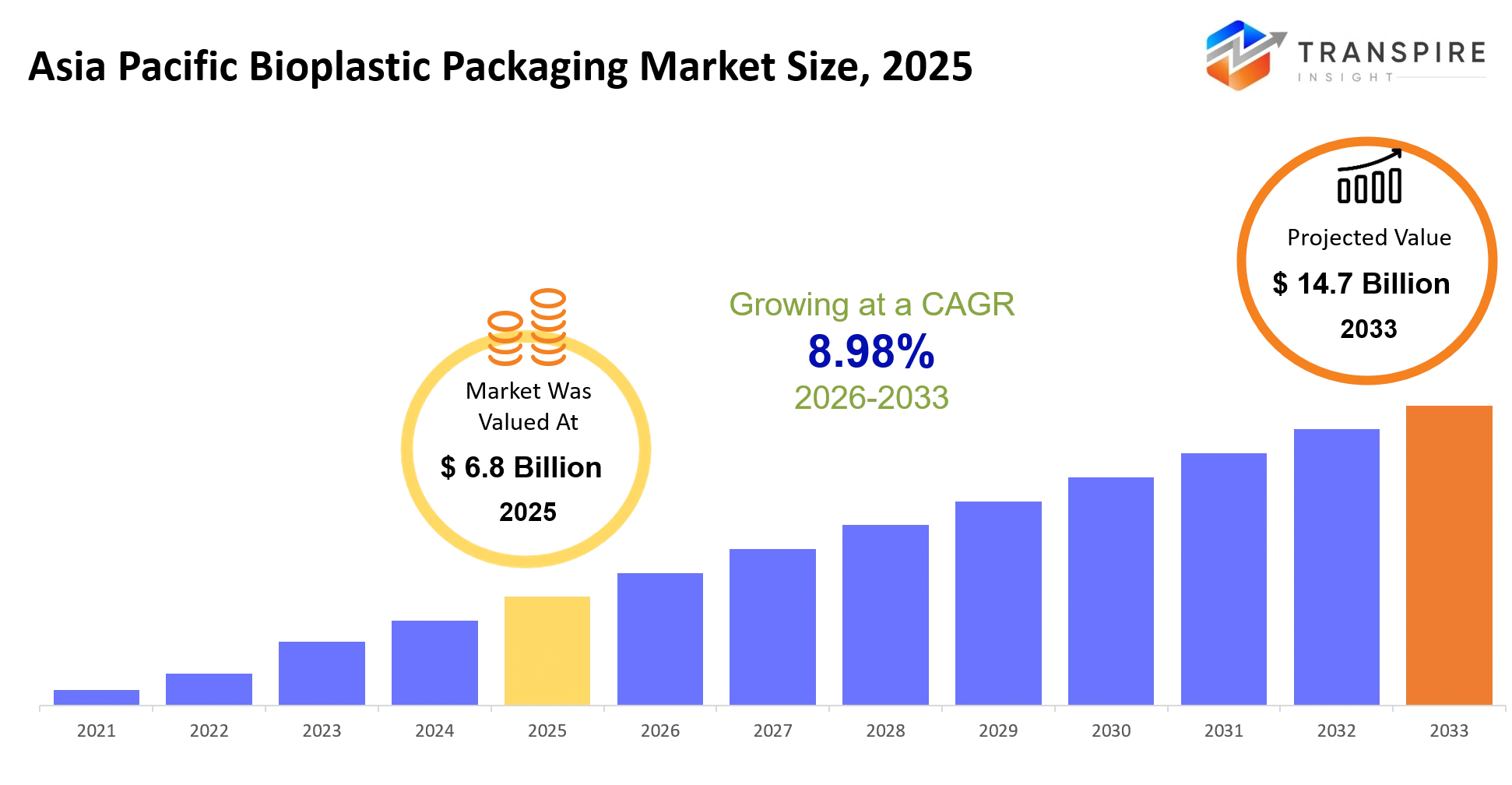
Asia Pacific Bioplastic Packaging Market Size & Forecast:
- Asia Pacific Bioplastic Packaging Market Size 2025: USD 6.8 Billion
- Asia Pacific Bioplastic Packaging Market Size 2033: USD 14.7 Billion
- Asia Pacific Bioplastic Packaging Market CAGR: 8.98%
- Asia Pacific Bioplastic Packaging Market Segments: By Material Type (PLA, PHA, PBS, PBAT, Starch-based Plastics, Others); By Packaging Type (Bottles, Films, Containers, Bags, Pouches, Others); By End User (Food & Beverage, Healthcare, Consumer Goods, Retail, Others); By Application (Flexible Packaging, Rigid Packaging, Industrial Packaging, Others).
To learn more about this report,  Download Free Sample Report
Asia Pacific Bioplastic Packaging Market Summary
The Asia Pacific Bioplastic Packaging Market was valued at USD 6.8 Billion in 2025. It is forecast to reach USD 14.7 Billion by 2033. That is a CAGR of 8.98% over the period.
The Asia Pacific Bioplastic Packaging Market is replacing packaging made from petroleum with materials from natural sources like corn starch, sugarcane and cellulose. This helps companies use plastics made from fuels and meet packaging waste rules in food, retail and industrial supply chains. It also helps brand owners get packaging that meets export market rules where recycling and composting rules are getting stricter.
There has been a change over the years. We have moved from testing bioplastics to actually using them on a large scale. Bioplastics can now compete with plastics when it comes to how long they last and how much they cost.
Governments in countries like India, China and Australia have made rules to limit the use of single-use plastics. This has made companies quickly switch to bioplastics for packaging food and everyday items.Big brands and packaging companies are now using bioplastics. The main reason the Asia Pacific Bioplastic Packaging Market is growing is that companies need to follow these rules and redesign their supply chains.They are doing this so they can follow the rules not because they want to be sustainable. This is making bioplastics a normal part of packaging systems in industries.The Asia Pacific Bioplastic Packaging Market is growing as companies adapt to these rules and make bioplastics a key part of their packaging systems for food and other items and the Asia Pacific Bioplastic Packaging Market is also growing because of this change, to bioplastics.
Key Market Insights
- Asia Pacific Bioplastic Packaging Market is shifting towards adopting bioplastics as a result of regulatory policies. The use of bioplastics is anticipated to rise by 2025 since several regions ban plastic and adopt a new system of packaging.
- The Asia Pacific Bioplastic Packaging Market is witnessing steady growth. There is a possibility that it will grow considerably by 2030 since firms are switching from plastics to bioplastics.
- China and Japan will have a share in the Asia Pacific Bioplastic Packaging Market by 2025 owing to their abundant industrialization and strong regulations for packaging waste.
- The Southeast Asia region is growing the fastest from 2025 to 2032. This is because they have taxes on plastics and are making their packaging better for export.
- Most of the materials used in the Asia Pacific Bioplastic Packaging Market are based on plastics. In 2025 they will make up over 50 percent of the materials used. They are replacing polyethylene in food and consumer packaging.
- Biodegradable packaging is the most used material. This is because companies are trying to be more sustainable and make packaging.
- Food and beverage packaging makes up a part of the Asia Pacific Bioplastic Packaging Market. This is because people use a lot of single-use packaging for food and drinks.
- Personal care and retail packaging are growing the fastest. This is because companies are moving towards packaging.
- Some of the large firms involved in the production of bioplastics include firms such as Natureworks, BASF, TotalEnergies Corbion, Danimer Scientific, and Mitsubishi Chemical. These firms have collaborated in making innovations in developing new products.
- Some of these firms are improving in the development of bioplastics due to their collaborations and innovations using advanced technologies. They are developing bioplastics in new locations as well.
What are the Key Drivers, Restraints, and Opportunities in the Asia Pacific Bioplastic Packaging Market?
Drivers
The Asia Pacific Bioplastic Packaging Market is growing quickly.This is mainly because many countries in that region are setting rules.This started happening after 2021 when India, China and Australia made laws that said companies have to recycle and use less plastic. Now companies that make food and other products have to follow these rules and use bioplastics of regular plastics. This means that companies that make bioplastics can see how money they will make in the future.
Restraints
One big problem is that bioplastics are still more expensive than plastics. This is because there is no material to make bioplastics and not many companies are making them in the Asia Pacific area. The price of corn and sugarcane can also go up and down which makes it hard to know how much bioplastics will cost. This means that many small companies cannot afford to use bioplastics and it slows down the growth of the market.
Opportunities
There is a chance for growth in countries like Japan and South Korea where they are investing in new ways to recycle bioplastics. They are building plants that can turn bioplastics into new products. As this technology gets better companies will start to use bioplastics not just because they have to. Because it is good for the environment. This will create opportunities for companies that make bioplastics and companies that use them to package their products.
What Has the Impact of Artificial Intelligence Been on the Asia Pacific Bioplastic Packaging Market?
The Asia Pacific Bioplastic Packaging Market is changing because of intelligence and new digital technologies. These things are making production better by helping with production control and quality monitoring and supply chain coordination. Manufacturers are using intelligence to automate production. They use it to control the way biopolymers are made and the conditions for molding and packaging. This helps reduce waste and makes the production of bio-based resin consistent.
Computer vision tools are now used to check the packaging in time. This replaces the way of checking quality by hand and it is more accurate. It is used for packaging lines that produce a lot of moving consumer goods.
Machine learning models are being used more and more to predict when machines will break down. They look at how the machines are vibrating and the temperature and how much they are producing. This helps predict when the machines will fail before they actually do. It is estimated that this can increase the time that machines are working by 10 to 20 percent in facilities. Artificial intelligence is also used to forecast demand. This helps producers buy the amount of raw materials and reduces the cost of storing inventory.
These digital systems make production better by reducing downtime and making the quality of the output more stable. They also reduce the amount of energy used when processing polymers. However one big problem is that it is very expensive to add intelligence systems to smaller packaging plants. This is especially true, for machines that do not have the right digital sensors. This makes it hard for smaller producers to use intelligence even though it can make production more efficient. The Asia Pacific Bioplastic Packaging Market is still trying to figure out how to make this work.
Key Market Trends
- The Asia Pacific Bioplastic Packaging Market is experiencing rapid growth. This is attributed to the fact that several countries have been enacting legislations aimed at restricting the use of single-use plastics. In 2021, India and China enacted legislation to restrict the use of single-use plastic.
- This has enabled suppliers of everyday consumer products such as foodstuffs and beverages to incorporate the packaging in their stores. This is contributing to the growth of the Asia Pacific Bioplastic Packaging Market.
- Between 2022 and 2025 people started to like bio-based plastics a lot. Bio-based plastics were used in more than half of the packaging for food and drinks. The Asia Pacific Bioplastic Packaging Market grew as bio-based plastics replaced the plastics that people used before.
- NatureWorks and BASF made bio-based plastics in Asia after 2022. They did this because the Fast Moving Consumer Goods companies needed compostable packaging materials. These companies wanted to use bio-based plastics for their products.
- TotalEnergies Corbion made its supply chain for PLA stronger in 2024. They worked with companies to do this. This helped to make the production of bio-based plastics efficient. TotalEnergies Corbion and other companies made bio-based plastics like PLA because they are better for the environment than plastics.
- The way food packaging was bought changed a lot from 2020 to 2025 as big Fast Moving Consumer Goods brands started to care more about following the rules than the cost.
- After 2023 Southeast Asia became a place where bioplastic packaging was used a lot. This was helped by new taxes on plastic and rules for packaging
- New manufacturing systems that used intelligence were introduced after 2022 and these helped to make biopolymer processing more efficient and reduced waste.
- The demand for packaging went up a lot after 2021 as stores started to use procurement contracts that were linked to sustainability, with global packaging suppliers.
- The competition became stronger as Mitsubishi Chemical and Danimer Scientific worked with Fast Moving Consumer Goods companies to make big changes to their packaging.
Asia Pacific Bioplastic Packaging Market Segmentation
By Material Type
People really like using PLA because it is clear and strong. It is also good for the environment because it can break down easily. Companies that make packaging are using PLA more and more because it is available in places. They are also trying to make it better so it can replace plastic in many things. The Asia Pacific Bioplastic Packaging Market is looking for materials that're good for the environment and can be used in many ways.
PHA and PBS are also popular because they can break down easily and are good for packaging food and medicine. PBAT is useful because it can be mixed with materials to make flexible packaging. Some plastics are made from starch. These are widely used because they are cheap and easy to make. There are materials that are used for special packaging needs.
By Packaging Type
Bottles are becoming more popular for drinks and personal care products because they can break down easily. Films are used a lot for wrapping and protecting things because they are strong and cheap. Containers are used more and more for food and retail storage because they are convenient. The Asia Pacific Bioplastic Packaging Market is always looking for materials that are strong and good for the environment.
Bags and pouches are also popular because they are flexible and can be used for things. There are types of packaging that are used for special needs where the product needs to be safe and sustainable. Companies that make packaging are always trying to design formats that use less plastic and can be recycled. They are changing the way packaging is designed to use materials in the long term.
By End User
Food and drink companies are switching to packaging because the government is pushing them to stop using single-use plastic packaging.This change is happening fast.The healthcare sector is also using packaging because it has to be safe and hygienic for medical use.Companies that make consumer goods are using bioplastic packaging because retailers want them to be more sustainable.Retailers are checking that all packaging, in their supply chains follows the rules.They want to make sure everything is safe and eco-friendly.
Other companies that use packaging include buyers who need protective and transport packaging solutions.These buyers look for materials that are certified as biodegradable.Suppliers of packaging are changing what they offer to meet the needs of sectors.The use of packaging will keep growing as companies have to follow sustainability rules.They have to make sure their packaging is eco-friendly.Companies are working hard to meet these rules.The future of packaging is looking greener.
By Application
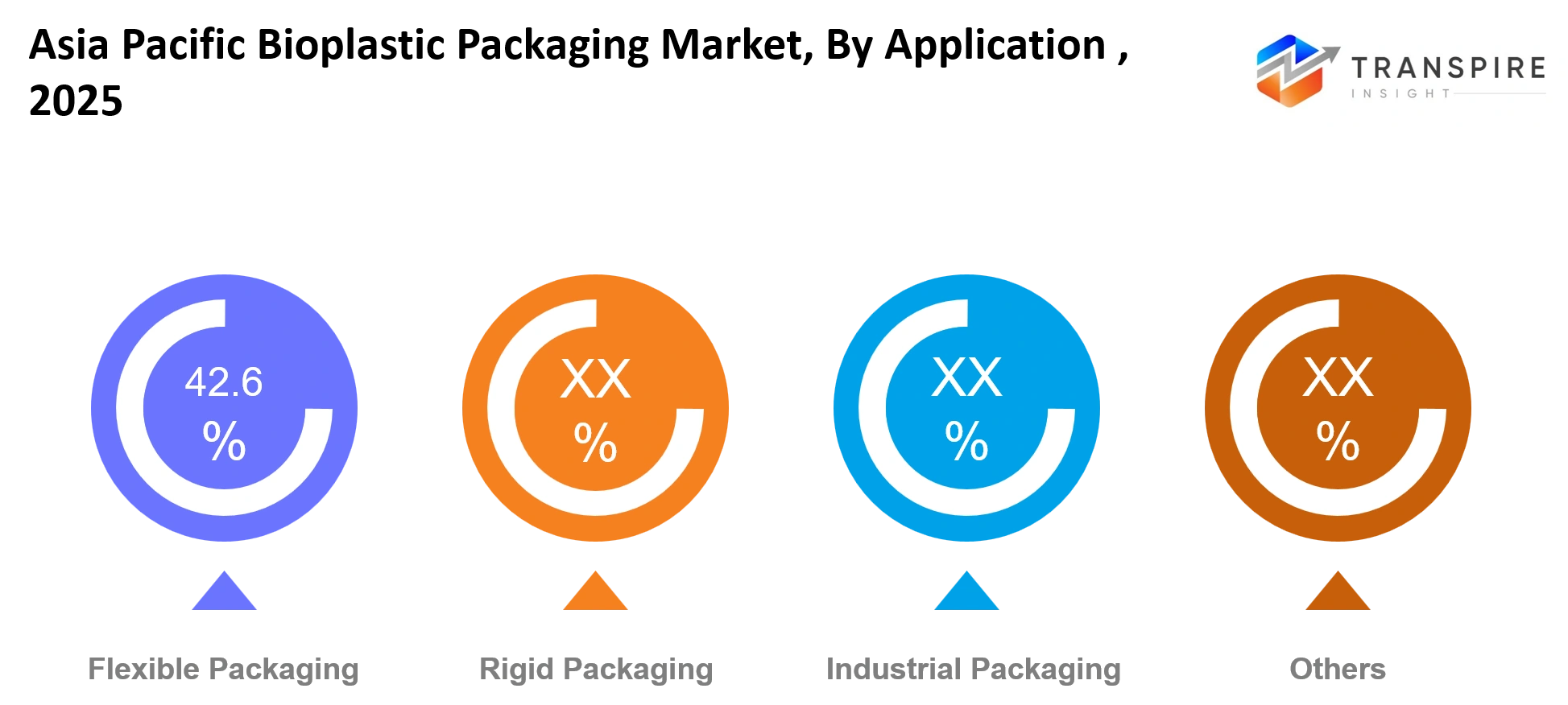
Flexible packaging is popular because it is used for wrapping food and making pouches and lightweight protective films.The rise of rigid packaging can be attributed to the increased use of material for manufacturing bottles and other containers. The rise in industrial packaging can similarly be attributed to the increased use of material to meet logistical requirements and for exporting. The Asia Pacific bioplastic packaging market will always require durable eco-friendly materials.
Flexible packaging will remain popular due to its low cost and large-scale usage in various products. The popularity of rigid packaging is expected to rise on account of the increased durability of materials as well as strict enforcement of policies. Slow growth in industrial packaging is attributed to sustainability policy compliance within supply chains.
The Asia Pacific Bioplastic Packaging Market will continue to grow and be stable, in the term because it is diversifying its applications.
To learn more about this report, Download Free Sample Report
What are the Key Use Cases Driving the Asia Pacific Bioplastic Packaging Market?
The Asia Pacific Bioplastic Packaging Market is doing well because of food and beverage packaging. This is happening because there are rules about using plastic once so companies that make food and drinks have to use materials that can break down naturally for everyday things. People in the Asia Pacific region buy a lot of packaged food and drinks. They also like to eat ready-to-eat meals so there is always a need for things like bags, bottles and containers to pack these things.Companies that make a lot of food and drinks have to follow rules about packaging for stores and for exporting to countries. That is why big companies are starting to use bioplastics when they make things.
Food and drink companies are using packaging because the government wants them to stop using single-use plastic packaging. The healthcare sector is also using packaging because it has to be safe.The packaging used by food and drink companies is getting a lot of attention. These companies want to show that they care about the environment and they want their products to look good on store shelves so people will buy them. The packaging is also popular because it has to be very clean and safe, made from materials that will not hurt people and can break down naturally.
Food and drink companies and the healthcare sector are doing well with packaging. This is because the materials are getting better and governments are starting to accept the Asia Pacific Bioplastic Packaging MarketPeople are starting to use bioplastics when they ship and store things because bioplastics are better for the environment. More and more people are shopping online. The Asia Pacific Bioplastic Packaging Market is being used for online purchases. However, the Asia Pacific Bioplastic Packaging Market will see significant growth due to food and beverage packaging. This market will continue to experience growth with the increasing usage of bioplastics by different firms. In addition, there is a rising demand for bioplastic packaging; hence, the Asia Pacific Bioplastic Packaging Market will continue to utilize packaging.
|
Report Metrics |
Details |
|
Market size value in 2025 |
USD 6.8 Billion |
|
Market size value in 2026 |
USD 8.05 Billion |
|
Revenue forecast in 2033 |
USD 14.7 Billion |
|
Growth rate |
CAGR of 8.98% from 2026 to 2033 |
|
Base year |
2025 |
|
Historical data |
2021 - 2024 |
|
Forecast period |
2026 - 2033 |
|
Report coverage |
Revenue forecast, competitive landscape, growth factors, and trends |
|
Regional scope |
Asia Pacific |
|
Key company profiled |
NatureWorks, BASF, Novamont, TotalEnergies Corbion, Danimer Scientific, Kaneka, Mitsubishi Chemical, Toray, Biome Bioplastics, FKuR, Plantic, Sulzer, Eastman, Green Dot Bioplastics, CJ Biomaterials. |
|
Customization scope |
Free report customization (country, regional & segment scope). Avail customized purchase options to meet your exact research needs. |
|
Report Segmentation |
By Material Type (PLA, PHA, PBS, PBAT, Starch-based Plastics, Others); By Packaging Type (Bottles, Films, Containers, Bags, Pouches, Others); By End User (Food & Beverage, Healthcare, Consumer Goods, Retail, Others); By Application (Flexible Packaging, Rigid Packaging, Industrial Packaging, Others). |
Which Regions are Driving the Asia Pacific Bioplastic Packaging Market Growth?
East Asia holds the leading position in the Asia Pacific Bioplastic Packaging Market due to strong regulatory enforcement, advanced manufacturing capacity, and large-scale FMCG production networks. Countries such as China, Japan, and South Korea enforce strict plastic waste reduction rules that directly push packaging converters toward bio-based alternatives. Well-developed industrial clusters and high-volume export packaging systems further strengthen adoption. Integrated supply chains across chemicals, packaging, and retail support consistent material innovation and large-scale production efficiency.
Southeast Asia contributes as a stable and steadily growing region, supported by expanding consumer markets and gradual policy alignment with global sustainability standards. Unlike East Asia’s regulation-heavy push, this region relies more on retail expansion, tourism-driven consumption, and improving packaging compliance in export industries. Countries such as Thailand, Vietnam, and Indonesia maintain steady investment from multinational FMCG companies that prioritize packaging consistency across regional supply chains. This stability ensures continuous demand for bioplastic materials without sharp policy shocks.
South Asia emerges as the fastest-growing region due to aggressive plastic restriction policies and rapid retail modernization, especially in India. Recent government bans on single-use plastics and incentives for biodegradable alternatives have accelerated adoption across packaging manufacturers. Rapid e-commerce growth and expansion of organized retail channels further increase demand for compostable packaging solutions. For investors and market entrants, this region will offer high-volume expansion opportunities between 2026 and 2033, supported by rising compliance-driven procurement and growing domestic production capacity.
Who are the Key Players in the Asia Pacific Bioplastic Packaging Market and How Do They Compete?
The Asia Pacific Bioplastic Packaging Market shows a moderately fragmented competitive structure where global chemical producers compete with specialized biopolymer innovators and regional packaging converters. Competition intensifies as regulatory mandates force rapid substitution of conventional plastics, allowing both incumbents and new entrants to scale quickly. Large firms defend their position through integrated supply chains and long-term FMCG contracts, while smaller companies disrupt pricing and innovation cycles with niche biodegradable solutions. Technology performance, feedstock efficiency, and compliance certification act as the main competitive levers rather than price alone.
NatureWorks strengthens its position through technology leadership in PLA-based materials, focusing on high-performance compostable resins for food packaging applications. The company expands through capacity investments in Asia and long-term supply agreements with FMCG manufacturers seeking scalable bio-based packaging solutions. BASF applies a diversified polymer strategy, combining biodegradable and partially bio-based materials while leveraging its global R&D network to improve material durability and processing efficiency.
TotalEnergies Corbion focuses on integrated PLA production with strong emphasis on supply chain control and feedstock optimization, supporting large-scale industrial packaging demand. Danimer Scientific differentiates through PHA-based biodegradable materials that offer marine degradability, targeting premium sustainable packaging segments. Mitsubishi Chemical expands through regional partnerships and material innovation programs, strengthening its footprint in flexible packaging solutions across Asia driven FMCG markets.
Company List
- NatureWorks
- BASF
- Novamont
- TotalEnergies Corbion
- Danimer Scientific
- Kaneka
- Mitsubishi Chemical
- Toray
- Biome Bioplastics
- FKuR
- Plantic
- Sulzer
- Eastman
- Green Dot Bioplastics
- CJ Biomaterials
Recent Development News
"In January 2026, CJ CheilJedang expanded its Hetbahn Rice Plan portfolio with additional slow-aging instant rice products. The expansion strengthened the company’s position in South Korea’s staple food market by targeting growing demand for healthier rice-based convenience foods and functional staple products.
Source: https://apps.fas.usda.gov
"In January 2026, Ottogi launched two ‘High-Protein Cup Noodles’ products that surpassed 1 million units in sales within one month. The successful product launch reinforced the company’s presence in South Korea’s staple food segment and highlighted strong consumer interest in healthier instant noodle alternatives.
Source: https://apps.fas.usda.gov
What Strategic Insights Define the Future of the Asia Pacific Bioplastic Packaging Market?
The Asia Pacific Bioplastic Packaging Market is moving toward a structurally regulated substitution model where conventional plastics will gradually be replaced by certified bio-based and compostable materials across FMCG, retail, and export packaging networks. This direction is driven by tightening plastic waste legislation, corporate sustainability mandates, and integration of circular economy frameworks into national packaging policies. Over the next 5 to 7 years, demand will increasingly depend on compliance readiness rather than discretionary sustainability adoption, reshaping procurement behavior across global supply chains.
A less visible risk lies in feedstock concentration and agricultural dependency for key biopolymers such as PLA and starch-based plastics. Any disruption in crop yield cycles or competing demand from food industries can tighten raw material supply and increase price volatility, limiting scalability for mid-tier manufacturers. At the same time, a key emerging opportunity is the development of industrial composting infrastructure linked with extended producer responsibility systems in Southeast Asia, particularly Thailand and Vietnam, where regulatory frameworks are still maturing.
Market participants should prioritize backward integration into feedstock sourcing while investing in region-specific production hubs aligned with upcoming waste management regulations. Companies that secure raw material stability and local compliance alignment will gain stronger long-term positioning across the region.
Asia Pacific Bioplastic Packaging Market Report Segmentation
By Material Type
- PLA
- PHA
- PBS
- PBAT
- Starch-based Plastics
- Others
By Packaging Type
- Bottles
- Films
- Containers
- Bags
- Pouches
- Others
By End User
- Food & Beverage
- Healthcare
- Consumer Goods
- Retail
- Others
By Application
- Flexible Packaging
- Rigid Packaging
- Industrial Packaging
- Others
Frequently Asked Questions
Find quick answers to common questions.
The expected Asia Pacific Bioplastic Packaging Market size for the market will be USD 147.7 Billion in 2033.
Key segments for the Asia Pacific Bioplastic Packaging Market are By Material Type (PLA, PHA, PBS, PBAT, Starch-based Plastics, Others); By Packaging Type (Bottles, Films, Containers, Bags, Pouches, Others); By End User (Food & Beverage, Healthcare, Consumer Goods, Retail, Others); By Application (Flexible Packaging, Rigid Packaging, Industrial Packaging, Others).
Major Asia Pacific Bioplastic Packaging Market players are NatureWorks, BASF, Novamont, TotalEnergies Corbion, Danimer Scientific, Kaneka, Mitsubishi Chemical, Toray, Biome Bioplastics, FKuR, Plantic, Sulzer, Eastman, Green Dot Bioplastics, CJ Biomaterials.
The Asia Pacific Bioplastic Packaging Market size is USD 6.8 Billion in 2025.
The Asia Pacific Bioplastic Packaging Market CAGR is 8.98% from 2026 to 2033.
- NatureWorks
- BASF
- Novamont
- TotalEnergies Corbion
- Danimer Scientific
- Kaneka
- Mitsubishi Chemical
- Toray
- Biome Bioplastics
- FKuR
- Plantic
- Sulzer
- Eastman
- Green Dot Bioplastics
- CJ Biomaterials
About the Authors

Kartik bhong
I am Kartik Bhong, a Senior Research Analyst at Transpire Insight, specializing in the Packaging, Manufacturing, and Construction industry. My work focuses on analyzing market trends, emerging technologies, industry regulations, and competitive landscapes to deliver accurate, data-driven insights. I am passionate about transforming complex industry information into clear, practical content that helps businesses, professionals, and decision-makers stay informed and make confident strategic decisions. Through continuous research and a strong commitment to accuracy, I strive to create reliable, well-researched content that reflects the latest developments across these dynamic industries and supports the vision of Transpire Insight in delivering valuable market intelligence.

Chakradhar Khansole
Chakradhar serves as the Research Director at Transpire Insight, bringing over 8 years of experience in technology, innovation, and strategic market intelligence. He specializes in transforming complex market data into actionable business insights that enable organizations to make informed, growth-oriented decisions. Recognized for his strategic vision and analytical expertise, Chakradhar leads high-impact research initiatives, delivering comprehensive market assessments, competitive intelligence, and forward-looking industry analysis.
Recently Published Reports
-
Apr 2026
Pharmaceutical Cold Chain Packaging Market
Pharmaceutical Cold Chain Packaging Market By Material (Plastic,(Polyethylene (PE), Polypropylene (PP), Polyethylene Terephthalate (PET), Expanded Polystyrene (EPS), Polyurethane (PU),Others), Paper, Metal, Others), By Product (Small Boxes, Pallets, Large Sized Pallet Containers, Others), By End Use (Biopharmaceutical Companies, Clinical Research Organizations, Hospitals, Research Institutes, Logistics and Distribution Companies, Others)”, By Industry Analysis, Size, Share, Growth, Trends, and Forecasts 2026-2033
-
Apr 2026
Active & Intelligent Packaging Market
Active & Intelligent Packaging Market By Type (Active Packaging, Smart Packaging), By Material (Polymer-Based, Paper & Board-Based, Metal-Based, Glass-Based), By Technology (Time-Temperature Indicators, Freshness Indicators, RFID, Antimicrobial Packaging, Modified Atmosphere Packaging), By Application (Food & Beverages, Pharmaceutical, Cosmetics & Personal Care, Electronics & Consumer Goods, Others), By Industry Analysis, Size, Share, Growth, Trends, and Forecasts 2026-2033
-
Apr 2026
Biodegradable Cut Flower Packaging Market
Biodegradable Cut Flower Packaging Market By Material Type (Paper & Paperboard, Biodegradable Plastics, Natural Fibers, Molded Pulp, Others), By Product Type (Sleeves, Wraps, Boxes & Cartons, Bags & Pouches, Inserts & Holders), By Application (Roses, Carnations, Tulips, Chrysanthemums, Mixed Flowers, Others) and By Distribution Channel (Direct Sales, Distributors & Wholesalers, Online Channels), By Industry Analysis, Size, Share, Growth, Trends, and Forecasts 2026-2033
-
May 2026
Pharmaceutical Packaging Market
Pharmaceutical Packaging Market By Material Type (Plastic, Glass, Metal, Paper & Paperboard, Others), By Packaging Type (Bottles, Blister Packs, Vials, Ampoules, Pouches & Sachets, Others) and By End User (Hospitals & Clinics, Retail Pharmacies, Online Pharmacies, Pharmaceutical Manufacturers), By Industry Analysis, Size, Share, Growth, Trends, and Forecasts 2026-2033