
Asia Pacific Sustainable Packaging Market Size & Forecast:
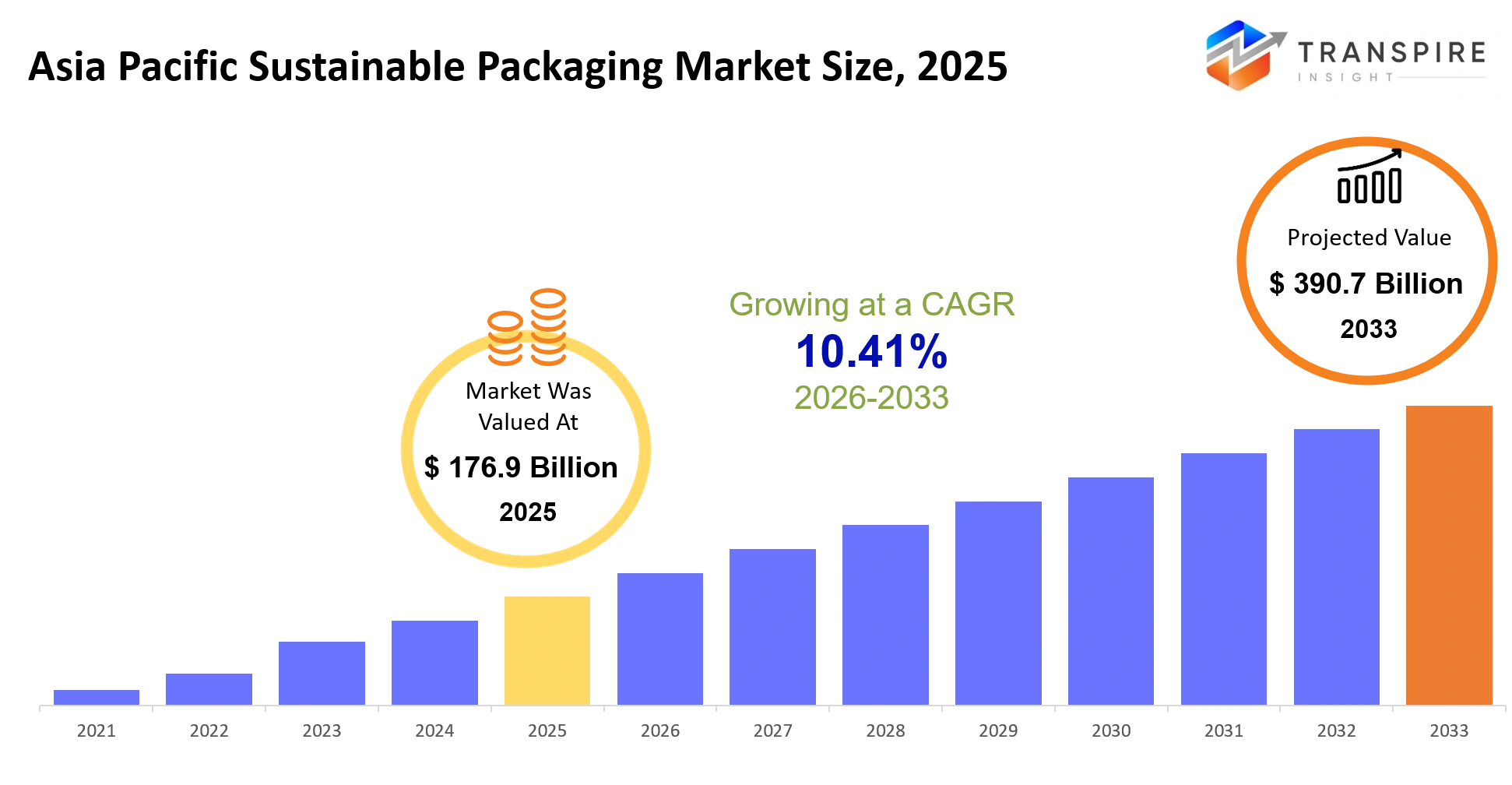
- Asia Pacific Sustainable Packaging Market Size 2025: USD 176.9 Billion
- Asia Pacific Sustainable Packaging Market Size 2033: USD 390.7 Billion
- Asia Pacific Sustainable Packaging Market CAGR: 10.41%
- Asia Pacific Sustainable Packaging Market Segments: By Material (Paper, Bioplastics, Recycled Plastic, Glass, Metal, Compostable Materials, Others); By Packaging Type (Bottles, Pouches, Boxes, Trays, Bags, Others); By End User (Food & Beverage, Healthcare, Personal Care, Retail, Others); By Function (Reusable, Recyclable, Compostable, Others).
To learn more about this report,  Download Free Sample Report
Asia Pacific Sustainable Packaging Market Summary
The Asia Pacific Sustainable Packaging Market was valued at USD 176.9 USD Billion in 2025. It is forecast to reach USD 390.7 Billion by 2033. That is a CAGR of 10.41% over the period.
The Asia Pacific Sustainable Packaging Market is aimed at addressing a real-life problem that manufacturers, retailers, and logistics companies are currently facing – the need to package their products in such a way that minimizes waste material usage, facilitates recycling, and reduces environmental footprint. Sustainable packaging has now emerged as a valuable tool that enables companies not only to respond to customer demands and environmental protection legislation but also effectively manage the use of resources throughout the entire supply chain. This product can be highly beneficial for various industries including food, beverages, health care, personal care, and eCommerce.
In the past three to five years, the market in question has seen significant shifts towards circular packaging solutions characterized by enhanced recyclability, reusability, and incorporation of post-consumer content into new products.What mainly drives such a trend stems from the introduction of tighter plastic waste regulation along with extended producer responsibility initiatives in multiple nations in the Asia Pacific region. The rise in expenses connected to traditional packages, as well as investment into new environmentally friendly solutions, which include paper-based products, biodegradable and recycled materials, have compelled brands to reconsider their existing packaging lineup..
Key Market Insights
- The Asia Pacific Sustainable Packaging Market is doing well because of rules about packaging waste, which is creating a lot of demand from the food, beverage, healthcare and retail industries.
- East Asia is the player in the region with over 45 percent of the market share by 2025 because it has really good manufacturing capabilities.
- Southeast Asia has been found to be a rapidly emerging region. It will continue emerging up to 2032. The reasons include increased online purchases and investments made towards environmentally friendly packaging.
- The most adopted packaging material in the Asia Pacific region is paper packaging since paper is one of the materials that can easily be recycled and which is favored by the government. Actually, paper packaging accounts for more than 35 percent of the market.
- Secondly, packaging made from plastic is the next preferred packaging since many companies are utilizing recycled plastic packaging to achieve their sustainability goals.
- There is also a kind of packaging that is becoming popular and that is compostable and bioplastic packaging. This is happening because of technology and government rules that support it. Southeast Asia and the Asia Pacific Sustainable Packaging Market are really into this kind of packaging.
- The major consumers of sustainable packaging in the market are food and beverages, accounting for roughly 40 percent of the market demand.
- Online shopping packaging is becoming really popular because online retailers are using recyclable and reusable packaging.
- Here, the users of sustainable packaging products are retail companies and consumer goods companies while health care companies have started using sustainable packaging.
- Some of the companies that would succeed the most in the Asia Pacific region's sustainable packaging market are Amcor, Mondi, Smurfit Westrock, Berry Global, Huhtamaki, and Tetra Pak.
What are the Key Drivers, Restraints, and Opportunities in the Asia Pacific Sustainable Packaging Market?
Driver
One of the major factors driving the rapid growth of the Asia Pacific Sustainable Packaging Market is that governments are setting packaging waste legislation and making corporations liable for their actions. In particular, they have decided against single-use plastics, encouraging recycling, and placing liability on businesses to account for what they have produced. As a result, companies that manufacture goods and those that have ownership in brands are forced to modify their packaging practices, requiring them to purchase recyclable paper materials as well as those that decompose, in addition to environmentally friendly packaging. Since corporations must comply with such legislations to operate, the manufacturers of packaging have been receiving orders and are benefiting financially from environmentally friendly packaging.
Restraints
The lack of an efficient recycling and waste processing framework within certain nations is one of the most significant challenges to the development of sustainable packaging practices. It is so because the implementation of such systems requires a great deal of financial resources and time investment. With regards to eco-friendly packaging, it is rather inefficient if there is no reliable way of disposing of packaging products properly. This leads to the underutilization of the potential sales capacity of companies producing packaging and subsequent losses. Such a factor negatively impacts the growth of the Asia Pacific Sustainable Packaging Market.
Opportunity
As the market is expected to grow significantly in the future due to innovations, there is an opportunity for the industry to develop further through the creation of sustainable packaging solutions made of natural fibers. There has been a considerable increase in investments into molded fiber, specialty paper and recyclable flexible packaging solutions in the Asian Pacific region. Particularly, the use of natural fiber-based packaging materials is on the rise in China, India, and Southeast Asia. Further progress in the production of these products will contribute greatly to the growth of the Asia Pacific Sustainable Packaging Market.
What Has the Impact of Artificial Intelligence Been on the Asia Pacific Sustainable Packaging Market?
The Asia Pacific Sustainable Packaging Market is changing because of intelligence and new digital technologies. These things are helping to make materials more efficient, automate production and make supply chains more visible. Packaging manufacturers are using intelligence to check the quality of their products. This artificial intelligence uses computer vision to find problems, watch how materials are used and make production better in time. This helps to reduce waste, make things more consistent and helps companies reach their sustainability goals while saving money.Some companies are also using twins and smart factories to test how packaging will work before it is made. This helps to make the process of making packaging faster and gets it to market sooner.
Artificial intelligence is also being used to predict what people will buy, how much inventory is needed and when machines need to be fixed. By looking at production data these tools help manufacturers to not have to stop production much use their machines better and save energy. These tools also help to make packaging better by finding ways to use material without hurting the product. As a result companies are working efficiently following rules better and saving money on packaging.
One big problem is that it costs a lot to add intelligence to old manufacturing systems. Many packaging companies also have trouble because their data is not all in one place and they do not have good data to make accurate predictions. This can make it harder to use intelligence in all of their production facilities.
Key Market Trends
- Since 2020 many countries in the Asia Pacific area have made rules about single-use plastic much stricter. This has made companies start using packaging that can be recycled, like paper and fiber-based packaging and packaging that can break down naturally.
- Big brands have changed the way they buy packaging between 2021 and 2025. They now prefer to buy from companies that can prove their packaging is made from materials and can track where it comes from.
- Companies that make packaging are using complicated designs like using one type of material instead of many. This makes it easier to recycle and gets rid of waste.
- Because more people are buying things online after 2020 packaging companies have to make packaging that's lighter and uses less material. This helps cut down on shipping costs.
- Companies like Amcor, Mondi and Huhtamaki are spending money on packaging that can be recycled. They are doing this to meet the sustainability rules that retailers have.
- More companies in the Asia Pacific area are using printing. This means they can make less packaging and cut down on waste.
- Companies such as Amcor, Mondi and Huhtamaki are investing in recyclable packaging. The rationale behind this strategy is the need to satisfy the requirements set by retailers for sustainable development.
- Food and beverage producers use recycled materials in the production of their packaging due to the introduction of governmental regulations that require the recycling of packaging.
- After 2022 Southeast Asia became a place for companies to invest in. This is because they are making things and their rules about waste are changing.
- Since 2021 packaging companies, retailers and recycling companies have been working together more. They are doing this to create a system in the Asia Pacific region where things can be used again and again.
Asia Pacific Sustainable Packaging Market Segmentation
By Material:
The choice of material relative to packaging in the Asia Pacific region is quite important. The producers always look for material which is friendly to the environment but at the same time protects the contents packed in them. They have to be able to withstand transportation till the destination point. Due to the growing pressure on environmental issues, it becomes even more necessary to have packages that take little from natural resources. Furthermore, there are always discoveries of better packaging materials all the time.
Increasingly many organizations are focusing on sustainable packaging due to the desire to join the circular economy. In order to become a part of such an economy, there is a need for packaging which is recyclable and sustainable. Companies strive to provide sustainable packaging solutions that would be easily recyclable and compatible with current infrastructure. When material providers packaging manufacturers and consumer goods manufacturers collaborate they develop sustainable packaging solutions for use by companies from various industries.
By Packaging Type:
Packaging aesthetics and ergonomics have been in constant change. Companies attempt to achieve the optimal packaging balance between protecting the product being cost-effective and convenient for consumers and being sustainable. The development of innovative packaging makes it more material while remaining effective and visually appealing when displayed in stores. Packaging manufacturers are working on new designs of packages that can reduce expenses in the distribution chain. The rapid expansion of consumer goods markets affects packaging design in the region under consideration.
Generation of ideas is an important step toward improving packaging design. Companies spend resources on the development of packaging which is beneficial from multiple perspectives such as efficiency in storage, lower cost of transportation and recyclability. These packaging design priorities result in creation of environmentally friendly packaging. Growing consumer interest in sustainable production processes leads to improvement of packaging design practices.
By End User:
The businesses that employ packaging solutions have some input into packaging design and its degree of sustainability. Various industries have different requirements concerning packaging that can preserve the integrity and compliance of their goods. Presently, businesses have an increasing need for sustainable packaging solutions, as the requirement affects the purchasing decision. Suppliers of packaging services offer a variety of packaging options that suit different industries.
Changing needs from companies on the attributes of packaging are coming about. Companies want packaging that works effectively, sustainably, and one that is customized according to their needs. Being environmentally sustainable is increasingly becoming part of a company’s supply chain strategy in various sectors, hence room for innovation. Product preservation, consumer satisfaction, adherence to laws, and sustainability are among the reasons why companies invest in packaging.
By Function:
Package effectiveness is vital to packaging. Packaging should ensure the safety of the products contained in it. Package recovery, reuse, and reduction can lead to savings and preservation of natural resources. Businesses have started working on package design that improves product longevity and contributes towards environmental protection. Concern about package effectiveness has made companies capable of achieving their business objectives and doing it in an environmentally responsible way.
Companies operating in the packaging sector are making efforts to create technologies that would allow them to improve package effectiveness. Improved material recovery, package design, and processing technology contribute to the application of sustainable packaging. Regulation and corporate sustainability programs promote environmentally friendly packaging design as well. Therefore, package effectiveness is directly related to long-term sustainable strategies used by firms within the packaging sector.
To learn more about this report, Download Free Sample Report
What are the Key Use Cases Driving the Asia Pacific Sustainable Packaging Market?
Food and beverage packaging is still the thing that people use sustainable packaging for in Asia Pacific. The people who make these things use materials that're good for the earth to keep their products safe, make them last longer and follow the rules about packaging waste. Because people buy a lot of these things and buy them often this is where most of the packaging is used.
The packaging for healthcare and personal care things is getting bigger because companies have to follow rules and be kind to the earth. Companies are using packaging that can be recycled and does not waste resources for medicines, medical things, makeup and hygiene things. Stores are also using packaging because they want to be good to the earth and make their customers happy.
There are things happening with packaging for online shopping and packaging that can be used again. Online stores are trying out packaging ideas that use less material and keep the things inside safe when they are being sent. Packaging that can be used again and special packaging that can turn into compost are also becoming popular because governments are making rules to reduce waste and make the earth a cleaner place, in Asia Pacific.
|
Report Metrics |
Details |
|
Market size value in 2025 |
USD 176.9 Billion |
|
Market size value in 2026 |
USD 195.3 Billion |
|
Revenue forecast in 2033 |
USD 390.7 Billion |
|
Growth rate |
CAGR of 10.41% from 2026 to 2033 |
|
Base year |
2025 |
|
Historical data |
2021 - 2024 |
|
Forecast period |
2026 - 2033 |
|
Report coverage |
Revenue forecast, competitive landscape, growth factors, and trends |
|
Regional scope |
Asia Pacific (India, China, Japan, Australia, South Korea, Rest of Asia Pacific) |
|
Key company profiled |
Amcor, Mondi, Smurfit Westrock, DS Smith, Berry Global, Huhtamaki, Sealed Air, Sonoco, UFlex, Tetra Pak, Stora Enso, Ball Corp, Crown Holdings, ProAmpac, Coveris. |
|
Customization scope |
Free report customization (country, regional & segment scope). Avail customized purchase options to meet your exact research needs. |
|
Report Segmentation |
By Material (Paper, Bioplastics, Recycled Plastic, Glass, Metal, Compostable Materials, Others); By Packaging Type (Bottles, Pouches, Boxes, Trays, Bags, Others); By End User (Food & Beverage, Healthcare, Personal Care, Retail, Others); By Function (Reusable, Recyclable, Compostable, Others). |
Which Regions are Driving the Asia Pacific Sustainable Packaging Market Growth?
East Asia leads the Asia Pacific Sustainable Packaging Market due to strong regulatory enforcement, advanced manufacturing capabilities, and well-established recycling infrastructure. China, Japan, and South Korea have introduced packaging waste reduction policies that encourage investment in recyclable and recycled-content materials. Large consumer goods companies and packaging producers operate extensive production networks across the region, supporting rapid commercialization of new packaging technologies. Strong research capabilities and integrated supply chains continue to reinforce regional leadership.
Oceania represents the second most significant regional contributor, although growth dynamics differ from those in East Asia. Australia and New Zealand benefit from stable regulatory implementation, consistent corporate sustainability programs, and mature retail sectors. Packaging adoption is driven by long-term environmental targets and steady investment rather than large-scale manufacturing expansion. This stability creates a reliable revenue base for packaging suppliers and material developers.
Southeast Asia is the fastest-growing region as governments increase focus on waste management and circular economy initiatives. Recent investments in recycling facilities, packaging manufacturing capacity, and e-commerce logistics networks have accelerated market development. International brands are expanding sustainable packaging programs across Indonesia, Vietnam, Thailand, and the Philippines to meet both regulatory and consumer requirements. Growth across these markets will create attractive opportunities for new entrants, material innovators, and investors between 2026 and 2033.
Who are the Key Players in the Asia Pacific Sustainable Packaging Market and How Do They Compete?
The competitive landscape of the Asia Pacific Sustainable Packaging Market remains moderately consolidated, with global packaging groups competing alongside regional specialists and material innovators. Competition is increasingly centered on material technology, recyclability performance, and the ability to help customers meet regulatory requirements. Large packaging companies are defending market share through research investments and manufacturing scale, while newer participants focus on niche sustainable materials and circular packaging solutions. Success depends less on production volume alone and more on innovation, recycling capabilities, and supply chain integration.
Amcor focuses on technology-driven packaging development, particularly recyclable and recycled-content solutions for food, beverage, and healthcare applications. A broad manufacturing footprint across Asia Pacific allows faster customer support and localized production. Mondi differentiates through integrated paper and packaging operations, giving greater control over raw material sourcing and sustainability performance. Investments in fiber-based packaging and collaborations with consumer brands strengthen market positioning in regions where plastic reduction targets are becoming stricter.
Huhtamaki concentrates on fiber-based and compostable packaging solutions, creating an advantage in food service and takeaway packaging applications. Product development efforts focus on reducing dependence on conventional plastics while maintaining packaging functionality. Smurfit Westrock expands through paper-based packaging innovation and regional capacity growth, while Tetra Pak leverages expertise in carton packaging and recycling partnerships. These strategies help companies build stronger customer relationships and capture opportunities created by circular economy initiatives across Asia Pacific.
Company List
- Amcor
- Mondi
- Smurfit Westrock
- DS Smith
- Berry Global
- Huhtamaki
- Sealed Air
- Sonoco
- UFlex
- Tetra Pak
- Stora Enso
- Ball Corp
- Crown Holdings
- ProAmpac
- Coveris
Recent Development News
"In February 2026, Amcor won two WorldStar Global Packaging Awards 2026 for its AmPrima® recycle-ready packaging technology. The recognition highlights continued investment in recyclable packaging solutions that support circular economy objectives and strengthen sustainable packaging adoption across food packaging applications.
Source: https://www.amcor.com
"In June 2026, Mother Dairy launched India's first naturally degradable milk pouch. The product introduces a packaging format designed to decompose naturally, supporting efforts to reduce plastic waste and accelerate sustainable packaging innovation in the Indian market.
Source: https://m.economictimes.com
"In April 2026, Yonwoo, a packaging company under Kolmar Korea, expanded promotion of paper-based tubes and pouches as plastic supply disruptions increased interest in alternative packaging materials. The development accelerated customer adoption of lower-plastic packaging formats and highlighted growing commercial opportunities for fiber-based packaging solutions across Asia.
Source: https://www.reuters.com
What Strategic Insights Define the Future of the Asia Pacific Sustainable Packaging Market?
The Asia Pacific Sustainable Packaging Market is moving toward a circular packaging model where material recovery, reuse, and recyclability will become more important than simple material substitution. Over the next five to seven years, growth will be driven by stricter packaging waste regulations, extended producer responsibility programs, and retailer requirements that increasingly link supplier selection to measurable sustainability performance. Packaging producers that can demonstrate closed-loop solutions and traceable recycled content will be positioned to capture premium contracts and long-term customer relationships.
A less visible risk is the growing dependence on limited supplies of high-quality recycled materials. If collection and recycling infrastructure fail to expand at the same pace as demand, material shortages could increase costs and slow adoption across key industries. At the same time, advanced fiber-based packaging with barrier coatings designed for food and e-commerce applications represents a significant emerging opportunity, particularly in Southeast Asia where regulatory frameworks are strengthening.
Market participants should invest now in recycling partnerships and material recovery networks rather than focusing solely on packaging conversion capacity. Control over recycled feedstock availability is likely to become a major competitive advantage by the end of the forecast period.
Asia Pacific Sustainable Packaging Market Report Segmentation
By Material
- Paper
- Bioplastics
- Recycled Plastic
- Glass
- Metal
- Compostable Materials
- Others
By Packaging Type
- Bottles
- Pouches
- Boxes
- Trays
- Bags
- Others
By End User
- Food & Beverage
- Healthcare
- Personal Care
- Retail
- Others
By Function
- Reusable
- Recyclable
- Compostable
- Others
Frequently Asked Questions
Find quick answers to common questions.
The expected Asia Pacific Sustainable Packaging Market size for the market will be USD 390.7 Billion in 2033.
Key segments for the Asia Pacific Sustainable Packaging Market are By Material (Paper, Bioplastics, Recycled Plastic, Glass, Metal, Compostable Materials, Others); By Packaging Type (Bottles, Pouches, Boxes, Trays, Bags, Others); By End User (Food & Beverage, Healthcare, Personal Care, Retail, Others); By Function (Reusable, Recyclable, Compostable, Others).
Major Asia Pacific Sustainable Packaging Market players are Amcor, Mondi, Smurfit Westrock, DS Smith, Berry Global, Huhtamaki, Sealed Air, Sonoco, UFlex, Tetra Pak, Stora Enso, Ball Corp, Crown Holdings, ProAmpac, Coveris.
The Asia Pacific Sustainable Packaging Market size is USD 176.9 Billion in 2025.
The Asia Pacific Sustainable Packaging Market CAGR is 10.41% from 2026 to 2033.
- Amcor
- Mondi
- Smurfit Westrock
- DS Smith
- Berry Global
- Huhtamaki
- Sealed Air
- Sonoco
- UFlex
- Tetra Pak
- Stora Enso
- Ball Corp
- Crown Holdings
- ProAmpac
- Coveris
About the Authors

Kartik bhong
I am Kartik Bhong, a Senior Research Analyst at Transpire Insight, specializing in the Packaging, Manufacturing, and Construction industry. My work focuses on analyzing market trends, emerging technologies, industry regulations, and competitive landscapes to deliver accurate, data-driven insights. I am passionate about transforming complex industry information into clear, practical content that helps businesses, professionals, and decision-makers stay informed and make confident strategic decisions. Through continuous research and a strong commitment to accuracy, I strive to create reliable, well-researched content that reflects the latest developments across these dynamic industries and supports the vision of Transpire Insight in delivering valuable market intelligence.

Chakradhar Khansole
Chakradhar serves as the Research Director at Transpire Insight, bringing over 8 years of experience in technology, innovation, and strategic market intelligence. He specializes in transforming complex market data into actionable business insights that enable organizations to make informed, growth-oriented decisions. Recognized for his strategic vision and analytical expertise, Chakradhar leads high-impact research initiatives, delivering comprehensive market assessments, competitive intelligence, and forward-looking industry analysis.
Recently Published Reports
-
Apr 2026
Pharmaceutical Cold Chain Packaging Market
Pharmaceutical Cold Chain Packaging Market By Material (Plastic,(Polyethylene (PE), Polypropylene (PP), Polyethylene Terephthalate (PET), Expanded Polystyrene (EPS), Polyurethane (PU),Others), Paper, Metal, Others), By Product (Small Boxes, Pallets, Large Sized Pallet Containers, Others), By End Use (Biopharmaceutical Companies, Clinical Research Organizations, Hospitals, Research Institutes, Logistics and Distribution Companies, Others)”, By Industry Analysis, Size, Share, Growth, Trends, and Forecasts 2026-2033
-
Apr 2026
Active & Intelligent Packaging Market
Active & Intelligent Packaging Market By Type (Active Packaging, Smart Packaging), By Material (Polymer-Based, Paper & Board-Based, Metal-Based, Glass-Based), By Technology (Time-Temperature Indicators, Freshness Indicators, RFID, Antimicrobial Packaging, Modified Atmosphere Packaging), By Application (Food & Beverages, Pharmaceutical, Cosmetics & Personal Care, Electronics & Consumer Goods, Others), By Industry Analysis, Size, Share, Growth, Trends, and Forecasts 2026-2033
-
Apr 2026
Biodegradable Cut Flower Packaging Market
Biodegradable Cut Flower Packaging Market By Material Type (Paper & Paperboard, Biodegradable Plastics, Natural Fibers, Molded Pulp, Others), By Product Type (Sleeves, Wraps, Boxes & Cartons, Bags & Pouches, Inserts & Holders), By Application (Roses, Carnations, Tulips, Chrysanthemums, Mixed Flowers, Others) and By Distribution Channel (Direct Sales, Distributors & Wholesalers, Online Channels), By Industry Analysis, Size, Share, Growth, Trends, and Forecasts 2026-2033
-
May 2026
Pharmaceutical Packaging Market
Pharmaceutical Packaging Market By Material Type (Plastic, Glass, Metal, Paper & Paperboard, Others), By Packaging Type (Bottles, Blister Packs, Vials, Ampoules, Pouches & Sachets, Others) and By End User (Hospitals & Clinics, Retail Pharmacies, Online Pharmacies, Pharmaceutical Manufacturers), By Industry Analysis, Size, Share, Growth, Trends, and Forecasts 2026-2033