
Global Last Mile Delivery Transportation Market Size & Forecast:
- Global Last Mile Delivery Transportation Market Size 2025: USD 182.6 Billion
- Global Last Mile Delivery Transportation Market Size 2033: USD 398.3 Billion
- Global Last Mile Delivery Transportation Market CAGR: CAGR 10.15%
- Global Last Mile Delivery Transportation Market Segments: By Mode (Two-wheelers, Vans, Drones, Autonomous Vehicles), By Application (E-commerce, Food Delivery, Retail, Courier), By End-User (Logistics Companies, E-commerce Firms, Retailers, Consumers)

To learn more about this report,  Download Free Sample Report
Global Last Mile Delivery Transportation Market Summary:
The global last-mile delivery market was valued at USD 182.6 billion in 2025 and is projected to reach USD 398.3 billion by 2033, registering a CAGR of 10.15%during the forecast period (2025-2033).
The marketplace represents the ultimate handover process between a warehouse and its customer's doorstep, focusing on logistics in a localized sense. The sector has grown from a luxury service to a necessity over the last five years due to the "Amazon effect." One of the main changes is the trend towards decentralization and micro fulfilment centres, allowing inventory to be closer to urban centres in order to cut down travel time. The actual driver for the change is the increase in demand for contactless grocery and pharmaceutical deliveries, necessitating carriers to use artificial intelligence in real-time routing and monitoring processes. Thus, the market is growing as density increases, and automated dispatch systems have now enabled high-speed, low-cost deliveries for small- to medium-sized businesses as well.
Key Market Insights:
- The overwhelming 61% dominance gives the sub-segment of vans supremacy in the market, making companies like Amazon and FedEx change the way they run their fleets.
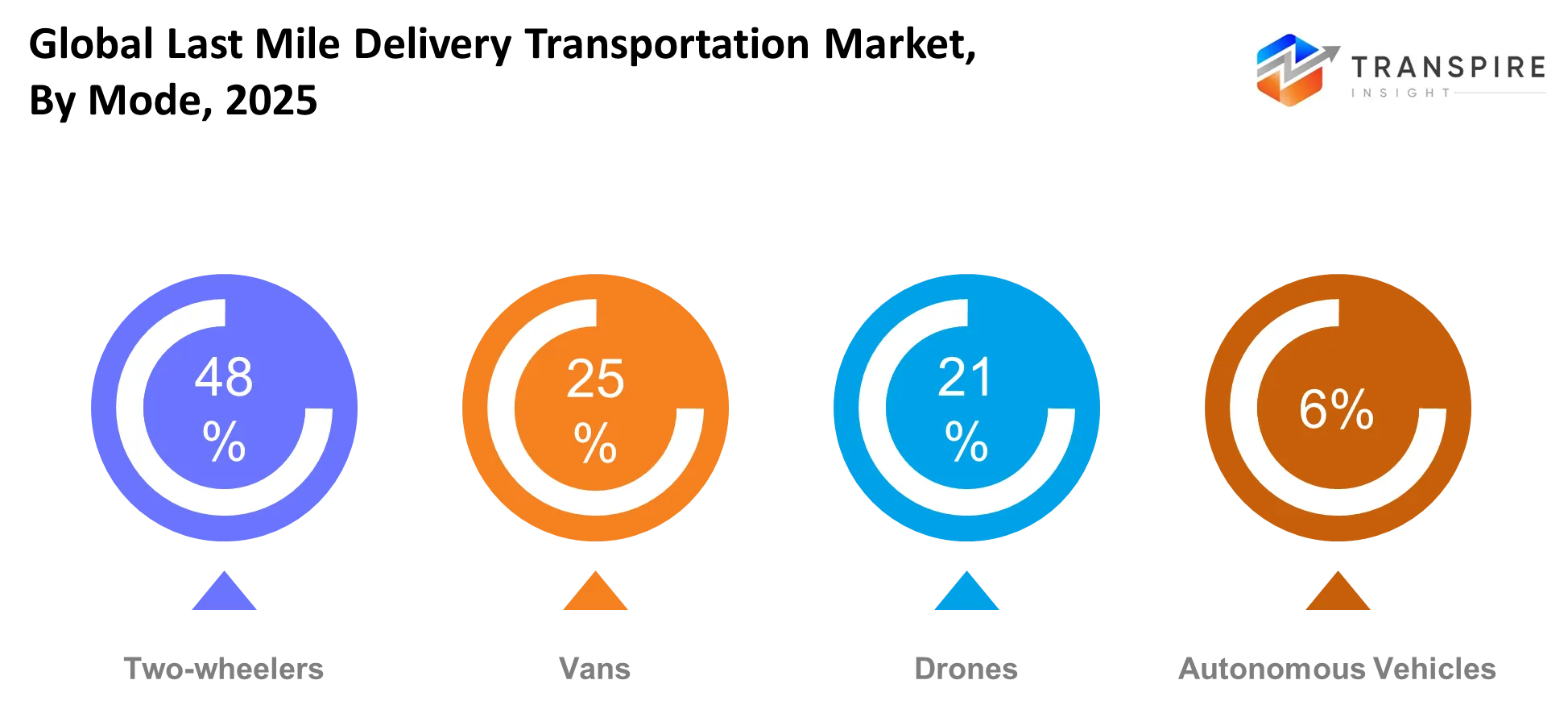
- The operation rate of 48% has made two-wheelers one of the most rapidly growing segments because many logistics companies are trying to cope with the increasing demands from cities.
- The forecasted CAGR of 13.5% shows how quickly the technology and logistics processes develop in terms of the van segment amid infrastructural changes.
- A considerable share of 48% is maintained by two-wheelers, indicating a radical behavioural change towards efficient and highly capable delivery services.
- The noticeable share of 25% is kept by vans in general among other fleet types as an example of balancing between traditional cars and others.
- A considerable share of 21% has been reached by drones as one of the fastest-growing segments that demonstrate technological growth.
- An increasing share of 6% is owned by autonomous vehicles, that indicate a shift in the logistics industry towards self-driving cars.
- The bulk of last-mile operations occurs within the B2C segment, hence necessitating that businesses adopt crowdsourcing techniques to deal with point-of-delivery deliveries.
- There is a crucial number of people living in urban centers, which means that logistic service providers have to introduce Micro-Fulfillment Centers to reduce empty miles costs.
What are the Key Drivers, Restraints, and Opportunities in the Global Last Mile Delivery Transportation Market?
Drivers
The rapid growth in the last-mile delivery industry can be attributed to the advent of e-commerce and the development of Quick Commerce, in which consumers give preference to quickness and tracking capabilities over pricing and are likely to abandon their orders due to the potential for delays. Responding to such concerns directly leads to more purchases and greater acceptance, but since the last mile makes up the bulk of all shipment costs, it must be handled effectively.
Restraints
logistics costs, businesses use Micro Fulfilment Centers to overcome the challenge since 68% of the population lives in urban areas. Changes in the environmental scenario prompt 60% of customers to prefer eco-friendly companies, thus encouraging EV adoption, and AI routes optimization reduces costs by 30% and prevents 20% first-attempt delivery failures
Opportunities
However, there are constraints such as inadequate regional internet connection, the absence of drone landing stations, and rural distance range concerns. In order to capitalize on these trends, logistics companies incorporate automated storage and retrieval systems in MFCs within metropolitan cities to circumvent diesel bans in places like Tokyo, Seoul, London, and Paris. Mega corporations such as Amazon and Alibaba implement the use of synchronized truck-drone algorithms, which allow for parallel transportation in North America and the Middle East suburbs via drones launched from delivery trucks. Lastly, independent operators utilize open-access, refrigerated smart lockers using Bluetooth APIs.
What has the Impact of Artificial Intelligence been on the last-mile delivery transportation market?
The concept of artificial intelligence has radically changed the paradigm within the domain of last-mile delivery services, shifting the emphasis from reactive routing to a robustly proactive digital environment. The underlying principle behind this innovation is its capability to revolutionize logistical efficiency via smart route optimization. In contrast to static navigation tools, AI-driven systems analyze dynamic factors such as gridlock situations, unexpected climatic conditions, and abrupt roadblocks, enabling the system to dynamically calculate the best possible sequence for deliveries.
From an architectural perspective, artificial intelligence has been instrumental in unlocking predictive analytics. Utilizing huge amounts of historical data combined with dynamic parameters such as seasonal variations and regional purchasing behaviour, prediction models enable logistics companies to project package volumes accurately.
A major drawback that has prevented its acceptance across all sectors is the vast disparity between systems. Most older logistics companies have an ageing database system for transporting goods. Combining these old databases with the newer AI algorithms often results in data incompatibility and higher costs during implementation.
AI transforms logistics from a reactive to a proactive environment by providing optimal delivery routes based on real-time calculations. The system predicts package numbers using records, regional purchasing habits, and seasonal factors before their arrival.
Key Market Trends:
- Independent Transition: Combined fleets of air drones and sidewalk robots circumvent urban congestion, resulting in reduced dependence on human drivers for substantial manpower savings.
- Automation by Service: Robot-as-a-Service (RaaS) becomes an alternative to owning robots, thus enabling businesses to use state-of-the-art delivery robots through subscriptions.
- Sustainability Measures: North America's logistics system is based on the "green first" concept; it involves replacing internal combustion engines with electric vehicles to meet consumer demands.
- Crowdsourced Scalability: Exclusive inflexible network structures are replaced by crowdsourced B2C logistics systems that make it easy to handle unexpected changes in demand.
- Localized Logistics: The logistics infrastructure will move away from extensive suburban distribution centers and toward micro-hubs located near consumers for sub-hour deliveries.
- Predictive Routing: GPS technology gives way to more advanced algorithms, which analyze live traffic and weather information to eliminate downtime during transportation processes.
- Delivery without Human Interactions: As a result of expensive attempts at home delivery, autonomous solutions such as smart lockers and drop boxes are favoured.
Global Last Mile Delivery Transportation Market Segmentation:
By Mode
In the category of the Mode segment, vans hold the dominant position with a 61% share and 25% of the market, while two-wheelers dominate the hyper-local deliveries segment with a forecasted 40.93% market share in 2026, making them the fastest-growing sub-segment with a compound annual growth rate (CAGR) of 48%. Meanwhile, the shares of drones are estimated at 21%, while those of autonomous cars are at 6%. Growth rationale behind this segment features a 13.5% CAGR for vans, combined with the emergence of sidewalk robots such as Amazon Scout, bypassing traffic jams for door-to-door deliveries, and drones' leveraging geographic benefits in reducing delivery times in rural and highly urbanized areas. Ground deliveries rely on innovations in artificial intelligence and Global Positioning System technology brought to life by leading companies such as Tesla, Volvo, GM, Nissan, and Renault. Future implications include a tech-heavy transport mix, which comprises autonomous, van-based and rapid two-wheeled delivery options.
To learn more about this report, Download Free Sample Report
By Application
The dominant market share belongs to e-commerce because there has been a lasting change in global consumer behaviour. Large-scale investments in infrastructure and the use of sophisticated routing algorithms manage varied inventories, ensuring that next-day delivery becomes common across the world. Retail and food delivery are merging into a single segment known as "instant commerce." Transitioning from their physical models to digital platforms, they leverage localized mini-hubs to provide on-demand deliveries within minutes. Thus, the old courier model is forced to focus on premium goods across borders and to leverage autonomous bots.
By End-User
Logistics service providers continue to be the major buyers of lead-acid batteries because transitioning from lead-acid batteries to lithium batteries for their large fleets of forklifts does not make economic sense. Lead-acid battery technology is more predictable and easier to recycle, which helps in complying with the environmental disposal requirements. Likewise, in e-commerce, lead-acid batteries are leveraged in automated fulfillment centers to support backup power and energy surges during the peak buying times. In addition, power security needs of both retailers and consumers exist.
What are the Key Use Cases Driving the Global Last Mile Delivery Transportation Market?
The rapid rise of B2C e-commerce serves as the major catalyst behind last-mile logistics. With the routine nature of online shopping, retailers have no choice but to employ micro-fulfilment facilities in cities to reduce transit time and ensure high-velocity fulfilment services. Moreover, the industry is rapidly growing towards healthcare and grocery. Both segments necessitate cold chain capabilities and narrow delivery windows to manage fresh produce and pharmaceutical products. The focus here lies on product quality and "white glove" service rather than mere fast delivery.
Lastly, automation and sustainability contribute to innovation in the industry. The use of drones, sidewalk robots, and electric vehicles in dense urban areas is becoming a common trend due to environmental considerations, while smart lockers provide cost-efficient and convenient parcel pick-up points.
|
Report Metrics |
Details |
|
Market size value in 2025 |
USD 182.6 Billion |
|
Market size value in 2026 |
USD 202.4 Billion |
|
Revenue forecast in 2033 |
USD 398.3Billion |
|
Growth rate |
CAGR of 10.15% from 2026 to 2033 |
|
Base year |
2025 |
|
Historical data |
2021 - 2024 |
|
Forecast period |
2026 - 2033 |
|
Report coverage |
Revenue forecast, competitive landscape, growth factors, and trends |
|
Regional scope |
United States; Canada; Mexico; United Kingdom; Germany; France; Italy; Spain; Denmark; Sweden; Norway; China; Japan; India; Australia; South Korea; Thailand; Brazil; Argentina; South Africa; Saudi Arabia; United Arab Emirates |
|
Key company profiled |
Amazon, UPS, FedEx, DHL, Delhivery, Blue Dart, XPO Logistics, SF Express, JD Logistics, Uber Eats, DoorDash, Zomato, Swiggy, Postmates, Instacart |
|
Customization scope |
Free report customisation (country, regional & segment scope). Avail customised purchase options to meet your exact research needs. |
|
Report Segmentation |
By Mode (Two-wheelers, Vans, Drones, Autonomous Vehicles), By Application (E-commerce, Food Delivery, Retail, Courier), By End-User (Logistics Companies, E-commerce Firms, Retailers, Consumers) |
Which Regions are driving the Global Last Mile Delivery Transportation Market Growth?
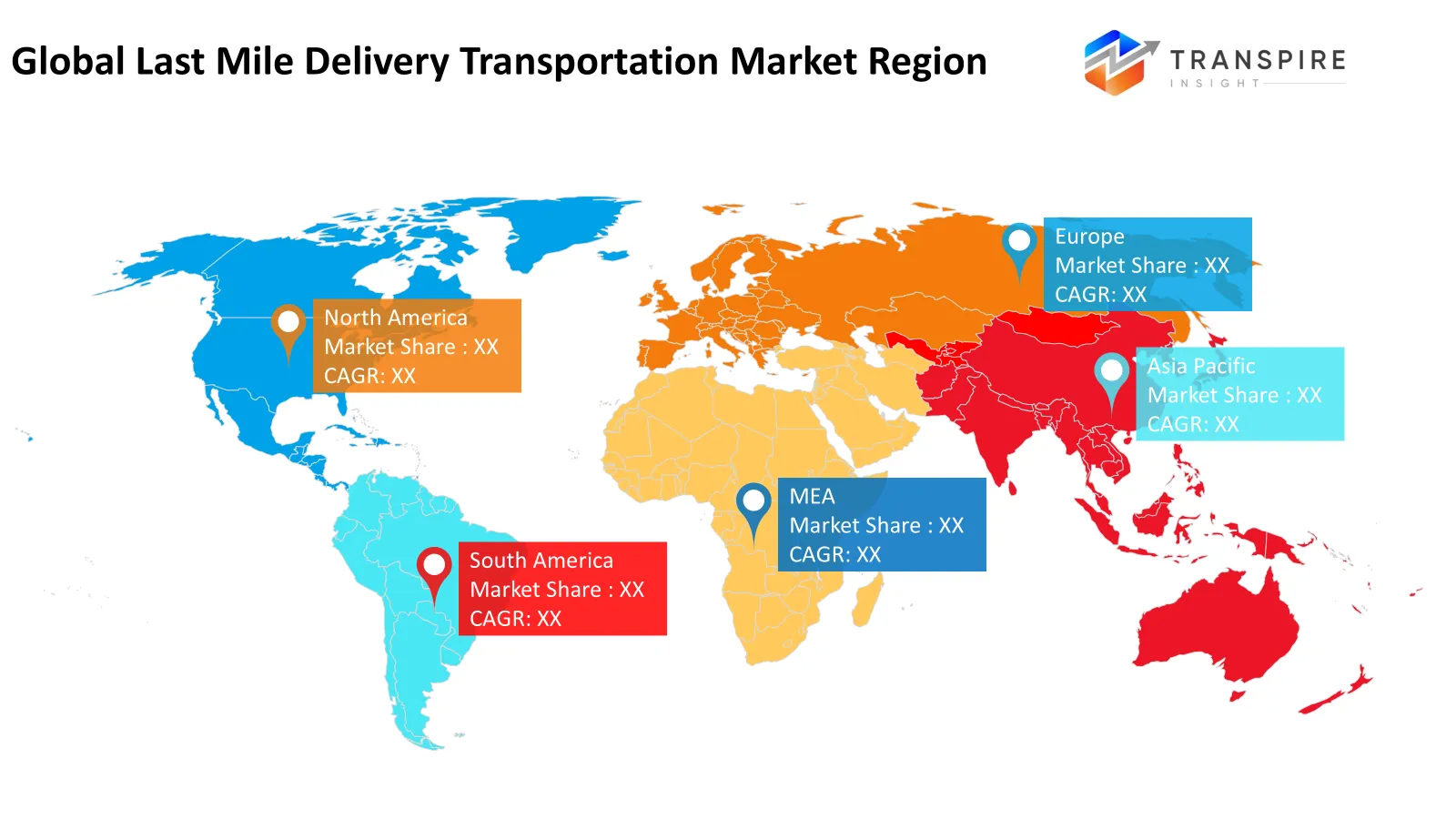
North America is at the forefront, with a dominating market share of 44%, due to its extremely dynamic e-commerce environment. With robust logistics provided by companies such as Amazon and FedEx, North America emerges as the fastest-growing region, boasting a CAGR of 14.9%. Positive regulations aid in the implementation of autonomous vehicles and drones that meet the increasing demands of same-day delivery.
Europe follows close behind, accounting for 25% of global volume. While Western markets drive technology integration, the whole continent is driven by environmental regulations such as the European Union Green Deal. Germany and the United Kingdom are pioneers in resilience with the use of urban micro-hubs and electric vehicles to cut down on carbon emissions.
Asia-Pacific comprises 19% of the market, driven by high levels of urbanization, digitalization by governments, and rapid growth in online retail sectors in China and India. Here, logistics companies work to ensure equal distribution of logistics in both rural areas and urban centers. The rest of the world constitutes 12% of the global market share.
To learn more about this report, Download Free Sample Report
Who are the Key Players in the Global Last Mile Delivery Transportation Market, and how do they compete?
The last-mile delivery industry involves high R&D expenditure, merger and acquisition activities, and efficiency measures to offer cost-effective solutions. Growth in the global industry comes from mergers, acquisitions, inter-industry collaborations, and innovations, particularly in health care logistics.
DHL Group follows a niche innovation strategy to emphasize sustainable logistics and green infrastructure. The company collaborates with Fiat Professional to introduce electric vehicles in its fleets and plans to achieve a 60% electrified fleet by 2030 to remain the leader of European parcel shipping by virtue of environmental superiority.
FedEx Express follows a global-scale strategy as the world's largest cargo airline, serving 220 countries. FedEx Express expands through acquisitions; an example is its acquisition of P2P Mailing Limited at a price of $129.8 million.
Last-mile delivery transportation market companies
- Amazon
- UPS
- FedEx
- DHL
- Delhivery
- Blue Dart
- XPO Logistics
- SF Express,
- JD Logistics
- Uber Eats
- DoorDash
- Zomato
- Swiggy
- Postmates
- Instacart
Recent Development News
In October 2025, PR Newswire reported the release of a logistics industry news report stating that a self-driving urban delivery company at Level 4 managed to raise a Series D capital round exceeding 600 million dollars in October 2025. This significant influx of cash is the biggest capital raising event in the mentioned autonomous vehicle sector within the year, allowing the company to expand its unique cargo van logistics solution into foreign territories.
In April 2026, GlobeNewswire reported a detailed logistics prediction stating that the market leaders are adopting a multi-warehouse delivery strategy as a means to counter urban courier shortages. The shift is being driven by the need to ensure faster delivery times and manage ever-increasing ground transport costs in the region.
What Strategic Insights Define the Future of the Last-mile delivery transportation market?
In last-mile delivery transport, there is an evident transition to a decentralized system for logistics, whereby hyper locality is ensured through the use of automation and regional hubs. In the same vein, while there continues to be emphasis on data-driven routing optimizations, there is a transition from reactive distribution to proactive placement.
An important but often neglected risk in last-mile delivery transport is regulatory backlash, with the increasing likelihood of congestion charging, robot sidewalks, and stringent urban curb-space management policies that may hinder existing delivery models. The emerging opportunities include circular logistics collaborations, where the backhaul capabilities of the delivery trucks are utilized to recycle products or return them to merchants. To take advantage of that, the operators need to move towards building fleets that are not based on fixed assets but rather on a more flexible, tiered approach. By utilizing crowd-sourced labour in conjunction with their own EVs, this is made possible.
Global Military Rotorcraft Market Segmentation
By Mode
- Two-wheelers
- Vans
- Drones
- Autonomous Vehicles
By Application
- E-commerce
- Food Delivery
- Retail
- Courier
By End-User
- Logistics Companies
- E-commerce Firms
- Retailers
- Consumers
Regional Outlook
North America
- United States
- Canada
- Mexico
Europe
- Germany
- United Kingdom
- France
- Spain
- Italy
- Rest of Europe
Asia Pacific
- Japan
- China
- Australia & New Zealand
- South Korea
- India
- Rest of Asia Pacific
South America
- Brazil
- Argentina
- Rest of South America
Middle East & Africa
- Saudi Arabia
- United Arab Emirates
- South Africa
- Rest of the Middle East & Africa
Frequently Asked Questions
Find quick answers to common questions.
The expected global last-mile delivery market size will be USD 398.3 billion in 2033.
Key segments for the global last-mile delivery market are By Mode (Two-wheelers, Vans, Drones, Autonomous Vehicles), By Application (E-commerce, Food Delivery, Retail, Courier), By End-User (Logistics Companies, E-commerce Firms, Retailers, Consumers).
Major global last-mile delivery market players are Accenture Plc, CMA CGM SA Group, Deutsche Post AG, DSV AS, Far Eye Technologies Inc., FedEx Corp., FM LOGISTIC CORP, DHL, Fiat Professional, P2P Mailing Limited, Nuro, Amazon, UPS, Locus Robotics, DoorDash, Wolt, Starship Technologies, Walmart, JD Logistics, Instacart, Uber, Royal Mail, and Cain Iao.
The global last-mile delivery market size is USD182.6 billion in 2025.
The global last-mile delivery market CAGR is 10.15%.
- Amazon
- UPS
- FedEx
- DHL
- Delhivery
- Blue Dart
- XPO Logistics
- SF Express,
- JD Logistics
- Uber Eats
- DoorDash
- Zomato
- Swiggy
- Postmates
- Instacart
About the Authors

Mayur Shinde
I am Mayur Shinde, a Senior Research Analyst at Transpire Insight, specializing in the Automotive & Transportation and Information & Communication Technology (ICT) Industry. My work focuses on analyzing emerging market trends, technological advancements, competitive landscapes, and industry developments to deliver accurate, data-driven insights. I am passionate about transforming complex market information into clear, actionable content that helps businesses, professionals, and decision-makers stay informed and make confident strategic decisions.

Chakradhar Khansole
Chakradhar serves as the Research Director at Transpire Insight, bringing over 8 years of experience in technology, innovation, and strategic market intelligence. He specializes in transforming complex market data into actionable business insights that enable organizations to make informed, growth-oriented decisions. Recognized for his strategic vision and analytical expertise, Chakradhar leads high-impact research initiatives, delivering comprehensive market assessments, competitive intelligence, and forward-looking industry analysis.
Recently Published Reports
-
Apr 2026
ATV & UTV Market
ATV & UTV Market Size, Share & Analysis Report By Type (ATV, and UTV), By Variants (Less Than 400 CC, 400 CC To 800 CC, and More Than 800 CC), and Geography (North America, Europe, Asia-Pacific, Middle East and Africa, South and Central America), 2021 - 2031
-
Apr 2026
Automotive Central Gateway Module Market
Automotive Central Gateway Module Market Size, Share & Analysis Report By Type (Ethernet Central Gateway Module, CAN Central Gateway Module, LIN Central Gateway Module, and FlexRay), By Application (Powertrain Control, Body Control, Infotainment System, Advanced Driver Assistance Systems (ADAS), and Others), By End User (Passenger Vehicles, and Commercial Vehicles), and Geography (North America, Europe, Asia-Pacific, Middle East and Africa, South and Central America), 2021 - 2031
-
Apr 2026
Automotive Engine Oil Filter Market
Automotive Engine Oil Filter Market Size, Share & Analysis Report By Filter Type (Fuel Filter, Engine Oil Filter, Hydraulic Oil Filter, and Others), By Filter Media (Cellulose, Synthetic, and Micro), By Sales Channel (OEMs, and Aftermarket), By Vehicle Type (Passenger Cars, Light Commercial Vehicles, Heavy Duty Trucks, Buses and Coaches, and Off-road Vehicles), and Geography (North America, Europe, Asia-Pacific, Middle East and Africa, South and Central America), 2021 - 2031
-
Apr 2026
Automotive Parts Aluminium Die Casting Market
Automotive Parts Aluminium Die Casting Market Size, Share & Analysis Report By Production Process (Pressure Die Casting, Vacuum Die Casting, Squeeze Die Casting, Gravity Die Casting), By Application (Body Parts, Engine Parts, Transmission Parts, Battery And Related Components, Other Application Types), and Geography (North America, Europe, Asia-Pacific, Middle East and Africa, South and Central America), 2021 - 2031
Our Clients



