

United States Delivery Robots Market Size & Forecast:
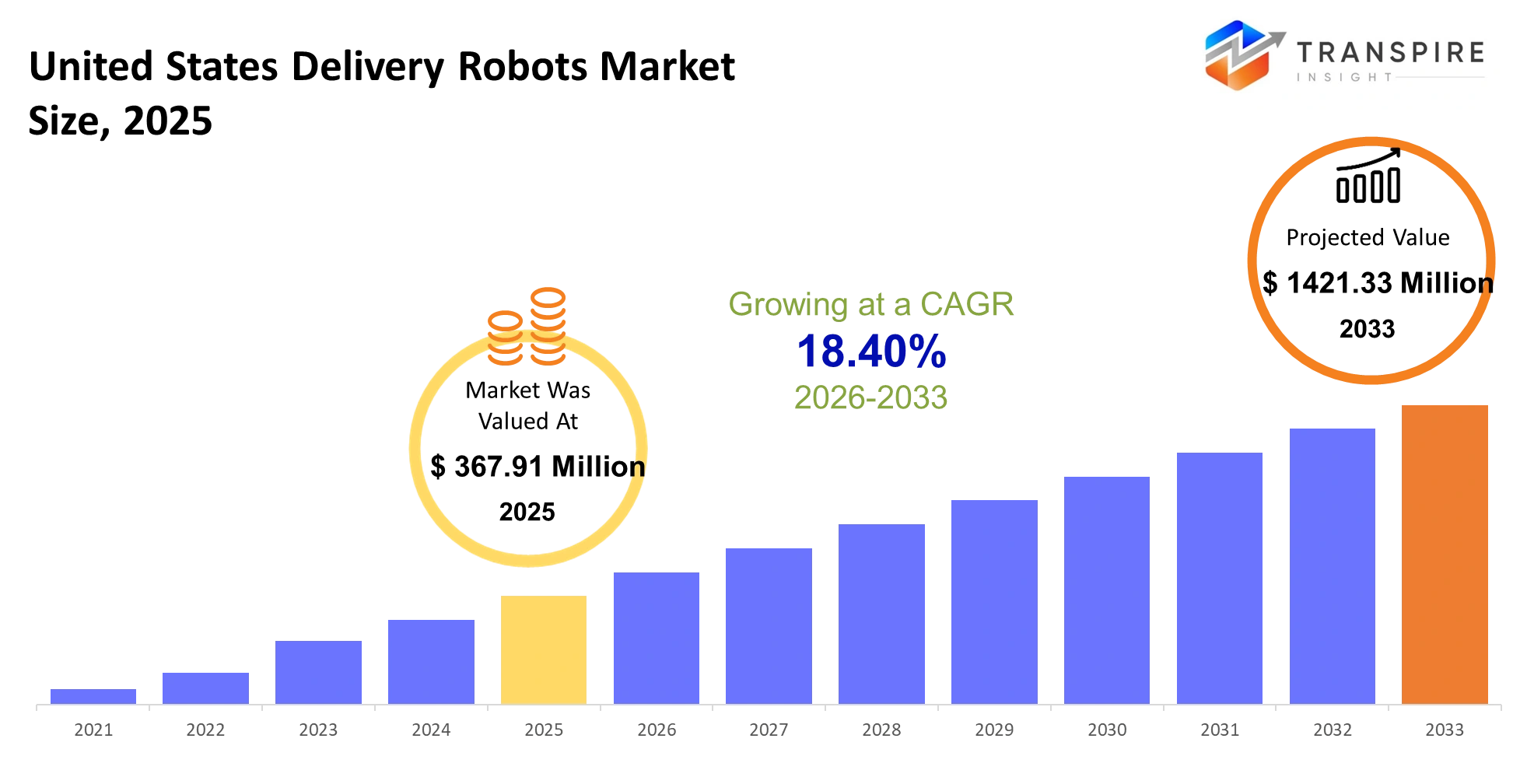
- United States Delivery Robots Market Size 2025: USD 367.91 Million
- United States Delivery Robots Market Size 2033: USD 1421.33 Million
- United States Delivery Robots Market CAGR: 18.40%
- United States Delivery Robots Market Segments: By Robot Type: Sidewalk Robots, Autonomous Ground Vehicles, Aerial Delivery Drones, Indoor Delivery Robots, Warehouse Robots | By Application: Food Delivery, Grocery Delivery, Parcel Delivery, Healthcare Delivery, Retail Logistics | By End User: E-commerce, Restaurants, Healthcare, Retail Stores, Logistics Providers
To learn more about this report,  Download Free Sample Report
United States Delivery Robots Market Summary
The United States Delivery Robots Market was valued at USD 367.91 Million in 2025. It is forecast to reach USD 1421.33 Million by 2033. That is a CAGR of 18.40% over the period.
In the United States Delivery Robots Market, autonomous ground robots are getting used to move small packages, food, and medical supplies over short distances in controlled areas like university campuses, hospital complexes , business parks, and dense urban neighborhoods. These systems take some of the load off human couriers for those same repetitive short-haul runs and they also let operators handle last-mile traffic jams and delivery delays a bit more calmly, sort of manage the whole situation.
Over the past five years, the market sorta shifted from small pilot runs into more complete fleet based rollouts, powered by AI navigation and real time mapping. One big nudge was the COVID-19 pandemic, it bumped up the need for touchless dropping off items, and it also made labor constraints in last-mile logistics feel way more real during the supply chain disruptions. So, companies and logistics providers rushed to adopt these setups to keep operations steady and cut down on the swing in delivery timing, which then pushed vendors to increase output and tighten autonomous reliability for everyday commercial use.
Key Market Insights
- The United States Delivery Robots Market is sorta shifting toward scalable autonomous fleets, moved by last mile efficiency pressures and a labor shortage thing in urban logistics ecosystems, you know.
- Market growth is also being helped along by more adoption of AI navigation , and the United States Delivery Robots Market is getting more and more tied into smart city delivery infrastructure.
- California is leading the United States Delivery Robots Market, with more than 35% share in 2025, mainly due to dense urban pilots and tech ecosystem concentration, too.
- Hardware based delivery robot platforms take the leading share in the United States Delivery Robots Market because the deployment demand stays strong.
- Fleet management software is the second-largest segment here, backing real time tracking and autonomous coordination systems, kind of like the backbone.
- AI powered navigation and autonomy software is one of those fastest-growing segments, speeding up operational efficiency from 2024 to 2030, pretty quickly.
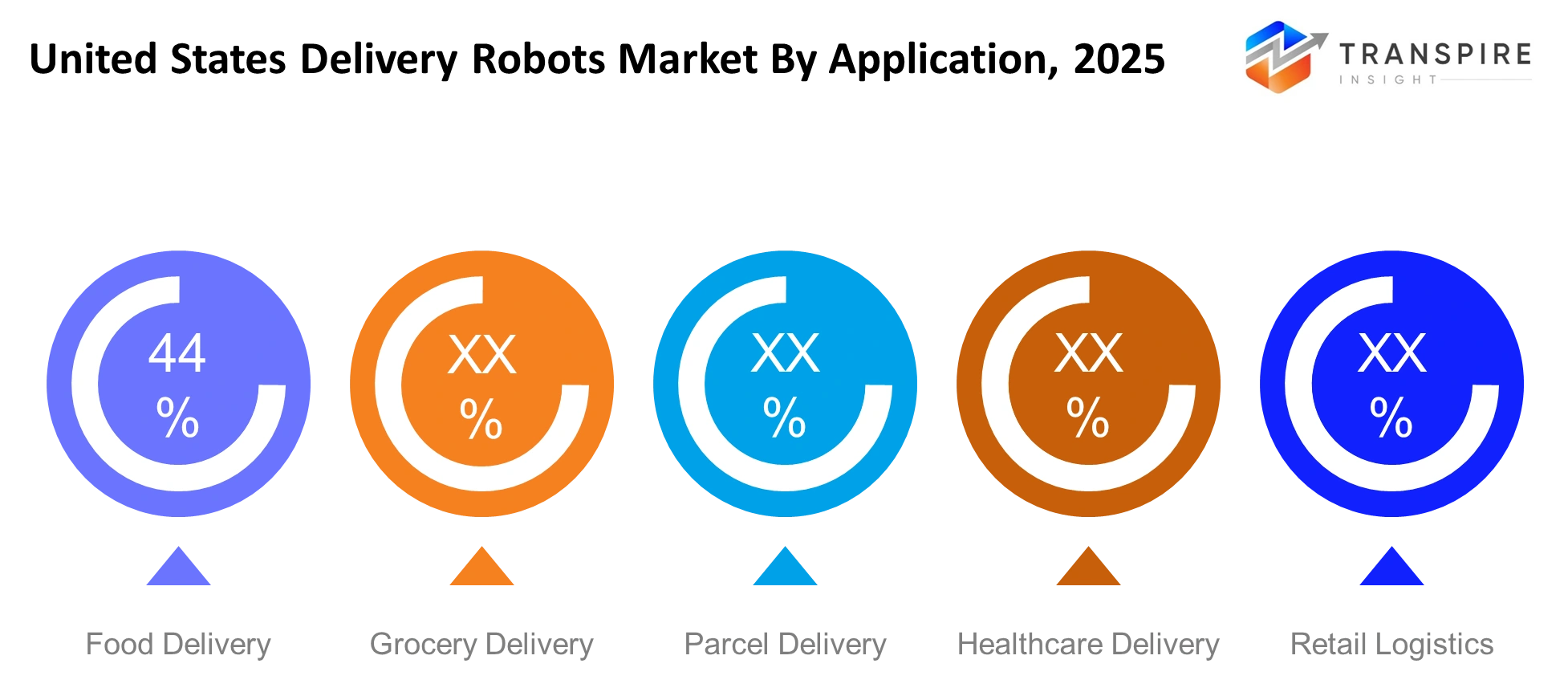
- In terms of adoption, food delivery kind of dominates, taking almost 45% share, largely thanks to restaurant partnerships and those high frequency, short distance orders mostly across city areas.
- For healthcare logistics, it’s the fastest mover, because the need for contactless transport of medical supplies keeps growing. It expands rapidly particularly in hospitals.
- When you look at end users, restaurants and quick service chains tend to lead the way with a large share, mostly because last mile delivery needs are so high volume.
- And on the healthcare side, healthcare institutions are the fastest-growing end user category, fueled by automation requirements for careful and time critical deliveries.
What are the Key Drivers, Restraints, and Opportunities in the United States Delivery Robots Market?
The main driver seems kinda obvious I guess, it’s the fast progress in autonomous navigation systems, paired with those rising last-mile delivery costs that hit hard in crowded US cities. As AI based route optimization, computer vision, and sensor fusion keep getting better, navigation errors go down and robots can move around more safely on sidewalks and in those controlled spaces. Meanwhile, courier wages keep climbing, and fuel costs aren’t exactly relaxing either, so retailers, food delivery platforms, and healthcare providers start replacing short distance human runs with robots. That shift makes deployments denser and turns recurring service revenues into the bigger deal.
The biggest restraint is regulatory fragmentation across city and state jurisdictions, which basically blocks large scale fleet standardization. A lot of municipalities add limits on sidewalk usage, also speed rules, or even operating hours, so the deployment rules end up inconsistent and sort of patchwork. That slows down nationwide scaling, and it also bumps up compliance costs for operators, which then hurts revenue predictability. In the end, commercial rollouts get delayed especially in those high value urban corridors.
One major opportunity is showing up through hospital automation, plus smart campus infrastructure projects, especially in places like California and Texas. Healthcare organizations are pouring money into autonomous internal logistics to transport medications, lab samples, and supplies between buildings and across sites. When that ties in with 5G enabled private networks and real time hospital mapping platforms, it should open the door to high margin, mission critical use cases for delivery robotics providers.
What Has the Impact of Artificial Intelligence Been on the United States Delivery Robots Market?
Artificial intelligence plus advanced digital systems are, basically, reshaping autonomous last mile delivery stuff in the United States by changing how delivery robots look at the world, decide what to do, and handle fleet performance in real time. From an operational perspective, AI navigation setups use computer vision, LiDAR fusion, and SLAM methods to sort out route selection, dodge obstacles, and also keep watch on sidewalk compliance, sorta continuously. On top of that, fleet orchestration platforms automate dispatching and even coordinate control systems together, so operators can monitor robot status, battery levels, and service compliance across a bunch of different urban areas, with no constant manual pushing.
Machine learning is also getting used for predictive maintenance, where sensor signals from motors, batteries and drive systems get analyzed to anticipate component wear before something actually fails. That tends to reduce surprise downtime, and it improves overall fleet availability by making scheduled servicing more normal rather than only reacting after a problem shows up. Meanwhile, route optimization algorithms are constantly reworking delivery paths based on traffic density, pedestrian movement, and weather variation, and this has helped reduce average delivery times while also lowering the cost per trip in crowded metro regions.
Still, one big limitation stays there—the high cost and the overall complexity of connecting AI systems to real world urban infrastructure. Uneven sidewalk surfaces, not enough edge case training data, and spotty connectivity in dense city settings can leave accuracy gaps, and those gaps can hurt reliability, plus delay wider rollouts.
Key Market Trends
- Delivery robots moved away from those kinda isolated campus pilots in 2020–2021, to multi-city fleet rollouts along US urban logistics corridors by 2025. Kinda wild how fast that happened.
- By 2023, AI driven navigation started replacing the older rule-based routing, so obstacle dodging got noticeably better, especially where pedestrians are dense , and the accuracy jumped by more than 30%.
- Restaurant delivery platforms also leaned more into robotics partnerships after 2022 , and companies like Serve Robotics have been scaling sidewalk delivery across big US cities.
- In healthcare, adoption sped up after 2024, with hospitals swapping out manual courier runs for autonomous robots that move stuff within campuses, like supplies and such.
- Regulations didn’t move in a clean straight line between 2023 and 2026 though. Some places , for example San Francisco, widened operational permits while others tightened restrictions.
- Battery efficiency improvements rolled in during 2024, which basically stretched the operating range per charge, and that cut recharge downtime by almost 20% across city fleets.
- Fleet operators went from just sending out one robot at a time, to using centralized cloud based management systems. That shift helped with real time monitoring and predictive dispatch optimization, not just guesswork.
- On the consumer side, acceptance got better after 2022 as contactless delivery became normal. Repeat use went up across both food and retail segments.
- Competition also heated up. Companies like Nuro expanded autonomous vehicle based delivery pilots, not only sticking with the traditional sidewalk robot style.
United States Delivery Robots Market Segmentation
By Robot Type:
Sidewalk robots work on pedestrian paths and they help with short trip drop offs in cities. Autonomous ground vehicles drive on roads and manage mid to longer delivery jobs. Aerial delivery drones fly on air corridors for fast arrival in certain zones. Indoor delivery robots help inside buildings. Warehouse robots back up storage and goods relocation inside the same facility.
Those kinds of robots answer to different delivery needs, mostly based on distance, surroundings, and payload ability. Sidewalk units, along with indoor units, tend to stay in confined spaces, with lower speed expectations. Ground vehicles and warehouse robots do the heavy movement, and they also cover longer routes. Aerial drones cover quick fulfillment when timing is sensitive, which improves the whole delivery system flow, or something close to that.
By Application:
Food delivery kinda uses robots for rapid movement of meals from restaurants to customers, but not always in a straight line. Grocery delivery is mostly about moving daily essentials without delay. Parcel delivery tends to support the movement of small packages. Healthcare delivery covers transporting medicines and lab items, which is a bit more delicate than people think. Retail logistics manages product movement between stores and distribution spots, keeping things in sync.
Each application kind of depends on speed, safety, and accuracy, though the balance shifts. Food and grocery delivery really need fast response and mostly short-distance travel. Parcel delivery is more about secure handling of packages, step by step. Healthcare delivery needs careful transport, and it has to be timely too. Retail logistics supports smooth supply flow between storage centers and retail locations, which helps service reliability.
To learn more about this report, Download Free Sample Report
To learn more about this report, Download Free Sample Report
By End User:
E-commerce platforms use delivery robots to speed up order fulfillment and last mile delivery, so the customer sees it sooner. Restaurants use them for sending food orders, usually within tight time windows. Healthcare users apply robots for medical transport tasks that need consistency. Retail stores use them for internal deliveries and also for deliveries to customers, depending on setup. Logistics providers manage bigger delivery operations at scale, across multiple regions.
In the end, each user gets better delivery speed and less manual effort. E commerce depends on high volume automated shipping, because that’s what keeps it moving. Restaurants tend to prioritize quick food movement. Healthcare care needs safe handling of sensitive items, not just “fast.” Retail stores improve their in store efficiency when robots do the repeated work. Logistics providers use robots to handle complicated delivery networks and keep the overall service flow smoother.
What are the Key Use Cases Driving the United States Delivery Robots Market?
Food and quick-commerce delivery kinda stays the main use case in the United States Delivery Robots Market , mostly because of dense city ordering habits and the whole high-frequency short distance trips. Restaurants and food delivery platforms send out sidewalk robots to cut courier costs, and also to make delivery time more steady even when streets get crowded in those city zones.
But outside of food delivery there’s healthcare logistics and campus internal transport, that part is growing fast too. Hospitals use autonomous robots to shuttle prescriptions, lab samples, and medical supplies between departments, while university campuses and corporate parks put them in place for controlled intra site runs. In these end user settings, teams care a lot about predictable routing, and less reliance on people for the same repetitive movements day after day.
Then there are the newer things coming up, like retail micro fulfillment and municipal service logistics. In those areas delivery robots are being trialed for small parcel distribution, and for last mile public service tasks. There are also pilot programs in smart city districts that are looking at how to plug into curbside pickup systems, plus regulated sidewalk corridors, so it looks like the market may end up having more structured urban logistics automation across the forecast period.
|
Report Metrics |
Details |
|
Market size value in 2025 |
USD 367.91 Million |
|
Market size value in 2026 |
USD 435.62 Million |
|
Revenue forecast in 2033 |
USD 1421.33 Million |
|
Growth rate |
CAGR of 18.40% from 2026 to 2033 |
|
Base year |
2025 |
|
Historical data |
2021 - 2024 |
|
Forecast period |
2026 - 2033 |
|
Report coverage |
Revenue forecast, competitive landscape, growth factors, and trends |
|
Geographic scope |
United States of America |
|
Key company profiled |
Starship Technologies, Nuro, Amazon Robotics, Kiwibot, Relay Robotics, FedEx, JD Logistics |
|
Customization scope |
Free report customization (country, regional & segment scope). Avail customized purchase options to meet your exact research needs. |
|
Report Segmentation |
By Robot Type: Sidewalk Robots, Autonomous Ground Vehicles, Aerial Delivery Drones, Indoor Delivery Robots, Warehouse Robots | By Application: Food Delivery, Grocery Delivery, Parcel Delivery, Healthcare Delivery, Retail Logistics | By End User: E-commerce, Restaurants, Healthcare, Retail Stores, Logistics Providers |
Which Regions are Driving the United States Delivery Robots Market Growth?
The West Coast sort of leads the United States Delivery Robots market, while California feels like the main hub where deployment and testing really happen. Municipal support for autonomous mobility pilots in places like San Francisco and Los Angeles , has made the rules more friendly for sidewalk based robotics. With dense city layouts and a lot of delivery demand coming from techy consumers, adoption keeps looking stronger. There is also this mature mix of robotics startups, venture funding, and AI research groups that keeps pushing new ideas , and then commercial scaling comes out fast.
The Midwest is steadier but it’s also less of an experiment playground. Here adoption tends to lean on organized logistics networks and institutional end users. Compared with the West Coast pilot frenzy, Chicago and Minneapolis are more about limited deployments that stay controlled, usually inside hospitals, corporate campuses, and logistics parks. Industrial infrastructure is strong there, and regulatory enforcement tends to be predictable, so utilization stays consistent instead of chasing constant trials. Revenue growth shows up more as steady enterprise contracting, not as huge consumer delivery volume.
Then the Southeast looks like the fastest mover. It’s supported by newer investments in smart city infrastructure and the way e-commerce keeps spreading through urban areas like Atlanta and Miami. Since 2024 state initiatives that encourage automation across logistics and healthcare supply chains have helped pilots turn into actual commercial work. Also the warmer climate means robots can operate year round, which can improve fleet efficiency compared to colder regions. For investors and new entrants, this region offers big expansion upside between 2026 and 2033 , mainly because urban density keeps rising and deployment economics start to look more favorable.
Who are the Key Players in the United States Delivery Robots Market and How Do They Compete?
The United States delivery robots market is kinda moderately fragmented, like you can see startups running more of the sidewalk robotics side, while just a few scaling firms fight for city approvals and enterprise contracts. A lot of the competition seems to land on autonomy performance, unit economics, and regulatory access across different municipalities. New entrants tend to shake things up via lower deployment costs and quicker rollout cycles but the older players lean hard on reliability, fleet uptime, and already-approved operating zones.
Starship Technologies keeps focusing on high density campus and residential deployments, and they scale standardized sidewalk robots through longer term institutional partnerships plus repeated delivery routes. Serve Robotics works with food delivery platforms, optimizing urban routing and then expanding via partnerships with gig economy delivery networks across major US cities. Nuro goes after bigger autonomous delivery vehicles aimed at grocery and retail logistics, pushing regulated road based pilots forward and securing partnerships with major retail chains too.
Kiwibot pushes low-cost campus robotics using a subscription fleet model, and it’s been expanding across universities through longer service contracts, plus predictable utilization agreements that make procurement easier. Cartken targets industrial and mixed environment logistics automation, building stronger enterprise pilots, and then widening deployments across US campuses as well as a few select international markets.
Company List
- Starship Technologies
- Nuro
- Amazon Robotics
- Kiwibot
- Relay Robotics
- FedEx
- JD Logistics
Recent Development News
In November 2025, Uber Technologies kinda entered a partnership with Starship Technologies, to roll out autonomous delivery robots for Uber Eats across the United States and United Kingdom. Through this collaboration, Uber Eats customers in some chosen pilot areas can get their food delivered using Starship’s Level 4 autonomous sidewalk robots which is honestly a pretty strong nudge for Uber’s automation push in last mile logistics. It also helps broaden the real world commercial robot delivery rollout in the U.S. market, as they keep moving things forward. Source https://www.reuters.com/
In April 2026, Starship Technologies said they already surpassed 10 million autonomous robot deliveries worldwide, and there’s more to it, with operations also expanding across several U.S. cities. That milestone, sort of underlines how the company leads by scale in sidewalk delivery robotics and it hints at growing commercial maturity, plus the real world usage of autonomous last-mile delivery systems in the United States keeps getting stronger.
Source https://retailtechinnovationhub.com/
What Strategic Insights Define the Future of the United States Delivery Robots Market?
The United States delivery robots market is kinda moderately fragmented, like you can see startups running more of the sidewalk robotics side, while just a few scaling firms fight for city approvals and enterprise contracts. A lot of the competition seems to land on autonomy performance, unit economics, and regulatory access across different municipalities. New entrants tend to shake things up via lower deployment costs and quicker rollout cycles but the older players lean hard on reliability, fleet uptime, and already-approved operating zones.
Starship Technologies keeps focusing on high density campus and residential deployments, and they scale standardized sidewalk robots through longer term institutional partnerships plus repeated delivery routes. Serve Robotics works with food delivery platforms, optimizing urban routing and then expanding via partnerships with gig economy delivery networks across major US cities. Nuro goes after bigger autonomous delivery vehicles aimed at grocery and retail logistics, pushing regulated road based pilots forward and securing partnerships with major retail chains too.
Kiwibot pushes low-cost campus robotics using a subscription fleet model, and it’s been expanding across universities through longer service contracts, plus predictable utilization agreements that make procurement easier. Cartken targets industrial and mixed environment logistics automation, building stronger enterprise pilots, and then widening deployments across US campuses as well as a few select international markets.
United States Delivery Robots Market Report Segmentation
By Robot Type
- Sidewalk Robots
- Autonomous Ground Vehicles
- Aerial Delivery Drones
- Indoor Delivery Robots
- Warehouse Robots
By Application
- Food Delivery
- Grocery Delivery
- Parcel Delivery
- Healthcare Delivery
- Retail Logistics
By End User
- E-commerce
- Restaurants
- Healthcare
- Retail Stores
- Logistics Providers
Frequently Asked Questions
Find quick answers to common questions.
The United States Delivery Robots Market size is USD 1421.33 Million in 2033.
Key segments for the United States Delivery Robots Market are By Robot Type: Sidewalk Robots, Autonomous Ground Vehicles, Aerial Delivery Drones, Indoor Delivery Robots, Warehouse Robots | By Application: Food Delivery, Grocery Delivery, Parcel Delivery, Healthcare Delivery, Retail Logistics | By End User: E-commerce, Restaurants, Healthcare, Retail Stores, Logistics Providers.
Major United States Delivery Robots Market players are Starship Technologies, Nuro, Amazon Robotics, Kiwibot, Relay Robotics, FedEx, JD Logistics.
The United States Delivery Robots Market size is USD 367.91 Million in 2025.
The United States Delivery Robots Market CAGR is 18.40% from 2026 to 2033.
- Starship Technologies
- Nuro
- Amazon Robotics
- Kiwibot
- Relay Robotics
- FedEx
- JD Logistics
Recently Published Reports
-
Apr 2026
3D Optical Profiler Market
3D Optical Profiler Market Size, Share & Analysis Report By Type (Desktop 3D Optical Profiler, and Portable 3D Optical Profiler), By Technology (Confocal Technology, and White Light Interference), By End-Use Industry (Manufacturing, Research Institutions, Automotive, Aerospace and Defense, Medical Devices, and Other), and Geography (North America, Europe, Asia-Pacific, Middle East and Africa, South and Central America), 2021 - 2031
-
Apr 2026
Depth Sensor Market
Depth Sensor Market Size, Share & Analysis Report By Type (Infrared Depth Sensors, Time-of-Flight (ToF) Sensors, Stereo Vision Sensors, Structured Light Sensors, Ultrasonic Depth Sensors), By Application (Automotive, Robotics, Gaming, Consumer Electronics, Industrial Automation, Healthcare, Security & Surveillance, Others), By End Users (Automotive Manufacturers, Consumer Electronics Companies, Healthcare Providers, Industrial Companies, Security Agencies, Gaming Companies, Robotics Companies, Others), and Geography (North America, Europe, Asia-Pacific, Middle East and Africa, South and Central America), 2021 – 2031
-
Apr 2026
Digital Manufacturing Market
Digital Manufacturing Market Size, Share & Analysis Report By Component (Hardware, Software, and Services), By Technology (Robotics, 3D Printing, Internet of Things (IoT), and Others), By Application (Automotive and Transportation, Aerospace and Defense, Consumer Electronics, Industrial Machinery, and Others), By Process Type (Computer-Based Designing, Computer-Based Simulation, Computer 3D Visualization, Analytics, and Others), and Geography (North America, Europe, Asia-Pacific, Middle East and Africa, South and Central America), 2021 – 2031
-
Apr 2026
Digital Visa Services Market
Digital Visa Services Market Size, Share & Analysis Report By Type (Individual Travelers, Group Travelers), By Application (Tourism, Business Travel, Others), and Geography (North America, Europe, Asia-Pacific, Middle East and Africa, South and Central America), 2021 – 2031