France Vehicle Roadside Assistance Market Size & Forecast:
- France Vehicle Roadside Assistance Market Size 2025: USD 1862.6 Million
- France Vehicle Roadside Assistance Market Size 2033: USD 2753.67 Million
- France Vehicle Roadside Assistance Market CAGR: 5.04%
- France Vehicle Roadside Assistance Market Segments: By Type (Towing, Battery Jumpstart, Flat Tire Assistance, Fuel Delivery, Lockout Services, Breakdown Repair, Others); By Application (Passenger Vehicles, Commercial Vehicles, Electric Vehicles, Two-wheelers, Fleet Vehicles, Others); By End-User (Individual Owners, Fleet Operators, Insurance Companies, Automotive OEMs, Leasing Companies, Transport Firms, Others); By Service Provider (Automakers, Insurance Firms, Third-party Providers, Emergency Services, Others).
To learn more about this report,  Download Free Sample Report
France Vehicle Roadside Assistance Market Summary
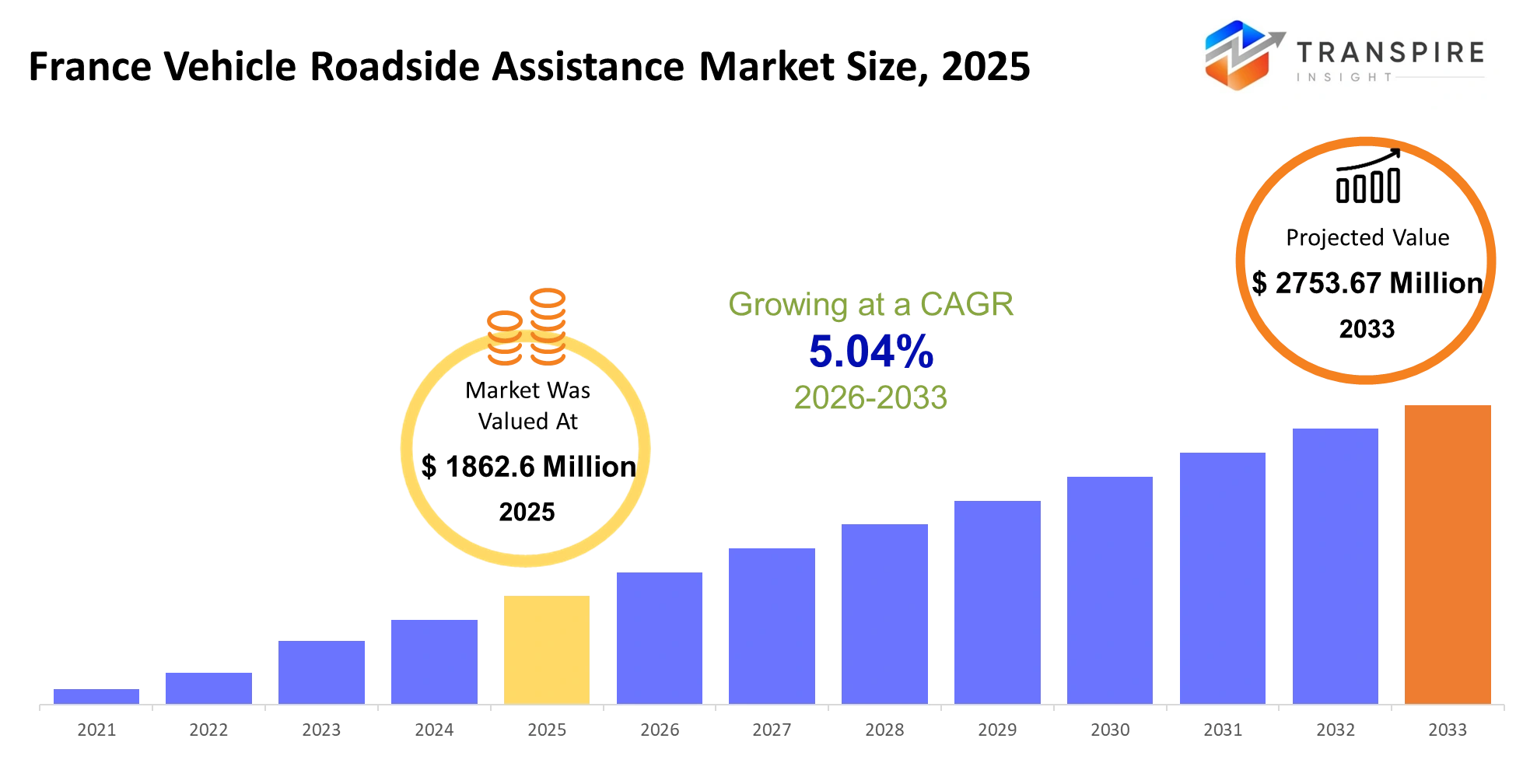
The France Vehicle Roadside Assistance Market was valued at USD 1862.6 Million in 2025. It is forecast to reach USD 2753.67 Million by 2033. That is a CAGR of 5.04% over the period.
In France, the vehicle roadside assistance market kind of matters a lot for keeping both passenger and commercial vehicles in motion when something goes wrong like breakdowns, battery failures, tire punctures, towing incidents, or even weird electronic malfunctions that stop mobility. For insurers, automakers, fleet operators, and mobility providers, this roadside help isn’t just a nice add on, it works like a retention lever as well as a kind of service continuity cushion that limits downtime, boosts driver safety , and helps protect vehicle utilization rates. Over the last five years, the whole market vibe shifted a bit, from mostly reactive towing services toward more connected, digitally coordinated support ecosystems, powered by telematics, mobile apps, and predictive diagnostics. Also, France is seeing faster electric vehicle adoption, and with that comes more intricate vehicle electronics, so the service needs are basically different now.
On top of it, supply chain issues and semiconductor shortages during the post pandemic recovery period made maintenance cycles run longer, and that in turn increased roadside incidents, which then pushed more demand for subscription based assistance programs. Meanwhile, automakers bundling connected services with new vehicles means providers are able to earn more recurring revenue via integrated mobility support and higher end premium response packages.
Key Market Insights
- In France, the Northern and urbanized areas make up more than 40% of the market share, mainly because vehicle ownership is dense and premium service uptake is higher, than in other parts. It feels like the map here is just different, you know.
- Western France is, right now, the fastest growing regional cluster through 2033, and this is backed by EV charging rollouts plus logistics fleet expansion. In practice, more charging points plus more vans and trucks means more roadside demand.
- Towing and breakdown recovery are still the biggest part of the France Vehicle Roadside Assistance Market, holding over 35% of revenue in 2025, pretty much leading everything else.
- After 2022, battery support along with mobile jump start services showed the fastest growth, driven by rising hybrid and electric vehicle adoption. So even if people think “flat battery only”, it’s more like quick electrical help.
- When it comes to applications, passenger vehicles remain in front. This is supported by strong personal vehicle dependency and insurance-linked assistance bundles.
- Commercial fleet assistance is expanding quickly too, especially as logistics operators focus on uptime visibility and centralized roadside coordination platforms.
- Subscription based assistance plans also really gained traction after 2021, because automakers started bundling connected emergency support when they sell new vehicles.
- Digital dispatch platforms managed to cut average response times by almost 20% from 2021 to 2025, across major metropolitan regions, and that part matters a lot operationally.
- Lastly, strategic partnerships between insurers, EV manufacturers, and telematics providers are reshaping competitive positioning across the French mobility assistance ecosystem, slowly but surely.
What are the Key Drivers, Restraints, and Opportunities in the France Vehicle Roadside Assistance Market?
The most powerful driver pushing the France roadside assistance market forward is sort of a rapid, almost relentless, rise in vehicle electrification and the wider take-up of connected cars. Once you’re dealing with electric vehicles, roadside help is not just “swap a tire” or do a quick reboot; it often means specialized roadside interventions, like battery diagnostics, tricky charging coordination, and software related troubleshooting that older style garages can’t always deliver right away. In France, automakers and insurers have been answering that gap by weaving roadside support into vehicle subscription deals and also extended warranty programs. Over time, this has lifted recurring service revenues, and yeah it also helps with customer stickiness for insurers and OEMs. Connected telematics systems now can spot likely faults remotely, before dispatching technicians, which cuts down on operational waste, and it boosts the odds of first-time fixes.
On the other hand, the main restraint is more structural than temporary, namely the shortage of skilled technicians who can actually manage modern electric and software defined vehicles. More advanced roadside interventions keep demanding specialist know-how in high voltage systems, onboard diagnostics, and connected vehicle software, so the bar keeps moving. Training still takes a long time, costs a lot, and it becomes even harder outside the biggest city areas. That capability gap messes with the consistency of service coverage and tends to stretch response times in rural zones, and as a result, it dampens the revenue growth that assistance operators might otherwise capture.
A notable opportunity sits in predictive roadside ecosystems, powered by embedded telematics and vehicle data analytics. French fleet operators and insurers are putting money into platforms that can anticipate breakdown risk before failures fully show up. Firms that combine predictive maintenance with real-time mobility services can reduce towing frequency, raise overall fleet uptime, and even support premium subscription models that feel more “value-added” than traditional plans.
What Has the Impact of Artificial Intelligence Been on the France Vehicle Roadside Assistance Market?
Artificial intelligence and newer digital technologies are in a way changing roadside assistance work across France, with dispatch getting faster , maintenance forecasts getting more precise, and the whole customer response flow becoming more coordinated. Assistance companies are more and more relying on AI powered systems to look through telematics data coming from connected cars, so dispatchers can catch battery wear, engine odd behaviors, tire pressure inconsistencies , or even software problems before the vehicle fully breaks down. Then the machine learning tools sort and sort emergency calls by what’s nearest and safest, plus traffic patterns, the kind of vehicle, and whether a technician is really available right now, which tends to cut the average intervention time especially along crowded city routes.
Predictive analytics matters even more for commercial fleet operators and for electric vehicle support teams. AI assisted diagnostics can help guess battery trend lines and anticipate when maintenance is likely, and this often leads to less surprising downtime, plus better utilization across fleets. A few platforms working in France also roll out automated customer conversations and smarter routing options, which helps lower operating expenses while keeping the service quality more consistent.
On top of that, digital optimization tools boost how efficiently technicians get assigned, and they also reduce towing events that are not really needed because remote diagnostics are available, plus over-the-air troubleshooting guidance. Still, AI adoption is not fully smooth, there are limitations tied to uneven vehicle data standards and the costs of system integration. Smaller roadside providers often have trouble linking older systems with advanced telematics infrastructure, and in rural areas, inconsistent connectivity can mess with the reliability of real time predictive models, and it can also weaken remote support features.
Key Market Trends
- Roadside incidents with electric vehicles went up pretty noticeably after 2022, which pushed a bunch of providers to grow their mobile charging options and also beef up battery diagnostics, kind of like faster intel on what is happening in the field.
- At the same time connected vehicle integration really picked up across France as OEMs started bundling telematics assistance services , with those premium ownership packages , you know the ones that feel like a value add rather than just “help later”.
- Between 2021 and 2025, digital dispatch systems reduced technician idle time and it also made the urban response process feel more efficient, even when things were chaotic.
- Fleet operators increasingly moved toward predictive maintenance platforms so they could cut unplanned downtime and improve how much commercial vehicle utilization they’re getting out there.
- After 2021, subscription based roadside assistance plans kind of replaced the one-time emergency call model across several insurance and leasing programs, instead of waiting for the last minute.
- AI driven routing and triage also helped sharpen first-response accuracy for companies like Allianz Partners and Europ Assistance; that part got a lot better over time.
- Mobile applications became the main customer engagement channel , letting drivers do real-time tracking, handle digital claims and keep up a direct technician conversation.
- Meanwhile independent assistance operators expanded partnerships with EV charging networks, to support stranded electric vehicle users along intercity highways, not only in city centers.
- Still, rural coverage gaps widened briefly between 2022 and 2024 because technician shortages slowed the network expansion efforts outside urban regions.
- Insurance providers have been using roadside assistance programs more and more as a customer retention lever rather than treating it like a standalone emergency service offering, simple as that.
France Vehicle Roadside Assistance Market Segmentation
By Type
Towing still grabs the largest share, at least in practice, because big roadside incidents basically need real vehicle recovery, then some transport follow-up too, not just a quick fix. There is a lot of vehicle density along urban corridors and people doing long distance highway trips keeps pulling in strong towing interest for both passenger and commercial drivers. Also, insurance linked roadside bundles often put towing coverage first, and that, somehow, boosts how often customers actually use the service, giving steadier recurring contract income. On top of that, the already built towing network plus wide regional reach helps towing stay in front across metro areas and regional transport routes.
Battery Jumpstart is growing fast, mostly because modern cars feel more electronically complex, and electric vehicle adoption keeps rising across France. Flat Tire Assistance stays fairly steady, since urban commutes and intercity freight movement keep turning up tire related problems. Fuel Delivery and Lockout Services remain key, more like convenience driven options especially where subscription style mobility assistance plans are aimed at individual vehicle owners. Breakdown Repair is getting more momentum as remote diagnostics improve and mobile technicians get deployed more often, which reduces the dependency on towing. Over the forecast period, predictive diagnostics and mobile repair features are expected to shift roadside response priorities and make companies more willing to invest in tech enabled service delivery platforms.
By Application
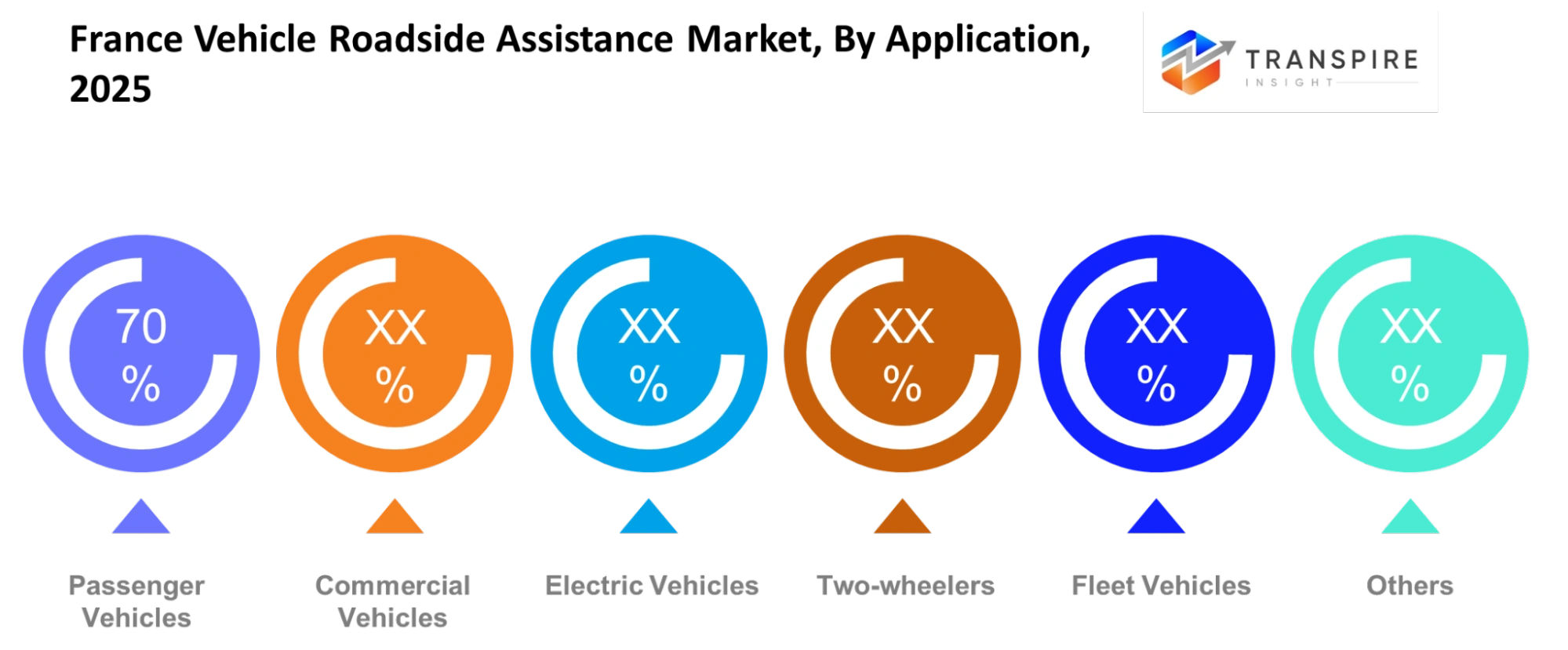
Passenger Vehicles keep the lead in the market, more or less, because day to day personal mobility still relies a lot on privately owned cars in urban as well as suburban zones across France. People commute often, connected vehicle features are being adopted faster, and insurance coverage remains strong,so roadside assistance keeps seeing steady demand in this space. Automakers and insurers are also bundling these help services directly into new car sales, and into more premium ownership programs, and that tends to lock in longer customer engagement. Service request numbers stay high too, especially with battery failures, tire punctures, and electronic faults,so the segment leadership keeps getting reinforced.
Commercial Vehicles, plus Fleet Vehicles, are getting more attention lately, driven by the rise in logistics work and by time critical freight movements along regional and international transport routes. Electric Vehicles are the fastest growing application, mainly because roadside providers keep extending charging support, battery diagnostics, and higher voltage technical response skills. Two wheelers still bring moderate demand in city areas, where scooters and motorcycles help with short range travel and also with delivery errands. Other mobility options, like shared transport and rental fleets, are also starting to use roadside services more often through subscription style coverage models. Over the forecast window, fleet digitization along with the spread of electric mobility should speed up specialized assistance needs across commercial, and more connected vehicle ecosystems.
To learn more about this report, Download Free Sample Report
By End-User
Individual Owners are seen as the leading end user segment because private vehicle ownership is still the primary mobility way in France. Many personal vehicle users rely on roadside assistance programs that sit inside insurance policies and extended warranties , plus those dealership service packages. There is solid demand from city drivers who want a fast reaction service, so they can minimize travel disruption and also support better roadside safety. On top of that mobile apps, and digital claims handling platforms , make it easier for customers to access help. They also help nudge recurring subscription renewals for this group.
Fleet Operators and Transport Firms keep growing, it’s pretty steady, because delivery networks, logistics providers, and mobility fleets care a lot about vehicle uptime and day to day operational continuity. Insurance Companies are also getting more influence by slipping roadside support into broader customer retention plans, and risk management tactics too. Automotive OEMs are starting to integrate connected roadside assistance systems directly into their vehicle platforms, that way they boost brand loyalty and make the whole ownership experience feel more differentiated. Leasing Companies are adopting it more as well, through bundled maintenance and mobility service agreements that target corporate clients and subscription based vehicle users. Over time, enterprise oriented assistance contracts and predictive fleet maintenance services should produce stronger revenue growth than the more traditional consumer focused roadside assistance models.
By Service Provider
Insurance Firms kinda hold the dominant position, mainly because roadside assistance is already spread out pretty widely via motor insurance policies and those bundled protection programs. They typically get to keep stronger customer databases, plus the premiums often repeat in a steady rhythm, and then there’s the nationwide partner networks. Because of that, insurers can scale roadside coverage more efficiently across a bunch of different vehicle categories. Also, their long time relationships with towing operators, repair networks, and emergency response providers makes the day to day operations feel more dependable. Insurance-linked assistance programs also tend to gain from higher retention, since policyholders more and more prefer integrated protection services inside one provider ecosystem.
Third-Party Providers are gaining traction too, mostly through app based dispatch platforms, AI assisted routing systems, and subscription models that feel more flexible for connected mobility services. Automakers keep pushing embedded roadside support, and connected vehicles are kind of opening new doors for predictive diagnostics, and real-time technical intervention. Emergency Services stay important for accident response, and especially for high priority incidents, most notably across highway networks and rural transport corridors. Then you have other providers, like mobility startups and fleet focused operators, entering via specialized EV support and digital first assistance models. Over the forecast period, competition is expected to move toward technology integration, access to real time vehicle data, and ecosystem partnerships that link insurers, automakers, and mobility platforms together.
What are the Key Use Cases Driving the France Vehicle Roadside Assistance Market?
In France the dominant use case in the vehicle roadside assistance market still feels like emergency breakdown recovery for passenger vehicles, mostly around urban arteries and the intercity kind of transport corridors. Things like battery failures, tire punctures, towing situations, and electronic malfunctions keep producing the biggest service volumes, mainly because today’s cars lean so much on complicated onboard systems that honestly need immediate technical help.
Commercial fleet support is turning into a real secondary application, particularly for logistics outfits, leasing operators, and last mile delivery providers. Fleet managers are more and more leaning on a centralized roadside coordination setup, to reduce the idle time, keep route continuity steady, and protect delivery schedules. Electric vehicle assistance services too, such as mobile charging plus high-voltage diagnostics, are expanding quickly inside corporate mobility fleets, not just as a niche offer.
Some emerging use cases start sounding like predictive roadside intervention, powered by telematics and AI based diagnostics. Connected vehicle platforms can spot fault patterns before a breakdown even happens, and that lets operators plan preventive interventions instead of reacting. Shared mobility fleets, along with subscription based vehicle ownership programs are also expected to create new demand for integrated digital assistance ecosystems across the forecast period.
|
Report Metrics |
Details |
|
Market size value in 2025 |
USD 1862.6 Million |
|
Market size value in 2026 |
USD 1952.01 Million |
|
Revenue forecast in 2033 |
USD 2753.67 Million |
|
Growth rate |
CAGR of 5.04% from 2026 to 2033 |
|
Base year |
2025 |
|
Historical data |
2021 - 2024 |
|
Forecast period |
2026 - 2033 |
|
Report coverage |
Revenue forecast, competitive landscape, growth factors, and trends |
|
Regional scope |
France |
|
Key company profiled |
Allianz, AXA, AAA, RAC, Europ Assistance, Agero, Allstate, Mapfre, Zurich Insurance, Generali, Falck, Good Sam, Honk, Urgently, Blink. |
|
Customization scope |
Free report customization (country, regional & segment scope). Avail customized purchase options to meet your exact research needs. |
|
Report Segmentation |
By Type (Towing, Battery Jumpstart, Flat Tire Assistance, Fuel Delivery, Lockout Services, Breakdown Repair, Others); By Application (Passenger Vehicles, Commercial Vehicles, Electric Vehicles, Two-wheelers, Fleet Vehicles, Others); By End-User (Individual Owners, Fleet Operators, Insurance Companies, Automotive OEMs, Leasing Companies, Transport Firms, Others); By Service Provider (Automakers, Insurance Firms, Third-party Providers, Emergency Services, Others). |
Which Regions are Driving the France Vehicle Roadside Assistance Market Growth?
Île-de-France still seems like the main driver of the France vehicle roadside assistance market, mostly because it kind of mixes the country’s largest vehicle density with fairly advanced digital mobility infrastructure, and that combo really matters. Paris plus the nearby metropolitan routes pull in big service volumes, not only for passenger vehicles but also for ride-hailing fleets, corporate leasing operators, and last mile delivery networks. On top of that , the region has a strong cluster of insurers, dense towing networks, and it’s also pushing connected vehicle technologies pretty fast, which ends up supporting predictive assistance models.
Auvergne-Rhône-Alpes looks different in how it grows, it leans more toward steady long distance transport and cross border movement demand rather than just the usual urban emergency volume. Its weight in the market is tied to freight transport corridors that link France with Switzerland and Italy, so recovery for commercial vehicles stays consistently needed, along with fleet support services. Compared with Île-de-France, there’s also a stronger reliance on logistics continuity, winter mobility assistance, and highway towing capabilities. Even when consumer mobility habits fluctuate, the mix of regional economic resilience , solid industrial activity, and ongoing investment in commercial fleets helps roadside assistance providers keep relatively predictable revenue.
Occitanie is currently emerging as the fastest-growing regional market, largely due to newer electric mobility investments and infrastructure modernization programs across southern France. Growth in EV charging corridors, higher tourism related transport activity, plus regional smart mobility initiatives after 2023 have boosted the demand for more specialized roadside assistance, especially where support for electric vehicles becomes a key requirement.
Who are the Key Players in the France Vehicle Roadside Assistance Market and How Do They Compete?
The France vehicle roadside assistance market works in a pretty moderately consolidated competitive setup, where insurance-linked assistance groups have a lot of influence, but at the same time digital-first mobility platforms are changing what customers expect, like basically right away. The rivalry now looks more at response speed, connected vehicle integration, EV servicing know-how and a smoother digital customer experience , not only the classic towing ability. Meanwhile, older assistance providers try to keep their share via embedded insurance relationships and nationwide technician coverage, but newer tech players show up with app based dispatch systems and predictive service models.
Allianz Partners kind of stands out due to very tight integration with automotive manufacturers and connected mobility ecosystems. Its partnership with Kia France expanded EV specific roadside coverage and brought in mobility as a service options that include multimodal transport coordination. AXA Assistance competes mainly through strong ties with insurers and a wide service footprint across both urban and regional France, especially for premium vehicle owners and leasing customers. They also pushed ahead with digital claims handling and telematics enabled roadside coordination, to make responses more accurate and keep customers longer.
Europ Assistance leans hard into digital engagement, using mobile-first assistance platforms and remote support functions, so there is less reliance on physical interventions. Urgently meanwhile plays a different game by using AI driven dispatch optimization and mobility data analytics, built for connected and electric vehicles.
Company List
- Allianz
- AXA
- AAA
- RAC
- Europ Assistance
- Agero
- Allstate
- Mapfre
- Zurich Insurance
- Generali
- Falck
- Good Sam
- Honk
- Urgently
- Blink
Recent Development News
“In January 2026, Allianz Partners and Kia France announced a strategic roadside assistance partnership. The agreement expanded Kia Assistance coverage across all new Kia vehicles sold in metropolitan France while strengthening EV-focused digital roadside services.
Source: http://www.allianz-partners.com
“In October 2025, Urgently entered a partnership with Sony Honda Mobility of America to provide AI-enabled roadside assistance services for AFEELA drivers. The partnership reinforced the growing role of connected vehicle ecosystems and predictive mobility support technologies in global roadside assistance operations.
Source: http://investors.geturgently.com
What Strategic Insights Define the Future of the France Vehicle Roadside Assistance Market?
The France vehicle roadside assistance market is kinda, slowly but surely shifting toward predictive, software-enabled mobility support that’s basically woven right into connected vehicle environments. The biggest push behind this change is that electric vehicles, telematics infrastructure, and subscription-based automotive ownership models are all lining up at the same time. Over the next five to seven years, assistance providers that start acting like real-time mobility platforms, not just reactive towing guys, are likely to pull in the highest-value service contracts.
One risk that gets talked about less than it should is dependence on automaker-controlled data ecosystems. As OEMs end up holding more control over vehicle diagnostics and connected services, independent roadside providers could run into restricted access to operational data that they actually need, which may reduce their ability to pivot competitively and, in turn, make the market more concentrated. Meanwhile, remote diagnostics and on-the-go mobile EV charging services are an emerging chance, but they’re still underpenetrated in most areas outside the biggest metropolitan regions.
Market players should focus funding on AI-enabled dispatch systems, training EV technicians, and forming partnerships with charging infrastructure providers. The firms that build interoperable digital assistance platforms before connected vehicle ecosystems get more closed off will probably end up with the better long-term position across France’s changing mobility services space.
France Vehicle Roadside Assistance Market Report Segmentation
By Type
- Towing
- Battery Jumpstart
- Flat Tire Assistance
- Fuel Delivery
- Lockout Services
- Breakdown Repair
- Others
By Application
- Passenger Vehicles
- Commercial Vehicles
- Electric Vehicles
- Two-wheelers
- Fleet Vehicles
- Others
By End-User
- Individual Owners
- Fleet Operators
- Insurance Companies
- Automotive OEMs
- Leasing Companies
- Transport Firms
- Others
By Service Provider
- Automakers
- Insurance Firms
- Third-party Providers
- Emergency Services
- Others
Frequently Asked Questions
Find quick answers to common questions.
The approximate France Vehicle Roadside Assistance Market size for the market will be USD 2753.67 Million in 2033.
Key segments for the France Vehicle Roadside Assistance Market are By Type (Towing, Battery Jumpstart, Flat Tire Assistance, Fuel Delivery, Lockout Services, Breakdown Repair, Others); By Application (Passenger Vehicles, Commercial Vehicles, Electric Vehicles, Two-wheelers, Fleet Vehicles, Others); By End-User (Individual Owners, Fleet Operators, Insurance Companies, Automotive OEMs, Leasing Companies, Transport Firms, Others); By Service Provider (Automakers, Insurance Firms, Third-party Providers, Emergency Services, Others).
Major France Vehicle Roadside Assistance Market players are Allianz, AXA, AAA, RAC, Europ Assistance, Agero, Allstate, Mapfre, Zurich Insurance, Generali, Falck, Good Sam, Honk, Urgently, Blink.
The France Vehicle Roadside Assistance Market size is USD 1862.6 Million in 2025.
The France Vehicle Roadside Assistance Market CAGR is 5.04% from 2026 to 2033.
- Allianz
- AXA
- AAA
- RAC
- Europ Assistance
- Agero
- Allstate
- Mapfre
- Zurich Insurance
- Generali
- Falck
- Good Sam
- Honk
- Urgently
- Blink
Recently Published Reports
-
Apr 2026
ATV & UTV Market
ATV & UTV Market Size, Share & Analysis Report By Type (ATV, and UTV), By Variants (Less Than 400 CC, 400 CC To 800 CC, and More Than 800 CC), and Geography (North America, Europe, Asia-Pacific, Middle East and Africa, South and Central America), 2021 - 2031
-
Apr 2026
Automotive Central Gateway Module Market
Automotive Central Gateway Module Market Size, Share & Analysis Report By Type (Ethernet Central Gateway Module, CAN Central Gateway Module, LIN Central Gateway Module, and FlexRay), By Application (Powertrain Control, Body Control, Infotainment System, Advanced Driver Assistance Systems (ADAS), and Others), By End User (Passenger Vehicles, and Commercial Vehicles), and Geography (North America, Europe, Asia-Pacific, Middle East and Africa, South and Central America), 2021 - 2031
-
Apr 2026
Automotive Engine Oil Filter Market
Automotive Engine Oil Filter Market Size, Share & Analysis Report By Filter Type (Fuel Filter, Engine Oil Filter, Hydraulic Oil Filter, and Others), By Filter Media (Cellulose, Synthetic, and Micro), By Sales Channel (OEMs, and Aftermarket), By Vehicle Type (Passenger Cars, Light Commercial Vehicles, Heavy Duty Trucks, Buses and Coaches, and Off-road Vehicles), and Geography (North America, Europe, Asia-Pacific, Middle East and Africa, South and Central America), 2021 - 2031
-
Apr 2026
Automotive Parts Aluminium Die Casting Market
Automotive Parts Aluminium Die Casting Market Size, Share & Analysis Report By Production Process (Pressure Die Casting, Vacuum Die Casting, Squeeze Die Casting, Gravity Die Casting), By Application (Body Parts, Engine Parts, Transmission Parts, Battery And Related Components, Other Application Types), and Geography (North America, Europe, Asia-Pacific, Middle East and Africa, South and Central America), 2021 - 2031
Our Clients