
France Electric Vehicle Market Size & Forecast:
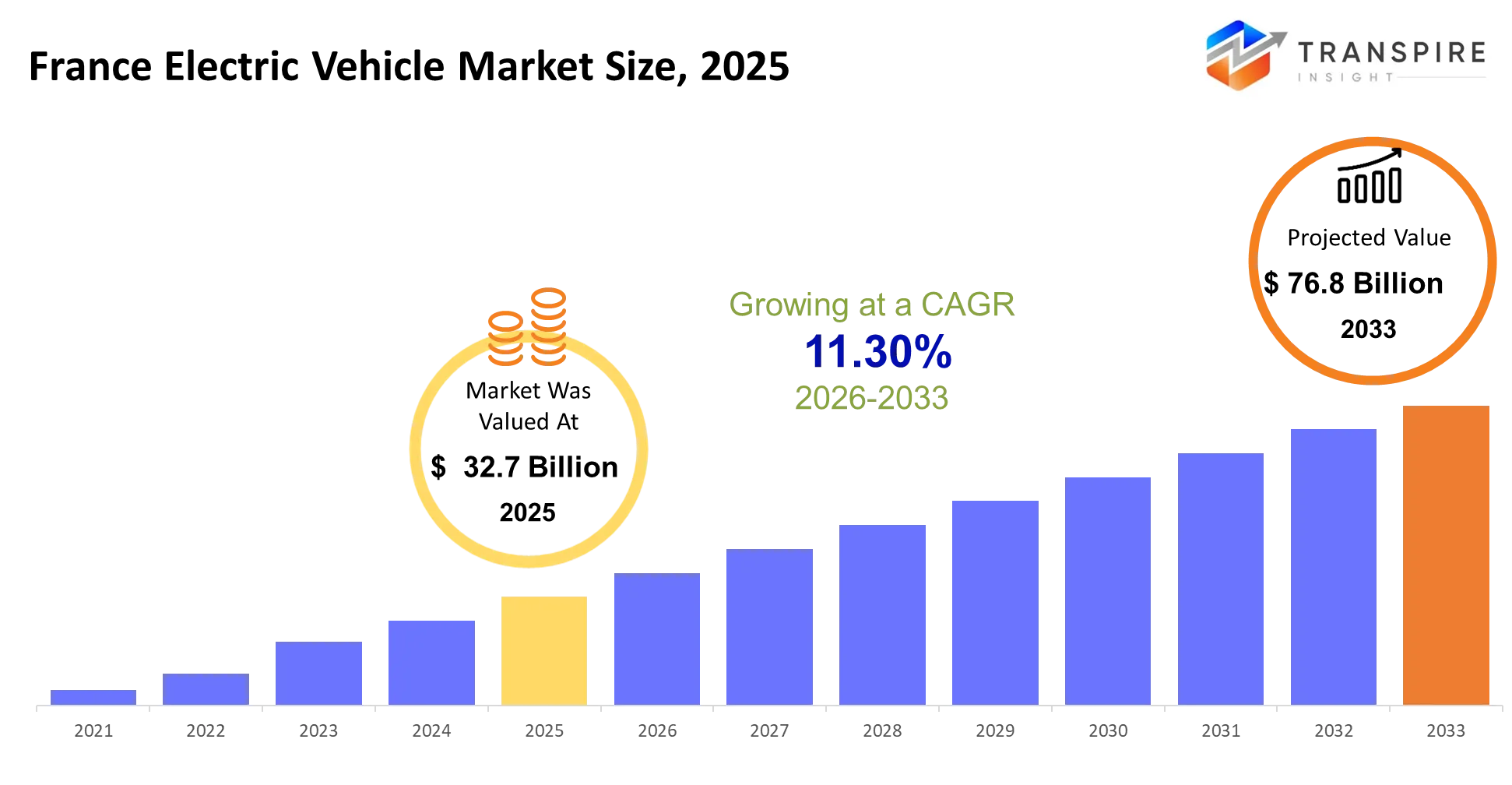
- France Electric Vehicle Market Size 2025: USD 32.7 Billion
- France Electric Vehicle Market Size 2033: USD 76.8 Billion
- France Electric Vehicle Market CAGR: 11.30%
- France Electric Vehicle Market Segments: By Type (Battery Electric Vehicles, Plug-in Hybrid, Hybrid Vehicles, Fuel Cell Vehicles, Others); By Application (Passenger Vehicles, Commercial Vehicles, Public Transport, Logistics, Ride Sharing, Others); By End-User (Individual Consumers, Fleet Operators, Government, Logistics Companies, Businesses, Others); By Charging (Fast Charging, Slow Charging, Wireless Charging, Battery Swapping, Others)
To learn more about this report,  Download Free Sample Report
France Electric Vehicle Market Summary
The France Electric Vehicle Market was valued at USD 32.7 Billion in 2025. It is forecast to reach USD 76.8 Billion by 2033. That is a CAGR of 11.30% over the period.The France electric vehicle market enables a structural shift in national mobility by replacing combustion-based transport with low-emission electric systems across private, commercial, and public fleets. The system enables urban areas to decrease their carbon emissions while achieving energy independence and connecting their vehicles to an extensive energy network that combines smart grid technology with charging stations that operate throughout the city. The market operates as two distinct systems which provide cities and logistics companies and government facilities with enhanced transportation solutions and support their energy system transformation initiatives.
The electrification process has transformed from its initial stage of incentive-based adoption during the past three to five years toward its current state of regulation-based development with supporting infrastructure. Fleet renewal has become necessary for cities through expanded low-emission zones, which Paris established, while battery prices decreased to make new electric vehicles affordable. EU-wide CO2 emission standards created a pivotal force which pushed OEMs such as Renault and Stellantis to expand their electric vehicle production operations while developing their local battery manufacturing capabilities.
Adoption now depends on compliance requirements and cost savings which customers achieve through operational efficiency rather than subsidies. The logistics and ride-sharing industries have increased their fleet electrification efforts because their operations require consistent routes and high vehicle usage, which enables manufacturers and infrastructure companies to earn profits at a faster pace.
Key Market Insights
- The French Electric Vehicle Market is changing from a demand model based on government subsidies to one which depends on charging station development as electric vehicles reach a market share of 20% for new car sales by 2025.
- The France Electric Vehicle Market shows its highest market share through battery electric vehicles which capture more than 60% of the market because of their essential use within low-emission areas and their manufacturers' production capacity.
- The market for plug-in hybrid vehicles is entering a decline phase which will continue until 2024 when full electric vehicles reach both price equality and increased regulatory support.
- Île-de-France leads the France Electric Vehicle Market with highest adoption due to dense urban population, strict emission rules, and advanced charging networks.
- Hauts-de-France is the fastest-growing region (2024–2030) driven by battery gigafactory investments and cross-border EV manufacturing expansion.
- Passenger vehicles hold the largest application share in the France Electric Vehicle Market, contributing over 55% due to strong private ownership demand.
- The application segment for logistics and commercial fleets shows the highest growth rate because e-commerce development drives the need for electric delivery services in urban areas.
- The individual consumer group represents the biggest part of end-user consumers while fleet operators who implement corporate electric vehicle programs show the fastest growth rate.
- Fast charging infrastructure is expanding rapidly, growing at over 25�GR as highway corridors and urban hubs scale across France.
- Residential charging systems continue to use slow charging as their main method but they now begin to adopt both smart charging and grid-connected charging solutions.
- The France Electric Vehicle Market is controlled by Stellantis and Renault Group and Tesla and BYD and Volkswagen through their development of new vehicle platforms and their establishment of local manufacturing facilities and their control of battery supply chains.
- Stellantis develops affordable modular electric vehicle platforms which enable Peugeot and Citroën to reach more customers.
- Renault uses its Ampere division to accelerate electric vehicle development which focuses on building compact electric vehicles and creating local battery production agreements.
- Tesla strengthens its market leadership in France through its software development and self-driving technology and expansion of Supercharger stations.
- BYD enters the France Electric Vehicle Market through its extensive European expansion which brings its complete battery production capabilities and affordable prices.
- Volkswagen uses its ID-series electric vehicles and charging network partnerships to expand its electric vehicle operations throughout Europe.
What are the Key Drivers, Restraints, and Opportunities in the France Electric Vehicle Market?
The France electric vehicle market exists because the government enforces strict decarbonization regulations while cities implement low-emission zones throughout their main urban areas. The introduction of regulations which ban internal combustion vehicles from urban areas, especially in Paris, has resulted in increased electric vehicle adoption by both individual customers and business vehicle fleets. The expansion of fast-charging stations together with declining battery prices has decreased ownership expenses, which leads to more customers buying products and results in continuous revenue growth for original equipment manufacturers and charging station operators.
The most important limitation affects areas outside major cities because charging stations do not distribute evenly while electrical grid systems lack sufficient capacity. The remote and semi-urban areas of the country experience extended times for charging stations to become available, which decreases peoples confidence in electric vehicle travel and prevents them from transitioning away from hybrid and traditional vehicles. The elevated initial expense of cars prevents low-income families from buying vehicles that operate like standard automobiles. The process of expanding grid systems and installing new stations will take time because these activities require significant financial investment.
France's renewable energy expansion creates a vital chance to develop vehicle-to-grid systems and large-scale battery networks through its ongoing renewable energy capacity growth. Electric vehicle systems serve as distributed energy storage systems through their implementation in pilot projects that operate in Île-de-France and Hauts-de-France regions. The electric vehicle system creates a dual revenue stream for fleet operators and utilities because electric vehicles function as both energy consumers and grid stabilization resources which create new market revenue opportunities that extend beyond transportation.
What Has the Impact of Artificial Intelligence Been on the France Electric Vehicle Market?
The French electric vehicle industry experiences operational efficiency improvements through artificial intelligence which manages fleet electrification and charging infrastructure and energy optimization systems throughout its operational lifespan. The AI-powered fleet management system performs automated functions which include creating routes and managing charging times and tracking emission zone compliance for cities which include Paris and Lyon. The system uses real-time traffic data and vehicle battery levels and system rules to manage vehicle deployment which decreases idle time while enhancing fleet efficiency.
Machine learning models serve as common tools for battery and motor and thermal system predictive maintenance because they enable users to identify performance decline before actual system breakdowns occur. The charging networks employ AI technology to predict energy consumption trends while balancing electricity distribution throughout their fast-charging stations. The capabilities of these systems enable fleet operators to monitor vehicle availability because they experience less maintenance downtime and their electric vehicle fleets maintain consistent energy use patterns.
The process of AI adoption in organizations confronts obstacles because data systems across the enterprise remain dispersed and vehicle platforms have not established unified standardized driving datasets. Smaller operators face high expenses for system integration while unpredictable traffic and weather situations lead to decreased algorithm performance. The mobility network faces operational limitations because OEM systems and charging infrastructure lack sufficient interoperability which prevents complete AI optimization potential.
Key Market Trends
- Battery electric vehicle adoption increased sharply after 2023 as France expanded low-emission zones across major metropolitan cities.
- The demand for plug-in hybrids decreased over time because new emission regulations made electric vehicles more suitable for urban operations than plug-in hybrids.
- Fast charging infrastructure expanded significantly after 2024 which enabled logistics and ride-sharing operators to increase their usage of electric vehicles.
- Stellantis and Renault strengthened domestic EV production after 2025 to reduce dependency on imported battery supply chains from Asia.
- Corporate fleet electrification accelerated in 2025 as leasing companies shifted their vehicle portfolios toward full electric models which provided better cost efficiency.
- French municipalities increased their electric bus procurement under long-term decarbonization targets which expanded public transport electrification.
- The operational costs of ride-sharing platforms decreased after 2024 because regulatory pressure pushed them to increase their usage of electric vehicles.
- The development of hydrogen fuel cells for passenger vehicles experienced a slowdown because research efforts moved towards developing pilot programs for heavy-duty transport.
- Smart charging systems integrated with renewable energy systems after 2025 to decrease grid demand during peak EV charging times.
- Chinese EV manufacturers entered France more aggressively in 2026 which resulted in increased competition among mid-range electric vehicle manufacturers.
France Electric Vehicle Market Segmentation
By Type
The Electric Vehicle Market in France is predominantly controlled by Battery Electric Vehicles because of government regulations which support electric vehicles and charging networks which continue to grow and their widespread use in both public transportation and business vehicle fleets. The transition to complete electrification is advanced through the combination of strict emission regulations in central urban areas and government financial support programs. The domestic battery manufacturing capacity and electric vehicle platform investments made by OEMs will provide increased supply chain reliability and help them maintain competitive pricing.
The transitional stage between conventional vehicles and electric vehicles exists through the development of charging systems which currently are not complete. The price-sensitive market and rural regions with limited charging facilities make hybrid vehicles useful in these areas. The production costs of fuel cell vehicles combined with the current state of hydrogen infrastructure development limit their market potential to a small segment while micro-mobility and experimental electric solutions serve specialized needs in urban settings.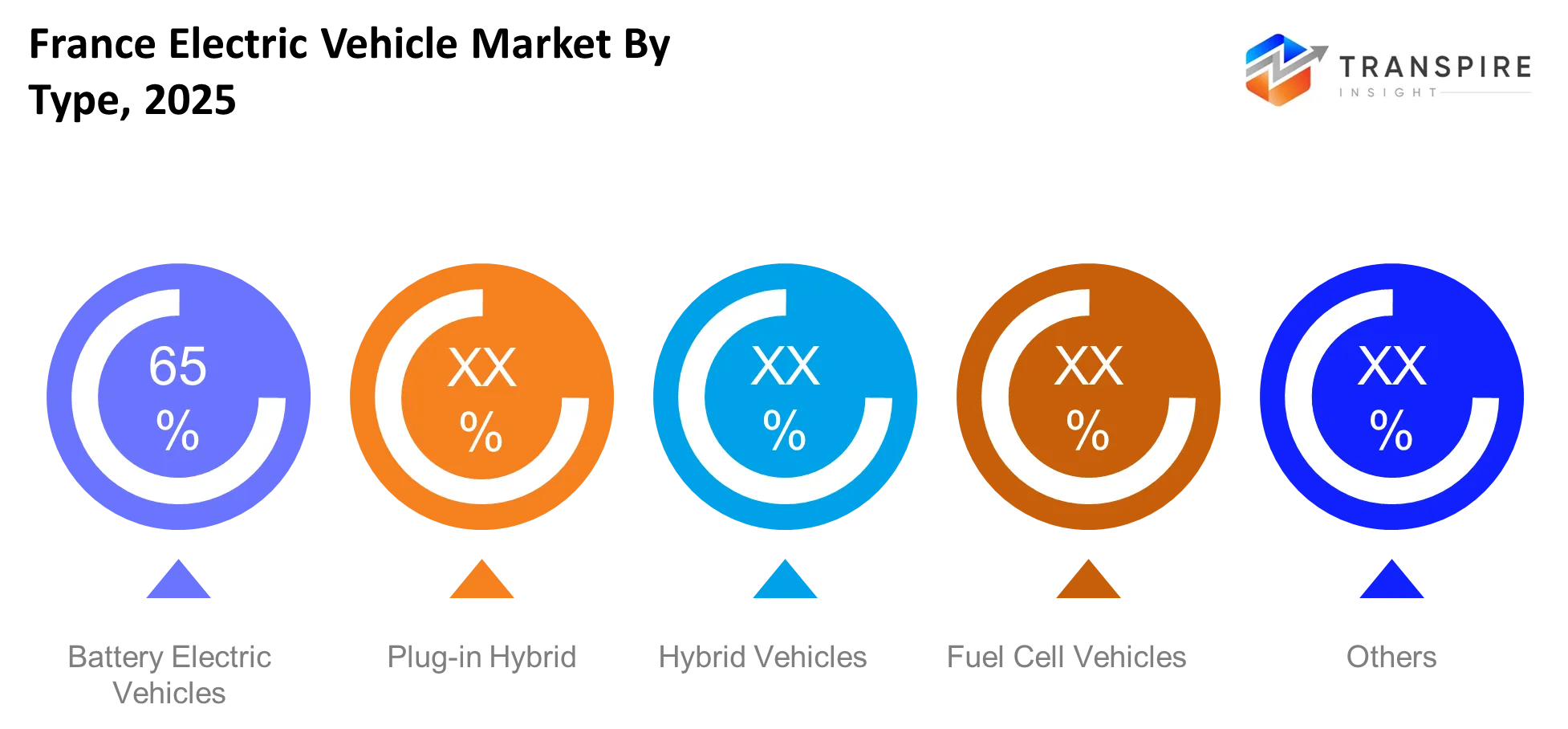
To learn more about this report, Download Free Sample Report
By Application
The France Electric Vehicle Market identifies Passenger Vehicles as its biggest market segment because people own electric vehicles and government regulations support their use. Urban areas require new vehicles because of their need for transportation and their limits on emissions. OEMs focus on developing electric vehicles with compact and mid-size designs to meet the needs of mainstream consumers.
The commercial vehicle market expands fast because of two main factors which are logistics electrification and urban delivery requirements. Public transport adoption is driven by government-led bus electrification programs. The high utilization efficiency of assets drives growth for logistics and ride-sharing services while municipal and specialized fleet operations develop.
By End-User
The electric vehicle market in France exists because individual consumers drive the market through their strong demand for private vehicle ownership and the government provides financial incentives. Urban households choose electric vehicles because they offer lower operating expenses and help them meet regulatory requirements. Compact electric vehicles enable metropolitan areas to achieve high electric vehicle adoption rates.
Corporate electrification combined with logistics optimization has created fleet operators as the fastest expanding market segment. Government fleets adopt electric vehicles through their established procurement systems. The logistics sector and business organizations increase electric vehicle adoption to enhance operational performance and meet environmental social governance standards while the healthcare and institutional sectors adopt electric vehicles.
By Charging
Fast charging leads the France Electric Vehicle Market because customers need shorter vehicle downtime to operate their vehicle fleets at maximum capacity. The development of highway corridors together with urban charging stations enables both long-distance travel and commercial electric vehicle operation. The process of building infrastructure moves faster because public and private organizations increase their financial support.
The residential and workplace charging systems depend on slow charging because it requires minimal installation expenses and people use it during nighttime hours. The field of wireless charging has not yet advanced beyond its initial testing stage which focuses on applications for smart cities. The niche market for battery swapping exists because of difficult infrastructure requirements which exist for both experimental and hybrid charging systems currently being developed.
What are the Key Use Cases Driving the France Electric Vehicle Market?
The France electric vehicle market uses private passenger mobility as its primary application which particularly applies to compact urban cars that operate in metropolitan areas such as Île-de-France. The demand exists because high fuel costs and low-emission zone restrictions together with strong consumer incentives create an economic advantage for electric vehicle ownership. The adoption of electric vehicles receives support from two factors which are the compact city design and the limited distance people travel each day.
The use of electric vehicles expands to commercial fleet electrification which focuses on last-mile delivery and corporate leasing operations that logistics and e-commerce businesses conduct. The taxi and ride-hailing sectors accelerate electric vehicle adoption through their shift to operational savings and their need to meet urban emission zone rules. The predictable driving routes of these segments together with their centralized charging systems create operational advantages.
Commercial electric light vehicles operate in regional freight while shared mobility platforms offer subscription-based access to electric vehicles. The public sector is starting to adopt electric vehicles for its municipal services and postal delivery operations. The development of charging infrastructure together with the decreasing total ownership costs will enable these applications to achieve expansion.
|
Report Metrics |
Details |
|
Market size value in 2025 |
USD 32.7 Billion |
|
Market size value in 2026 |
USD 36.3 Billion |
|
Revenue forecast in 2033 |
USD 76.8 Billion |
|
Growth rate |
CAGR of 11.30% from 2026 to 2033 |
|
Base year |
2025 |
|
Historical data |
2021 - 2024 |
|
Forecast period |
2026 - 2033 |
|
Report coverage |
Revenue forecast, competitive landscape, growth factors, and trends |
|
Regional scope |
France |
|
Key company profiled |
Tesla, Renault, Nissan, BMW, Volkswagen, Hyundai, Kia, Ford, Stellantis, Toyota, Mercedes-Benz, Volvo, BYD, Rivian, Lucid . |
|
Customization scope |
Free report customization (country, regional & segment scope). Avail customized purchase options to meet your exact research needs. |
|
Report Segmentation |
By Type (Battery Electric Vehicles, Plug-in Hybrid, Hybrid Vehicles, Fuel Cell Vehicles, Others); By Application (Passenger Vehicles, Commercial Vehicles, Public Transport, Logistics, Ride Sharing, Others); By End-User (Individual Consumers, Fleet Operators, Government, Logistics Companies, Businesses, Others); By Charging (Fast Charging, Slow Charging, Wireless Charging, Battery Swapping, Others) |
Which Regions are Driving the France Electric Vehicle Market Growth?
Île-de-France remains the leading region in the France electric vehicle market because urban regions demand electric vehicles and low-emission transportation rules and the area has the most corporate and ride-hailing vehicle operations. The Paris regulations which implement low-emission zones make it necessary for drivers to use electric vehicles because they prohibit internal combustion cars from entering central city areas. The strong charging infrastructure network which receives funding from both public and private sectors helps to establish initial EV adoption in the region. The system generates permanent demand for replacements which establishes the region as the primary area for electric vehicle adoption throughout the entire country.
Auvergne-Rhône-Alpes serves as a stable second hub because its automotive manufacturing sector supports production operations and its supply chain extends from Lyon to nearby industrial areas. Its growth pattern depends on production capacity because it functions as an automotive production center which includes original equipment manufacturer plants and component manufacturing facilities for electric vehicles. The region has access to multiple energy sources which include hydroelectric power that enables cleaner development of charging infrastructure. The industrial sector maintains its demand for investments because it requires them to remain operational during periods when consumer interest declines.
Hauts-de-France has become the fastest expanding EV market because it attracts battery gigafactory projects while benefiting from its cross-border logistics connections to Belgium and the European Union automotive network. The recent industrial rules of the area have brought major electrification initiatives which now alter its existing manufacturing base. The region is changing from its established industrial base to develop into a central electric vehicle manufacturing hub. The current battery supply chain market offers new players and investors multiple chances to establish themselves in battery supply chains and export-focused electric vehicle manufacturing until 2033.
Who are the Key Players in the France Electric Vehicle Market and How Do They Compete?
The French electric vehicle market exhibits moderate consolidation because domestic companies maintain substantial advantages over foreign market entrants. Stellantis and Renault Group control volume markets through their extensive dealership networks and their ability to manufacture vehicles in nearby facilities, while Tesla establishes new standards for premium electric vehicles through its software-based system. Modern competition depends on three factors: battery cost efficiency, platform scalability, and charging ecosystem control, which modern vehicles require beyond their basic design. Chinese companies now enter the market to disrupt existing pricing systems, which indicates that the mid-range electric vehicle market will start to experience market breakdown.
Stellantis uses a cost leadership strategy that depends on shared platform development across its brands, which include Peugeot and Citroën, to achieve more rapid electric vehicle production throughout its compact vehicle line. The company establishes its growth path through STLA modular architecture, which simplifies the manufacturing procedure. Renault Group relies on its Ampere electric vehicle unit and Renault 5 EV revival project to develop market differentiation through innovative product development, which provides cost stability through its battery supply agreements. Tesla uses its software system and Supercharger network to create customer dependency while making charging services more accessible. BYD has entered the French market through distributor agreements, while using its battery production control and competitive pricing to attract customers who seek affordable products.
Company List
- Tesla
- Renault
- Nissan
- BMW
- Volkswagen
- Hyundai
- Kia
- Ford
- Stellantis
- Toyota
- Mercedes-Benz
- Volvo
- BYD
- Rivian
- Lucid
Recent Development News
In February 2026, Stellantis announced that it had taken the lead in the French electric vehicle market for Q1 2026, highlighting its dominance in both EV and hybrid segments and reinforcing its nearly 31% market share across vehicle categories. The development underscores intensifying competition among OEMs for leadership in France’s accelerating EV transition.https://www.ecomotorsnews.com
In February 2026, Renault announced the full acquisition of its Flexis electric van joint venture from Volvo Group and CMA CGM, consolidating control over its light commercial EV strategy and strengthening its France-based EV production ecosystem. The move is expected to streamline operations and accelerate the rollout of next-generation electric vans manufactured in Sandouville, France.https://www.reuters.com
What Strategic Insights Define the Future of the France Electric Vehicle Market?
The France electric vehicle market will experience its main development between 2023 and 2030 because customers now depend more on charging infrastructure and electric vehicle prices than on government subsidies. The hidden danger comes from upstream battery supply because manufacturers need to control multiple refining locations which force them to pay higher prices and experience operational delays despite strong local demand. The combination of vehicle-to-grid technology and second-life battery energy storage presents financial opportunities that remain unexploited yet show potential for growth as France enforces its grid flexibility requirements and increases renewable energy usage. Market participants should establish vertical partnerships that combine charging infrastructure with energy management software and battery lifecycle services because this approach will enable them to create stable revenue sources while protecting their business from declining profit margins.
France Electric Vehicle Market Report Segmentation
By Type
- Battery Electric Vehicles
- Plug-in Hybrid
- Hybrid Vehicles
- Fuel Cell Vehicles
- Others
By Application
- Passenger Vehicles
- Commercial Vehicles
- Public Transport
- Logistics
- Ride Sharing
- Others
By End-User
- Individual Consumers
- Fleet Operators
- Government
- Logistics Companies
- Businesses
- Others
By Charging
- Fast Charging
- Slow Charging
- Wireless Charging
- Battery Swapping
- Others
Frequently Asked Questions
Find quick answers to common questions.
The Confirmed 2033 Market size figure is USD 76.8 Billion.
Key Segments for the France Electric Vehicle Market are By Type (Battery Electric Vehicles, Plug-in Hybrid, Hybrid Vehicles, Fuel Cell Vehicles, Others); By Application (Passenger Vehicles, Commercial Vehicles, Public Transport, Logistics, Ride Sharing, Others); By End-User (Individual Consumers, Fleet Operators, Government, Logistics Companies, Businesses, Others); By Charging (Fast Charging, Slow Charging, Wireless Charging, Battery Swapping, Others).
Major France Electric Vehicle Market players are Tesla, Renault, Nissan, BMW, Volkswagen, Hyundai, Kia, Ford, Stellantis, Toyota, Mercedes-Benz, Volvo, BYD, Rivian, Lucid.
The France Electric Vehicle Market size is USD USD 32.7 Billion in 2025.
The France Electric Vehicle Market CAGR is 11.30% from 2026 to 2033.
- Tesla
- Renault
- Nissan
- BMW
- Volkswagen
- Hyundai
- Kia
- Ford
- Stellantis
- Toyota
- Mercedes-Benz
- Volvo
- BYD
- Rivian
- Lucid
Recently Published Reports
-
Apr 2026
ATV & UTV Market
ATV & UTV Market Size, Share & Analysis Report By Type (ATV, and UTV), By Variants (Less Than 400 CC, 400 CC To 800 CC, and More Than 800 CC), and Geography (North America, Europe, Asia-Pacific, Middle East and Africa, South and Central America), 2021 - 2031
-
Apr 2026
Automotive Central Gateway Module Market
Automotive Central Gateway Module Market Size, Share & Analysis Report By Type (Ethernet Central Gateway Module, CAN Central Gateway Module, LIN Central Gateway Module, and FlexRay), By Application (Powertrain Control, Body Control, Infotainment System, Advanced Driver Assistance Systems (ADAS), and Others), By End User (Passenger Vehicles, and Commercial Vehicles), and Geography (North America, Europe, Asia-Pacific, Middle East and Africa, South and Central America), 2021 - 2031
-
Apr 2026
Automotive Engine Oil Filter Market
Automotive Engine Oil Filter Market Size, Share & Analysis Report By Filter Type (Fuel Filter, Engine Oil Filter, Hydraulic Oil Filter, and Others), By Filter Media (Cellulose, Synthetic, and Micro), By Sales Channel (OEMs, and Aftermarket), By Vehicle Type (Passenger Cars, Light Commercial Vehicles, Heavy Duty Trucks, Buses and Coaches, and Off-road Vehicles), and Geography (North America, Europe, Asia-Pacific, Middle East and Africa, South and Central America), 2021 - 2031
-
Apr 2026
Automotive Parts Aluminium Die Casting Market
Automotive Parts Aluminium Die Casting Market Size, Share & Analysis Report By Production Process (Pressure Die Casting, Vacuum Die Casting, Squeeze Die Casting, Gravity Die Casting), By Application (Body Parts, Engine Parts, Transmission Parts, Battery And Related Components, Other Application Types), and Geography (North America, Europe, Asia-Pacific, Middle East and Africa, South and Central America), 2021 - 2031
Our Clients