Europe Electric Vehicle Battery Market Size & Forecast:
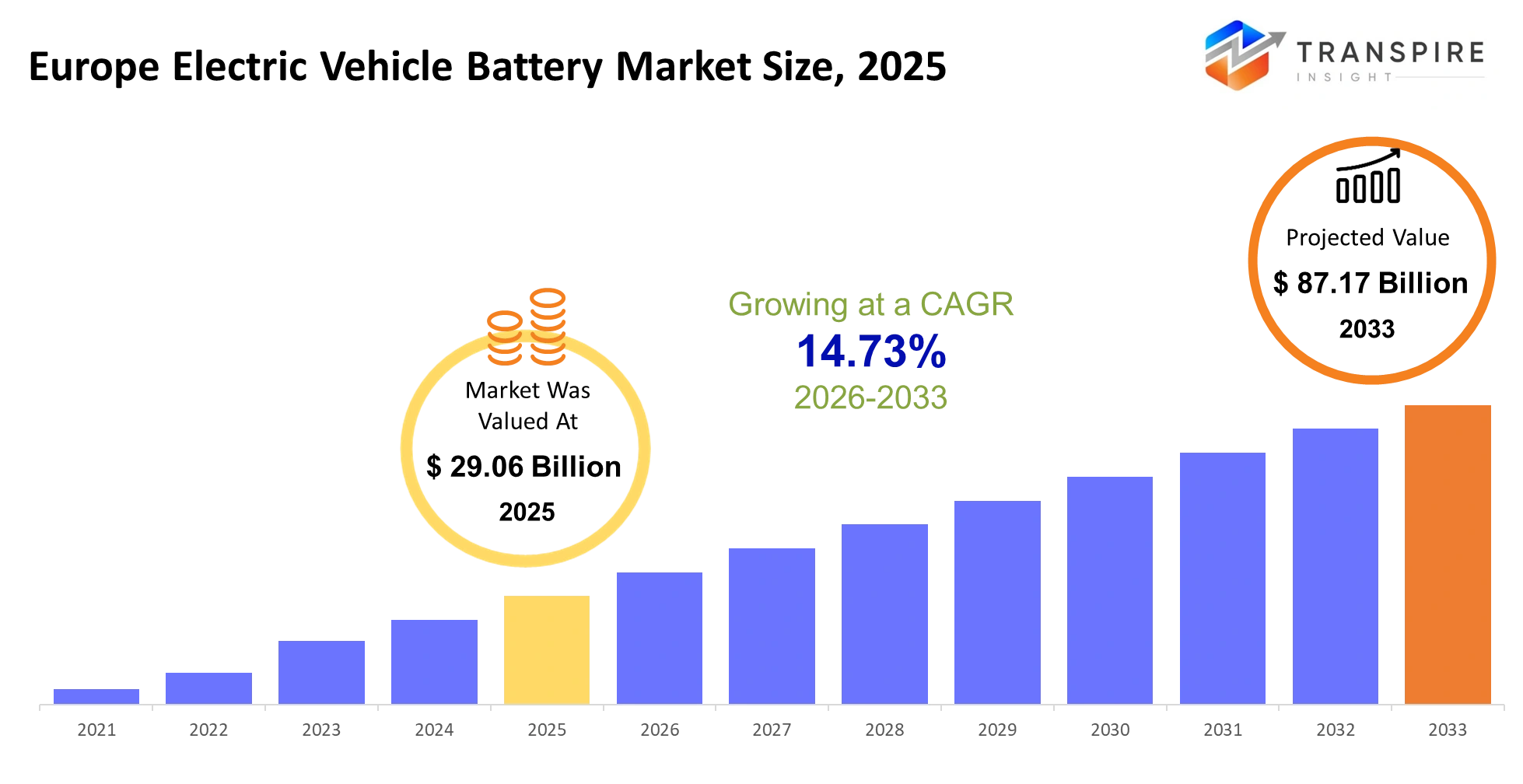
- Europe Electric Vehicle Battery Market Size 2025: USD 29.06 Billion
- Europe Electric Vehicle Battery Market Size 2033: USD 87.17 Billion
- Europe Electric Vehicle Battery Market CAGR: 14.73%
- Europe Electric Vehicle Battery Market Segments: By Type (Lithium-ion, Solid-state, Nickel Metal Hydride, Others); By Application (Passenger Vehicles, Commercial Vehicles, Energy Storage, Two-wheelers, Grid Storage, Others); By End-User (Automakers, Battery Manufacturers, Energy Companies, Fleet Operators, Governments, Others); By Chemistry (LFP, NMC, NCA, Others).
To learn more about this report,  Download Free Sample Report
Europe Electric Vehicle Battery Market Summary:
The Europe Electric Vehicle Battery Market size is estimated at USD 29.06 Billion in 2025 and is anticipated to reach USD 87.17 Billion by 2033, growing at a CAGR of 14.73% from 2026 to 2033.
The European Union electric vehicle battery market centralizes all activities related the region's clean transportation sector because it determines which vehicle technologies will be developed and used in future automotive production. The product will now show customer demand changes because customers will evaluate products based on three factors which include range and charging speed and long-term product durability, in addition to their price. The combination of solid-state design development and lithium-ion chemical advancement will create new performance benchmarks, while local production capabilities will decrease the need for foreign products. Automotive manufacturers face ongoing policy demand which requires them to adopt electric vehicles because the government strengthens emission regulations and promotes technological progress. Recycling systems together with second-life battery applications will become essential components of sustainability practices because environmental demands continue to increase.
What Has the Impact of Artificial Intelligence Been on the Europe Electric Vehicle Battery Market?
The European electric vehicle battery market now uses artificial intelligence to create new decision-making methods which help businesses establish competitive advantages through increased operational efficiency. The European electric vehicle battery market uses AI technology to enhance market research by analyzing extensive data from vehicle operations and charging habits and regional market penetration. The solution helps businesses identify concealed patterns while they develop their operational plans with increased trust. Machine learning models improve demand forecasting accuracy which helps manufacturers predict changes in battery chemical composition and capacity needs and price sensitivity.
Artificial intelligence helps European electric vehicle battery market production by providing efficiency gains that can be measured through tangible results. Smart automation technology is enhancing battery assembly lines by decreasing defects which results in better cell performance consistency. Predictive analytics technology monitors equipment conditions to avoid expensive production interruptions while it improves energy efficiency during manufacturing operations. AI technology is revolutionizing supply chain operations by detecting process bottlenecks which help organizations enhance their inventory management systems while they decrease expenses for essential materials particularly lithium and cobalt.
The European electric vehicle battery market now stands ready to experience flexible and ground-breaking development because of these technological advancements. Through AI-driven insights, companies create battery solutions which enhance vehicle performance and extend product lifespan. Intelligent systems will give companies a competitive advantage during times of rising competition because they enable companies to develop new products faster while reducing costs and improving operational efficiency.
Key Market Trends & Insights:
- Germany maintains its position as the leading market for electric vehicle batteries in Europe through its automotive industry and governmental support which together create more than 30 percent of the market.
- The period between 2025 and 2030 sees Eastern Europe emerging as the most rapidly expanding area because of its affordable manufacturing centers and rising international investments.
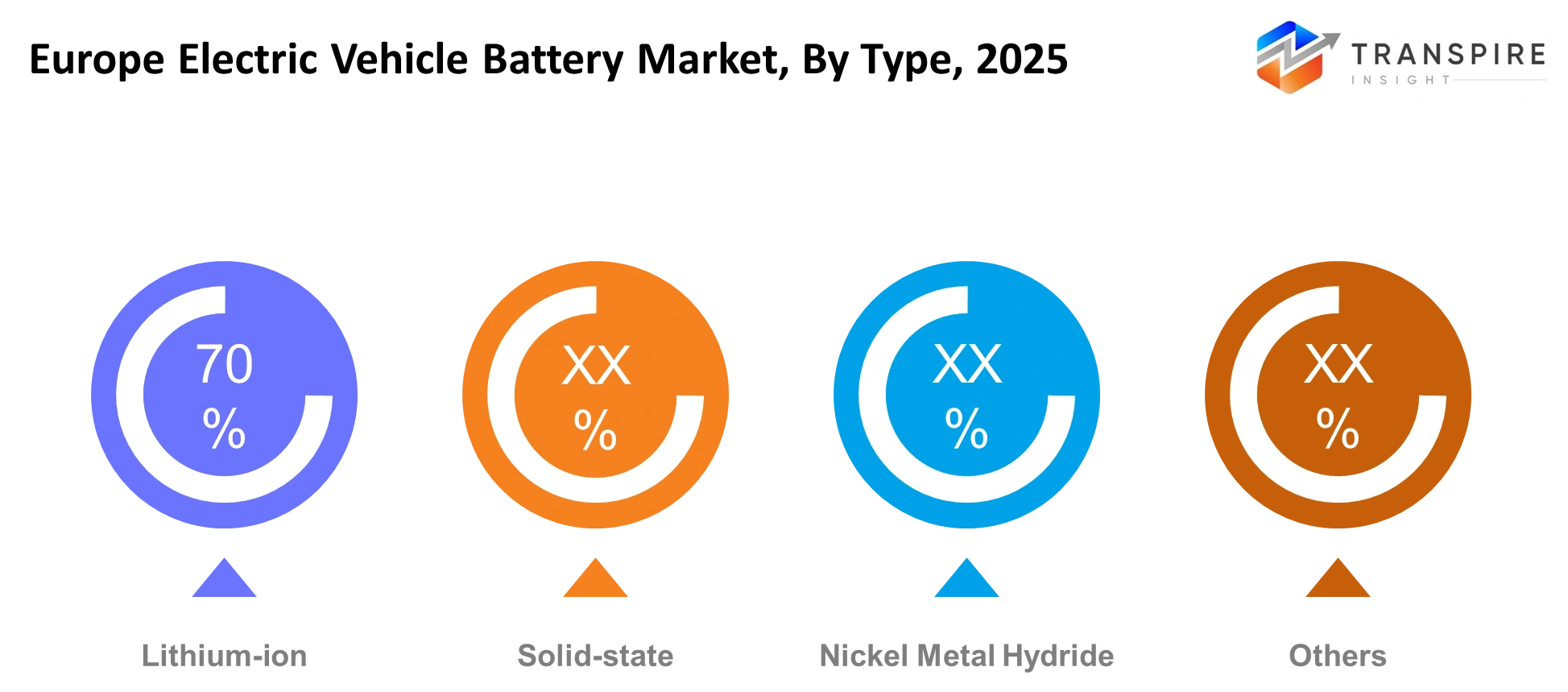
- The market in 2025 shows lithium-ion batteries as the dominant technology with a 75 percent market share because they deliver high energy density and their supply chain system has become established.
- The second-largest market share belongs to nickel-cobalt-aluminum batteries which deliver performance benefits for high-end electric vehicles.
- The solid-state battery segment represents the fastest-growing market segment which will grow substantially until 2030 through technological advancements.
- The European market for passenger electric vehicles shows high consumer interest and government support because these vehicles hold more than 65 percent market share.
- The logistics industry drives the growth of commercial electric fleets because companies implement electric vehicle systems while governments enforce stricter emissions standards.
- The automotive original equipment manufacturers (OEM) sector will exceed 70 percent market share in 2025 because manufacturers expand their electric vehicle production capabilities.
- Energy storage providers experience rapid expansion because they use battery reuse together with second-life applications to create solutions for grid stability.
- The implementation of AI-driven manufacturing and recycling solutions enables organizations to achieve cost savings while developing sustainable operations for the future.
Europe Electric Vehicle Battery Market Segmentation
By Type:
The European market for electric vehicle batteries shows a clear preference for lithium-ion batteries because these batteries deliver optimal performance at affordable prices. Solid-state batteries will attract users because they provide safe operation and extended service life. Nickel metal hydride batteries will serve specific applications, while other battery types will undergo testing in both experimental environments and limited operational settings to meet upcoming transportation demands.
To learn more about this report, Download Free Sample Report
By Application:
Passenger vehicles will become the most popular choice among customers because their use increases in urban areas. Commercial vehicles will grow at a steady rate because the logistics industry embraces electric vehicle technology. Energy storage and grid storage systems will assist in integrating renewable energy sources, while two-wheelers will expand their presence in urban areas. The other applications will have restricted usage, yet they will provide solutions for specific mobility needs.
By End-User:
The automotive industry will drive market demand because manufacturers plan to produce vehicles at high volume. Battery manufacturers will concentrate on maintaining stable supplies while developing new products. Energy companies will expand their operations through storage initiatives, while fleet owners and government agencies will create new electric vehicle adoption pathways through their infrastructure development projects.
By Chemistry:
LFP will grow in popularity because it offers safety and cost advantages which make it suitable for entry-level vehicles. NMC will continue strong use for balanced performance, while NCA will serve high-performance segments. The remaining chemical compounds will help research activities and future enhancements which will support upcoming efficiency standards and sustainability requirements.
What are the Main Challenges for the Europe Electric Vehicle Battery Market Growth?
The electric vehicle battery market in Europe encounters multiple technical and operational problems which prevent it from achieving stable performance and efficient expansion. The efficiency of batteries depends on three factors which include temperature management and battery charging inventory and the ability of materials to withstand actual usage conditions. The demand for lithium and cobalt essential minerals creates supply chain problems which result in market uncertainty and hinder the expansion of the European electric vehicle battery market and its ability to maintain reliable performance over time.
The European electric vehicle battery market experiences slow progress because of manufacturing and commercialization obstacles that need resolution. The production process requires businesses to invest in expensive equipment and maintain all necessary legal requirements while operating their factories. The combination of high production expenses and unstable raw material costs creates margin pressure that hinders companies from achieving widespread market success. The industry faces these market constraints which prevent smaller companies from entering the market and extend the time needed for industry development.
The European electric vehicle battery market faces significant problems related to adoption because users encounter two main obstacles which include insufficient charging stations and inconsistent government backing. Charging time requirements and battery replacement expenses and resale value concerns lead to consumer indecision which decreases product demand. The shortage of qualified workers and the funding deficits for new projects generate obstacles that impede development in developing areas.
Organizations face two types of risks which include competitive threats and changes in technological advancements. The market will experience changes due to energy storage alternatives and fast technological advancements, while businesses must modify their operations to meet environmental laws, which will make future business expansion more complicated.
Regional Insights
The European electric vehicle battery market shows strong market presence throughout Western Europe because Germany and France and Netherlands control the market through their established automotive industries and their supportive government policies. The upcoming battery production facility investments will help create stronger supply chains while innovation hubs will enable development of better efficiency standards and safety measures and enduring performance requirements.
The Northern European region will experience continuous growth because of its clean energy adoption combined with its strong sustainability targets. The countries of Sweden and Norway will boost battery consumption through their electric vehicle programs and their efforts to combine renewable energy sources. The combined effects of local production projects and recycling programs will enhance resource efficiency while decreasing reliance on outside supply sources.
Eastern Europe will transform into an affordable manufacturing center that will draw foreign investments and establish new production facilities. Industrial development will receive support from decreasing labor expenses and the growth of existing infrastructure. The regional market development will experience hindrance because two main factors exist which include insufficient charging infrastructure and limited availability of trained professionals.
Recent Development News
In 04 2026, CATL introduced its next generation electric vehicle batteries. The company developed two new battery technologies which enable ultra-fast charging and extended driving range to help European automotive manufacturers meet their operational needs.
Source: https://www.reuters.com
In 04 2026, Northvolt Drei Project GmbH underwent a restructuring process. The German battery project transferred its operations to a new entity which supports operational stability and development work for the planned Heide battery plant.
Source: https://de.wikipedia.org
|
Report Metrics |
Details |
|
Market size value in 2025 |
USD 29.06 Billion |
|
Market size value in 2026 |
USD 33.32 Billion |
|
Revenue forecast in 2033 |
USD 87.17 Billion |
|
Growth rate |
CAGR of 14.73% from 2026 to 2033 |
|
Base year |
2025 |
|
Historical data |
2021 - 2024 |
|
Forecast period |
2026 - 2033 |
|
Report coverage |
Revenue forecast, competitive landscape, growth factors, and trends |
|
Regional scope |
Europe (Germany, United Kingdom, France, Italy, Spain, Rest of Europe) |
|
Key company profiled |
CATL, LG Energy Solution, Panasonic, Samsung SDI, SK On, Northvolt, BYD, Tesla, AESC, Saft, Envision AESC, CALB, EVE Energy, Farasis, Amperex. |
|
Customization scope |
Free report customization (country, regional & segment scope). Avail customized purchase options to meet your exact research needs. |
|
Report Segmentation |
By Type (Lithium-ion, Solid-state, Nickel Metal Hydride, Others); By Application (Passenger Vehicles, Commercial Vehicles, Energy Storage, Two-wheelers, Grid Storage, Others); By End-User (Automakers, Battery Manufacturers, Energy Companies, Fleet Operators, Governments, Others); By Chemistry (LFP, NMC, NCA, Others). |
How Can New Companies Establish a Strong Foothold in the Europe Electric Vehicle Battery Market?
New entrants aiming to succeed in the europe electric vehicle battery market will need a focused strategy built on differentiation and clear value creation. Companies should focus on niche markets which include high-performance batteries and recycling solutions and energy storage integration instead of competing directly with major manufacturers. This approach will enable emerging players to develop solutions which meet current market requirements while delivering cost-effective and sustainable outcomes.
Innovation will remain a critical entry lever in the europe electric vehicle battery market. Startups that invest in advanced chemistries, such as solid-state or cobalt-free batteries, will stand out as industry trends shift toward safer and more sustainable solutions. Northvolt shows how companies can establish strong market positions through local production and green energy use while ACC demonstrates joint ventures to accelerate their business development.
Strategic partnerships will create additional opportunities for establishing market positions. Through partnerships with automakers and energy providers and technology firms new businesses will obtain permanent contracts and distribution rights. Smart manufacturing combined with digital tools will create better production outcomes while lowering operational hazards to solve important problems that the industry faces.
To maintain their competitive advantage, new companies entering the europe electric vehicle battery market must follow regulatory requirements and dedicate resources to circular economy initiatives. Battery recycling and second-life applications and transparent supply chains will decrease expenses while establishing trust with stakeholders, which will guarantee ongoing market presence.
Key Europe Electric Vehicle Battery Market Company Insights
The European electric vehicle battery market exhibits intense competition among international and local manufacturers because both groups pursue capacity growth while controlling their operational expenses. Companies will establish production facilities and battery research centers because they want to decrease their need for foreign imports. Their supply agreements with automakers will provide them with market stability and competitive advantages.
The competitive landscape will undergo transformation through strategic partnerships and joint ventures which will establish new market dynamics. Battery manufacturers will partner with automobile companies to drive innovation while developing scalable solutions. The establishment of research centers and pilot initiatives will enable companies to speed up product development while satisfying evolving performance standards and safety requirements.
Sustainability practices and recycling technologies and energy efficiency enhancements will provide the basis for product differentiation. Companies will implement circular economy systems which enable them to retrieve materials while decreasing their disposal expenses. The company establishes digital manufacturing and process optimization as its top priority because this approach will create better results. It enables companies to sustain their market position while handling pricing pressures and following government regulations.
Company List
- CATL
- LG Energy Solution
- Panasonic
- Samsung SDI
- SK On
- Northvolt
- BYD
- Tesla
- AESC
- Saft
- Envision AESC
- CALB
- EVE Energy
- Farasis
- Amperex
What are the Key Use-Cases Driving the Growth of the Europe Electric Vehicle Battery Market?
The europe electric vehicle battery market is expanding rapidly because of its effective applications in passenger transportation. Electric cars are the main source of demand because car manufacturers increase production to achieve their emission goals while consumers demand vehicles with greater driving range and quicker charging times. The current trend creates greater battery requirements which drives development of better energy storage solutions with extended operational lifetimes.
The europe electric vehicle battery market benefits from commercial mobility services which provide essential support to public transport and logistics operations. Delivery van electrification by fleet operators operates together with bus electrification and ride-hailing vehicle electrification to achieve two goals which include cost reduction and urban emission compliance. These use cases need robust batteries which maintain high performance throughout their operational life, which creates opportunities for advanced battery management systems and fast-charging solutions.
The europe electric vehicle battery market receives its direction from energy storage applications which depend on increasing renewable energy installations to meet their needs. The batteries function as storage systems for surplus solar and wind energy, which helps maintain grid balance while enabling decentralized power distribution. The practice of second-life battery usage from retired vehicles is becoming popular because it provides affordable storage solutions for power utilities and industrial customers.
The europe electric vehicle battery market will grow because of new applications which include two-wheelers and micro-mobility vehicles and smart city infrastructure. The applications require battery technology which combines compact design with energy efficiency and cost effectiveness, which enables businesses to create new products while expanding their operations into various industries.
Europe Electric Vehicle Battery Market Report Segmentation
By Type
- Lithium-ion
- Solid-state
- Nickel Metal Hydride
- Others
By Application
- Passenger Vehicles
- Commercial Vehicles
- Energy Storage
- Two-wheelers
- Grid Storage
- Others
By End-User
- Automakers
- Battery Manufacturers
- Energy Companies
- Fleet Operators
- Governments
- Others
By Chemistry
- LFP
- NMC
- NCA
- Others
Frequently Asked Questions
Find quick answers to common questions.
The approximate Europe Electric Vehicle Battery Market size for the market will be USD 87.17 Billion in 2033.
Key segments for the Europe Electric Vehicle Battery Market are By Type (Lithium-ion, Solid-state, Nickel Metal Hydride, Others); By Application (Passenger Vehicles, Commercial Vehicles, Energy Storage, Two-wheelers, Grid Storage, Others); By End-User (Automakers, Battery Manufacturers, Energy Companies, Fleet Operators, Governments, Others); By Chemistry (LFP, NMC, NCA, Others).
Major Europe Electric Vehicle Battery Market players are CATL, LG Energy Solution, Panasonic, Samsung SDI, SK On, Northvolt, BYD, Tesla, AESC, Saft, Envision AESC, CALB, EVE Energy, Farasis, Amperex.
The Europe Electric Vehicle Battery Market size is USD 29.06 Billion in 2025.
The Europe Electric Vehicle Battery Market CAGR is 14.73%.
- CATL
- LG Energy Solution
- Panasonic
- Samsung SDI
- SK On
- Northvolt
- BYD
- Tesla
- AESC
- Saft
- Envision AESC
- CALB
- EVE Energy
- Farasis
- Amperex
Recently Published Reports
-
Apr 2026
ATV & UTV Market
ATV & UTV Market Size, Share & Analysis Report By Type (ATV, and UTV), By Variants (Less Than 400 CC, 400 CC To 800 CC, and More Than 800 CC), and Geography (North America, Europe, Asia-Pacific, Middle East and Africa, South and Central America), 2021 - 2031
-
Apr 2026
Automotive Central Gateway Module Market
Automotive Central Gateway Module Market Size, Share & Analysis Report By Type (Ethernet Central Gateway Module, CAN Central Gateway Module, LIN Central Gateway Module, and FlexRay), By Application (Powertrain Control, Body Control, Infotainment System, Advanced Driver Assistance Systems (ADAS), and Others), By End User (Passenger Vehicles, and Commercial Vehicles), and Geography (North America, Europe, Asia-Pacific, Middle East and Africa, South and Central America), 2021 - 2031
-
Apr 2026
Automotive Engine Oil Filter Market
Automotive Engine Oil Filter Market Size, Share & Analysis Report By Filter Type (Fuel Filter, Engine Oil Filter, Hydraulic Oil Filter, and Others), By Filter Media (Cellulose, Synthetic, and Micro), By Sales Channel (OEMs, and Aftermarket), By Vehicle Type (Passenger Cars, Light Commercial Vehicles, Heavy Duty Trucks, Buses and Coaches, and Off-road Vehicles), and Geography (North America, Europe, Asia-Pacific, Middle East and Africa, South and Central America), 2021 - 2031
-
Apr 2026
Automotive Parts Aluminium Die Casting Market
Automotive Parts Aluminium Die Casting Market Size, Share & Analysis Report By Production Process (Pressure Die Casting, Vacuum Die Casting, Squeeze Die Casting, Gravity Die Casting), By Application (Body Parts, Engine Parts, Transmission Parts, Battery And Related Components, Other Application Types), and Geography (North America, Europe, Asia-Pacific, Middle East and Africa, South and Central America), 2021 - 2031
Our Clients