
Middle East and Africa Lithium-ion Battery Recycling Market Size & Forecast:
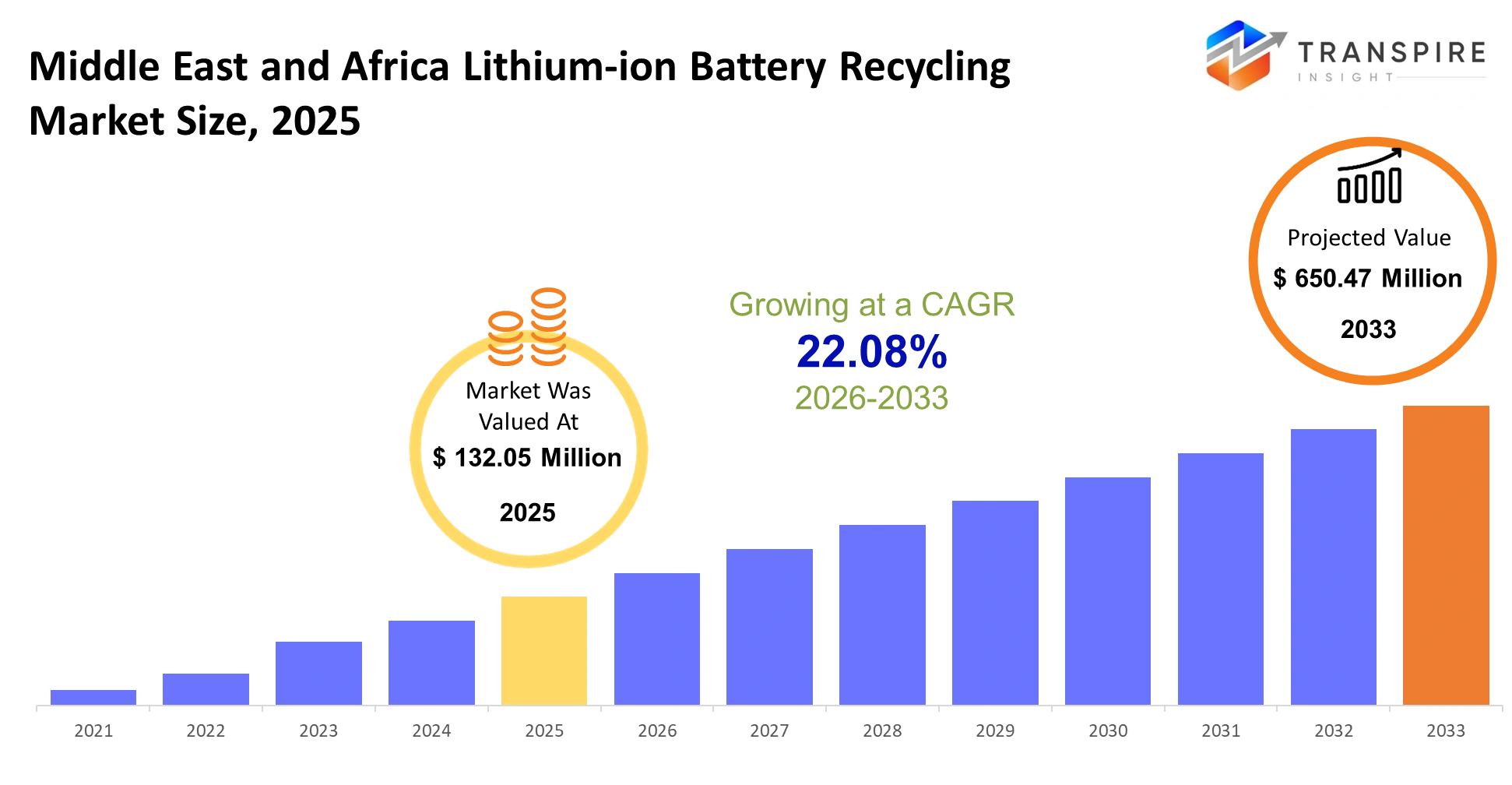
- Middle East and Africa Lithium-ion Battery Recycling Market Size 2025: USD 132.05 Million
- Middle East and Africa Lithium-ion Battery Recycling Market Size 2033: USD 650.47 Million
- Middle East and Africa Lithium-ion Battery Recycling Market CAGR: 22.08%
- Middle East and Africa Lithium-ion Battery Recycling Market Segments: By Process (Hydro, Pyro, Mechanical), By Source (EV Batteries, Consumer Electronics, Industrial Batteries), By Application (Material Recovery, Reuse, Disposal), By End-User (Recyclers, OEMs, Battery Manufacturers, Governments)
To learn more about this report,  Download Free Sample Report
Middle East and Africa Lithium-ion Battery Recycling Market Summary:
The Middle East and Africa Lithium-ion Battery Recycling Market size is estimated at USD 132.05 Million in 2025 and is anticipated to reach USD 650.47 Million by 2033, growing at a CAGR of 22.08% from 2026 to 2033. The Middle East and Africa (Saudi Arabia, United Arab Emirates, South Africa, Rest of Middle East and Africa) lithium-ion battery recycling market will stand at the intersection of energy transition and waste management within the regional industrial landscape. The market will develop through two forces which include increased electric mobility adoption and government enforcement of stricter disposal regulations. Consumers will increasingly demand responsible solutions to recycle batteries, leading firms to invest in clean technology methods for recycling. Hydrometallurgy methods alongside automated sorting techniques will revolutionize how business is done, while both the UAE and South Africa will put in place strategies to ensure that recycling processes can be undertaken in the respective countries with minimal reliance on imports.
Key Market Trends & Insights:
- The government will provide policy incentives to businesses that operate treatment facilities inside their home countries while companies will fund their operational centers which will serve specific geographical areas. The upcoming changes will support national sustainability objectives while enabling better management of vital mineral extraction especially for cobalt and lithium and nickel resources.
- Urban populations will shift their consumption patterns because they become more aware of their environmental responsibilities. Electric vehicle users and electronics consumers will expect structured take-back systems and transparent recycling practices.
- The process of material extraction and sustainable reuse of materials will evolve through ongoing technological advancements. The adoption of advanced recycling methods which include low-emission hydrometallurgy and direct recycling will increase because these methods help to maintain material properties.
- The future of industrial operations will depend on how regulations develop to establish new industry standards. Extended producer responsibility systems in Saudi Arabia and the UAE will require manufacturers to handle battery waste according to existing frameworks.
Middle East and Africa Lithium-ion Battery Recycling Market Segmentation
By Process
Hydrometallurgical- The hydrometallurgical processing method will receive broad acceptance because it enables high-purity metal extraction with reduced emissions when compared to conventional thermal extraction methods. The industry will use aqueous chemical methods to extract lithium and cobalt and nickel because this approach provides effective mining results. The method will enable recyclers to process various battery chemistries while maintaining environmental regulations in areas with more stringent rules. The system will be chosen by upcoming facilities because it requires lower energy consumption compared to its current performance level.
Pyrometallurgical- The treatment of large amounts of mixed battery waste will continue to use pyrometallurgical methods because they offer efficient waste management solutions.High-temperature smelting helps operators obtain precious metals from substances, while requiring fewer efforts to separate materials. Further development of technology related to emissions control and energy efficiency can be expected to follow the increasing importance placed on these factors. Companies will likely integrate emission control systems and hybrid approaches, ensuring this method remains relevant while adapting to environmental expectations.
Mechanical- The process of mechanical processing will function as the primary pre-treatment procedure which includes shredding and crushing battery components while separating their different parts. The process will create a safer handling method by using a procedure that keeps dangerous elements apart from future processing steps. The development of automation technologies will improve the efficiency of material separation because they will decrease contamination levels and boost recovery success. The process continues to need this operation because it creates the essential components which help both hydrometallurgical and pyrometallurgical systems work together for efficient recycling operations.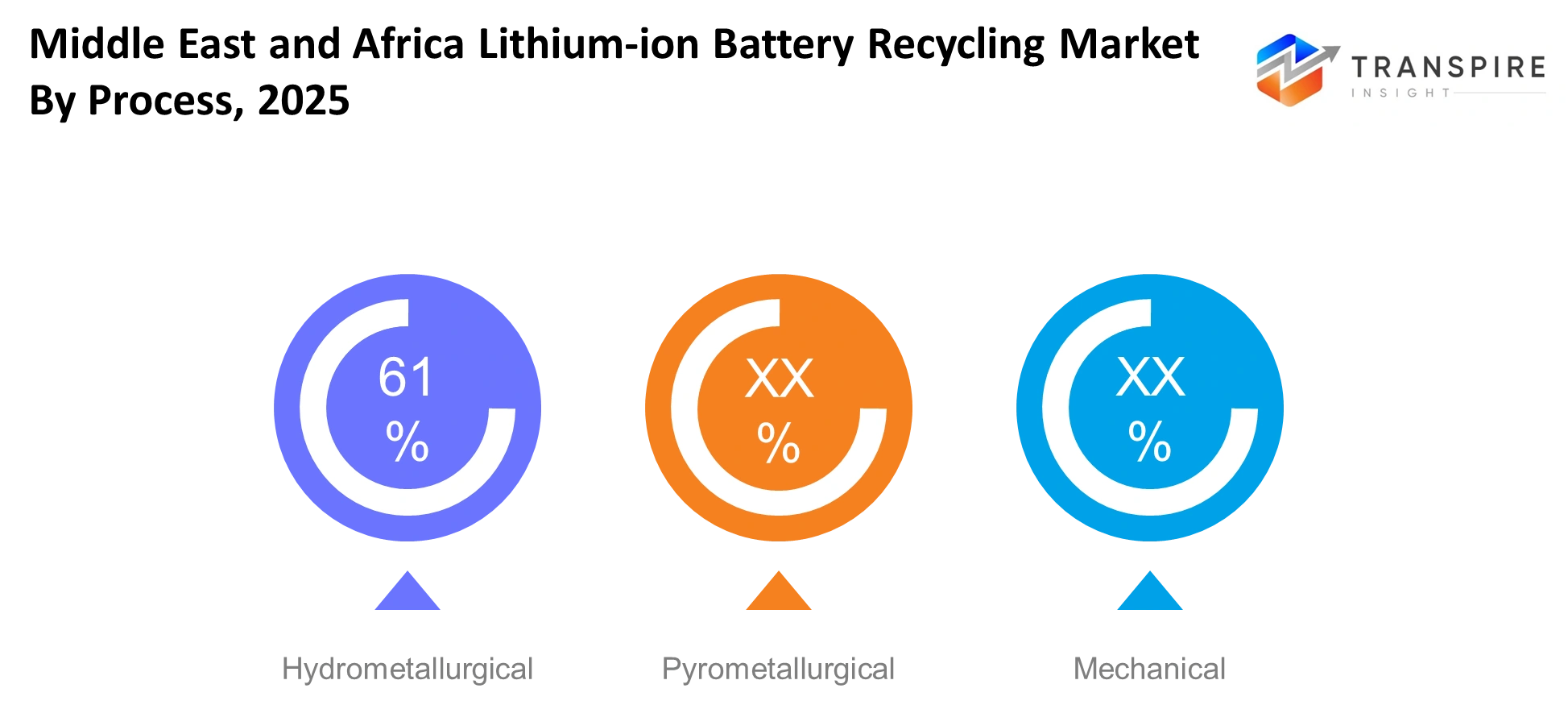
To learn more about this report, Download Free Sample Report
By Source
EV Batteries- The increasing adoption of electric vehicles through urban centers will make electric vehicle batteries into the primary source of all energy needed for electric vehicle operation. The recycling systems require upgrades to handle increased battery end-of-life processing demands which include complex pack designs. The stakeholders will build their operations around two distinct areas of specialized dismantling and logistics solutions. The high concentration of valuable metals in EV batteries will create economic advantages for recycling operations which will lead to sustained infrastructure development throughout the entire region.
Consumer Electronics- The market will continue to receive used batteries from smartphones and laptops and all other mobile devices. Their shorter life cycles will create an ongoing stream of batteries which will enter recycling processes. Companies will build drop-off networks which enable customers to drop off their items because collection processes face obstacles from multiple ownership situations. The recovery rates will experience improvement because of increased consumer knowledge and retail involvement which will turn this market segment into a reliable source for recycling activities.
Industrial Batteries- Energy storage systems and telecom infrastructure and backup power systems all require industrial batteries to have structured recycling methods because of their size and technical complexity. The batteries will be handled through official business agreements which exist between companies and recycling organizations. The process of collecting their products becomes simpler because their ownership structure and design patterns create predictable usage patterns. Industrial energy storage growth will make this business sector essential for providing feedstock needs.
By Application
Material Recovery- Material recovery will remain the primary focus driven by the value of extracted metals which include lithium and cobalt and nickel. Recycling facilities will improve their processes to achieve higher quality results which can be used to make new batteries. This application will decrease the need for imported raw materials while strengthening local supply chains. Continuous improvements in recovery efficiency will enhance profitability while supporting circular economy goals.
Reuse- Battery reuse will become more important as companies investigate second-life uses for their products especially in stationary energy storage systems. Electric vehicle manufacturers will use partially degraded batteries to create products which require less power. This approach will postpone recycling processes while companies extract maximum value from their products. Battery diagnostics and performance assessment tools will enable safe and efficient reuse practices which renewable energy integration projects require.
Disposal- Disposal The need for disposing batteries not viable to recycle or reuse economically is inevitable. There will be regulatory policies guiding on how hazardous substances should be disposed of safely. Landfill use will decrease because authorities are promoting alternative waste management methods yet controlled disposal methods will remain necessary. Companies will invest in safer containment technologies to minimize environmental risks associated with this segment.
By End-User
Recyclers- The industry depends on recyclers who will operate their processing facilities to extract valuable materials through their recycling operations. The organization will enhance its operational efficiency through the implementation of cutting-edge technologies which also help it achieve regulatory requirements. The organization will enhance its supply chain operations through strategic partnerships between manufacturers and government entities. Recyclers will gain a competitive edge by achieving higher material recovery rates and generating compliance data for their performance and delivering affordable service to customers.
OEMs- Original equipment manufacturers will take a more active role in managing battery life cycles. The companies will establish product return systems which they will use to partner with recycling companies for environmental regulation compliance. Battery design will introduce new features which enable simpler battery disassembly and recycling processes. The operational engagement of original equipment manufacturers allows them to protect their brand image while fulfilling both new regulatory requirements and customer demands.
Battery Manufacturers- Battery manufacturers will use recycled materials in their production processes to decrease expenses associated with raw materials while decreasing risks that come from supply chain interruptions. The organization plans to develop closed-loop systems which will enable recovered metals to be used again in battery manufacturing.The process will assist in helping firms reach their goals for sustainable development through efficient use of resources. Manufacturers have to work together with recycling firms since such cooperation will help manufacturers get a constant supply of materials necessary for production.
Governments- The government sector will determine the industry's future through their development of policy frameworks which will create performance incentives and enforcement mechanisms. The government will establish regulations which require companies to follow safe disposal methods and proper recycling procedures. The government will provide financial assistance to develop infrastructure which will result in increased private sector investment. The government sector will create an organized system for environmental protection and sustainable resource management through their efforts to unite different stakeholder groups.
Regional Insights
Saudi Arabia will establish itself as a battery recycling center through its efforts to combine industrial growth with resource recovery programs. The country will build complete operational centers which will manage all aspects of waste collection and material processing and resource recovery within its national borders. Strong policy direction will create incentives for energy companies to work together with recyclers. The development of electric mobility and renewable energy projects will create organized systems which will manage end-of-life batteries.
The United Arab Emirates will prioritize the development of recycling systems which use advanced technology through the creation of innovation-based policies. Free zones and clean energy initiatives will attract global players looking to establish specialized processing units. The country will focus on sustainable waste management through its identification of efficient collection systems which will track waste materials from start to finish. The increasing awareness among consumers combined with business responsibility initiatives will create a stronger organized recycling system especially in urban areas like Dubai and Abu Dhabi.
South Africa will use its existing mining and metallurgical expertise to create a recycling sector which can compete in the market. The current industrial infrastructure will enable the extraction of valuable metals from discarded batteries. The new regulations will promote responsible waste disposal together with official recycling operations which will decrease the dangers linked to unregulated waste processing. The country will increase its recycling operations because energy storage needs are growing from both grid power and industrial usage.
The Middle East and Africa will experience slow development which will depend on different levels of infrastructure and policy development. Emerging economies will start establishing their first systems for basic collection and pre-processing operations which will receive backing from international partnerships. The implementation of awareness campaigns will serve as the main method for increasing battery return rates. The region will struggle with operational challenges and financial obstacles but regional partnerships and knowledge exchange will create a more interconnected recycling system in the future.
Recent Development News
In April 2025, the research study which published its findings on April 10 2025 demonstrated how the United Arab Emirates evaluates lithium-ion battery recycling through its assessment of lifecycle costs and its cost-benefit analysis methods. The research results showed that using both hydrometallurgical and pyrometallurgical methods together will produce better environmental results and more cost-effective results. The new development will enhance the nation's commitment to sustainable waste management systems while helping to achieve its objective of using recycled materials in energy production and transportation systems throughout the country.
In September 2025, discussions among industry experts on September 9 2025 showed that battery waste problems have become a major issue in the Middle East because people are now using electric vehicles and renewable energy storage systems. The region will need to establish organized recycling programs which will control the increasing waste from electric vehicles and renewable energy systems. The clean energy transition will create environmental stress which will lead to the development of recycling systems that can effectively retrieve important materials from local sources.
|
Report Metrics |
Details |
|
Market size value in 2025 |
USD 132.05 Million |
|
Market size value in 2026 |
USD 160.97 Million |
|
Revenue forecast in 2033 |
USD 650.47 Million |
|
Growth rate |
CAGR of 22.08% from 2026 to 2033 |
|
Base year |
2025 |
|
Historical data |
2021 – 2024 |
|
Forecast period |
2026 – 2033 |
|
Report coverage |
Revenue forecast, competitive landscape, growth factors, and trends |
|
Country scope |
Middle East and Africa (Saudi Arabia, United Arab Emirates, South Africa, Rest of Middle East and Africa) |
|
Key company profiled |
Umicore, Li-Cycle, Redwood Materials, Glencore, CATL Recycling, TES, American Battery Technology, Ecobat, Neometals, Fortum, Veolia, Retriev, GEM, SungEel, Akkuser |
|
Customization scope |
Free report customization (country, regional & segment scope). Avail customized purchase options to meet your exact research needs. |
|
Report Segmentation |
By Process (Hydro, Pyro, Mechanical), By Source (EV Batteries, Consumer Electronics, Industrial Batteries), By Application (Material Recovery, Reuse, Disposal), By End-User (Recyclers, OEMs, Battery Manufacturers, Governments) |
Key Middle East and Africa Lithium-ion Battery Recycling Market Company Insights
Key players operating within the Middle East and Africa (Saudi Arabia, United Arab Emirates, South Africa, Rest of Middle East and Africa) lithium-ion battery recycling market will increasingly focus on building integrated value chains that connect collection processing and material recovery. The Saudi Investment Recycling Company will partner with regional waste specialists to develop new capabilities through their infrastructure investments, while UAE companies will create recycling systems that follow regulations and track their electronic waste. Developing companies in Egypt and Kenya will develop local processing facilities which demonstrate the region's transition toward independent recycling systems.
Company List
- Umicore
- Li-Cycle
- Redwood Materials
- Glencore
- CATL Recycling
- TES
- American Battery Technology
- Ecobat
- Neometals
- Fortum
- Veolia
- Retriev
- GEM
- SungEel
- Akkuser
Middle East and Africa Lithium-ion Battery Recycling Market Report Segmentation
By Process
- Hydro
- Pyro
- Mechanical
By Source
- EV Batteries
- Consumer Electronics
- Industrial Batteries
By Application
- Material Recovery
- Reuse
- Disposal
By End-User
- Recyclers
- OEMs
- Battery Manufacturers
- Governments
Frequently Asked Questions
Find quick answers to common questions.
The Approximate Middle East and Africa Lithium-ion Battery Recycling Market size for the market will be USD 650.47 Million in 2033.
Key Segments for the Middle East and Africa Lithium-ion Battery Recycling Market By Process (Hydro, Pyro, Mechanical), By Source (EV Batteries, Consumer Electronics, Industrial Batteries), By Application (Material Recovery, Reuse, Disposal), By End-User (Recyclers, OEMs, Battery Manufacturers, Governments).
Major Players in the Middle East and Africa Lithium-ion Battery Recycling Market are Umicore, Li-Cycle, Redwood Materials, Glencore, CATL Recycling, TES, American Battery Technology, Ecobat, Neometals, Fortum, Veolia, Retriev, GEM, SungEel, Akkuser.
The Current Middle East and Africa Lithium-ion Battery Recycling Market size is USD 132.05 Million in 2025.
The Middle East and Africa Lithium-ion Battery Recycling Market CAGR is 22.08%.
- Umicore
- Li-Cycle
- Redwood Materials
- Glencore
- CATL Recycling
- TES
- American Battery Technology
- Ecobat
- Neometals
- Fortum
- Veolia
- Retriev
- GEM
- SungEel
- Akkuser
Recently Published Reports
-
Apr 2026
Active Power Filter Market
Active Power Filter Market Size, Share & Analysis Report By Type (Shunt Active Power Filters, Series Active Power Filter, Hybrid Active Power Filter), By Application (Harmonics Mitigation, Reactive Power Compensation, Voltage Regulation, Power Factor Correction), By Phase (Single Phase, Three Phase), By End-User Industry (Manufacturing, Healthcare, Commercial, Automotive, Oil and Gas, Others), and Geography (North America, Europe, Asia-Pacific, Middle East and Africa, South and Central America), 2021 - 2031
-
Apr 2026
Electrical Transformer Market
Electrical Transformer Market Size, Share & Analysis Report By Core (Closed, Shell, and Berry), By Insulation (Gas, Oil, Solid, Air, and Other), By Phase (Single, and Three), By Rating (100 MVA to 500 MVA, 501 MVA to 800 MVA, and 801 MVA to 1200 MVA), and Geography (North America, Europe, Asia-Pacific, Middle East and Africa, South and Central America), 2021 – 2031
-
Apr 2026
Hydraulic Piston Pumps Market
Hydraulic Piston Pumps Market Size, Share & Analysis Report By Type (Axial Piston Pumps, Radial Piston Pumps), By Operating Pressure (Low Pressure, Medium Pressure, High Pressure), By Application (Construction, Mining, Agriculture, Automotive, Oil & Gas, Industrial Machinery, Others), By End-User (OEMs, Aftermarket), and Geography (North America, Europe, Asia-Pacific, Middle East and Africa, South and Central America), 2021 – 2031
-
Apr 2026
Laboratory Gas Generators Market
Laboratory Gas Generators Market Size, Share & Analysis Report By Product (Nitrogen Gas Generator, Hydrogen Gas Generator, Zero Air Gas Generator, Purge Gas Generator, TOC Gas Generators, Others), By Application (Gas Chromatography, Liquid Chromatography-mass Spectrometry (LC-MS), Gas Analyzers, Others), By End-user (Life Science, Chemical & Petrochemical, Food & Beverage, Others), and Geography (North America, Europe, Asia-Pacific, Middle East and Africa, South and Central America), 2021 – 2031