
Middle East and Africa Industrial Packaging Market Size & Forecast:
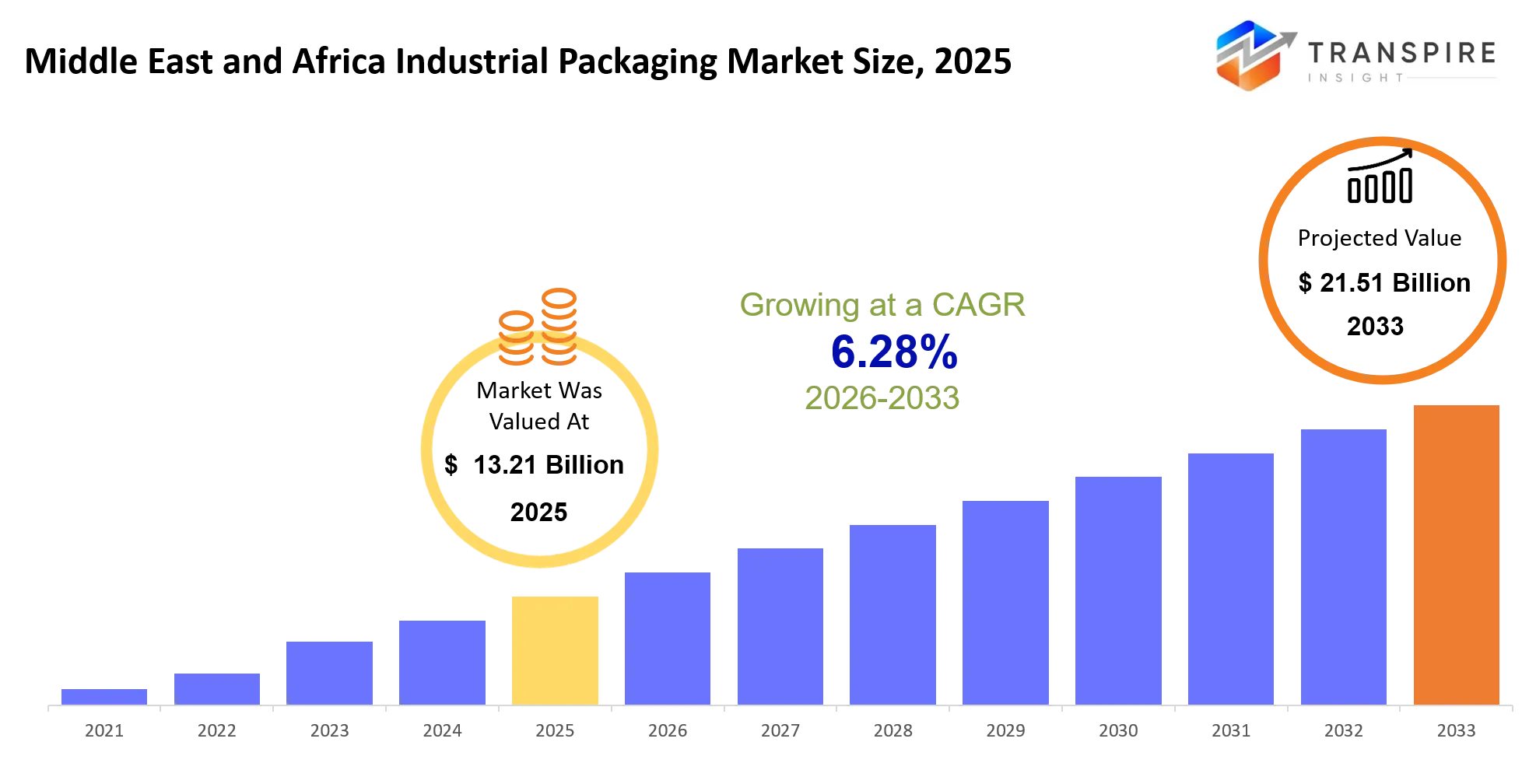
- Middle East and Africa Industrial Packaging Market Size 2025: USD 13.21 Billion
- Middle East and Africa Industrial Packaging Market Size 2033: USD 21.51 Billion
- Middle East and Africa Industrial Packaging Market CAGR: 6.28%
- Middle East and Africa Industrial Packaging Market Segments: By Packaging Type (Drums, IBCs, Sacks, Pails, Bulk Containers, Crates, Corrugated Boxes, Others); By Material (Plastic, Metal, Paper & Paperboard, Wood, Glass, Composite Materials, Others); By End-Use Industry (Chemicals, Food & Beverages, Pharmaceuticals, Agriculture, Construction Materials, Oil & Gas, Others); By Function (Storage, Transportation, Protective Packaging, Export Packaging, Hazardous Material Packaging, Others)
To learn more about this report,  Download Free Sample Report
Middle East and Africa Industrial Packaging Market Summary:
The Middle East and Africa Industrial Packaging Market was valued at USD 13.21 Billion in 2025. It is forecast to reach USD 21.51 Billion by 2033. That is a CAGR of 6.28% over the period.
Industrial packaging across the Middle East and Africa is like the backbone of regional trade and industrial motion, mainly because it keeps bulk chemicals , oil derivatives , construction materials and food-grade goods protected while they sit in storage or move across borders. It actually trims down product loss on those long-haul routes, which can stretch from ports, across deserts, and into a patchwork of supply corridors. In the last few years the market has started to drift away from conventional stiff packaging, and toward high-performance reusable systems, kind of because circular economy needs became part of several GCC industrial policies.
Meanwhile, supply chain troubles—sparked by global shipping logjams and also geopolitical tensions around Red Sea corridors—made manufacturers and exporters lean harder toward safer and traceable plus longer-lasting packing options. Because of that, more advanced intermediate bulk containers are being used along with returnable packaging systems, so lifecycle efficiency goes up and replacement intervals get pushed further out. So now, packaging suppliers are getting pulled into the industrial value chain more deeply, instead of just acting as stand alone vendors, if you know what I mean.
Key Market Insights
- The Middle East and Africa Industrial Packaging Market seems to be seeing more adoption of reusable bulk containers, which is cutting long-term logistics costs by about 18% since 2022, give or take.
- In 2025 GCC countries hold roughly 42% share , mostly because petrochemical exports keep moving and industrial packaging consumption clusters keep expanding.
- Africa looks like the fastest-growing sub-region too, supported by a 6–8% yearly rise in mining plus agro-export packaging demand.
- As for products, intermediate bulk containers are still taking the lead, mainly because they’re efficient for liquid chemical and oil transport use cases.
- Flexible industrial packaging is also growing quickly, with a forecast momentum of 7%+ , linked to industrial distribution channels that ride on e-commerce demand cycles.
- On applications, construction is doing the heavy lifting , contributing more than one-third share thanks to cement needs and raw material logistics requirements.
- Food and beverage packaging demand is climbing in a steady way as well, pushed by tighter safety compliance across export-facing processing units .
- Regional players like Greif Inc. and Mauser Packaging Solutions are strengthening their footprint through localized manufacturing and supply chain optimization moves.
- Smart packaging with RFID tracking is helping too, because shipment visibility improves and logistics loss rates can drop by as much as 12%.
- Finally, sustainability mandates in the UAE and Saudi Arabia are speeding up the shift toward recyclable and returnable packaging systems, overall.
What are the Key Drivers, Restraints, and Opportunities in the Middle East and Africa Industrial Packaging Market?
So basically the main driver of the Middle East and Africa industrial packaging market is the rapid expansion of export focused manufacturing, especially in petrochemicals, construction materials and processed food. Governments across GCC countries have put serious money into industrial diversification programs. That alone has increased the cross border movement of bulk goods. And because of that, the demand is getting pushed toward durable, high strength packaging systems, you know those that can cut down leakage contamination, and transit damage even over long logistics routes. Once production volumes really climb, packaging turns into a critical cost control and safety component, not some “nice to have” secondary operational input, right.
A big restraint, though, is the uneven availability of standardized packaging recycling infrastructure, and this is particularly noticeable across different parts of Africa. In many regions, waste collection still feels fragmented and patchwork, which kind of blocks the large-scale use of reusable industrial packaging formats. This structural gap then makes single use packaging cycles more likely, and that drives up long term operational costs for exporters and logistics providers. At the same time it slows down sustainability transitions, which is not ideal.
The biggest opportunity seems to sit in circular packaging ecosystems that are expanding in Saudi Arabia UAE and South Africa. There are investments popping up around reverse logistics networks and smart returnable container systems, and they are starting to reshape the whole packaging economics. Companies that introduce digitally tracked reusable containers and connect them to supply chain platforms are getting an early edge. This is especially true in oilfield services and chemical transportation networks, where visibility matters a lot.
What Has the Impact of Artificial Intelligence Been on the Middle East and Africa Industrial Packaging Market?
Artificial intelligence is gradually reshaping industrial packaging operations across the Middle East and Africa, mostly by making logistics feel faster, material usage more sensible, and supply chain visibility less cloudy. Packaging manufacturers are now leaning on AI driven systems to fine tune container design, based on how the load settles, what the transport route looks like, and even material stress simulation. The overall effect is fewer breakages, and better structural dependability along those long distance shipping corridors that link ports in the UAE, Saudi Arabia, and South Africa.
Alongside that, machine learning models are being used for predictive maintenance of automated packaging lines. This helps factories dial down unplanned stoppages and keep production more steady. Meanwhile, in logistics operations, AI enabled tracking systems support route optimization and container utilization, which boosts turnaround efficiency and can lower fuel related transportation costs, indirectly through stronger load planning. In practice these changes often show up as measurable wins in operational uptime and fewer packaging waste cycles.
Still, adoption stays somewhat limited, because the integration costs can be high and the digital infrastructure is uneven across many African logistics networks. A lot of smaller packaging manufacturers find the expense of deploying AI monitoring systems hard to absorb, and they also lack access to standardized, good quality operational data. So full scale deployment moves slowly, even with the obvious efficiency gains, especially in non GCC markets where digital maturity can be inconsistent.
Key Market Trends
- After 2023 the adoption of returnable industrial containers went up quite a bit, mostly because logistics costs kept rising, and also because sustainability mandates started to get more attention.
- In the UAE, industrial zones moved toward RFID -enabled packaging systems, which helped track shipments more cleanly across petrochemical exports, by roughly 10 to 12% give or take.
- In Saudi Arabia, the whole industrial diversification push seems to have boosted demand for heavy-duty packaging in non-oil manufacturing, especially from 2024 onward.
- Meanwhile in Africa, mining export routes are slowly shifting toward reinforced bulk packaging, mainly to lower transit damage rates that used to happen more often.
- Mauser Packaging Solutions also expanded localized production units.The idea was to rely less on cross-border logistics and also shorten lead times , not just improve volume.
- Smart packaging tech got a stronger foothold too, since exporters wanted real-time monitoring for chemical and hazardous materials, not only faster handling.
- On top of that, the construction boom across GCC countries kept raising the need for cement and raw material packaging, fairly consistently between 2023 and 2025.
- And finally, sustainability rules nudged companies to replace single-use drums bit by bit, switching toward recyclable and reconditioned industrial packaging formats.
Middle East and Africa Industrial Packaging Market Segmentation
By Packaging Type
Drums help with safe storing and moving of liquids, chemicals, and industrial oils across long-distance transport routes, not really a small task. There’s strong demand because a lot of sectors want leak-proof handling and consistent containment standards during export work, so people don’t improvise mid transit. Intermediate Bulk Containers , or IBCs, are used for big-volume shipping of liquids and semi-solids, particularly in chemical and oil-based operations where efficiency plus reusability brings down the overall running costs. Sacks work well for bulk handling of agricultural goods, cement, and powdered materials, they keep things flexible and also stack pretty easily during logistics.
Pails cover smaller industrial packaging needs for paints, coatings, and specialty chemicals, where controlled dispensing actually matters. Bulk Containers are for heavy industrial loads and they back up large-scale movement of raw materials between ports and industrial hubs. Crates give structural protection for fragile or high-value items across storage rounds and transport cycles. Corrugated Boxes fit lightweight packaging needs across many industries, and they help with cost-effective distribution along with storage efficiency. Others include specialized packaging formats used for niche industrial use cases that demand customized handling solutions, depending on what’s being shipped.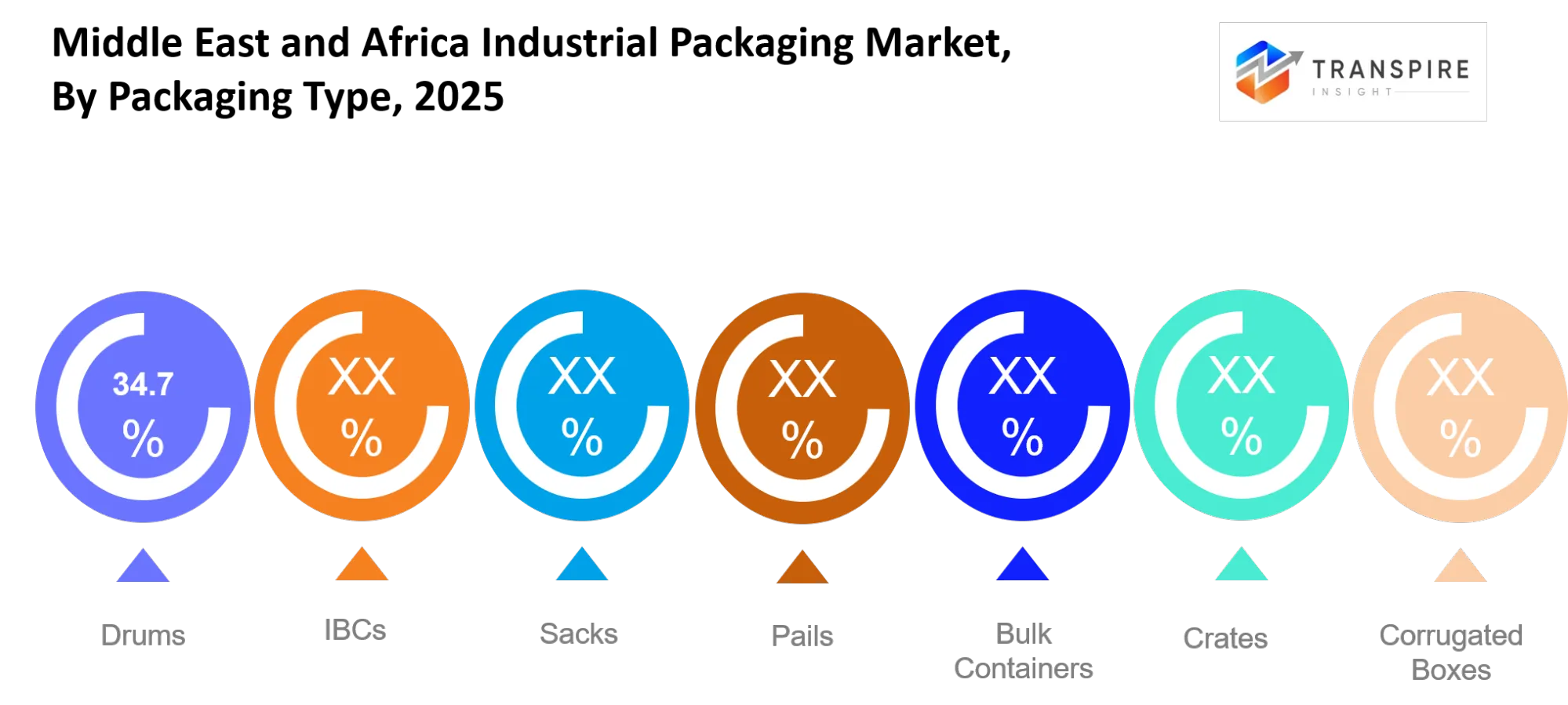
To learn more about this report, Download Free Sample Report
By Material
Plastic remains really common in industrial packaging because it holds up well, resists corrosion, and it’s usually cheaper across chemical as well as food related work. It keeps getting picked for reusable containers, drums, and intermediate bulk systems too, mainly where long service life performance is what matters most, and not just this one shipment. Metal packaging still backs high strength storage requirements, particularly for oil, gas, and hazardous materials, where the safety rules stay strict all the way. Paper and paperboard packaging cover lighter industrial needs, plus export crates or cases where recyclability and budget control continue to be key, even when timelines feel tight.
Wood packaging gets used a lot for heavy machinery transport and export crates where structural steadiness really must stay consistent over long distance shipping. Glass packaging shows up less often but it counts in pharmaceuticals and certain specialty chemicals, where product purity plus contamination control become non negotiable. Composite materials support modern packaging approaches, mixing strength with flexibility for industrial logistics systems that need to flex instead of just resist. Other options exist as well, like mixed or hybrid material systems built for specialized industrial use cases, with tailored performance traits meant for different transport and storage conditions.
By End-Use Industry
Chemicals are a big demand driver for industrial packaging because theres a pretty constant need for safe transport of dangerous, reactive materials. Strong packing standards help stop leaks, make sure regulatory compliance is satisfied, and help with safe handling across various international trade routes. Food and beverage products really need hygienic packaging solutions to keep safety intact during storage , transportation, and export. This is especially true when supply chains get long and kinda complex. For pharmaceuticals, controlled packaging formats matter a lot, they shield the product’s integrity while also aligning with strict regulatory requirements that cannot be compromised or, you know, bent a little.
Agricultural uses depend on industrial packaging for fertilizers, seeds, and bulk crop materials, where durability and moisture resistance become an important factor in protecting quality. Construction materials, on the other hand, rely on heavy-duty packaging for cement, aggregates, and other building inputs; these are moving nonstop through big infrastructure projects. Overall, these packaging solutions help cut down material loss, improve handling efficiency, and support a smoother flow across tough construction and logistics environments . Oil and gas operations need tough containment systems for fuels, lubricants, and drilling materials, even under extreme conditions. Then there are the others, kind of a mix of industrial fields, that depend on tailored packaging formats so materials move safely and effectively across nearby and global markets, without much hassle.
By Function
Storage packaging really helps keep industrial goods held securely between warehouses and production sites where product stability and safety matter, you know. There is strong demand from chemical, food, and construction sectors, because they want long-term containment solutions with minimal degradation exposure . Transportation packaging in the same way ensures goods are moved safely over road, sea, and rail networks while also lowering damage chances during far distance logistics moves. Export packaging then supports international trade rules , where compliance, durability, and standardized formats stay critical for cross-border shipments.
Protective packaging leans on damage prevention by using cushioning, sealing, and structural reinforcements during both handling and transit, more or less. Hazardous material packaging makes sure dangerous chemicals and other risky substances stay contained safely while meeting strict regulatory and safety instructions. Industrial packaging will keep evolving as storage and transport needs become more complicated across global supply chains. Other options can include specialized functional packaging systems , built for unique industrial use cases where tailored safety and performance elements are required .
What are the Key Use Cases Driving the Middle East and Africa Industrial Packaging Market?
In the Middle East and Africa industrial packaging market the main sort of use case is bulk moving of petrochemicals and refined oil products. Those substances need very durable container types so you can get leak prevention, and also meet safety compliance while goods travel long-haul export routes through large ports.
A second layer of use cases pops up with construction material packing and mining outputs. Here you often see heavy-duty sacks, drums, and intermediate bulk containers that help keep cement, ores, and industrial aggregates secure even when the ground is rough and the deliveries stretch across long supply lines.
Newer applications are also taking shape around renewable energy logistics and processed food exports. Battery components , solar equipment material, and boxed food ingredients are starting to demand more standardized, traceable, reusable packaging formats, and these should match international export rules.
|
Report Metrics |
Details |
|
Market size value in 2025 |
USD 13.21 Billion |
|
Market size value in 2026 |
USD 14.04 Billion |
|
Revenue forecast in 2033 |
USD 21.51 Billion |
|
Growth rate |
CAGR of 6.28% from 2026 to 2033 |
|
Base year |
2025 |
|
Historical data |
2021 - 2024 |
|
Forecast period |
2026 - 2033 |
|
Report coverage |
Revenue forecast, competitive landscape, growth factors, and trends |
|
Regional scope |
Middle East and Africa (Saudi Arabia, United Arab Emirates, South Africa, Rest of Middle East and Africa) |
|
Key company profiled |
Greif Inc., Mauser Packaging Solutions, SCHÜTZ GmbH, Berry Global, Mondi Group, Smurfit WestRock, International Paper, DS Smith, Amcor, Sonoco Products, Nefab Group, Myers Industries, Time Technoplast, Balmer Lawrie, Hoover Ferguson |
|
Customization scope |
Free report customization (country, regional & segment scope). Avail customized purchase options to meet your exact research needs. |
|
Report Segmentation |
By Packaging Type (Drums, IBCs, Sacks, Pails, Bulk Containers, Crates, Corrugated Boxes, Others); By Material (Plastic, Metal, Paper & Paperboard, Wood, Glass, Composite Materials, Others); By End-Use Industry (Chemicals, Food & Beverages, Pharmaceuticals, Agriculture, Construction Materials, Oil & Gas, Others); By Function (Storage, Transportation, Protective Packaging, Export Packaging, Hazardous Material Packaging, Others) |
Which Regions are Driving the Middle East and Africa Industrial Packaging Market Growth?
The Middle East tends to lead the market, mainly because its petrochemical base is strong and the port infrastructure is world-class in the UAE and Saudi Arabia. Large export volumes of oil derivatives, plus industrial chemicals, are keeping demand steady for advanced packaging systems. On top of that, government backed industrial diversification programs keep pushing packaging consumption in the non-oil spaces. And because the logistics corridors are well established, companies can adopt standardized packaging technologies without too much interruption.
Africa shows up as a steady but still developing contributor, with mining, agriculture, and increasing intra-regional trade playing a role. Yet, unlike the Middle East, expansion there is usually powered more by raw commodity exports than by industrial diversification. Infrastructure limits are still a real hurdle though, but gradual improvements in transport networks are making packaging reliability better over time. Overall, the region keeps offering a consistent starting point, for cost-effective packaging solutions that make sense financially.
The fastest growth is happening in the GCC cluster, especially Saudi Arabia and the UAE, where industrial expansion is moving quickly and regulations are being modernized. New investments in logistics hubs and free zones have boosted demand for advanced reusable packaging systems. Sustainability targets that are pushed through policy are also speeding up the switch toward recyclable materials and smart packaging technologies. In a way, this momentum is a clear sign of long term opportunities for packaging manufacturers that want to serve high-value industrial ecosystems.
Who are the Key Players in the Middle East and Africa Industrial Packaging Market and How Do They Compete?
The Middle East and Africa industrial packaging market is sort of moderately fragmented, where big global manufacturers compete next to regional suppliers, a lot of the time. What really pushes competition is durability and cost efficiency, plus the ability to deliver logistics-compatible packaging that kinda fits into existing systems. The larger players are also trying to hold onto their ground by going with localized production and sustainability-driven innovation, not only by trying to undercut prices.
For example, Greif Inc. and Mauser Packaging Solutions tend to center on high-performance intermediate bulk containers and returnable packaging systems, made to suit petrochemical and chemical logistics. Their edge comes from global supply networks and compliance-driven product engineering too, which sounds dry but it matters.
Meanwhile, Mondi Group and Smurfit WestRock are leaning more heavily toward sustainable, fiber-based packaging alternatives. They match up with regional sustainability rules and connect into circular economy initiatives, so it’s not just “green” in name.
Then Amcor and Sonoco Products are expanding by betting on material innovation and lighter, slimmer packaging designs that reduce logistics expenses and help export efficiency. In general, their growth is increasingly supported by joint ventures, regional manufacturing locations, and supply chain localization tactics, even when the strategy looks similar from company to company.
Company List
- Greif Inc.
- Mauser Packaging Solutions
- SCHÜTZ GmbH & Co. KGaA
- Berry Global
- Mondi Group
- Smurfit WestRock
- International Paper Company
- DS Smith
- Amcor
- Sonoco Products
- Nefab Group
- Myers Industries
- Time Technoplast
- Balmer Lawrie
- Hoover Ferguson
Recent Development News
In March 2025, Constantia Flexibles announced acquisition of a majority stake in Aluflexpack AG. The deal strengthens its aluminum and flexible packaging capacity across Europe and the Middle East & Africa region, improving supply chain integration for high-barrier industrial packaging solutions used in food and pharmaceutical logistics.https://en.wikipedia.org/
In June 2025, Bisleri International entered a strategic partnership with Apparel Group for Middle East and Africa distribution expansion. The agreement enables large-scale manufacturing, marketing, and distribution of packaged goods across UAE and wider MEA markets, strengthening regional packaging demand through expanded FMCG logistics networks.https://economictimes.indiatimes.com
What Strategic Insights Define the Future of the Middle East and Africa Industrial Packaging Market?
The Middle East and Africa industrial packaging market is kinda moving toward a more integrated ecosystem, where packaging starts acting like a piece of end-to-end logistics intelligence, not just a standalone product, you know. The momentum is going to be shaped by industrial diversification across GCC countries, plus the growing export complexity stretching through African trade corridors. There is also this less visible kind of risk, like over-relying on imported raw packaging materials, which basically leaves manufacturers exposed to global resin and fiber price swings, and that can squeeze margins hard when supply shocks hit.
At the same time though, there’s an emerging opportunity that feels stronger than it seems: digitally enabled returnable packaging setups tied with IoT tracking, especially across oilfield services and chemical logistics networks. Firms that push early into localized production, and pair it with smart packaging platforms, should end up with better cost control and compliance benefits. In the end, strategic success will likely come down to balancing sustainability requirements with scalable yet cost-efficient industrial packaging models, even when regional supply chains are kinda fragmented and not straightforward.
Middle East and Africa Industrial Packaging Market Report Segmentation
By Packaging Type
- Drums
- Intermediate Bulk Containers (IBCs)
- Sacks
- Pails
- Bulk Containers
- Crates
- Corrugated Boxes
- Others
By Material
- Plastic
- Metal
- Paper & Paperboard
- Wood
- Glass
- Composite Materials
- Others
By End-Use Industry
- Chemicals
- Food & Beverages
- Pharmaceuticals
- Agriculture
- Construction Materials
- Oil & Gas
- Others
By Function
- Storage
- Transportation
- Protective Packaging
- Export Packaging
- Hazardous Material Packaging
- Others
Frequently Asked Questions
Find quick answers to common questions.
The Expected Middle East and Africa Industrial Packaging Market size for the Market will be USD 21.51 Billion in 2033.
Key Segments for the Middle East and Africa Industrial Packaging Market are By Packaging Type (Drums, IBCs, Sacks, Pails, Bulk Containers, Crates, Corrugated Boxes, Others); By Material (Plastic, Metal, Paper & Paperboard, Wood, Glass, Composite Materials, Others); By End-Use Industry (Chemicals, Food & Beverages, Pharmaceuticals, Agriculture, Construction Materials, Oil & Gas, Others); By Function (Storage, Transportation, Protective Packaging, Export Packaging, Hazardous Material Packaging, Others).
Major Middle East and Africa Industrial Packaging Market Players are Greif Inc., Mauser Packaging Solutions, SCHÜTZ GmbH, Berry Global, Mondi Group, Smurfit WestRock, International Paper, DS Smith, Amcor, Sonoco Products, Nefab Group, Myers Industries, Time Technoplast, Balmer Lawrie, Hoover Ferguson.
The Current Middle East and Africa Industrial Packaging Market size is USD 13.21 Billion in 2025.
The Middle East and Africa Industrial Packaging Market CAGR is 6.28% from 2026 to 2033.
- Greif Inc.
- Mauser Packaging Solutions
- SCHÜTZ GmbH & Co. KGaA
- Berry Global
- Mondi Group
- Smurfit WestRock
- International Paper Company
- DS Smith
- Amcor
- Sonoco Products
- Nefab Group
- Myers Industries
- Time Technoplast
- Balmer Lawrie
- Hoover Ferguson
About the Authors

Pankaj Ghogare Patil
I am Pankaj Ghogare Patil, a Senior Research Analyst at Transpire Insight, specializing in the Pharmaceutical, Chemicals & Materials, Healthcare IT, and Biotechnology industry. My expertise lies in conducting comprehensive market research, analyzing industry trends, evaluating competitive landscapes, and translating complex data into actionable insights. At Transpire Insight, I closely follow emerging technologies, regulatory developments, and market innovations to create accurate, well-researched, and informative content that helps businesses and professionals make informed decisions. I am committed to producing credible, evidence-based articles that reflect industry best practices while making technical topics accessible and valuable for a broad audience.

Chakradhar Khansole
Chakradhar serves as the Research Director at Transpire Insight, bringing over 8 years of experience in technology, innovation, and strategic market intelligence. He specializes in transforming complex market data into actionable business insights that enable organizations to make informed, growth-oriented decisions. Recognized for his strategic vision and analytical expertise, Chakradhar leads high-impact research initiatives, delivering comprehensive market assessments, competitive intelligence, and forward-looking industry analysis.
Recently Published Reports
-
May 2026
Healthcare Polymer Packaging Market
Healthcare Polymer Packaging Market Size, Share & Analysis Report By Packaging Type (Syringes, IV Bottles and Pouches, Clamshells, Blisters, Bottles & Jars, Containers, Tubes, IV Parental Packaging, Others), By Type (Regulated, Non-regulated), By Polymer Type (LDPE (Low-Density Polyethylene), HDPE (High-Density Polyethylene), Homo-polymer (Homo), Random Copolymer (Random), Block Copolymer (Block), PET, Polystyrene, Polyvinyl Chloride, Polyamide/EVOH, Others), and Geography (North America, Europe, Asia-Pacific, Middle East and Africa, South and Central America), 2021 - 2031
-
Apr 2026
Hydrophilic Tape (Waterstop) Market
Hydrophilic Tape (Waterstop) Market Size, Share & Analysis Report By Type (Bentonite-Based Hydrophilic Tape, Rubber-Based Hydrophilic Tape), By Application (Residential Buildings, Commercial Buildings, Infrastructure Projects), and Geography (North America, Europe, Asia-Pacific, Middle East and Africa, South and Central America), 2021 - 2031
-
Apr 2026
Metalens Market
Metalens Market Size, Share & Analysis Report By Type (Visible Light Metalens, and Infrared Metalens), By Application (Consumer Electronics, Automotive Electronics, Industrial, Medical, and Others), and Geography (North America, Europe, Asia-Pacific, Middle East and Africa, South and Central America), 2021 - 2031
-
Apr 2026
PBT Resin Market
PBT Resin Market Size, Share & Analysis Report By Type (Reinforced PBT Resin, Unreinforced PBT Resin), By Processing Method (Injection Molding, Extrusion, Blow Molding, Others), By End-User (Automotive, Electrical & Electronics, Consumer Appliances, Industrial Machinery, Medical Devices, Packaging, Others), and Geography (North America, Europe, Asia-Pacific, Middle East and Africa, South and Central America), 2021 - 2031