
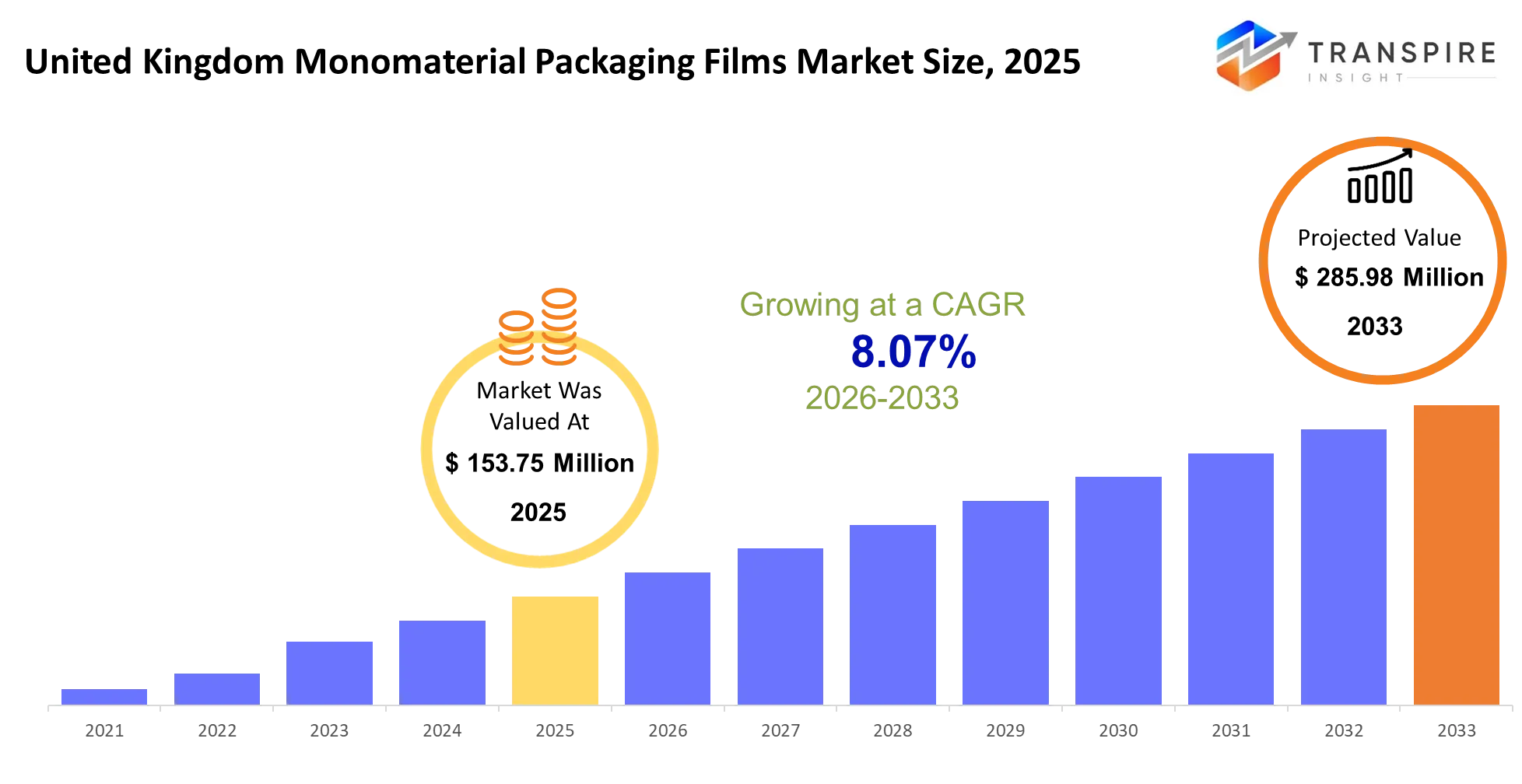
United Kingdom Monomaterial Packaging Films Market Size & Forecast:
- United Kingdom Monomaterial Packaging Films Market Size 2025: USD 153.75 Million
- United Kingdom Monomaterial Packaging Films Market Size 2033: USD 285.98 Million
- United Kingdom Monomaterial Packaging Films Market CAGR: 8.07%
- United Kingdom Monomaterial Packaging Films Market Segments: By Material Type (Polyethylene Films, Polypropylene Films, PET Films, Biopolymer Films, Others); By Application (Food Packaging, Pharmaceutical Packaging, Personal Care Packaging, Industrial Packaging, Others); By Product Type (Flexible Films, Barrier Films, Recyclable Films, Laminated Films, Others); By End User (Food Industry, Pharmaceutical Industry, FMCG Companies, Retail Sector, Others)
To learn more about this report,  Download Free Sample Report
United Kingdom Monomaterial Packaging Films Market Summary
The United Kingdom Monomaterial Packaging Films Market was valued at USD 153.75 Million in 2025. It is forecast to reach USD 285.98 Million by 2033. That is a CAGR of 8.07% over the period.
In the UK, monomaterial packaging films are used to shield and keep food, pharma products, and various industrial goods, so you can think of it as a kind of protection plus preservation, but also with the recycling angle in mind. The key idea is that it relies on one polymer structure, not those mixed laminates that are awkward to pull apart, so end of life is a bit more straightforward. What happens in practice is that these films still allow good sealing, decent printing, and logistics performance, while somehow fitting into the newer circular packaging systems that are starting to take shape.
Over the last 3–5 years the market has moved away from multilayer barrier films, and more toward mono-PE and mono-PP designs, with advanced coating and extrusion technologies backing them up. The goal is to keep shelf life steady without, you know, sacrificing recyclability or making the material harder to process. There is also a policy shift: the UK Plastic Packaging Tax in 2022, plus the evolving Extended Producer Responsibility rules, has really sped up redesign decisions. It does this by penalizing non-recycled content and also raising compliance costs, which pushes companies to look at new options sooner, rather than later.
So as a consequence, FMCG brands and converters have adjusted their production lines, and that means faster uptake commercially, plus some fresh revenue streams linked to packaging that is recyclable-by-design.
Key Market Insights
- Southern England sort of dominates the United Kingdom Monomaterial Packaging Films Market with about 38% share in 2025 , mostly because the FMCG manufacturing clusters and those logistics hubs keep things moving.
- Meanwhile Scotland comes in as the fastest growing region from 2025 to 2030, it seems driven by circular economy investments, plus a few packaging innovation programs that keep getting funded.
- The Midlands meanwhile shows steady adoption, mainly tied to strong food processing and industrial packaging needs throughout the wider supply chain.
- On the material side, Mono-PE films are leading around 52% share in 2025, and this is usually linked to good recyclability and the cost efficient processing benefits.
- Mono-PP films grab the second largest slice , they’re commonly used where high barrier protection matters, like food and pharmaceutical packaging.
- Then the bio based monomaterial films are the fastest growing segment between 2025 and 2030, largely pushed by sustainability mandates across the United Kingdom Monomaterial Packaging Films Market.
- For end uses, food packaging remains on top with a nearly 61% share in 2025, driven by strong retail demand and ready-meal consumption trends.
- Pharmaceutical packaging is the quicker mover, supported by tighter safety rules, traceability expectations, and the push for recyclable packaging.
- Industrial protective packaging looks fairly stable, especially across e-commerce and export focused sectors, where durability matters.
- Finally, FMCG manufacturers lead overall with about 58% share, using monomaterial films to align with EPR requirements and plastic tax compliance targets.
What are the Key Drivers, Restraints, and Opportunities in the United Kingdom Monomaterial Packaging Films Market?
The primary driver seems to be regulatory pressure, tied to the UK Plastic Packaging Tax and the Extended Producer Responsibility framework. In practice these policies kind of changed the cost structures, sort of in favor of recyclable mono-structures. So, FMCG and pharmaceutical brands end up redesigning their packaging lines, and it makes sense. This has directly boosted the procurement of mono-PE and mono-PP films, which then speeds up conversion cycles and gives converters better revenue visibility if they can provide certified recyclable formats at scale.
The main restraint though is still technical, because hitting high barrier performance from a single-polymer setup is just hard. Multilayer laminates are usually better for moisture and oxygen resistance, but monomaterial films often don’t hold up as well in longer shelf-life use cases, especially for delicate food and healthcare products. That performance gap, in a way slows down total substitution, so businesses lean toward hybrid adoption models. And that is why the immediate revenue potential in the United Kingdom Monomaterial Packaging Films Market remains somewhat capped.
At the same time, a big opportunity is showing up via newer coating methods, like plasma-enhanced barrier layers, and nano engineered additives. These improvements help maintain recyclability without sacrificing protection, enabling adoption in premium packaged foods and sterile medical products. There are also expected pilot investments, in UK-based packaging innovation hubs, mainly around the Midlands manufacturing corridor. That should help unlock the next stage of scalable commercial roll out.
What Has the Impact of Artificial Intelligence Been on the United Kingdom Monomaterial Packaging Films Market?
Artificial intelligence and more advanced digital tools are getting increasingly woven into the UK monomaterial packaging films market, especially through extrusion, coating, and converting steps where precision kindof directly shapes film behavior and recyclability. In the factory space, AI based control systems run real-time tweaks around thickness uniformity, melt temperature, and the steadiness of each layer, so material variance drops during fast mono-PE and mono-PP film making. On top of that, computer vision checks surface blemishes and seal strength inline, which means less hand-led checking and usually better production uptime.
Alongside this, predictive analytics models are beginning to estimate wear on extruders, chill rollers, and coating stations, so maintenance teams can act before an unexpected pause occurs. In certain UK plants, the impact has been pretty noticeable, with downtime moving down by double digit levels and batch to batch quality feeling more stable. Energy optimization logic also pushes efficiency, by shifting heating and cooling cycles, helping reduce scrap and supporting stronger yield per production run.
Still, uptake isn’t seamless, mostly because integration costs can be steep, and retrofitting older film extrusion lines to be “AI-ready” is not always easy, there’s a sensor infrastructure hurdle. Many converters also struggle with insufficient high-quality training data for uncommon defect categories, which limits how accurate the models remain when real-world variability arises. Even with that friction, digital transformation continues to reshape competitiveness in the UK monomaterial packaging films market, mainly by improving consistency and reducing operational waste.
Key Market Trends
- UK regulators kinda moved from voluntary recycling targets to forced Plastic Packaging Tax compliance in 2022, and that really sped up material substitution decisions across FMCG supply chains, more or less.
- Big converters like Amcor and Mondi kept expanding mono-PE extrusion capacity after 2023, essentially replacing older multilayer setups to meet recyclability expectations.
- FMCG brands over time shifted buying away from multilayer films toward monomaterial formats, and yeah recyclability mattered more than those barrier performance compromises since 2021.
- Also, UK packaging supply chains have been leaning more local on film production during 2024, partly to cut transport emissions, and because sustainability reporting kind of needs it.
- Barrier coating methods advanced pretty fast, so mono-PP and mono-PE films could start taking over a share of multilayer structures in food packaging.
- E-commerce meanwhile grew and changed demand toward lightweight recyclable films, so converters had to redesign packaging for last-mile efficiency , and to reduce waste.
- After 2023, more facilities adopted AI-driven process monitoring, which improved extrusion steadiness, reduced defects, and even lowered operational downtime in UK plants.
- Market competition got tougher too, as global players consolidated their UK operations, aiming at innovation in recyclable film and strategic FMCG collaborations.
United Kingdom Monomaterial Packaging Films Market Segmentation
By Material Type
When you look at the material segmentation, polyethylene films kind of take the lead, they hold the strongest position and end up with the largest share because they are flexible, relatively low cost, and they play well with recyclable mono structure conversion systems. After that, polypropylene films come next, pretty common , mostly because they handle heat better and they work for food-grade and pharmaceutical packaging too. PET films are smaller but still steady, mainly showing up in premium packaging where clarity and stiffness matter a lot. And then biopolymer films remain a niche segment, not because they are useless, but because costs and processing constraints make them harder to scale.
What’s fueling growth for polyethylene is basically the quick swap away from multilayer laminates in FMCG packaging lines, especially when UK recycling compliance costs went up. Polypropylene is gaining interest in areas that need better thermal stability , like ready-to-eat meals and sterilized medical packaging. For biopolymers, adoption stays limited since barrier performance can be inconsistent and production costs remain high.
Looking ahead, demand will keep focusing on polyethylene, while polypropylene pushes further into higher-performance applications. Biopolymer films might get a slow increase as coating technologies get better at recyclability. Material developers are also prioritizing mono compatible resin solutions so they can match regulatory driven packaging redesign timelines.
By Application
In application segmentation, food packaging dominates, and it has the highest share. That’s tied to supermarkets, ready-meal producers, and fresh produce distribution networks , all of which want longer shelf life and packaging formats that can be recycled. Pharmaceutical packaging remains in a strong secondary position, largely due to stringent safety regulations and traceability requirements. Personal care and industrial packaging segments are still on the smaller side, but they remain steady, more or less, thanks to ongoing consumer goods consumption and export packaging needs.
Food packaging is really moving because regulatory pressure is mounting, and retailer sustainability mandates have essentially pushed multilayer films out, replacing them with recyclable alternatives across the major UK grocery chains. Pharmaceutical packaging meanwhile grows through compliance-led redesign, particularly in blister packs and those sterile barrier systems. Industrial packaging is growing slower, mostly because cost sensitivity is stubborn, and because monomaterial alternatives hit some performance limitations in heavy duty use cases.
Looking ahead, expansion is likely to stay focused in food and pharmaceutical applications, with sustainability compliance and packaging innovation overlapping more and more. Buyers will tend to favor mono material systems that try to keep both recyclability and barrier protection in balance , so suppliers will need to tighten up coating and extrusion technologies.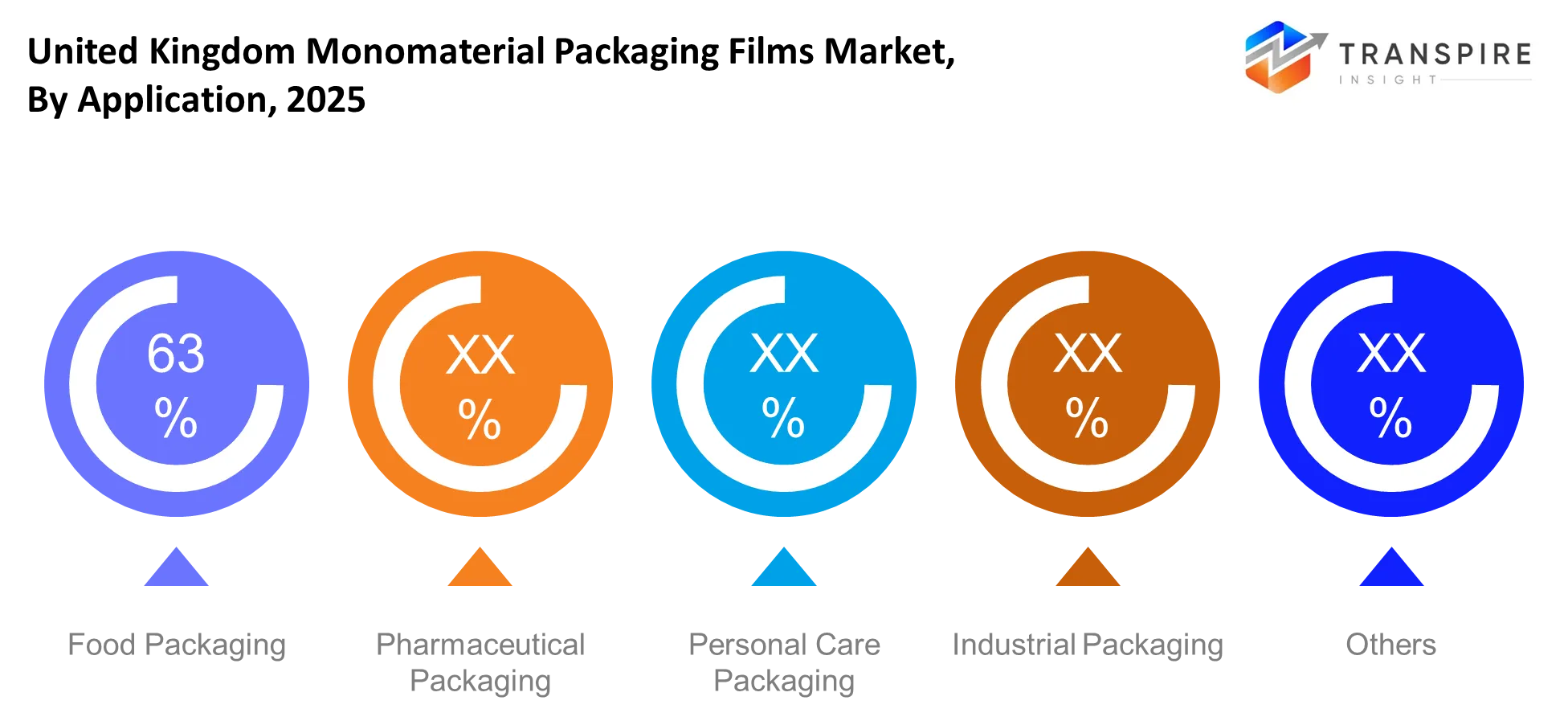
To learn more about this report, Download Free Sample Report
By Product Type
Flexible films are still the front runner, mainly because they’re used everywhere in pouches, wraps, and flow packaging formats across retail and food supply chains. Barrier films are a key slice, especially where moisture and oxygen resistance requirements don’t really budge. Recyclable films are seeing the fastest growth, backed by regulatory frameworks and corporate sustainability commitments. Laminated films are slowly losing ground, largely because they’re harder to recycle, or the recyclability just doesn’t play well.
Flexible films keep expanding because theyre pretty cost efficient and they play nicely with high speed packaging lines. Barrier films are still essential for extending product shelf life, even if there are noticeable performance gaps compared to multilayer systems. Recyclable films are getting more traction too, since converters are redesigning their structures to satisfy extended producer responsibility rules and also to benefit from Plastic Packaging Tax incentives.
In the coming years growth will likely lean toward recyclable film formats, mainly because technical improvements keep trimming the performance trade offs. Barrier enhanced monomaterial solutions are set to become a central area of innovation, making it easier to swap laminated structures in sensitive packaging categories more broadly.
By End User
In terms of end users, the food industry sits at the top. That is mostly because processed foods, dairy, and fresh produce distribution all consume flexible packaging at big scale. FMCG companies are right behind, pushed by brand level sustainability commitments and a bunch of packaging redesign efforts. The pharmaceutical industry stays strong, since packaging has to meet compliance-driven requirements, while the retail segment is adopting more steadily, helped by private label sustainability programs.
Food industry growth is kinda pulled forward by supermarket mandates that basically require recyclable packaging to be used across supplier chains, and it’s enforced pretty directly. FMCG businesses then push the change faster with centralized purchasing, plus some pretty firm long-term sustainability targets. In pharma, adoption rises too because regulatory packaging validation is stricter and because there’s greater demand for traceable, safe, and recyclable materials, all at once.
In the future , demand should spike harder across both FMCG and pharmaceutical, since the regulatory rulebooks keep getting tighter. Retailers will start steering upstream packaging choices more often, so there’ll be better alignment between brand owners and material suppliers who are working on recyclable film innovation.
What are the Key Use Cases Driving the United Kingdom Monomaterial Packaging Films Market?
Food packaging is still basically the big thing in the United Kingdom Monomaterial Packaging Films Market, mainly pulled by supermarkets, ready meal producers and also fresh produce distributors moving toward more recyclable flexible formats, thanks to the UK packaging tax and EPR rules. Because retailers want volume and very firm shelf life timing, mono-PE films tend to be the go to swap when multilayer laminates get phased out.
Pharmaceutical blister packs are also growing, along with FMCG personal care packaging, these secondary areas benefit from compliance changes and brand level sustainability pledges. A lot of FMCG companies lean into monomaterial approaches too, in order to keep recycling claims simple, while healthcare suppliers focus on sterile barrier integrity and they want recyclable structures that still perform.
Other up-and-coming uses are e-commerce protective wrapping and industrial export wraps, where lighter recyclable films help lower shipping expenses and make carbon reporting feel less heavy. There’s also more interest in premium eco friendly packaging for cosmetics and specialty foods, supported by retailer led plastic reduction targets, so demand keeps climbing a bit faster than before.
|
Report Metrics |
Details |
|
Market size value in 2025 |
USD 153.75 Million |
|
Market size value in 2026 |
USD 166.15 Million |
|
Revenue forecast in 2033 |
USD 285.98 Million |
|
Growth rate |
CAGR of 8.07% from 2026 to 2033 |
|
Base year |
2025 |
|
Historical data |
2021 - 2024 |
|
Forecast period |
2026 - 2033 |
|
Report coverage |
Revenue forecast, competitive landscape, growth factors, and trends |
|
Regional scope |
United Kingdom |
|
Key company profiled |
Amcor, Mondi Group, Berry Global, Sealed Air, Coveris, Huhtamaki, Constantia Flexibles, UFlex, Winpak, ProAmpac, Sonoco Products, Clondalkin Group, Smurfit Kappa, Borealis, Innovia Films |
|
Customization scope |
Free report customization (country, regional & segment scope). Avail customized purchase options to meet your exact research needs. |
|
Report Segmentation |
By Material Type (Polyethylene Films, Polypropylene Films, PET Films, Biopolymer Films, Others); By Application (Food Packaging, Pharmaceutical Packaging, Personal Care Packaging, Industrial Packaging, Others); By Product Type (Flexible Films, Barrier Films, Recyclable Films, Laminated Films, Others); By End User (Food Industry, Pharmaceutical Industry, FMCG Companies, Retail Sector, Others) |
Which Regions are Driving the United Kingdom Monomaterial Packaging Films Market Growth?
Southern England kind of leads the United Kingdom Monomaterial Packaging Films Market, mostly because it has a dense set of FMCG headquarters, packaging converters, and pretty advanced logistics infrastructure around London plus the South East corridor. And with stronger enforcement of UK packaging tax compliance along with Extended Producer Responsibility rules , big brand owners have been pushed to centralize procurement decisions in this area. Also there’s this mature ecosystem of material suppliers, recyclers, and high-speed converting facilities, which helps keep things moving for mono-PE and mono-PP film production. On top of that, high retail density and fast-moving consumer goods distribution keep sustaining demand volumes, even when the market gets a bit noisy.
The Midlands is basically the second key region, but it’s different , it’s more about its industrial manufacturing base than any kind of regulatory centralization. Compared with Southern England, where decision-making is corporate-led, Midlands growth is anchored in food processing plants, packaging machinery clusters, and mid-sized converters that supply national retailers. Investment there tends to be stable from domestic manufacturers , and extrusion capacity upgrades have been consistent, so output stays steady instead of switching too quickly. Because of that structural resilience, the region can act like a reliable supply backbone even when material specifications change or compliance cycles shift around.
Scotland is the fastest-growing region, and this seems tied to recent investments in circular economy infrastructure, plus government-backed sustainability programs that rolled out after 2023. With new expansions in recycling facilities and packaging innovation grants , local adoption of recyclable film formats has become easier for food and beverage industries.Improved port-linked logistics in Glasgow and Edinburgh has also strengthened export-oriented packaging demand. For market entrants and investors, Scotland offers early-stage scaling opportunities between 2026 and 2033, particularly in bio-based and advanced barrier monomaterial technologies.
Who are the Key Players in the United Kingdom Monomaterial Packaging Films Market and How Do They Compete?
In the United Kingdom Monomaterial Packaging Films Market, the competitive scene is kinda moderately consolidated, with a blend of big global packaging players and more specialized regional converters all chasing FMCG contracts. You can see the fight mostly comes down to material innovation, compliance readiness with the UK packaging tax rules, and whether a firm can reliably ship recyclable mono-PE or mono-PP solutions at a proper industrial scale. Sure, price competition still matters, but lately the thing that really swings contract wins is tech leadership—like stronger barrier capability, and better recycling compatibility.
Amcor is leaning into a technology-first edge, scaling high-barrier recyclable film platforms for food and healthcare use, and they often work side by side with major FMCG brands to lock in longer term supply agreements. Mondi, on the other hand, leans hard on sustainable mono-material approaches and paper-integrated packaging systems. They use their UK and wider European production footprint to deliver solutions that remain compliant. Berry Global pursues cost efficiency by leveraging large resin processing capacity and integrating recycled polymers. At the same time, they keep expanding mono-PE production partnerships with retail packaging suppliers to stay competitive on both supply and price.
Sealed Air is pushing forward with automation driven protective packaging systems, aiming to boost operational efficiency in e-commerce and industrial logistics. Huhtamaki differentiates by focusing on food packaging know-how and by developing hybrid fibre-plastic ideas that support structures that are recyclable-ready for recycling and retail chains. Coveris is growing its UK presence through targeted acquisitions and investments in extrusion capacity, with an overall focus on quick-turnaround supply for regional FMCG customers and private-label buyers.
Company List
- Amcor
- Mondi Group
- Berry Global
- Sealed Air
- Coveris
- Huhtamaki
- Constantia Flexibles
- UFlex
- Winpak
- ProAmpac
- Sonoco Products
- Clondalkin Group
- Smurfit Kappa
- Borealis
- Innovia Films
Recent Development News
“In January 2026, Amcor expanded its mono-PE and mono-PP high-barrier film portfolio. The expansion introduced recyclable monomaterial structures designed to replace aluminum and multi-layer laminates in food and pharmaceutical packaging while maintaining barrier performance through advanced coating technologies.https://www.globenewswire.com
“In January 2025, Berry Global completed successful trials of its Entour™ mono-material PE/PE lamination films on a new conversion line. The development validated recyclable mono-PE structures for flow wraps and pouches, supporting replacement of mixed-material PET/PE and OPP/PE laminates.https://packagingsolutions.amcor.com
What Strategic Insights Define the Future of the United Kingdom Monomaterial Packaging Films Market?
The United Kingdom Monomaterial Packaging Films Market is kinda moving toward full on swapping multilayer laminates with mono-PE and more advanced mono-PP set ups, mainly because regulation is being enforced, not so much from natural demand growth. Under Extended Producer Responsibility rules plus packaging tax penalties, brand owners are getting pushed to rethink their portfolios at the material science level, not just by changing the packaging format. So yeah, the whole value story tilts toward resin innovation, barrier-coating know-how, and higher-efficiency extrusion platforms.
There is also a less obvious risk, like performance saturation, where monomaterial solutions just don’t quite land the same barrier performance as multilayer structures, especially in high-sensitivity food and medical use. That basically forms a hidden limit on how much substitution can happen, and it can increase reliance on hybrid packaging formats, which may end up slowing revenue acceleration even with all that regulatory pressure still sitting there.
At the same time, an opportunity is starting to show up around plasma-enhanced barrier coatings and recyclable, high performance additives. This seems especially relevant within UK innovation clusters in the Midlands and Scotland. If those technologies work as expected, they could enable the next generation monomaterial films that still satisfy premium shelf-life demands, without sacrificing recyclability. Market players should likely focus on early collaborations with coating tech developers and lock in longer term FMCG co-development arrangements, because first mover access to proven high-barrier recyclable systems will probably shape competitive position for the next decade.
United Kingdom Monomaterial Packaging Films Market Report Segmentation
By Material Type
- Polyethylene Films
- Polypropylene Films
- PET Films
- Biopolymer Films
- Others
By Application
- Food Packaging
- Pharmaceutical Packaging
- Personal Care Packaging
- Industrial Packaging
- Others
By Product Type
- Flexible Films
- Barrier Films
- Recyclable Films
- Laminated Films
- Others
By End User
- Food Industry
- Pharmaceutical Industry
- FMCG Companies
- Retail Sector
- Others
Frequently Asked Questions
Find quick answers to common questions.
The Expected United Kingdom Monomaterial Packaging Films Market size is USD 285.98 Million in 2033.
Key Segments for the United Kingdom Monomaterial Packaging Films Market are By Material Type (Polyethylene Films, Polypropylene Films, PET Films, Biopolymer Films, Others); By Application (Food Packaging, Pharmaceutical Packaging, Personal Care Packaging, Industrial Packaging, Others); By Product Type (Flexible Films, Barrier Films, Recyclable Films, Laminated Films, Others); By End User (Food Industry, Pharmaceutical Industry, FMCG Companies, Retail Sector, Others).
Major United Kingdom Monomaterial Packaging Films Market Players are Amcor, Mondi Group, Berry Global, Sealed Air, Coveris, Huhtamaki, Constantia Flexibles, UFlex, Winpak, ProAmpac, Sonoco Products, Clondalkin Group, Smurfit Kappa, Borealis, Innovia Films.
The United Kingdom Monomaterial Packaging Films Market size is USD 153.75 Million in 2025.
The United Kingdom Monomaterial Packaging Films Market CAGR is 8.07% from 2026 to 2033.
- Amcor
- Mondi Group
- Berry Global
- Sealed Air
- Coveris
- Huhtamaki
- Constantia Flexibles
- UFlex
- Winpak
- ProAmpac
- Sonoco Products
- Clondalkin Group
- Smurfit Kappa
- Borealis
- Innovia Films
About the Authors

Pankaj Ghogare Patil
I am Pankaj Ghogare Patil, a Senior Research Analyst at Transpire Insight, specializing in the Pharmaceutical, Chemicals & Materials, Healthcare IT, and Biotechnology industry. My expertise lies in conducting comprehensive market research, analyzing industry trends, evaluating competitive landscapes, and translating complex data into actionable insights. At Transpire Insight, I closely follow emerging technologies, regulatory developments, and market innovations to create accurate, well-researched, and informative content that helps businesses and professionals make informed decisions. I am committed to producing credible, evidence-based articles that reflect industry best practices while making technical topics accessible and valuable for a broad audience.

Chakradhar Khansole
Chakradhar serves as the Research Director at Transpire Insight, bringing over 8 years of experience in technology, innovation, and strategic market intelligence. He specializes in transforming complex market data into actionable business insights that enable organizations to make informed, growth-oriented decisions. Recognized for his strategic vision and analytical expertise, Chakradhar leads high-impact research initiatives, delivering comprehensive market assessments, competitive intelligence, and forward-looking industry analysis.
Recently Published Reports
-
May 2026
Healthcare Polymer Packaging Market
Healthcare Polymer Packaging Market Size, Share & Analysis Report By Packaging Type (Syringes, IV Bottles and Pouches, Clamshells, Blisters, Bottles & Jars, Containers, Tubes, IV Parental Packaging, Others), By Type (Regulated, Non-regulated), By Polymer Type (LDPE (Low-Density Polyethylene), HDPE (High-Density Polyethylene), Homo-polymer (Homo), Random Copolymer (Random), Block Copolymer (Block), PET, Polystyrene, Polyvinyl Chloride, Polyamide/EVOH, Others), and Geography (North America, Europe, Asia-Pacific, Middle East and Africa, South and Central America), 2021 - 2031
-
Apr 2026
Hydrophilic Tape (Waterstop) Market
Hydrophilic Tape (Waterstop) Market Size, Share & Analysis Report By Type (Bentonite-Based Hydrophilic Tape, Rubber-Based Hydrophilic Tape), By Application (Residential Buildings, Commercial Buildings, Infrastructure Projects), and Geography (North America, Europe, Asia-Pacific, Middle East and Africa, South and Central America), 2021 - 2031
-
Apr 2026
Metalens Market
Metalens Market Size, Share & Analysis Report By Type (Visible Light Metalens, and Infrared Metalens), By Application (Consumer Electronics, Automotive Electronics, Industrial, Medical, and Others), and Geography (North America, Europe, Asia-Pacific, Middle East and Africa, South and Central America), 2021 - 2031
-
Apr 2026
PBT Resin Market
PBT Resin Market Size, Share & Analysis Report By Type (Reinforced PBT Resin, Unreinforced PBT Resin), By Processing Method (Injection Molding, Extrusion, Blow Molding, Others), By End-User (Automotive, Electrical & Electronics, Consumer Appliances, Industrial Machinery, Medical Devices, Packaging, Others), and Geography (North America, Europe, Asia-Pacific, Middle East and Africa, South and Central America), 2021 - 2031