
Asia Pacific Food Packaging Market Size & Forecast:
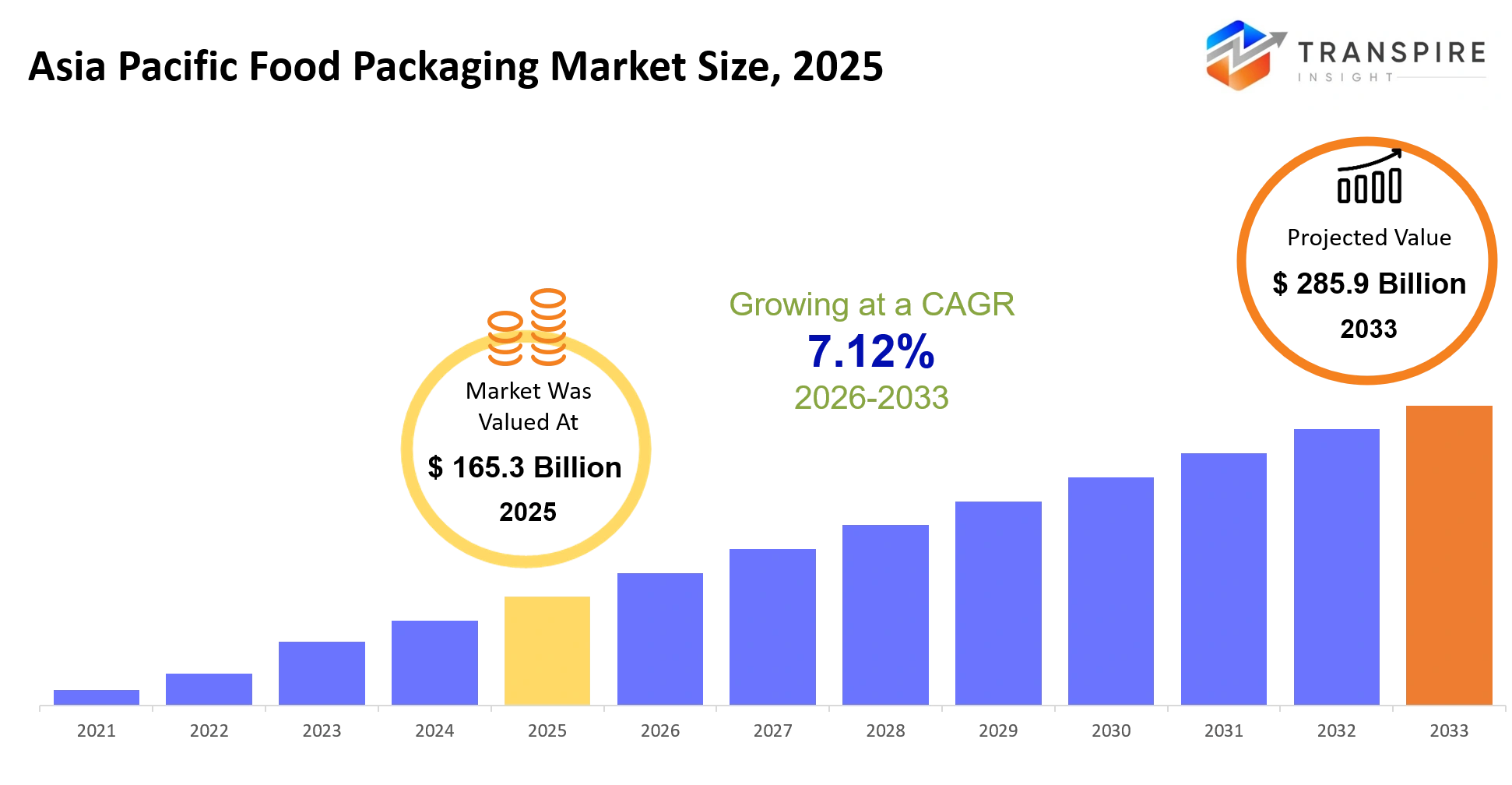
- Asia Pacific Food Packaging Market Size 2025: USD 165.3 Billion
- Asia Pacific Food Packaging Market Size 2033: USD 285.9 Billion
- Asia Pacific Food Packaging Market CAGR: 7.12%
- Asia Pacific Food Packaging Market Segments: By Material (Plastic, Paper, Metal, Glass, Bioplastics, Others); By Packaging Type (Flexible, Rigid, Cartons, Pouches, Trays, Others); By Application (Bakery, Dairy, Beverages, Meat, Snacks, Others); By End User (Food Manufacturers, Retailers, Foodservice, Others).
To learn more about this report,  Download Free Sample Report
Asia Pacific Food Packaging Market Summary
The Asia Pacific Food Packaging Market was valued at USD 165.3 Billion in 2025. It is forecast to reach USD 285.9 Billion by 2033. That is a CAGR of 7.12% over the period.
In the Asia Pacific food packaging market it kind of has a very critical operational role, because it keeps food safe, helps extend shelf life, and basically preserves product quality while goods travel through retail, e-commerce, and cold chain systems that are getting more and more complex. It allows food manufacturers, processors, and retailers to cut down spoilage, satisfy labeling rules, and move products efficiently across different consumer regions.
Over the last five years there’s been some kind of structural change, like a clear pivot, toward recyclable lightweight and mono material packaging styles, which is kinda surprising if you think about it. This happened because governments across the region tightened packaging waste regulations, and producers looked for ways to improve their sustainability performance in a more straightforward manner. Then COVID-19, and later supply chain disruptions, also reshaped buying and distribution behavior too, and in the end it sped up investments in packaged foods, flexible packaging, and automated packing operations. Meanwhile urbanization, organized retail growth, and cross border food trade keep increasing product flow and shelf life expectations, so packaging suppliers are chasing fresh revenue paths. They do this by using higher value materials, adding smart packaging features, and pushing compliance driven product improvements, kind of right alongside those market changes.
Key Market Insights
- China really seems to dominate the Asia Pacific Food Packaging Market, grabbing about 35–40% market share in 2025 , and this is mostly held up by large scale food manufacturing.
- India is kinda the fastest growing regional market during the whole forecast period, mainly because organized retail keeps expanding, and packaged food is getting more common.
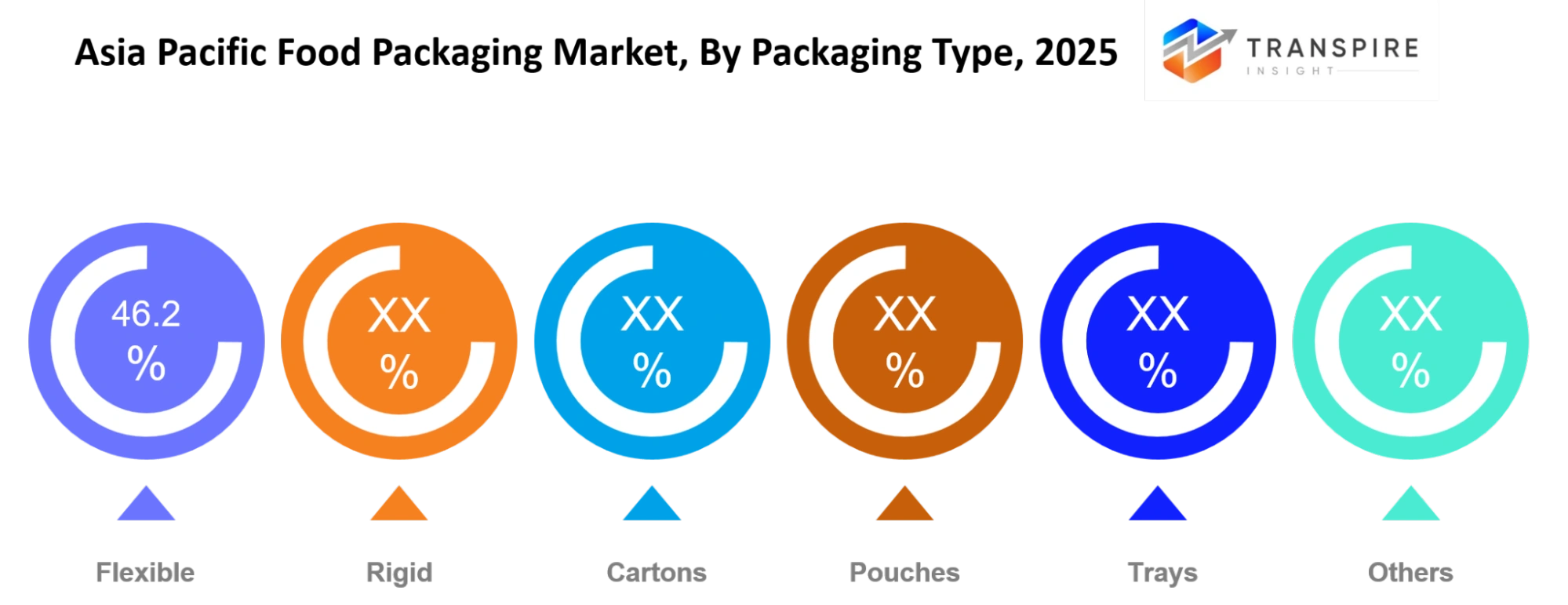
- For product types, flexible packaging is leading, holding something like 45–50% market share in 2025 . This is linked to cost efficiency, lightweight design, and that extra shelf life benefit .
- Rigid packaging lands as the second largest segment, and it’s backed by strong usage in beverages, dairy, and also premium food categories, where sturdier formats matter .
- And then, sustainable plus recyclable packaging solutions are the quickest growing segment all the way through 2030 , pulled along by regulatory compliance and those corporate sustainability targets.
- Mono material packaging formats are kinda gaining traction now, as manufacturers try to push improved recyclability and a lower environmental impact, basically.
- Processed and packaged foods are still taking the biggest slice of applications, and in 2025 they are about 40% of all packaging demand.
- Ready to eat meals and convenience foods, meanwhile, are showing the fastest growth in urban markets.
- The growth of online grocery platforms is also speeding up demand for durable, tamper evident, and transport friendly food packaging solutions, which makes sense.
- And for premium food products, advanced barrier packaging is being used more and more, to keep freshness longer and protect overall product quality.
What are the Key Drivers, Restraints, and Opportunities in the Asia Pacific Food Packaging Market?
The most powerful growth driver in the Asia Pacific Food Packaging Market is, kind of, the fast modernization of food supply lines and retail distribution systems. In the last few years, big investments in organized retail, cold-chain logistics, and food processing capacity across China, India, Indonesia and Vietnam have pushed up the amount of packaged goods moving through neighborhood and regional markets. This change has been pushed further by tighter food safety rules and traceability requirements, so manufacturers are basically forced to use packaging solutions that enhance product shielding, improve labeling accuracy , and strengthen shelf-life results. And when food producers keep widening distribution beyond local neighborhoods they lean more and more on smarter packaging formats to cut spoilage plus transportation losses. That, in turn, backs higher packaging usage and revenue growth.
Still, volatility in raw material costs stays the biggest structural hurdle. Food packaging manufacturers rely heavily on petrochemical-derived resins, specialty films, aluminum and paperboard, and all of those are sensitive to shifts in energy prices, global supply shocks , and trade-related dynamics. Since packaging contracts are frequently signed ahead of time, producers cannot always pass along higher input costs to customers right away . The end result is thinner margins, postponed capital spending, and slower adoption of premium packaging technologies, especially among small and mid-size food processors.
A major future opportunity is in the commercialization of high-performance recyclable and mono material packaging solutions, basically. Across Asia Pacific, governments are tightening packaging waste regulations, and at the same time, food manufacturers are looking for formats that keep recyclability front and center without giving up barrier performance. There are also improvements happening in mono material polyethylene and polypropylene structures, and the coating technologies are getting better too, somehow. So, packaging suppliers can kind of swap out those tricky difficult to recycle multilayer materials. In spots like Japan , South Korea, and Australia, the operating conditions are getting more favorable for these next generation approaches, and it is opening up new revenue channels for companies that can balance sustainability, product protection, and regulatory compliance.
What Has the Impact of Artificial Intelligence Been on the Asia Pacific Food Packaging Market?
Artificial intelligence is sort of reshaping food packaging operations across Asia Pacific, sort of at the same time improving production efficiency, quality control, and supply chain decision making in a way that feels very “hands on”. Packaging manufacturers are now more often deploying AI powered vision systems on production lines to catch sealing defects, labeling mistakes , surface imperfections, and even contamination risks in real time. These automated inspections can reduce the need for manual quality checks, and in practice they help manufacturers keep product standards consistent while also pushing throughput higher.
Alongside that, machine learning is being used in predictive maintenance plans for packaging machinery. Basically, by watching sensor data from filling, sealing , printing, and converting equipment, AI can notice early clues of component wear and likely failures before a breakdown happens.The result is better equipment availability, fewer surprise stoppages, and lower maintenance spending. Also, advanced analytics platforms help companies optimize material usage, reduce packaging waste, and tighten production schedule accuracy which makes the whole operation smoother.
In the wider supply chain, AI is helping with demand forecasting and inventory planning too.It kind of does this by studying sales patterns, looking at seasonal consumption moods ,and pulling distribution data from different regions. When the forecast turns out more accurate, packaging producers can better line up production volumes with what the customers really need. In that way they can also cut down on surplus inventory that just kind of sits around .
Still, AI adoption isn’t totally straightforward, because high implementation costs and a fragmented manufacturing environment slow things down. A lot of packaging facilities run on legacy equipment, and it may lack the sensors and digital infrastructure needed for advanced analytics. So large scale integration becomes technically complex, and it often requires heavy capital investment.
Key Market Trends
- Since 2020, big food producers started to speed up using mono material packaging structures to match the changing, waste cut rules across Asia Pacific.
- Between 2021 and 2025, money for cold chain infrastructure grew a lot, so demand rose for packaging that can keep freshness, even when distribution takes longer.
- Food manufacturers also began replacing multilayer packaging with recyclable options as regulators in India, Australia and South Korea got more strict about what’s allowed.
- After 2022, AI powered quality inspection systems showed up more often, which helped packaging plants lower defect levels, and keep production more consistent.
- E-commerce grocery sales kind of shifted the packaging specs a bit, so manufacturers had to work out sturdier, tamper evident types of formats that can deal with those tricky delivery routes.
- Companies like Amcor, Huhtamaki, and Mondi expanded their regional production capacity too, sort of trying to cut down on long supply chains and move faster, responding quicker to nearby customers.
- Digital printing is also getting used more across premium food segments, letting firms run shorter batches, launch items faster, and create more tailored packaging ideas.
- Since 2021, resin and energy costs have been kinda unstable , so manufacturers leaned toward cutting down material usage a bit, plus fine tuning designs so they can get better cost efficiency, even if it’s not perfect.
- Retailers too started preferring packaging that comes with traceability upgrades , like QR codes and smart label tech, which supports the whole transparency program.
- Meanwhile sustainability goals pushed brands to rethink procurement, so multinational food companies are now factoring recyclability, and even material recovery performance, into who they pick as suppliers .
Asia Pacific Food Packaging Market Segmentation
By Material :
This segment kinda groups food packaging products based on what material is used during manufacturing, even if it sounds simple it really depends. Plastic keeps staying popular, mainly for durability, being light in weight, moisture resistance, and that overall cost efficiency thing. Plastic packaging also backs up a broad variety of food products like fresh , frozen, and processed items. Paper packaging matters too, mostly because printing is easier, it is recyclable, and it fits well with dry food products plus takeaway uses.
Metal and glass materials, on the other hand, get chosen when stronger protection and longer shelf life are needed. Metal packaging is commonly used for canned foods and beverages. Glass is often picked for products where you want product visibility and flavor preservation, and that’s kind of a big deal for some brands. Bioplastics and other alternative materials are getting more attention lately, as packaging producers search for solutions that match shifting environmental regulations and waste management goals.
The selection process usually depends on things like product type, storage conditions, transportation requirements, and regulatory standards. Manufacturers keep assessing material performance together with cost, and sustainability factors, when they choose packaging solutions for food products across the region.
By Packaging Type :
This part sort of classifies the market based on packaging format, I mean the way the material is set up. Flexible packaging covers films, wraps and sachets, which can quickly adapt to the product shape while still using less material. People use this setup a lot since it helps cut transportation costs and it also feels more convenient for storage, as well as handling. You often see these flexible solutions in snacks, frozen foods, and ready-to-eat items, not always but pretty often, it depends.
Rigid packaging on the other hand is more like containers, bottles, jars and other forms that keep a fixed shape. Cartons are used a lot for beverages, dairy goods and packaged foods, because they give sturdy protection, and they also help with the branding requirements. Pouches have become more and more common, largely due to convenience traits like resealable closures, lightweight construction, and that easy day-to-day practicality.
Trays are frequently used for meat, seafood, bakery products and fresh produce where product presentation really matters. Then there are other packaging formats that serve specialized needs, depending on things like food characteristics, distribution constraints, and what consumers prefer. Packaging manufacturers keep refining their designs too, to enhance protection, increase convenience, and boost operational efficiency a bit across the board.
To learn more about this report, Download Free Sample Report
By Application :
This segment sorta categorizes food packaging based on the food product type being packed. Like, for bakery products the packaging sort of has to help keep freshness, texture, and the whole appearance pretty steady during storage and shipping, even if the conditions change a bit, you know. For dairy products especially, they usually need packaging with strong barrier abilities, so it can guard against moisture, light, and contamination, while also extending shelf life as far as possible.
Beverage packaging kinda leans on ease of use, safety for the product and transportation efficiency, not just one thing at a time. Meat packaging does require specialized materials that support freshness and reduce the contact with external contaminants. Snack products depend on packaging that maintains flavor, crunch or crispness, and the general quality of the product throughout distribution and retail display.
Other uses show up too, like frozen foods, confectionery, prepared meals, and those specialty food categories. Basically different food items lead to different packaging needs, so manufacturers develop application tailored solutions that cover preservation, safety, handling, plus consumer convenience, all in one go.
By End User :
This segment describes the main users of food packaging solutions. Food manufacturers show up as a big end-user group, because packaging is basically a core piece of production, storage, transportation, and also product display. Through packaging, manufacturers are able to secure what they produce, meet regulatory duties, and still keep the product quality pretty intact for basically the entire supply chain process, even if it’s a bit messy along the way.
Retailers as well lean on packaging, mainly to push product visibility, keep the shelves more orderly , and help customers find what they need faster. In retail areas packaging additionally backs up labeling requirements, and of course branding efforts that happen right on the floor. Then you have foodservice businesses , like restaurants, cafés, catering providers, and takeaway operators, they need packaging that supports secure handling, easy transit, and safe consumption of food items.
There are also other end users, such as institutional kitchens, hospitality venues, and niche food distributors. Every end-user category has its own packaging needs, shaped by day-to-day operations, what customers expect , the types of products, and how goods move from place to place. As food distribution networks become more sophisticated, packaging solutions keep shifting and adapting, to support better efficiency, stronger food safety, and overall product integrity across the Asia Pacific Food Packaging Market.
What are the Key Use Cases Driving the Asia Pacific Food Packaging Market?
In Asia Pacific , the biggest use case for food packaging really comes from processed and packaged food production . Food manufacturers end up leaning on high-performance materials to help preserve freshness, keep contamination at bay, and stretch shelf life while items move around regional plus international lanes . With modern retail still expanding, and with more organized food supply chains showing up, the appetite for these packaging solutions keeps rising.
There’s also more adoption happening in dairy and beverage packaging, where product protection and meeting regulatory rules are still a hard requirement. At the same time, foodservice operators and bigger retail groups are using more convenience-oriented packaging, the kind that supports takeaway services, home delivery, and faster inventory handling. These scenarios have become even more relevant as digital food ordering platforms keep spreading through major cities.
On top of that, some emerging use cases are starting to look more “next level”, like smart packaging that brings traceability options such as QR codes and digital product authentication tools. Meanwhile, packaging tied to circular economy initiatives is getting noticeably more attention too, including advanced recyclable designs and mono-material structures. This is happening because governments are tightening packaging waste rules, and food producers are preparing for tougher sustainability expectations during the forecast period.
|
Report Metrics |
Details |
|
Market size value in 2025 |
USD 165.3 Billion |
|
Market size value in 2026 |
USD 176.7 Billion |
|
Revenue forecast in 2033 |
USD 285.9 Billion |
|
Growth rate |
CAGR of 7.12% from 2026 to 2033 |
|
Base year |
2025 |
|
Historical data |
2021 - 2024 |
|
Forecast period |
2026 - 2033 |
|
Report coverage |
Revenue forecast, competitive landscape, growth factors, and trends |
|
Regional scope |
Asia Pacific (India, China, Japan, Australia, South Korea, Rest of Asia Pacific) |
|
Key company profiled |
Amcor, Mondi, Berry Global, Sealed Air, Huhtamaki, Sonoco, DS Smith, Tetra Pak, UFlex, Coveris, ProAmpac, Winpak, Smurfit Westrock, Ball Corp, Crown Holdings. |
|
Customization scope |
Free report customization (country, regional & segment scope). Avail customized purchase options to meet your exact research needs. |
|
Report Segmentation |
By Material (Plastic, Paper, Metal, Glass, Bioplastics, Others); By Packaging Type (Flexible, Rigid, Cartons, Pouches, Trays, Others); By Application (Bakery, Dairy, Beverages, Meat, Snacks, Others); By End User (Food Manufacturers, Retailers, Foodservice, Others). |
Which Regions are Driving the Asia Pacific Food Packaging Market Growth?
China kind of represents the dominant market across Asia Pacific, and it keeps that standing by leaning on huge-scale food manufacturing ability, broad retail networks, and also strong government oversight for food safety rules. On top of that, the regulatory expectations around labeling , traceability, and packaging quality tend to push businesses to keep putting money into more advanced packaging solutions. China also has a pretty established packaging supply chain, where raw material suppliers, converters, equipment manufacturers, and food processors are linked together in an almost seamless way. Because of this integrated setup, companies can move faster on new products, run large production batches, and distribute efficiently both inside the country and for export .
Japan comes in next as the second-largest contributor, and it feels different from China in a few ways. Japan is more focused on product quality, premium packaging formats, and long-term operational stability. Instead of relying mainly on production scale alone, the market is sustained by ongoing investments in packaging technology, automation , and high-performance materials. Strict quality standards across food processing and within retail channels create steady demand for barrier packaging , plus packaging designs that are more specialized. With a mature consumer base and a dependable regulatory framework, revenue for packaging suppliers stays more predictable, more like stable ground under the feet.
India seems like the fastest-growing market in the region, mainly because food distribution and the retail setup are changing really quickly. With organized retail expanding, e-commerce grocery platforms growing, and more funds going into food processing facilities, packaging manufacturers are getting fresh opportunities in a way that is kind of obvious but also a bit overlooked. At the same time , government initiatives that push food processing modernization and cold-chain development are also helping packaging adoption move faster. Between 2026 and 2033, all this momentum should pull in new investments for manufacturing capacity, more sustainable packaging technologies, and localized production sites, so in practice it will open real doors for both domestic players and international market participants.
Who are the Key Players in the Asia Pacific Food Packaging Market and How Do They Compete?
Competition in the Asia Pacific Food Packaging Market feels moderately fragmented , like not completely consolidated. You can see global packaging groups side by side with regional manufacturers, which have really strong local supply routes and that kind of thing. How companies position themselves is shaped by material innovation, manufacturing efficiency, sustainability performance, and also the ability to keep up with new food safety requirements. While big, established players keep defending their market share using scale and deep technical expertise, smaller or more specialized firms are getting some momentum. They tend to offer customized packaging solutions, adjusted for local regulatory rules and what consumers actually expect, not just generic options.
Amcor plc puts a strong focus on material innovation and recyclable packaging development. They differentiate through advanced barrier technologies, which help food manufacturers keep product quality stable, while also improving recyclability. Amcor keeps expanding its regional presence via investments in sustainable packaging platforms, plus close work with multinational food brands. Huhtamaki, instead, competes through fiber based packaging solutions and solid capabilities in foodservice packaging. That setup lets the company benefit as regulations shift around packaging waste and material recovery , like the direction of those requirements is changing over time.
Mondi Group leans into paper based and flexible packaging innovation. The idea is that customers can cut material usage, yet still get good product protection. Sealed Air Corporation differentiates with specialized food preservation technologies , aimed at reducing spoilage and extending shelf life. Berry Global Group stays competitive thanks to wide manufacturing capabilities and ongoing regional production expansion, so they can deliver faster and respond more quickly to customer needs across many Asia Pacific markets.
Company List
- Amcor
- Mondi
- Berry Global
- Sealed Air
- Huhtamaki
- Sonoco
- DS Smith
- Tetra Pak
- UFlex
- Coveris
- ProAmpac
- Winpak
- Smurfit Westrock
- Ball Corp
- Crown Holdings
Recent Development News
In May 2025, Amcor plc entered a partnership with Metsä Group. The collaboration will develop molded fiber food packaging solutions that combine fiber-based structures with high-barrier liner technology, supporting recyclable packaging adoption and expanding sustainable food packaging options across global and Asia Pacific markets.
Source: https://www.amcor.com/
In April 2025, Amcor plc completed construction of an advanced coating facility in Malaysia. The facility introduced Asia’s first air knife coating technology for healthcare packaging, strengthening regional packaging manufacturing capacity, improving supply chain resilience, and reducing lead times for customers across Asia Pacific.
Source: https://www.prnewswire.com/
What Strategic Insights Define the Future of the Asia Pacific Food Packaging Market?
The Asia Pacific Food Packaging Market is kind of moving toward a model where packaging performance, recyclability, and supply chain intelligence will all matter in roughly equal ways. In the next five to seven years, growth should increasingly come from packaging solutions that help food manufacturers satisfy tighter waste-management rules but still keep product protection, and distribution efficiency working smoothly. The main driver behind this change is basically the meeting point of regulatory pressure, retail modernization, and more investment in regional food processing infrastructure.
There is also a quieter risk, which is about the availability and price of advanced packaging materials. As more manufacturers switch to recyclable and mono material formats, competition for specialized resins, coatings, and barrier materials may rise, and that could lead to supply constraints and squeezed margins. This situation could get worse if regulatory requirements ramp up faster than material production capacity, and then everyone scrambles.
At the same time there is an emerging opportunity, smart packaging systems that blend digital traceability, authentication, and product condition monitoring. Right now adoption is still limited, but stricter food safety and transparency expectations could push deployment forward, especially across China, Japan, and South Korea. Players in the market should start investing early in scalable sustainable-material platforms and digital packaging capabilities, because those capabilities are likely to turn into real differentiators in future procurement and regulatory compliance decisions.
Asia Pacific Food Packaging Market Report Segmentation
By Material
- Plastic
- Paper
- Metal
- Glass
- Bioplastics
By Packaging Type
- Flexible
- Rigid
- Cartons
- Pouches
- Trays
By Application
- Bakery
- Dairy
- Beverages
- Meat
- Snacks
By End User
- Food Manufacturers
- Retailers
- Foodservice
Frequently Asked Questions
Find quick answers to common questions.
The Asia Pacific Food Packaging Market size is USD 285.9 Billion in 2033.
Key segments for the Asia Pacific Food Packaging Market are By Material (Plastic, Paper, Metal, Glass, Bioplastics, Others); By Packaging Type (Flexible, Rigid, Cartons, Pouches, Trays, Others); By Application (Bakery, Dairy, Beverages, Meat, Snacks, Others); By End User (Food Manufacturers, Retailers, Foodservice, Others).
Major Asia Pacific Food Packaging Market players are Amcor, Mondi, Berry Global, Sealed Air, Huhtamaki, Sonoco, DS Smith, Tetra Pak, UFlex, Coveris, ProAmpac, Winpak, Smurfit Westrock, Ball Corp, Crown Holdings.
The Asia Pacific Food Packaging Market size is USD 165.3 Billion in 2025.
The Asia Pacific Food Packaging Market CAGR is 7.12% from 2026 to 2033.
- Amcor
- Mondi
- Berry Global
- Sealed Air
- Huhtamaki
- Sonoco
- DS Smith
- Tetra Pak
- UFlex
- Coveris
- ProAmpac
- Winpak
- Smurfit Westrock
- Ball Corp
- Crown Holdings
About the Authors

Kartik bhong
I am Kartik Bhong, a Senior Research Analyst at Transpire Insight, specializing in the Packaging, Manufacturing, and Construction industry. My work focuses on analyzing market trends, emerging technologies, industry regulations, and competitive landscapes to deliver accurate, data-driven insights. I am passionate about transforming complex industry information into clear, practical content that helps businesses, professionals, and decision-makers stay informed and make confident strategic decisions. Through continuous research and a strong commitment to accuracy, I strive to create reliable, well-researched content that reflects the latest developments across these dynamic industries and supports the vision of Transpire Insight in delivering valuable market intelligence.

Chakradhar Khansole
Chakradhar serves as the Research Director at Transpire Insight, bringing over 8 years of experience in technology, innovation, and strategic market intelligence. He specializes in transforming complex market data into actionable business insights that enable organizations to make informed, growth-oriented decisions. Recognized for his strategic vision and analytical expertise, Chakradhar leads high-impact research initiatives, delivering comprehensive market assessments, competitive intelligence, and forward-looking industry analysis.
Recently Published Reports
-
Apr 2026
Pharmaceutical Cold Chain Packaging Market
Pharmaceutical Cold Chain Packaging Market By Material (Plastic,(Polyethylene (PE), Polypropylene (PP), Polyethylene Terephthalate (PET), Expanded Polystyrene (EPS), Polyurethane (PU),Others), Paper, Metal, Others), By Product (Small Boxes, Pallets, Large Sized Pallet Containers, Others), By End Use (Biopharmaceutical Companies, Clinical Research Organizations, Hospitals, Research Institutes, Logistics and Distribution Companies, Others)”, By Industry Analysis, Size, Share, Growth, Trends, and Forecasts 2026-2033
-
Apr 2026
Active & Intelligent Packaging Market
Active & Intelligent Packaging Market By Type (Active Packaging, Smart Packaging), By Material (Polymer-Based, Paper & Board-Based, Metal-Based, Glass-Based), By Technology (Time-Temperature Indicators, Freshness Indicators, RFID, Antimicrobial Packaging, Modified Atmosphere Packaging), By Application (Food & Beverages, Pharmaceutical, Cosmetics & Personal Care, Electronics & Consumer Goods, Others), By Industry Analysis, Size, Share, Growth, Trends, and Forecasts 2026-2033
-
Apr 2026
Biodegradable Cut Flower Packaging Market
Biodegradable Cut Flower Packaging Market By Material Type (Paper & Paperboard, Biodegradable Plastics, Natural Fibers, Molded Pulp, Others), By Product Type (Sleeves, Wraps, Boxes & Cartons, Bags & Pouches, Inserts & Holders), By Application (Roses, Carnations, Tulips, Chrysanthemums, Mixed Flowers, Others) and By Distribution Channel (Direct Sales, Distributors & Wholesalers, Online Channels), By Industry Analysis, Size, Share, Growth, Trends, and Forecasts 2026-2033
-
May 2026
Pharmaceutical Packaging Market
Pharmaceutical Packaging Market By Material Type (Plastic, Glass, Metal, Paper & Paperboard, Others), By Packaging Type (Bottles, Blister Packs, Vials, Ampoules, Pouches & Sachets, Others) and By End User (Hospitals & Clinics, Retail Pharmacies, Online Pharmacies, Pharmaceutical Manufacturers), By Industry Analysis, Size, Share, Growth, Trends, and Forecasts 2026-2033