
Asia Pacific Plastic Compounding Market Size & Forecast:
- Asia Pacific Plastic Compounding Market Size 2025: USD 29.93 Billion
- Asia Pacific Plastic Compounding Market Size 2033: USD 58.77 Billion
- Asia Pacific Plastic Compounding Market CAGR: 8.83%
- Asia Pacific Plastic Compounding Market Segments: By Polymer Type (PP, PE, PVC, ABS, PET, Engineering Plastics, Others); By Filler Type (Glass Fiber, Mineral Fillers, Carbon Fiber, Talc, Others); By Application (Automotive, Packaging, Construction, Electrical & Electronics, Others); By End User (OEMs, Manufacturers, Industrial Users, Others)
Asia Pacific Plastic Compounding Market Summary
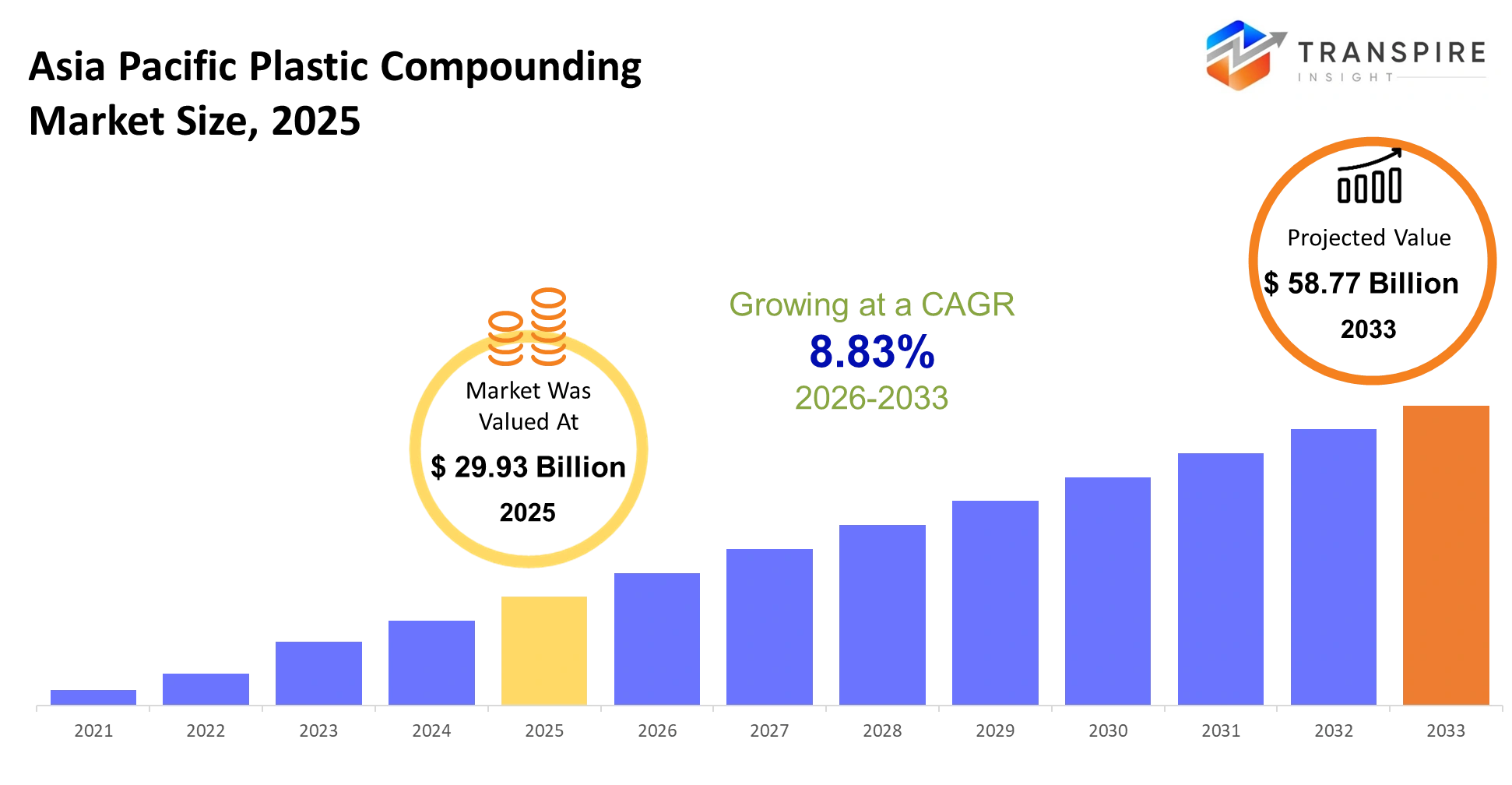
The Asia Pacific Plastic Compounding Market was valued at USD 29.93 Billion in 2025. It is forecast to reach USD 58.77 Billion by 2033. That is a CAGR of 8.83% over the period.
Asia Pacific's plastic compounding market is important to manufacturers as it offers tailor-made materials with special characteristics that meet the required performance needs like high impact, heat resistance, light weight, fire resistance or chemical stability. Such compounds are utilized in applications ranging from auto components, electrical and electronic equipment, consumer products, building & construction applications, to industrial equipment as basic polymers do not fulfill requirements.
The past 5 years' market trends revealed a structural change towards the use of higher-performance and sustainable compounds as companies aim to decrease the weight of their final products, enhance energy efficiency and meet stringent environmental regulations. Major developments include an increase in the usage of high-performance compounds driven by supply chain disruptions during the COVID-19 outbreak which uncovered risks in supply chains for raw materials and drove local production and material optimization strategies. As Asian and Pacific markets invest further in electrification in auto, the need for the manufacture of high-value components for complex electronics, as well as development of construction and industrial infrastructure, compounders are obtaining a greater portion of value from the supply of application-specific compounds.
Key Market Insights
- The Asia Pacific Plastic Compounding Market is dominated by China with over 40% of the total market, which relies on a vast amount of polymer manufacturing capacity.
- India is estimated to be the fastest growing market due to growing automotive production, consumer goods market and electrical applications.
- The share of Southeast Asian countries is increasing due to global players shifting their supply chains and establishing a regional production network.
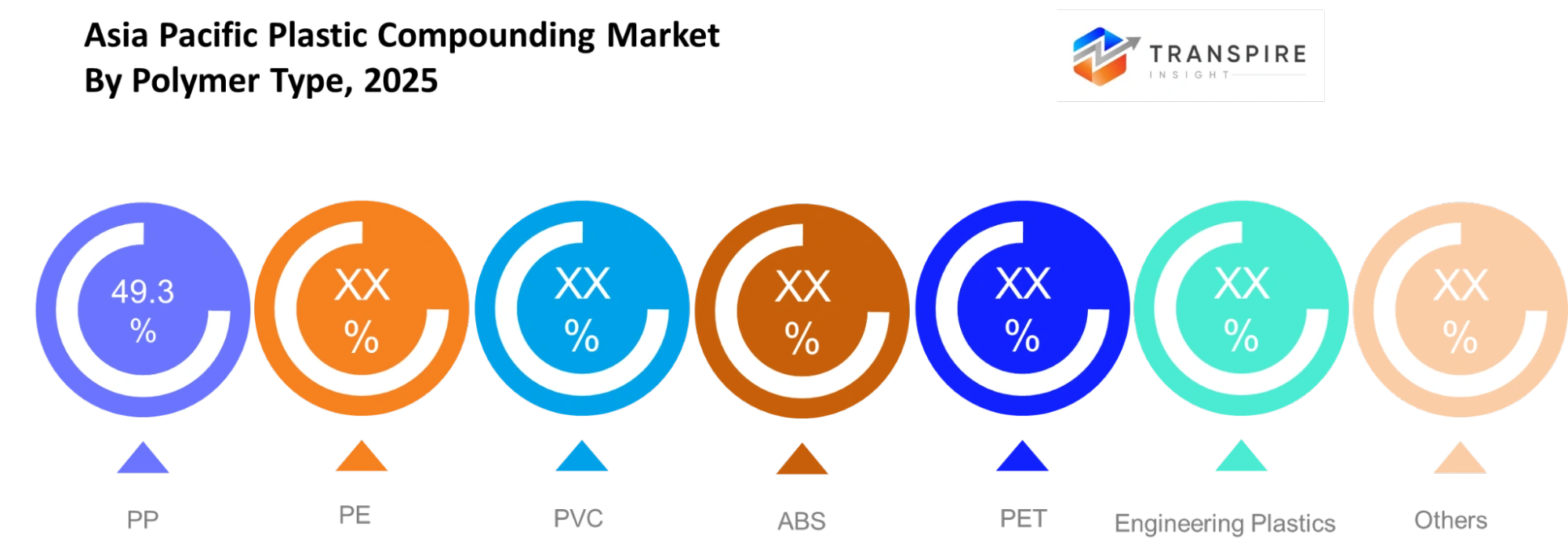
- The share of PP compounds accounted for over 30% of the market, owing to the cost benefits of using the compound and its usage in the automotive industry and its lightweight character.
- Polyethylene compounds account for the second largest share and have been primarily used for packaging, construction and industry.
- With an approximate 40% share, the market leader of Asia Pacific plastic compounding market, China is backed by abundant plastic manufacturing and polymer processing capability.
- The fastest regional growing market will be India, fueled by growth of automobile production, electrical industry and consumer goods sector, in forecast period.
- Southeast Asia countries gain market share due to globalization of companies to disperse the supply chain to set up manufacturing bases locally.
- Polypropylene compounds captured more than 30% market share, on the back of its economic and lightweight characteristics and its application in automobile industry.
- Polyethylene compounds become the second market segment for their wide applications in packaging, construction and other industries.
What are the Key Drivers, Restraints, and Opportunities in the Asia Pacific Plastic Compounding Market?
The most important growth driver is the rapid shift to lightweight, high performance material solutions within automotive and electronics. Automobile manufacturers require strong, thermally stable, lightweight materials in the face of challenging fuel efficiency and electrification mandates. Plastic compounders are offering strong polypropylene, polyamide and engineering plastic formulations capable of replacing metal in vehicle interiors, battery housings and under the hood applications, thereby driving the value per vehicle of compounded plastic and widening revenue opportunities for the entire value chain.
Volatility of petrochemical feedstock prices is the most challenging structural barrier to growth. A large share of compounded plastics utilize resin inputs which have prices closely tied to crude oil and natural gas markets globally. The volatility impacts costs, margins and planning and it is a challenge which cannot be solved quickly as feedstock supply chains are inherently linked to global energy markets, leading to a postponement of purchases, lower profitability of compounders and a slower penetration of specialty materials into cost sensitive sectors.
A major growth opportunity for the future are advanced recycled and circular polymer compounds. Governments throughout Asia Pacific are legislating targets for the percentage of recycled content in packaging, consumer products and industrial applications. Developments in mechanical and chemical recycling are leading to improved quality and performance. India, China and SE Asia are at the forefront of developments as infrastructure is built and governments create opportunities for high-performance recycled compounds and thus new revenues for manufacturers and compounders.
What Has the Impact of Artificial Intelligence Been on the Asia Pacific Plastic Compounding Market?
The implementation of artificial intelligence and other digital technologies are having a transformative effect on plastic compounding with enhanced control over processes, better production rates and improved product consistency. Increasing AI monitoring systems are installed on compounding and extrusion, blending and compounding processes, automatically adjusting temperature, pressure, screw speeds and feed rates in an attempt to produce compounds with reduced processing variability, high quality compounds with little material waste.
Machine learning algorithms are increasingly being employed in preventative maintenance, with sensors in mixing, extruders and pelletizing machinery determining wear trends and enabling operators to forecast the likelihood of failures before they occur, thereby minimizing unplanned downtimes, improving equipment lifespans and increasing plant utilization rates. AI formulation software is used to accelerate product development and optimize formulations for target properties and performance by determining thousands of possible combinations.
At the operational level the effects are to achieve greater production throughputs with fewer rejects, improved energy efficiency and greater customer specification compliance. These factors are limited by integration costs, along with the need for significant quantities of quality historical production data for use in analysis programs. Large numbers of plants are running on older equipment lacking sensors for advanced analyses, slowing deployment across much of the regional plastics value chain.
Key Market Trends
- From 2020 onward, OEMs are actively reducing the amount of metal in vehicles, which in turn has led to the growing demand for reinforced PP and engineered compounds.
- Since 2021-25 electric vehicles have had significant impact on the material specification; this has been addressed by compounders introducing higher heat resistance and flame retardancy levels in their materials.
- New compounding plants are being established in China, India, and Southeast Asia. The need to decrease their overreliance on a single country has been accelerated after the disruptions from pandemic related issues.
- Plastic waste scrutiny by regulatory authorities prompted procurement reevaluation, pushing major converters to introduce post-consumer recycled (PCR) resin into their commodity grade compounds from 2022.
- Due to increase complexity in the semiconductor and consumer electronics, these electronics manufacturers prefer specialized compounds that excel in managing heat.
- Major suppliers, namely BASF, SABIC, and Mitsubishi Chemical, are expanding their regional R&D centers to respond quickly to the needs for customization and product development at the application level.
- Since 2021 quality control through monitoring systems, coupled with AI assisted optimization, have been progressively adopted to achieve significant reduction in the percentage of scrapped product batches as well as improving their homogeneity.
- Competitiveness is increasingly going beyond price, with manufacturer gaining leverage through sustainability certifications, portfolios of recycled-containing products, and high performance features.
- For construction and infrastructure applications, polymeric compounds have begun to migrate towards more weather resistant and durable products especially in the fast developing regions of South and Southeast Asia.
- From 2023 strategic collaborations between compounders and OEM have proliferated, facilitating quicker new product development and the establishment of more stable supply contracts.
Asia Pacific Plastic Compounding Market Segmentation
By Polymer Type :
Polymer type segmentation involves various material bases used within plastic compounding to fulfill specific end-use conditions and properties. Polypropylene is a primary material selection for lightweight and durable applications and it also fulfills numerous product needs and characteristics while polyethylene's primary applications lie in areas requiring ductility, flexibility, and chemical resistance. Polyvinyl Chloride, Acrylonitrile Butadiene Styrene, and Polyethylene Terephthalate plastic compounds contribute to various industries and their related product needs.
Engineering plastics and specialty polymer compounds used in areas requiring a higher mechanical strength, elevated temperatures, electrical resistance and the combination of many desirable properties. Selection criteria is influenced by processing and application needs as well as product desired performance criteria. This helps industries obtain desired product properties using various polymers.
By Filler Type :
Filler type segmentation is characterized by materials included within the plastic compound's polymer base as fillers or reinforcements. Glass fibers are used as a filler in various plastic compounds in an effort to increase strength and stiffness; mineral fillers improve dimensional stability and reduce cost. Carbon fibers are used within plastic compounds when reduced weight and enhanced strength are demanded.
Talc and additional filler materials within plastic compounds are used for modification in product surface finish, rigidity, temperature, and workability. Filler type plays a role in obtaining desired properties within plastic compounds and various industries choose specific fillers based on a certain end-use's longevity expectations, production demands, and final product performance requirements.
By Application :
Application segmentation indicates various application areas for compounded plastics. The applications for the automotive sector include its use as backup components for lightweights and as a result into interiors and functional components. The packaging sector uses compounded plastics as materials offering a good combination of strength, protection and ease of processing. In the construction sector, it is used as material for pipes, fittings, panels, and structural products.
For applications of the electrical and electronics section, compounds that provide insulation, fire retardancy, thermal resistance, and safety are required. Applications also include consumer goods, machinery parts and specific components. These application areas vary depending on performance demands, regulations and manufacturing practices applied for specific use.
By End User :
End-user segmentation indicates the various categories that consume or buy compounded plastics. Original equipment manufacturers (OEM) use these compounds in producing parts and components of automobiles, electronics, and industrial equipment. Manufacturers use compounded plastics as inputs for manufacturing a wide range of commercial and consumer goods.
Industrial users also procure these products as components of their equipment or machinery. Some specialized firms producing products with very specific attributes can be categorized under 'other'. Purchasing patterns for this section depend on required specifications of product, price and efficiency of production.
What are the Key Use Cases Driving the Asia Pacific Plastic Compounding Market?
The Automotive sector represents the largest market for demand in the Asia Pacific Plastic Compounding Market. The compounded plastics help manufacturers build vehicles with reduced component weight for improved fuel efficiency and more creative vehicle designs. The interior trims, bumpers, under the hood parts and battery housings must all have specific properties and hence automotive manufacturing is the highest consumption sector of compounded plastics.
Steady increase is noted across Packaging and electrical equipment application sectors in the region. Consumer goods manufacturers use custom compounds to improve wear performance and ease of processing while electronics component manufacturers utilize high performance plastics for high demand performance requirements and safety standards like insulation parts, connectors and housings.
There are developing opportunities in electric vehicle and renewable energy segments in the region. The advanced compounds are used in batteries and charging parts and also in solar energy applications. Currently the segments hold a modest share but will represent future avenues of growth for compounded plastics during the forecast period owing to rapidly growing regional investment.
|
Report Metrics |
Details |
|
Market size value in 2025 |
USD 29.93 Billion |
|
Market size value in 2026 |
USD 32.51 Billion |
|
Revenue forecast in 2033 |
USD 58.77 Billion |
|
Growth rate |
CAGR of 8.83% from 2026 to 2033 |
|
Base year |
2025 |
|
Historical data |
2021 - 2024 |
|
Forecast period |
2026 - 2033 |
|
Report coverage |
Revenue forecast, competitive landscape, growth factors, and trends |
|
Regional scope |
Asia Pacific (India, China, Japan, Australia, South Korea, Rest of Asia Pacific) |
|
Key company profiled |
LyondellBasell, SABIC, BASF, Dow, Covestro, Asahi Kasei, Mitsubishi Chemical, Avient, RTP Company, LG Chem, Hanwha, Reliance, Sumitomo Chemical, Celanese, Toray |
|
Customization scope |
Free report customization (country, regional & segment scope). Avail customized purchase options to meet your exact research needs. |
|
Report Segmentation |
By Polymer Type (PP, PE, PVC, ABS, PET, Engineering Plastics, Others); By Filler Type (Glass Fiber, Mineral Fillers, Carbon Fiber, Talc, Others); By Application (Automotive, Packaging, Construction, Electrical & Electronics, Others); By End User (OEMs, Manufacturers, Industrial Users, Others) |
Which Regions are Driving the Asia Pacific Plastic Compounding Market Growth?
China is the leading country in the Asia Pacific Plastic Compounding Market due to the vast manufacturing base, fully integrated petro-chemical supply chain, and the large production volume. Support from the government for advanced manufacturing, electric vehicles, and industrial modernizations continues to spur investments in high performance materials. The country is characterized by a network of compounders, resin suppliers, processors, and end users operating in geographically tight clusters that enables faster development times, reduces logistics costs, and accelerates market adoption of new compound formulations.
Japan is the second largest country market but follows a different growth trajectory to China. Instead of relying on the sheer manufacturing volume, steady investments in specialty materials, precision engineering, and product quality are what drive Japan's performance in this sector. Supported by mature automotive, electronics, and industrial markets which value high performance, reliability, and long product lifetimes, demand for engineering compounds and specialty formulations remains stable and drives revenue streams.
The most dynamic and fast-growing market in the region is undoubtedly India. Significant growth in automotive production, electronics manufacturing and the construction sector have raised demand for application-specific plastic compounds. Growth support from government in promoting domestic manufacturing and local supply chains have attracted significant investment in compounding capabilities and downstream applications. From 2026 to 2033, India poses exciting opportunities for material suppliers, technology developers, and investors interested in accessing a growing manufacturing and consumption market.
Who are the Key Players in the Asia Pacific Plastic Compounding Market and How Do They Compete?
The Asia Pacific Plastic Compounding Market features moderate fragmentation, with multinational chemical organizations competing alongside local compounders and regional specialists. Although price is a significant factor for commodity-based applications, the market position is increasingly influenced by factors like technology, formulation know-how, application support, and custom compounding capabilities. Manufacturers are channeling investments into developing advanced compounds, recycled materials and application-specific materials to ensure customer loyalty and maintain profitable margins. There has been a shift in the competitive environment, with the focus moving away from purely supplying raw materials to providing performance-enhancing materials customized for specific end-use applications.
BASF SE distinguishes itself by primarily targeting technology-driven solutions, such as engineered plastics and application-specific compounds, for automobile and electronics makers. The company’s sophisticated R&D activities enable it to produce materials with advanced thermal resistance, wear performance, and low-weight features. SABIC faces stiff competition through a comprehensive range of products and tight integration with automobile and industrial users of high-performance polymer compounds. The expansion of localized product development resources and technical assistance services has enabled the company to address rapidly evolving customer demands.
LyondellBasell Industries places great emphasis on innovation and the sustainability of compounded materials, with product portfolios including innovative recycled contents and advanced polymer technologies. The company has strategically strengthened its market position with investments, both in circular economy solutions and in improving local manufacturing and supply capacity. Mitsubishi Chemical Group relies on a specialized range of products for critical industrial and electronics applications where precise performance of the plastic compound is essential. Asahi Kasei Corporation focuses its strategy on advanced engineered polymers and relies heavily on its well-established relationships with automotive manufacturers for the implementation of materials in lightweight vehicle and electrified automobile applications.
Company List
- LyondellBasell
- SABIC
- BASF
- Dow
- Covestro
- Asahi Kasei
- Mitsubishi Chemical
- Avient
- RTP Company
- LG Chem
- Hanwha
- Reliance
- Sumitomo Chemical
- Celanese
- Toray
Recent Development News
In April 2026, BASF SE launched new plastics innovation initiatives at CHINAPLAS 2026 under its #OurPlasticsJourney program. The initiative expanded collaboration with customers in eMobility, robotics, and advanced industrial applications, strengthening BASF’s position in high-performance plastic compounds across Asia. Sourcehttps://www.basf.com/
In February 2026, SABIC showcased and introduced new advanced material solutions for electrification, infrastructure, packaging, and mobility applications at PlastIndia 2026. The initiative expanded customer collaboration opportunities in India and reinforced SABIC's regional strategy to support high-performance and sustainable plastics applications across fast-growing industrial sectors. Sourcehttps://www.sabic.com/
What Strategic Insights Define the Future of the Asia Pacific Plastic Compounding Market?
Asia Pacific plastic compounding market is shifting towards a more niche and performance based model with value creation being determined more by material engineering and less by the volume. Vehicle electrification, booming consumer electronics production, and stringent product performance regulations would drive growth for the next five to seven years. Formula and formulation driven compounders would gain more share from the industry's profits as customers begin demanding materials with lighter weight, better thermal stability, and longer service life.
One more insidious risk associated is with the highly concentrated supply of key raw material streams. Reliance on the few resin manufacturers and feedstock suppliers could prove damaging in terms of sudden price shocks and supply disturbances even when end market demand is booming.
An immediate opportunity arises in the field of advanced recycled compounds suitable for electric vehicle and electronics applications, specifically in India and Southeast Asia where regulatory structures are taking shape. Early investments in advanced compounding technologies and local application development centers would allow industry players to consolidate customer relations and gain an enduring competitive advantage.
Asia Pacific Plastic Compounding Market Report Segmentation
By Polymer Type
- PP
- PE
- PVC
- ABS
- PET
- Engineering Plastics
By Filler Type
- Glass Fiber
- Mineral Fillers
- Carbon Fiber
- Talc
By Application
- Automotive
- Packaging
- Construction
- Electrical & Electronics
By End User
- OEMs
- Manufacturers
- Industrial Users
Frequently Asked Questions
Find quick answers to common questions.
The Asia Pacific Plastic Compounding Market size is USD 58.77 Billion in 2033.
Key segments for the Asia Pacific Plastic Compounding Market are By Polymer Type (PP, PE, PVC, ABS, PET, Engineering Plastics, Others); By Filler Type (Glass Fiber, Mineral Fillers, Carbon Fiber, Talc, Others); By Application (Automotive, Packaging, Construction, Electrical & Electronics, Others); By End User (OEMs, Manufacturers, Industrial Users, Others).
Major Asia Pacific Plastic Compounding Market players are LyondellBasell, SABIC, BASF, Dow, Covestro, Asahi Kasei, Mitsubishi Chemical, Avient, RTP Company, LG Chem, Hanwha, Reliance, Sumitomo Chemical, Celanese, Toray.
The Asia Pacific Plastic Compounding Market size is USD 29.93 Billion in 2025.
The Asia Pacific Plastic Compounding Market CAGR is 8.83% from 2026 to 2033.
- LyondellBasell
- SABIC
- BASF
- Dow
- Covestro
- Asahi Kasei
- Mitsubishi Chemical
- Avient
- RTP Company
- LG Chem
- Hanwha
- Reliance
- Sumitomo Chemical
- Celanese
- Toray
About the Authors

Pankaj Ghogare Patil
I am Pankaj Ghogare Patil, a Senior Research Analyst at Transpire Insight, specializing in the Pharmaceutical, Chemicals & Materials, Healthcare IT, and Biotechnology industry. My expertise lies in conducting comprehensive market research, analyzing industry trends, evaluating competitive landscapes, and translating complex data into actionable insights. At Transpire Insight, I closely follow emerging technologies, regulatory developments, and market innovations to create accurate, well-researched, and informative content that helps businesses and professionals make informed decisions. I am committed to producing credible, evidence-based articles that reflect industry best practices while making technical topics accessible and valuable for a broad audience.

Chakradhar Khansole
Chakradhar serves as the Research Director at Transpire Insight, bringing over 8 years of experience in technology, innovation, and strategic market intelligence. He specializes in transforming complex market data into actionable business insights that enable organizations to make informed, growth-oriented decisions. Recognized for his strategic vision and analytical expertise, Chakradhar leads high-impact research initiatives, delivering comprehensive market assessments, competitive intelligence, and forward-looking industry analysis.
Recently Published Reports
-
May 2026
Healthcare Polymer Packaging Market
Healthcare Polymer Packaging Market Size, Share & Analysis Report By Packaging Type (Syringes, IV Bottles and Pouches, Clamshells, Blisters, Bottles & Jars, Containers, Tubes, IV Parental Packaging, Others), By Type (Regulated, Non-regulated), By Polymer Type (LDPE (Low-Density Polyethylene), HDPE (High-Density Polyethylene), Homo-polymer (Homo), Random Copolymer (Random), Block Copolymer (Block), PET, Polystyrene, Polyvinyl Chloride, Polyamide/EVOH, Others), and Geography (North America, Europe, Asia-Pacific, Middle East and Africa, South and Central America), 2021 - 2031
-
Apr 2026
Hydrophilic Tape (Waterstop) Market
Hydrophilic Tape (Waterstop) Market Size, Share & Analysis Report By Type (Bentonite-Based Hydrophilic Tape, Rubber-Based Hydrophilic Tape), By Application (Residential Buildings, Commercial Buildings, Infrastructure Projects), and Geography (North America, Europe, Asia-Pacific, Middle East and Africa, South and Central America), 2021 - 2031
-
Apr 2026
Metalens Market
Metalens Market Size, Share & Analysis Report By Type (Visible Light Metalens, and Infrared Metalens), By Application (Consumer Electronics, Automotive Electronics, Industrial, Medical, and Others), and Geography (North America, Europe, Asia-Pacific, Middle East and Africa, South and Central America), 2021 - 2031
-
Apr 2026
PBT Resin Market
PBT Resin Market Size, Share & Analysis Report By Type (Reinforced PBT Resin, Unreinforced PBT Resin), By Processing Method (Injection Molding, Extrusion, Blow Molding, Others), By End-User (Automotive, Electrical & Electronics, Consumer Appliances, Industrial Machinery, Medical Devices, Packaging, Others), and Geography (North America, Europe, Asia-Pacific, Middle East and Africa, South and Central America), 2021 - 2031