
Asia Pacific Biodegradable Plastic Market Size & Forecast:
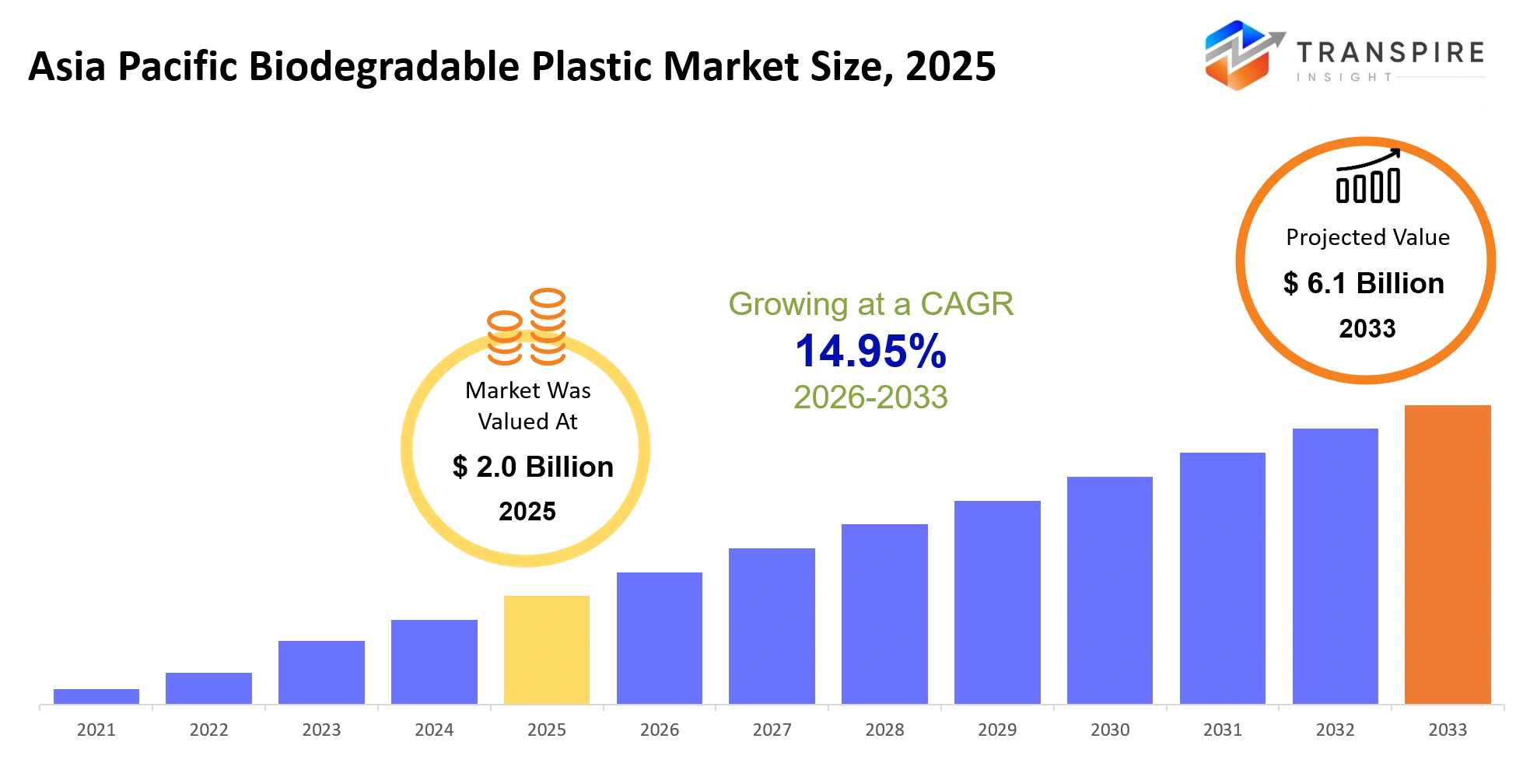
- Asia Pacific Biodegradable Plastic Market Size 2025: USD 2.0 Billion
- Asia Pacific Biodegradable Plastic Market Size 2033: USD 6.1 Billion
- Asia Pacific Biodegradable Plastic Market CAGR: 14.95%
- Asia Pacific Biodegradable Plastic Market Segments: By Product Type (PLA, PHA, Starch-based Plastics, PBS, PBAT, Others); By Application (Packaging, Agriculture Films, Consumer Goods, Textile Applications, Medical Applications, Others); By End User (Packaging Industry, Agriculture Sector, Consumer Goods Industry, Others).
To learn more about this report,  Download Free Sample Report
Asia Pacific Biodegradable Plastic Market Summary
The Asia Pacific Biodegradable Plastic Market was valued at USD 2.0 Billion in 2025. It is forecast to reach USD 6.1 Billion by 2033. That is a CAGR of 14.95% over the period.
The Asia Pacific biodegradable plastic market kinda tackles a real-world issue that manufacturers, retailers, food service operators and municipalities keep running into: trying to cut long-term plastic waste, but still keeping the performance, and overall utility of what people already use in conventional packaging and disposable products. Biodegradable plastics are showing up more and more in food packaging, agricultural films, shopping bags and everyday consumer goods, especially where what happens after disposal has turned into a major operational and regulatory worry.
In the last five years, the whole market has basically shifted in a more solid way, from smaller sustainability experiments, to something more compliance driven, and this change is not just cosmetic. Across China, India, Japan, South Korea, and even parts of Southeast Asia, authorities went ahead and put limits on single use plastics , so producers basically had to redo their packaging catalogs and start spending money on biodegradable substitutes or similar materials. It kind of gathered extra steam when waste management rules became stricter, and also when mandates aimed at plastic reduction were rolled out across major regional economies.
So, brand owners are now folding these biodegradable materials into regular, mainstream packaging plans, and they are setting up longer term procurement agreements and production investments. Overall, the growth in this space seems tied to a larger direction toward regulatory compliance, circular economy goals, and supply chain adjustments, which then turns sustainability expectations into tangible commercial demand and revenue opportunities.
Key Market Insights
- China’s leadership looks like it’s driven by nationwide clampdowns on single-use plastics, plus big investments into biodegradable polymer production capacity, you know.
- India meanwhile is showing the quickest regional momentum through 2030, backed by plastic waste regulations and a steady rise in demand for sustainable packaging , more or less.
- In Southeast Asia, multiple countries are turning into noticeable growth hubs as governments toughen waste management rules and set packaging sustainability goals.
- Polylactic Acid (PLA) is still the main material here, with an estimated 40%+ market share in 2025, mainly because it’s used so widely in packaging applications.
- Starch based biodegradable plastics are in second place, and they kind of get a boost from cost competitiveness with easy access to farming feedstock.
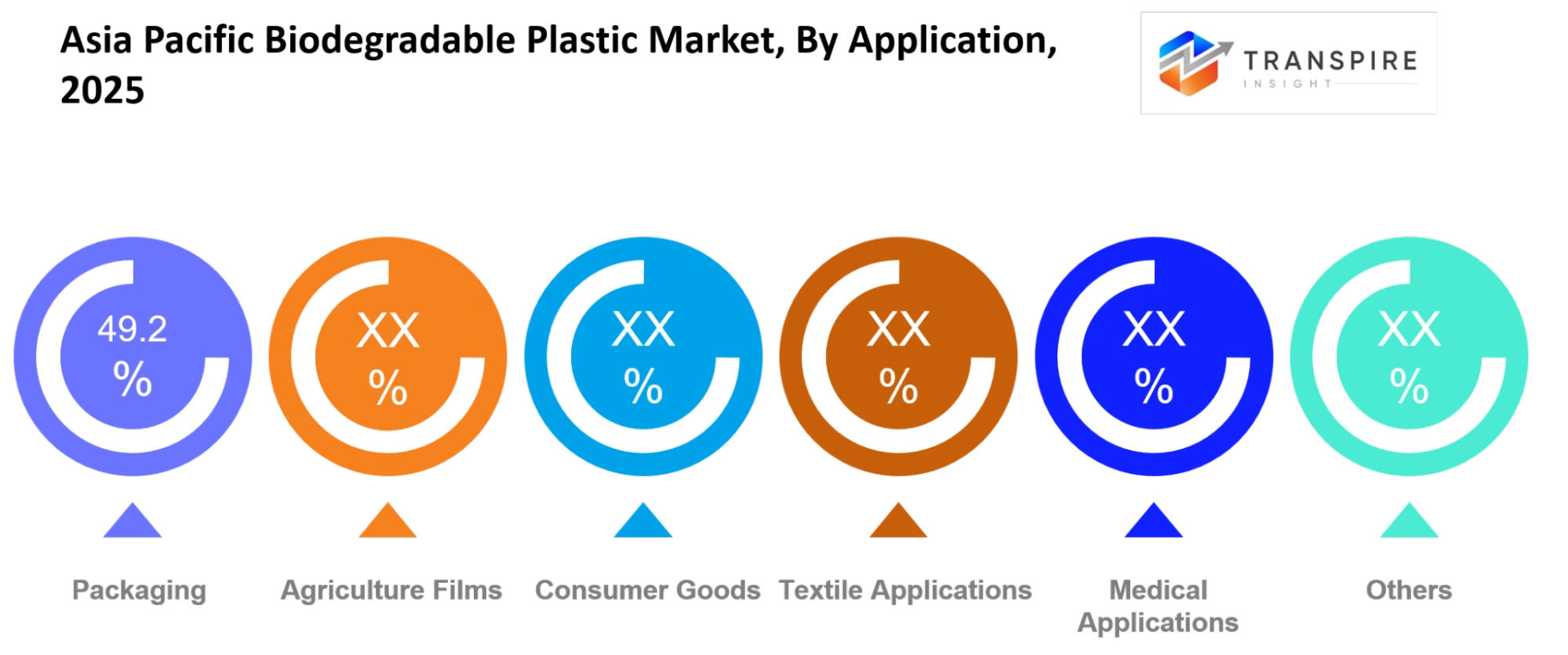
- And if you zoom out a bit, packaging is the category that clearly runs the show making up more than 55% of the Asia Pacific biodegradable plastic market revenue in 2025, or so.
- Food packaging stays the top use case because brands increasingly switch to compostable materials to satisfy regulatory requirements.
- Agriculture seems like the fastest-growing application segment, it’s being pushed forward by the wider use of biodegradable mulch films, also there are more crop protection related products involved.
- Then again, the food and beverage industry holds the largest market share, in fact it exceeds 40% of the overall biodegradable plastic consumption.
What are the Key Drivers, Restraints, and Opportunities in the Asia Pacific Biodegradable Plastic Market?
The strongest force speeding up the Asia Pacific biodegradable plastic market is basically the tightening of single-use plastic rules across big economies like China, India, South Korea, and Japan. Regulators have gone past “voluntary” sustainability promises, and now they’re rolling out bans, levies, and required packaging terms that really hit manufacturers and retailers right in the middle of operations. So consumer goods firms, food service operators, and e-commerce players are pushed to swap out regular plastics for biodegradable alternatives. And as compliance deadlines start getting closer, procurement agreements for biodegradable resins and kind of related packaging keep getting bigger, like more and more, which ends up giving resin producers and packaging manufacturers a more steady, predictable flow of income and also speeds up commercial-scale use faster than before.
Still , the biggest obstacle is the cost gap between biodegradable plastics and conventional petrochemical plastics. This isn’t just a minor delay, it’s kind of structural, because it comes from feedstock economics, plus not enough production capacity, and still an underdeveloped processing infrastructure. Even if manufacturing methods are getting better over time, biodegradable polymers often remain pricier when made at scale. That tends to slow adoption in price-sensitive segments, particularly in several emerging Asian economies where packaging decisions are mainly cost-led. In the end, this pricing disadvantage limits how far the market can spread, and it also drags out the revenue pickup for high-volume applications.
A big opening sits in growing advanced biopolymer production alongside composting ecosystems across Southeast Asia, like it’s kind of a two part move. In places such as Thailand and Indonesia, more investment is flowing toward bio based feedstocks taken from agricultural resources, including sugarcane and cassava. As the regional production capacity keeps increasing, and supply chains get more mature, manufacturers may lower costs, while also making material availability better, steadier. All of that together could let wider adoption happen in packaging , agriculture and consumer goods. In the end it supports the market’s next phase of scalable growth , without making it feel out of reach.
What Has the Impact of Artificial Intelligence Been on the Asia Pacific Biodegradable Plastic Market?
Artificial intelligence along with these advanced digital technologies are slowly but surely reshaping the Asia Pacific market for biodegradable plastic, and they do it in a few ways that kind of stack up. For example material development gets sped up, manufacturing efficiency improves , and supply chain management becomes more organized or at least more predictable. Polymer producers are leaning on AI driven modeling platforms to help them quickly design biodegradable resins that actually aim for specific traits such as strength , flexibility, and compostability. Rather than only depending on those long laboratory testing cycles, machine learning algorithms sift through material datasets and then surface the more promising formulations. That means faster development timelines, and also less spending on research, which is kind of the point.
On top of that manufacturers are using AI-enabled process control systems in biopolymer production facilities. These setups keep watching variables like temperature, pressure, and feedstock quality , and they then adjust production parameters automatically. The goal is clearer yield consistency and less material waste. Predictive maintenance models also help, they look at equipment performance data and flag possible failures before they show up. In practice this supports higher uptime and helps plants avoid those expensive production interruptions.
There are also advanced analytics platforms that help with demand forecasting and inventory optimization. Producers can line up output with packaging needs, agriculture requirements, and even consumer goods expectations. The result is better operational efficiency and fewer costs tied to excess inventory, across the wider value chain.
Still, there are limitations , because AI adoption isn’t just plug and play. One issue is the shortage of high quality material datasets, another one is the big investment needed to integrate digital technologies into older or existing manufacturing infrastructure. These problems can delay implementation, especially for small and mid-sized producers who are already operating in cost sensitive markets.
Key Market Trends
- Since 2020, China has tightened rules on single-use plastic, and in practice that kind of thing pushed manufacturers to move faster toward biodegradable material uptake across packaging and retail supply chains, like, yesterday already.
- From 2021 to 2025, major consumer brands went from small pilot tests into longer procurement deals for compostable packing materials, but they did it more decisively than before , honestly.
- Production investments have been drifting more and more to Southeast Asia, where Thailand and Indonesia expanded bio-based feedstock capacity, using sugarcane and cassava as the base, nothing fancy but it works.
- Biopolymer makers have shortened their development cycles by leaning on AI-assisted material design platforms, the ones that sort out likely formulations before too much lab work gets done.
- Since 2022, packaging converters have been putting more focus on compostability certifications, so regulatory compliance became a real buying requirement not just some marketing talking point.
- Companies such as NatureWorks LLC and TotalEnergies Corbion have been broadening regional partnerships, to lock in local supply chains and make availability of materials feel more reliable.
- Agricultural use cases gained momentum too, as farmers started swapping out conventional mulch films for biodegradable alternatives in order to cut down disposal expenses.
- Manufacturers have gradually redirected investment toward higher-performance PHA materials, because technology upgrades made scaling for real-world production and end-use flexibility more feasible.
- Regional governments have been increasingly linking waste reduction targets to packaging requirements, and that creates a kind of stronger incentive for retailers and for food service operators to comply, without much room to dodge it.
- Also competition shifted a bit away from product differentiation alone, towards integrated solutions that mix material innovation with local production ability and then support for end-of-life waste management.
Asia Pacific Biodegradable Plastic Market Segmentation
By Product Type:
Polylactic Acid (PLA) is basically a pretty common biodegradable plastic, made from renewable resources like corn starch and sugar-derived feedstocks. Its strong usage in food packaging, disposable items , and also flexible packaging setups keeps demand up, mostly because the processing characteristics are favorable, and it tends to be compostable too. Meanwhile Polyhydroxyalkanoates (PHA) are biodegradable polymers, grown through microbial fermentation , and they’re getting more attention for their high biodegradation performance across a range of environmental conditions.
Starch-based plastics rely on natural starch sources and they act as cost-effective replacements for packaging, plus certain agricultural uses. Polybutylene Succinate (PBS) gives durability, flexibility, and biodegradability, so PBS fits well in packaging films and even some consumer products. Polybutylene Adipate Terephthalate (PBAT) is known for flexibility and toughness , which helps it work in compostable bags and film products as well. The others category is where emerging biodegradable materials show up , usually created to boost overall performance, increase processing efficiency, and expand application versatility across different industries.
By Application:
Packaging ends up being a big application area because more and more people are switching to biodegradable materials for food containers, trays, bags, pouches, and those protective packaging solutions that feel kinda “safer” over time. A bunch of regulatory measures aimed at conventional plastic waste, have pushed packaging manufacturers to bring biodegradable alternatives into their product lineup. Then there’s agriculture films too, which count as a meaningful segment. They help support crop cultivation using mulch films and other agricultural products that can naturally degrade once they’ve been used.
On the consumer side you’ll see things like disposable cutlery, household products, personal care packaging, and everyday items made to lower long term waste generation. For textile uses, biodegradable fibers and fabrics show up in apparel as well as industrial textiles. In medical contexts, it’s about specialized items such as biodegradable medical packaging and certain healthcare materials. The “others” category is basically everything else, like different industrial or niche uses where biodegradable plastics bring both environmental and operational benefits, even if the exact use case varies a lot.
To learn more about this report, Download Free Sample Report
By End User:
The packaging industry kind of works as a major end-user segment since biodegradable plastics give an option, instead of conventional materials, for food, beverage, retail, and e-commerce packaging. Brand owners as well as packaging converters are now more and more embedding biodegradable solutions because they have to satisfy regulatory requirements and also their sustainability goals. Ongoing product development along with material innovation, is what really helps push wider adoption across different packaging formats.
In agriculture, biodegradable plastics are used for mulch films, plant protection products, and cultivation applications. This is meant to help cut down plastic residue on farmland. In the consumer goods space, companies apply biodegradable materials in everyday products, disposable items, and personal care packaging. The “other” category basically bundles healthcare, textile, industrial, and specialty activities, where biodegradable plastics assist with waste reduction objectives while still keeping the needed product functionality and performance standards intact.
What are the Key Use Cases Driving the Asia Pacific Biodegradable Plastic Market?
The biggest share of biodegradable plastic consumption is sort of coming from food and consumer packaging. Food makers, retailers, and e-commerce firms are increasingly rolling out biodegradable films, bags, trays , and containers, so they can comply with single-use plastic rules across China, India, Japan, and yeah other Asia Pacific countries. When packaging volumes stay high, that creates stable demand and, basically, it helps large-scale take up of these materials.
Agriculture looks like a fast-rising use case too. Farmers are choosing biodegradable mulch films that will break down after they’re used, and this can reduce the hassles of collecting , plus disposal costs. Also, consumer goods manufacturers are weaving biodegradable materials into throwaway tableware, shopping bags ,and personal care packaging, mainly to satisfy regulatory requirements and corporate sustainability pledges.
Then, there are the emerging uses, like biodegradable textiles and a few specialized medical products. Textile producers are trying out biodegradable fibers to address end-of-life waste worries, while healthcare players are evaluating biodegradable options for niche packaging and disposable goods. If the material innovation keeps moving forward, and the performance traits keep improving, that should make uptake broader across the forecast timeline.
|
Report Metrics |
Details |
|
Market size value in 2025 |
USD 2.0 Billion |
|
Market size value in 2026 |
USD 2.3 Billion |
|
Revenue forecast in 2033 |
USD 6.1 Billion |
|
Growth rate |
CAGR of 14.95% from 2026 to 2033 |
|
Base year |
2025 |
|
Historical data |
2021 - 2024 |
|
Forecast period |
2026 - 2033 |
|
Report coverage |
Revenue forecast, competitive landscape, growth factors, and trends |
|
Regional scope |
Asia Pacific (India, China, Japan, Australia,South Korea, Rest of Asia Pacific) |
|
Key company profiled |
NatureWorks, BASF, TotalEnergies Corbion, Novamont, Mitsubishi Chemical, Danimer Scientific, Biome Bioplastics, Toray Industries, FKuR Kunststoff, Plantic Technologies, Green Dot Bioplastics, Yield10 Bioscience, Kaneka, Eastman Chemical, Sulzer. |
|
Customization scope |
Free report customization (country, regional & segment scope). Avail customized purchase options to meet your exact research needs. |
|
Report Segmentation |
By Product Type (PLA, PHA, Starch-based Plastics, PBS, PBAT, Others); By Application (Packaging, Agriculture Films, Consumer Goods, Textile Applications, Medical Applications, Others); By End User (Packaging Industry, Agriculture Sector, Consumer Goods Industry, Others). |
Which Regions are Driving the Asia Pacific Biodegradable Plastic Market Growth?
East Asia sort of shows up as the leading region across the Asia Pacific biodegradable plastic market, with China taking up the biggest slice of both regional consumption and production. Strong government pressure , especially against single-use plastics, has pushed manufacturers , retailers, and food service companies to switch over to biodegradable alternatives in a more mass way. On top of that, the area has solid polymer production capacity , plus research work that is pretty advanced, and supply lines that are already well established. So, you get this mix of policy backing and industrial setup that keeps re-strengthening East Asia’s place at the front.
Japan and South Korea meanwhile make up the second-largest regional market, even if the growth story doesn’t quite track the China pattern. Instead of leaning mainly on regulatory orders, these places often ride on steady industrial demand , ongoing investment in advanced materials, and broader long-running corporate sustainability programs. Big consumer goods players, packaging businesses, and electronics companies have gradually worked biodegradable content into their product design and packaging plans. The whole slow , steady , somewhat predictable adoption rhythm makes the region a dependable source for market revenue.
Southeast Asia is kind of showing up as the fastest-growing region, mostly because manufacturing investment is expanding and new restrictions are coming in on conventional plastic waste. Countries like Thailand, Indonesia, they have also ramped up support for bio-based industries, using locally available agricultural feedstocks such as sugarcane and cassava. With new production facilities, and with waste management policies getting better, the business case for biodegradable materials has gotten stronger , not just on paper but in practice. From 2026 into 2033 this momentum should create pretty attractive opportunities for manufacturers, technology providers, and investors who are looking for access to end-use markets that are developing quickly, and in a more sustained way.
Who are the Key Players in the Asia Pacific Biodegradable Plastic Market and How Do They Compete?
Competition in the Asia Pacific biodegradable plastic market is still a bit moderately fragmented, where global biopolymer producers end up competing beside regional manufacturers and a bunch of newer specialty material players. What really decides the outcomes, like technology know-how, production scale, access to feedstock, and cost efficiency, seems to matter more than plain pricing tactics. Older producers keep pushing capacity higher and tightening supply chains, basically to hold onto their market share. Meanwhile newer entrants tend to aim at niche biodegradable materials, plus region-specific uses, kind of like they are carving out smaller corners. Also as regulations keep getting stricter, the companies that manage to blend performance, certification readiness, and dependable supply are the ones taking a firmer stance.
NatureWorks LLC competes with large-scale PLA production, and there is also this strong emphasis on renewable feedstocks, so the company can support packaging converters needing stable material quality and supply security. They keep expanding regional partnerships, and the distribution reaches across Asia, which should make customer access easier and delivery timelines shorter. TotalEnergies Corbion, on the other hand, leans into higher-performance PLA grades made for food packaging , consumer goods, and specialty uses. Their ongoing investments in production capacity, plus teamwork with packaging manufacturers, help reinforce their market penetration across the region.
BASF SE is pretty much all in on tech innovation, with biodegradable polymer formulations that come across as flexible and durable, for compostable packaging use. By doing it this way, BASF can deal with those performance expectations that regular, biodegradable materials sometimes can’t quite meet.
Novamont S.p.A. puts the spotlight on compostable material solutions, and they lean on a wide know-how base for developing biodegradable products. Meanwhile Mitsubishi Chemical Group, sort of builds on advanced materials research and also strong ties with Asian manufacturers. Both are growing, through strategic collaborations, product innovation initiatives, and more hands-on engagement with packaging, agriculture, and consumer goods sectors. In those areas, regulatory compliance is starting to shape purchasing choices more and more, so yeah that matters a lot.
Company List
- NatureWorks
- BASF
- TotalEnergies Corbion
- Novamont
- Mitsubishi Chemical
- Danimer Scientific
- Biome Bioplastics
- Toray Industries
- FKuR Kunststoff
- Plantic Technologies
- Green Dot Bioplastics
- Yield10 Bioscience
- Kaneka
- Eastman Chemical
- Sulzer
Recent Development News
In May 2026, CJ Biomaterials launched PHACT™ CB0504A, a new all-PHA extrusion coating resin for paper food-service packaging and secured TÜV Austria OK compost Home, OK compost Industrial, and OK biodegradable MARINE certifications. The launch strengthens the commercialization of certified biodegradable PHA materials in Asia-Pacific and supports the replacement of conventional plastic coatings in food-service applications.
Source: https://www.globenewswire.com/
In January 2026, SmartSolve commercially launched PureNil™ 0, described as the world's first plastic-free, 100% bio-based, flushable flexible-packaging substrate. Following successful validation and production readiness, the product entered ramp production, providing consumer-goods companies with a scalable alternative to conventional single-use plastic packaging.
SOurce: https://smartsolve.com/
What Strategic Insights Define the Future of the Asia Pacific Biodegradable Plastic Market?
Over the next five to seven years, the Asia Pacific biodegradable plastic market is likely going to shift from something that’s mostly compliance driven, to a more scale driven materials arena. The main push behind this change is probably the growth of regional production capacity, paired with stricter waste management frameworks that now, and more often, prefer biodegradable options for high volume use cases. As manufacturing gets better, and supply chains start to look more localized, cost competitiveness will matter just as much as environmental performance, when it comes to who really wins in the market.
There’s also a less visible kind of risk, and it sits in feedstock concentration, along with raw material volatility. A lot of biodegradable plastics depend on agricultural inputs like corn, sugarcane, and cassava. If weather patterns get disrupted, or if competing food demand rises, or if agricultural policy shifts around, you can get supply constraints. That then hits production costs and profitability, even if end market demand is still strong.
Meanwhile, one interesting opportunity is the next generation push for PHA materials plus better composting infrastructure across Southeast Asia. Companies and investors might want to focus on partnerships that connect materials production with end of life waste processing. If you build these integrated value chains early, today , it should improve competitive positioning later, especially as regulations increasingly watch both material composition and disposal outcomes.
Asia Pacific Biodegradable Plastic Market Report Segmentation
By Product Type
- PLA
- PHA
- Starch-based Plastics
- PBS
- PBAT
By Application
- Packaging
- Agriculture Films
- Consumer Goods
- Textile Applications
- Medical Applications
By End User
- Packaging Industry
- Agriculture Sector
- Consumer Goods Industry
Frequently Asked Questions
Find quick answers to common questions.
The expected Asia Pacific Biodegradable Plastic Market size is USD 6.1 Billion in 2033.
Key segments for the Asia Pacific Biodegradable Plastic Market are By Product Type (PLA, PHA, Starch-based Plastics, PBS, PBAT, Others); By Application (Packaging, Agriculture Films, Consumer Goods, Textile Applications, Medical Applications, Others); By End User (Packaging Industry, Agriculture Sector, Consumer Goods Industry, Others).
Major Asia Pacific Biodegradable Plastic Market players are NatureWorks, BASF, TotalEnergies Corbion, Novamont, Mitsubishi Chemical, Danimer Scientific, Biome Bioplastics, Toray Industries, FKuR Kunststoff, Plantic Technologies, Green Dot Bioplastics, Yield10 Bioscience, Kaneka, Eastman Chemical, Sulzer.
The Asia Pacific Biodegradable Plastic Market size is USD 2.0 Billion in 2025.
The Asia Pacific Biodegradable Plastic Market CAGR is 14.95% from 2026 to 2033.
- NatureWorks
- BASF
- TotalEnergies Corbion
- Novamont
- Mitsubishi Chemical
- Danimer Scientific
- Biome Bioplastics
- Toray Industries
- FKuR Kunststoff
- Plantic Technologies
- Green Dot Bioplastics
- Yield10 Bioscience
- Kaneka
- Eastman Chemical
- Sulzer
About the Authors

Pankaj Ghogare Patil
I am Pankaj Ghogare Patil, a Senior Research Analyst at Transpire Insight, specializing in the Pharmaceutical, Chemicals & Materials, Healthcare IT, and Biotechnology industry. My expertise lies in conducting comprehensive market research, analyzing industry trends, evaluating competitive landscapes, and translating complex data into actionable insights. At Transpire Insight, I closely follow emerging technologies, regulatory developments, and market innovations to create accurate, well-researched, and informative content that helps businesses and professionals make informed decisions. I am committed to producing credible, evidence-based articles that reflect industry best practices while making technical topics accessible and valuable for a broad audience.

Chakradhar Khansole
Chakradhar serves as the Research Director at Transpire Insight, bringing over 8 years of experience in technology, innovation, and strategic market intelligence. He specializes in transforming complex market data into actionable business insights that enable organizations to make informed, growth-oriented decisions. Recognized for his strategic vision and analytical expertise, Chakradhar leads high-impact research initiatives, delivering comprehensive market assessments, competitive intelligence, and forward-looking industry analysis.
Recently Published Reports
-
May 2026
Healthcare Polymer Packaging Market
Healthcare Polymer Packaging Market Size, Share & Analysis Report By Packaging Type (Syringes, IV Bottles and Pouches, Clamshells, Blisters, Bottles & Jars, Containers, Tubes, IV Parental Packaging, Others), By Type (Regulated, Non-regulated), By Polymer Type (LDPE (Low-Density Polyethylene), HDPE (High-Density Polyethylene), Homo-polymer (Homo), Random Copolymer (Random), Block Copolymer (Block), PET, Polystyrene, Polyvinyl Chloride, Polyamide/EVOH, Others), and Geography (North America, Europe, Asia-Pacific, Middle East and Africa, South and Central America), 2021 - 2031
-
Apr 2026
Hydrophilic Tape (Waterstop) Market
Hydrophilic Tape (Waterstop) Market Size, Share & Analysis Report By Type (Bentonite-Based Hydrophilic Tape, Rubber-Based Hydrophilic Tape), By Application (Residential Buildings, Commercial Buildings, Infrastructure Projects), and Geography (North America, Europe, Asia-Pacific, Middle East and Africa, South and Central America), 2021 - 2031
-
Apr 2026
Metalens Market
Metalens Market Size, Share & Analysis Report By Type (Visible Light Metalens, and Infrared Metalens), By Application (Consumer Electronics, Automotive Electronics, Industrial, Medical, and Others), and Geography (North America, Europe, Asia-Pacific, Middle East and Africa, South and Central America), 2021 - 2031
-
Apr 2026
PBT Resin Market
PBT Resin Market Size, Share & Analysis Report By Type (Reinforced PBT Resin, Unreinforced PBT Resin), By Processing Method (Injection Molding, Extrusion, Blow Molding, Others), By End-User (Automotive, Electrical & Electronics, Consumer Appliances, Industrial Machinery, Medical Devices, Packaging, Others), and Geography (North America, Europe, Asia-Pacific, Middle East and Africa, South and Central America), 2021 - 2031