
United States Organic Fast Moving Consumer Goods Market Size & Forecast:
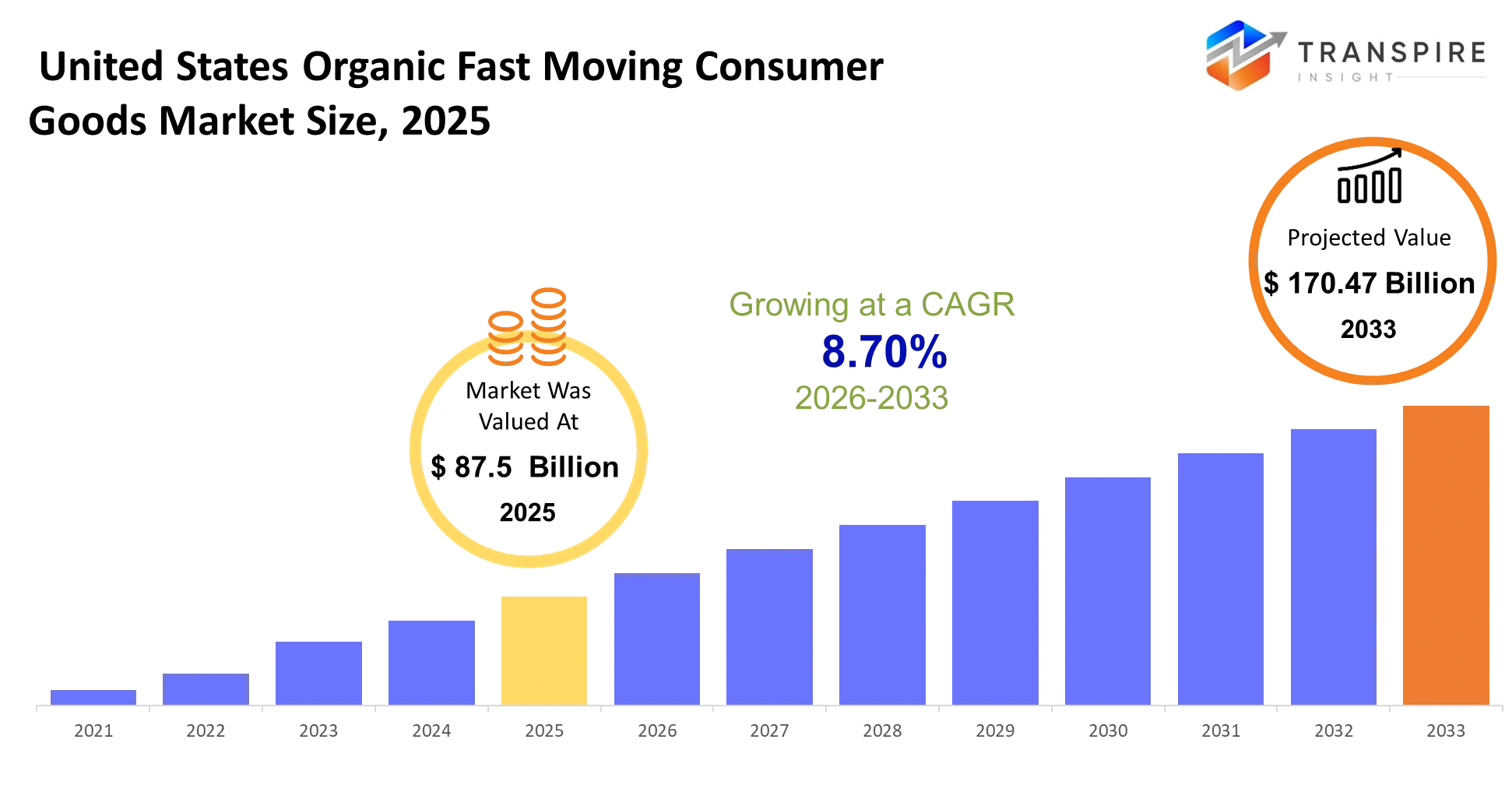
- United States Organic Fast Moving Consumer Goods Market Size 2025: USD 87.5 Billion
- United States Organic Fast Moving Consumer Goods Market Size 2033: USD 170.47 Billion
- United States Organic Fast Moving Consumer Goods Market CAGR: 8.70%
- United States Organic Fast Moving Consumer Goods Market Segments:By Product (Food, Beverages, Personal Care, Household), By Distribution (Supermarkets, Online, Specialty Stores, Direct), By Certification (USDA Organic, Non-GMO, Natural, Eco-label), By End-User (Consumers, Retailers, Food Companies, Households), By Packaging (Sustainable, Recyclable, Bulk, Premium).
To learn more about this report,  Download Free Sample Report
United States Organic Fast Moving Consumer Goods Market Summary:
The United States Organic Fast Moving Consumer Goods Market size is estimated at USD 87.5 Billion in 2025 and is anticipated to reach USD 170.47 Billion by 2033, growing at a CAGR of 8.70% from 2026 to 2033. The United States Organic Fast Moving Consumer Goods market continues to expand because more people become health conscious and adopt environmentally friendly sustainable practices. Consumers now prefer organic food and beverages and personal care items because they believe these products are safer and protect the environment better. Retailers increase their organic product offerings because brands work to make their products more transparent and use environmentally friendly packaging. Young people who live in cities show strong demand for products that help them make healthier choices throughout their day even when prices are slightly above normal.
Key Market Trends & Insights:
- Consumers today choose their products after they confirm which items contain no hazardous chemical substances and no pesticide residues and no synthetic chemical ingredients. The new purchasing trend has become a powerful force that affects all consumer buying decisions for food items and drinks and personal care products.
- Consumers today prefer to buy products which have simple ingredient lists that provide direct information about their contents. Customers build stronger trust and loyalty toward brands which establish their sourcing and production methods through precise communication.
- Retailers and brands expand their organic product range because consumer tastes keep changing. Consumers can now find organic products everywhere from snack foods to basic home products which they need.
- People prefer packaging designs which allow for recycling and biodegradation and require only minimal material use. Consumers prefer to buy organic products from brands which demonstrate their commitment to sustainable business practices.
- Many customers choose to spend additional money on organic products because they believe these items deliver better quality and safer results. The customer base has started to purchase decisions based on their assessment of product value.
- Retailers are introducing their own organic private-label products at competitive prices. This development enables more people to buy organic products which now cost less than before.
United States Organic Fast Moving Consumer Goods Market Segmentation
By Type
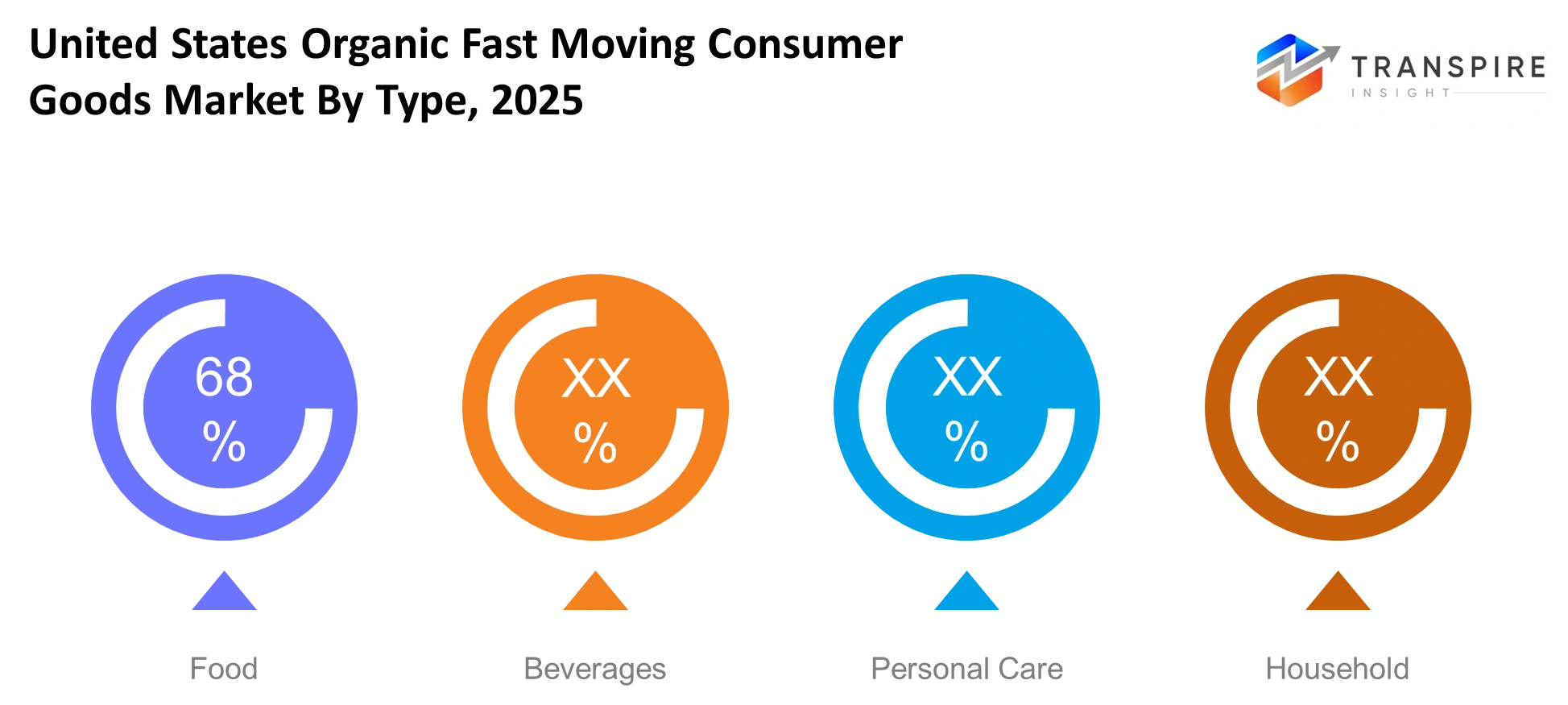
- Food: The market exists because organic food products serve as its foundation which grows because consumers seek chemical-free and pure nutritional options. Customers select organic fruits and vegetables and dairy products and packaged foods according to their requirements for healthier eating patterns. The segment experiences growth because people learn about long-term health advantages which provide better health advantages.
- Beverages: Health-focused customers choose organic beverages which include juices and teas and plant-based drinks. Consumers are turning away from sweetened drinks that contain artificial taste to embrace natural drink options. The segment gains advantages through new flavor and ingredient developments which create organic drinks that offer both refreshing taste and functional benefits.
- Personal Care: Consumers who want soft products without synthetic components now prefer organic personal care items. The market shows high demand for products that include skincare items and hair care products and personal hygiene essentials. Natural products which improve health during their use are becoming more attractive to consumers who want to minimise their contact with synthetic substances.
- Household: Consumers now prefer organic household products, which include cleaners and detergents, because they want to create safer spaces within their homes. The products enable users to avoid dangerous substances while they practise environmentally friendly living. The public now understands indoor health and environmental sustainability better, which drives them to select organic products for their residential spaces.
To learn more about this report, Download Free Sample Report
By Distribution
- Supermarkets: Supermarkets function as the leading distribution method because they offer customers both extensive product choices and easy accessibility. The major retail chains are now expanding their organic product offerings because of growing customer demand for these products. The combination of in-store promotions together with improved product visibility enables customers to discover and start using organic fast-moving consumer goods.
- Online: Online platforms are rapidly transforming the way consumers purchase organic goods. The platforms provide customers with two major benefits, which include product details and access to multiple brands. The rising atmosphere of digital technology has established e-commerce as the primary market growth factor which proves especially effective with young consumers who possess advanced technical skills.
- Specialty Stores: Specialty stores that sell organic and natural products present customers with specific product collections together with customized shopping experiences. These stores attract consumers who want to purchase products that offer both high quality and dependable sourcing. The organic fast-moving consumer goods market develops customer loyalty through its skilled staff members and specialized product range.
- Direct: The direct-to-consumer market segment now includes brand websites together with subscription-based systems which are becoming popular among customers. The system enables brands to create stronger ties with their customers through personalized service delivery. The method guarantees product authenticity and transparent information display because these elements modern organic product customers consider essential.
By Certification
- The USDA Organic certification delivers the most trustworthy organic market certification because it demands complete adherence to all organic farming and processing standards. The certification enables consumers to verify product authenticity and quality, which drives their buying choices for all organic fast-moving consumer goods products.
- The Non-GMO certification attracts consumers who want to avoid products that contain genetically modified elements. The certification guarantees customers that the products contain no genetic engineering treatment. The food and beverage industry depends on this label because customers need to know the product's contents and how its components affect their perception of the brand.
- Natural: Products labelled as 'natural' are perceived as safer and closer to their original form. The label attracts a large audience because its regulations function as less strict matching organic certification requirements. Consumers believe that natural products enable them to choose healthier options which contain reduced synthetic substances for their everyday consumption.
- Eco-label: Eco-label certifications display the total environmental effects of a product through its sustainable resource acquisition and environmentally friendly manufacturing methods. Environmentally aware customers connect with these labels because they want to achieve both sustainability and health-related goals. The growth of eco-label awareness has made these labels into essential elements that shape customer preferences for brands and their loyalty to those brands.
By End-User
- Consumers: The organic FMCG market depends on individual consumers who make up its main customer base. Their rising health awareness combined with their dedication to wellness and sustainable practices creates new buying habits. Buyers who make everyday purchases will pay extra for organic products that match their personal beliefs and their future health objectives.
- Retailers: Retailers execute two vital functions through their activities because they create additional product display areas while they market organic items. Retailers establish private-label organic product lines to satisfy their customers' organic product demands. Retailers use their business methods to control product distribution and product pricing, which determines the market expansion of organic FMCG products.
- Food Companies: Food companies use organic ingredients to create products that satisfy current consumer demands. Some companies develop new organic products while others update their current offerings through product reformulation. The product industry is moving toward transparent product information, which includes clean labelling and healthier products, because of this development.
- Households: Organic FMCG products have become a regular part of household routines because of their rising popularity. Families begin to choose safer products which use sustainable materials for their food and cleaning product needs. The increasing acceptance of this practice turns into a lifestyle change which helps people consume more sustainably while they improve their living standards.
By Packaging
- Sustainable: The need for sustainable packaging solutions has increased because consumers now prefer environmentally friendly packaging options. The brands work to decrease their waste production while they utilise materials which have renewable properties. The packaging trends show that businesses now make packaging choices which help their green sustainability efforts because their packaging selections directly impact customer buying patterns.
- Recyclable: Eco-conscious consumers who aim to reduce their carbon footprint are drawn to recyclable packaging materials. Businesses today choose materials which their operations can handle for reuse purposes. The public will choose to recycle products with recyclable packaging through effective labelling systems and educational programmes which create product awareness.
- Bulk: The market demand for bulk packaging has increased because budget-minded consumers and environmentally friendly shoppers prefer this option. The solution decreases packaging waste while delivering cost-effective results. This option works best for families who buy organic products in large quantities and for regular users who need more product supply.
- Premium:The combination of premium packaging and product presentation creates a strong brand image. The product features sophisticated designs together with premium materials which attract customers with high standards. Businesses in the organic FMCG sector use premium packaging to establish consumer trust while presenting their exclusive products and brand identity to their specific target markets.
Country Insights
The United States Organic Fast Moving Consumer Goods (FMCG) market shows a mature market that experiences fast changes because of new consumer behavior patterns and emerging consumer value systems. The entire nation experiences a powerful transformation that leads people to adopt consumption practices which prioritize health and environmental sustainability and cleaner products. Demand in urban areas such as New York City and Los Angeles exceeds suburban and rural areas because residents there have better product knowledge and higher spending capacity.
The United States possesses an advanced retail system which enables consumers to access organic products through supermarkets and specialty stores and online shopping platforms. The regulatory framework provides strong backing through certifications such as USDA Organic which helps establish consumer confidence in products and maintains their genuine nature.
The market receives benefits from ongoing innovation that domestic companies and new businesses bring through their efforts to create transparent products and sustainable packaging solutions and ethical product acquisition methods. The United States stands as the main international center for organic FMCG expansion because of consumer awareness and the development of retail systems in the country.
Recent Development News
In March 2026, organic sales reached a new high in 2025: U.S. organic product sales saw strong growth momentum, reflecting rising consumer demand for healthier and sustainable goods. The category continues to outperform conventional FMCG segments.
In February 2026, organic brand Once Upon a Farm raises $198M in IPO: A U.S.-based organic food company successfully raised nearly $198 million, signalling renewed investor confidence in organic FMCG startups and health-focused brands.
|
Report Metrics |
Details |
|
Market size value in 2025 |
USD 87.5 Billion |
|
Market size value in 2026 |
USD 95.1 Billion |
|
Revenue forecast in 2033 |
USD 170.47 Billion |
|
Growth rate |
CAGR of 8.70% from 2026 to 2033 |
|
Base year |
2025 |
|
Historical data |
2021 – 2024 |
|
Forecast period |
2026 – 2033 |
|
Report coverage |
Revenue forecast, competitive landscape, growth factors, and trends |
|
Country scope |
United States |
|
Key company profiled |
Unilever, Procter & Gamble, Nestle, PepsiCo, Coca-Cola, Danone, General Mills, Kellogg, Hain Celestial, Clorox, Whole Foods, Sprouts Farmers Market, Nature’s Path, Amy’s Kitchen, Organic Valley |
|
Customization scope |
Free report customization (country, regional & segment scope). Avail customized purchase options to meet your exact research needs. |
|
Report Segmentation |
By Product (Food, Beverages, Personal Care, Household), By Distribution (Supermarkets, Online, Specialty Stores, Direct), By Certification (USDA Organic, Non-GMO, Natural, Eco-label), By End-User (Consumers, Retailers, Food Companies, Households), By Packaging (Sustainable, Recyclable, Bulk, Premium). |
Key United States Organic Fast Moving Consumer Goods Company Insights
The United States Organic Fast Moving Consumer Goods market operates as a competitive field which includes both existing companies and new market entrants who drive its development. Companies that lead the market today concentrate their efforts on developing new products and creating clean-label products and obtaining sustainable materials. Companies develop eco-friendly packaging and open supply chain systems to establish customer trust according to their objectives. The market currently provides small specialized enterprises with success opportunities through their delivery of distinctive products which follow ethical manufacturing standards. The current market trends prompt businesses to enhance their operations because customers now prefer sustainable products.
Company List
- Unilever
- Procter & Gamble
- Nestlé
- PepsiCo
- Coca-Cola
- Danone
- General Mills
- Kellogg
- Hain Celestial
- Clorox
- Whole Foods
- Sprouts Farmers Market
- Nature’s Path
- Amy’s Kitchen
- Organic Valley
United States Organic Fast Moving Consumer Goods Market Report Segmentation
By Product
- Food
- Beverages
- Personal Care
- Household
By Distribution
- Supermarkets
- Online
- Specialty Stores
- Direct
By Certification
- USDA Organic
- Non-GMO
- Natural
- Eco-label
By End-User
- Consumers
- Retailers
- Food Companies
- Households
By Packaging
- Sustainable
- Recyclable
- Bulk
- Premium
Frequently Asked Questions
Find quick answers to common questions.
The approximate United States Organic Fast Moving Consumer Goods Market size for the market will be USD 170.47 Billion in 2033.
The key segments of the United States Organic Fast Moving Consumer Goods Market are By Product (Food, Beverages, Personal Care, Household), By Distribution (Supermarkets, Online, Specialty Stores, Direct), By Certification (USDA Organic, Non-GMO, Natural, Eco-label), By End-User (Consumers, Retailers, Food Companies, Households), By Packaging (Sustainable, Recyclable, Bulk, Premium).
Major players in the United States Organic Fast Moving Consumer Goods Market are Unilever, Procter & Gamble, Nestle, PepsiCo, Coca-Cola, Danone, General Mills, Kellogg, Hain Celestial, Clorox, Whole Foods, Sprouts Farmers Market, Nature’s Path, Amy’s Kitchen, Organic Valley.
The current market size of the United States Organic Fast Moving Consumer Goods Market is USD 87.5 Billion in 2025.
The United States Organic Fast Moving Consumer Goods Market CAGR is 8.70%.
- Unilever
- Procter & Gamble
- Nestlé
- PepsiCo
- Coca-Cola
- Danone
- General Mills
- Kellogg
- Hain Celestial
- Clorox
- Whole Foods
- Sprouts Farmers Market
- Nature’s Path
- Amy’s Kitchen
- Organic Valley
Recently Published Reports
-
Apr 2026
Bottled Water Market
Bottled Water Market Size, Share & Analysis Report By Product Type (Still Bottled Water, Carbonated Bottled Water, Functional Bottled Water, and Others), By Packaging (PET, Cans, and Others), By Sales Channel (Supermarkets/Hypermarkets, Convenience Stores/Drug Stores, Grocery Stores/Club Stores, Foodservice, and Others) and Geography (North America, Europe, Asia-Pacific, Middle East and Africa, South and Central America), 2021 - 2032
-
Apr 2026
Color Cosmetic Packaging Market
Color Cosmetic Packaging Market Size, Share & Analysis Report By Application (Mascara Packaging, Liquid Packaging, and Liquid Face), By Type (Tubes & Bottles, Pens & Markers, Compacts & Containers, and Droppers & Pumps), and Geography (North America, Europe, Asia-Pacific, Middle East and Africa, South and Central America), 2021 - 2031
-
Apr 2026
External Microphone For Camera Market
External Microphone For Camera Market Size, Share & Analysis Report By Type (Shotgun Microphone, Lavalier Microphone, and Others), By Application (Digital Camera, Professional Video Camera, and Others), and Geography (North America, Europe, Asia-Pacific, Middle East and Africa, South and Central America), 2021 - 2031
-
Apr 2026
Foot Orthotic Insoles Market
Foot Orthotic Insoles Market Size, Share & Analysis Report By Type (Pre-fabricated, and Custom-made), By Material (Thermoplastic, Composite Carbon Fiber, and Others), By Distribution Channel (Drug Stores, Hospitals & Clinics, and Others), and Geography (North America, Europe, Asia-Pacific, Middle East and Africa, South and Central America), 2021 - 2031