
United States Non-Alcoholic Beverages Market Size & Forecast:
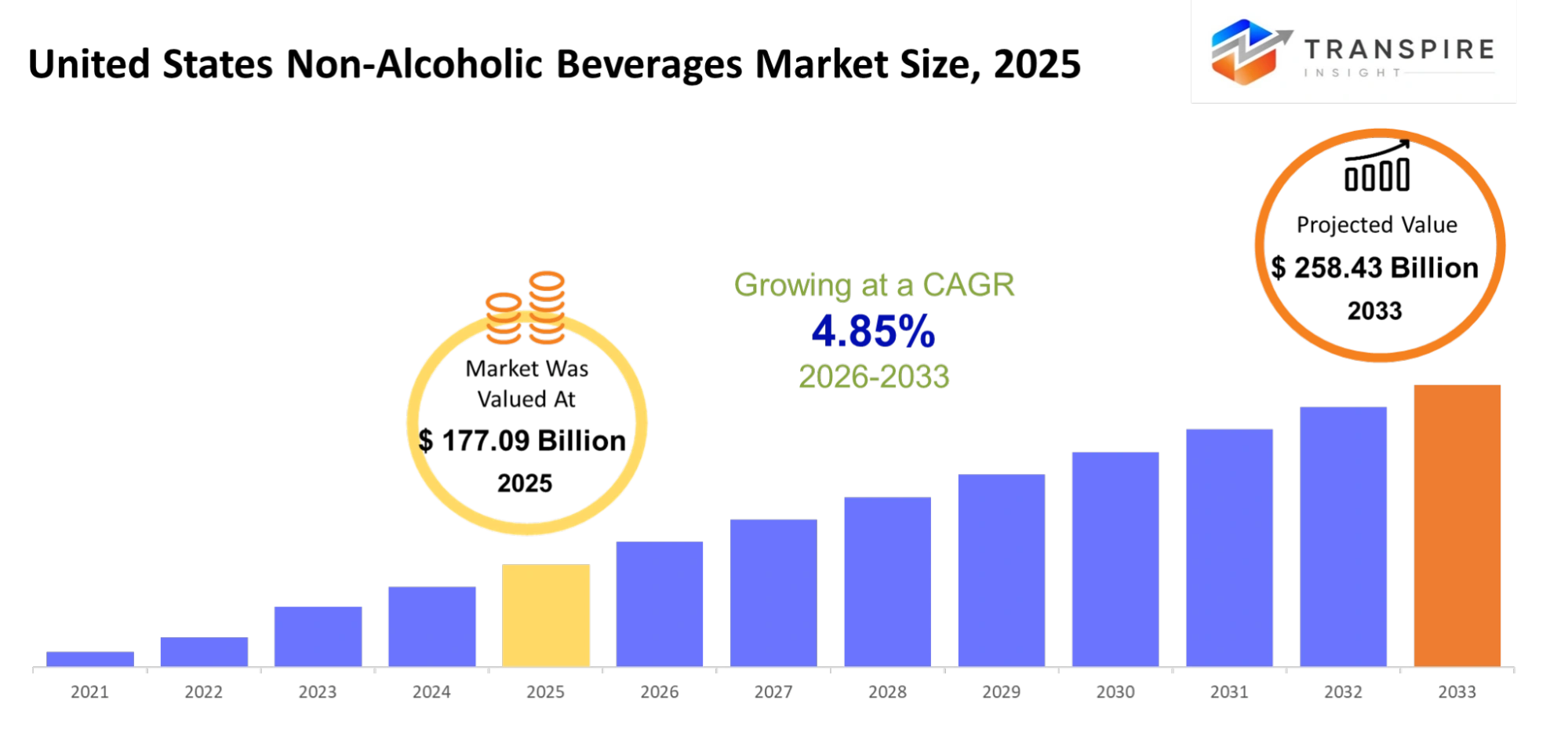
- United States Non-Alcoholic Beverages Market Size 2025: USD 177.09 Billion
- United States Non-Alcoholic Beverages Market Size 2033: USD 258.43 Billion
- United States Non-Alcoholic Beverages Market CAGR: 4.85%
- United States Non-Alcoholic Beverages Market Segments:By Product Type (Carbonated Soft Drinks, Bottled Water, Juice & Juice Drinks, Energy Drinks, Ready-to-Drink Tea & Coffee), By Distribution Channel (Supermarkets & Hypermarkets, Convenience Stores, Online Retail).
To learn more about this report,  Download Free Sample Report
United States Non-Alcoholic Beverages Market Summary:
The United States Non-Alcoholic Beverages Market size is estimated at USD 177.09 Billion in 2025 and is anticipated to reach USD 258.43 Billion by 2033, growing at a CAGR of 4.85% from 2026 to 2033. The United States' non-alcoholic beverage market is experiencing ongoing expansion because consumers are becoming more health-conscious and requesting functional drinks. Consumers are increasingly choosing beverages that contain low sugar and organic components and plant-based ingredients, which include energy drinks and flavoured water and herbal teas. The market trends are being influenced by new developments in flavours and packaging and user-friendly product designs which are making it easier for people to purchase products through online shopping platforms. The market will experience substantial growth because Americans are developing healthier drinking habits and selecting from a wider range of beverage options.
Key Market Trends & Insights:
- Consumers now prefer beverages that contain low sugar and organic ingredients and provide health benefits. The market for drinks which support immunity and gut health and provide energy has reached substantial growth.
- Plant-based beverages which include almond milk and oat milk and herbal infusions have reached mainstream popularity. Health-conscious consumers prefer products which use natural flavours and clean-label ingredients.
- Businesses are testing new taste profiles which include sparkling beverages and ready-to-drink products. Customers choose to buy products which offer both convenience and appealing flavours.
- The growth of online grocery shopping together with beverage subscription services has changed how products get distributed. Customers show a strong preference for receiving packages at their homes, especially when it comes to high-quality and unique beverages.
- Eco-conscious consumers now choose packaging materials which they can recycle or reuse or which will break down naturally. Brands which commit to sustainability practices succeed in building stronger customer loyalty.
- The market for beverages which contain added vitamins and minerals and adaptogens and probiotics is increasing. Consumers seek beverages which offer both refreshing taste and health advantages.
- Millennials and Gen Z drive the market demand for beverages which have become popular on Instagram and match their lifestyle preferences. Consumers base their purchasing decisions on social media advertising and creative company branding.
United States Non-Alcoholic Beverages Market Segmentation
By Product Type
- Carbonated Soft Drinks: The United States maintains carbonated soft drinks as a fundamental beverage choice which attracts customers through their bubbly flavour and established brand connections. The manufacturers now create low-sugar and zero-calorie products because consumers have changed their health preferences. The product category maintains its ability to attract customers through its innovative taste combinations and special seasonal releases which contradict current trends of healthy eating.
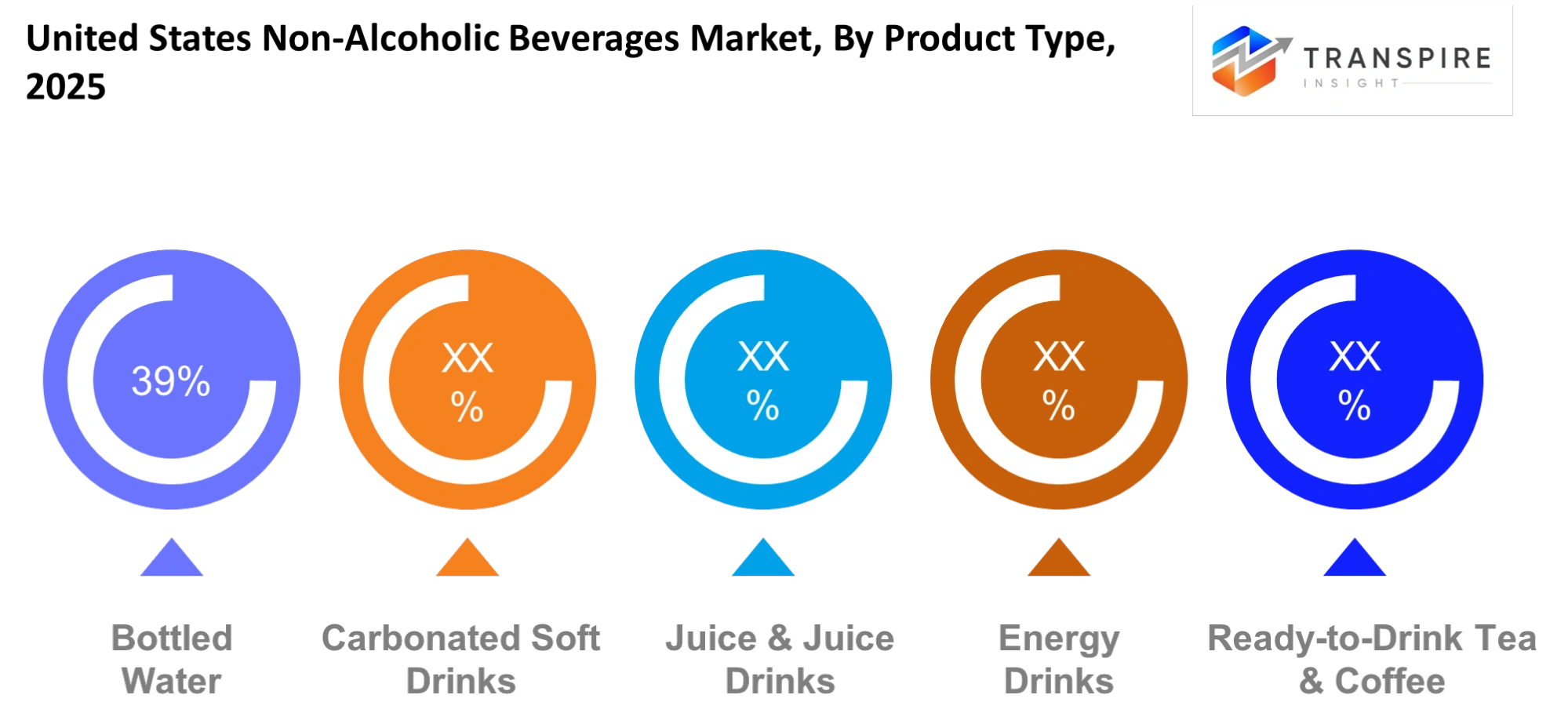
- Bottled Water: Bottled water provides customers with a healthy and convenient drinking solution which operates well with their active lifestyles. The market for enhanced waters which contain both vitamins and minerals continues to grow. Urban millennials choose products based on sustainable packaging, which includes recyclable bottles and environmentally friendly brands, as their main decision factor.
- Juice & Juice Drinks: Juices and juice-based drinks receive greater appreciation because people recognise their natural components and vitamin content. Health-conscious consumers show a preference for cold-pressed organic juices, which have become popular. Manufacturers create new products by using exotic fruits and different blends and fortified products to meet customer taste and wellness requirements.
- Energy Drinks: Youth and working professionals drive energy drink consumption because they need immediate energy solutions. Brands develop sugar-free products which include functional components such as caffeine and B-vitamins and herbal extracts. The combination of unique packaging with marketing that targets active consumers increases product attractiveness to this dynamic consumer group.
- Ready-to-Drink Tea & Coffee: People choose ready-to-drink tea and coffee products because these beverages offer them easy access to delicious alternatives which do not require brewing equipment. Cold brews and flavoured teas and functional beverages attract consumers who want to experience delicious tastes while staying healthy. The market for this segment develops through three main trends, which include premiumisation and organic product availability and sustainable sourcing practices.
To learn more about this report, Download Free Sample Report
By Distribution Channel
- Supermarkets and Hypermarkets: Supermarkets and hypermarkets serve as the main distribution points for non-alcoholic beverages, which they sell at competitive prices while providing customers with numerous product choices. The combination of promotional offers and bulk buying options and in-store product displays acts as a key factor which determines how consumers make their purchasing choices. Large retailers create brand exposure for both established and new beverage products which they sell in their stores.
- Convenience Stores: Convenience stores serve customers who make unplanned purchases and need products while travelling. The channel mainly uses single-serve packaging and ready-to-drink products for its operations. Convenience stores serve as essential business points for young urban customers who need quick access to their products.
- Online Retail: Online retail is experiencing rapid growth because customers prefer to shop from home for more product choices which they want delivered to their homes. Online shopping revenue is experiencing growth because of subscription services and exclusive online flavours and digital marketing campaigns. Premium beverages and functional beverages and niche beverages use this channel as their main distribution point.
Country Insights
The United States Non-Alcoholic Beverages Market stands as one of the world's largest and most active markets, which operates under changing consumer drinking patterns that result from their healthy dietary selections. Americans are increasingly opting for low-sugar, organic, and functional drinks that provide both refreshment and wellness benefits. Consumers show strong demand for bottled water and ready-to-drink tea and coffee and energy drinks and juices because they want to experience new taste combinations which come together with easy-to-use products that contain transparent ingredient lists.
Premium beverages and plant-based drinks become more popular among urban residents and younger consumers because e-commerce platforms and delivery services provide better access to these products. Sustainable practices drive purchasing decisions because consumers now consider environmentally friendly packaging their most important factor. The market expands through three elements, which include seasonal changes and customer dedication and social behaviour patterns. The U.S. market currently shows a combination of innovative products and health-orientated solutions and easy-to-use services which will drive market growth because customers show rising interest in healthy and diverse non-alcoholic drinks.
Recent Development News
Non‑Alcoholic Beer Sales Surge 22% as Nearly Half of Americans Cut Back on Drinking: Younger generations cutting back on alcohol are boosting non‑alcoholic beer sales in the United States, reshaping adult beverage consumption patterns.
Record‑Low U.S. Drinking Rate Spurs Interest in Alternative Beverages: Gallup reports a historic drop in U.S. alcohol consumption, prompting greater interest in non‑alcoholic beverage alternatives.
|
Report Metrics |
Details |
|
Market size value in 2025 |
USD 177.09 Billion |
|
Market size value in 2026 |
USD 185.56 Billion |
|
Revenue forecast in 2033 |
USD 258.43 Billion |
|
Growth rate |
CAGR of 4.85% from 2026 to 2033 |
|
Base year |
2025 |
|
Historical data |
2021 – 2024 |
|
Forecast period |
2026 – 2033 |
|
Report coverage |
Revenue forecast, competitive landscape, growth factors, and trends |
|
Country scope |
United States |
|
Key company profiled |
Coca-Cola Company, PepsiCo Inc., Keurig Dr Pepper Inc., Nestlé SA, Red Bull GmbH, Monster Beverage Corporation, Danone SA, National Beverage Corp., Arizona Beverage Company, Suntory Holdings Ltd., Tata Consumer Products Ltd., Parle Agro Pvt. Ltd., Otsuka Pharmaceutical Co. Ltd., Nongfu Spring Co. Ltd., Unilever PLC. |
|
Customization scope |
Free report customization (country, regional & segment scope). Avail customized purchase options to meet your exact research needs. |
|
Report Segmentation |
By Product Type (Carbonated Soft Drinks, Bottled Water, Juice & Juice Drinks, Energy Drinks, Ready-to-Drink Tea & Coffee), By Distribution Channel (Supermarkets & Hypermarkets, Convenience Stores, Online Retail). |
Key United States Non-Alcoholic Beverages Company Insights
The leading companies which operate in the United States non-alcoholic beverage market are using three main strategies to attract consumers. The brands are launching beverages which contain low sugar content and organic ingredients and functional components while they develop new taste combinations and ready-to-drink products. The company uses three different methods, which include e-commerce and subscription services and strategic partnerships, to expand its market presence. The companies which develop sustainable packaging solutions and plant-based packaging materials achieve better customer retention. The market leaders in the industry maintain their competitive edge through their product development, which combines taste and wellness benefits and easy-to-use features to satisfy changing consumer demands in the United States beverage market.
Company List
- Coca-Cola Company
- PepsiCo Inc.
- Keurig Dr Pepper Inc.
- Nestlé SA
- Red Bull GmbH
- Monster Beverage Corporation
- Danone SA
- National Beverage Corp.
- Arizona Beverage Company
- Suntory Holdings Ltd.
- Tata Consumer Products Ltd.
- Parle Agro Pvt. Ltd.
- Otsuka Pharmaceutical Co. Ltd.
- Nongfu Spring Co. Ltd.
- Unilever PLC.
United States Non-Alcoholic Beverages Market Report Segmentation
By Product Type
- Carbonated Soft Drinks
- Bottled Water
- Juice & Juice Drinks
- Energy Drinks
- Ready-to-Drink Tea & Coffee
By Distribution Channel
- Supermarkets & Hypermarkets
- Convenience Stores
- Online Retail
Frequently Asked Questions
Find quick answers to common questions.
The approximate United States Non-Alcoholic Beverages Market size for the Market will be USD 258.43 Billion in 2033.
The key segments of the United States Non-Alcoholic Beverages Market are By Product Type (Carbonated Soft Drinks, Bottled Water, Juice & Juice Drinks, Energy Drinks, Ready-to-Drink Tea & Coffee), By Distribution Channel (Supermarkets & Hypermarkets, Convenience Stores, Online Retail).
Major players in the United States Non-Alcoholic Beverages Market are Coca-Cola Company, PepsiCo Inc., Keurig Dr Pepper Inc., Nestlé SA, Red Bull GmbH, Monster Beverage Corporation, Danone SA, National Beverage Corp., Arizona Beverage Company, Suntory Holdings Ltd., Tata Consumer Products Ltd., Parle Agro Pvt. Ltd., Otsuka Pharmaceutical Co. Ltd., Nongfu Spring Co. Ltd., Unilever PLC.
The current Market size of the United States Non-Alcoholic Beverages Market is USD 177.09 Billion in 2025.
The United States Non-Alcoholic Beverages Market CAGR is 4.85%.
- Coca-Cola Company
- PepsiCo Inc.
- Keurig Dr Pepper Inc.
- Nestlé SA
- Red Bull GmbH
- Monster Beverage Corporation
- Danone SA
- National Beverage Corp.
- Arizona Beverage Company
- Suntory Holdings Ltd.
- Tata Consumer Products Ltd.
- Parle Agro Pvt. Ltd.
- Otsuka Pharmaceutical Co. Ltd.
- Nongfu Spring Co. Ltd.
- Unilever PLC.
Recently Published Reports
-
Apr 2026
Baby Infant Formula Market
Baby Infant Formula Market Size, Share & Analysis Report By ype (Infant Milk, Follow On Milk, Specialty Baby Milk, Growing-Up Milk), By Ingredient (Carbohydrate, Fat, Protein, Minerals, Vitamins, and Others), By Product Form (Powder, Liquid, and Ready-to-feed), By Distribution Channels (Supermarket/Hypermarket, Specialty Store, Pharmacies, Online Retail, and Others), and Geography (North America, Europe, Asia-Pacific, Middle East and Africa, South and Central America), 2021 - 2031
-
Apr 2026
Edible Insects for Animal Feed Market
Edible Insects for Animal Feed Market Size, Share & Analysis Report By Type (Insect Powder, Insect Meal, Insect Bar, Insect Paste, Insect Oil, and Others), By Insect Type (Beetles, Cricket, Caterpillar, Hymenoptera, Orthoptera, Tree Bugs, and Others), By Application (Livestock, Pet Food, and Aquaculture), By Livestock Type (Poultry, Swine, and Others), and Geography (North America, Europe, Asia-Pacific, Middle East and Africa, South and Central America), 2021 - 2031
-
Apr 2026
Food Industry Disinfection and Bacterial Control Market
Food Industry Disinfection and Bacterial Control Market Size, Share & Analysis Report By Type (Chemical Disinfectants, Physical Disinfectants, and Biocides and Antimicrobials), By Application (Food Processing Equipment Surface Disinfection, Food Preparation Areas Surface Disinfection, Storage Areas Surface Disinfection, Anti-microbial Coatings Food Preservation, and Preservative Solutions Food Preservation), By End User (Meat and Poultry Processing, Dairy Processing, Seafood Processing, Bakery and Confectionery, Restaurants and Commercial Kitchens, and Food Service Providers), By Sales Channel (Online, Offline), and Geography (North America, Europe, Asia-Pacific, Middle East and Africa, South and Central America), 2021 - 2031
-
Apr 2026
Freeze Dried Food Market
Freeze Dried Food Market Size, Share & Analysis Report By Product Type (Fruits, Vegetables, Freeze-Dried Dairy Products, Freeze-Dried Meat and Seafood, Freeze-Dried Pet Food, and Prepared Meal), By Nature (Organic, and Conventional), By Form (Powdered, Granules, and Diced), By End Use (Breakfast Cereals, Dairy Products, Bakery & Confectionery, Nutritional Bars & Supplements, Powdered Beverages, Snacks, and Retail (Household)), and Geography (North America, Europe, Asia-Pacific, Middle East and Africa, South and Central America), 2021 - 2031