
Italy Internet Of Things In Retail Market Size & Forecast:
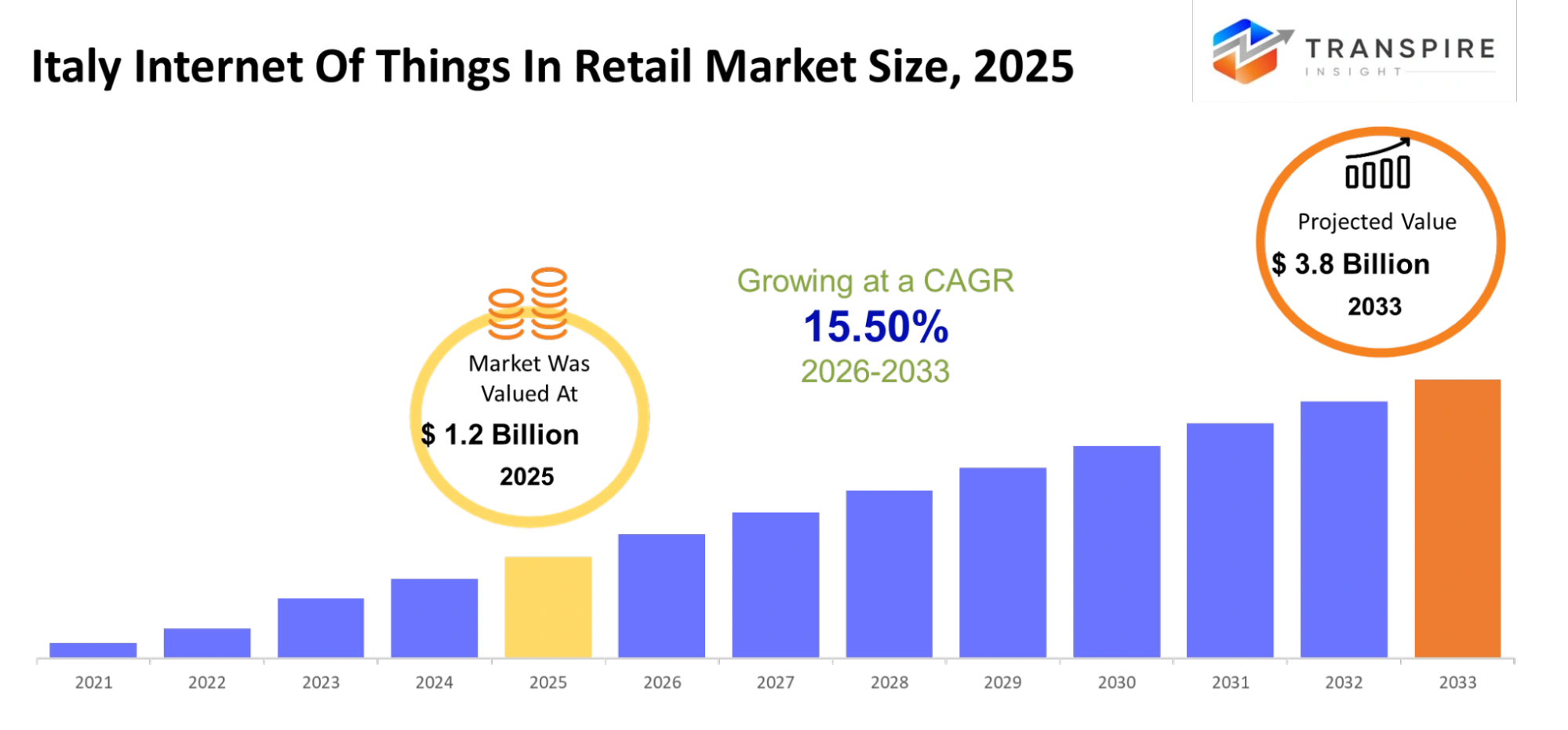
- Italy Internet Of Things In Retail Market Size 2025: USD 1.2 Billion
- Italy Internet Of Things In Retail Market Size 2033: USD 3.8 Billion
- Italy Internet Of Things In Retail Market CAGR: 15.50%
- Italy Internet Of Things In Retail Market Segments: By Component (Hardware, Software, Services), By Application (Smart Shelves, Inventory Management, Customer Analytics, Supply Chain Management), By Deployment (Cloud, On-Premise), By End-User (Supermarkets, Convenience Stores, E-commerce Retailers).
To learn more about this report,  Download Free Sample Report
Italy Internet Of Things In Retail Market Summary:
The Italy Internet Of Things In Retail Market size was estimated at USD 1.2 Billion in 2025 and is anticipated to reach USD 3.8 Billion by 2033, growing at a CAGR of 15.50% from 2026 to 2033. The retail technology industry defines the Italy internet of things market which connects devices to change how retail stores operate and interact with customers. Retailers will use smart shelves and sensors along with real-time analytics to meet Italian consumer demands for faster service and customized offers and smooth checkout processes. The Italian data privacy regulations will determine how businesses collect and utilize customer data while promoting the need for open data management systems. The development of edge computing technology combined with artificial intelligence will help stores fulfill customer requests according to their current demand levels. Retailers will use connected systems to maintain operational effectiveness as urban shopping patterns change.
Key Market Trends & Insights:
- The Italian retail market for Internet of Things technology will develop through retailer investments in intelligent shelving systems together with inventory management solutions that provide real-time product tracking . The new approach will help businesses maintain proper inventory levels by decreasing both stockout situations and their excessive inventory problems. The improvement will enable Italian consumers to find more products in stores while retailers will use data-based methods to control their inventory according to changes in consumer buying patterns.
- Italian retailers will start using automated checkout systems which provide seamless shopping experiences through sensor technology and mobile device connections. The systems will help urban consumers by reducing wait times at stores while providing them with better service. Stores will create integrated shopping experiences that combine physical and digital payments because customers prefer using digital payment methods now.
- The retailers will use these connected devices to keep tabs on customer behavior, hence providing better personal shopping experiences. The retailers will also use these connected devices to develop advertising campaigns, including specific pricing strategies and product display formats based on their customer shopping behavior. Italian customers will seek suitable product suggestions during their store visits whereas brands will enhance their consumer relationship efforts through localized data that shows cultural differences and seasonal shopping patterns.
- Retailers will use IoT systems to monitor their energy consumption together with their supply chain operations because sustainability drives their decision to adopt connected technologies. The Italian regulatory system will require companies to reveal their sourcing methods while they display their progress in waste reduction. The combination of intelligent logistics systems and tracking technologies will allow companies to operate in an environmentally friendly manner while complying with both regulatory requirements and customer demands.
Italy Internet Of Things In Retail Market Segmentation
By Component
Hardware- The hardware system will consist of sensors, RFID tags, smart cameras and connected shelving units which will be set up throughout Italian retail locations. The devices will track product movement and customer foot traffic and shelf conditions in real time to help retailers achieve accurate store visibility and better operational performance throughout their retail and distribution networks.
Software- The software platforms will analyze and interpret data from all connected devices while delivering dashboard displays and analytical tools and automated processes. The systems will enable Italian retailers to predict future demand and create customized offers while connecting store-level data to their enterprise systems for decision-making based on constant and trustworthy information resources.
Services- The services will provide system integration services and maintenance services and consulting services and data management support services. Italian retailers will increasingly depend on specialized service providers to implement IoT frameworks and maintain system reliability and create solutions that meet local regulatory requirements because these providers enable businesses to enhance customer experience while sustaining operational efficiency.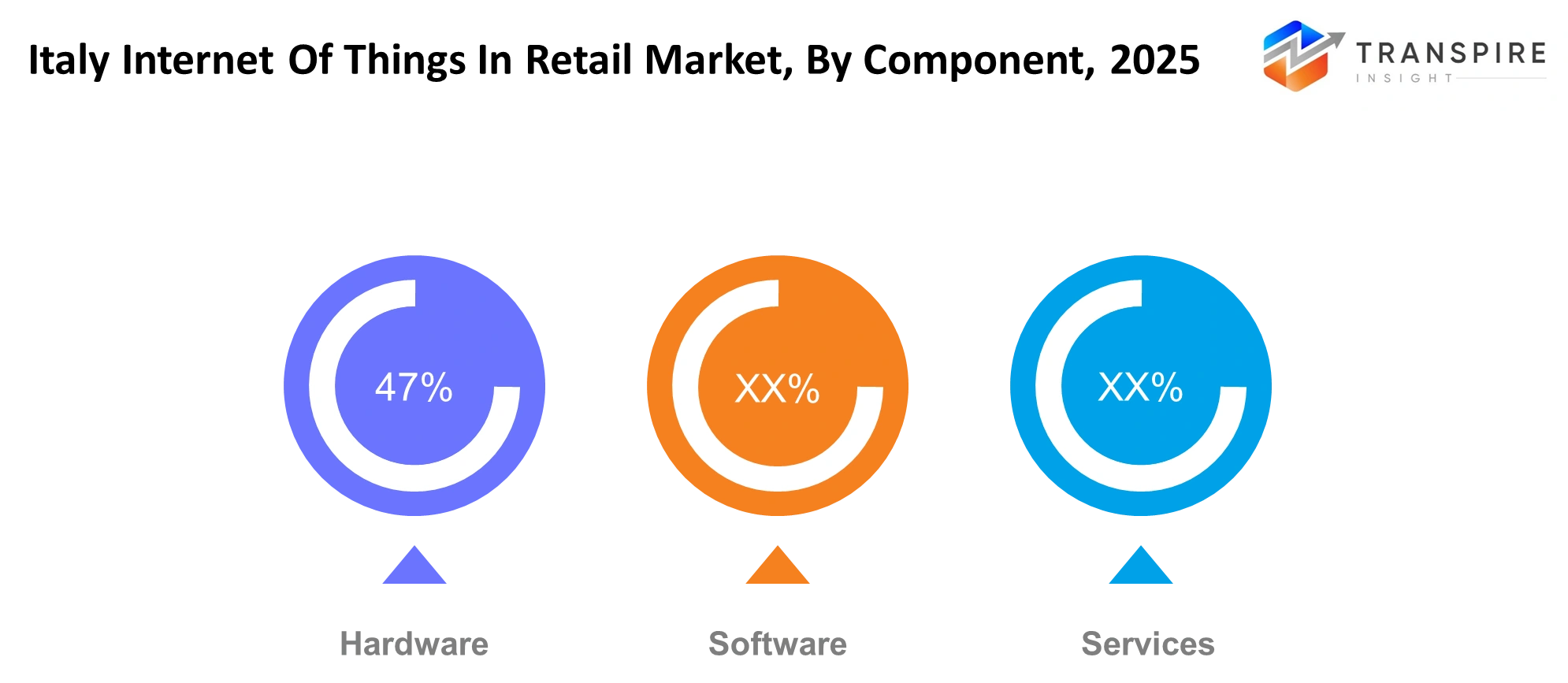
To learn more about this report, Download Free Sample Report
By Application
Smart Shelves- Smart shelves will use embedded sensors and weight detection to monitor stock levels automatically. Italian retailers will receive automatic inventory notifications which will decrease their requirement for manual inventory checks. The shelves enable retailers to adjust their pricing and promotional offers according to actual customer demand which they observe in their physical stores.
Inventory Management- Inventory management solutions will provide real-time tracking of goods across stores and warehouses. Retailers will achieve better stock precision through automatic updates which will decrease their inventory losses. The system will help Italian businesses handle seasonal inventory while they stay consistent between their urban stores and their regional distribution centers.
Customer Analytics- The customer analytics tools will use in-store customer movement patterns and their length of stay and buying patterns to create customer insights. This information will be used by the Italian retailers to enhance their store designs and promotion strategies. Businesses will start offering customers a personalized experience. Businesses will begin providing personalized experiences for their consumers. This is because they will be customizing their product offerings based on their evolving demands.
Supply Chain Management- Supply chain management applications will provide for data exchange among suppliers, warehouses, and stores. Italian retailers will improve their delivery times while decreasing operational waste through their ability to monitor products during transportation. The system will enhance product distribution by enabling better operational management which allows products to reach retail shelves without delays while all distribution activities remain visible.
By Deployment
Cloud- Cloud deployment enables retailers to use centralized data and analytics tools without needing to build expensive infrastructure systems. Italian businesses will prefer this model because it enables them to grow their operations through remote system monitoring and multiple store management and equipment performance that remains stable across different areas.
On-Premise- The implementation of on-premise solutions will enable retailers to maintain complete authority over their entire system operations and all their stored data assets. The approach will attract businesses that need to protect their data and follow the regulatory rules in Italy. The solution requires more upfront funding yet delivers dependable performance with tailored features that meet particular operational needs.
By End-User
Supermarkets- Supermarkets will use IoT technology to manage their large inventory and high customer traffic. Italian supermarket chains will use connected systems to streamline restocking operations and monitor product freshness, and to improve their checkout processes, enabling their stores to run more efficiently while delivering fast service to customers who want to shop anytime.
Convenience Stores- Convenience stores will use compact IoT solutions which designers created for small retail spaces. The Italian stores will use automated inventory tracking systems together with simplified checkout systems to optimize their operations which require only limited personnel to run their business while they keep products available for customers who want quick service.
E-commerce Retailers- E-commerce retailers will use IoT systems to connect their warehouse operations with their delivery networks, as this connection will enhance order processing accuracy and delivery speed. The businesses in Italy will use connected technologies to match their online customer demand with their actual inventory stock because this method guarantees them successful delivery operations while it improves their ability to manage their online platforms and their delivery operations.
Country Insights
The retail industry in Italy combines its traditional shopping customs with its current digital shopping patterns. Consumers require in-store shopping as an essential service, but they expect stores to provide quicker product access and improved customer support. Retailers will use connected retail systems to improve store operations while maintaining traditional shopping experiences preferred by the Italian market.
The cities of Milan and Rome will serve as the initial testing grounds for connected retail technology. The combination of high customer traffic and active retail competition will lead companies to test their automation systems, intelligent tracking solutions and customized customer interaction methods. These cities will serve as experimental locations where new ideas will be developed before they are introduced to nearby smaller markets.
All retail operations in Italy will comply with national retail data regulations that control their data processing activities. Retailers will need to establish clear data handling procedures because the intense focus on consumer privacy requires them to do so. Companies will have to find a way to merge their creative work with their legal obligations by developing connected systems that meet both domestic and European data protection regulations.
Retailers across Italy will adopt connected systems according to the different needs of each region. Northern regions of Italy will likely implement advanced technologies more quickly because they have better infrastructure while southern regions will develop their systems through a slower process. Retailers will need to employ adaptable strategies because their technologies must follow both local economic patterns and customer purchasing habits.
Recent Development News
Expansion of Data Infrastructure Supporting Connected Retail- Italy has made substantial investments in digital infrastructure which creates the foundation needed for connected retail environments. The establishment of additional data centers throughout various cities will enhance real-time data processing capabilities that help retailers control their Internet of Things operations while they respond to in-store and supply chain data needs.
Rising Integration of IoT with Smart Logistics and Retail Systems- The adoption of Internet of Things technology in logistics and retail operations will accelerate through partnerships between technology companies and Italian businesses. Retailers are using connected systems for product tracking and supply chain management which helps them achieve operational excellence through accurate inventory control based on customer purchasing patterns.
Shift Toward AI-Driven and Data-Centric Retail Experiences- Retail spaces are evolving to create a seamless connection between Internet of Things technology and artificial intelligence with analytics capabilities. The new system will provide real-time shelf tracking and customized customer interaction and the ability to make automatic choices. This transformation will create better customer experiences while helping retailers eliminate waste and adapt rapidly to new consumer purchasing trends.
|
Report Metrics |
Details |
|
Market size value in 2025 |
USD 1.2 Billion |
|
Market size value in 2026 |
USD 1.386 Billion |
|
Revenue forecast in 2033 |
USD 3.8 Billion |
|
Growth rate |
CAGR of 15.50% from 2026 to 2033 |
|
Base year |
2025 |
|
Historical data |
2021 – 2024 |
|
Forecast period |
2026 – 2033 |
|
Report coverage |
Revenue forecast, competitive landscape, growth factors, and trends |
|
Country scope |
Italy |
|
Key company profiled |
IBM Corporation, Microsoft Corporation, Intel Corporation, Cisco Systems Inc., SAP SE, Oracle Corporation, Amazon Web Services Inc., Google LLC, Zebra Technologies Corporation, Honeywell International Inc., PTC Inc., Bosch GmbH, Siemens AG, Hewlett Packard Enterprise Company, Arm Holdings plc. |
|
Customization scope |
Free report customization (country, regional & segment scope). Avail customized purchase options to meet your exact research needs. |
|
Report Segmentation |
By Component (Hardware, Software, Services), By Application (Smart Shelves, Inventory Management, Customer Analytics, Supply Chain Management), By Deployment (Cloud, On-Premise), By End-User (Supermarkets, Convenience Stores, E-commerce Retailers). |
Key Italy Internet Of Things In Retail Market Company Insights
Companies that operate in this field will be focused on developing integrated platforms that incorporate hardware, analytics, and service support specifically for retailers in Italy. The partnership between technology companies and retail companies will also be improved. Companies will be focused on providing safe data handling, flexible cloud computing, and dynamic solutions that meet the changing needs of consumers and the changing retail landscape in Italy.
Company List
- IBM Corporation
- Microsoft Corporation
- Intel Corporation
- Cisco Systems Inc.
- SAP SE
- Oracle Corporation
- Amazon Web Services Inc.
- Google LLC
- Zebra Technologies Corporation
- Honeywell International Inc.
- PTC Inc.
- Bosch GmbH
- Siemens AG
- Hewlett Packard Enterprise Company
- Arm Holdings plc
Italy Internet Of Things In Retail Market Report Segmentation
By Component
- Hardware
- Software
- Services
By Application
- Smart Shelves
- Inventory Management
- Customer Analytics
- Supply Chain Management
By Deployment
- Cloud
- On-Premise
By End-User
- Supermarkets
- Convenience Stores
- E-commerce Retailers
Frequently Asked Questions
Find quick answers to common questions.
The Approximate Italy Internet Of Things In Retail Market size will be USD 3.8 Billion in 2033.
The key Segments of the Italy Internet Of Things In Retail Market are By Component (Hardware, Software, Services), By Application (Smart Shelves, Inventory Management, Customer Analytics, Supply Chain Management), By Deployment (Cloud, On-Premise), By End-User (Supermarkets, Convenience Stores, E-commerce Retailers).
Major Players in the Italy Internet Of Things In Retail Market are IBM Corporation, Microsoft Corporation, Intel Corporation, Cisco Systems Inc., SAP SE, Oracle Corporation, Amazon Web Services Inc., Google LLC, Zebra Technologies Corporation, Honeywell International Inc., PTC Inc., Bosch GmbH, Siemens AG, Hewlett Packard Enterprise Company, Arm Holdings plc.
The Current Market size of the Italy Internet Of Things in Retail Market is USD 1.2 Billion by 2025.
The Italy Internet Of Things In Retail Market CAGR is 15.50%.
- IBM Corporation
- Microsoft Corporation
- Intel Corporation
- Cisco Systems Inc.
- SAP SE
- Oracle Corporation
- Amazon Web Services Inc.
- Google LLC
- Zebra Technologies Corporation
- Honeywell International Inc.
- PTC Inc.
- Bosch GmbH
- Siemens AG
- Hewlett Packard Enterprise Company
- Arm Holdings plc
Recently Published Reports
-
Apr 2026
3D Optical Profiler Market
3D Optical Profiler Market Size, Share & Analysis Report By Type (Desktop 3D Optical Profiler, and Portable 3D Optical Profiler), By Technology (Confocal Technology, and White Light Interference), By End-Use Industry (Manufacturing, Research Institutions, Automotive, Aerospace and Defense, Medical Devices, and Other), and Geography (North America, Europe, Asia-Pacific, Middle East and Africa, South and Central America), 2021 - 2031
-
Apr 2026
Depth Sensor Market
Depth Sensor Market Size, Share & Analysis Report By Type (Infrared Depth Sensors, Time-of-Flight (ToF) Sensors, Stereo Vision Sensors, Structured Light Sensors, Ultrasonic Depth Sensors), By Application (Automotive, Robotics, Gaming, Consumer Electronics, Industrial Automation, Healthcare, Security & Surveillance, Others), By End Users (Automotive Manufacturers, Consumer Electronics Companies, Healthcare Providers, Industrial Companies, Security Agencies, Gaming Companies, Robotics Companies, Others), and Geography (North America, Europe, Asia-Pacific, Middle East and Africa, South and Central America), 2021 – 2031
-
Apr 2026
Digital Manufacturing Market
Digital Manufacturing Market Size, Share & Analysis Report By Component (Hardware, Software, and Services), By Technology (Robotics, 3D Printing, Internet of Things (IoT), and Others), By Application (Automotive and Transportation, Aerospace and Defense, Consumer Electronics, Industrial Machinery, and Others), By Process Type (Computer-Based Designing, Computer-Based Simulation, Computer 3D Visualization, Analytics, and Others), and Geography (North America, Europe, Asia-Pacific, Middle East and Africa, South and Central America), 2021 – 2031
-
Apr 2026
Digital Visa Services Market
Digital Visa Services Market Size, Share & Analysis Report By Type (Individual Travelers, Group Travelers), By Application (Tourism, Business Travel, Others), and Geography (North America, Europe, Asia-Pacific, Middle East and Africa, South and Central America), 2021 – 2031