
North America Natural Food Colorants Market Size & Forecast:
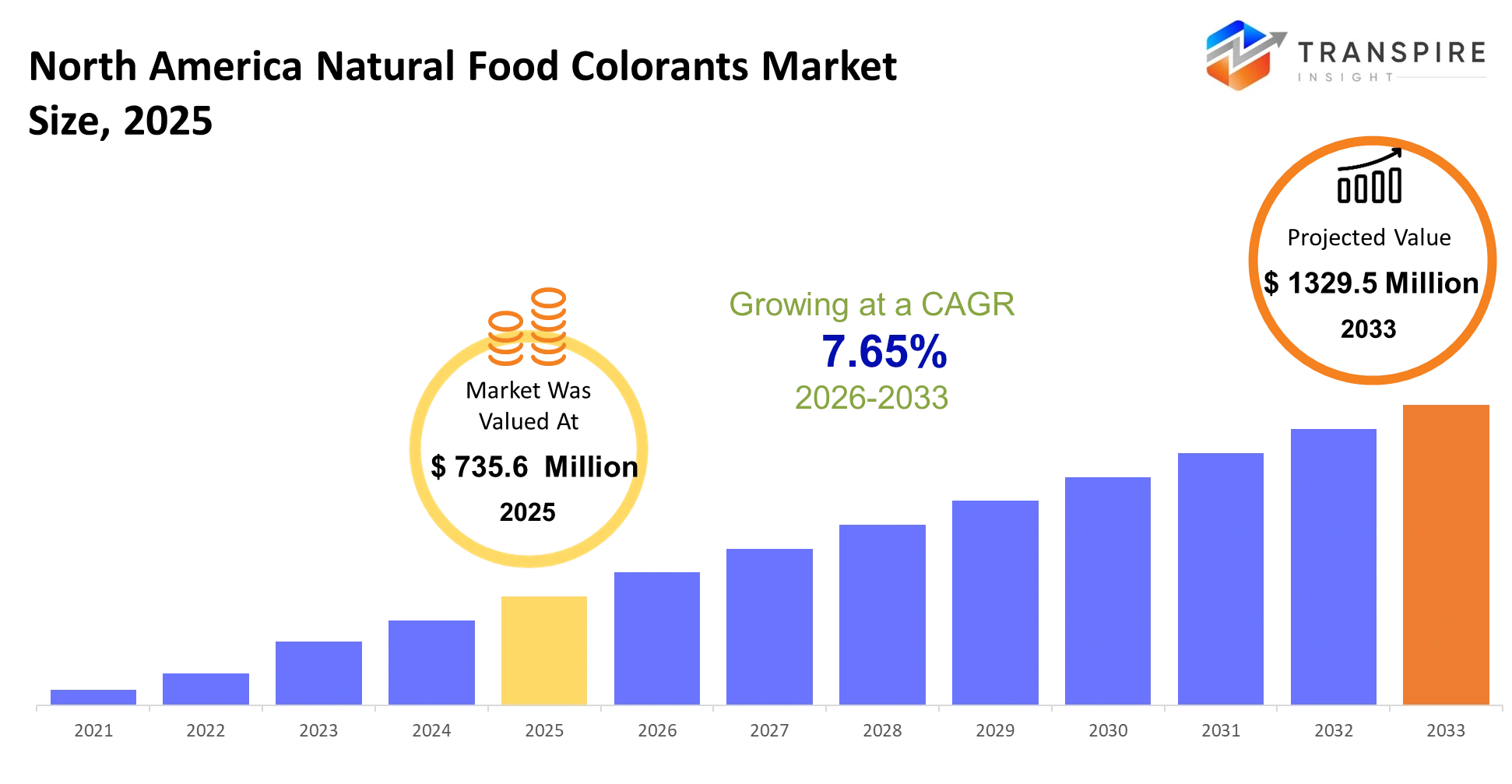
- North America Natural Food Colorants Market Size 2025: USD 735.6 Million
- North America Natural Food Colorants Market Size 2033: USD 1329.5 Million
- North America Natural Food Colorants Market CAGR: 7.65%
- North America Natural Food Colorants Market Segments: By Type (Carotenoids, Anthocyanins, Chlorophyll, Curcumin), By Application (Beverages, Bakery & Confectionery, Dairy, Processed Foods), By End-User (Food & Beverage Industry).
To learn more about this report,  Download Free Sample Report
North America Natural Food Colorants Market Summary:
The North America Natural Food Colorants Market size is estimated at USD 735.6 Million in 2025 and is anticipated to reach USD 1329.5 Million by 2033, growing at a CAGR of 7.65% from 2026 to 2033. The Natural Food Colorants Market in North America which includes Canada and the United States and Mexico operates within the food ingredients industry because clean-label consumption has become a dominant trend. Consumers now question synthetic additives and will increasingly favor plant-based pigments derived from beetroot, spirulina, and turmeric. Manufacturers develop new product recipes which can maintain their original color without using artificial color solutions while they invest in extraction methods that maintain product brightness and extended shelf life. The regulatory authorities in this area will implement stricter regulations for product labeling which will require businesses to disclose their ingredients and production methods. The market will achieve deeper connections between the visual appearance of products and their healthiness and the ability to trace ingredients because culinary trends now focus on authentic food experiences.
Key Market Trends & Insights:
The United States and Canada now experience changes in consumer expectations because people want food producers to reveal all their ingredient information which includes details about plant-based color sources that consumers can identify. The growing trend of consumers linking bright colors to health benefits instead of synthetic additives will force companies to disclose their color sources which include berry extracts and vegetable concentrates. Customers will perceive packaging changes because its visual design elements will now display their authentic product quality and health benefits.
Processing technologies will enable better methods to extract and stabilize natural pigments for their use in commercial products. Companies will invest in methods like microencapsulation and cold-press extraction to maintain color intensity under varying temperatures and pH conditions. The enhancements will enable manufacturers to use natural ingredients in their products across beverages and dairy and confectionery items while maintaining product shelf life. The changes will enable businesses to use natural ingredients in complex product formulations.
Retail and foodservice channels will play a growing role in influencing colorant preferences, particularly as private labels adopt cleaner ingredient standards. Supermarkets and quick-service restaurants will choose products based on their visual appeal which satisfies new dietary requirements. Natural colorants will become the main method which seasonal and limited-edition products use to create unique appearances because products need to meet consumer requirements for less processed materials.
The regulatory changes that take place in Canada and the United States and Mexico will determine how companies develop their formulation strategies because the new labeling requirements and additive disclosure standards will be implemented more stringently. Authorities will require manufacturers to establish new compliance methods because they want better methods for showing color sources. The business environment will create an atmosphere that supports new ideas because it protects safety and ensures transparency, which will help people trust natural color solutions that come from nature.
North America Natural Food Colorants Market Segmentation
By Type
Carotenoids- Carotenoids will be used in food products to create yellow orange and red colors which manufacturers obtain from carrots and paprika and algae. The product will attract consumers because they believe the product has health benefits in addition to its color. The company will develop new oil and water dispersible product formats which will enable customers to use products in different product categories. The company will improve product stability through light and heat protection to expand product usability in both beverages and processed food items.
Anthocyanins- Anthocyanins will attract more research because they can create bright red purple and blue colors which come from berries and grapes and purple vegetables. Their natural origin will align strongly with clean-label expectations. The product requires special formulation because its pH level sensitivity. The development of stabilization techniques will help maintain drink and dairy products which need visual appeal and ingredient transparency to show their original color.
Chlorophyll- Chlorophyll-based colorants will provide green shades which create an impression of freshness and connection to plant-based products. The pigments extracted from leafy greens and algae will be used more frequently in functional foods and beverages. The food industry needs to develop new processing techniques because current methods cannot handle heat and light which leads to color loss. The development of better encapsulation methods, along with improved product formula, will help manufacturers keep natural green colors during different commercial uses.
Curcumin- Curcumin will be used as a bright yellow colorant because people across multiple cultures use turmeric in their traditional cooking. The product will attract food manufacturers because it provides both a colorant and a useful component for their products. Enhancement of product formulas will resolve solubility and stability issues which will enable broader application in dairy products.
By Application
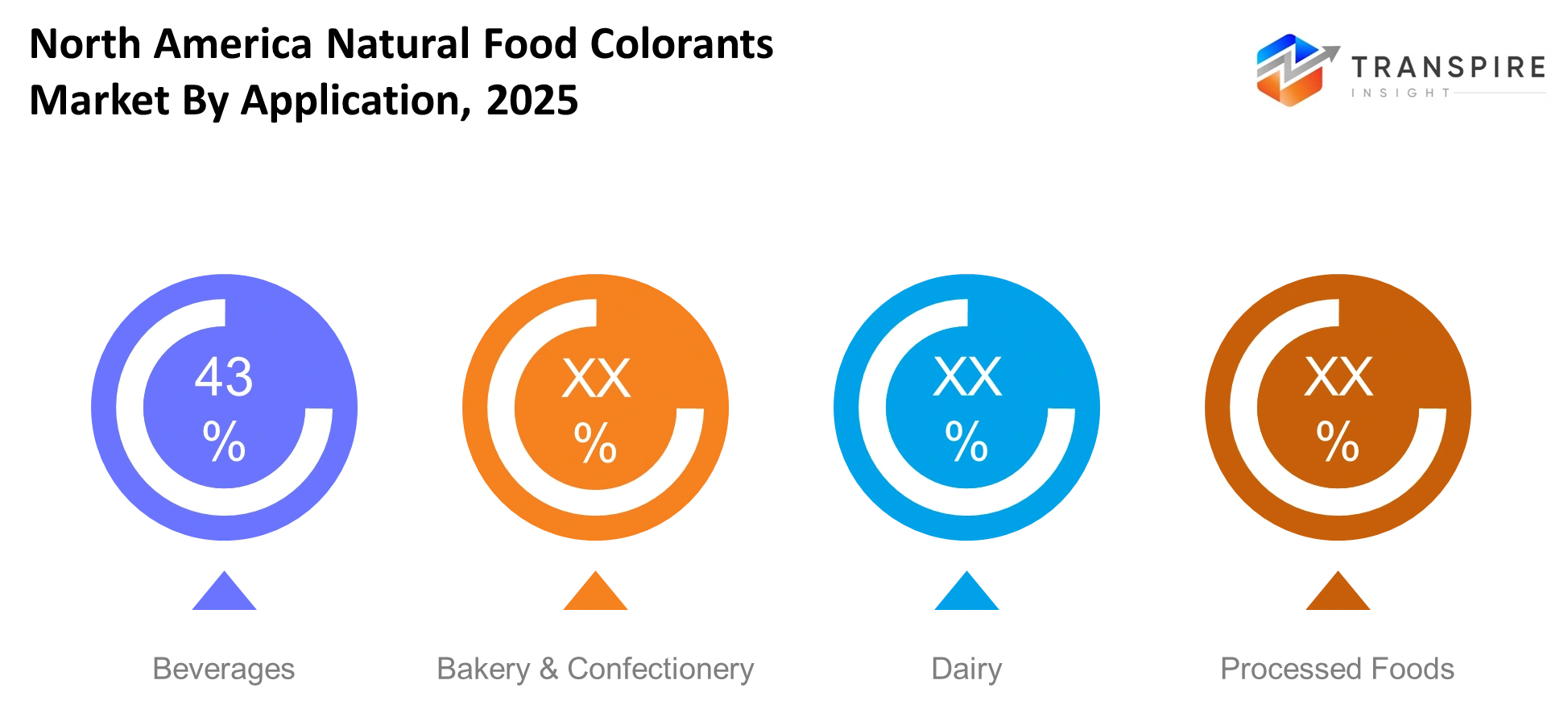
Beverages- The use of natural colorants will provide an important application in beverages, as they will determine the way consumers will perceive beverages carrying juices, flavored water, and plant-based beverages. There will be an increased focus on attaining attractive colors without the use of synthetic colorants. The need to ensure color stability at different pH levels and temperature conditions will necessitate the formulation of new drink types. This combination of clear labeling and natural colorants for beverages will create a stronger bond between consumers and naturally colored beverages.
Bakery & Confectionery- Products in the bakery and confectionery sector will witness increased use of natural colorants to match the evolving demands of consumers. Natural colorants will provide intense colors, which will act as important components for display purposes in products ranging from frosting to candies. Advanced formulations will be required to overcome the key challenge of developing heat-resistant products, which can withstand the high temperatures involved in the baking process. Seasonal products will greatly benefit from the availability of different shades of natural colors, which match the clean label trend.
Dairy- Dairy products will require natural colorants with the capability of performing in products like yogurt, milk, and desserts. Natural pigments will have to show promise in handling changing fat content and different storage conditions. Light shades will help in differentiating products while at the same time giving consumers the perception of fresh products. Natural coloring solutions will attract consumers since they will want natural and minimally processed dairy products.
Processed Foods- Natural pigments will replace synthetic pigments in processed foods because they will maintain quality without the need for artificial pigments. Plant-based pigments will be used in ready meals and snacks as well as in packaging different foods to match dietary trends. They will have to withstand different processes, storage, and reheating. This will help in the removal of synthetic pigments from different foods.
To learn more about this report, Download Free Sample Report
By End-User
Food & Beverage Industry- Adoption of natural colorants by the food and beverage industry is expected to be the key strategy adopted by the industry in the future. This is because the industry will focus on transparency of ingredients used in their products. They will invest in research aimed at resolving formulation problems. They will also seek to extend their supplier network for consistent quality of their products. With increased competition, the adoption of natural colorants is expected to be key in positioning their products.
Regional Insights
The United States market for natural food colorants will experience growth because consumers want to know the origins of ingredients and the details on product labels. Food manufacturers will reformulate their existing products by removing artificial colorings but they will keep the same visual appearance. Retail shelves will display an increasing number of products which contain natural colors in their beverage and snack and dairy product lines. The existing rules about required additive information will create pressure on companies to provide better ingredient details and safer product alternatives.
Canada will present a market shaped by health-conscious consumers and a regulatory framework that supports clear labeling practices. Producers will use plant-derived pigments to create products which will be available in both common and specialized food markets. Food producers will start to use local raw material sources because sustainability issues will start to affect their buying decisions. Natural color solutions will become more common in packaged and fresh food products because organic and minimally processed food categories will create new opportunities for innovation.
Mexico will show a distinct blend of traditional food practices and modern processing trends, influencing the use of natural colorants. The country’s culinary heritage will complement vibrant natural colors which come from nature. Food production companies will need to find a way to make their products stay fresh while keeping their product taste constant. Natural ingredients will become the main focus for manufacturers who want to provide urban consumers with healthy packaged food that still tastes familiar.
The trade relationships between different countries in North America and their supply chain networks will determine the methods used to obtain and distribute natural colorants.Companies will work together with local suppliers to maintain consistent product quality and product availability. The development of new technologies for extraction and stabilization will enable companies to use their products across multiple food categories. The geographic alignment will enhance the shift towards natural ingredient use because it meets common customer demands for product transparency and safety and product attractiveness.
Recent Development News
United States: Regulatory Push and Industry Reformulation
Recent developments in the United States will continue to reshape the direction of natural food color adoption. Authorities have accelerated efforts to phase out petroleum-based dyes, encouraging companies to switch toward plant-derived alternatives. Major food manufacturers have already committed to reformulating products, with deadlines extending toward 2026–2027. This regulatory pressure, combined with consumer health concerns, will steadily transform ingredient strategies across packaged foods and beverages.
Canada: Alignment with Clean-Label Standards
In Canada, recent developments will reflect a steady alignment with clean-label expectations already established in global markets. Food producers will continue integrating natural pigments while maintaining compliance with strict labeling frameworks. Innovation in color stability and performance will gain importance, especially in processed foods. Canadian brands will increasingly emphasize transparency and sustainability, positioning naturally derived colorants as a standard rather than a niche feature in product development.
Mexico: Transition Blending Tradition with Modern Processing
Mexico will experience a gradual but meaningful shift as food manufacturers balance traditional culinary aesthetics with modern health-driven expectations. Recent industry movements will show increased adoption of natural color sources in packaged snacks and beverages. Companies will invest in improving formulation techniques to ensure consistency without synthetic inputs. This transition will reflect both export market requirements and rising domestic awareness around ingredient quality and food safety.
North America: Corporate Commitments Driving Market Change
Across the region, large food corporations have announced significant moves toward eliminating artificial dyes and replacing them with natural alternatives. Companies such as Nestlé and Kraft Heinz are actively reformulating their portfolios, aiming to remove synthetic colors within the next few years. These commitments will influence supply chains, accelerate innovation in natural pigments, and set new benchmarks for product development across North America’s food industry.
|
Report Metrics |
Details |
|
Market size value in 2025 |
USD 735.6 Million |
|
Market size value in 2026 |
USD 793.4 Million |
|
Revenue forecast in 2033 |
USD 1329.5 Million |
|
Growth rate |
CAGR of 7.65% from 2026 to 2033 |
|
Base year |
2025 |
|
Historical data |
2021 – 2024 |
|
Forecast period |
2026 – 2033 |
|
Report coverage |
Revenue forecast, competitive landscape, growth factors, and trends |
|
Regional scope |
North America (Canada, The United States, and Mexico) |
|
Key company profiled |
Chr. Hansen Holding A/S, Givaudan SA, Sensient Technologies Corporation, DSM-Firmenich, Kerry Group plc, BASF SE, DDW The Color House, Naturex (Givaudan), Döhler GmbH, FMC Corporation, Lycored Ltd., Kalsec Inc., Archer Daniels Midland Company, Roha Dyechem Pvt. Ltd., Fiorio Colori S.p.A. |
|
Customization scope |
Free report customization (country, regional & segment scope). Avail customized purchase options to meet your exact research needs. |
|
Report Segmentation |
By Type (Carotenoids, Anthocyanins, Chlorophyll, Curcumin), By Application (Beverages, Bakery & Confectionery, Dairy, Processed Foods), By End-User (Food & Beverage Industry). |
Key North America Natural Food Colorants Market Company Insights
Leading companies in the North America (Canada, the United States, and Mexico) Natural Food Colorants Market will focus on two main strategies. The first strategy will use plant-based product development to build their brand. Their second strategy will establish partnerships with food manufacturers to build their brand. The companies will use advanced extraction methods and stabilization methods to create products that maintain consistent color through time. As clean-label products become more popular beverage and dairy and confectionery companies will start working together. Companies will use sustainable methods to obtain their raw materials which will let them trace their products and maintain high quality standards. Companies will need to process three components which are visual appeal and regulatory requirements and new consumer demands to create their competitive advantages.
Company List
- Chr. Hansen Holding A/S
- Givaudan SA
- Sensient Technologies Corporation
- DSM-Firmenich
- Kerry Group plc
- BASF SE
- DDW The Color House
- Naturex (Givaudan)
- Döhler GmbH
- FMC Corporation
- Lycored Ltd.
- Kalsec Inc.
- Archer Daniels Midland Company
- Roha Dyechem Pvt. Ltd.
- Fiorio Colori S.p.A
North America Natural Food Colorants Market Report Segmentation
By Type
- Carotenoids
- Anthocyanins
- Chlorophyll
- Curcumin
By Application
- Beverages
- Bakery & Confectionery
- Dairy
- Processed Foods
By End-User
- Food & Beverage Industry
Frequently Asked Questions
Find quick answers to common questions.
The approximate North America Natural Food Colorants Market size for the market will be USD 1329.5 Million in 2033.
Key segments for the North America Natural Food Colorants Market By Type (Carotenoids, Anthocyanins, Chlorophyll, Curcumin), By Application (Beverages, Bakery & Confectionery, Dairy, Processed Foods), By End-User (Food & Beverage Industry).
Major players in the North America Natural Food Colorants Market are Chr. Hansen Holding A/S, Givaudan SA, Sensient Technologies Corporation, DSM-Firmenich, Kerry Group plc, BASF SE, DDW The Color House, Naturex (Givaudan), Döhler GmbH, FMC Corporation, Lycored Ltd., Kalsec Inc., Archer Daniels Midland Company, Roha Dyechem Pvt. Ltd., Fiorio Colori S.p.A.
The North America Natural Food Colorants Market size is USD 735.6 Million in 2025.
The North America Natural Food Colorants Market CAGR is 7.65%.
- Chr. Hansen Holding A/S
- Givaudan SA
- Sensient Technologies Corporation
- DSM-Firmenich
- Kerry Group plc
- BASF SE
- DDW The Color House
- Naturex (Givaudan)
- Döhler GmbH
- FMC Corporation
- Lycored Ltd.
- Kalsec Inc.
- Archer Daniels Midland Company
- Roha Dyechem Pvt. Ltd.
- Fiorio Colori S.p.A
Recently Published Reports
-
May 2026
Healthcare Polymer Packaging Market
Healthcare Polymer Packaging Market Size, Share & Analysis Report By Packaging Type (Syringes, IV Bottles and Pouches, Clamshells, Blisters, Bottles & Jars, Containers, Tubes, IV Parental Packaging, Others), By Type (Regulated, Non-regulated), By Polymer Type (LDPE (Low-Density Polyethylene), HDPE (High-Density Polyethylene), Homo-polymer (Homo), Random Copolymer (Random), Block Copolymer (Block), PET, Polystyrene, Polyvinyl Chloride, Polyamide/EVOH, Others), and Geography (North America, Europe, Asia-Pacific, Middle East and Africa, South and Central America), 2021 - 2031
-
Apr 2026
Hydrophilic Tape (Waterstop) Market
Hydrophilic Tape (Waterstop) Market Size, Share & Analysis Report By Type (Bentonite-Based Hydrophilic Tape, Rubber-Based Hydrophilic Tape), By Application (Residential Buildings, Commercial Buildings, Infrastructure Projects), and Geography (North America, Europe, Asia-Pacific, Middle East and Africa, South and Central America), 2021 - 2031
-
Apr 2026
Metalens Market
Metalens Market Size, Share & Analysis Report By Type (Visible Light Metalens, and Infrared Metalens), By Application (Consumer Electronics, Automotive Electronics, Industrial, Medical, and Others), and Geography (North America, Europe, Asia-Pacific, Middle East and Africa, South and Central America), 2021 - 2031
-
Apr 2026
PBT Resin Market
PBT Resin Market Size, Share & Analysis Report By Type (Reinforced PBT Resin, Unreinforced PBT Resin), By Processing Method (Injection Molding, Extrusion, Blow Molding, Others), By End-User (Automotive, Electrical & Electronics, Consumer Appliances, Industrial Machinery, Medical Devices, Packaging, Others), and Geography (North America, Europe, Asia-Pacific, Middle East and Africa, South and Central America), 2021 - 2031