

Israel Natural Gas Liquids Market Size & Forecast:
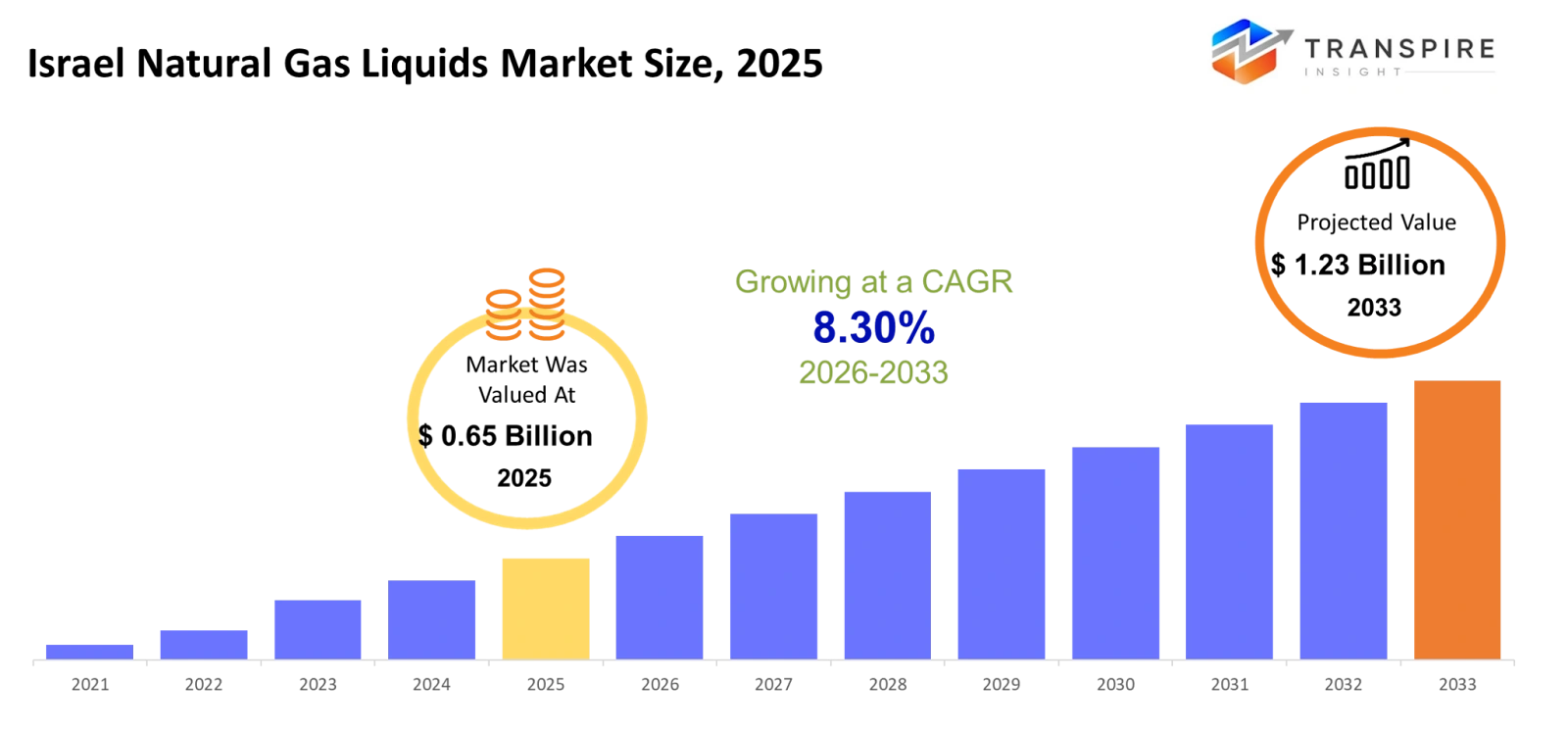
- Israel Natural Gas Liquids Market Size 2025: USD 0.65 Billion
- Israel Natural Gas Liquids Market Size 2033: USD 1.23 Billion
- Israel Natural Gas Liquids Market CAGR: 8.30%
- Israel Natural Gas Liquids Market Segments: By Product Type (Ethane, Propane, Butane, Isobutane, Natural Gasoline), By Application (Petrochemical Feedstock, Residential Fuel, Industrial Fuel), By End-User Industry (Petrochemical Industry, Energy & Utilities, Industrial Sector).
To learn more about this report,  Download Free Sample Report
Israel Natural Gas Liquids Market Summary:
The Israel Natural Gas Liquids Market size is estimated at USD 0.65 Billion in 2025 and is anticipated to reach USD 1.23 Billion by 2033, growing at a CAGR of 8.30% from 2026 to 2033.
The market for natural gas liquids in Israel is part of the country's hydrocarbon and petrochemical sector, which is developing in response to offshore gas discoveries and rising domestic consumption needs. The system will provide energy for residential and industrial purposes, including plastics production and fuel mixture development. Consumers will choose cleaner-burning fuels, leading to improved distribution systems and enhanced safety regulations. Processing facilities will implement cutting-edge separation methods and monitoring systems to improve operational efficiency while reducing environmental waste. The implementation of regulatory policies will establish frameworks for organizations to meet environmental standards and conduct export operations, thereby affecting their capital investment choices. The energy sector will develop a market equilibrium between local power generation and controlled energy resource distribution through increased international energy relationships, which will show how Israel's energy strategies are evolving.
Key Market Trends & Insights:
The market will shift toward greater use of propane and butane in residential and small commercial settings as consumers choose cleaner, portable fuel options. The demand patterns will show two main factors driving purchasing decisions in urban areas: people will choose small energy systems over large ones that cause more environmental damage.
Processing operators will invest in advanced recovery and fractionation technologies to improve output efficiency from existing gas fields. Digital monitoring systems will be adopted to enhance operational control and reduce losses. The upgrades will enable producers to extract maximum value from each gas unit while sustaining their supply delivery standards.
Energy cooperation between regions will create new trade patterns, as neighboring countries purchase the excess liquid resources available. The export contracts will determine how pricing models will be developed and how infrastructure projects will be carried out. The storage and transport networks will develop in multiple phases, creating more efficient distribution systems while addressing capacity issues in both domestic and international supply networks.
Regulatory systems will establish higher environmental protection and safety standards, pushing businesses to implement environmentally friendly manufacturing methods. The government will implement policy changes to help develop new energy infrastructure while maintaining the security of energy resources. The changing regulatory framework will determine how organizations develop their future operations, as it will guide investment decisions and create a consistent business environment that benefits all parties.
Israel Natural Gas Liquids Market Segmentation
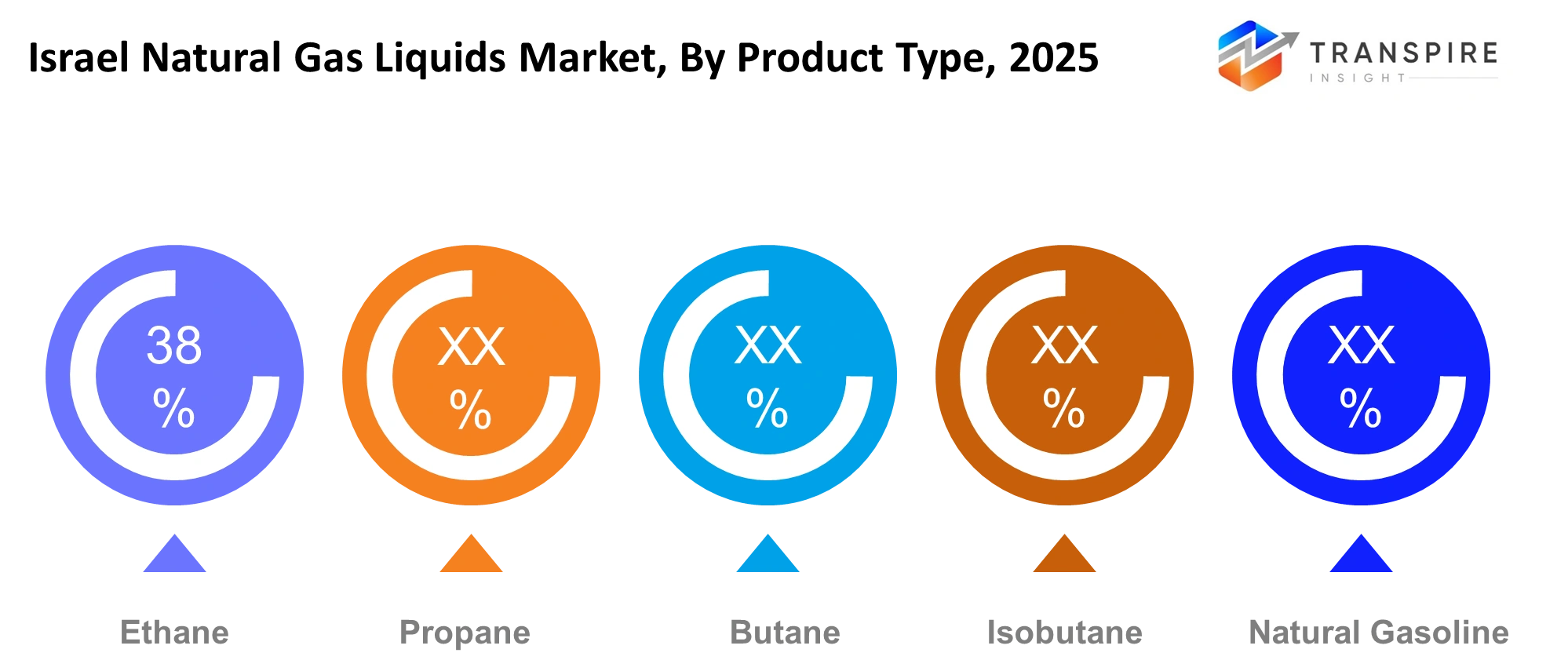
By Product Type
Ethane - The primary function of ethane will be to enable petrochemical manufacturing operations, which focus on producing ethylene. The offshore gas processing operations will provide ethane as a resource which will enhance local chemical production networks because it will enable companies to establish production facilities while decreasing their dependence on imported materials needed for producing polymers and plastics.
Propane - People will continue to use propane for their energy requirements in homes and businesses because it serves as an essential fuel for both cooking and heating purposes. The demand for the product will remain strong because it delivers portable energy solutions which produce cleaner emissions and because people need alternative fuel sources in areas without pipeline networks.
Butane - The domestic market and industrial sector will use butane for two separate purposes which include its use as a blending material in LPG cylinders and its function as a fuel. The product will be useful for small industrial operations and portable power systems because it enables safe storage and versatile use across different power consumption levels.
Isobutane - Refining and petrochemical operations will increasingly depend on isobutane which serves as a vital feedstock for alkylation processes. The production of high-octane fuels and specialty chemicals will become possible through its use which will lead to industrial growth while making refining processes more efficient.
Natural Gasoline - Natural gasoline will serve two purposes, which include fuel blending and petrochemical production. The liquid state of the substance, with its increased energy density will function as a transportation fuel while providing companies and industrial users with export options to regional markets.
To learn more about this report, Download Free Sample Report
By Application
Petrochemical Feedstock - Natural gas liquids serve as vital chemical feedstocks, producing both ethylene and propylene. This application will support domestic manufacturing growth through two benefits which include decreasing import needs and strengthening Israel's status within regional petrochemical supply networks.
Residential Fuel - The residential sector will use fuel for cooking and heating purposes which will benefit areas that lack direct access to gas pipelines. Consumers will choose portable fuel solutions which provide dependable performance along with cost savings and reduced emissions when compared to traditional energy sources.
Industrial Fuel - Industries will use these liquids as alternative fuels for heating and operational processes. The system provides consistent energy output which results in cleaner combustion that helps industries achieve both their environmental targets and their cost reduction goals.
By End-User Industry
Petrochemical Industry - The petrochemical industry will continue to use these liquids as essential raw materials which they need to produce plastic and chemical manufacturing materials. The industry expansion will create more demand which will boost local production capabilities while driving infrastructure development.
Energy & Utilities - Energy providers will utilize natural gas liquids to diversify fuel supply and enhance energy security. The liquids will help manage peak demand while providing backup energy sources which will maintain stable and flexible power generation systems.
Industrial Sector - The various industries will use these liquids for two purposes their operational efficiency and their fuel flexibility. The industrial sector will increasingly use these materials for heating processing and manufacturing because cost factors and cleaner energy needs drive their adoption.
Country Insights
The energy sector of Israel will undergo ongoing changes which will increase its use of domestic gas resources while producing valuable byproducts through the extraction of liquids. The country will achieve self-sufficiency through its offshore reserves which will enable it to cut back on foreign energy needs and build its domestic power capacity while fueling industrial growth in gas-related operations.
The patterns of urban consumption will determine how distribution systems should be developed because urban centers need storage solutions which can efficiently move products to customers. The need for bottled gas will remain constant because both households and small businesses continue to require this product. The infrastructure improvements will create better safety measures while making it easier to reach services and ensuring that all areas receive equal delivery of essential products.
The industrial sector will experience rising demand for liquids because of upcoming petrochemical and manufacturing advancements which will use these liquids in their production operations. Local industries will seek reliable feedstock availability, encouraging investments in processing capacity. The country will achieve stronger economic growth through this energy supply alignment which enables industrial development and decreases need for foreign resources.
The government will establish the future development of the country through its environmental policies and its international trade regulations. The authorities will establish a system which protects internal energy needs while allowing for cross-border trading because they want to guarantee reliable energy distribution while investigating new business agreements. The development of regulatory clarity will lead to effective energy system development because it will help both private and public sector investments establish organized energy systems which operate efficiently.
Recent Development News
Geopolitical Disruptions Impacting Gas and Liquids Supply- The current Middle Eastern tensions have caused Israel to stop its energy activities because of security issues that forced them to shut down their essential offshore facilities. Uncertainty about production levels has created problems for supply reliability which will lead to problems with the output of connected liquid products. The disruptions demonstrate that operational choices as well as temporary market trends continue to be influenced by geopolitical dangers.
Regional Conflict Driving Energy Market Volatility- The ongoing conflict between Israel and its neighboring countries has caused major disruptions to energy infrastructure throughout the region which resulted in both price changes and supply issues. These events have created uncertainty in global gas flows which indirectly influences liquid extraction and trade. The situation demonstrates that external shocks continue to determine how prices change and how supply networks operate.
|
Report Metrics |
Details |
|
Market size value in 2025 |
USD 0.65 Billion |
|
Market size value in 2026 |
USD 0.704 Billion |
|
Revenue forecast in 2033 |
USD 1.23 Billion |
|
Growth rate |
CAGR of 8.30% from 2026 to 2033 |
|
Base year |
2025 |
|
Historical data |
2021 – 2024 |
|
Forecast period |
2026 – 2033 |
|
Report coverage |
Revenue forecast, competitive landscape, growth factors, and trends |
|
Country scope |
Israel |
|
Key company profiled |
ExxonMobil Corporation, Chevron Corporation, Royal Dutch Shell plc, BP plc, TotalEnergies SE, Saudi Aramco, QatarEnergy, ConocoPhillips, Phillips 66 Company, Marathon Petroleum Corporation, Occidental Petroleum Corporation, Eni S.p.A., Equinor ASA, Gazprom PJSC, Reliance Industries Ltd. |
|
Customization scope |
Free report customization (country, regional & segment scope). Avail customized purchase options to meet your exact research needs. |
|
Report Segmentation |
By Product Type (Ethane, Propane, Butane, Isobutane, Natural Gasoline), By Application (Petrochemical Feedstock, Residential Fuel, Industrial Fuel), By End-User Industry (Petrochemical Industry, Energy & Utilities, Industrial Sector). |
Key Israel Natural Gas Liquids Market Company Insights
The main businesses in the Israeli natural gas liquids industry will work to improve their capacity to extract, refine, and distribute natural gas resources obtained from offshore gas sites. The primary market participants will establish new business alliances, develop new advanced separation technologies, and build new facilities. The organization of their business operations will focus on maintaining steady domestic resources while choosing specific export items and meeting all regulatory requirements to deliver reliable results that satisfy industrial and energy sector needs.
Company List
- ExxonMobil Corporation
- Chevron Corporation
- Royal Dutch Shell plc
- BP plc
- TotalEnergies SE
- Saudi Aramco
- QatarEnergy
- ConocoPhillips
- Phillips 66 Company
- Marathon Petroleum Corporation
- Occidental Petroleum Corporation
- Eni S.p.A.
- Equinor ASA
- Gazprom PJSC
- Reliance Industries Ltd
Israel Natural Gas Liquids Market Report Segmentation
By Product Type
- Ethane
- Propane
- Butane
- Isobutane
- Natural Gasoline
By Application
- Petrochemical Feedstock
- Residential Fuel
- Industrial Fuel
By End-User Industry
- Petrochemical Industry
- Energy & Utilities
- Industrial Sector
Frequently Asked Questions
Find quick answers to common questions.
The approximate Israel Natural Gas Liquids Market size for the market will be USD 1.23 Billion in 2033.
Key segments for the Israel Natural Gas Liquids Market By Product Type (Ethane, Propane, Butane, Isobutane, Natural Gasoline), By Application (Petrochemical Feedstock, Residential Fuel, Industrial Fuel), By End-User Industry (Petrochemical Industry, Energy & Utilities, Industrial Sector).
Major players in the Israel Natural Gas Liquids Market are ExxonMobil Corporation, Chevron Corporation, Royal Dutch Shell plc, BP plc, TotalEnergies SE, Saudi Aramco, QatarEnergy, ConocoPhillips, Phillips 66 Company, Marathon Petroleum Corporation, Occidental Petroleum Corporation, Eni S.p.A., Equinor ASA, Gazprom PJSC, Reliance Industries Ltd.
The Israel Natural Gas Liquids Market size is USD 0.65 Billion in 2025.
The Israel Natural Gas Liquids Market CAGR is 8.30%.
- ExxonMobil Corporation
- Chevron Corporation
- Royal Dutch Shell plc
- BP plc
- TotalEnergies SE
- Saudi Aramco
- QatarEnergy
- ConocoPhillips
- Phillips 66 Company
- Marathon Petroleum Corporation
- Occidental Petroleum Corporation
- Eni S.p.A.
- Equinor ASA
- Gazprom PJSC
- Reliance Industries Ltd
Recently Published Reports
-
Apr 2026
Active Power Filter Market
Active Power Filter Market Size, Share & Analysis Report By Type (Shunt Active Power Filters, Series Active Power Filter, Hybrid Active Power Filter), By Application (Harmonics Mitigation, Reactive Power Compensation, Voltage Regulation, Power Factor Correction), By Phase (Single Phase, Three Phase), By End-User Industry (Manufacturing, Healthcare, Commercial, Automotive, Oil and Gas, Others), and Geography (North America, Europe, Asia-Pacific, Middle East and Africa, South and Central America), 2021 - 2031
-
Apr 2026
Electrical Transformer Market
Electrical Transformer Market Size, Share & Analysis Report By Core (Closed, Shell, and Berry), By Insulation (Gas, Oil, Solid, Air, and Other), By Phase (Single, and Three), By Rating (100 MVA to 500 MVA, 501 MVA to 800 MVA, and 801 MVA to 1200 MVA), and Geography (North America, Europe, Asia-Pacific, Middle East and Africa, South and Central America), 2021 – 2031
-
Apr 2026
Hydraulic Piston Pumps Market
Hydraulic Piston Pumps Market Size, Share & Analysis Report By Type (Axial Piston Pumps, Radial Piston Pumps), By Operating Pressure (Low Pressure, Medium Pressure, High Pressure), By Application (Construction, Mining, Agriculture, Automotive, Oil & Gas, Industrial Machinery, Others), By End-User (OEMs, Aftermarket), and Geography (North America, Europe, Asia-Pacific, Middle East and Africa, South and Central America), 2021 – 2031
-
Apr 2026
Laboratory Gas Generators Market
Laboratory Gas Generators Market Size, Share & Analysis Report By Product (Nitrogen Gas Generator, Hydrogen Gas Generator, Zero Air Gas Generator, Purge Gas Generator, TOC Gas Generators, Others), By Application (Gas Chromatography, Liquid Chromatography-mass Spectrometry (LC-MS), Gas Analyzers, Others), By End-user (Life Science, Chemical & Petrochemical, Food & Beverage, Others), and Geography (North America, Europe, Asia-Pacific, Middle East and Africa, South and Central America), 2021 – 2031