

United States Liquefied Petroleum Gas (LPG) Market Size & Forecast:
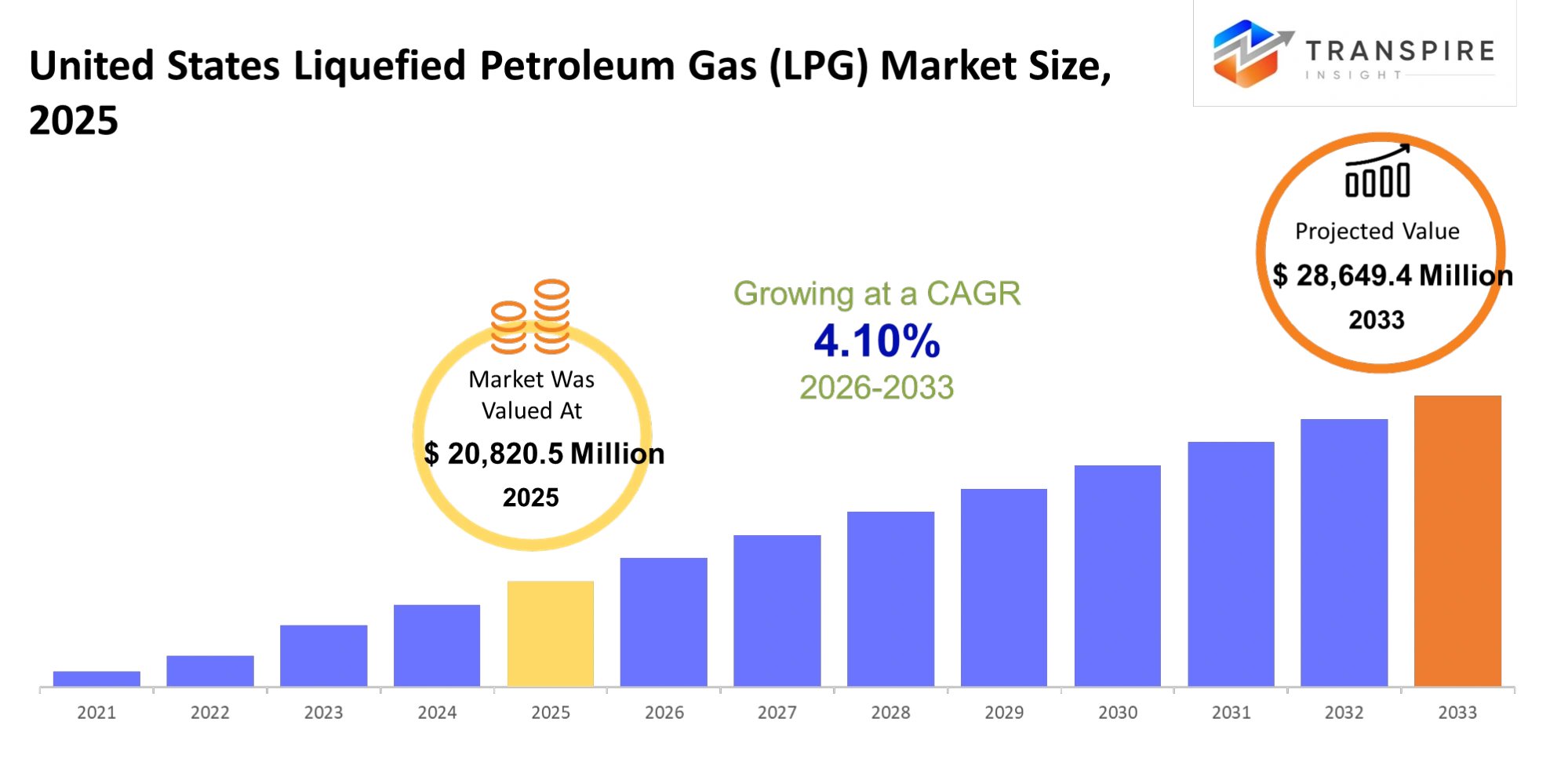
- United States Liquefied Petroleum Gas (LPG) Market Size 2025: USD 20820.5 Million
- United States Liquefied Petroleum Gas (LPG) Market Size 2033: USD 28649.4 Million
- United States Liquefied Petroleum Gas (LPG) Market CAGR: 4.10%
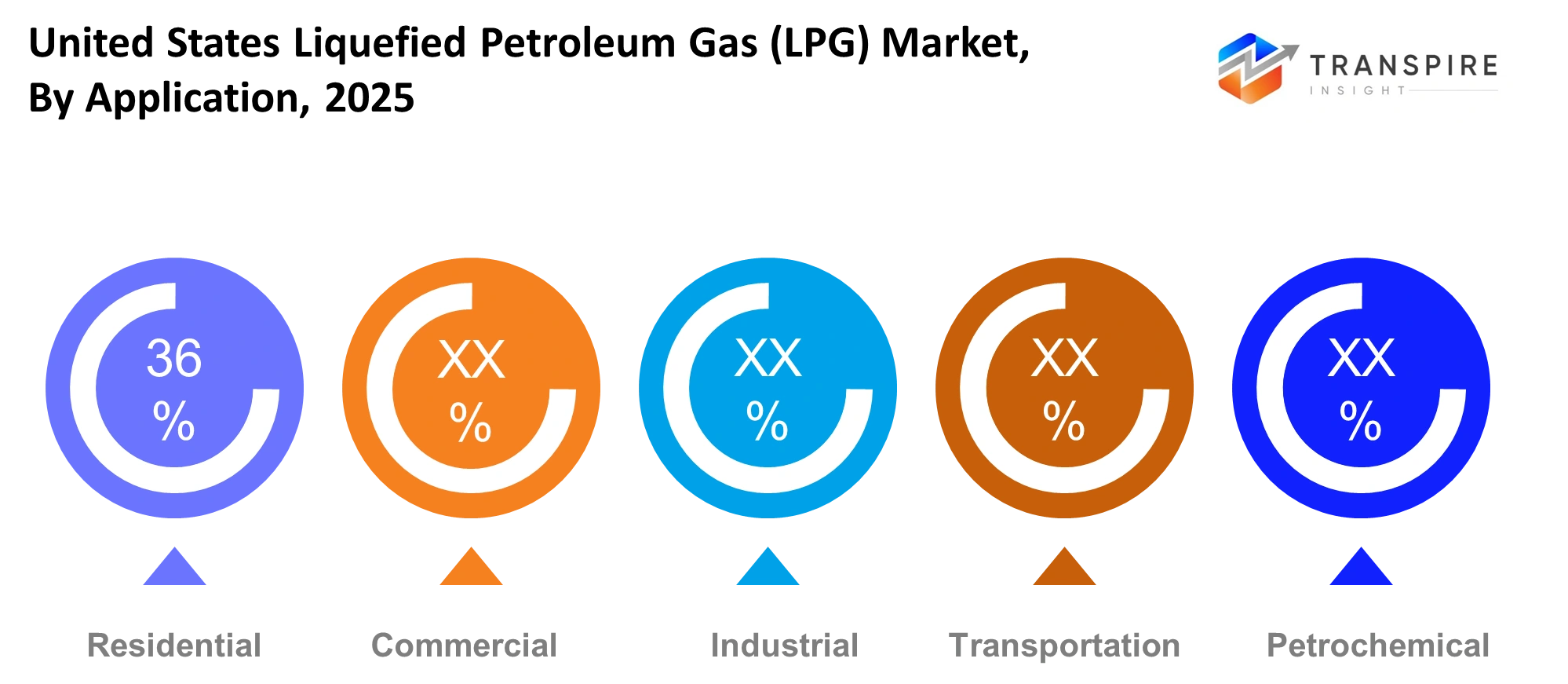
- United States Liquefied Petroleum Gas (LPG) Market Segments: By Source (Refineries, Associated Gas, Non-Associated Gas), By Application (Residential, Commercial, Industrial, Transportation, Petrochemical).
To learn more about this report,  Download Free Sample Report
United States Liquefied Petroleum Gas (LPG) Market Summary:
The United States Liquefied Petroleum Gas (LPG) Market size is estimated at USD 20820.5 Million in 2025 and is anticipated to reach USD 28649.4 Million by 2033, growing at a CAGR of 4.10% from 2026 to 2033. The United States Liquefied Petroleum Gas (LPG) market continues to show steady growth because residential and commercial and industrial sectors have increasing demand for LPG. Commonly used for heating and cooking and as an alternative fuel, LPG delivers cleaner energy that provides flexible usage options. The growing demand for energy efficiency solutions, together with decreased emissions requirements, drives higher acceptance of this technology. The market demonstrates both reliable performance and growth potential because it has developed strong infrastructure and its export capabilities continue to expand, which makes LPG essential to the country's changing energy system.
Key Market Trends & Insights:
- LPG is being recognised as a cleaner fuel option that burns more safely than coal and oil. The fuel attracts households and industries because it produces fewer carbon emissions, which helps them achieve their goals of decreasing environmental harm.
- People continue to need LPG for their needs in heating and cooking and water heating. LPG serves as the primary energy source for many rural and off-grid communities because of its availability and simple storage options.
- The U.S. has established itself as a leading LPG exporter because of its abundant shale gas resources. The rising demand from Asian markets has created new international trade opportunities for companies.
- The company improves its supply operations through ongoing development of storage facilities and transportation systems. The system guarantees product availability during periods of increased customer demand.
- LPG has become a popular fuel choice for vehicles through its use as autogas. Fleet operators and environmentally aware consumers find its emissions reduction and cost advantages to be an attractive solution.
- LPG prices move following the changes that occur in crude oil and natural gas prices. The market will experience stability problems because of this, and consumer behaviour will change according to it.
United States Liquefied Petroleum Gas (LPG) Market Segmentation
By Source
- Refineries: LPG from refineries functions as a stable and trustworthy commodity which exists in the United States market. The material exists as a byproduct from the process of refining crude oil, which utilises existing infrastructure to deliver its output. The segment ensures continuous domestic supply, which provides essential product availability to all business sectors that require it.
- Associated Gas: Associated gas, which becomes available through combined extraction methods for crude oil, now functions as an increasing source for LPG production. The source has become essential because of the growing exploration efforts for oil resources. The system enables industrial operations to reduce expenses while expanding capacity to fulfil both rising domestic needs and growing international trade requirements.
- Non-Associated Gas: Non-associated gas, which comes from dedicated natural gas fields, serves as an essential source for producing LPG. The system delivers two key advantages through its ability to provide flexible and expandable supply options. The U.S. natural gas exploration sector works to maintain steady LPG production, which supports permanent market expansion in this industry.
By Application
- Residential: The residential sector uses LPG for cooking and heating and water heating purposes. The fuel serves as the preferred option for people who live in rural areas and areas without electrical power because of its convenient and efficient performance. The segment maintains steady demand because it offers affordable and portable and cleaner-burning fuel options that outperform traditional fuels.
- Commercial: The commercial segment uses LPG throughout its operational activities at restaurants and hotels and small businesses. The system provides operational dependability, which enables it to function normally during commercial activities. Businesses use LPG because it delivers energy savings together with financial savings which enable them to conduct various commercial operations.
- Industrial: Industrial operations use LPG for metal cutting and heating and manufacturing processes. The fuel operates at a high calorific value because its combustion process produces clean energy, which makes it fit for accurate operations. LPG serves as the preferred choice for industries because it delivers efficient performance while enabling them to achieve their environmental compliance requirements and maintain operational efficiency.
- Transportation: The transportation industry uses LPG as an automotive fuel which people refer to as autogas. The fuel delivers a budget-friendly solution which produces fewer emissions when compared to petrol and diesel. The adoption process is moving forward at a slow pace, but fleet operators who want to save fuel expenses and protect the environment have started using the technology.
- Petrochemical: The petrochemical industry uses LPG as a primary feedstock which produces chemicals such as ethylene and propylene. The material provides essential support to the industries that follow it. The market demand for plastics and chemical goods has created an expansion in this segment which strengthens LPG's position throughout the value chain.
To learn more about this report, Download Free Sample Report
Country Insights
The United States Liquefied Petroleum Gas (LPG) market shows established energy development through its capacity to produce various energy sources which meet multiple market requirements. The country has become a top LPG producer and exporter because of its abundant shale resources. The domestic market maintains constant demand because people use it for residential heating purposes and industrial applications and to explore cleaner fuel options.
Rural areas continue to depend heavily on LPG because they lack access to natural gas pipelines, but urban markets use LPG for its various commercial and industrial purposes. The Gulf Coast export terminal expansion has increased US international market presence, especially in Asian and European regions.
The market's resiliency receives improvement through regulatory backing of cleaner energy solutions and continuous development of necessary infrastructure. The US LPG market maintains equilibrium between strong domestic consumption and rising international business prospects, which makes it essential to the country’s overall energy system.
Recent Development News
U.S. Energy Exporters Benefit from Global Crisis: Rising geopolitical tensions have boosted demand for U.S. energy exports, including LPG. American suppliers are increasingly seen as stable partners in uncertain markets.
U.S. LPG Cargo Expands Trade with Asia: A major LPG shipment from Texas to India reflects growing export ties. This highlights the U.S. role in meeting global energy demand.
|
Report Metrics |
Details |
|
Market size value in 2025 |
USD 20820.5 Million |
|
Market size value in 2026 |
USD 21631.7 Million |
|
Revenue forecast in 2033 |
USD 28649.4 Million |
|
Growth rate |
CAGR of 4.10% from 2026 to 2033 |
|
Base year |
2025 |
|
Historical data |
2021 – 2024 |
|
Forecast period |
2026 – 2033 |
|
Report coverage |
Revenue forecast, competitive landscape, growth factors, and trends |
|
Country scope |
United States |
|
Key company profiled |
ExxonMobil Corporation, Chevron Corporation, Phillips 66, Valero Energy Corporation, BP PLC, Shell PLC, ConocoPhillips, Marathon Petroleum Corporation, Enterprise Products Partners LP, Kinder Morgan Inc., Suburban Propane Partners LP, AmeriGas Propane Inc., Ferrellgas Partners LP, UGI Corporation, Plains All American Pipeline LP. |
|
Customization scope |
Free report customization (country, regional & segment scope). Avail customized purchase options to meet your exact research needs. |
|
Report Segmentation |
By Source (Refineries, Associated Gas, Non-Associated Gas), By Application (Residential, Commercial, Industrial, Transportation, Petrochemical). |
Key United States Liquefied Petroleum Gas (LPG) Company Insights
The United States Liquefied Petroleum Gas (LPG) market uses both major energy corporations and local distribution companies to create its operational structure. Companies focus on strengthening supply chains while expanding storage capacity and improving distribution networks to achieve their objectives of handling constant customer requirements. The industry participants are making investments into export facilities because they want to take advantage of the rising international market prospects. The establishment of strategic partnerships together with technological advancements and customer-focused service delivery has become the primary method which companies use to establish their market differentiation. Companies compete with each other through their operational methods because they want to survive in a market environment which keeps changing at a fast pace.
Company List
- ExxonMobil Corporation
- Chevron Corporation
- Phillips 66
- Valero Energy Corporation
- BP PLC
- Shell PLC
- ConocoPhillips
- Marathon Petroleum Corporation
- Enterprise Products Partners LP
- Kinder Morgan Inc.
- Suburban Propane Partners LP
- AmeriGas Propane Inc.
- Ferrellgas Partners LP
- UGI Corporation
- Plains All American Pipeline LP.
United States Liquefied Petroleum Gas (LPG) Market Report Segmentation
By Source
- Refineries
- Associated Gas
- Non-Associated Gas
By Application
- Residential
- Commercial
- Industrial
- Transportation
- Petrochemical
Frequently Asked Questions
Find quick answers to common questions.
The approximate United States Liquefied Petroleum Gas (LPG) Market size for the market will be USD 28649.4 Million in 2033.
The key segments of the United States Liquefied Petroleum Gas (LPG) Market are By Source (Refineries, Associated Gas, Non-Associated Gas), By Application (Residential, Commercial, Industrial, Transportation, Petrochemical).
Major players in the United States Liquefied Petroleum Gas (LPG) Market are ExxonMobil Corporation, Chevron Corporation, Phillips 66, Valero Energy Corporation, BP PLC, Shell PLC, ConocoPhillips, Marathon Petroleum Corporation, Enterprise Products Partners LP, Kinder Morgan Inc., Suburban Propane Partners LP, AmeriGas Propane Inc., Ferrellgas Partners LP, UGI Corporation, Plains All American Pipeline LP.
The current market size of the United States Liquefied Petroleum Gas (LPG) Market is USD 20820.5 Million in 2025.
The United States Liquefied Petroleum Gas (LPG) Market CAGR is 4.10%.
- ExxonMobil Corporation
- Chevron Corporation
- Phillips 66
- Valero Energy Corporation
- BP PLC
- Shell PLC
- ConocoPhillips
- Marathon Petroleum Corporation
- Enterprise Products Partners LP
- Kinder Morgan Inc.
- Suburban Propane Partners LP
- AmeriGas Propane Inc.
- Ferrellgas Partners LP
- UGI Corporation
- Plains All American Pipeline LP.
Recently Published Reports
-
Apr 2026
Active Power Filter Market
Active Power Filter Market Size, Share & Analysis Report By Type (Shunt Active Power Filters, Series Active Power Filter, Hybrid Active Power Filter), By Application (Harmonics Mitigation, Reactive Power Compensation, Voltage Regulation, Power Factor Correction), By Phase (Single Phase, Three Phase), By End-User Industry (Manufacturing, Healthcare, Commercial, Automotive, Oil and Gas, Others), and Geography (North America, Europe, Asia-Pacific, Middle East and Africa, South and Central America), 2021 - 2031
-
Apr 2026
Electrical Transformer Market
Electrical Transformer Market Size, Share & Analysis Report By Core (Closed, Shell, and Berry), By Insulation (Gas, Oil, Solid, Air, and Other), By Phase (Single, and Three), By Rating (100 MVA to 500 MVA, 501 MVA to 800 MVA, and 801 MVA to 1200 MVA), and Geography (North America, Europe, Asia-Pacific, Middle East and Africa, South and Central America), 2021 – 2031
-
Apr 2026
Hydraulic Piston Pumps Market
Hydraulic Piston Pumps Market Size, Share & Analysis Report By Type (Axial Piston Pumps, Radial Piston Pumps), By Operating Pressure (Low Pressure, Medium Pressure, High Pressure), By Application (Construction, Mining, Agriculture, Automotive, Oil & Gas, Industrial Machinery, Others), By End-User (OEMs, Aftermarket), and Geography (North America, Europe, Asia-Pacific, Middle East and Africa, South and Central America), 2021 – 2031
-
Apr 2026
Laboratory Gas Generators Market
Laboratory Gas Generators Market Size, Share & Analysis Report By Product (Nitrogen Gas Generator, Hydrogen Gas Generator, Zero Air Gas Generator, Purge Gas Generator, TOC Gas Generators, Others), By Application (Gas Chromatography, Liquid Chromatography-mass Spectrometry (LC-MS), Gas Analyzers, Others), By End-user (Life Science, Chemical & Petrochemical, Food & Beverage, Others), and Geography (North America, Europe, Asia-Pacific, Middle East and Africa, South and Central America), 2021 – 2031