
Germany Textile Market Size & Forecast:
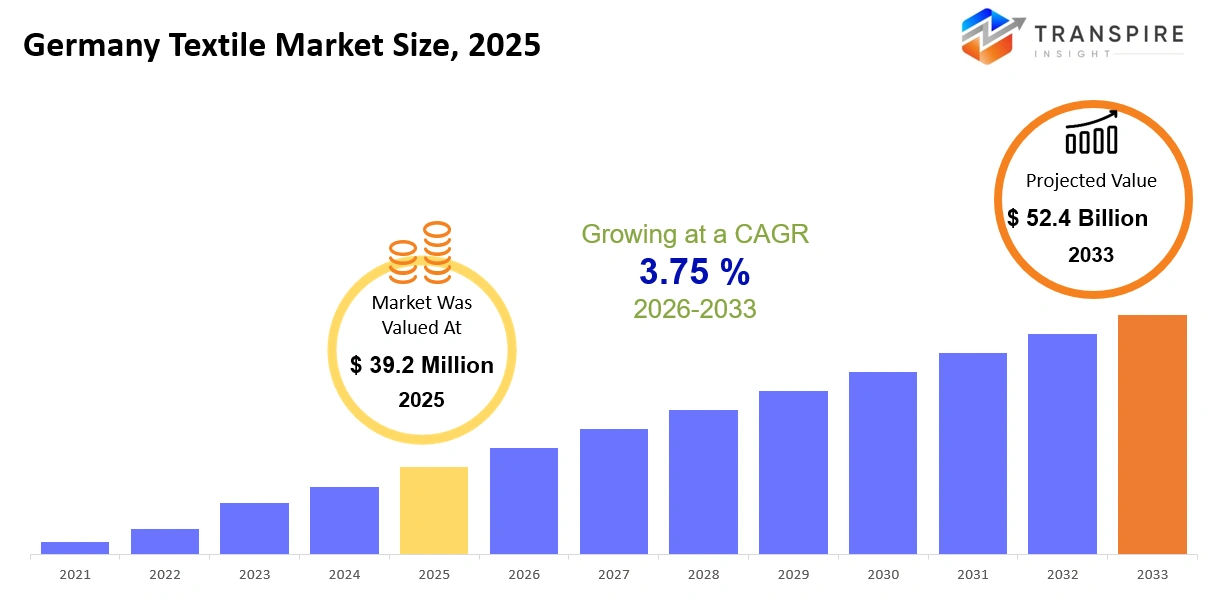
- Germany Textile Market Size 2025: USD 39.2 Million
- Germany Textile Market Size 2033: USD 52.4 Million
- Germany Textile Market CAGR: 3.75%
- Germany Textile Market Segments: By Product Type (Apparel Textiles, Home Textiles, Technical Textiles), By Material (Natural Fibers, Synthetic Fibers, Blended Fibers), By Distribution Channel (Online Retail, Offline Retail)
To learn more about this report,  Download Free Sample Report
Germany Textile Market Summary:
The Germany Textile Market size is estimated at USD 39.2 Million in 2025 and is anticipated to reach USD 52.4 Million by 2033, growing at a CAGR of 3.75 % from 2026 to 2033. The German textile industry operates as a fully established sector which produces clothing products and home textiles and technical textiles and all related market segments while generating annual revenue that exceeds 10 billion euros and competes with international markets through its substantial export business. Germany stands as one of the top global textile exporters because the country sells $37.8 billion worth of textiles to European and international markets while bringing in shipments from major producer nations such as China and Bangladesh and Turkey and Italy and Vietnam. The fashion textile market shows continuous development because it produced more than $60 billion in revenue during 2022 and customer needs and sustainable practices and new technical fabric developments are expected to drive market growth until 2030. The domestic textile industry concentrates on producing high-grade materials which use cutting-edge technology whereas consumers now prefer products which meet environmental standards and support sustainability practices.
Key Market Trends & Insights:
- Technical and Innovative Textiles: Technical textiles which various industries use in automotive and construction and healthcare and sports applications have emerged as the main force driving market expansion.
- Sustainability and Circular Economy: The manufacturing industry now uses resource-efficient production methods which follow sustainability principles and implement circular economy approaches. The industry is shifting away from linear “take-make-dispose” models toward closed-loop systems which use recycling and eco-friendly materials and digital tools to enhance resource efficiency while decreasing environmental damage.
- Digitalisation and Advanced Manufacturing: Digital technologies including AI manufacturing platforms and smart textile innovations are changing the entire German textile production process. Textile Factory 7.0 targets the combination of digital technology with automation and sustainable methods to boost competitiveness and productivity for both domestic and export business operations.
Germany Textile Market Segmentation
By Product Type
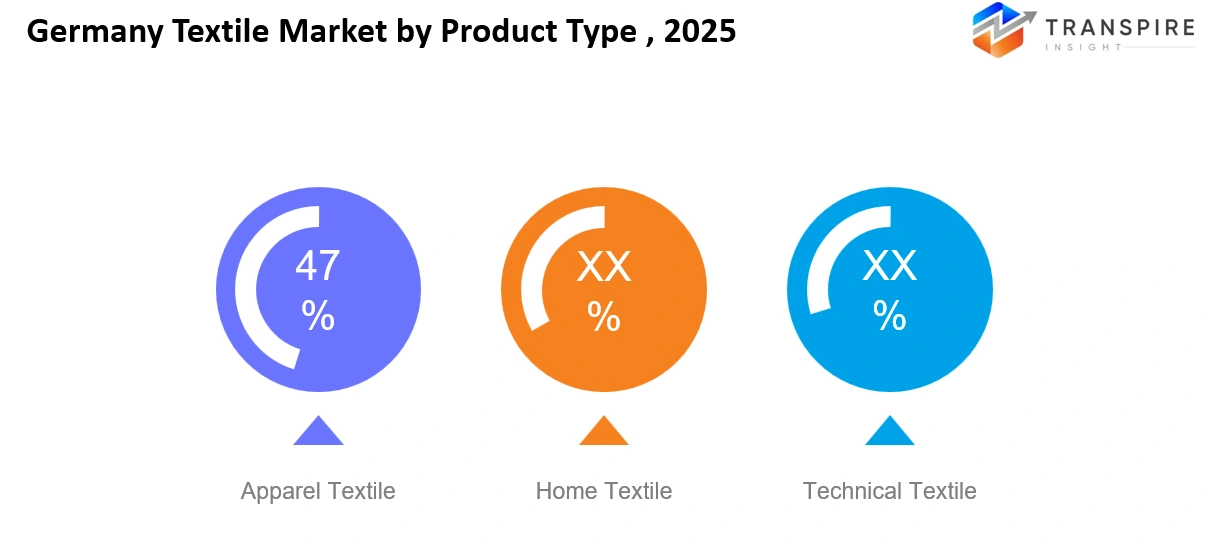
Apparel Textiles- Apparel textiles represent a major share of Germany's textile market which includes fabrics used for shirts trousers sportswear and fashion garments. Fashion trends and premium quality standards and sustainability initiatives drive demand while domestic and export markets create strong demand.
Home Textiles- Home textiles include products like bed linens, curtains, carpets, upholstery fabrics, towels, and decorative textiles. The growing housing development together with interior decoration trends and consumer preference for comfort and durability and eco-friendly fabrics has created ongoing demand for products.
Technical Textiles- Technical textiles are high-performance fabrics used in industrial sectors such as automotive, healthcare, construction, agriculture, and protective clothing. Germany maintains its position as the leading global center for technical textile innovation through its advanced research and development capabilities together with its superior manufacturing technologies.
To learn more about this report, Download Free Sample Report
By Material
Natural Fibers- The German textile industry depends on natural fibers which include cotton, wool, linen, and silk because these materials provide comfort and breathability while offering sustainable advantages. The rising environmental awareness among people today leads to increased interest in organic products and biodegradable fiber materials.
Synthetic Fibers- Synthetic fibers including polyester and nylon and acrylic and polypropylene materials have become popular because they offer durability and cost efficiency and versatile applications. The materials find their primary use in technical textiles and sportswear and industrial applications which need strong and high-performance materials.
Blended Fibers- Blended fibers combine natural and synthetic materials which enhance the strength, durability, comfort, and flexibility of fabrics. German manufacturers use blends extensively in apparel and technical textiles to achieve balanced performance and cost efficiency.
By Distribution Channel
Online Retail- Germany's textile market experiences fast online retail growth because e-commerce provides customers with convenient access to a wide range of products which they can purchase at competitive rates. The digital platforms enable consumers to perform product comparisons while they use the platforms to purchase products directly from brands.
Offline Retail- Physical retail stores operate through their brick-and-mortar establishments which include supermarkets and specialty textile stores and brand shops. In-store shopping remains the preferred method for many consumers who want to assess textile products through their fabric quality and comfort and fit before they decide to buy.
Country Insights
Germany maintains its textile manufacturing heritage through three essential elements: modern technological systems, expert workforce, and research facilities. The country focuses on high-quality textiles, especially technical fabrics used in automotive, healthcare, construction, and industrial applications.
The German textile industry has made sustainability its primary goal. The textile companies in Germany now produce their products through environmentally friendly methods. The companies use recycled fibers to create their products. The companies in the industry implement circular economy practices to produce their products.
Germany serves as a vital component of the European textile market. The country exports technical textiles and specialty fabrics, which have high value. The country imports apparel and raw materials from Asian and European manufacturing countries.
The German textile market experiences growth through two main factors. The first factor includes ongoing product development activities. The second factor includes strong demand from the industrial sector. Companies can enhance their productivity and business performance through investments in three areas. Businesses can accomplish better results through their investments in automated systems and digital manufacturing solutions and smart textile technology.
Recent Development News
- Germany is developing Textile Factory 7.0 which serves as a research center that creates AI and robotics and energy-efficient production methods and biotechnology solutions for textile manufacturing. The project intends to create sustainable innovations which will improve Germany's ability to compete with other nations.
- The fast-fashion waste problem is being addressed by policymakers who plan to create a new textile law that requires brands to pay for the expenses linked to collecting and recycling and reusing their used clothing. The industry now pays more attention to sustainability practices which support circular economy models.
|
Report Metrics |
Details |
|
Market size value in 2025 |
USD 39.2 Million |
|
Market size value in 2026 |
USD 40.5 Million |
|
Revenue forecast in 2033 |
USD 52.4 Million |
|
Growth rate |
CAGR of 3.75% from 2026 to 2033 |
|
Base year |
2025 |
|
Historical data |
2021 – 2024 |
|
Forecast period |
2026 – 2033 |
|
Report coverage |
Revenue forecast, competitive landscape, growth factors, and trends |
|
Country scope |
Germany |
|
Key company profiled |
Adidas AG, Puma SE, Hugo Boss AG, H&M Group, Inditex Group (Zara), Nike Inc., LVMH Group, PVH Corp., Fast Retailing (Uniqlo), VF Corporation, Under Armour Inc., Levi Strauss & Co., Decathlon Group, Esprit Holdings, Bestseller Group. |
|
Customization scope |
Free report customization (country, regional & segment scope). Avail customized purchase options to meet your exact research needs. |
|
Report Segmentation |
By Product Type (Apparel Textiles, Home Textiles, Technical Textiles), By Material (Natural Fibers, Synthetic Fibers, Blended Fibers), By Distribution Channel (Online Retail, Offline Retail). |
Key Germany Textile Market Company Insights
Germany's textile market shows industrial strength because it uses advanced technologies to develop technical textiles. The market benefits from three factors which include innovative solutions, sustainable development efforts, and high manufacturing quality standards. The market experiences constant growth because automotive and healthcare and fashion industries continue to expand their e-commerce distribution networks.
Company List
- Adidas AG
- Puma SE
- Hugo Boss AG
- H&M Group
- Inditex Group (Zara), Nike Inc.
- LVMH Group
- PVH Corp.
- Fast Retailing (Uniqlo)
- VF Corporation
- Under Armour Inc.
- Levi Strauss & Co.
- Decathlon Group
- Esprit Holdings
- Bestseller Group
Germany Textile Market Report Segmentation
Product Type
- Apparel Textiles
- Home Textiles
- Technical Textiles
Material
- Natural Fibers
- Synthetic Fibers
- Blended Fibers
Distribution Channel
- Online Retail
- Offline Retail
Frequently Asked Questions
Find quick answers to common questions.
The approximate Germany Textile Market size for the Market will be USD 52.4 Million in 2033.
Key segments for the Germany Textile Market By Product Type (Apparel Textiles, Home Textiles, Technical Textiles), By Material (Natural Fibers, Synthetic Fibers, Blended Fibers), By Distribution Channel (Online Retail, Offline Retail).
Major players in the Germany Textile Market are Adidas AG, Puma SE, Hugo Boss AG, H&M Group, Inditex Group (Zara), Nike Inc., LVMH Group, PVH Corp., Fast Retailing (Uniqlo), VF Corporation, Under Armour Inc., Levi Strauss & Co., Decathlon Group, Esprit Holdings, Bestseller Group.
The Germany Textile Market size is USD 39.2 Million in 2025.
The Germany Textile Market CAGR is 3.75%.
- Adidas AG
- Puma SE
- Hugo Boss AG
- H&M Group
- Inditex Group (Zara), Nike Inc.
- LVMH Group
- PVH Corp.
- Fast Retailing (Uniqlo)
- VF Corporation
- Under Armour Inc.
- Levi Strauss & Co.
- Decathlon Group
- Esprit Holdings
- Bestseller Group
Recently Published Reports
-
Apr 2026
Healthcare Polymer Packaging Market
Healthcare Polymer Packaging Market Size, Share & Analysis Report By Packaging Type (Syringes, IV Bottles and Pouches, Clamshells, Blisters, Bottles & Jars, Containers, Tubes, IV Parental Packaging, Others), By Type (Regulated, Non-regulated), By Polymer Type (LDPE (Low-Density Polyethylene), HDPE (High-Density Polyethylene), Homo-polymer (Homo), Random Copolymer (Random), Block Copolymer (Block), PET, Polystyrene, Polyvinyl Chloride, Polyamide/EVOH, Others), and Geography (North America, Europe, Asia-Pacific, Middle East and Africa, South and Central America), 2021 - 2031
-
Apr 2026
Hydrophilic Tape (Waterstop) Market
Hydrophilic Tape (Waterstop) Market Size, Share & Analysis Report By Type (Bentonite-Based Hydrophilic Tape, Rubber-Based Hydrophilic Tape), By Application (Residential Buildings, Commercial Buildings, Infrastructure Projects), and Geography (North America, Europe, Asia-Pacific, Middle East and Africa, South and Central America), 2021 - 2031
-
Apr 2026
Metalens Market
Metalens Market Size, Share & Analysis Report By Type (Visible Light Metalens, and Infrared Metalens), By Application (Consumer Electronics, Automotive Electronics, Industrial, Medical, and Others), and Geography (North America, Europe, Asia-Pacific, Middle East and Africa, South and Central America), 2021 - 2031
-
Apr 2026
PBT Resin Market
PBT Resin Market Size, Share & Analysis Report By Type (Reinforced PBT Resin, Unreinforced PBT Resin), By Processing Method (Injection Molding, Extrusion, Blow Molding, Others), By End-User (Automotive, Electrical & Electronics, Consumer Appliances, Industrial Machinery, Medical Devices, Packaging, Others), and Geography (North America, Europe, Asia-Pacific, Middle East and Africa, South and Central America), 2021 - 2031