
Global MS Polymer Hybrid Adhesives and Sealants Market Size & Forecast:
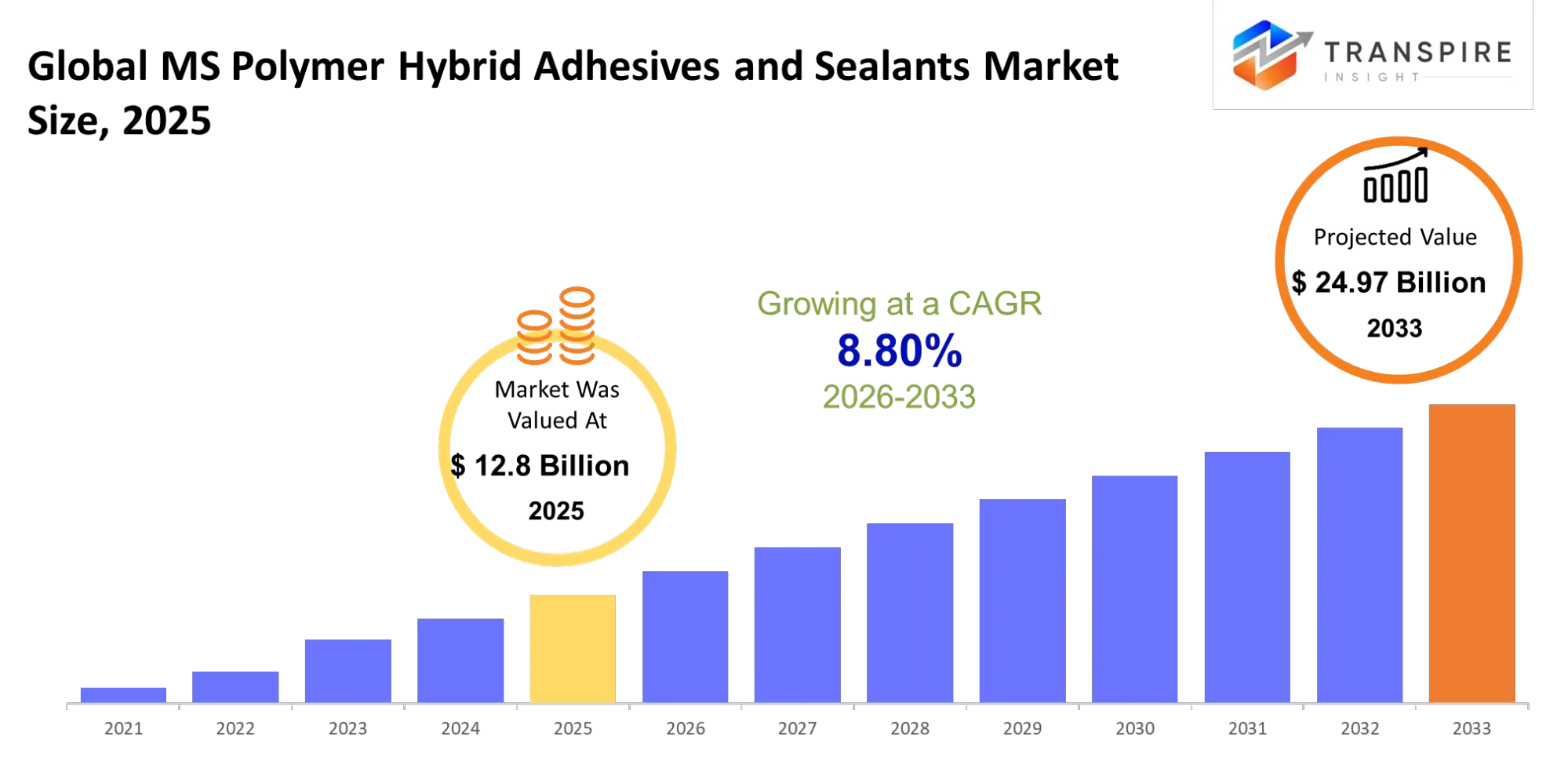
- Global MS Polymer Hybrid Adhesives and Sealants Market Size 2025: USD 12.8 Billion
- Global MS Polymer Hybrid Adhesives and Sealants Market Size 2033: USD 24.97 Billion
- Global MS Polymer Hybrid Adhesives and Sealants Market CAGR: 8.80%
- Global MS Polymer Hybrid Adhesives and Sealants Market Segments: By Type (Construction Adhesives, Industrial Sealants, Automotive Adhesives, Waterproofing Sealants, Flexible Hybrid Adhesives, High-strength Bonding Sealants, Others); By Application (Building & Construction, Automotive Assembly, Marine Applications, Industrial Manufacturing, Electronics Assembly, Others); By End-User (Construction Companies, Automotive OEMs, Industrial Manufacturers, Others); By Form (Paste Form, Liquid Form, Cartridge-based Sealants, Others)
To learn more about this report,  Download Free Sample Report
Global MS Polymer Hybrid Adhesives and Sealants Market Summary:
The Global MS Polymer Hybrid Adhesives and Sealants Market size is estimated at USD 12.8 billion in 2025 and is anticipated to reach USD 24.97 billion by 2033, growing at a CAGR of 8.80% from 2026 to 2033.
This market provides all-in-one bonding and sealing solutions for the construction, automotive, and manufacturing industries, which do not require primers to bond different surfaces, are flexible, and can be painted. MS polymer is superior to silicon and polyurethane, which blister and require dry surfaces, because it can be used on moist surfaces, shrinks less and withstands longer in the outdoors. The primary regulatory and environmental change over the last few years has been the introduction of more stringent VOC limits, which have encouraged specifiers to switch to low-emission and solvent-free, green-building-compliant hybrids. The actual application is the EV boom: lightweight, mixed-material bodies that require structural bonding, and MS polymer provides these benefits and weight savings. The market grows as construction and auto directly replace legacy chemistries, while growth drivers include EV/lightweight vehicle demand and low-VOC regulations, with more structural bonding/sealing contracts moving from PU/silicone to MS polymer.
Key Global MS Polymer Hybrid Adhesives and Sealants Market Insights:
The MS polymer hybrid adhesives and sealants are evolving from high-end niche products to standard specifications as VOC controls and EV light-weighting drive the replacement of traditional sealants. The reality is not market size, but the replacement of silicone and polyurethane with paintable one-component hybrids without the need for rework or labour.
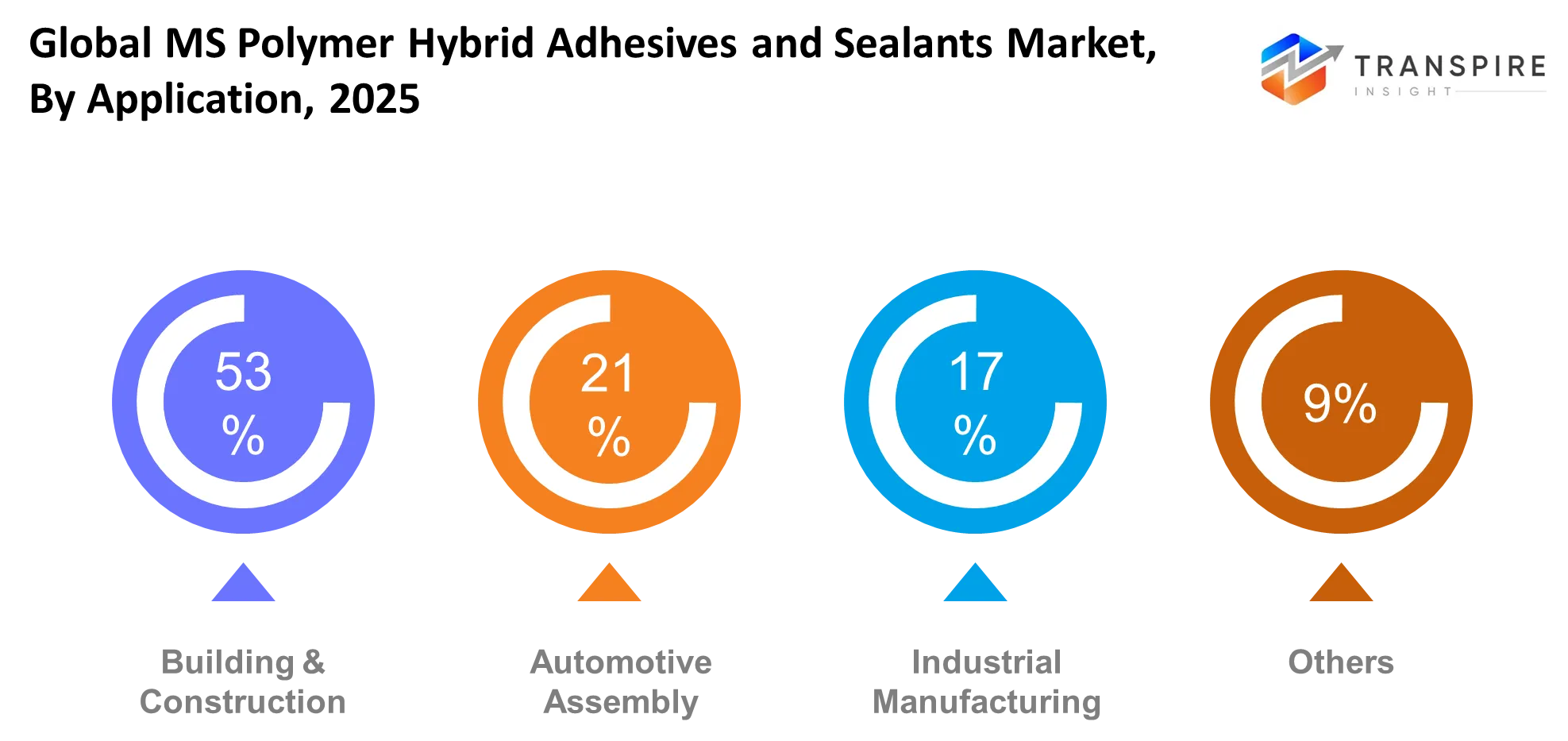
Building & Construction holds 53% market share, with 60% of European construction activity being renovation-driven demand for façade and window sealing without primers.
The Flexible Hybrid Adhesives segment is the fastest-growing market at 11.7% CAGR, owing to tolerating thermal expansion in modular construction and damping vibrations in EV chassis.
Automotive Assembly represents 21% of demand, with ~15 kg of MS polymer adhesives now required per vehicle for lightweight aluminium-composite body bonding.
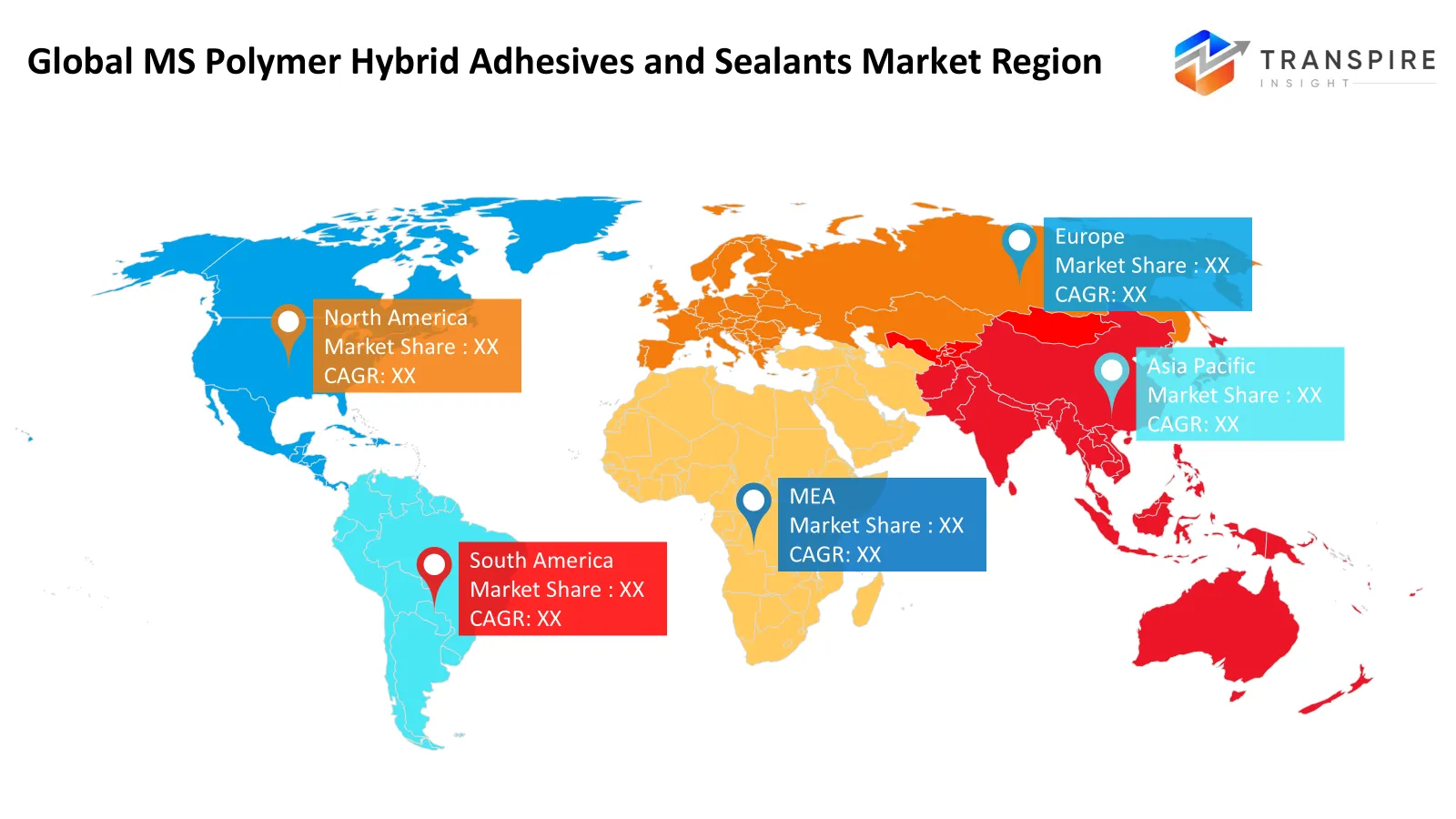
Europe has a regional share of 36%, and REACH VOC regulations have been introduced, requiring low-emission sealants for all new construction or refurbishment projects.
Asia Pacific is the fastest-growing region at 12.4% CAGR, with 1,500+ R&D programs underway to localise formulations for China and India's green-building requirements.
Industrial Manufacturing accounts for 17% of the market, where saltwater-resistant MS polymer with UV stability is needed for offshore wind turbine blade assembly.
In Europe, DIY and contractor applications are dominated by cartridge-based Sealants, which account for 65% household penetration in Belgium and the Netherlands, allowing for easy, colour-matched applications.
North America accounts for 25% of the market, with EV manufacturing and infrastructure bills supporting bridge/roadway sealing driving growth, while resin production in the country lowers supply chain risk for both Dow and Henkel.
What are the Key Drivers, Restraints, and Opportunities in the Global MS Polymer Hybrid Adhesives and Sealants Market?
Drivers:
The pre-treatment-free adhesion and paintability are pushing out the end of the legacy sealants. MS polymers adhere to any substrates without primers, unlike polyurethane, which requires dry surfaces, and can be painted over within hours, unlike silicone, which stains and cannot be painted. In Europe, 60% of window and façade projects now call for MS polymer, as it eliminates rework that results from problematic bonding, thereby saving labour costs of 20-30% per project and providing quicker revenue recognition. In January 2026, Sika launched Sikaflex® PRO-3 Hybrid with enhanced paintability for European facade contractors, reducing application time by 25%.
Restraint:
Skills gap in training cuts down on informal labour market uptake. MS polymer demands careful surface preparation and bead control in comparison to silicone (which is forgiving), and early failures tarnish reputations and instil doubt about the product in the minds of small contractors in India, Brazil, and Southeast Asia. It continues because only 15-20% of the workforce is being trained by the manufacturers.
Opportunities:
Cold-cure formulations for polar regions and industrial automation can open new markets. MS polymer variants that cure at −40°C allow winter construction in Scandinavia, Canada and Russia, where traditional sealants would freeze. At the same time, automotive assembly plants introduce robot-based, one-component MS polymer with a 15-minute setting time for adhesive dispensing and Henkel and Bostik are rolling out ready-to-automate cartridges for EV battery assembly, which are expected to bring in 1.2 billion in revenue by 2028. In March 2026, Henkel launched Teroson® MS Hybrid adhesive cartridges for automated EV battery assembly lines at Tesla's Berlin Gigafactory.
What Has the Impact of Artificial Intelligence Been on the Global MS Polymer Hybrid Adhesives and Sealants Market?
AI is transforming the Global MS Polymer Hybrid Adhesives and Sealants Market mainly via formulation and predictive manufacturing. In R&D, machine learning models leverage data from past experiments to forecast which combinations of ingredients would achieve desired properties (such as bond strength, flexibility, cure time), reducing development time from months to weeks and trial-and-error experiments by 50-70%. The inverse polymer design approach is one in which you define the desired performance, and the AI suggests the formula. On the production side, AI systems enable real-time tracking of mixing, curing, and quality, with automated parameter adjustments to prevent defects and minimise waste. Predictive maintenance algorithms reduce unnecessary downtime by predicting equipment failures before they occur. AI also predicts raw material price volatility and supply shortages to ensure that manufacturers optimise their stocks.
The majority of mid-sized adhesive manufacturers do not have the clean and structured data to build precise ML models. If the lab and production data are not digitised for years, the AI predictions fall short, which means that companies need to invest a significant amount of money in data infrastructure before the business can start benefiting from AI. In March 2026, Sika launched a global commercial partnership with Giatec Scientific Inc. to integrate AI-driven quality control and mix optimisation into its product portfolio.
Key Global MS Polymer Hybrid Adhesives and Sealants Market Trends:
As Volatile Organic Compound regulationsbecome more strict and EV light-weighting ramps up, MS polymer hybrids are moving from premium niche products to mainstream specifications. Both builders and automakers are diligently replacing silicone and polyurethane with MS polymers for paintable, low-emission, multi-substrate bonding.
- Solvent-based polyurethane was replaced by low-VOC MS polymer hybrids throughout the construction and automotive sectors in the tightened VOC regulations of 2023-2025.
- EV production ramped up in 2024/25, leading the automaker to use MS polymer for structural bonding of light bodies (e.g., made of aluminium composites and glass).
- Paintable sealant demand increased as contractors switched away from silicone stain and non-paintable sealing from MS polymer as used for façade and window applications.
- One-component MS polymers now account for the mass of the market (around 60%) and are being favoured because they do not require mixing, unlike the two-component polymers.
- APAC manufacturing grew faster in 2024-2025, led by infrastructure development and FDI-induced industrialisation in India/China, making Asia-Pacific the fastest-growing region.
- The new formulations that cure faster entered the market in 2024-2025 to meet the challenges faced by contractors, with faster cure times than traditional products.
- Major companies (Henkel, Sika, Bostik) redirected investment into customisation and versatility, and introduced products for more specialised industrial and marine applications.
- However, while MS polymer is superior in long-term performance, its higher cost of 20–40% than silicone poses a barrier to its use in low-cost residential projects.
Global MS Polymer Hybrid Adhesives and Sealants Market Segmentation
By Type:
The Building & Construction is leading with 53% market share, due to building renovation projects and VOC regulations for the replacement of polyurethane and silicone sealants for façade and window installation. The market for Flexible Hybrid Adhesives is the fastest-growing segment at 11.7% CAGR, with the need for vibration-dampening bonding in electric vehicle chassis and modular construction, where traditional rigid adhesives cannot withstand thermal expansion cycles. Industrial Sealants and Waterproofing Sealants are steady, and High-strength Bonding Sealants are making a mark in the aerospace industry and on offshore wind turbine blades, where structural integrity is essential under extreme conditions.
By Application:
The Building & Construction segment is dominated by ageing infrastructure in Europe and North America that needs weather-resistant sealing and waterproofing of expansion joints, accounting for 53% of total demand. Automotive Assembly accounts for 21% of sales, and it is growing because EV manufacturers are using MS polymer as an alternative to welding lightweight aluminium-composite bodies to meet CAFE fuel economy rules. Industrial Manufacturing accounts for 17% of the market, due to the use of saltwater-resistant bonding in marine applications and UV-stable sealants in offshore wind farms. The other 9% covers Marine Applications, Electronics Assembly, and Others, including an emerging need for biocompatible adhesives for wearable medical sensors.
To learn more about this report, Download Free Sample Report
By End-User:
Adoption is led by Construction Companies, benefiting from the ability of MS polymer to adhere to substrates without requiring any pretreatment, so as to save labour costs by 20-30% per project. The automotive OEMs are the next largest group, with a growing trend of using MS polymer in single-vendor supply contracts along with surface treatment chemicals. Industrial Manufacturers put emphasis on vibration damping and heat resistance rather than bond strength.
By Form:
Cartridge-based Sealants dominate DIY and contractor channels in Europe, with 65% household penetration in Belgium and the Netherlands. Paste Form, Robotic Dispensing requires viscosity control, and Liquid Form is a Marine Application, where the product must penetrate the substrate. Two-component systems are becoming more popular in high-temperature industrial curing applications where quick set times are a priority.
What are the Key Use Cases Driving the Global MS Polymer Hybrid Adhesives and Sealants Market?
Building and construction dominate MS polymer use, where contractors rely on them for façade sealing, window/door jambs, and expansion joints that need to stay flexible through temperature swings. These applications represent the largest demand segment because MS polymers bond to virtually all construction materials without primers.
Automotive and transportation is rapidly expanding adoption for trailer bonding, windscreen/sunroof sealing, and interior fit-ups in trucks and buses, where vibration damping and weather resistance matter. The rise in EV production and lightweight vehicle manufacturing is accelerating this shift.
New applications include joints for precast concrete in modular construction, fire-resistant wall penetrations, sealants for bathroom mildew, wood floor bonding and bonding artificial grass. Other industrial assembly items, such as non-slip stair treads and hygienic wall panels, are also becoming popular in the food processing and healthcare industries.
|
Report Metrics |
Details |
|
Market size value in 2025 |
USD 12.8 Billion |
|
Market size value in 2026 |
USD 13.84 Billion |
|
Revenue forecast in 2033 |
USD 24.97 Billion |
|
Growth rate |
CAGR of 8.80% from 2026 to 2033 |
|
Base year |
2025 |
|
Historical data |
2021 - 2024 |
|
Forecast period |
2026 - 2033 |
|
Report coverage |
Revenue forecast, competitive landscape, growth factors, and trends |
|
Regional scope |
United States; Canada; Mexico; United Kingdom; Germany; France; Italy; Spain; Denmark; Sweden; Norway; China; Japan; India; Australia; South Korea; Thailand; Brazil; Argentina; South Africa; Saudi Arabia; United Arab Emirates |
|
Key company profiled |
Sika, Henkel, Bostik, H.B. Fuller, Dow, Arkema, Wacker Chemie, Mapei, Tremco, Soudal, 3M, Huntsman, ITW Performance Polymers, Permabond, RPM International. |
|
Customization scope |
Free report customisation (country, regional & segment scope). Avail customised purchase options to meet your exact research needs. |
|
Report Segmentation |
By Type (Construction Adhesives, Industrial Sealants, Automotive Adhesives, Waterproofing Sealants, Flexible Hybrid Adhesives, High-strength Bonding Sealants, Others); By Application (Building & Construction, Automotive Assembly, Marine Applications, Industrial Manufacturing, Electronics Assembly, Others); By End-User (Construction Companies, Automotive OEMs, Industrial Manufacturers, Others); By Form (Paste Form, Liquid Form, Cartridge-based Sealants, Others). |
Which Regions are Driving the Global MS Polymer Hybrid Adhesives and Sealants Market Growth?
Europe's market share is 36%, and is being driven by low-emission sealants in all new construction and refurbishment projects and product regulation such as REACH in Europe, which has been recently implemented for VOCs. The region's ageing building stock, with 60% of construction activity being renovation, drives ongoing demand for MS polymer's inherent paintability and adhesion to old substrates without primers. Energy-efficient façade and window installations are further secured in the MS polymer specifications by robust contractor certification programs and the passive house standards. Over 50% of European demand comes from Germany, France and the Netherlands, where industrial distribution networks and green building incentives are well developed. In February 2026, Avantium and Will & Co launched a partnership to advance sustainable, bio-based chemical building blocks like FDCA for European adhesives and sealants.
North America is at 25% market share and is seeing consistent growth due to the expansion of EV manufacturing and the sealing of bridges and roads through infrastructure bills. North America's growth derives from the shift of automotive OEMs focusing on lightweight vehicle bonding for CAFE fuel economy standards, rather than regulation-driven demand like in Europe. It is good as the region has domestic resin from Dow and Henkel, which minimises the risk of supply chain disruptions and allows for competitive pricing with importation. Resilience to economic slowdowns is provided by stable construction activity and a positive end-use diversification among automotive, industrial assembly, and residential construction. In October 2025, Henkel and Dow announced an expanded partnership to accelerate decarbonization by integrating low-carbon raw materials into Henkel's hot melt adhesive production, reducing product carbon footprints by 20% to 40%.
Asia Pacific is the fastest-growing region with a 12.4% CAGR, supported by the implementation of green-building mandates for all government-funded infrastructure projects in China and India by 2025–2030. The change is happening recently from export-oriented manufacturing to local consumption, and more than 1500 R&D projects have been initiated in 2024 to meet regional pricing demands with MS polymer formulations. Opportunity is in the modular construction and 3-D printed houses that are slowly beginning to appear in Japan and South Korea, where MS polymer's quick-cure property dovetails with automated systems for dispensing off-site in fabrication facilities that are projected to create 2.5 billion in demand by 2030. In December 2025, Kastar launched standard-driven high-tack MS polymer sealants in global green construction markets. This product line was specifically tailored to meet demand in regions lacking isocyanates or solvents, allowing early holding strength and elastic performance to support fast-paced automated modular systems.
To learn more about this report, Download Free Sample Report
Who are the Key Players in the Global MS Polymer Hybrid Adhesives and Sealants Market and how do they Compete?
The market for MS Polymer Hybrid Adhesives and Sealants is highly fragmented, with regional players controlling construction markets and multinationals dominating the high-performance end. The emphasis is on compliance with sustainability standards, customisation speed and automation preparedness, not just the price.
Sika adopts a differentiation strategy based on innovation with cold-cure formulations for cold climates, and extends manufacturing facilities in Scandinavia and Canada to cater to winter construction markets. Under franchise bundling, Henkel combines its MS polymer adhesives with surface treatment chemicals in order to offer surface treatment solutions under a single-vendor contract for automotive OEMs. Bostik (Arkema) uses a channel-exclusive approach, selling construction-grade MS polymer exclusively through industrial distributors and protecting the DIY channel separately. Bostik (Arkema) follows a channel-exclusive approach, selling construction-grade MS polymer exclusively through industrial distributors and protecting DIY channels on its own.
Dow is able to use resin pricing leverage by offering customers bundled discounts for purchasing both MS polymer and polyurethane products. 3M focuses on the medical device segment, creating MS polymer adhesives that are safe on skin and must be certified for medical use with wearable sensors. Mapei and RPM International are also running contractor loyalty programmes offering volume-based rebates and equipment lease-free deals to secure big construction companies. Huntsman and ITW Performance Polymers compete in the Marine and Shipbuilding market, providing saltwater-resistant MS polymer for hull bonding. In the area of fire-resistant applications, Wacker Chemie is a leader, for example, in developing sealants that meet UL 1709 fire-resistance requirements for commercial high-rises. Tremco's speciality is curtain wall, engineered sealing packages that serve glass facades on skyscrapers. Soudal leads the markets for contractor referrals across Eastern Europe through trade certification programmes. Permabond specialises in anodised aluminium bonding, providing adhesive performance for aerospace suppliers for whom mechanical fasteners are not required.
Key Players are:
- Sika
- Henkel
- Bostik
- H.B. Fuller
- Dow
- Arkema
- Wacker Chemie
- Mapei
- Tremco
- Soudal
- 3M
- Huntsman
- ITW Performance Polymers
- Permabond
- RPM International
Recent Development News
In April 2026, Bostik (an Arkema subsidiary) launched a new series of high-tack elastic bonding adhesives based on silyl-modified polymers (SMP). The product release improves initial bonding strength in industrial and transportation assemblies while adhering to isocyanate-free and low-VOC environmental mandates.
Source: https://www.ulbrich-group.com/ms-polymer-adhesives
What Strategic Insights Define the Future of the Global MS Polymer Hybrid Adhesives and Sealants Market?
The Global MS Polymer Hybrid Adhesives and Sealants Market is transitioning into a performance-driven specification and is being used to replace silicone or polyurethane materials, and not simply due to commodity substitution. Procurement criteria will be transformed by the introduction of 40% of new contracts under environmental product declaration (EPD) and carbon footprint information by 2028.
Feedstock dependency—the market is subject to trade disputes or export restrictions, and prices could rise by 25-30% overnight due to silane supply being from three Chinese manufacturers. Carbon-negative MS-based polymer formulations are getting into the pilot stage and will unlock premium pricing in the carbon-conscious market in Europe and North America, using bio-based silanes from agricultural waste (rice husks, wheat straw). Invest in regional partnerships in silane supplies in India and Brazil, while investing in bio-resin R&D for carbon-negative adhesives and gaining first-mover advantage to support regulations that propose to report lifecycle emissions.
Key Segmentations are:
By Type
- Construction Adhesives
- Industrial Sealants
- Automotive Adhesives
- Waterproofing Sealants
- Flexible Hybrid Adhesives
- High-strength Bonding Sealants
- Others
By Application
- Building & Construction
- Automotive Assembly
- Marine Applications
- Industrial Manufacturing
- Electronics Assembly
- Others
By End-User
- Construction Companies
- Automotive OEMs
- Industrial Manufacturers
- Others
By Form
- Paste Form
- Liquid Form
- Cartridge-based Sealants
- Others
Regional Outlook
North America
- United States
- Canada
- Mexico
Europe
- Germany
- United Kingdom
- France
- Spain
- Italy
- Rest of Europe
Asia Pacific
- Japan
- China
- Australia & New Zealand
- South Korea
- India
- Rest of Asia Pacific
South America
- Brazil
- Argentina
- Rest of South America
Middle East & Africa
- Saudi Arabia
- United Arab Emirates
- South Africa
- Rest of the Middle East & Africa
Frequently Asked Questions
Find quick answers to common questions.
The Global MS Polymer Hybrid Adhesives and Sealants Market size was valued at USD 12.8 billion in 2025 and is poised to reach USD 24.97 billion by 2033, expanding at a 8.80% CAGR.
Key segments for the Global MS Polymer Hybrid Adhesives and Sealants Market are By Type (Construction Adhesives, Industrial Sealants, Automotive Adhesives, Waterproofing Sealants, Flexible Hybrid Adhesives, High-strength Bonding Sealants, Others); By Application (Building & Construction, Automotive Assembly, Marine Applications, Industrial Manufacturing, Electronics Assembly, Others); By End-User (Construction Companies, Automotive OEMs, Industrial Manufacturers, Others); By Form (Paste Form, Liquid Form, Cartridge-based Sealants, Others).
Growth is primarily driven by stricter volatile organic compound regulations forcing substitution from polyurethane/silicone to low-emission MS polymers, combined with EV lightweighting requiring structural bonding for mixed-material bodies. Contractors adopt MS polymer because it eliminates rework on damp or dirty substrates, saving 20–30% in labour costs while meeting green-building compliance in Europe and the Asia Pacific.
The Global MS Polymer Hybrid Adhesives and Sealants Market is led by major manufacturers, including Sika, Henkel, Bostik, H.B. Fuller, Dow, Arkema, Wacker Chemie, Mapei, Tremco, Soudal, 3M, Huntsman, ITW Performance Polymers, Permabond, and RPM International.
Europe holds 36% market share, dominating through stringent VOC regulations (EU REACH) mandating low-emission sealants and 60% renovation-driven construction demand for MS polymer's primer-free adhesion that saves contractors 20–30% in labour costs.
Commercial opportunities include Asia Pacific green-building mandates and localised bio-based MS polymer formulations cutting shipping costs by 15–20% while unlocking carbon-negative premium pricing in EU/US markets.
- Sika
- Henkel
- Bostik
- H.B. Fuller
- Dow
- Arkema
- Wacker Chemie
- Mapei
- Tremco
- Soudal
- 3M
- Huntsman
- ITW Performance Polymers
- Permabond
- RPM International
About the Authors

Pankaj Ghogare Patil
I am Pankaj Ghogare Patil, a Senior Research Analyst at Transpire Insight, specializing in the Pharmaceutical, Chemicals & Materials, Healthcare IT, and Biotechnology industry. My expertise lies in conducting comprehensive market research, analyzing industry trends, evaluating competitive landscapes, and translating complex data into actionable insights. At Transpire Insight, I closely follow emerging technologies, regulatory developments, and market innovations to create accurate, well-researched, and informative content that helps businesses and professionals make informed decisions. I am committed to producing credible, evidence-based articles that reflect industry best practices while making technical topics accessible and valuable for a broad audience.

Chakradhar Khansole
Chakradhar serves as the Research Director at Transpire Insight, bringing over 8 years of experience in technology, innovation, and strategic market intelligence. He specializes in transforming complex market data into actionable business insights that enable organizations to make informed, growth-oriented decisions. Recognized for his strategic vision and analytical expertise, Chakradhar leads high-impact research initiatives, delivering comprehensive market assessments, competitive intelligence, and forward-looking industry analysis.
Recently Published Reports
-
May 2026
Healthcare Polymer Packaging Market
Healthcare Polymer Packaging Market Size, Share & Analysis Report By Packaging Type (Syringes, IV Bottles and Pouches, Clamshells, Blisters, Bottles & Jars, Containers, Tubes, IV Parental Packaging, Others), By Type (Regulated, Non-regulated), By Polymer Type (LDPE (Low-Density Polyethylene), HDPE (High-Density Polyethylene), Homo-polymer (Homo), Random Copolymer (Random), Block Copolymer (Block), PET, Polystyrene, Polyvinyl Chloride, Polyamide/EVOH, Others), and Geography (North America, Europe, Asia-Pacific, Middle East and Africa, South and Central America), 2021 - 2031
-
Apr 2026
Hydrophilic Tape (Waterstop) Market
Hydrophilic Tape (Waterstop) Market Size, Share & Analysis Report By Type (Bentonite-Based Hydrophilic Tape, Rubber-Based Hydrophilic Tape), By Application (Residential Buildings, Commercial Buildings, Infrastructure Projects), and Geography (North America, Europe, Asia-Pacific, Middle East and Africa, South and Central America), 2021 - 2031
-
Apr 2026
Metalens Market
Metalens Market Size, Share & Analysis Report By Type (Visible Light Metalens, and Infrared Metalens), By Application (Consumer Electronics, Automotive Electronics, Industrial, Medical, and Others), and Geography (North America, Europe, Asia-Pacific, Middle East and Africa, South and Central America), 2021 - 2031
-
Apr 2026
PBT Resin Market
PBT Resin Market Size, Share & Analysis Report By Type (Reinforced PBT Resin, Unreinforced PBT Resin), By Processing Method (Injection Molding, Extrusion, Blow Molding, Others), By End-User (Automotive, Electrical & Electronics, Consumer Appliances, Industrial Machinery, Medical Devices, Packaging, Others), and Geography (North America, Europe, Asia-Pacific, Middle East and Africa, South and Central America), 2021 - 2031