
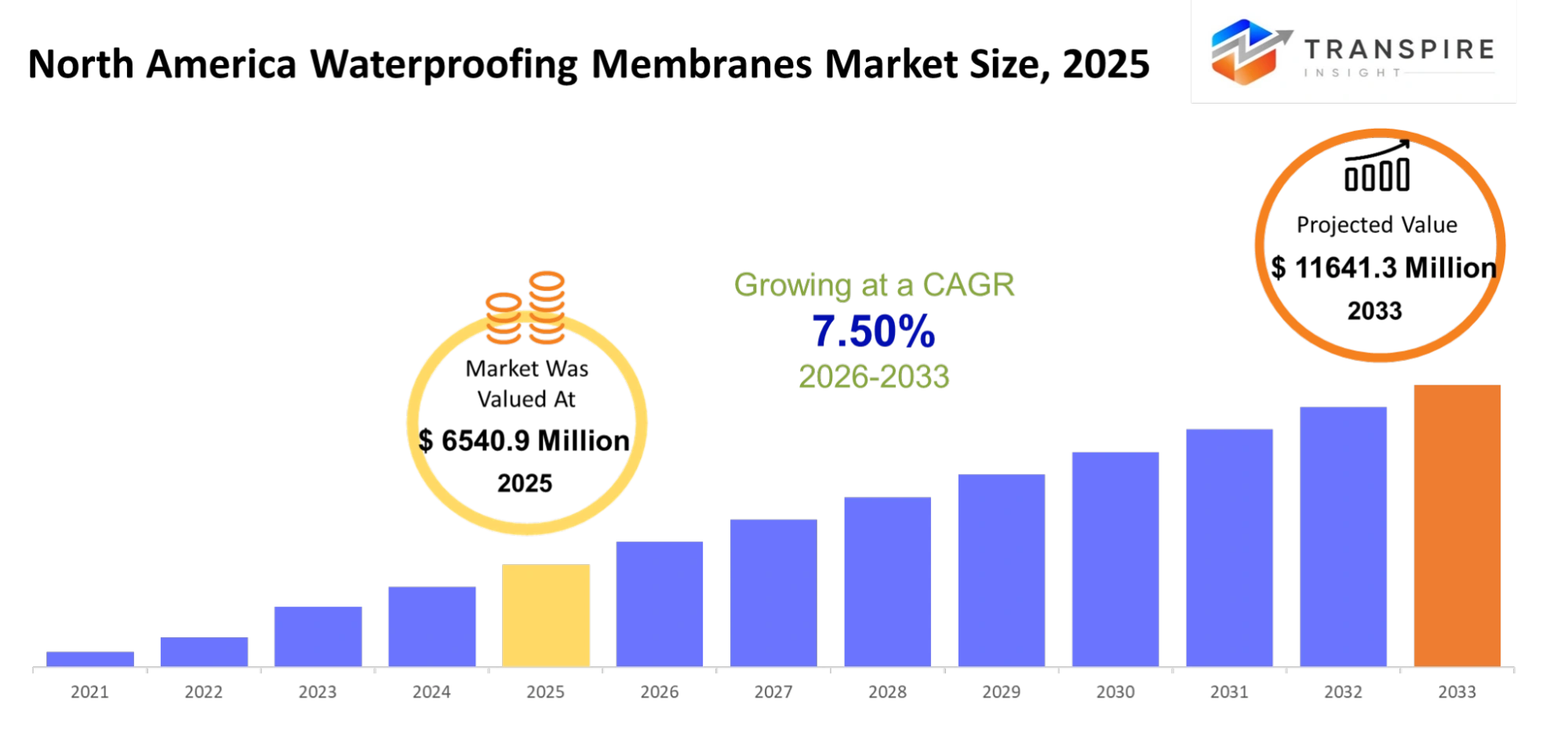
North America Waterproofing Membranes Market Size & Forecast:
- North America Waterproofing Membranes Market Size 2025: USD 6540.9 Million
- North America Waterproofing Membranes Market Size 2033: USD 11641.3 Million
- North America Waterproofing Membranes Market CAGR: 7.50%
- North America Waterproofing Membranes Market Segments: By Type (Sheet Membranes, Liquid Applied Membranes), By Application (Roofing, Walls, Foundations), By End-User (Residential, Commercial, Industrial).
To learn more about this report,  Download Free Sample Report
North America Waterproofing Membranes Market Summary:
The North America Waterproofing Membranes Market size is estimated at USD 6540.9 Million in 2025 and is anticipated to reach USD 11641.3 Million by 2033, growing at a CAGR of 7.50% from 2026 to 2033. The construction materials sector in North America, which includes Canada, the United States and Mexico will use waterproofing membranes to develop building materials that protect against moisture damage in different climate conditions. Developers will increasingly choose enduring solutions which require minimal maintenance because urban areas become more populated and their existing infrastructure deteriorates. The new consumer trend will require environmentally friendly materials which last longer and create less harm to the planet. The development of new polymer chemistry and liquid-applied systems will enable better flexibility and performance. The building industry will face stricter safety regulations which will force manufacturers to create new products. The market will build compatibility with resilient construction methods and intelligent design standards that respond to climate changes.
Key Market Trends & Insights:
The production of new materials will increase as manufacturers develop hybrid membranes that combine strength with elasticity and environmentally safe properties. The market will demand products that have low VOC emissions and recyclable materials because environmental regulations become more stringent. The construction industry will adopt solutions that complete projects faster without compromising their ability to withstand time because these solutions meet their needs for big commercial buildings and infrastructure that operates in different weather conditions.
People will change their buying patterns because urban redevelopment projects need better waterproofing solutions for older buildings. The process of retrofitting will become more common in major cities where their older buildings experience problems with water entering the structure. Property owners will prioritize long-term performance over short-term cost, encouraging adoption of premium membranes designed for extended lifecycle efficiency and reduced maintenance requirements.
The advancement of technology will bring new methods of application which now use digital monitoring systems and smart coatings technology. Sensors that engineers install inside membrane systems will provide early warning information about upcoming leakage or system deterioration. The new method will enhance maintenance work that prevents equipment failure while decreasing repair expenses for essential infrastructure including tunnels and bridges and underground construction sites.
Product development will proceed under the influence of new regulations which building codes use to establish safety standards and energy efficiency requirements and environmental regulations. Governments will promote sustainable construction materials which will affect the standards that businesses use to buy materials. Manufacturers will adjust their product lines to meet green certification requirements and compliance changes to compete for public sector and private sector contracts.
North America Waterproofing Membranes Market Segmentation
By Type
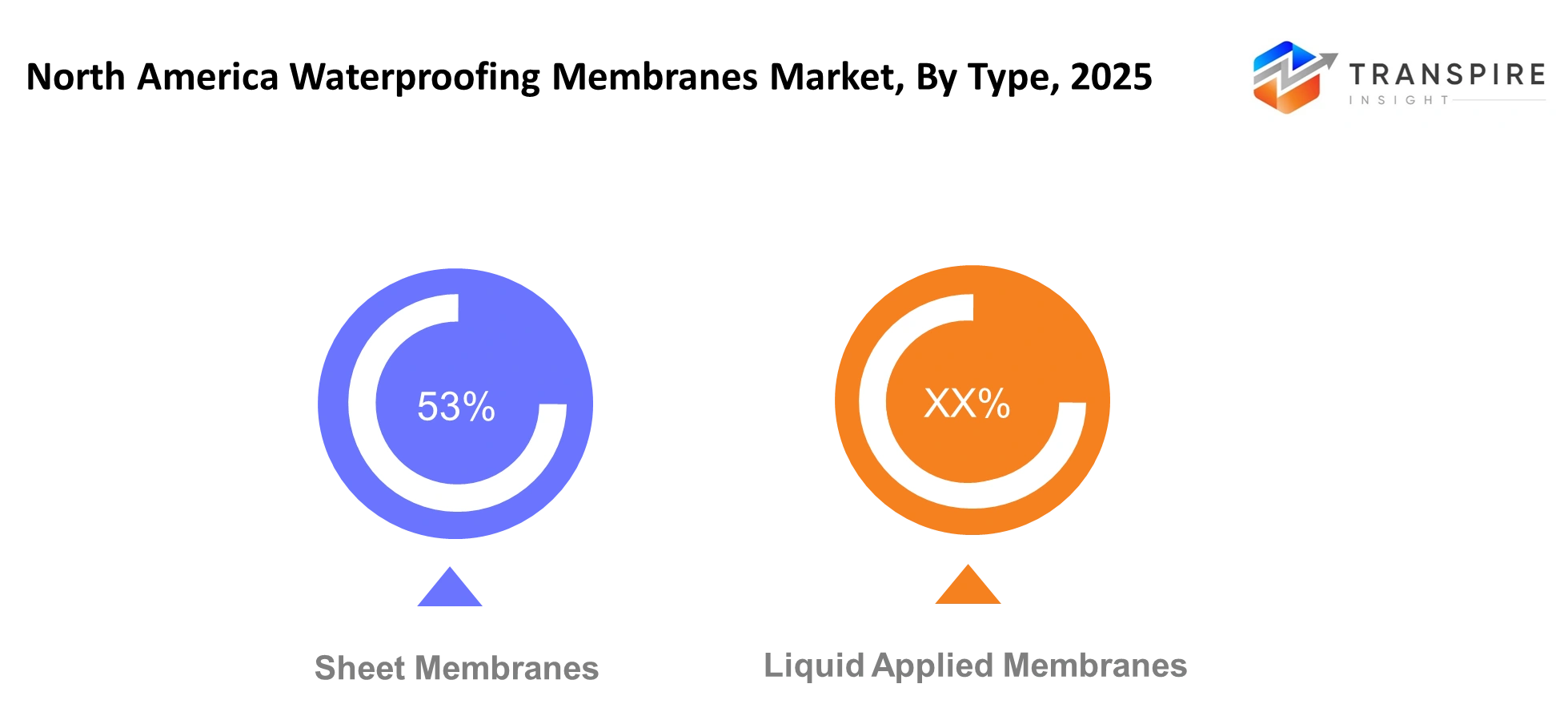
Sheet Membranes- Sheet membranes maintain their popularity because they deliver consistent thickness and dependable results in extensive construction work. Builders will prefer them for their ability to deliver even coverage and their simple inspection process which enables builders to check their work during installation. Future demand will lean toward advanced variants with improved flexibility, UV resistance, and stronger adhesion to withstand varying environmental and structural conditions.
Liquid Applied Membranes- Liquid applied membranes will attract interest because they provide a continuous surface and can effectively design intricate needs. Contractors will increasingly select them for irregular structures where traditional sheets may not fit effectively. Enhancements to curing time and material strength will enable these coatings to perform better during severe climate conditions and through extended periods of building movement.
To learn more about this report, Download Free Sample Report
By Application
Roofing- Roofing installations will be prominent in the future as buildings are exposed to permanent conditions of rain and heat. Property owners will look for solutions that ensure no leakage occurs while being energy efficient. In the future, buildings will be equipped with materials that can withstand heat for comfort inside. These materials will be effective in both residential and commercial properties.
Walls- Waterproofing for walls is an essential feature in future buildings. Moisture seeping into buildings is responsible for structural damage and indoor air quality issues. In future, external and internal wall systems will be equipped with advanced materials for effective resistance against seepage. Developers will look for solutions that ensure no dampness occurs in buildings while being effective in different climatic conditions.
Foundations- Waterproofing for building foundations is essential for ensuring building stability. It protects buildings from heavy rainfall and changes in underground water levels. In future, effective protective materials will be used for building foundations. Developers will look for solutions that ensure building longevity while being effective in protecting against hydrostatic pressure.
By End-User
Residential- The main residential market needs of homeowners will increase because homeowners learn about how their homes can suffer water damage and require maintenance. Buyers will prefer properties equipped with reliable waterproofing systems. Future trends will showcase applications that provide easy usability, materials that offer financial savings, and solutions which enhance indoor comfort in areas with high humidity and seasonal rainfall.
Commercial- The commercial sector needs advanced waterproofing systems which provide complete protection for their assets and operational activities and the safety of their building occupants. Developers will spend money on new membrane technologies which enable them to build large-scale projects and their intricate architectural designs. The industry demand will shift towards solutions which provide extended operational periods while minimizing maintenance needs and achieving environmental sustainability requirements which modern commercial facilities demand.
Industrial- Industrial facilities will need strong waterproofing systems to protect their machinery and storage spaces and production zones. The production process requires special membranes because the facility will face chemical exposure and heavy loads and extreme environmental conditions. The upcoming technology adoption will focus on high-strength materials which offer resistance to continuous operational requirements and extreme climate conditions.
Regional Insights
The United States will drive regional demand because of its extensive infrastructure projects and its implementation of strict building standards. Urban centers will need advanced waterproofing systems to protect their aging buildings from the impact of climate change. Developers will use high-performance membranes which provide long-lasting durability and energy efficiency and meet new building codes for residential and commercial development.
Canada will experience steady adoption because extreme weather patterns and the demand for resilient building methods force all constructing operations to follow extreme weather patterns. Builders will choose materials which provide both flexibility and long-lasting performance because of cold climates and freeze-thaw cycle conditions. Sustainable construction policies will influence product selection which leads to eco-friendly waterproofing solutions that meet environmental goals while protecting structures during extreme seasonal weather.
Mexico will experience rising usage because urban growth and industrial expansion continue to spread through its important regions. The increasing understanding of building durability will drive developers to choose dependable waterproofing systems. Projects located in coastal areas and high-humidity regions will benefit from advanced membranes which protect against moisture and extend building life in extreme environmental situations.
North American construction developments will be driven by regional partnerships and unified building regulations which create new product development pathways. The availability of advanced materials will be supported through cross-border supply chains while the alignment of regulations will determine quality standards. Future construction practices will identify waterproofing as a fundamental design component because it protects building durability and energy efficiency and building adaptability to future climate changes.
Recent Development News
United States: Sustainable Materials Push in Construction Sector- The United States has begun to adopt waterproofing methods that protect the environment through their latest technological advances. Manufacturers will increasingly move away from high-emission materials and adopt low-VOC, polymer-based membranes. The design of products will continue to be affected by regulatory requirements and green building certifications which drive new developments of durable energy-efficient waterproofing systems used in extensive infrastructure projects and commercial construction work.
Canada: Climate-Responsive Waterproofing Innovations- Canadian product development will create solutions that protect against severe weather conditions which include freeze-thaw cycles. Companies will invest in flexible membrane technologies that maintain performance under temperature stress. Sustainable construction guidelines will further shape adoption, with developers choosing solutions that balance environmental compliance and long-term durability in both residential and public infrastructure developments.
Mexico: Urban Expansion Driving Advanced Applications- Mexico will see a rise in the installation of advanced waterproofing technologies because urban growth progresses. Recent project trends will highlight the use of high-performance membranes in commercial and industrial construction. Builders will implement better application methods and better materials to deal with humidity and water exposure which will extend building lifespan while decreasing maintenance difficulties throughout expanding urban areas.
|
Report Metrics |
Details |
|
Market size value in 2025 |
USD 6540.9 Million |
|
Market size value in 2026 |
USD 7018.7 Million |
|
Revenue forecast in 2033 |
USD 11641.3 Million |
|
Growth rate |
CAGR of 7.50% from 2026 to 2033 |
|
Base year |
2025 |
|
Historical data |
2021 – 2024 |
|
Forecast period |
2026 – 2033 |
|
Report coverage |
Revenue forecast, competitive landscape, growth factors, and trends |
|
Regional scope |
North America (Canada, The United States, and Mexico) |
|
Key company profiled |
Sika AG, BASF SE, Carlisle Companies Inc., GAF Materials Corporation, Johns Manville Corporation, Soprema Group, Firestone Building Products (Holcim), Saint-Gobain S.A., Dow Inc., Fosroc International Ltd., RPM International Inc., Kemper System America Inc., Tremco Incorporated, Henry Company LLC, Polyglass S.p.A. |
|
Customization scope |
Free report customization (country, regional & segment scope). Avail customized purchase options to meet your exact research needs. |
|
Report Segmentation |
By Type (Sheet Membranes, Liquid Applied Membranes), By Application (Roofing, Walls, Foundations), By End-User (Residential, Commercial, Industrial). |
Key North America Waterproofing Membranes Market Company Insights
The main business operations throughout North America will involve Sika AG and Saint-Gobain and SOPREMA and Holcim and GAF Materials Corporation and Carlisle Coatings as key companies. The companies will concentrate their efforts on developing new products while maintaining extensive distribution systems and creating comprehensive system solutions. The ability to succeed in business will depend more on companies’ use of sustainable materials and their capacity to install products efficiently and comply with strict building performance requirements.
Company List
- Sika AG
- BASF SE
- Carlisle Companies Inc.
- GAF Materials Corporation
- Johns Manville Corporation
- Soprema Group
- Firestone Building Products (Holcim)
- Saint-Gobain S.A.
- Dow Inc.
- Fosroc International Ltd.
- RPM International Inc.
- Kemper System America Inc.
- Tremco Incorporated
- Henry Company LLC
- Polyglass S.p.A.
North America Waterproofing Membranes Market Report Segmentation
By Type
- Sheet Membranes
- Liquid Applied Membranes
By Application
- Roofing
- Walls
- Foundations
By End-User
- Residential
- Commercial
- Industrial
Frequently Asked Questions
Find quick answers to common questions.
The approximate North America Waterproofing Membranes Market size for the market will be USD 11641.3 Million in 2033.
Key segments for the North America Waterproofing Membranes Market By Type (Sheet Membranes, Liquid Applied Membranes), By Application (Roofing, Walls, Foundations), By End-User (Residential, Commercial, Industrial).
Major players in the North America Waterproofing Membranes Market are Sika AG, BASF SE, Carlisle Companies Inc., GAF Materials Corporation, Johns Manville Corporation, Soprema Group, Firestone Building Products (Holcim), Saint-Gobain S.A., Dow Inc., Fosroc International Ltd., RPM International Inc., Kemper System America Inc., Tremco Incorporated, Henry Company LLC, Polyglass S.p.A.
The North America Waterproofing Membranes Market size is USD 6540.9 Million in 2025.
The North America Waterproofing Membranes Market CAGR is 7.50%.
- Sika AG
- BASF SE
- Carlisle Companies Inc.
- GAF Materials Corporation
- Johns Manville Corporation
- Soprema Group
- Firestone Building Products (Holcim)
- Saint-Gobain S.A.
- Dow Inc.
- Fosroc International Ltd.
- RPM International Inc.
- Kemper System America Inc.
- Tremco Incorporated
- Henry Company LLC
- Polyglass S.p.A.
Recently Published Reports
-
Apr 2026
Handling and Lifting Equipment Market
Handling and Lifting Equipment Market Size, Share & Analysis Report By Product (Cranes and Hoists, Forklifts, Conveyor Systems, Aerial Work Platforms, Others), By Application (E-Commerce, Automotive and Railway, Food and Beverages, Aviation, Others), and Geography (North America, Europe, Asia-Pacific, Middle East and Africa, South and Central America), 2021 - 2031
-
Apr 2026
HVAC Equipment Market
HVAC Equipment Market Size, Share & Analysis Report By Heating Equipment Type (Boilers and Furnaces, Heat Pumps, and Unitary Heaters), By Ventilation Equipment (Air Handling Units, Humidifiers and Dehumidifiers, Air Filters, and Fan Coiling Units), By Air Conditioning Equipment (Unitary Air Conditioners, Room Air Conditioners, Packaged Terminal Air Conditioners, and Chillers), By End User (Commercial, Residential, Industrial, and others), and Geography (North America, Europe, Asia-Pacific, Middle East and Africa, South and Central America), 2021 – 2031
-
Apr 2026
Refrigeration Valves Market
Refrigeration Valves Market Size, Share & Analysis Report By Type (Solenoid Valves, Expansion Valves, Check Valves, Service Valves, Others), By Application (Commercial Refrigeration, Industrial Refrigeration, Transport Refrigeration, Residential Refrigeration, Air Conditioning Systems), By End User (Food and Beverage Industry, Pharmaceutical Industry, HVAC Industry, Chemical Industry, Others), and Geography (North America, Europe, Asia-Pacific, Middle East and Africa, South and Central America), 2021 – 2031
-
Apr 2026
E-Commerce Packaging Materials Market
E-Commerce Packaging Materials Market By Material Type (Corrugated Boxes, Paper & Paperboard, Foam & Cushioning Materials, Plastic Packaging, Flexible Packaging, Protective Packaging, Others), By Product(Primary Packaging, Secondary Packaging, Tertiary Packaging), By Packaging Function (Protective Packaging, Branding & Presentation Packaging, Transit & Logistic Packaging, Sustainable Packaging, Tamper Evidence Packaging), By End-User (Retail & Consumer Goods, Electronic Appliances, Food & Beverages, Healthcare & Pharmaceutical, Fashion & Apparel, Home & Furnishing, Others); By Industry Analysis, Size, Share, Growth, Trends, and Forecasts 2021-2033