
Asia Pacific Heavy Construction Equipment Market Size & Forecast:
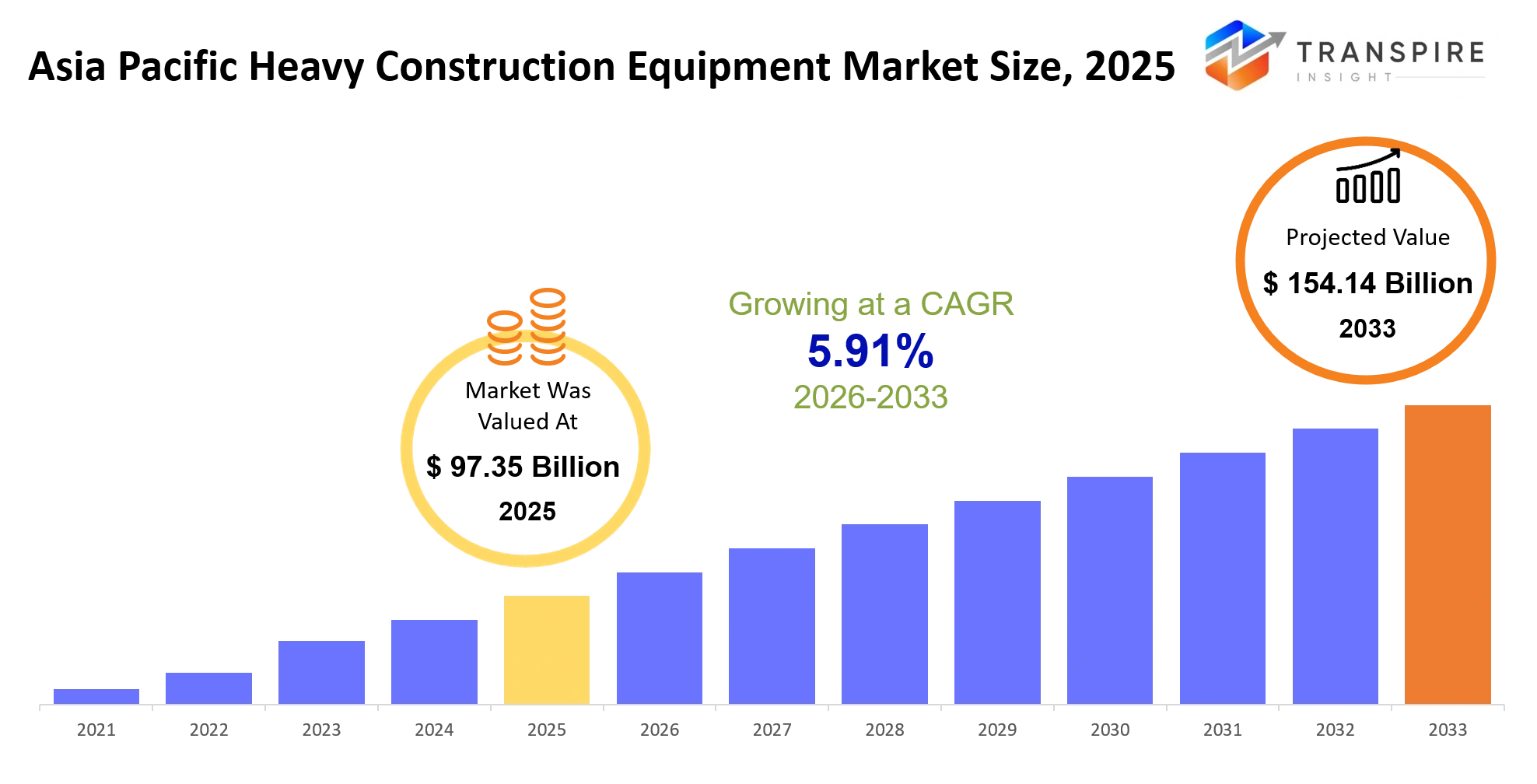
- Asia Pacific Heavy Construction Equipment Market Size 2025: USD 97.35 Billion
- Asia Pacific Heavy Construction Equipment Market Size 2033: USD 154.14 Billion
- Asia Pacific Heavy Construction Equipment Market CAGR: 5.91%
- Asia Pacific Heavy Construction Equipment Market Segments: By Equipment Type (Excavators, Loaders, Bulldozers, Cranes, Graders, Dump Trucks, Road Rollers, Others); By Propulsion (Diesel, Electric, Hybrid, Others); By Application (Infrastructure, Mining, Construction, Oil & Gas, Agriculture, Others); By End User (Contractors, Mining Companies, Government Projects, Rental Companies, Others).
To learn more about this report,  Download Free Sample Report
Asia Pacific Heavy Construction Equipment Market Summary
The Asia Pacific Heavy Construction Equipment Market was valued at USD 97.35 Billion in 2025. It is forecast to reach USD 154.14 Billion by 2033. That is a CAGR of 5.91% over the period.
The Asia Pacific heavy construction equipment market, you know, sort of underpins a lot of these big infrastructure, mining, energy, and even urban development projects, by supplying the machinery required to move earth, lift materials, excavate sites, and generally speed up how work gets done. It’s basically that equipment lets contractors and project owners finish tricky jobs more quickly , and often in a safer way, plus with better cost efficiency across economies that are still developing fast.
In the last five years the market has gone through a noticeable structural shift , toward equipment that’s more digitally connected and lower-emission i n general. Fleet owners are increasingly leaning on telematics, predictive maintenance tools, and those automation features too, trying to push utilization rates upward, and help reduce the day-to-day operating expenses. One big trigger that really changed how buyers behaved was the supply chain disruption that was felt during, and also after, the COVID-19 period.That disruption made equipment availability risk more obvious, so contractors started updating fleets sooner and tightening their procurement planning. Meanwhile, as governments expanded infrastructure spending and invested in industrial capacity, project timelines became more demanding , which then drove broader use of high-productivity equipment. This whole transition is now feeding into stronger equipment sales , higher aftermarket service revenue, and more opportunities tied to technology-enabled fleet management across the region.
Key Market Insights
- In a way China kinda dominates the Asia Pacific Heavy Construction Equipment Market, with an estimate around 40%+ market share , it is backed by big scale infrastructure and mining investments.
- India shows up as the second biggest regional market, mostly because of road building, rail modernization and the whole industrial corridor push .
- Meanwhile Southeast Asia is the fastest-growing part over the forecast period , driven by port enlargements , energy initiatives and a steady stream of urban infrastructure spending.
- Australia still holds a notable slice too, mainly from ongoing demand linked to mining, resource extraction and massive civil engineering projects.
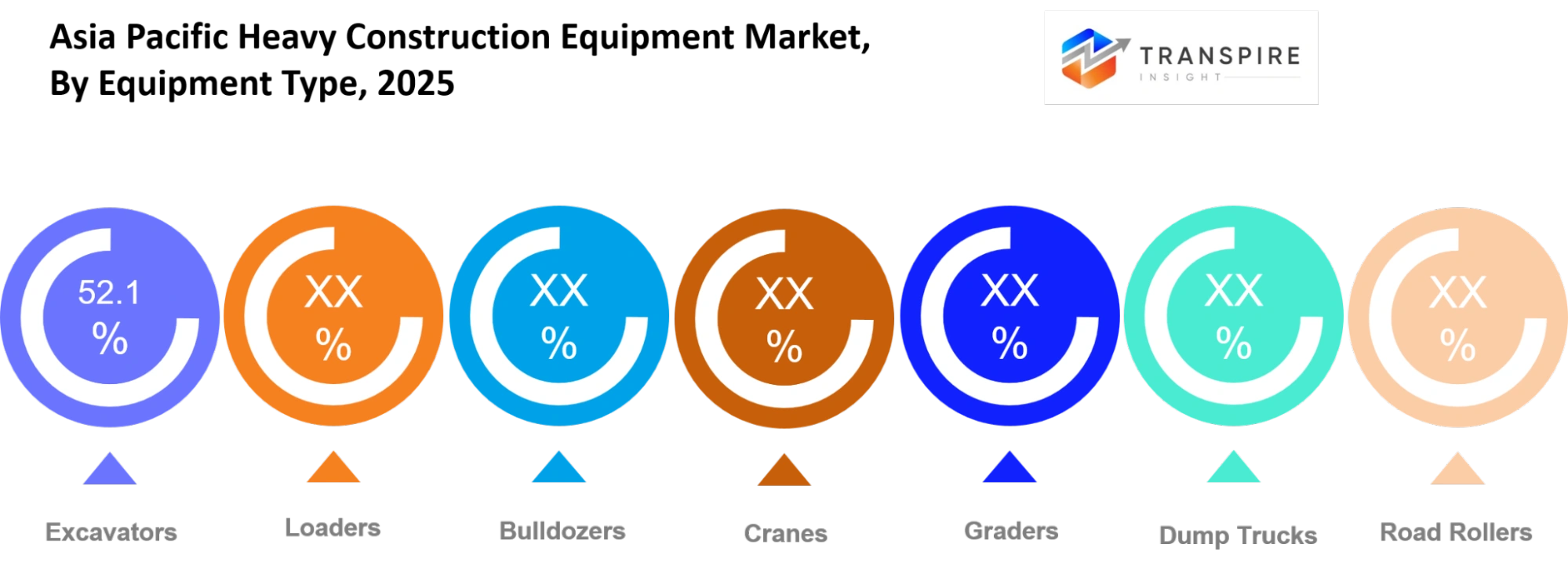
- As for the equipment, excavators are taking the lead with more than 35% share, which makes sense since they get used a lot across construction , mining and earth moving activities.
- Loaders sit as the second- largest piece here due to their broad deployment in material handling, and infrastructure projects, really everywhere.
- Autonomous and smart construction equipment is the fastest-growing segment through 2030, with it pulled along by productivity goals and safety requirements, kind of hand in hand.
- Infrastructure construction still dominates at about 45% market share, mostly because of transportation and public works funding that keeps showing up.
- Mining counts as the quickest-rising application segment as critical mineral extraction keeps expanding through Australia, Indonesia,and India.
- Renewable energy projects are also lighting up new need— specialized heavy machinery, across the region.
What are the Key Drivers, Restraints, and Opportunities in the Asia Pacific Heavy Construction Equipment Market?
The main thing driving the Asia Pacific Heavy Construction Equipment Market is basically the continued push from both public and private spending, in transportation, energy, mining, and those ever growing urban infrastructure needs. In places like China, India, Indonesia, and a bunch of other emerging economies, governments have been upping capital outlays on highways , rail corridors, airports , renewable energy sites, and industrial parks. Because of that, the whole investment wave sort of pulls demand up for larger, faster, high capacity excavators, wheel loaders, rigid dump trucks, and a mix of earthmoving machinery that can still hit more strict schedules. When contractors start juggling bigger project pipelines, fleet modernization starts to feel necessary, it then supports equipment sales, boosts rental operations, grows aftermarket services , and also encourages more tech adoption.
Still, the biggest structural snag is the high ownership cost across the equipment lifecycle. Not just the purchase prices, but also financing costs, fuel burn, maintenance workloads, and frankly the shortage of skilled operators all stack up into long term financial pressure. This hits hardest for small and medium sized contractors. And it isnt something that can be fixed overnight, since it depends on how much capital is available , how workforce training develops, and what the broader economy is doing. So a lot of prospective buyers end up postponing fleet upgrades, which slows equipment replacement cycles and, in turn, narrows revenue chances for manufacturers.
A big future opportunity, is in rolling out connected semi-autonomous, and electric construction equipment across markets that are industrializing very fast. Like, you could pair advanced telematics platforms with machine automation and somehow get better usage of the equipment, bring down fuel consumption and, in turn, boost project output. India and Indonesia for example are putting more money into infrastructure, and at the same time pushing digital construction ways of working, which makes it easier for next-generation machines to be adopted, and also supports longer term market growth.
What Has the Impact of Artificial Intelligence Been on the Asia Pacific Heavy Construction Equipment Market?
Artificial intelligence is kinda transforming heavy construction equipment operations across the Asia Pacific region, by boosting machine productivity , fleet management , and even maintenance planning in a more practical way. Equipment manufacturers and contractors are using AI-enabled telematics systems more often to keep an eye on machine performance, fuel usage, operator behavior, and job-site productivity, all in real time . In general, these setups automate fleet compliance tracking , fine tune equipment deployment, and let managers sort out resources more efficiently across several project locations , even when schedules shift.
Machine learning models are also showing up more and more in predictive maintenance. They can look through sensor signals coming from engines, hydraulic systems, transmissions, and undercarriage components, then spot likely failures before actual breakdowns happen. This method cuts unplanned downtime, raises equipment availability, and pushes maintenance costs down a notch. On top of that, advanced analytics help with fuel efficiency as well—by detecting inefficient operating patterns and offering recommended corrective actions. So it’s not only “observe”, it is also “suggest”.
AI-powered site management solutions are improving project execution too, through automated progress tracking, safety monitoring, and equipment utilization analysis. Contractors seem to get higher machine uptime, better asset productivity, and stronger operational visibility , which feels pretty critical on complex jobs.
Still, AI adoption has a limitation that keeps coming back. A lot of construction sites in developing areas do not have dependable digital infrastructure, and connectivity is not always consistent. That makes real-time data collection , and analytics, rather hard to maintain. Also, high integration expenses and fragmented equipment fleets slow rollouts, especially for smaller contractors who have limited technology budgets, and sometimes even limited staff to manage all the changes .
Key Market Trends
- Since 2020, contractors really started upping telematics adoption, and kinda connected equipment is now more or less a standard thing for big infrastructure, plus mining projects too.
- Manufacturers like Komatsu Ltd. and Caterpillar Inc. also pushed harder on autonomous or semi autonomous machines, sort of to cope with labor shortages, and to hit those productivity targets.
- From 2020 to 2022, supply chain disruptions kinda forced OEMs to diversify where components come from, while expanding regional manufacturing footprints across Asia, which was a big deal.
- Fleet buyers are now leaning more toward total lifecycle costs rather than the initial purchase price, so procurement decisions often go toward fuel-efficient equipment that’s also digitally monitored.
- Since 2021, governments in India, Indonesia, and Australia have accelerated infrastructure spending, and that has created stronger demand for high-capacity earthmoving machinery.
- Mining companies have increased their investment in advanced haulage and excavation equipment, especially after 2022, when critical mineral projects became more strategic.
- At the same time, equipment rental providers have expanded their market presence, and contractors are increasingly choosing flexible rental models to handle capital expenditure and project uncertainty, at least compared to earlier years.
- Since 2020, predictive maintenance platforms moved out of trial phases, like from pilots into mainstream deployment, and that helps operators reduce downtime, plus improve asset utilization.
- Manufacturers have intensified investments in electric, and hybrid construction equipment too, because emission standards and sustainability requirements have become more prominent.
- More recently, competitive behavior has shifted toward software enabled services, and leading OEMs are capturing more value through fleet analytics, remote diagnostics, and equipment management platforms, which is kinda where the money is going.
Asia Pacific Heavy Construction Equipment Market Segmentation
By Equipment Type :
Equipment type segmentation kind of explains how different machines end up supporting specific tasks across construction, infrastructure, mining, and industrial projects. Excavators are used a lot for digging, trenching ,and material handling , while loaders move and transport stuff around project sites. Bulldozers matter for land clearing , grading, and earthmoving activities that need strong pushing power.
Cranes get used for lifting and placing heavy materials in construction and industrial locations. Graders help create smooth, level surfaces for roads and bigger infrastructure developments. Dump trucks handle soil, rock,and general construction materials. Road rollers support compaction work, and the “other” category includes specialized equipment made for unusual operational needs in varied project environments.
To learn more about this report, Download Free Sample Report
By Propulsion :
Propulsion segmentation is basically about the power source used to operate heavy construction equipment. Diesel-powered machines keep a big presence because they deliver high torque, solid durability, and they can run for long periods even in demanding environments. You usually see these chosen for major infrastructure and mining projects where steady performance is non-negotiable.
Electric equipment is getting more attention on projects that want lower emissions and less operating noise. Hybrid models combine traditional engines with electric systems, which helps with fuel efficiency and overall operational performance. The other category covers alternative power solutions that people are still exploring as technology keeps moving and sustainability goals become more important throughout the industry.
By Application :
Application based segmentation kinda points at the industries where heavy construction equipment gets used most. Infrastructure projects are a big slice, covering highways, railways, airports ,ports and public utilities, basically a whole lot of civil needs. Construction work in general also asks for a wide toolkit of machinery for residential, commercial, and industrial developments, you know, the usual mix.
Mining operations rely on large , durable equipment for excavation , hauling and moving bulk materials. For oil and gas, specialized machines tend to show up for site preparation and facility build out, while agriculture applications lean toward land preparation and earthmoving activities. Then there’s the other segment, which covers a spread of industrial and specialized uses that still need heavy equipment support, kind of a catch all but still valid.
By End User :
Now end user segmentation is more about who actually buys and runs the equipment. Contractors are a major part of this market, because equipment is needed across many project types and in different locations. Mining companies also put money into machines that can manage harsh extraction and transport tasks under tough operating conditions.
Government projects use heavy equipment for public infrastructure development, transportation networks, and programs focused on community improvement. Rental companies provide more elastic access to machinery for organizations that want practical equipment solutions, without making big capital investments up front. The other category includes industrial operators and specialized entities that use heavy equipment for particular operational needs ,which can be pretty specific in practice.
What are the Key Use Cases Driving the Asia Pacific Heavy Construction Equipment Market?
Infrastructure development is still, kinda the main thing pushing equipment adoption across the Asia Pacific Heavy Construction Equipment Market. Big highway networks, metro rail systems, airports, ports, and all that urban sprawl are basically asking for a ton of earthmoving, digging, hoisting, and material handling. Because these jobs run on pretty strict timelines, it becomes really important to have high capacity equipment, which helps with both productivity and cost control, at the same time.
Mining and energy work are turning into more of a secondary driver too. Mining operators are leaning on advanced machines for overburden removal, hauling, and overall site preparation, especially in places like Australia and Indonesia. On the oil and gas side, heavy equipment is used for site prep, pipeline construction, and facility build-outs in remote areas where logistics are never easy.
Meanwhile, newer use cases are starting to show up around renewable energy infrastructure and smart city programs. Utility scale solar and wind deployments need specialized equipment for foundation tasks and transporting materials. There’s also this growing interest in semi autonomous and connected machinery in large industrial projects, and that looks like a solid opportunity, since owners want more efficiency, better safety, and a clearer operational view.
|
Report Metrics |
Details |
|
Market size value in 2025 |
USD 97.35 Billion |
|
Market size value in 2026 |
USD 103.09 Billion |
|
Revenue forecast in 2033 |
USD 154.14 Billion |
|
Growth rate |
CAGR of 5.91% from 2026 to 2033 |
|
Base year |
2025 |
|
Historical data |
2021 - 2024 |
|
Forecast period |
2026 - 2033 |
|
Report coverage |
Revenue forecast, competitive landscape, growth factors, and trends |
|
Regional scope |
Asia Pacific (India, China, Japan, Australia, South Korea, Rest of Asia Pacific) |
|
Key company profiled |
Caterpillar, Komatsu, Hitachi Construction Machinery, Volvo CE, Liebherr, SANY, XCMG, Zoomlion, JCB, Doosan Bobcat, Hyundai Construction Equipment, Kobelco, CASE, John Deere, Terex. |
|
Customization scope |
Free report customization (country, regional & segment scope). Avail customized purchase options to meet your exact research needs. |
|
Report Segmentation |
By Equipment Type (Excavators, Loaders, Bulldozers, Cranes, Graders, Dump Trucks, Road Rollers, Others); By Propulsion (Diesel, Electric, Hybrid, Others); By Application (Infrastructure, Mining, Construction, Oil & Gas, Agriculture, Others); By End User (Contractors, Mining Companies, Government Projects, Rental Companies, Others). |
Which Regions are Driving the Asia Pacific Heavy Construction Equipment Market Growth?
China still feels like the main spot in the Asia Pacific Heavy Construction Equipment Market , mainly because it has this unmatched scale for infrastructure buildup, manufacturing know-how, and mining activity. Even with timing shifts , national plus provincial investment programs keep backing things like transportation corridors, city expansion efforts, industrial parks, and energy related infrastructure. There’s also this fairly tight ecosystem around it, with equipment manufacturers, component vendors, lending or financing institutions, and aftermarket service providers all kinda working together. So the whole thing lets contractors grab the right machines faster, keep fleets running with less downtime, and push through big project schedules more smoothly, and that ends up reinforcing China’s leadership role , in a way that’s hard to replicate.
India comes next, as the second most influential region, but its momentum is built on a different base. Instead of leaning mostly on manufacturing scale, India rides on long term public infrastructure programs, growing transportation links, and ongoing investment in industrial development. Government supported road works, railway modernization, and logistics corridor initiatives create a steadier, multi year demand stream for equipment. That sort of continuity gives suppliers a chance to plan output better, tighten up dealer coverage, and grow service capabilities. And on top of that, it supports dependable market revenue, year after year.
Southeast Asia is kind of emerging as the fastest growing region , mainly because infrastructure investment is accelerating, and industrial expansion is happening across countries like Indonesia, Vietnam and Philippines. Lately, there are more commitments around port upgrades, renewable energy projects mining development, and even urban transportation systems, so that means there are new opportunities for equipment deployment. A lot of governments have also increased their spending on strategic infrastructure— to boost regional competitiveness and make supply chains work more smoothly. Overall, growth across this region should create really attractive chances for manufacturers, rental providers, and technology suppliers who are looking to expand somewhere between 2026 and 2033.
Who are the Key Players in the Asia Pacific Heavy Construction Equipment Market and How Do They Compete?
Competition in the Asia Pacific Heavy Construction Equipment Market is sort of moderately consolidated , where global manufacturers show up next to big regional producers. Instead of just arguing about purchase price , what really matters more these days is tech know how, dependable machine performance, total lifecycle operating costs , and even the aftermarket help. The longer established players still try to hold on to market share via digital services, automation options, and then expanding the dealer footprint. At the same time regional competitors push harder using localized production and those cost advantages that can be hard to match .
Caterpillar Inc. goes at it with advanced machine connectivity, autonomous operation capabilities, and predictive maintenance tools that assist customers in lowering downtime while pushing better asset utilization. Also, its broad service network is a real edge for contractors managing large fleets across different project sites, mostly because response time can matter. Komatsu Ltd., for its part, tends to stand out with intelligent machine control systems and automation technologies meant to boost both precision and productivity. Ongoing spending on smart construction solutions helps reinforce its standing in infrastructure and mining , and the momentum tends to stay steady when project requirements get tighter.
Hitachi Construction Machinery is pretty much about digital fleet management tools, and also doing small operational efficiency upgrades that allow customers to watch performance in real time, like all the time. SANY Group , at the same time , boosts competitiveness via localized manufacturing , broad product portfolios, and pricing flexibility that feels more comfortable across a range of emerging Asian markets. XCMG Group keeps pushing its international presence by leaning hard into technology investment , enlarging its distribution network, and developing equipment that is tuned for infrastructure work and mining requirements, not just generic tasks. In the end these approaches let equipment makers compete beyond raw machine capability, also on productivity gains, service responsiveness, and the long term ownership value, which is sort of the big deal for many buyers.
Company List
- Caterpillar
- Komatsu
- Hitachi Construction Machinery
- Volvo CE
- Liebherr
- SANY
- XCMG
- Zoomlion
- JCB
- Doosan Bobcat
- Hyundai Construction Equipment
- Kobelco
- CASE
- John Deere
- Terex
Recent Development News
In May 2026, SANY Group launched its 100-ton mining excavator in Europe. The debut expanded SANY’s large-scale mining equipment portfolio and strengthened its competitiveness in global mining and heavy construction projects.
Source: https://www.sanyglobal.com/
In October 2025, Sany Heavy Industry secured funding of approximately US$1.59 billion through a Hong Kong listing. The capital commitment will support international expansion, smart and electric machinery research, and overseas manufacturing investments, strengthening the company's position in the heavy construction equipment market.
Source: https://www.reuters.com/
What Strategic Insights Define the Future of the Asia Pacific Heavy Construction Equipment Market?
The Asia Pacific Heavy Construction Equipment Market is starting to move toward a more technology centered operating model, where equipment value will be judged more by productivity data , automation capability, and lifecycle efficiency rather than machine specs by themselves. Over the next five to seven years infrastructure modernization, critical mineral development , and labor shortages will nudge contractors and asset owners to use connected and semi autonomous equipment at a quicker pace. As this happens, there will be new revenue streams from software , fleet analytics, and predictive maintenance services, in a way that feels less like “just selling iron” and more like ongoing operations.
There is also a risk that is a bit less obvious, it’s sort of hidden in the supply chain concentration for advanced components , for example semiconductors, batteries , sensors, and control systems. If dependence stays on a small group of suppliers, manufacturers could face production disruptions and margin pressure even while project activity is still looking strong.
On the opportunity side , one emerging path is deploying autonomous and remotely operated equipment in mining projects across Australia , plus parts of Southeast Asia, where safety rules and workforce limits are becoming harder to ignore. Market participants should put money early into digital ecosystems, service capabilities, and local technology partnerships. That way they can lock in a longer term competitive edge because equipment buying decisions are turning more and more data driven.
Asia Pacific Heavy Construction Equipment Market Report Segmentation
By Equipment Type
- Excavators
- Loaders
- Bulldozers
- Cranes
- Graders
- Dump Trucks
- Road Rollers
By Propulsion
- Diesel
- Electric
- Hybrid
By Application
- Infrastructure
- Mining
- Construction
- Oil & Gas
- Agriculture
By End User
- Contractors
- Mining Companies
- Government Projects
- Rental Companies
Frequently Asked Questions
Find quick answers to common questions.
The Asia Pacific Heavy Construction Equipment Market size is USD 154.14 Billion in 2033.
Key segments for the Asia Pacific Heavy Construction Equipment Market are By Equipment Type (Excavators, Loaders, Bulldozers, Cranes, Graders, Dump Trucks, Road Rollers, Others); By Propulsion (Diesel, Electric, Hybrid, Others); By Application (Infrastructure, Mining, Construction, Oil & Gas, Agriculture, Others); By End User (Contractors, Mining Companies, Government Projects, Rental Companies, Others).
Major Asia Pacific Heavy Construction Equipment Market players are Caterpillar, Komatsu, Hitachi Construction Machinery, Volvo CE, Liebherr, SANY, XCMG, Zoomlion, JCB, Doosan Bobcat, Hyundai Construction Equipment, Kobelco, CASE, John Deere, Terex.
The Asia Pacific Heavy Construction Equipment Market size is USD 97.35 Billion in 2025.
The Asia Pacific Heavy Construction Equipment Market CAGR is 5.91% from 2026 to 2033.
- Caterpillar
- Komatsu
- Hitachi Construction Machinery
- Volvo CE
- Liebherr
- SANY
- XCMG
- Zoomlion
- JCB
- Doosan Bobcat
- Hyundai Construction Equipment
- Kobelco
- CASE
- John Deere
- Terex
About the Authors

Kartik bhong
I am Kartik Bhong, a Senior Research Analyst at Transpire Insight, specializing in the Packaging, Manufacturing, and Construction industry. My work focuses on analyzing market trends, emerging technologies, industry regulations, and competitive landscapes to deliver accurate, data-driven insights. I am passionate about transforming complex industry information into clear, practical content that helps businesses, professionals, and decision-makers stay informed and make confident strategic decisions. Through continuous research and a strong commitment to accuracy, I strive to create reliable, well-researched content that reflects the latest developments across these dynamic industries and supports the vision of Transpire Insight in delivering valuable market intelligence.

Chakradhar Khansole
Chakradhar serves as the Research Director at Transpire Insight, bringing over 8 years of experience in technology, innovation, and strategic market intelligence. He specializes in transforming complex market data into actionable business insights that enable organizations to make informed, growth-oriented decisions. Recognized for his strategic vision and analytical expertise, Chakradhar leads high-impact research initiatives, delivering comprehensive market assessments, competitive intelligence, and forward-looking industry analysis.
Recently Published Reports
-
Apr 2026
Handling and Lifting Equipment Market
Handling and Lifting Equipment Market Size, Share & Analysis Report By Product (Cranes and Hoists, Forklifts, Conveyor Systems, Aerial Work Platforms, Others), By Application (E-Commerce, Automotive and Railway, Food and Beverages, Aviation, Others), and Geography (North America, Europe, Asia-Pacific, Middle East and Africa, South and Central America), 2021 - 2031
-
Apr 2026
HVAC Equipment Market
HVAC Equipment Market Size, Share & Analysis Report By Heating Equipment Type (Boilers and Furnaces, Heat Pumps, and Unitary Heaters), By Ventilation Equipment (Air Handling Units, Humidifiers and Dehumidifiers, Air Filters, and Fan Coiling Units), By Air Conditioning Equipment (Unitary Air Conditioners, Room Air Conditioners, Packaged Terminal Air Conditioners, and Chillers), By End User (Commercial, Residential, Industrial, and others), and Geography (North America, Europe, Asia-Pacific, Middle East and Africa, South and Central America), 2021 – 2031
-
Apr 2026
Refrigeration Valves Market
Refrigeration Valves Market Size, Share & Analysis Report By Type (Solenoid Valves, Expansion Valves, Check Valves, Service Valves, Others), By Application (Commercial Refrigeration, Industrial Refrigeration, Transport Refrigeration, Residential Refrigeration, Air Conditioning Systems), By End User (Food and Beverage Industry, Pharmaceutical Industry, HVAC Industry, Chemical Industry, Others), and Geography (North America, Europe, Asia-Pacific, Middle East and Africa, South and Central America), 2021 – 2031
-
Apr 2026
E-Commerce Packaging Materials Market
E-Commerce Packaging Materials Market By Material Type (Corrugated Boxes, Paper & Paperboard, Foam & Cushioning Materials, Plastic Packaging, Flexible Packaging, Protective Packaging, Others), By Product(Primary Packaging, Secondary Packaging, Tertiary Packaging), By Packaging Function (Protective Packaging, Branding & Presentation Packaging, Transit & Logistic Packaging, Sustainable Packaging, Tamper Evidence Packaging), By End-User (Retail & Consumer Goods, Electronic Appliances, Food & Beverages, Healthcare & Pharmaceutical, Fashion & Apparel, Home & Furnishing, Others); By Industry Analysis, Size, Share, Growth, Trends, and Forecasts 2021-2033