
Asia Pacific Agriculture IoT Market Size & Forecast:
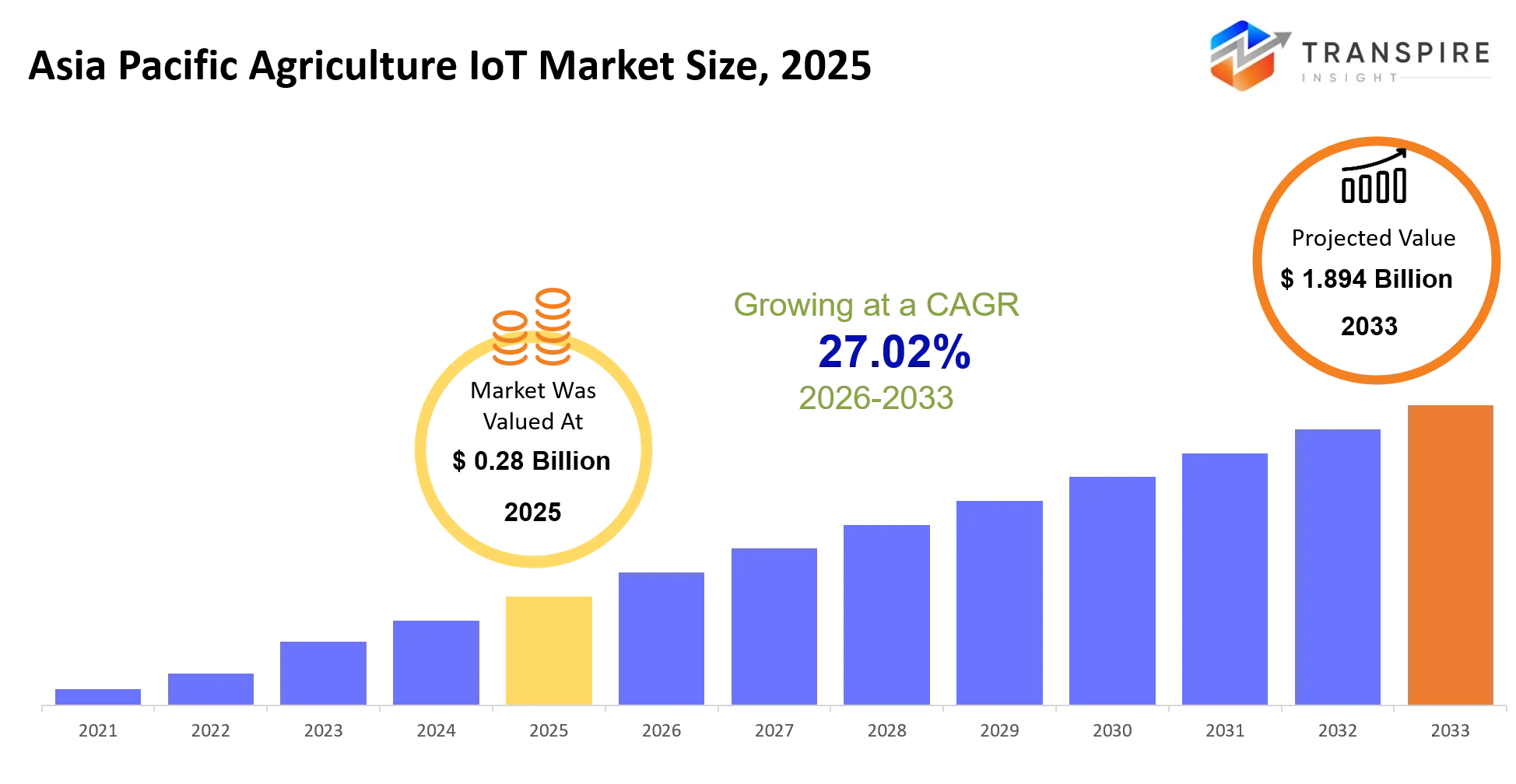
- Asia Pacific Agriculture IoT Market Size 2025: USD 0.28 Billion
- Asia Pacific Agriculture IoT Market Size 2033: USD 1.894 Billion
- Asia Pacific Agriculture IoT Market CAGR: 27.02%
- Asia Pacific Agriculture IoT Market Segments: By Component (Sensors, Drones, Software Platforms, Connectivity Devices, Smart Controllers, Others); By Application (Precision Farming, Livestock Monitoring, Smart Irrigation, Greenhouse Management, Crop Monitoring, Others); By Deployment (Cloud-Based, On-Premise, Hybrid, Others); By End User (Farmers, Agribusinesses, Cooperatives, Government Agencies, Others)
To learn more about this report,  Download Free Sample Report
Asia Pacific Agriculture IoT Market Summary
The Asia Pacific Agriculture IoT Market was valued at USD 0.28 Billion in 2025. It is forecast to reach USD 1.894 Billion by 2033. That is a CAGR of 27.02% over the period.
In the Asia Pacific Agriculture IoT Market, farmers and agribusiness organizations are adopting connected sensors, equipment, drones and data management platforms for managing daily production. Through the integration of these technologies farmers and organizations are currently monitoring the health of soil, irrigation performance, livestock health, and utilization of machinery and the progress of crops so that they can apply input effectively with decreased production loss.
In the last 3-5 years, the structural evolution in the Asia Pacific Agriculture IoT market shifted from isolated monitoring systems towards an interconnected farm management ecosystem that encompasses IoT technology with cloud analysis, automated operations, and recommendations based on AI and machine learning. Climate related disruptions, such as drought, flood and erratic precipitation in various agriculture regions of Asia Pacific acted as a strong catalyst driving the adoption of these technologies, since they revealed vulnerabilities in existing farming methods and raised the value of information delivered in real time to fields. The agriculture sector is expanding investments in connectivity solutions so as to improve efficiency, enhance input management and reinforce resilience, building up new sources of revenue for technology and service providers.
Key Market Insights
- China has the largest market share at around 35-40% of the Asia Pacific Agriculture IoT market by 2025 as digital agriculture projects of scale are being deployed throughout the region.
- Australia continues to hold a substantial market share as the adoption of remote monitoring solutions across commercial farms continues to rise.
- The Southeast Asian countries have emerging market demand for connected farming solutions, as this trend is attributed to the rising crop production and growing necessity for water management efficiency.
- Hardware solutions dominate with market size of almost 45% of the industry in 2025 as sensors, GPS devices, and connected monitoring equipment have been the top contributing components.
- Software and analytics platforms capture the second largest share as smart farms are expected to increase their dependency on data decision-making and support solutions.
- Cloud-based farm management platforms expected to be the fastest growing sector through 2030 driven by scalable subscription-based deployment models.
- Integrated IoT ecosystems are the trend to watch with hardware, connectivity and analysis combined together forming an emerging market opportunity.
- Precision farming continues to be the dominant application, accounting for about 40% market revenue in 2025 through soil monitoring, crop analysis and variable-rate application.
- Smart irrigation is the fastest growing application sector owing to growing scarcity of water globally in major regions.
- Livestock monitoring solutions have seen an increasing adoption due to its ability in enabling real-time tracking of livestock and its predictive management ability.
What are the Key Drivers, Restraints, and Opportunities in the Asia Pacific Agriculture IoT Market?
Growing precision agriculture supported by digital farming policies and demonstrable gains in productivity are the biggest drivers of the Asia Pacific Agriculture IoT Market. Countries such as China, India, Japan and Australia are increasing spending on agricultural digitisation to mitigate labour shortages, water constraints and food security needs while sensor costs, cloud storage costs and connectivity roll out costs have fallen dramatically, making technology adoption more attractive from a return on investment standpoint. Now, real-time information can be used to optimize irrigation, fertilizer application and use of farm machinery to maximize yield and minimize costs. The clear financial return is leading directly to greater technology expenditure and recurring revenue from software.
Structural challenges continue to limit overall market adoption. Limited connectivity in rural areas and uneven digital infrastructure throughout agricultural land will continue to prove problematic. Infrastructure roll out (both connectivity and power) as well as gains in digital literacy are long-term public and private sector investments that will take many years to mature. Consequently, smaller, fragmented farm holdings are still located in areas with unreliable internet access and a lack of investment funds leading to long roll-out periods, greater costs and significant market revenues left on the table.
A huge opportunity for growth will be AI powered predictive farming platforms integrated with satellite imagery, drones, and IoT sensor networks. India and Southeast Asia are also looking very promising as agri-tech investment ecosystems in these regions mature. The combination of weather intelligence, crop health analytics and automated recommendations has the potential to revolutionise farm-level decision making. This is technology that will become cheaper and scalable and that will open the next growth stage for Asia Pacific Agriculture IoT Market, pushing from commercial farms to a wider agricultural network.
What Has the Impact of Artificial Intelligence Been on the Asia Pacific Agriculture IoT Market?
AI and other emerging digital technologies are enabling an overhaul in the Asia Pacific Agriculture IoT market, with farm data translating directly into an automated system of operations. From soil sensors and weather stations to drones, satellites and smart machinery, AI based platforms are now automating irrigation schedules, fertilizer inputs, and monitoring of crop health, enabling the shifting from rigid, fixed schedules to real-time adjustments based on actual field conditions, leading to less resource use.
Machine learning models are also proving increasingly effective in strengthening decision making capabilities at a number of stages of the farm operation process. From forecasting pest infestations and predicting yields to detecting plant disease and optimizing harvest timings, machine learning is a valuable tool in predictive farming techniques. Intelligent systems in equipment can diagnose machinery faults on a routine basis, enabling predictive maintenance and reduction in the frequency and costs associated with downtime. This enhances operations, inputs use efficiency, and agricultural productivity.
The results obtained from utilizing these advanced technologies include quantifiable water savings, reduced fertilizer usage, increased farm profitability, and better machinery utilization. One significant challenge is a lack of application of these technologies across the diverse agricultural environment where many farmers may lack connectivity, standardized data inputs and the sufficient amounts of historical data for efficient models.
Key Market Trends
- Farms began to transition from standalone sensors toward an integrated platform with IoT, AI analytics, imagery, and automated decision support system in 2020.
- China's smart agriculture rollout intensified from 2021 to 2025, driving the deployment of irrigation and crop monitoring network connectivity.
- The decline in cost of both sensors and connectivity has enabled medium size farms to invest in smart agriculture and allowed the adoption of the technology outside large enterprises.
- The global water scarcity issue has prompted increased demand and adoption of precision irrigation in 2022, which provides the flexibility for the farmer to have the automatically adjusted watering based on the current status of the fields.
- The farm equipment manufacturers, like John Deere and AGCO Corporation, started to bundle their connected hardware with their subscription-based software services instead of selling them individually.
- Farm owners began to transition from proactive to predictive maintenance through use of ML and equipment condition monitoring technology.
- Crop monitoring using drone has grown from pilot to routine fieldwork within high-value crops in 2021-2025.
- Indian, Australian, and Southeast Asian governments switched their policy towards smart agriculture infrastructure in 2021-2025 to increase their farm production and optimize resource use.
- The farmers chose the cloud-based platform in 2021-2025 to manage various fields, resources and workflows together and provide an entire overview of their farms.
- The competition is based on the ecosystem that technology developers form through partnership to provide weather forecasting, remote sensing, agronomic modeling, and IoT integration services to farmers in 2021-2025.
Asia Pacific Agriculture IoT Market Segmentation
By Component :
Sensors are key components of many IoT Agriculture applications because they enable data acquisition in the field for conditions such as soil moisture, temperature, humidity, nutrient level and crop health. Through constant data collection it is possible to make accurate and timely decisions regarding field activities. Drones provide aerial imagery and field mapping for better visualization of large cultivation areas to control plant health and identify possible problems.
The data is brought together, analyzed and used to support decision making via software platforms. Communication between machinery, sensors and management systems are ensured through connectivity devices, and smart controllers enable automated actions for specific equipment (such as irrigation and environment control). Gateways, monitoring devices and hardware components contribute to the overall system.
By Application :
Precision agriculture refers to a farm management concept that aims to optimize input application rates (water, fertilizer and pesticides) according to specific field needs. Data-driven strategies enable increasing yield while minimizing waste of resources. Crop monitoring solutions are implemented to provide data about the progress of the crops, the field's performance and environmental factors.
Livestock monitoring systems collect real time data regarding animal's health and behavior, movement patterns and feeding habits, while smart irrigation solutions enable an efficient water application according to field needs and greenhouse control manages optimum greenhouse environmental conditions.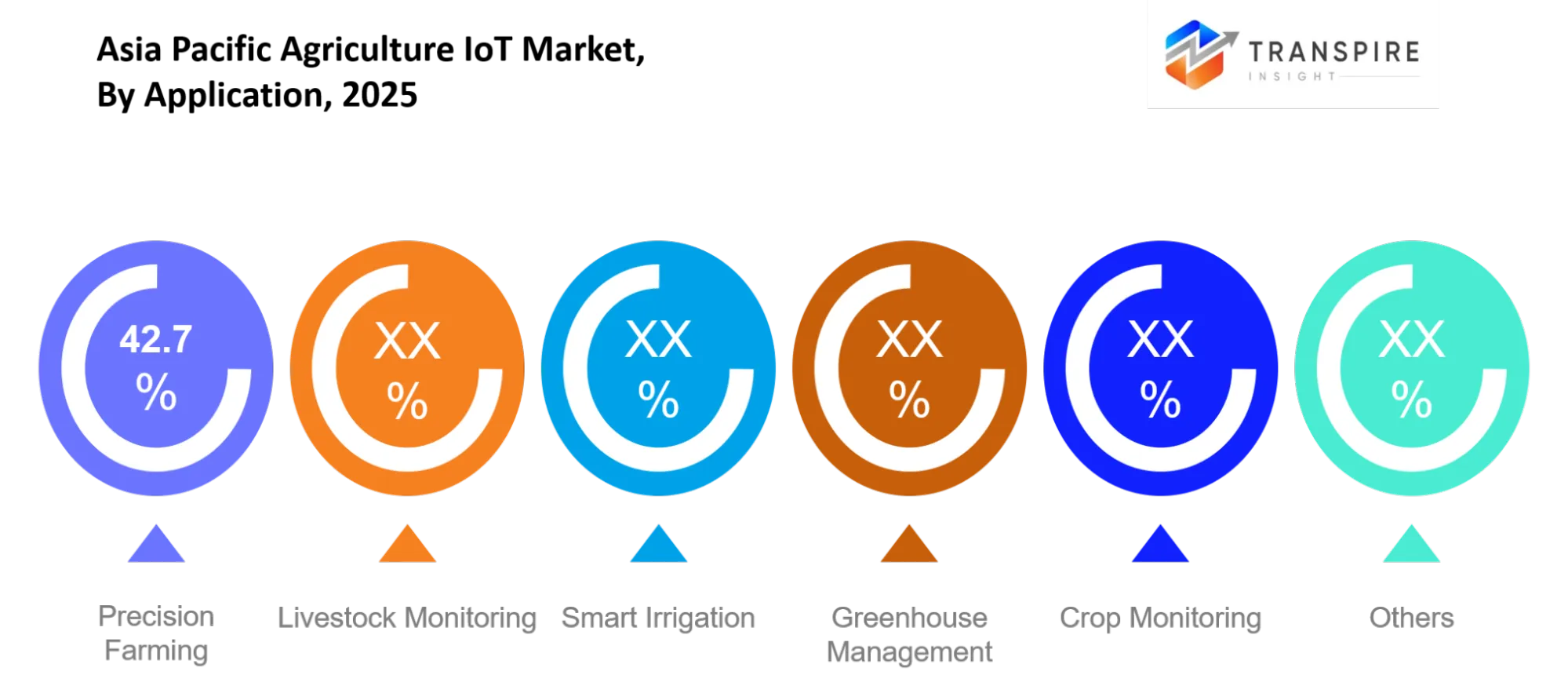
To learn more about this report, Download Free Sample Report
By Deployment :
Cloud deployment facilitates storage, processing, and remote access to the agricultural data at remote servers. It provides ease in scalability, real-time tracking and ease of access at many different locations. Many agricultural activities prefer cloud because data can easily be updated, and maintained without any local facilities.
The on-premise deployment keeps the data and the software within the local facilities. This helps the organizations to have greater control over data and systems. The hybrid deployment model combines cloud and on-premise environments, where information is accessible and systems can be effectively managed. Other deployment models include those considering special needs, connectivity issues and storage desire.
By End User :
Farmers comprise one of the biggest segments of the end-users. It is with connected technology they manage their farm more efficiently, optimize their resources, and increase their yield. They use the IoT systems in agriculture for tracking various parameters of the crop, equipment and environment to better manage their work. Agribusinesses can be considered a key end-user to efficiently manage the chain of supply networks and overall production.
Cooperatives can also be regarded as end-users of the interconnected agricultural systems to offer their members technology support for the common good and benefit. Government agencies also find applications for these systems for planning and tracking purposes, besides many others like the researchers, services and organizations involved in developing the agricultural sector.
What are the Key Use Cases Driving the Asia Pacific Agriculture IoT Market?
Precision farming continues to remain the dominant use case propelling the adoption across the Asia Pacific Agriculture IoT Market. Here farmers use interconnected sensor systems, field monitoring systems, and data analytics platforms to precisely manage irrigation, fertilizer application and crops. This is the strongest use case due to its direct impact and value creation in terms of yield increase, input utilization efficiency, and productivity enhancement.
Adoption is being driven in smart irrigation and livestock monitoring as well. Both commercial farms and agribusinesses are adopting interconnected irrigation systems to help overcome the challenges posed by scarcity of water and ensure effective utilization of the resource. Livestock managers employ wearable sensors and monitoring platforms to keep track of animals’ feeding behavior, overall health, and breeding efficiency which ultimately leads to lesser losses and an enhanced herd productivity.
The use cases are evolving to include crop disease prediction with the aid of Artificial Intelligence, along with autonomous management of farm machinery. Large scale farming applications with drone analytics and satellite integrated crop monitoring systems are emerging as another significant application area in Agriculture IoT. While adoption for this particular use case still remains marginal, future applications like these prove that Agriculture IoT holds the key for efficient agriculture with reduced dependence on manpower and the long term well-being of the farming ecosystem.
|
Report Metrics |
Details |
|
Market size value in 2025 |
USD 0.28 Billion |
|
Market size value in 2026 |
USD 0.355 Billion |
|
Revenue forecast in 2033 |
USD 1.894 Billion |
|
Growth rate |
CAGR of 27.02% from 2026 to 2033 |
|
Base year |
2025 |
|
Historical data |
2021 - 2024 |
|
Forecast period |
2026 - 2033 |
|
Report coverage |
Revenue forecast, competitive landscape, growth factors, and trends |
|
Regional scope |
Asia Pacific (India, China, Japan, Australia, South Korea, Rest of Asia Pacific) |
|
Key company profiled |
John Deere, Trimble, Bayer, AGCO, Topcon, CropX, DeLaval, IBM, Microsoft, Cisco, Huawei, Bosch, SAP, Oracle, Syngenta |
|
Customization scope |
Free report customization (country, regional & segment scope). Avail customized purchase options to meet your exact research needs. |
|
Report Segmentation |
By Component (Sensors, Drones, Software Platforms, Connectivity Devices, Smart Controllers, Others); By Application (Precision Farming, Livestock Monitoring, Smart Irrigation, Greenhouse Management, Crop Monitoring, Others); By Deployment (Cloud-Based, On-Premise, Hybrid, Others); By End User (Farmers, Agribusinesses, Cooperatives, Government Agencies, Others) |
Which Regions are Driving the Asia Pacific Agriculture IoT Market Growth?
China is Asia Pacific's largest regional market and maintains its leadership position in Agriculture IoT deployments. The substantial push by the government towards the modernization of agriculture, large-scale digital farming programs, and investments in connectivity to rural areas has accelerated its deployment in major farming regions. Moreover, a rich technology ecosystem of hardware and software providers, telecommunications firms, equipment manufacturers, and agricultural research organizations supports speedy adoption, continuous innovation and broad deployment of connected agriculture solutions.
Although Japan ranks second largest, its adoption rate differs from that of China. It is being fueled not by volume, but by a labor shortage and an aging farm labor workforce as well as the necessity of agricultural operations being highly efficient. Japanese farmers and agribusinesses continuously invest in automation systems, robots and real-time monitored agricultural fields that increase yields and does not require high labor inputs. They regularly spend a steady amount on agricultural technologies, which makes Japan a steady market contributor to the regional revenue stream.
Although growing at the fastest rate from 2026 through 2033, India remains one of the leading regions in the adoption of agriculture IoT. Improving access to the internet in rural areas, a large injection of investments into agri-tech and government initiatives to digitalize the agriculture industry, has led to much improved agriculture IoT adoption conditions during the last several years. Lower cost sensors, cloud based farm management applications and other low cost solutions available today, enable wide ranging agriculture IoT applications access to the end users, making it an attractive investment and market opportunity for tech vendors and platform providers.
Who are the Key Players in the Asia Pacific Agriculture IoT Market and How Do They Compete?
The competitive landscape of the Asia Pacific Agriculture IoT Market is still pretty split up, moderately fragmented, where big global agriculture technology companies go head to head with regional specialists, software providers, and connectivity firms that sort of sit in the background. In practice competition seems to land on technology capabilities first, then the quality of data analytics, plus how smoothly platforms integrate, and also whether they can actually show measurable productivity gains .
Long standing equipment manufacturers keep pushing stronger digital offerings, but the newer technology companies tend to narrow in on more specialized solutions, like precision agriculture tools, irrigation management, and farm analytics . There’s a lot of overlap, and everyone is trying to look more “ecosystem ready” than the next player.
John Deere competes using tightly linked machinery, sensors, and cloud based farm management platforms . The company stands out by taking equipment performance data and turning it into operational decision tools, so customers get something closer to a unified ecosystem, which helps keep customers around longer. Their expansion is mostly about boosting precision agriculture software capabilities and building partnerships that make digital farming workflows stick.
Trimble Inc. leans more toward positioning technology, guidance systems, and advanced analytics that raise field accuracy and operational efficiency. Ongoing investment in connected agriculture platforms also helps it widen its footprint across different farming environments, from one geography to another, without having to reinvent everything each time .
Company List
- John Deere
- Trimble
- Bayer
- AGCO
- Topcon
- CropX
- DeLaval
- IBM
- Microsoft
- Cisco
- Huawei
- Bosch
- SAP
- Oracle
- Syngenta
Recent Development News
In October 2025, Google expanded its India-developed Agricultural Landscape Understanding (ALU) and Agricultural Monitoring & Event Detection (AMED) APIs to trusted testers in Malaysia, Vietnam, Indonesia, and Japan. The rollout broadened the availability of AI- and IoT-enabled agricultural monitoring tools across Asia-Pacific, supporting data-driven farm management and precision agriculture adoption. Source https://timesofindia.indiatimes.com/
In May 2025, Punjab Agricultural University entered a partnership with BITS Pilani through a memorandum of understanding focused on precision agriculture, IoT, geospatial science, and data analytics. The collaboration is expected to accelerate development and field deployment of IoT-enabled farming technologies and smart agriculture research in India.
Source https://timesofindia.indiatimes.com/
What Strategic Insights Define the Future of the Asia Pacific Agriculture IoT Market?
The Asia Pacific Agriculture IoT Market is moving toward highly connected, sort of autonomous farming ecosystems where real time data, artificial intelligence automation, and predictive analytics will more and more steer agricultural decisions. The main push behind this change is the growing need to grow more food using limited land, water, and labor resources, while still keeping productivity strong even as climate conditions get more erratic. Over the next five to seven years, value creation is likely to drift away from just hardware deployment and toward integrated platforms that bring together data gathering, analytics, and automated execution.
There’s also a risk that feels less obvious at first, like data fragmentation across devices, software systems, and agricultural equipment suppliers. When farms start using technologies from a mix of different vendors, interoperability issues could make big rollouts slower, and in turn diminish the returns on digital investments. On top of that, market concentration among only a few platform providers could quietly raise switching costs for users, even if the products look similar on paper.
One interesting chance is AI powered digital twins for agriculture, especially in India and parts of Southeast Asia, where digital farming infrastructure is expanding very quickly. Market players should really focus on open, interoperable platforms, the ones that can mesh well with different data sources. That kind of foundation can support long term scalability and help keep customers as the industry matures and competition gets sharper.
Asia Pacific Agriculture IoT Market Report Segmentation
By Component
- Sensors
- Drones
- Software Platforms
- Connectivity Devices
- Smart Controllers
By Application
- Precision Farming
- Livestock Monitoring
- Smart Irrigation
- Greenhouse Management
- Crop Monitoring
By Deployment
- Cloud-Based
- On-Premise
- Hybrid
By End User
- Farmers
- Agribusinesses
- Cooperatives
- Government Agencies
Frequently Asked Questions
Find quick answers to common questions.
The Expected Asia Pacific Agriculture IoT Market size is USD 1.894 Billion in 2033.
Key Segments for the Asia Pacific Agriculture IoT Market are By Component (Sensors, Drones, Software Platforms, Connectivity Devices, Smart Controllers, Others); By Application (Precision Farming, Livestock Monitoring, Smart Irrigation, Greenhouse Management, Crop Monitoring, Others); By Deployment (Cloud-Based, On-Premise, Hybrid, Others); By End User (Farmers, Agribusinesses, Cooperatives, Government Agencies, Others).
Major Asia Pacific Agriculture IoT Market Players are John Deere, Trimble, Bayer, AGCO, Topcon, CropX, DeLaval, IBM, Microsoft, Cisco, Huawei, Bosch, SAP, Oracle, Syngenta.
The Current Asia Pacific Agriculture IoT Market size is USD 0.28 Billion in 2025.
The Asia Pacific Agriculture IoT Market CAGR is 27.02% from 2026 to 2033.
- John Deere
- Trimble
- Bayer
- AGCO
- Topcon
- CropX
- DeLaval
- IBM
- Microsoft
- Cisco
- Huawei
- Bosch
- SAP
- Oracle
- Syngenta
About the Authors

Mayur Shinde
I am Mayur Shinde, a Senior Research Analyst at Transpire Insight, specializing in the Automotive & Transportation and Information & Communication Technology (ICT) Industry. My work focuses on analyzing emerging market trends, technological advancements, competitive landscapes, and industry developments to deliver accurate, data-driven insights. I am passionate about transforming complex market information into clear, actionable content that helps businesses, professionals, and decision-makers stay informed and make confident strategic decisions.

Chakradhar Khansole
Chakradhar serves as the Research Director at Transpire Insight, bringing over 8 years of experience in technology, innovation, and strategic market intelligence. He specializes in transforming complex market data into actionable business insights that enable organizations to make informed, growth-oriented decisions. Recognized for his strategic vision and analytical expertise, Chakradhar leads high-impact research initiatives, delivering comprehensive market assessments, competitive intelligence, and forward-looking industry analysis.
Recently Published Reports
-
Apr 2026
3D Optical Profiler Market
3D Optical Profiler Market Size, Share & Analysis Report By Type (Desktop 3D Optical Profiler, and Portable 3D Optical Profiler), By Technology (Confocal Technology, and White Light Interference), By End-Use Industry (Manufacturing, Research Institutions, Automotive, Aerospace and Defense, Medical Devices, and Other), and Geography (North America, Europe, Asia-Pacific, Middle East and Africa, South and Central America), 2021 - 2031
-
Apr 2026
Depth Sensor Market
Depth Sensor Market Size, Share & Analysis Report By Type (Infrared Depth Sensors, Time-of-Flight (ToF) Sensors, Stereo Vision Sensors, Structured Light Sensors, Ultrasonic Depth Sensors), By Application (Automotive, Robotics, Gaming, Consumer Electronics, Industrial Automation, Healthcare, Security & Surveillance, Others), By End Users (Automotive Manufacturers, Consumer Electronics Companies, Healthcare Providers, Industrial Companies, Security Agencies, Gaming Companies, Robotics Companies, Others), and Geography (North America, Europe, Asia-Pacific, Middle East and Africa, South and Central America), 2021 – 2031
-
Apr 2026
Digital Manufacturing Market
Digital Manufacturing Market Size, Share & Analysis Report By Component (Hardware, Software, and Services), By Technology (Robotics, 3D Printing, Internet of Things (IoT), and Others), By Application (Automotive and Transportation, Aerospace and Defense, Consumer Electronics, Industrial Machinery, and Others), By Process Type (Computer-Based Designing, Computer-Based Simulation, Computer 3D Visualization, Analytics, and Others), and Geography (North America, Europe, Asia-Pacific, Middle East and Africa, South and Central America), 2021 – 2031
-
Apr 2026
Digital Visa Services Market
Digital Visa Services Market Size, Share & Analysis Report By Type (Individual Travelers, Group Travelers), By Application (Tourism, Business Travel, Others), and Geography (North America, Europe, Asia-Pacific, Middle East and Africa, South and Central America), 2021 – 2031