
Europe Biosensors Market Size & Forecast:
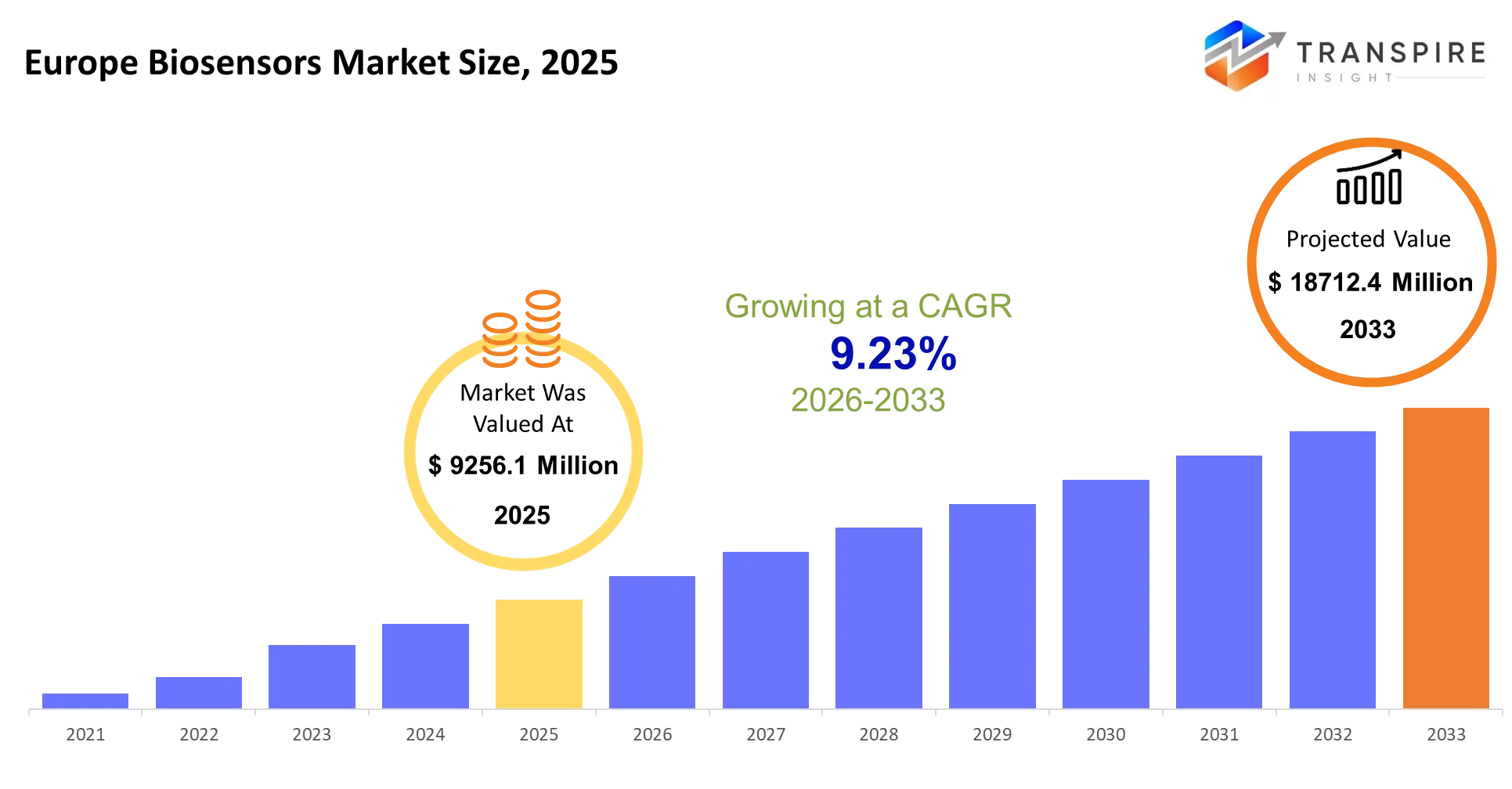
- Europe Biosensors Market Size 2025: USD 9256.1 Million
- Europe Biosensors Market Size 2033: USD 18712.4 Million
- Europe Biosensors Market CAGR: 9.23%
- Europe Biosensors Market Segments: By Type (Electrochemical, Optical, Piezoelectric, Thermal, Wearable Sensors, Others), By Application (Medical Diagnostics, Environmental Monitoring, Food Safety, Bioprocessing, Agriculture, Others), By End-User (Healthcare, Research Institutes, Food Industry, Environmental Agencies, Agriculture Sector, Others), By Technology (Wearable Sensors, Implantable Sensors, Nano Sensors, Others).
To learn more about this report,  Download Free Sample Report
Europe Biosensors Market Summary:
The Europe Biosensors Market size is estimated at USD 9256.1 Million in 2025 and is anticipated to reach USD 18712.4 Million by 2033, growing at a CAGR of 9.23% from 2026 to 2033. Biosensors in Europe convert biological signals into immediate data which operators use to assess water quality and find pollutants and manage bioprocessing operations through multiple industries including pharmaceuticals and food processing and maritime operations. The systems monitor ports and offshore areas to detect pathogens and chemical spills before they develop into compliance violations or safety issues.
The market has undergone structural changes in the last three to five years by adopting integrated digital biosensing platforms which operate through IoT and cloud systems and have replaced traditional diagnostic systems. The COVID-19 pandemic served as a main proponent for this development because it compelled healthcare organizations to implement quick testing and remote health monitoring systems which led to faster regulatory approval and increased investment in biosensor technology.
The new shift creates business expansion because companies now consider biosensing as a permanent element of their ongoing monitoring systems instead of using it for occasional assessments. The usage expands from laboratory settings to outdoor work sites which results in businesses needing more sensor equipment and data solutions and system integration services.
Key Market Insights
- The Europe Biosensors Market is primarily controlled by Western Europe which will hold more than 45% of the market in 2025 because of its advanced healthcare system and research funding resources.
- Northern Europe will become the most rapidly expanding area until 2030 because of its increasing use of digital health technologies and its implementation of environmental monitoring laws.
- The Europe biosensors industry selects electrochemical biosensors as its leading technology because they provide cost-effective solutions which deliver high sensitivity measurements which will account for approximately 50% market share in 2025.
- Optical biosensors hold the second-most market share because they are increasingly used in both clinical diagnostics and food safety testing.
- The wearable biosensors market functions as the fastest-expanding area which will experience substantial growth until 2030 because of increasing requirements for remote patient monitoring.
- Medical diagnostics will control more than 60% of the market in 2025 because healthcare providers need continuous glucose monitoring and infectious disease detection as vital tools.
- Environmental monitoring becomes the most rapidly expanding application because EU regulations require stricter water quality standards and pollution control measures.
- The Europe Biosensors Market is dominated by healthcare providers who control approximately 55% of the market because hospitals need diagnostic tools and Point-Of-Care tests.
- The homecare and remote monitoring market experiences its highest growth rate because aging populations currently drive the need for decentralized healthcare solutions.
What are the Key Drivers, Restraints, and Opportunities in the Europe Biosensors Market?
The Europe Biosensors Market experiences its main growth driver from the rising demand for decentralized and continuous health monitoring solutions because of post-pandemic healthcare system changes and EU-funded digital health initiatives. The healthcare sector implemented point-of-care testing and wearable biosensors because governments and healthcare providers needed to deliver diagnostic services directly to patients for improved hospital capacity management. The new system enables testing to become an ongoing process which produces continuous data streams that generate revenue through the sale of devices and consumables and data services. The adoption of remote monitoring in chronic disease management especially for diabetes and cardiovascular care has increased because reimbursement policies now support this practice.
The EU In Vitro Diagnostic Regulation (IVDR) creates an intricate and disorganized regulatory system which functions as the greatest existing obstacle. Organizations must conduct comprehensive clinical studies while preparing complete documentation and obtaining various certifications which results in extended product development times and higher costs. The existing structure experiences challenges because member states have not achieved complete regulatory alignment while smaller manufacturers lack sufficient resources to handle multiple approval procedures. The process delays product launches while it decreases the speed of innovation and forces smaller enterprises to either collaborate with larger companies or leave the market which results in decreased competition and reduced market growth.
The main potential exists for organizations to develop biosensor systems which combine with artificial intelligence-based analytical platforms to provide predictive diagnostic capabilities. The combination of wearable biosensors and machine learning models enables home-based detection of sepsis and metabolic disorders through their ability to identify early warning signs.
What Has the Impact of Artificial Intelligence Been on the Europe Biosensors Market?
The deployment of biosensors in industrial and maritime settings receives transformation from artificial intelligence and advanced digital technologies which convert biological signals into automated decision systems. The operators use biosensors together with AI-based control systems to create automated water quality monitoring systems that operate in ballast systems while they also enhance onboard treatment operations. The system performs continuous monitoring of microbial levels and chemical parameters which enables them to make immediate adjustments that decrease the need for manual sampling while they enhance compliance monitoring throughout their fleet operations.
Machine learning models also enable predictive capabilities by correlating biosensor data with historical performance patterns. The operators of marine emission control systems use predictive analytics to forecast biofouling or contamination events which decrease treatment efficiency because this allows maintenance teams to start their work before system failures happen. This method increases system availability while decreasing unexpected maintenance expenses which helps businesses stay compliant with strict European environmental standards.
The companies report operational improvements which result in increased efficiency through their ability to reduce chemical waste and their decreased number of compliance breaches and their better use of assets. The adoption of artificial intelligence technology faces limitations because organizations have to deal with data quality problems and they lack sufficient training datasets from actual situations which occurs in offshore environments where sensor calibration problems and environmental changes impact model performance.
Key Market Trends
- The healthcare sector moved to point-of-care biosensors from laboratory-based diagnostic tests which resulted in 40 percent faster clinical decision-making processes since 2020.
- The European Union introduced its In Vitro Diagnostic Regulation in 2022 which required manufacturers to create new validation methods that would raise their compliance expenses while forcing them to postpone product development until their validation process achieved compliance.
- The popularity of wearable biosensors increased after 2021 because remote patient monitoring systems expanded their capabilities to track both glucose levels and heart activity through chronic disease management programs.
- Manufacturers use biosensors as core components which they integrate into IoT systems that enable instant data transfer while decreasing the need for human labor during industrial operations and environmental monitoring processes.
- The digital biosensing systems became popular in Northern Europe after 2021 because the region possessed advanced health data systems and received governmental support for telehealth development.
- Abbott Laboratories and Roche decided to focus on continuous monitoring devices because they wanted to switch their revenue model from one-time sales to subscription-based services.
- The environmental laws became more stringent between 2020 and 2024 which required industries to install biosensors that would provide continuous water and contamination monitoring instead of using their existing manual testing methods.
- European companies now obtain biosensor components from local suppliers because their supply chains changed after the pandemic which reduced their need to rely on Asian suppliers of semiconductor and reagent products.
- The biosensor systems enhanced their predictive analytics capabilities after 2022 which allowed them to identify system anomalies at earlier stages and thus achieved better operational efficiency while decreasing total operational downtime.
Europe Biosensors Market Segmentation
By Type
Electrochemical biosensors currently dominate the market because they offer affordable pricing and rapid response times and work well with portable testing equipment. Optical biosensors follow because they are widely used in both high-precision clinical testing and food safety assessments. Industrial and research applications use piezoelectric and thermal sensors because they track specific measurements that occur in specialized fields. The period after 2021 saw rapid growth in wearable sensors because healthcare organizations began using remote monitoring for their chronic disease management programs.
The electrochemical devices market has expanded because these devices enable easy scaling and direct application in point-of-care settings while optical systems achieve precise detection in complex testing conditions. The future will probably see research efforts directed at developing hybrid sensor systems which combine high sensitivity with lightweight design while manufacturers work on creating smaller devices that can detect multiple substances to fulfill various industrial and clinical needs.
By Application
Medical diagnostics operate through their various applications which find extensive use in glucose monitoring and infectious disease detection and decentralized testing. Increased environmental monitoring activity results from stricter European regulations that control water quality and pollution, while food safety applications expand their reach to meet traceability needs. Bioprocessing and agriculture demonstrate steady growth through biosensor technology which enhances yield tracking and contamination management.
The healthcare system now operates diagnostic tests according to two new testing methods which require rapid testing and nearby test facilities, while environmental applications utilize compliance-based systems. The market will require continuous monitoring solutions to support various applications, which will prompt solution developers to create flexible platforms that meet the needs of both healthcare providers and industrial organizations.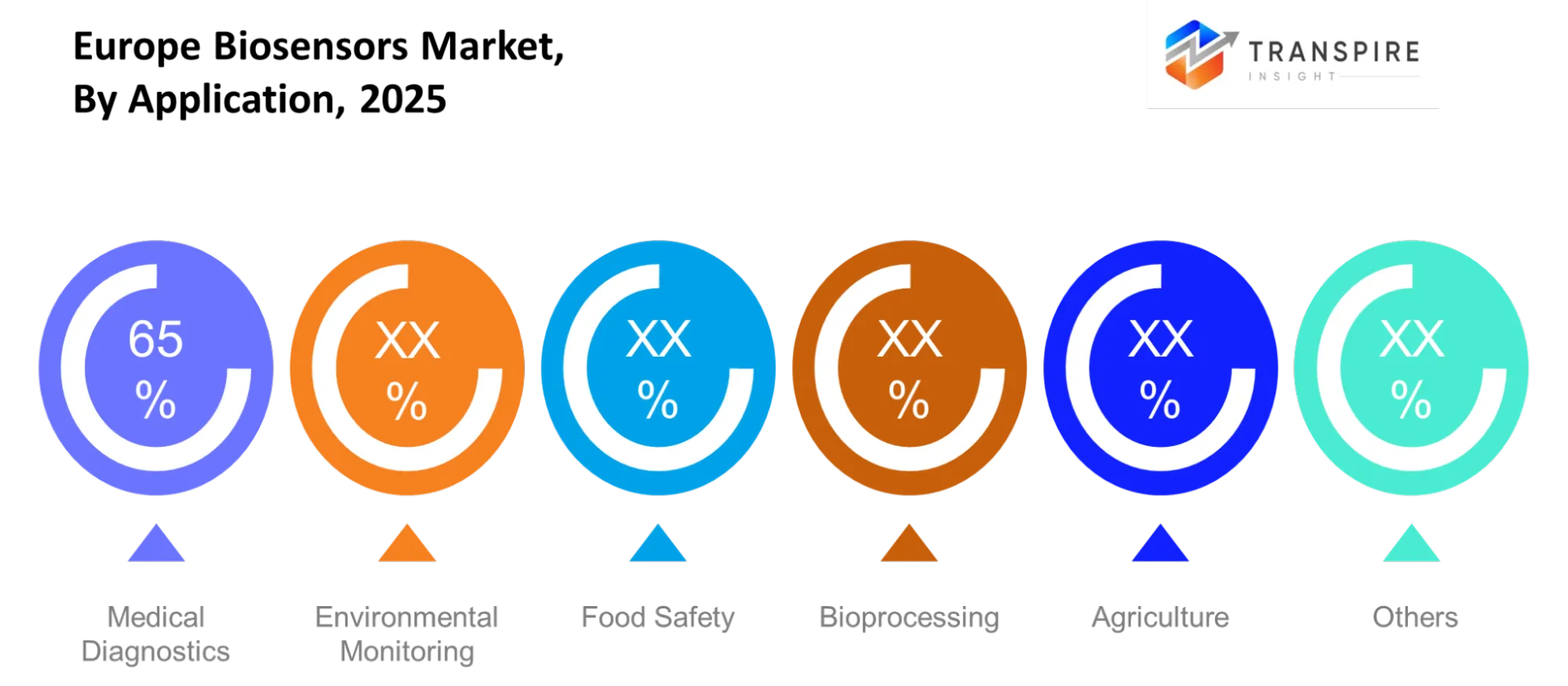
To learn more about this report, Download Free Sample Report
By End-User
The healthcare sector stands as the top market segment because it handles large patient numbers and has established reimbursement methods and uses point-of-care diagnostic tests. Research institutes create major innovations through their early adoption of cutting-edge biosensing technologies which they develop as research projects, while the food industry and environmental agencies use biosensors for compliance and quality assurance. The agriculture sector shows gradual uptake, particularly in soil health and crop monitoring applications.
Digital health solutions drive healthcare growth because they enable better disease management, while industrial users focus on maintaining regulatory compliance and boosting their work productivity. The company needs to expand its product range because non-clinical users will drive product development which requires them to create affordable and easy-to-use solutions for businesses that need rugged systems which can work in outdoor environments.
By Technology
Wearable sensor technology leads due to integration with consumer health devices and remote monitoring platforms which receive backing from strong investment in digital health infrastructure. Medical applications use implantable sensors as their second most common form of detection, which includes long-term disease management, while nanosensors create a new segment that exhibits advanced detection capabilities for early-stage identification.
Existing technologies maintain their functions through support of both established systems and specialized applications. The growth of wearable systems depends on their ability to provide instant data to users, whereas research funding for nanosensors exists because they offer precise measurement capabilities. The future will advance through better data sharing systems between different technologies and lower production costs which will motivate companies to develop products that work with both digital ecosystems and actual market needs.
What are the Key Use Cases Driving the Europe Biosensors Market?
Medical diagnostics serves as the primary application that uses continuous glucose monitoring and rapid infectious disease testing in both hospitals and homecare environments. Healthcare systems use biosensors to provide instant results which enable patients to manage their chronic conditions without needing to visit laboratories for testing.
Biosensors have created new applications for environmental monitoring and food safety testing. Industrial operators and environmental agencies use biosensors to comply with EU water quality standards while food processors employ them to track contamination and maintain supply chain traceability.
The new applications of precision agriculture and bioprocess optimization. Farmers use biosensors to test their soil nutrients and monitor the health of their plants while biopharma companies research real-time fermentation control to enhance their production efficiency and decrease their product failure rates.
|
Report Metrics |
Details |
|
Market size value in 2025 |
USD 9256.1 Million |
|
Market size value in 2026 |
USD 10089.2 Million |
|
Revenue forecast in 2033 |
USD 18712.4 Million |
|
Growth rate |
CAGR of 9.23% from 2026 to 2033 |
|
Base year |
2025 |
|
Historical data |
2021 - 2024 |
|
Forecast period |
2026 - 2033 |
|
Report coverage |
Revenue forecast, competitive landscape, growth factors, and trends |
|
Regional scope |
Europe (Germany, United Kingdom, France, Italy, Spain and Rest of Europe) |
|
Key company profiled |
Abbott, Medtronic, Siemens Healthineers, Roche, GE Healthcare, Thermo Fisher, Bio-Rad, Danaher, Agilent, Honeywell, STMicroelectronics, NXP, Sensirion, Nova Biomedical, Ametek |
|
Customization scope |
Free report customization (country, regional & segment scope). Avail customized purchase options to meet your exact research needs. |
|
Report Segmentation |
By Type (Electrochemical, Optical, Piezoelectric, Thermal, Wearable Sensors, Others), By Application (Medical Diagnostics, Environmental Monitoring, Food Safety, Bioprocessing, Agriculture, Others), By End-User (Healthcare, Research Institutes, Food Industry, Environmental Agencies, Agriculture Sector, Others), By Technology (Wearable Sensors, Implantable Sensors, Nano Sensors, Others) |
Which Regions are Driving the Europe Biosensors Market Growth?
Western Europe leads the regional landscape because its strong regulatory enforcement and advanced healthcare systems which emphasize early diagnosis and ongoing patient observation. The countries Germany, France, and the United Kingdom enforce strict compliance rules that require healthcare and environmental testing to be conducted in real time. The advanced hospital system and the well-funded research environment enable quick implementation of emerging biosensing solutions. Public health agencies and universities and manufacturing partners maintain existing partnerships to drive innovation while they deploy solutions in both clinical and industrial environments.
Southern Europe maintains stable growth because its healthcare systems evolve at a slow pace while its food safety and environmental monitoring systems receive continuous funding. The main region operates differently from Italy and Spain because these two countries concentrate their efforts on developing budget-friendly solutions instead of creating premium technological advancements. The economic recovery initiatives together with EU-sponsored financing will maintain steady market growth because they enable businesses to adopt new technologies. The local industries of the region demand dependable products which meet regulatory standards, thus creating a stable market for biosensor manufacturers.
Northern Europe experiences its most rapid development because of the fast integration of digital health technologies and because governments support remote patient monitoring systems. The countries Sweden and Denmark have developed their telehealth systems since 2021, which has increased the use of biosensors for home healthcare and remote medical testing. The high readiness of digital infrastructure enables biosensors to connect with data systems and artificial intelligence platforms without difficulties.
Who are the Key Players in the Europe Biosensors Market and How Do They Compete?
The European biosensor market exhibits a semi-consolidated competition pattern which enables major diagnostic companies to control most market share while smaller companies and startups develop specific innovations. Incumbents maintain their market position through two main advantages which include their knowledge of regulatory processes and their existing distribution channels that meet EU compliance demands. The new market players create disturbances in specialized markets which include wearable devices and nano-enabled sensing technologies. The main competitive factors include technological precision and testing speed plus the capability to combine biosensors with digital health systems and industrial monitoring solutions.
Abbott Laboratories develops continuous monitoring systems which specialize in glucose detection through a service-based approach that produces ongoing income from consumable items and data management systems. Roche establishes its unique identity through its creation of high-precision diagnostic systems which fully comply with European regulatory requirements to achieve faster product approval and complete hospital adoption. Siemens Healthineers develops complete diagnostic systems which merge biosensors with imaging technologies and laboratory equipment to produce clinical workflows that competitors find difficult to copy.
Medtronic develops implantable biosensor systems which provide continuous monitoring for patients with chronic illnesses through their ability to track patient-specific information. Bio-Rad Laboratories provides research and bioprocessing solutions through specialized detection equipment which assists customers in developing pharmaceutical products. The companies build their business through strategic alliances which involve hospitals and research institutions and digital health platforms to enhance their regional presence while driving connected biosensing solution adoption.
Company List
- Abbott
- Medtronic
- Siemens Healthineers
- Roche
- GE Healthcare
- Thermo Fisher
- Bio-Rad
- Danaher
- Agilent
- Honeywell
- STMicroelectronics
- NXP
- Sensirion
- Nova Biomedical
- Ametek
Recent Development News
In April 2026, Bruker launches automated molecular biosensor diagnostics system in Europe: Bruker Corporation introduced its MyGenius PRO automated molecular diagnostics platform in Europe, expanding its biosensor-enabled PCR testing portfolio. The system improves infectious disease detection speed using integrated sample-to-result biosensing automation.
Source: https://uk.investing.com
In April 2026, Senseonics launches Eversense 365 implantable biosensor CGM in Europe: Senseonics Holdings initiated the European rollout of its Eversense 365 implantable continuous glucose biosensor, the world’s first 365-day CGM system. The device strengthens Europe’s wearable biosensor ecosystem for long-term metabolic monitoring.
Source: https://www.drugdeliverybusiness.com
What Strategic Insights Define the Future of the Europe Biosensors Market?
The Europe biosensors market is developing into integrated systems that collect data permanently, which use sensing equipment for ongoing digital decision processes instead of using it as an independent testing instrument. The market shift happens because biosensing technology and artificial intelligence analytics and flexible health and industrial data systems have unified to create value through long-term data service and predictive analytics business models. Companies will achieve their competitive advantage through system integration and software development and international regulatory compliance, which will become more critical than sensor accuracy in the next 5 to 7 years.
The company faces an unknown danger because it relies on semiconductor and biochemical suppliers, which creates a single point of failure in its supply chain that will result in increased costs during times of international conflict and trade restrictions. An opportunity exists through the development of nanosensors, which enables early disease detection in Northern Europe because the region has developed digital infrastructure and research funding to support fast market entry.
Organizations should create platform-based business models, which combine sensing with analytics and service delivery, while they establish multiple supply channels to protect their operational activities from future threats.
Europe Biosensors Market Report Segmentation
By Type
- Electrochemical
- Optical
- Piezoelectric
- Thermal
- Wearable Sensors
- Others
By Application
- Medical Diagnostics
- Environmental Monitoring
- Food Safety
- Bioprocessing
- Agriculture
- Others
By End-User
- Healthcare
- Research Institutes
- Food Industry
- Environmental Agencies
- Agriculture Sector
- Others
By Technology
- Wearable Sensor
- Implantable Sensors
- Nano Sensors
- Others
Frequently Asked Questions
Find quick answers to common questions.
The Approximate Europe Biosensors Market size for the Market will be USD 18712.4 Million in 2033.
The key Segments of the Europe Biosensors Market are By Type (Electrochemical, Optical, Piezoelectric, Thermal, Wearable Sensors, Others), By Application (Medical Diagnostics, Environmental Monitoring, Food Safety, Bioprocessing, Agriculture, Others), By End-User (Healthcare, Research Institutes, Food Industry, Environmental Agencies, Agriculture Sector, Others), By Technology (Wearable Sensors, Implantable Sensors, Nano Sensors, Others).
Major players in the Europe Biosensors Market are Abbott, Medtronic, Siemens Healthineers, Roche, GE Healthcare, Thermo Fisher, Bio-Rad, Danaher, Agilent, Honeywell, STMicroelectronics, NXP, Sensirion, Nova Biomedical, Ametek.
The Current Market size of the Europe Biosensors Market is USD 9256.1 Million in 2025.
The Europe Biosensors Market CAGR is 9.23%.
- Abbott
- Medtronic
- Siemens Healthineers
- Roche
- GE Healthcare
- Thermo Fisher
- Bio-Rad
- Danaher
- Agilent
- Honeywell
- STMicroelectronics
- NXP
- Sensirion
- Nova Biomedical
- Ametek
Recently Published Reports
-
Apr 2026
Fiber Optic Faceplates Market
Fiber Optic Faceplates Market Size, Share & Analysis Report By Type (< 300 mm2, 300-350 mm2, and > 350 mm2, By Application (Night Vision, Holographic Imaging, Medical, and Others), and Geography (North America, Europe, Asia-Pacific, Middle East and Africa, South and Central America), 2021 - 2031
-
Apr 2026
High Temperature Superconductors Market
High Temperature Superconductors Market Size, Share & Analysis Report By Type (1G HTS, and 2G HTS), By Application (Power Cable, Fault Current Limiter, and Transformer), and Geography (North America, Europe, Asia-Pacific, Middle East and Africa, South and Central America), 2021 - 2031
-
Apr 2026
Industrial Plugs and Socket Market
Industrial Plugs and Socket Market Size, Share & Analysis Report By Type (Industrial Plugs, Industrial Sockets), By Current (Up to 32 A, 32 to 125 A, Above 125 A), By Protection (Dustproof and Splash Proof, Waterproof, Explosion Proof), By End User (Heavy Industries, Oil and Gas, Chemicals and Pharmaceuticals, Power Generation, Others), and Geography (North America, Europe, Asia-Pacific, Middle East and Africa, South and Central America), 2021 - 2031
-
Apr 2026
InGaAs Avalanche Photodiodes Market
InGaAs Avalanche Photodiodes Market Size, Share & Analysis Report By Type (1100 - 1700 nm, and 1000 - 1600 nm), By Application (Missile Warning System, Muzzle Flash Detection, Wafer Defect Inspection, Laser Rangefinders, and Others), and Geography (North America, Europe, Asia-Pacific, Middle East and Africa, South and Central America), 2021 - 2031