

North America Diffractive Optical Element Market Size & Forecast:
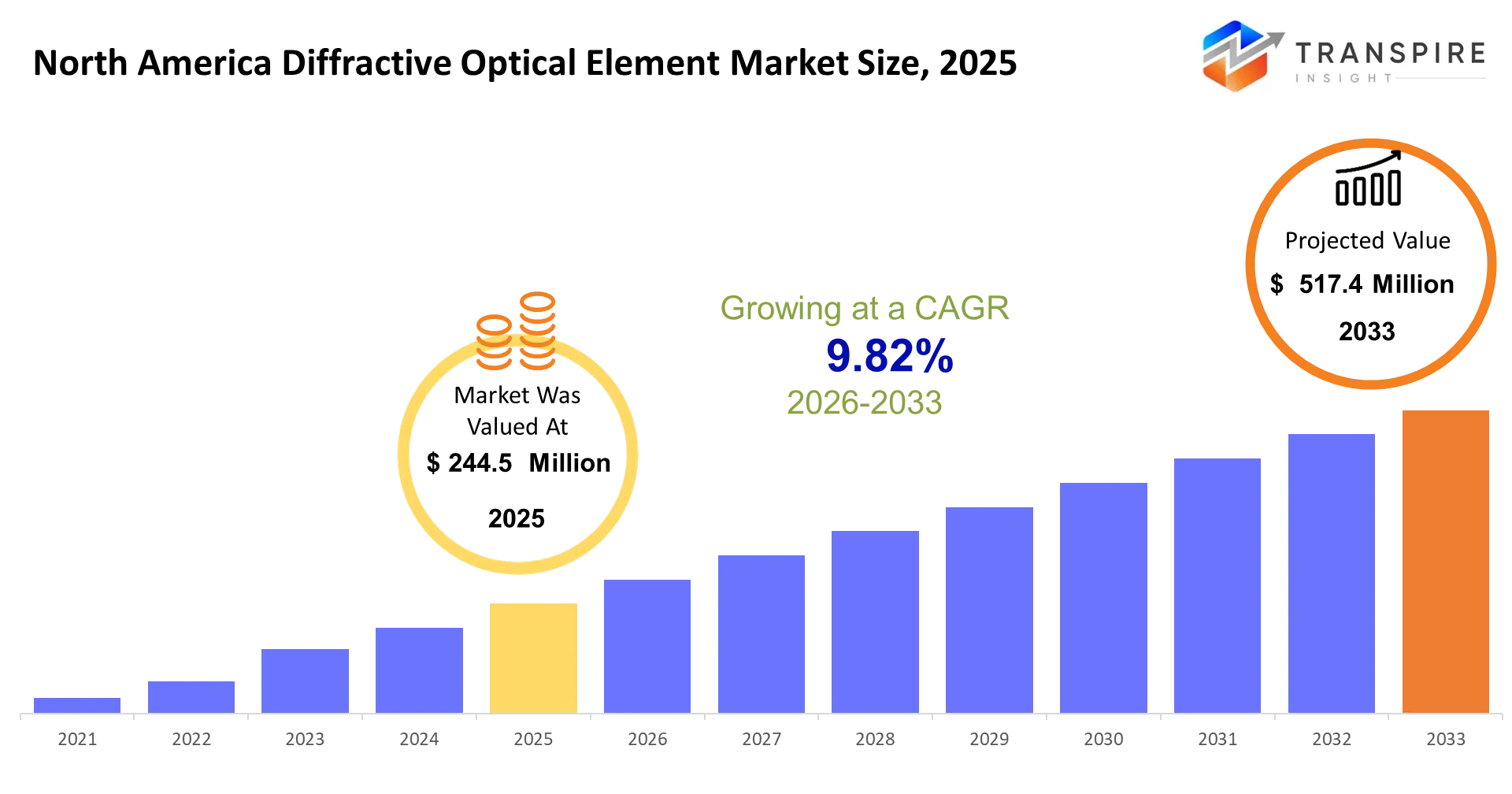
- North America Diffractive Optical Element Market Size 2025: USD 244.5 Million
- North America Diffractive Optical Element Market Size 2033: USD 517.4 Million
- North America Diffractive Optical Element Market CAGR: 9.82%
- North America Diffractive Optical Element Market Segments: By Type (Beam Splitters, Beam Shapers, Diffusers, Lenses, Gratings, Others), By Application (Laser Systems, Imaging, Lithography, Sensors, Defense, Others), By End-User (Electronics, Aerospace, Defense, Healthcare, Industrial, Others), By Material (Glass, Polymer, Silicon, Quartz, Others).
To learn more about this report,  Download Free Sample Report
North America Diffractive Optical Element Market Summary:
The North America Diffractive Optical Element Market size is estimated at USD 244.5 Million in 2025 and is anticipated to reach USD 517.4 Million by 2033, growing at a CAGR of 9.82% from 2026 to 2033. The North America Diffractive Optical Element (DOE) market provides essential light control technology which various industries use in their operations for industrial automation and semiconductor inspection and medical imaging and advanced sensing systems. Through practical implementation DOEs provide manufacturers with the capability to split and shape laser beams while achieving high efficiency through homogenization which enables them to solve multiple real-world problems that include uniform material processing and accurate 3D sensing and optical assembly miniaturization.
The market has experienced a structural shift during the past 3 to 5 years because businesses now prefer to use integrated system-level photonics solutions instead of standalone optical components. The transition relates to the increasing adoption of LiDAR and AR/VR technology and semiconductor lithography applications. The global semiconductor supply chain disruption during the COVID-19 period served as the main catalyst which led original equipment manufacturers to develop efficient systems that relied on local suppliers for their components.
The market has shifted towards custom-engineered DOEs which manufacturers produce according to specific customer requirements that require them to maintain precise tolerances while delivering products at faster manufacturing speeds. This shift enables businesses to obtain higher product value while developing stronger long-term relationships with their suppliers.
Key Market Insights
- The United States maintains a market dominance over 75% in the North America Diffractive Optical Element Market because of semiconductor and defense sector investments which will continue in 2025.
- Canada will maintain its position as the fastest-growing region until 2030 because of its photonics research and development funding and its new quantum technology research projects.
- The market share for beam shaping diffractive optical elements will reach 40% in 2025 because industries use them extensively for laser material processing.
- Beam splitting diffractive optical elements provide the second-largest market share because they receive widespread use in optical communication and sensing applications.
- The diffuser segment grows the fastest because it will experience rapid expansion until 2030 due to increasing LiDAR and AR/VR technology integration.
- The semiconductor lithography market leads with over 35% market share in 2025 because chip manufacturing requires precise optical systems.
- The development of autonomous vehicles and the industrial automation market drive the growth of LiDAR systems as their primary application.
- Advanced fabrication requirements lead to semiconductor and electronics manufacturers holding nearly 45% of the market share.
- The automotive and mobility industries are experiencing rapid growth because of the increased use of LiDAR-based safety and navigation systems.
What are the Key Drivers, Restraints, and Opportunities in the North America Diffractive Optical Element Market?
The North America Diffractive Optical Element Market experiences growth because LiDAR and advanced sensing systems become increasingly implemented in both the automotive and industrial automation sectors. The development began after 2020 when autonomous driving technology reached commercialization together with new mobility system safety standards. OEMs needed beam shaping solutions that functioned through compact energy-efficient systems because they switched from mechanical systems to solid-state LiDAR. The design-in rates for DOEs increased because sensor modules needed to meet the requirements of high-resolution mapping and object detection systems.
The most important obstacle requires micro and nano structured designs with high precision to be developed at manufacturing scale because their production process needs advanced lithography systems and special materials and strict process controls which cannot be produced or expanded without difficulty. The OEMs that operate on smaller scales must deal with extended waiting periods and expensive modifications which results in slower adoption for budget-conscious markets and restricts their ability to reach markets beyond premium products.
DOEs create a primary business opportunity through their potential application in augmented reality and wearable optics which require small systems for light management. The AR hardware ecosystem in the United States generates a need for optical components that combine lightweight properties with high efficiency because of ongoing ecosystem investments. DOE suppliers who create products for consumer-grade AR devices that enter mass production will benefit from new revenue opportunities and operational advantages through their alignment with this ecosystem.
What Has the Impact of Artificial Intelligence Been on the North America Diffractive Optical Element Market?
The manufacturing process of diffractive optical elements now uses artificial intelligence together with advanced digital technologies to create new methods for making and using precise optical systems. The AI-driven control systems in fabrication facilities observe lithography and etching operations through real-time monitoring, which permit automatic modifications of exposure dose and alignment settings to enhance yield performance and decrease production errors. The manufacturers achieved production cycle reduction together with material waste minimization through this automation system, which resulted in higher operational efficiency and production speed.
Machine learning models are also being applied to predictive maintenance of fabrication equipment and performance optimization of optical systems. The models use historical process data and environmental variables to predict equipment drift or failure before it happens, which helps facilities achieve uptime levels above 90 percent in high-volume production environments. AI improves optical performance in LiDAR and semiconductor inspection application environments by using dynamic calibration of beam shaping patterns, which results in better detection accuracy and system performance.
The high cost of AI implementation together with its technical requirements create a fundamental obstacle to using AI with existing photonics manufacturing systems. The absence of standardized data infrastructure in many facilities creates a barrier to achieving model accuracy, which delays the implementation of models across entire operations.
Key Market Trends
- The period after 2020 saw original equipment manufacturers transition from traditional bulk optics systems toward integrated diffractive designs which resulted in 40 percent smaller parts for their LiDAR and sensing equipment.
- The semiconductor equipment manufacturers started using design of experiments methodologies after 2021 because their advanced manufacturing processes needed better beam control and precise lithography systems.
- Edmund Optics and Thorlabs expanded custom DOE offerings between 2022 and 2025 to meet rising demand for application-specific optical solutionsThe COVID-19 pandemic caused supply chain problems which led North American manufacturers to start producing design of experiments systems locally, resulting in more than 20 percent increase in domestic production capacity since 2021.
- The automotive industry began using solid-state LiDAR technology for driver assistance systems after 2022, which created a need for design of experiments systems that would handle beam shaping and splitting functions.
- The introduction of AI-based optical design software by manufacturers after 2021 resulted in a 50 percent reduction for prototype development time, which allowed them to design high-volume products more efficiently.
- The market demand for high-efficiency design of experiments systems that achieved more than 90 percent diffraction efficiency led to the replacement of conventional optics systems used in laser material processing and medical imaging systems.
- The photonics industry formed more strategic collaborations with semiconductor original equipment manufacturers after 2023, which enabled them to jointly develop optical components for future technologies.
- The Canadian government established Canada as a center for photonics research after 2022, when it created funding programs for quantum and optics research which led to new investments in design of experiments systems.
North America Diffractive Optical Element Market Segmentation
By Type
The main segment of beam shapers maintains its leading status because laser material processing and semiconductor fabrication require their technology which delivers uniform energy distribution for optimal production results and accuracy. The second-largest market segment for beam splitters exists because they are widely used in both sensing applications and optical communication systems. The demand for controlled light scattering and pattern projection in LiDAR and augmented reality systems drives the growth of diffusers and gratings.
Lenses and other specialized diffractive components operate in specific fields because their customization expenses restrict their usage. The optical architecture system development process involves creating compact designs which use engineered surfaces to replace multiple traditional optical components. The future design development requires manufacturers to build high efficiency systems which include customized solutions for specific applications through advanced lithography and simulation technologies that simplify system operation for users and decrease equipment space needs.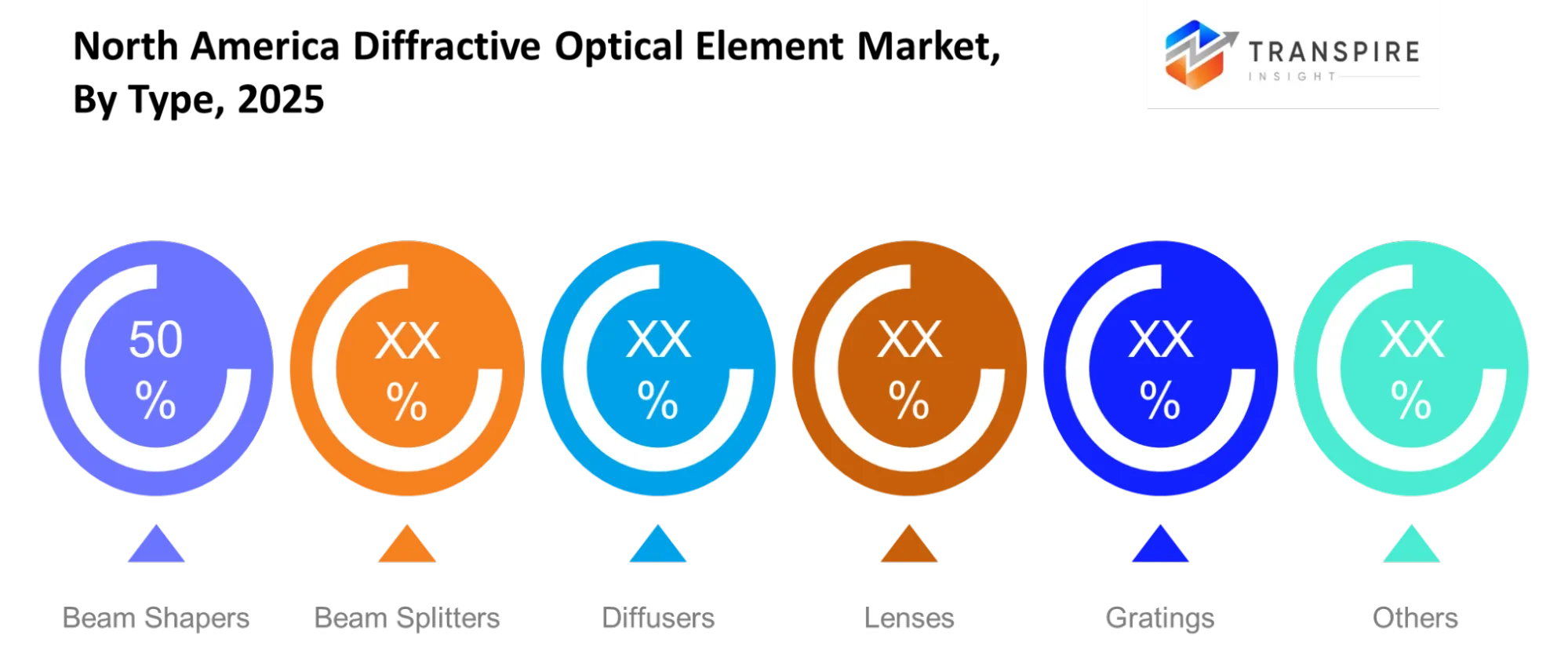
To learn more about this report, Download Free Sample Report
By Application
The cutting, welding and additive manufacturing processes depend on laser systems because those systems require exact beam control for their operations. The semiconductor lithography market holds a major position because modern chip manufacturing requires precise optical standards and consistent manufacturing results. Imaging applications maintain steady demand, particularly in medical diagnostics and inspection systems. The sensors market has become its fastest expanding section because of the growth of self-driving cars and industrial automation which need precise depth detection and object identification.
Defense applications continue to adopt diffractive optics for targeting and surveillance, though procurement cycles remain long. The development of intelligent systems, which need compact optical systems for light control, has created a demand for optical systems that require compact light control. The future will bring better collaboration across optical design, which will connect to system-level engineering, through partnerships between component suppliers and OEMs.
By End-User
The semiconductor fabrication industry, the consumer device market and advanced display technology sector show continuous demand which enables electronics manufacturers to control their respective markets. Industrial users follow, driven by adoption in automation, robotics, and precision manufacturing systems. The aerospace and defense sectors maintain their market share through their use of guidance systems and surveillance platforms, but high entry barriers exist because of certification requirements.
The healthcare sector experiences steady growth because advanced optical components in imaging systems and diagnostic tools enable better resolution and improved accuracy. The automotive and mobility sectors show the highest growth rate because they continue to develop their LiDAR and sensing technologies. The demand patterns show a shift toward high-performance optical solutions which have compact designs and support intelligent connected systems. The future outlook shows that cross-industry adoption will increase, which requires suppliers to find a balance between their need for customized products and their requirement for producing options at scale.
By Material
The glass-based diffractive optical elements outperform other materials because they provide better thermal stability and optical clarity and they withstand high-power laser use. Quartz follows closely behind glass because it offers better ultraviolet and high-precision performance through its ability to resist thermal distortion. Silicon-based elements become more popular because they use existing manufacturing methods for infrared and semiconductor applications. The fastest-growing segment in the market consists of polymer materials which provide cost benefits and work well for manufacturing high-volume products in consumer goods and automotive industries.
Polymers have two main problems because they do not last long and they cannot withstand high temperatures which prevents their use in extreme conditions. Material selection for applications needs to follow growth logic which requires choosing between performance and scalability. The future development of manufacturing will use hybrid material solutions together with advanced coatings which allow manufacturers to achieve multiple performance requirements while enhancing their production processes.
What are the Key Use Cases Driving the North America Diffractive Optical Element Market?
The primary application of laser material processing continues to serve semiconductor fabrication and industrial manufacturing. The cutting and welding and lithography procedures use beam shaping elements to deliver consistent energy distribution which leads to higher production rates and fewer defects.
The automotive sensing and medical imaging fields are developing new applications that build upon existing technologies. Advanced driver assistance systems use LiDAR systems because they depend on precise beam splitting to create accurate depth mapping. Healthcare imaging systems apply diffractive optics to improve resolution while creating smaller devices.
New applications are being developed for both augmented reality headsets and quantum photonics systems. The consumer electronics industry is conducting tests on lightweight optical components which they plan to use in their wearable display products. Research laboratories investigate diffractive structures because they want to achieve precise control over light manipulation which will benefit both future computing and secure communication systems.
|
Report Metrics |
Details |
|
Market size value in 2025 |
USD 244.5 Million |
|
Market size value in 2026 |
USD 268.5 Million |
|
Revenue forecast in 2033 |
USD 517.4 Million |
|
Growth rate |
CAGR of 9.82% from 2026 to 2033 |
|
Base year |
2025 |
|
Historical data |
2021 - 2024 |
|
Forecast period |
2026 - 2033 |
|
Report coverage |
Revenue forecast, competitive landscape, growth factors, and trends |
|
Regional scope |
North America (Canada, The United States, and Mexico) |
|
Key company profiled |
Jenoptik, HOLOEYE, Newport, Thorlabs, Edmund Optics, Hamamatsu, HORIBA, Nikon, Canon, Zeiss, SUSS MicroTec, II-VI Incorporated, LightTrans, Excelitas, Coherent |
|
Customization scope |
Free report customization (country, regional & segment scope). Avail customized purchase options to meet your exact research needs. |
|
Report Segmentation |
By Type (Beam Splitters, Beam Shapers, Diffusers, Lenses, Gratings, Others), By Application (Laser Systems, Imaging, Lithography, Sensors, Defense, Others), By End-User (Electronics, Aerospace, Defense, Healthcare, Industrial, Others), By Material (Glass, Polymer, Silicon, Quartz, Others) |
Which Regions are Driving the North America Diffractive Optical Element Market Growth?
The United States maintains its top position in the regional market because the country invests heavily in both semiconductor manufacturing and defense optics and advanced photonics research. The demand for precision optical components has grown because federal funding programs together with domestic chip production support policies have created new requirements for these components. The organization maintains its lead through a complete system that includes production facilities and research centers and system integration partners. The partnership between original equipment manufacturers and optical component manufacturers creates a strong system that supports both product development and market entry.
Canada serves as a dependable and constant source of support through its permanent research funding system and its strong connections between academia and industry in the fields of photonics and quantum technology. The United States market depends on large-scale manufacturing for its growth while this region requires specialized innovation to develop its niche markets. The government-funded projects guarantee continuous progress because they prevent sudden changes in market conditions. The region's consistent performance attracts businesses to establish partnerships while pilot projects create a dependable stream of income for the area.
The recent growth of electronics manufacturing together with nearshoring trends has made Mexico the fastest expanding region in the world. Industrial automation and automotive manufacturing growth have created fresh requirements for both sensing technologies and optical system integration. Companies have started using advanced components at a faster pace because infrastructure upgrades and supply chain adjustments from 2022 production schedules to now have enabled this process. The momentum creates chances for new businesses to establish affordable manufacturing facilities and access the growing industrial market that will emerge from 2026 until 2033.
Who are the Key Players in the North America Diffractive Optical Element Market and How Do They Compete?
The North America Diffractive Optical Element Market has a competitive environment that stays moderately divided between specialized photonics companies and companies that produce optics through vertical integration. The established companies in the industry use their knowledge of operational processes and their established relationships with original equipment manufacturers to protect their market positions, while new companies focus on developing specialized solutions for LiDAR systems and wearable optical devices. The primary competitive advantage for the company stems from its nanotechnology manufacturing abilities and its capacity to create unique products.
Customers increasingly prefer suppliers which show capacity to create tailored solutions based on their specific application needs, which leads to competition between companies that provide engineering assistance and deliver products at fast speeds. Edmund Optics enables customers to create prototypes and scale their products through its quick customization service and extensive product range, which eliminates the need for lengthy development processes. The company Thorlabs uses its vertically integrated production system together with its direct sales operations to create better product delivery times and customer support services. Both companies build their operations through better relationships with semiconductor and life sciences original equipment manufacturers, who help them with early design work and create ongoing business requirements.
Jenoptik uses its advanced lithography capability to produce high-precision manufacturing services for defense and semiconductor industry applications. HORIBA uses diffractive optics technology to develop its analytical and measurement systems, which deliver value through their overall system performance rather than through their individual components. HoloOr uses its efficient beam shaping technology to serve specialized markets and builds partnerships for laser processing and upcoming augmented reality technology.
Company List
- Jenoptik
- HOLOEYE
- Newport
- Thorlabs
- Edmund Optics
- Hamamatsu
- HORIBA
- Nikon
- Canon
- Zeiss
- SUSS MicroTec
- II-VI Incorporated
- LightTrans
- Excelitas
- Coherent
Recent Development News
In March 2026, Nvidia to invest $2 billion each in Lumentum, Coherent to bolster AI processors: Nvidia has announced a major expansion of its AI infrastructure strategy by investing $2 billion each in Lumentum and Coherent, two leading U.S.-based photonics companies. The move is aimed at accelerating the development of advanced optical and silicon photonics technologies that will enhance the performance of next-generation AI processors and data center chips. The investments also include long-term supply agreements and capacity expansion commitments, strengthening the U.S. optical manufacturing ecosystem. This strategic push reflects Nvidia’s effort to secure critical components for high-speed, energy-efficient AI computing at scale.
Source: https://www.reuters.com
In March 2026, NVIDIA invests in Lumentum to scale optical interconnects: NVIDIA announced a strategic multibillion-dollar investment in Lumentum to expand optical laser manufacturing and R&D capacity. The partnership is aimed at accelerating next-generation optical interconnects used in AI data center infrastructure, a key downstream driver for diffractive and photonic optical components.
Source: https://www.nasdaq.com
What Strategic Insights Define the Future of the North America Diffractive Optical Element Market?
The North America Diffractive Optical Element Market is moving toward advanced system integration for semiconductor technology and sensing systems and photonic computing systems. The market transition happens because miniaturized optical systems now work with AI-based sensing technologies which compel manufacturers to integrate DOEs into their device designs instead of using separate products. The next 5 to 7 years will result in value creation for enterprises which can develop optic systems together with their customer systems.
The primary danger stems from meta-optics and flat lens technology which can replace standard diffractive elements in mass production when their expenses reach equivalent levels. The risk increases because both academic institutions and startup companies develop nanostructured photonic surfaces which enable new production methods that do not need traditional DOE development processes.
DOEs present a new opportunity to create imaging modules for edge AI technology which robots and defense sensors use because these applications require small-scale optical intelligence systems. The companies should focus on building co-development partnerships with AI hardware companies and semiconductor original equipment manufacturers to achieve early design successes and obtain long-term supply advantages before the industry adopts next-generation optical systems.
North America Diffractive Optical Element Market Report Segmentation
By Type
- Beam Splitters
- Beam Shapers
- Diffusers
- Lenses
- Gratings
- Others
By Application
- Laser Systems
- Imaging
- Lithography
- Sensors
- Defense
- Others
By End-User
- Electronics
- Aerospace
- Defense
- Healthcare
- Industrial
- Others
By Material
- Glass
- Polymer
- Silicon
- Quartz
- Others
Frequently Asked Questions
Find quick answers to common questions.
The Approximate North America Diffractive Optical Element Market size for the Market will be USD 517.4 Million in 2033.
The key Segments of the North America Diffractive Optical Element Market are By Type (Beam Splitters, Beam Shapers, Diffusers, Lenses, Gratings, Others), By Application (Laser Systems, Imaging, Lithography, Sensors, Defense, Others), By End-User (Electronics, Aerospace, Defense, Healthcare, Industrial, Others), By Material (Glass, Polymer, Silicon, Quartz, Others).
Major Players in the North America Diffractive Optical Element Market are Jenoptik, HOLOEYE, Newport, Thorlabs, Edmund Optics, Hamamatsu, HORIBA, Nikon, Canon, Zeiss, SUSS MicroTec, II-VI Incorporated, LightTrans, Excelitas, Coherent.
The Current Market size of the North America Diffractive Optical Element Market is USD 244.5 Million in 2025.
The North America Diffractive Optical Element Market CAGR is 9.82%.
- Jenoptik
- HOLOEYE
- Newport
- Thorlabs
- Edmund Optics
- Hamamatsu
- HORIBA
- Nikon
- Canon
- Zeiss
- SUSS MicroTec
- II-VI Incorporated
- LightTrans
- Excelitas
- Coherent
Recently Published Reports
-
Apr 2026
Fiber Optic Faceplates Market
Fiber Optic Faceplates Market Size, Share & Analysis Report By Type (< 300 mm2, 300-350 mm2, and > 350 mm2, By Application (Night Vision, Holographic Imaging, Medical, and Others), and Geography (North America, Europe, Asia-Pacific, Middle East and Africa, South and Central America), 2021 - 2031
-
Apr 2026
High Temperature Superconductors Market
High Temperature Superconductors Market Size, Share & Analysis Report By Type (1G HTS, and 2G HTS), By Application (Power Cable, Fault Current Limiter, and Transformer), and Geography (North America, Europe, Asia-Pacific, Middle East and Africa, South and Central America), 2021 - 2031
-
Apr 2026
Industrial Plugs and Socket Market
Industrial Plugs and Socket Market Size, Share & Analysis Report By Type (Industrial Plugs, Industrial Sockets), By Current (Up to 32 A, 32 to 125 A, Above 125 A), By Protection (Dustproof and Splash Proof, Waterproof, Explosion Proof), By End User (Heavy Industries, Oil and Gas, Chemicals and Pharmaceuticals, Power Generation, Others), and Geography (North America, Europe, Asia-Pacific, Middle East and Africa, South and Central America), 2021 - 2031
-
Apr 2026
InGaAs Avalanche Photodiodes Market
InGaAs Avalanche Photodiodes Market Size, Share & Analysis Report By Type (1100 - 1700 nm, and 1000 - 1600 nm), By Application (Missile Warning System, Muzzle Flash Detection, Wafer Defect Inspection, Laser Rangefinders, and Others), and Geography (North America, Europe, Asia-Pacific, Middle East and Africa, South and Central America), 2021 - 2031