

Europe Internet of Things (IoT) in Agriculture Market Size & Forecast:
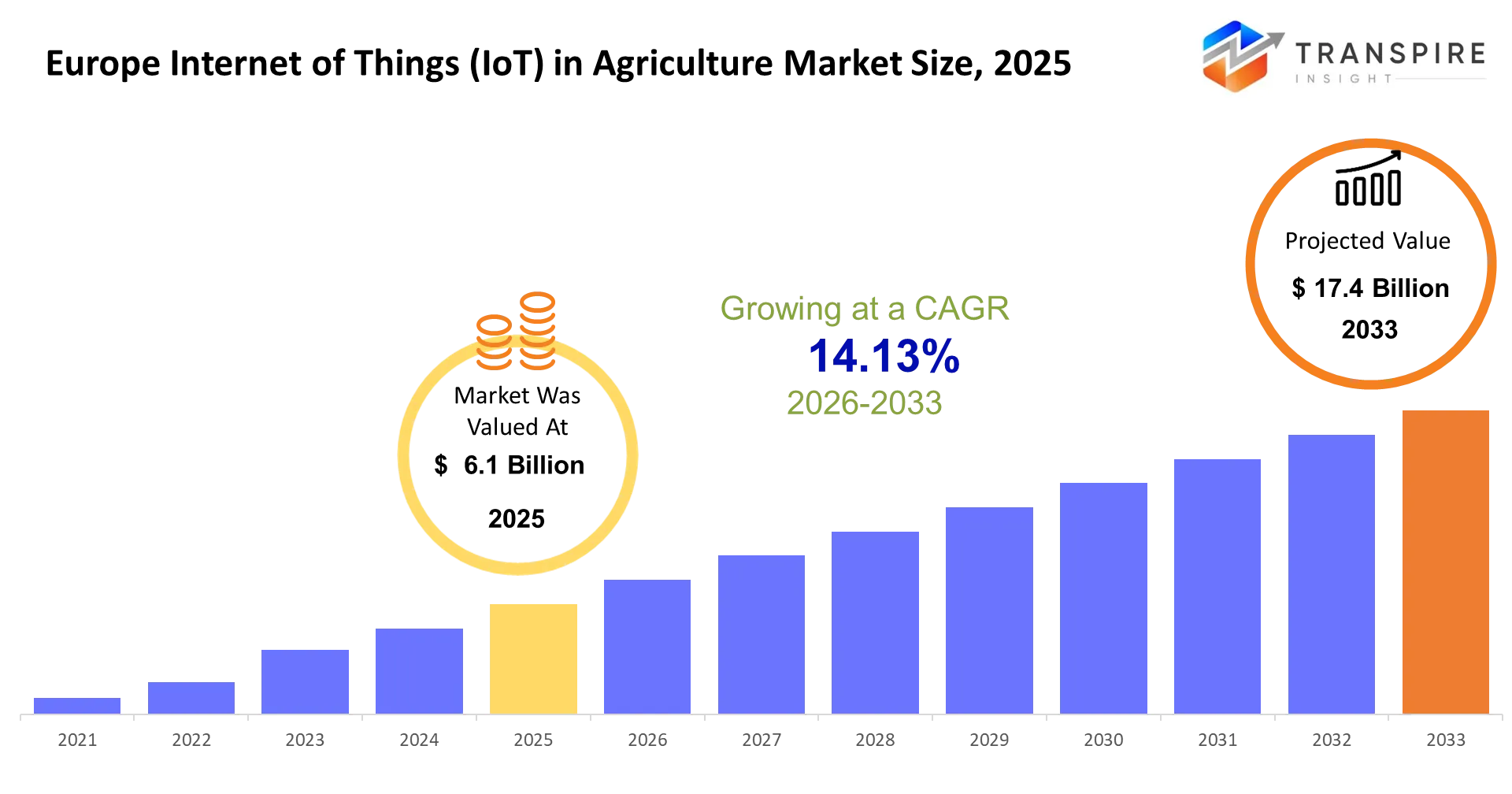
- Europe Internet of Things (IoT) in Agriculture Market Size 2025: USD 6.1 Billion
- Europe Internet of Things (IoT) in Agriculture Market Size 2033: USD 17.4 Billion
- Europe Internet of Things (IoT) in Agriculture Market CAGR: 14.13%
- Europe Internet of Things (IoT) in Agriculture Market Segments: By Type (Hardware, Software, Services, Sensors, Connectivity, Others); By Application (Precision Farming, Livestock Monitoring, Smart Irrigation, Crop Monitoring, Others); By End-User (Farmers, Agribusinesses, Cooperatives, Government, Others); By Deployment (Cloud, On-premise, Hybrid, Edge, Others)
To learn more about this report,  Download Free Sample Report
Europe Internet of Things (IoT) in Agriculture Market Summary
The Europe Internet of Things (IoT) in Agriculture Market was valued at USD 6.1 Billion in 2025. It is forecast to reach USD 17.4 Billion by 2033. That is a CAGR of 14.13% over the period.
The Europe Internet of Things (IoT) in Agriculture Market enables real-time monitoring and control of farming operations by connecting sensors, machinery, and analytics platforms to optimize soil conditions, water usage, livestock health, and equipment performance. The system decreases the need for manual inspections while helping farms achieve EU fertilizer use and emissions tracking and resource efficiency standards which results in better yield forecasts. The market has transitioned from standalone sensor deployments to integrated digital farming systems that combine hardware and software and data analytics during the last three to five years. The European Union has implemented stricter sustainability regulations which require farmers to monitor their agricultural inputs continuously instead of using periodic reporting methods. The pandemic period created supply chain disruptions which showed the importance of establishing strong data-driven farming systems that can sustain food production. The combination of regulatory pressure and operational risk exposure has changed adoption behavior which now leads farmers and agribusinesses to adopt subscription-based IoT ecosystems. The company generates most of its revenue through ongoing software and data services instead of selling hardware products only once.
Key Market Insights
- Western Europe controls 40% of the European Internet of Things (IoT) in Agriculture Market for 2025 because of its advanced agricultural machinery and its enforcement of EU environmental regulations.
- The fastest expansion in Eastern Europe will continue until 2030 because farm consolidation and EU subsidies and rural connectivity infrastructure development both promote IoT technology adoption.
- The Europe Internet of Things (IoT) in Agriculture Market designates hardware components which include sensors and telematics systems as the market's leading segment because modern agricultural machinery depends on OEM integration for their operational capabilities.
- The software platforms segment will experience the highest growth rate because farms will adopt subscription-based analytics services and AI-powered farm management solutions between 2024 and 2030.
- The precision farming application leads all other applications with a market share above 45% which results from its ability to optimize farming inputs and monitor crop yields and meet European sustainability standards.
- Smart irrigation has emerged as the fastest-growing application because European countries face water shortages during the current drought conditions.
- The majority of IoT technology implementation in agriculture comes from farmers who represent the largest user group because they achieve direct financial benefits through yield improvements and cost reductions.
- The fastest-growing end-user group in agribusiness consists of large-scale companies which implement integrated digital systems to monitor supply chain processes and enhance their operational performance.
- The key players John Deere CNH Industrial AGCO Trimble Bosch and CropX strengthen their market positions by implementing platform partnerships which combine artificial intelligence analytics with system interoperability.
- The companies receive a competitive edge because they move from selling equipment toward generating income through software subscriptions while developing their IoT networks and creating partnerships with European agritech organizations.
What are the Key Drivers, Restraints, and Opportunities in the Europe Internet of Things (IoT) in Agriculture Market?
Driver:
The enforcement of EU sustainability regulations and agricultural input reduction regulations which include nitrate management and emissions reporting requirements that stem from the Common Agricultural Policy present the strongest force which drives sector adoption. The rules compel farms to implement sensor-based monitoring systems which track actual fertilizer application, soil conditions and water usage throughout the day. Agritech vendors now gain more revenue from their subscription platforms which use IoT sensor networks and farm management software, because organizations need to track their compliance through digital verification instead of updating compliance records at specific times.
Restraint:
The most persistent barrier is fragmented rural connectivity combined with uneven digital readiness among small and mid-sized farms. The existing low-latency broadband service remains unstable in multiple areas which prevents immediate data transfer from field sensors and machinery. The existing rural infrastructure problem exists because public funding supports infrastructure development at an unsteady pace which does not match the speed of urban digital technology implementation. The existing data collection methods used by farms result in data arrival after certain intervals which decreases predictive analytics capabilities and hinders automation advantages, thus preventing farms from obtaining total benefits from their IoT systems.
Opportunity:
Carbon farming verification systems which use IoT soil monitoring technology and satellite data integration present a significant new business opportunity. The EU carbon credit framework has reached an advanced stage which enables platforms to deliver accurate soil carbon measurement solutions to France and Germany through their existing pilot programs. The upcoming investment period will bring faster adoption of this market segment because technology providers who combine sensor data with blockchain-based traceability systems will develop new revenue sources through carbon sequestration incentives.
What Has the Impact of Artificial Intelligence Been on the Europe Internet of Things (IoT) in Agriculture Market?
AI and advanced analytics are transforming European IoT agricultural systems because they establish automatic decision-making processes which operate all system components including equipment and crops and resource management. AI-based systems now enable fleet and machinery operations through tractor routing optimization and seeding density determination and irrigation scheduling implementation based on soil and weather conditions which help large-scale farms decrease their fuel consumption and resource waste. Agricultural control systems now use machine vision technology together with sensor fusion systems to manage field operations which reduces the need for human workers and establishes consistent performance during peak farming periods.
Machine learning models now expand predictive capabilities through their capacity to forecast machinery failures and determine optimal maintenance schedules by studying past yield information and equipmentTelemetry data and environmental conditions. The systems help equipment maintenance because they lower unexpected equipment failures and decrease maintenance expenses through condition-based servicing. Large agribusiness companies achieve better input efficiency along with reduced operational downtime which becomes especially valuable during the costly equipment harvesting season.
The adoption of AI technologies has advanced since artificial intelligence systems for agriculture still need complete data from all fields especially in areas which contain small and medium agricultural operations. The lack of internet access in rural regions creates two problems which include decreased operational capacity of real-time models and diminished effectiveness of continuous learning frameworks. The current situation prevents farms from achieving complete automation while it forces operators to use hybrid systems that combine human decision-making with artificial intelligence instead of using fully autonomous farming systems.
Key Market Trends
- From 2023 onward original equipment manufacturers such as John Deere and CNH Industrial started to sell their digital farming platforms through subscription services instead of selling machine equipment.
- The European Union sustainability regulations force agricultural operations to implement Internet of Things monitoring systems which track fertilizer usage and greenhouse gas emissions throughout their extensive agricultural activities.
- AGCO and Trimble established new interoperability partnerships because farmers require equipment which can operate with various brands instead of being restricted to particular manufacturer equipment.
- After 2024 growers adopted drone and satellite analytics technology because they needed to substitute their manual crop inspection methods with AI-based remote sensing systems.
- Southern European farms which experienced water shortages implemented smart irrigation systems from 2023 until 2026 because climate change and drought cycles worsened in their region.
- CropX and other agricultural technology companies expanded their soil intelligence subscription services because farmers began to purchase data services through subscription models instead of paying for hardware equipment once.
- In 2025 farmers began using edge computing technology because their automated tractor systems needed immediate results which cloud-based farm management solutions could not deliver.
- Eastern European farm cooperatives used their collective IoT infrastructure funding to create better digital negotiation capabilities which helped small and mid-sized farms reduce their technology implementation expenses.
- The EU carbon credit verification system developed through IoT soil tracking technology which allowed farmers to start their carbon farming pilot programs in 2024.
Europe Internet of Things (IoT) in Agriculture Market Segmentation
By Type :
The market distribution shows hardware as the dominant segment because Europe requires physical components which include sensors and connectivity modules and agricultural machinery links to establish its digital agriculture infrastructure. Large farms maintain high adoption rates because original equipment manufacturers integrate their products into tractors and irrigation systems and livestock monitoring devices. The software and services sector experiences faster growth than hardware because businesses create value by using analytics and predictive modeling and farm management platforms which optimize input usage to meet EU sustainability requirements. LPWAN and 5G-enabled modules are becoming more popular because rural areas now have improved broadband service through member state expansion of their coverage networks.
The growth patterns of subsegments show different characteristics because hardware needs depend on farm mechanization cycles while software needs arise from regulatory demands and needs to improve business profits. The agricultural industry depends on sensors to meet its ongoing demand because precision farming requires equipment to be replaced and calibrated continuously. Public infrastructure investment is decreasing deployment challenges which create connectivity issues in remote agricultural areas. The company expands its service offerings through managed analytics solutions which it provides together with original equipment manufacturer products.
The future path of development shows that software and services will surpass standalone hardware in their value contribution. Hardware remains essential but its market value will develop into a standardized commodity. The ability to compete in the market will depend on businesses using platform-based systems to control data movement among their equipment networks. Investors will choose to support business models which generate recurring revenue instead of funding efforts to sell equipment through single transactions.
By Application:
Precision farming serves as the primary application because it creates direct benefits through improved yield results and decreased input costs and their ability to meet stringent European environmental standards. Large farms and cooperatives become the first users of precision systems because these systems provide them with measurable cost reductions in their fertilizer and water and energy expenditures. Crop monitoring follows closely as satellite and drone integration becomes standard practice for field-level visibility. Smart irrigation systems and livestock monitoring systems experience high adoption rates in areas that deal with environmental challenges and restrictions on animal productivity.
Each application develops through its own unique growth factors instead of following a standard adoption pattern. Precision farming develops through the combination of regulatory enforcement together with subsidy alignment, while smart irrigation develops because of water shortages affecting Southern Europe. Dairy-intensive regions develop livestock monitoring systems, which enable farmers to track their animals' productivity to enhance herd health outcomes. Crop monitoring uses AI-powered imaging systems, which help decrease manual inspection expenses while enabling earlier risk identification.
The upcoming expansion will transition to combined application stacks instead of separate tool development. Precision farming platforms will develop unified dashboards, which will combine their irrigation and crop monitoring features. Livestock analytics will establish links with feed optimization systems and disease prediction models. To succeed in their market, technology providers must achieve interoperability across different application systems.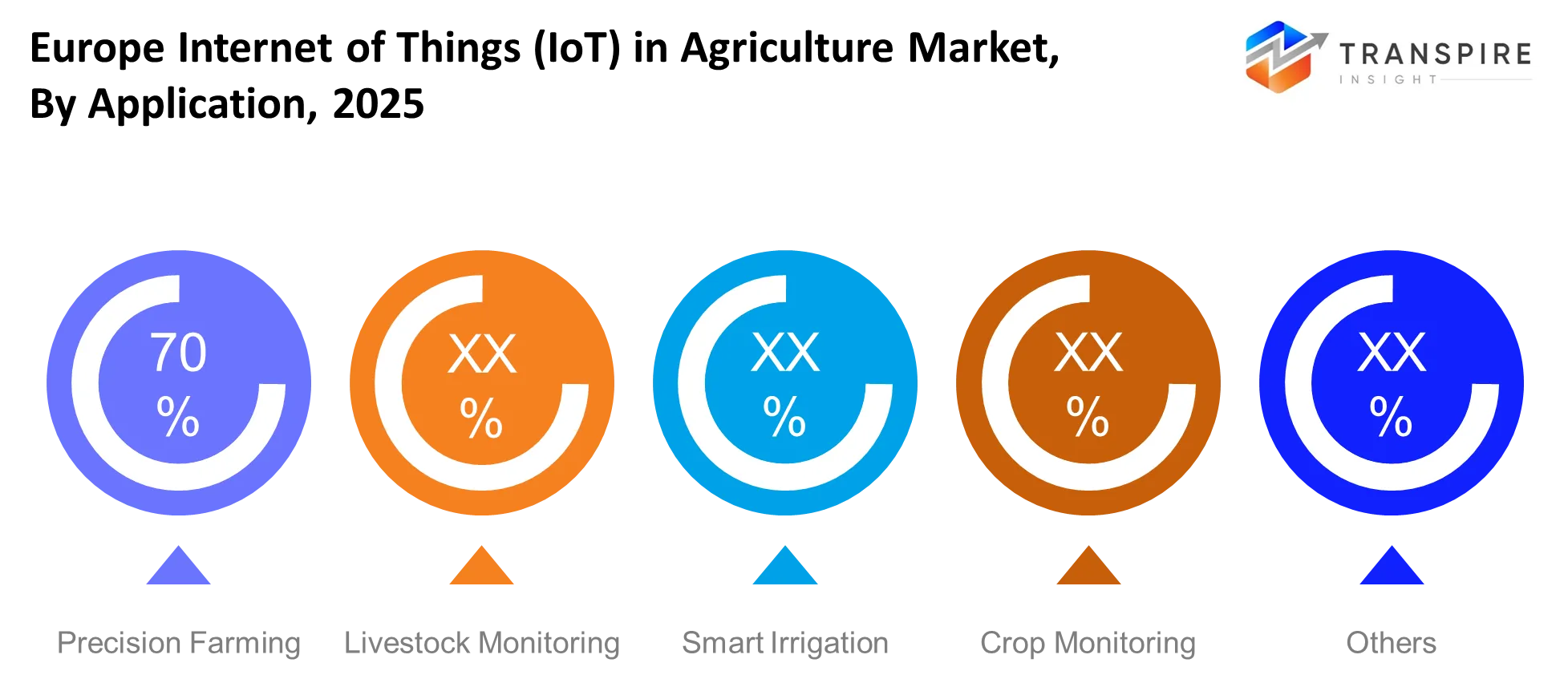
To learn more about this report, Download Free Sample Report
By End-User:
Differentiation of end-user segments shows that farmers represent the highest percentage of adoption because IoT technology enables farmers to optimize their yields and reduce their operational expenses through targeted farm decisions. Agribusinesses follow closely as large-scale operators integrate digital systems across supply chains to improve efficiency and traceability. The shared digital infrastructure which cooperatives establish through resource pooling serves as a fundamental element that drives smaller farms to adopt new technologies. Government bodies support adoption through subsidies and regulatory compliance monitoring systems.
End-user growth patterns show distinct differences because users operate with different levels of funding and business growth. Farmers adopt selective solutions which provide them the best return on investment while agribusinesses implement complete digital transformation initiatives. The establishment of shared data platforms together with collective purchasing models by cooperatives helps organizations to overcome barriers which block them from adopting new technologies. Government adoption occurs because of requirements for environmental monitoring and initiatives to track food security.
The future development of digital services will proceed toward greater integration which agribusiness and cooperative systems will create. Farmers will depend on platform providers for their needs instead of using independent tools. The public sector will take on expanding responsibilities for managing data and monitoring sustainability efforts. Cooperative-enabled scaling models will provide investors with their highest potential financial returns.
By Deployment:
The Cloud deployment method stands as the primary deployment method because centralized data platforms provide organizations with the ability to conduct large-scale analytics while enabling remote access and system integration across their entire farm operations. The hybrid deployment model experiences rapid expansion because farms require cloud resources to handle their business operations while maintaining the capacity to process critical tasks on-site. The need for edge computing becomes essential in agricultural sectors that depend on machinery to support their processes which need immediate choices during both planting and harvesting times. The on-premise solution exists only for traditional farming operations which need to maintain complete control over their data.
The operational needs of different infrastructures create distinct growth patterns due to their existing infrastructure capabilities. The software subscription model combined with cloud solutions offers cost-effective advantages which drive customers to adopt cloud technology. The automated systems in tractors and irrigation equipment and livestock monitoring devices which need real-time data processing have increased the demand for edge deployment solutions. Hybrid systems appear as a middle ground solution which enables farms to move from their traditional systems toward complete digital transformation.
The future development path indicates that cloud computing and edge computing systems will progressively merge into unified frameworks. The edge systems will process immediate data while the cloud platforms will handle all data needed for future analysis and system improvements. The service providers will establish competition based on how quickly they can integrate systems and how well their systems work together with other technologies. Agricultural investors will prefer platforms which enable complete computing integration across their farming operations.
What are the Key Use Cases Driving the Europe Internet of Things (IoT) in Agriculture Market?
The primary application of precision crop monitoring centers on real time soil and moisture and nutrient data collection because this data helps farmers boost crop yields while meeting European Union sustainability standards and fertilizer usage reduction requirements. The agricultural industry uses sensor networks and satellite analytic systems to help large scale commercial farms and farming cooperatives achieve their ecological goals through better resource management practices.
The agricultural industry experiences rapid growth in both equipment monitoring systems and automated farm management solutions that serve machinery heavy farms which include both cereal and dairy operations. Tractors and harvesters use their OEM telematics systems to provide predictive maintenance and fleet optimization while irrigation automation systems gain traction in water constrained regions like Southern Europe. Mid-sized farming operations use these applications to monitor their expenses while sustaining their daily business activities.
The agricultural industry currently develops carbon farming verification processes and livestock health analytics. EU carbon credit programs benefit from IoT enabled soil carbon tracking systems that connect with cattle and dairy monitoring systems through wearable devices which enhance disease detection and productivity monitoring. These applications exist at their initial development stage but they will expand when regulations and digital agriculture programs become established.
|
Report Metrics |
Details |
|
Market size value in 2025 |
USD 6.1 Billion |
|
Market size value in 2026 |
USD 6.9 Billion |
|
Revenue forecast in 2033 |
USD 17.4 Billion |
|
Growth rate |
CAGR of 14.13% from 2026 to 2033 |
|
Base year |
2025 |
|
Historical data |
2021 - 2024 |
|
Forecast period |
2026 - 2033 |
|
Report coverage |
Revenue forecast, competitive landscape, growth factors, and trends |
|
Regional scope |
Europe (Germany, United Kingdom, France, Italy, Spain, Rest of Europe) |
|
Key company profiled |
John Deere, Trimble, AGCO, CNH Industrial, IBM, Microsoft, SAP, Cisco, Bosch, Deere & Company, Topcon, Raven Industries, Taranis, CropX, Granular |
|
Customization scope |
Free report customization (country, regional & segment scope). Avail customized purchase options to meet your exact research needs. |
|
Report Segmentation |
By Type (Hardware, Software, Services, Sensors, Connectivity, Others); By Application (Precision Farming, Livestock Monitoring, Smart Irrigation, Crop Monitoring, Others); By End-User (Farmers, Agribusinesses, Cooperatives, Government, Others); By Deployment (Cloud, On-premise, Hybrid, Edge, Others) |
Which Regions are Driving the Europe Internet of Things (IoT) in Agriculture Market Growth?
The European Internet of Things sector for agricultural applications receives its highest development from Western European countries which include Germany France and the Netherlands. EU sustainability regulations create strong compliance demands which lead farmers to implement sensor systems for monitoring operations and measuring emissions. The area establishes a complete technology transfer system because it contains original equipment manufacturers and agritech software companies alongside agricultural cooperatives. The need for high farm productivity together with existing infrastructure systems leads to organizations using IoT platforms from their initial stages until they reach complete implementation.
The southern European region which includes Spain and Italy demonstrates a different pattern of technology adoption because environmental challenges impact their technological development. Farmers need to purchase Internet of Things (IoT) systems for irrigation management and crop stress monitoring because of water scarcity and heat variability. The region adopts technology based on its requirements for sustaining permanent agricultural practices that involve olive and grape and citrus cultivation. Public funding through EU agricultural programs supports gradual modernization which creates consistent demand even during economic cycles.
The fastest growing area in Eastern Europe includes Poland and Romania because farm consolidation activities combined with EU subsidy payments drive mechanization and digital technology advances. The recent infrastructure upgrades have improved rural access which now allows for broader use of affordable sensors together with cloud-based agricultural operational platforms. The region transitions from traditional agricultural practices to data-driven production methods at a faster pace than Western markets have historically moved. The period from 2026 to 2033 presents investment opportunities because agricultural businesses will increase their operations through farm size expansion and technology adoption, which will become widespread by that time.
Who are the Key Players in the Europe Internet of Things (IoT) in Agriculture Market and How Do They Compete?
European competition in Internet of Things agricultural solutions currently proceeds toward platform ecosystems which have partial market control because their development depends on machine manufacturers and software companies. Deere and CNH Industrial and AGCO build their complete platform solutions by combining hardware with farm management software while CropX and Taranis develop their analytical products through their respective analytics platforms. The main competition focus on who owns data together with how different vehicle systems operate together and the digital farming subscription services which support compliance with European Union regulations.
John Deere establishes a closed data ecosystem through its Operations Center which connects machine telemetry with satellite and drone data and this system helps farmers stay with the company while the business grows through the acquisition of Sentera. Trimble develops solutions which enable different equipment systems to work together and the company uses its PTx Trimble alliance with AGCO to enhance its market presence in Europe. Bosch provides industrial partners with IoT sensors and edge modules which they integrate into their original equipment manufacturer products.
CNH Industrial integrates precision agriculture technology into Case IH and New Holland equipment by using telematics to enhance operational efficiency and digital service revenue growth throughout Europe. CropX offers soil sensing and irrigation optimization services through its subscription software system which helps customers achieve higher water efficiency. Taranis uses AI powered aerial imagery to identify crop risks at an early stage and grows its business through collaborations with agronomy service providers.
Company List
- John Deere
- Trimble
- AGCO
- CNH Industrial
- IBM
- Microsoft
- SAP
- Cisco
- Bosch
- Deere & Company
- Topcon
- Raven Industries
- Taranis
- CropX
- Granular
Recent Development News
In October 2025, the European Partnership ‘Agriculture of Data’ was launched under Horizon Europe. The partnership was established to accelerate adoption of AI, IoT, and data-driven agricultural technologies, strengthening Europe’s digital agriculture and smart farming ecosystem.https://www.akjournals.com
In January 2025, the AGRARIAN project announced funding of up to €50,000 per project for smart agriculture technology pilots. The EU-backed initiative supported development and testing of IoT, edge computing, and advanced connectivity solutions designed to improve efficiency and sustainability in European farming operations.https://cascadefunding.eu
What Strategic Insights Define the Future of the Europe Internet of Things (IoT) in Agriculture Market?
The development of agricultural IoT technology in Europe will progress from hardware adoption during the first five to seven years until the complete implementation of AI-based systems which utilize sensor data and satellite images and edge computing to enhance agricultural efficiency and comply with EU environmental standards. The market will experience growth through two main factors which are the ability of different systems to work together and the practice of combining multiple platforms into one solution. The risk which remains hidden to most people is that data sovereignty requirements will increase while different organizations develop their own interoperability standards which will create vendor lock-in situations and disrupt international agricultural data sharing even as markets continue to expand. The agricultural sector can create new revenue opportunities through carbon farming infrastructure which uses IoT sensors to monitor soil conditions and remote sensing to verify carbon credits. The organization needs to establish open platforms which prioritize edge computing while forming early partnerships with agricultural cooperatives and agritech networks to control their data distribution systems.
Europe Internet of Things (IoT) in Agriculture Market Report Segmentation
By Type
- Hardware
- Software
- Services
- Sensors
- Connectivity
- Others
By Application
- Precision Farming
- Livestock Monitoring
- Smart Irrigation
- Crop Monitoring
- Others
By End-User
- Farmers
- Agribusinesses
- Cooperatives
- Government
- Others
By Deployment
- Cloud
- On-premise
- Hybrid
- Edge
- Others
Frequently Asked Questions
Find quick answers to common questions.
The Europe Internet of Things (IoT) in Agriculture Market size is USD 17.4 Billion in 2033.
Key Segments for the Europe Internet of Things (IoT) in Agriculture Market are By Type (Hardware, Software, Services, Sensors, Connectivity, Others); By Application (Precision Farming, Livestock Monitoring, Smart Irrigation, Crop Monitoring, Others); By End-User (Farmers, Agribusinesses, Cooperatives, Government, Others); By Deployment (Cloud, On-premise, Hybrid, Edge, Others).
Major Europe Internet of Things (IoT) in Agriculture Market Players are John Deere, Trimble, AGCO, CNH Industrial, IBM, Microsoft, SAP, Cisco, Bosch, Deere & Company, Topcon, Raven Industries, Taranis, CropX, Granular.
The Current Europe Internet of Things (IoT) in Agriculture Market size is USD 6.1 Billion in 2025.
The Europe Internet of Things (IoT) in Agriculture Market CAGR is 14.13% from 2026 to 2033.
- John Deere
- Trimble
- AGCO
- CNH Industrial
- IBM
- Microsoft
- SAP
- Cisco
- Bosch
- Deere & Company
- Topcon
- Raven Industries
- Taranis
- CropX
- Granular
Recently Published Reports
-
Apr 2026
3D Optical Profiler Market
3D Optical Profiler Market Size, Share & Analysis Report By Type (Desktop 3D Optical Profiler, and Portable 3D Optical Profiler), By Technology (Confocal Technology, and White Light Interference), By End-Use Industry (Manufacturing, Research Institutions, Automotive, Aerospace and Defense, Medical Devices, and Other), and Geography (North America, Europe, Asia-Pacific, Middle East and Africa, South and Central America), 2021 - 2031
-
Apr 2026
Depth Sensor Market
Depth Sensor Market Size, Share & Analysis Report By Type (Infrared Depth Sensors, Time-of-Flight (ToF) Sensors, Stereo Vision Sensors, Structured Light Sensors, Ultrasonic Depth Sensors), By Application (Automotive, Robotics, Gaming, Consumer Electronics, Industrial Automation, Healthcare, Security & Surveillance, Others), By End Users (Automotive Manufacturers, Consumer Electronics Companies, Healthcare Providers, Industrial Companies, Security Agencies, Gaming Companies, Robotics Companies, Others), and Geography (North America, Europe, Asia-Pacific, Middle East and Africa, South and Central America), 2021 – 2031
-
Apr 2026
Digital Manufacturing Market
Digital Manufacturing Market Size, Share & Analysis Report By Component (Hardware, Software, and Services), By Technology (Robotics, 3D Printing, Internet of Things (IoT), and Others), By Application (Automotive and Transportation, Aerospace and Defense, Consumer Electronics, Industrial Machinery, and Others), By Process Type (Computer-Based Designing, Computer-Based Simulation, Computer 3D Visualization, Analytics, and Others), and Geography (North America, Europe, Asia-Pacific, Middle East and Africa, South and Central America), 2021 – 2031
-
Apr 2026
Digital Visa Services Market
Digital Visa Services Market Size, Share & Analysis Report By Type (Individual Travelers, Group Travelers), By Application (Tourism, Business Travel, Others), and Geography (North America, Europe, Asia-Pacific, Middle East and Africa, South and Central America), 2021 – 2031