
Europe Hardware Encryption Market Size & Forecast:
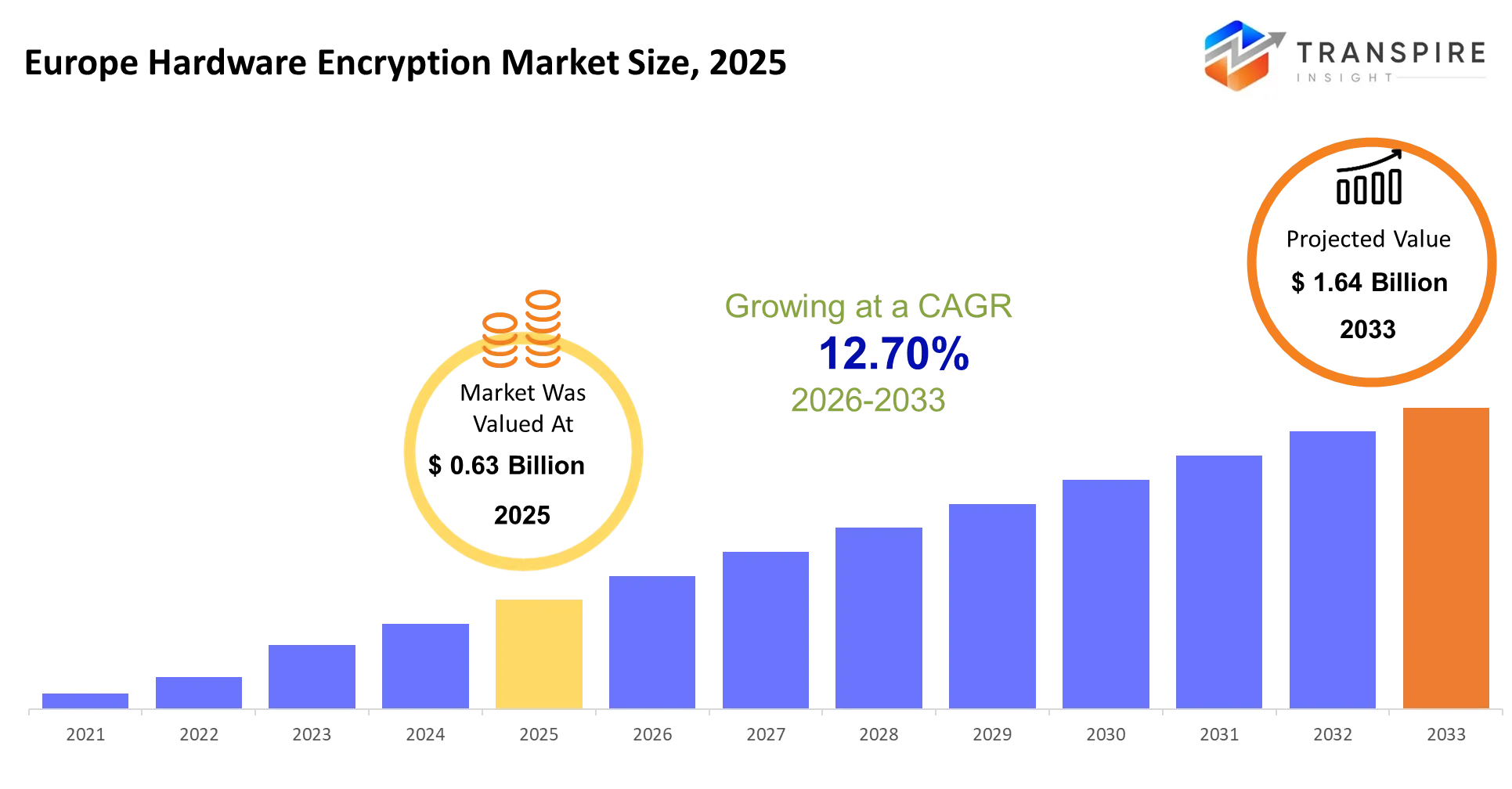
- Europe Hardware Encryption Market Size 2025: USD 0.63 Billion
- Europe Hardware Encryption Market Size 2033: USD 1.64 Billion
- Europe Hardware Encryption Market CAGR: 12.70%
- Europe Hardware Encryption Market Segments: By Type (Full Disk Encryption, USB Encryption, Network Encryption, Others); By Application (Data Security, Cloud Security, Network Security, Endpoint Security, Storage Security, Others); By End-User (Enterprises, BFSI, Government, IT & Telecom, Healthcare, Defense, Others); By Deployment (On-premise, Cloud, Hybrid, Others)
To learn more about this report,  Download Free Sample Report
Europe Hardware Encryption Market Summary
The Europe Hardware Encryption Market was valued at USD 0.63 Billion 2025. It is forecast to reach USD 1.64 Billion by 2033. That is a CAGR of 12.70% over the period.
Hardware encryption in Europe serves as the fundamental method that protects sensitive data through physical device security which protects various systems including industrial control systems automotive ECUs and maritime navigation systems and port infrastructure. The system protects data through its direct security integration which protects vital information from being accessed during actual use of fleet monitoring and international logistics operations.
The market has undergone a major structural change during the last three to five years because integrated security architectures now support encryption through built-in features of processors and IoT modules which protect system security better than traditional security methods. This transition aligns with stricter EU cybersecurity frameworks and certification schemes. The main factor started because cyber attacks against critical infrastructure became more common after Eastern European geopolitical conflicts revealed operational technology system vulnerabilities.
The current market demands hardware-level trust anchors as essential requirements for buyers. This requirement forces OEMs to create complete system designs at the beginning, which improves unit value while maintaining the security system throughout its entire life cycle.
Key Market Insights
- The Europe Hardware Encryption Market in 2025 shows Western Europe as the leading region because it controls more than 45% of the market share, which results from the industrial digitalization efforts of Germany, France, and the UK.
- Through 2030 Eastern Europe becomes the fastest-expanding area because cybersecurity improvements protect energy defense and transport infrastructure systems.
- The market for embedded hardware encryption solutions will exceed 40% share in 2025 because OEMs now include encryption features in their chipsets and processors.
- The market for external encryption devices serves as the second largest market segment because these devices are commonly used in outdated industrial systems and enterprise IT systems that need additional security protection.
- The market for Trusted Platform Modules and secure elements experiences rapid expansion because their use in IoT devices and edge computing systems increases.
- The industrial and manufacturing sector controls 35% of the market share in 2025 because organizations need automated systems that provide secure control functions.
- The automotive and connected mobility industries exhibit their strongest demand for security solutions through electric vehicle platforms advanced driver assistance systems and vehicle-to-everything communication protection.
- Large enterprises lead the Europe Hardware Encryption Market with over 60% share because their complex infrastructure and strict data protection requirements create demand for encryption solutions.
- The increasing compliance requirements push small and medium enterprises to adopt affordable hardware security solutions which make up the fastest expanding market segment.
- Advanced cryptographic modules and certification compliance and zero-trust security architecture integration provide companies with competitive benefits.
What are the Key Drivers, Restraints, and Opportunities in the Europe Hardware Encryption Market?
Driver:
The Europe Hardware Encryption Market undergoes its main growth acceleration through the enforcement of stricter regulatory cybersecurity requirements that exist within the EU Cybersecurity Act and its specific industry compliance regulations. The established security requirements mandate that devices need certified security systems which exhibit protection against physical attacks at the device level because these systems protect vital facilities and their associated operational networks. The shift occurred because attackers conducted multiple cyber intrusions against operational technology systems which demonstrated that software protection methods had reached their effective limits. The design process now enables original equipment manufacturers and system integrators to include encryption features into their chipsets and controllers. The design-in method creates additional value through each unit while binding hardware encryption to extended purchasing agreements which result in increased market revenue and faster adoption across automotive energy and manufacturing industries.
Restraint:
The high integration complexity of legacy systems which exist in the existing infrastructure functions as a primary structural obstacle. European industries continue to utilize control systems from previous decades which do not support current hardware-based encryption technology. The system retrofit process demands system redesign and certification testing plus will create operational downtime which leads to substantial switching expenses and operational hazards. The solution to this constraint remains difficult because industrial systems undergo their upgrade process during a time frame that lasts 10 to 20 years. The strong regulatory pressure which exists in brownfield environments creates a situation where companies postpone adoption because it limits their ability to generate revenue in the immediate future.
Opportunity:
The main opportunity of this market exists in the protection of edge and IoT ecosystems through the implementation of trusted platform modules and secure elements which protect connected devices.European countries develop smart factories together with intelligent transport systems, which create numerous endpoints that need device trust solutions. Automotive platforms currently use vehicle-to-everything communication systems, which require them to implement hardware root-of-trust security mechanisms. The semiconductor industry will achieve high-volume market expansion through secure microcontroller production, which will support multiple distributed real-time system applications.
What Has the Impact of Artificial Intelligence Been on the Europe Hardware Encryption Market?
Artificial intelligence together with digital technology advancements will start to change how physical security systems connect with operational systems in environments that resemble maritime and industrial control systems. Automated AI systems now control the monitoring process which checks encrypted control channels of scrubber performance systems and fleet compliance platforms. The system protects sensor data together with emissions logs from unauthorized access while it creates automated monitoring functions.
The system provides operators with immediate access to regulatory compliance data which reduces inspection times and decreases operational tasks. Machine learning models also introduce predictive capabilities by analyzing encrypted telemetry from exhaust gas cleaning technology and connected assets. The system will predict component wear and optimize performance while it will show emission threshold breaches before they occur. Operators achieve better system performance because better control loop calibration leads to improved uptime and decreased unexpected shutdowns and stable fuel efficiency results.
The operational environment uses secure data pipelines which achieve hardware encryption to allow trusted data transmission between fleets and ports. This process helps organizations prepare for audits while it decreases their risk of compliance violations. The process of adoption encounters an existing obstacle. The process faces challenges because offshore sites and legacy-heavy environments restrict connections and create disjointed data sets which results in decreased model performance and slowed down the implementation of AI systems.
Key Market Trends
- The automotive OEMs have moved away from software encryption methods since 2021 and now use secure embedded elements which enable them to integrate more semiconductor components into their vehicle electronic control units and industrial control systems.
- Manufacturers have changed their product designs to include hardware root-of-trust because the EU cybersecurity certification schemes which started after 2020 require them to develop products which take more time to build but will achieve better compliance results throughout their lifespan.
- Critical infrastructure operators began to spend more money on tamper-resistant systems because Eastern European geopolitical conflicts made them realize that they needed to protect their systems against security threats more than they needed to save money on purchasing equipment.
- Between 2022 and 2025 Infineon and STMicroelectronics expanded their secure microcontroller product lines to support Internet of Things devices and edge computing devices which need built-in encryption systems.
- Automotive manufacturers adopted hardware encryption technology faster after 2021 because vehicle-to-everything communication security problems required them to develop secure systems for their upcoming electric vehicle platforms and advanced driver assistance systems.
- Organizations now need to protect their data at individual endpoints instead of central data centers because they use edge devices which must have on-chip encryption to protect their real-time data operations.
- European companies started to develop their semiconductor supply chains after2020 because they lost access to essential hardware components during the supply chain breakdowns which happened between 2020 and 2022.
- The period after 2022 saw cloud providers and hardware vendors establish more joint ventures to create secure key management systems which work together with hardware encryption modules for hybrid infrastructure systems.
- The costs for pre-certified encryption components have become lower since 2023 which has led small and medium enterprises to start using standardized hardware security modules because of the new compliance requirements which have become more rigorous.
Europe Hardware Encryption Market Segmentation
By Type:
The full disk encryption element drives market growth through its 2025 forecast which shows more than 35% market share because businesses implement it on all their laptop and server and industrial storage systems. The financial services and healthcare industries and government networks show high adoption rates because their laws demand protection for data that remains in storage. The network encryption market holds second place because organizations need to protect their data which flows through their industrial and cloud systems. The market for USB encryption together with niche encryption methods remains restricted because users need portable storage solutions which meet specific compliance requirements.
Different growth patterns exist for each segment. Full disk encryption benefits from standardized deployment across enterprise endpoints, while network encryption expands due to increasing machine-to-machine communication in IoT ecosystems. The market for USB encryption shows reduced growth because users need less physical media and businesses implement stricter controls on their endpoints. The forecast period will see integrated chipset encryption technology transform all product categories because vendors will create secure element and processor-based encryption functions which will lead to semiconductor-driven product designs.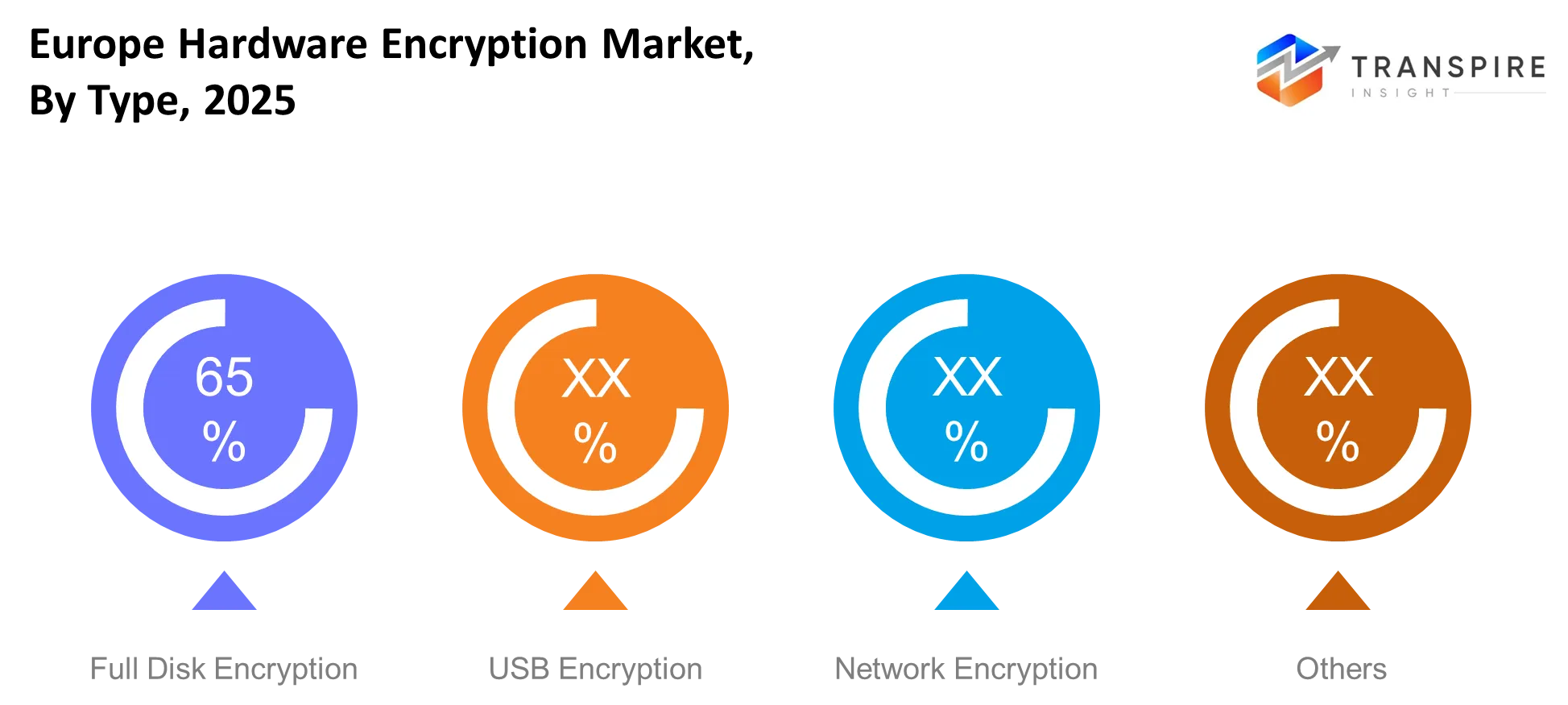
To learn more about this report, Download Free Sample Report
By Application:
Data security dominates with a share exceeding 30% in 2025, supported by strict data protection laws and enterprise-level encryption requirements. Endpoint security protects devices while network security safeguards communication pathways that used by hybrid systems. Cloud security has emerged as a high-growth segment as organizations migrate workloads to multi-cloud environments while maintaining encryption control. Storage security maintains steady demand because businesses need permanent solutions to protect their stored data.
The applications establish their unique expansion pathways through their distinct growth processes. Data security depends on compliance-driven investments while cloud security develops through shared responsibility models which require users to handle encryption tasks. Endpoint security develops because remote work and edge devices create additional opportunities for attackers to target systems. The industry will develop unified encryption systems which protect all three security layers because this approach will drive companies to create products that work together with shared key management systems.
By End-User:
The enterprise sector will become the largest market segment which will account for more than 40% of total spending in 2025 because organizations face complex IT environments and multiple regulatory requirements across different regions. The BFSI sector and government organizations follow the enterprise sector because they handle highly sensitive financial data and national security information. The IT and telecom industries maintain their strong market position because network operators handle substantial data traffic and protect their infrastructure assets. The defense and healthcare fields show rapid growth because their sectors undergo digital transformation and face increasing cybersecurity risks.
Each category develops through its own unique growth drivers. BFSI chooses to make substantial investments in encryption because this technology serves two purposes: it protects against financial fraud and it helps them achieve strict regulatory standards. The healthcare industry experiences rapid growth because healthcare organizations implement electronic health record systems and use connected medical devices. Small and mid-sized enterprises will begin to use encryption because vendors will develop affordable encryption solutions that give access to secure systems through simple deployment methods.
By Deployment:
The current on-premise deployment market shows more than 50% share for 2025 because organizations choose to control their encryption keys and secure data environments. This preference remains strong in regulated sectors such as finance, defense, and government where data sovereignty is critical. The cloud deployment model has experienced major growth because businesses now implement digital transformation initiatives and require cloud-based systems that can expand. Organizations establish hybrid models because they need to find an optimal solution that gives them both operational authority and operational flexibility.
The observed growth patterns demonstrate a complete changeover. The development of on-premise systems moves at a slow pace because organizations face both high infrastructure expenses and their present capacity limits, while cloud-based encryption solutions experience growth as security providers improve their protection methods and industry standards. The most rapid business expansion occurs through hybrid deployment, which enables organizations to safeguard their crucial operations while using cloud-based resources. The upcoming adoption trends will show a preference for encryption systems that support workload movement between different environments, which will require vendors to combine hardware security solutions with cloud-based encryption systems.
What are the Key Use Cases Driving the Europe Hardware Encryption Market?
The primary application of enterprise data-at-rest protection is used most frequently by financial institutions and government networks. The implementation of full disk encryption on servers and laptops and storage systems enables organizations to meet EU data protection requirements while decreasing their liability for data breaches.
The connected industries are experiencing growth through their ability to develop new applications which connect to existing use cases. Automotive manufacturers deploy hardware encryption in ECUs to secure vehicle-to-everything communication, while telecom operators use network-level encryption to protect high-volume data traffic across 5G infrastructure.
The development of new applications has started in edge computing and industrial IoT environments. Smart factories begin to incorporate secure elements into their sensors and controllers, while energy grids investigate hardware root-of-trust technology to safeguard their distributed assets and defend against cyber attacks that target entire systems.
|
Report Metrics |
Details |
|
Market size value in 2025 |
USD 0.63 Billion |
|
Market size value in 2026 |
USD 0.71 Billion |
|
Revenue forecast in 2033 |
USD 1.64 Billion |
|
Growth rate |
CAGR of 12.70% from 2026 to 2033 |
|
Base year |
2025 |
|
Historical data |
2021 - 2024 |
|
Forecast period |
2026 - 2033 |
|
Report coverage |
Revenue forecast, competitive landscape, growth factors, and trends |
|
Regional scope |
Europe (Germany, United Kingdom, France, Italy, Spain, Rest of Europe) |
|
Key company profiled |
Thales, IBM, Intel, Microsoft, Seagate, Western Digital, Kingston, Samsung, Micron, Cisco, Dell, HPE, NetApp, Toshiba, Broadcom |
|
Customization scope |
Free report customization (country, regional & segment scope). Avail customized purchase options to meet your exact research needs. |
|
Report Segmentation |
By Type (Full Disk Encryption, USB Encryption, Network Encryption, Others); By Application (Data Security, Cloud Security, Network Security, Endpoint Security, Storage Security, Others); By End-User (Enterprises, BFSI, Government, IT & Telecom, Healthcare, Defense, Others); By Deployment (On-premise, Cloud, Hybrid, Others) |
Which Regions are Driving the Europe Hardware Encryption Market Growth?
The market in Europe exists as the leading force because European countries enforce strict regulations and their businesses share compliance technologies from their first implementation. The regional policymakers establish definite environmental and safety regulations which compel operators to enhance their systems and uphold their peak performance standards. The region possesses advanced port facilities which enable complete monitoring capabilities and inspection capabilities and service capabilities. The established ecosystem, which includes technology providers and classification societies and experienced shipowners, supports regional leadership by delivering ongoing innovation and compliance solutions.
North America functions as a stable and powerful market contributor, which demonstrates different growth patterns from other regions. The region depends on the dual forces of economic resilience and established shipowners who exercise precise spending control instead of regulatory pressure. Companies here tend to adopt new solutions after proven performance, which creates a steady and predictable demand cycle. North America establishes itself as a trustworthy provider of permanent market income through its controlled business strategy and continuous trade activity and regular implementation of governmental regulations.
The Asia-Pacific region has become the fastest-growing area, which major industries undergo rapid growth while their fleets undergo complete modernization. The recent investments in port facilities and logistics corridors have resulted in better operational performance and increased capacity for operations. The governments from critical nations have introduced additional regulations, which helps them achieve global standardization while increasing their technology adoption rates. The market will create strong growth opportunities for new companies and investors because the region will experience fast expansion and changing market needs from 2026 to 2033.
Who are the Key Players in the Europe Hardware Encryption Market and How Do They Compete?
The Europe hardware encryption market displays a semi-consolidated structure because a few established companies maintain market control while new specialized companies develop their own business areas. The existing companies maintain their market position by establishing deep links with enterprise and government systems which operate in industries that require strict adherence to regulations. Technology depth and certification readiness form the primary competition basis because buyers demand established cryptographic performance and EU data protection compliance. Clients need local support which matches regional regulations because they often want services that can address their specific requirements.
Thales Group specializes in developing advanced technologies which achieve certification through its hardware security modules that comply with European eIDAS and GDPR requirements. The company creates a unique identity through its data protection solution that combines encryption with identity management and access control. The company grows by securing public sector agreements and establishing partnerships with cloud services to develop encryption solutions for their digital transformation projects. Utimaco operates in niche markets by delivering secure hardware security modules which meet the specific needs of financial institutions and telecom companies. The company provides custom solutions which meet European certification requirements, and it plans to establish partnerships with fintech companies and regional data center providers.
Infineon Technologies uses semiconductor innovations to create encrypted chips which automotive and industrial systems utilize throughout their operations.The hardware-based method separates different performance levels and security measures which operate at large scale through Internet of Things implementations. The company grows by integrating its solutions into next-generation mobility platforms and collaborating with OEMs across Europe. Microchip Technology uses affordable secure microcontrollers to establish its presence in mid-market applications while expanding through distributor networks and design partnerships which help small manufacturers adopt their products.
Company List
- Thales
- IBM
- Intel
- Microsoft
- Seagate
- Western Digital
- Kingston
- Samsung
- Micron
- Cisco
- Dell
- HPE
- NetApp
- Toshiba
- Broadcom
Recent Development News
“In December 2025, Thales Group released firmware updates and patches for its Luna T-Series Hardware Security Modules. The update enhanced security performance and compliance readiness for enterprise and government users, reinforcing Thales’ position in regulated European encryption markets. https://thalestct.com
“In April 2025, Thales Group partnered with Google Cloud to develop post-quantum-ready client-side encryption for Google Workspace. The collaboration integrates HSM-backed key management into cloud productivity tools, strengthening Europe’s push toward quantum-safe and sovereign encryption solutions. https://cpl.thalesgroup.com
What Strategic Insights Define the Future of the Europe Hardware Encryption Market?
The Europe hardware encryption market is moving toward tightly integrated, sovereignty-focused security architectures, which are required by new data residency regulations and increased threats from quantum technologies. The next five to seven years will see encryption transform from a separate security method into an essential security element that functions throughout cloud, edge, and device systems because government and regulated sectors will determine their encryption needs. The European technology landscape supports digital sovereignty because it requires countries to control their own cryptographic systems which are essential for national security.
The hidden danger from this situation arises because organizations rely too much on a limited set of certified suppliers. The current process of certification has created barriers for organizations. The combination of confidential computing and hardware-based encryption creates strong advantages for organizations that need to protect delicate information in their AI processing operations. Organizations need to establish quantum-resistant cryptography partnerships while developing certification-ready modular systems that can adapt to changing regulatory and technological requirements.
Europe Hardware Encryption Market Report Segmentation
By Type
- Full Disk Encryption
- USB Encryption
- Network Encryption
- Others
By Application
- Data Security
- Cloud Security
- Network Security
- Endpoint Security
- Storage Security
- Others
By End-User
- Enterprises
- BFSI
- Government
- IT & Telecom
- Healthcare
- Defense
- Others
By Deployment
- On-premise
- Cloud
- Hybrid
- Others
Frequently Asked Questions
Find quick answers to common questions.
The Europe Hardware Encryption Market size is USD 1.64 Billion in 2033.
Key Segments for the Europe Hardware Encryption Market are By Type (Full Disk Encryption, USB Encryption, Network Encryption, Others); By Application (Data Security, Cloud Security, Network Security, Endpoint Security, Storage Security, Others); By End-User (Enterprises, BFSI, Government, IT & Telecom, Healthcare, Defense, Others); By Deployment (On-premise, Cloud, Hybrid, Others).
Major Europe Hardware Encryption Market Players are Thales, IBM, Intel, Microsoft, Seagate, Western Digital, Kingston, Samsung, Micron, Cisco, Dell, HPE, NetApp, Toshiba, Broadcom.
The Current Europe Hardware Encryption Market size is USD 0.63 Billion in 2025.
The Europe Hardware Encryption Market CAGR is 12.70% from 2026 to 2033.
- Thales
- IBM
- Intel
- Microsoft
- Seagate
- Western Digital
- Kingston
- Samsung
- Micron
- Cisco
- Dell
- HPE
- NetApp
- Toshiba
- Broadcom
Recently Published Reports
-
Apr 2026
3D Optical Profiler Market
3D Optical Profiler Market Size, Share & Analysis Report By Type (Desktop 3D Optical Profiler, and Portable 3D Optical Profiler), By Technology (Confocal Technology, and White Light Interference), By End-Use Industry (Manufacturing, Research Institutions, Automotive, Aerospace and Defense, Medical Devices, and Other), and Geography (North America, Europe, Asia-Pacific, Middle East and Africa, South and Central America), 2021 - 2031
-
Apr 2026
Depth Sensor Market
Depth Sensor Market Size, Share & Analysis Report By Type (Infrared Depth Sensors, Time-of-Flight (ToF) Sensors, Stereo Vision Sensors, Structured Light Sensors, Ultrasonic Depth Sensors), By Application (Automotive, Robotics, Gaming, Consumer Electronics, Industrial Automation, Healthcare, Security & Surveillance, Others), By End Users (Automotive Manufacturers, Consumer Electronics Companies, Healthcare Providers, Industrial Companies, Security Agencies, Gaming Companies, Robotics Companies, Others), and Geography (North America, Europe, Asia-Pacific, Middle East and Africa, South and Central America), 2021 – 2031
-
Apr 2026
Digital Manufacturing Market
Digital Manufacturing Market Size, Share & Analysis Report By Component (Hardware, Software, and Services), By Technology (Robotics, 3D Printing, Internet of Things (IoT), and Others), By Application (Automotive and Transportation, Aerospace and Defense, Consumer Electronics, Industrial Machinery, and Others), By Process Type (Computer-Based Designing, Computer-Based Simulation, Computer 3D Visualization, Analytics, and Others), and Geography (North America, Europe, Asia-Pacific, Middle East and Africa, South and Central America), 2021 – 2031
-
Apr 2026
Digital Visa Services Market
Digital Visa Services Market Size, Share & Analysis Report By Type (Individual Travelers, Group Travelers), By Application (Tourism, Business Travel, Others), and Geography (North America, Europe, Asia-Pacific, Middle East and Africa, South and Central America), 2021 – 2031