

South Korea Drone Battery System Market Size & Forecast:
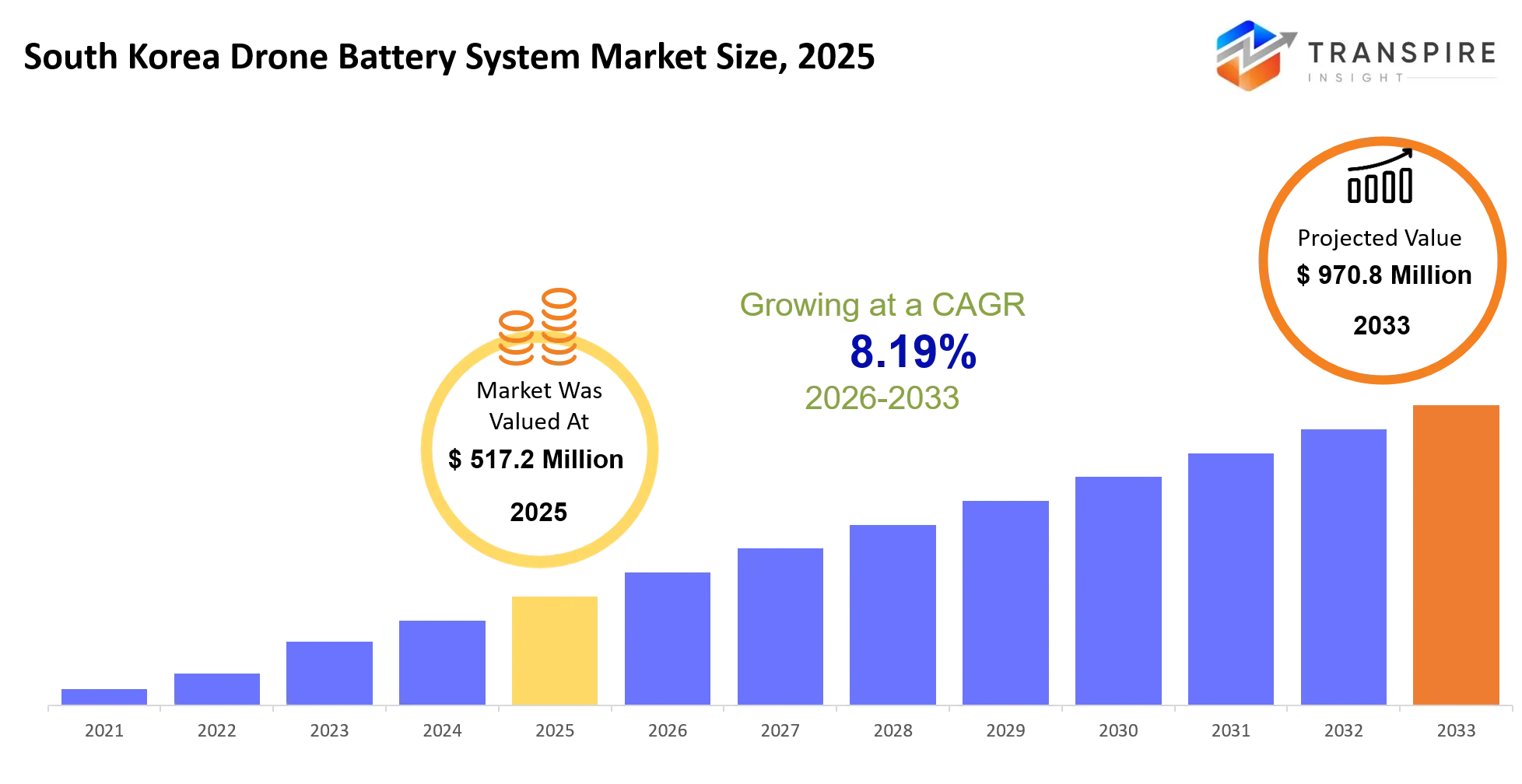
- South Korea Drone Battery System Market Size 2025: USD 517.2 Million
- South Korea Drone Battery System Market Size 2033: USD 970.8 Million
- South Korea Drone Battery System Market CAGR: 8.19%
- South Korea Drone Battery System Market Segments: By Battery Type (Lithium-ion, Lithium Polymer, Solid-State, Others); By Application (Commercial Drones, Military Drones, Consumer Drones, Others); By End User (Defense, Agriculture, Logistics, Others); By Capacity (Low, Medium, High, Others)
To learn more about this report,  Download Free Sample Report
South Korea Drone Battery System Market Summary
The South Korea Drone Battery System Market was valued at USD 517.2 Million in 2025. It is forecast to reach USD 970.8 Million by 2033. That is a CAGR of 8.19% over the period.
South Korea’s drone battery system market kind of underpins the whole power backbone for UAVs in coastal surveillance, port inspection, shipbuilding yards, offshore energy monitoring, and that last-mile industrial logistics stuff. These battery systems sort of decide flight duration, payload limits, and turnaround speed too , so deployment across maritime and heavy industry ends up looking different than it would for consumer-style drone use. Over the last five years, the scene shifted away from plain standalone lithium-ion packs toward modular and swappable battery setups, usually paired with intelligent battery management systems.
Those systems help squeeze better fleet uptime and keep thermal safety under control, not just “basic” performance.A primary driver was the sharp increase in regional maritime surveillance needs with growing geopolitical unrest. This spurred defense sectors and port authorities to ramp up their constant drone operations – as if on autopilot. Simultaneously, the erratic prices of lithium in 2021-2022 amplified the drive toward operational efficiency and distributed local battery integration. Together these have led to better operational continuity and provided the necessary backing to enabling service-based battery solutions rather than a direct purchase-and-own model.
Key Market Insights
- Seoul Capital Area basically holds about 42% share in manufacturing and R&D for the South Korea Drone Battery System Market, mostly because dense aerospace clusters and tech infrastructure are just there. In other words, the region is kind of set up for it.
- Regional expansion is also helping the South Korea Drone Battery System Market grow through defense-linked coastal industrial corridors, plus logistics hubs and more related services. This makes deliveries and maintenance more direct, less hassle overall.
- Lithium-ion battery packs are still the big thing, with roughly 48% share, and they power most UAV fleets in both industrial and defense use cases.
- Then there are battery management systems, which sit as the second-largest segment, keeping safety in check, managing heat, and improving day to day operational efficiency.
- Meanwhile, swappable modular battery systems are the fastest-growing portion for 2025 to 2030, because they raise drone uptime and cut down those operational delays.
- Offshore wind turbine check-ups are becoming the fastest-growing use case, backed by the whole renewable energy push and the automation needs that keep piling up in real life.
- Industrial logistics drones are slowly getting serious momentum too, they’re helping with last mile delivery efficiency, especially inside controlled industrial areas where things have to be predictable.
- Defense and maritime authorities seem to be in front, roughly ~40% share, mostly because there’s constant border monitoring and naval surveillance work going on, day after day.
- On the other hand, commercial drone service providers are the fastest-growing end user group, and it’s largely because inspection-as-a-service models are a pretty natural fit.
- Heavy industries are also increasingly using drone systems, not just for routine tasks, but for predictive maintenance and for improving operational safety in a more reliable way than before.
What are the Key Drivers, Restraints, and Opportunities in the South Korea Drone Battery System Market?
The strongest driver of growth is, basically, the fast spread of persistent drone monitoring across coastal and offshore zones. This change was sparked by tougher maritime security needs and more strict watchfulness expectations from harbor authorities after the regional naval activity started ramping up. So operators are, sort of, moving away from brief UAV sorties and going toward continuous-flight deployments, which bumps up the demand for high density lithium-ion packs plus better battery management systems. That transition has lifted procurement volumes and reinforced those repeat replacement cycles, making revenue more predictable for vendors in the South Korea Drone Battery System Market, overall.
The biggest limitation, though, is the energy density ceiling when compared with payload heavy industrial drones. It’s kind of a structural hurdle too, since electrochemical progress happens little by little, while real world demands for longer endurance and heavier sensor loads are rising even quicker. As a result, teams end up with trade-offs between flight duration and functionality, which can slow down broad rollout for offshore logistics, and also constrains fleet expansion budgets.
One notable opportunity is showing up through swappable solid state prototype setups that are being tested inside Busan’s smart port initiatives. Early trials in automated inspection drones for shipyards suggest they could reduce downtime and support near continuous operational cycles, putting the South Korea Drone Battery System Market in position for a next step efficiency upgrade.
What Has the Impact of Artificial Intelligence Been on the South Korea Drone Battery System Market?
Artificial intelligence and advanced digital systems are increasingly, kinda quietly, reshaping how the South Korea Drone Battery System Market supports maritime and industrial UAV operations, in particular for port inspection offshore energy monitoring, and shipyard maintenance workflows
On the automation side, AI enabled fleet management platforms now coordinate drone charging cycles, battery swapping schedules, and compliance tracking for long-duration maritime missions. These platforms are also getting tied into marine emission control technology inspection routines, where drones check scrubber performance systems, plus exhaust gas cleaning equipment on vessels, so there is less need for manual inspections and the results feel more consistent across ports
For predictive uses, machine learning models look at battery temperature swings, charge discharge cycles, and vibration data to anticipate degradation patterns. Because of this, operators can schedule preemptive battery replacement and tune flight routing, which in turn improves mission reliability and stretches the practical usable battery life. In South Korea deployments, there are directional gains around 10–18% for drone uptime, and there are also clear decreases in unplanned maintenance costs, mainly due to better energy forecasting
Still though, adoption is held back by limited real-time connectivity out at sea. Data transmission gaps between drones and shore based AI systems can reduce model accuracy and also slow down analytics refreshes especially during long-range maritime missions. And this connectivity problem stays like a structural constraint even while hardware capabilities keep improving, so full scale AI integration across the South Korea Drone Battery System Market moves slower than expected
Key Market Trends
- Swappable battery systems adoption has kinda sped up since 2023, and it reduced downtime for industrial drones, across maritime inspection and logistics missions , overall.
- Defense maritime surveillance kept expanding after 2022 regional tensions, and that pushed continuous UAV operations harder, so ports had to use battery cycles more and more.
- Then in 2024, AI based battery management got integrated more broadly, improving forecasting and also load balancing, with LG Energy Solution and Samsung SDI ecosystems moving deployment forward.
- The fluctuations in Li supply for 2021-2022 influenced SK On to embrace localization and recycling measures in an attempt to stabilize its drone battery supply chains.
- The testing of solid-state batteries using smart port pilot programs in Busan, with Doosan Mobility Innovation in 2025 mainly targeted at automatically inspecting shipyard sites with drones, has also been noted.
- Offshore wind inspection drone adoption between 2023-2026, correlated with expanding renewable energy projects along Korean coastlines, has also been an identified factor.
- Hanwha Aerospace and Korea Aerospace Industries contracts for expanded UAV battery integration to enhance reliability for defense-rated energy systems is notable, particularly for 2024.
- However, for heavy-payload UAV's, full commercialization remains hampered due to the slow improvements in energy density of all battery chemists.
South Korea Drone Battery System Market Segmentation
By Battery Type :
Lithium-ion batteries are still the default pick because the output stays fairly consistent, they last through more cycles, and they play well with industrial drone systems that get used for inspection, plus monitoring runs. There’s a solid manufacturing base behind them, and the cost picture is pretty efficient, so adoption keeps spreading across both commercial and defense deployments, even when requirements tighten up.
Lithium polymer batteries are used when the drone frame needs to stay light, and when the layout has to stay flexible, especially for compact designs. Solid-state batteries are still kind of in the testing stage, but they are showing better safety and promising energy density potential. Other chemistries exist too, but they’re mostly constrained to niche use , where the standard battery style just doesn’t line up with what the mission needs, for example odd size constraints or unusual duty cycles.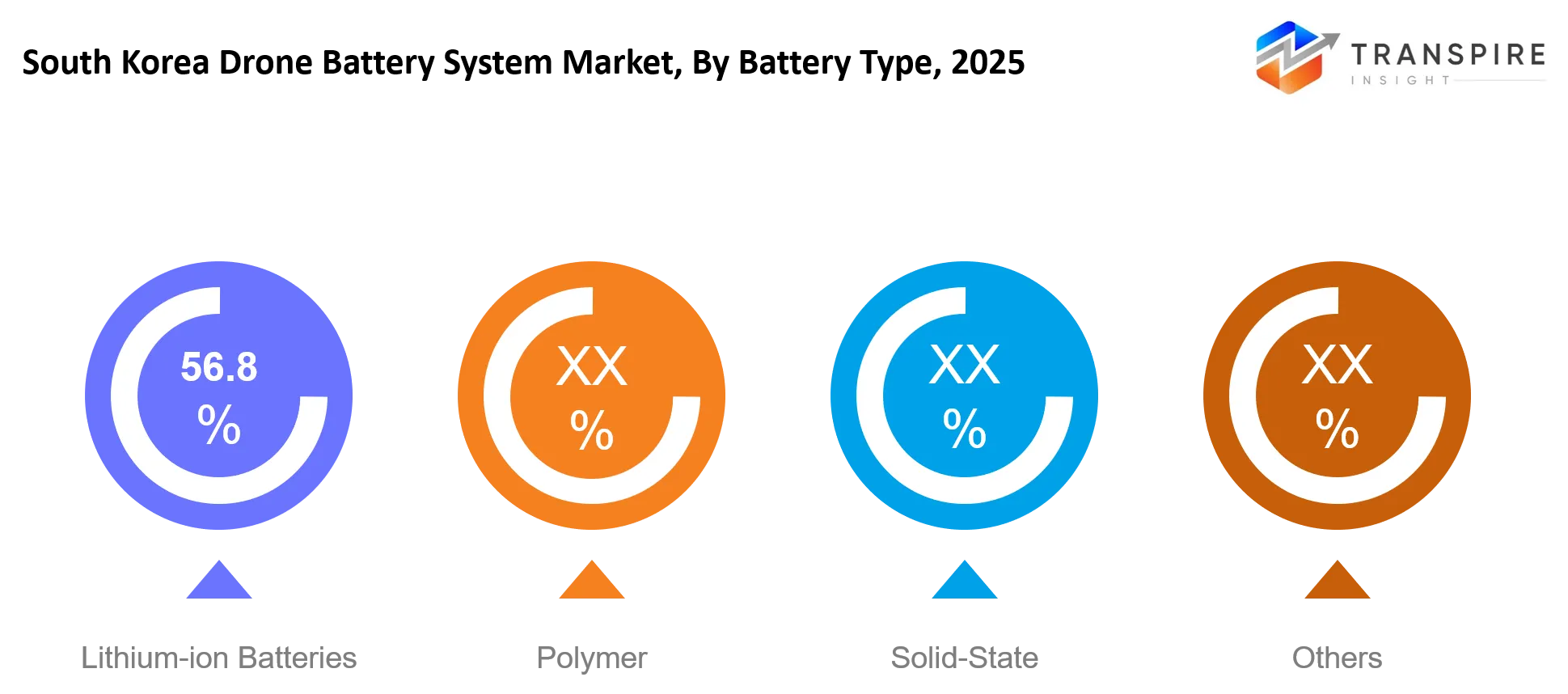
To learn more about this report, Download Free Sample Report
By Application :
Commercial drones drive the most usage because demand keeps rising for infrastructure checks , port monitoring, and industrial surveying. Battery setups in this segment tend to focus on endurance, quicker recharge, and steady behavior during repeat missions, all while working in controlled industrial settings.
Military drones lean toward more advanced battery systems meant for secure communication, extended flight time, and dependable operation in surveillance tasks. Consumer drones aren’t growing as fast now, partly because the market momentum shifted toward industrial use cases. Other applications stay pretty limited, but they still support experimental or specialized field work in controlled environments, where unusual constraints show up.
By End User :
Defense still sort of remains the leading end user, mostly because there’s always surveillance needed along the coastal and border areas. Battery systems help enable long-duration missions and also keep the high reliability side of things, so that drives steady procurement and upgrades across the broader military drone fleets.
Agriculture uses drones for crop monitoring and field analysis, and because of that they tend to need medium-capacity batteries, with these short operational cycles in mind. Logistics adoption is growing too, since drone based delivery and warehouse movement are expanding. Other end users include research and industrial testing, where customized battery systems are used to match specific operational conditions and sometimes pretty niche demands.
By Capacity :
Low-capacity batteries are used in lighter drones that are built for short inspection tasks and also more consumer type applications with limited flight duration. In these cases, the whole focus is on cost control and quick replacement cycles, in simpler operational environments that don’t really punish performance.
Medium-capacity batteries cover most commercial drones used for inspection, mapping, and monitoring, because they offer that balance between endurance and payload handling. High-capacity batteries show up in defense and offshore operations, where extended flight time is not optional. Then there are other capacity types, which basically serve specialized configurations designed for experimental setups or mission specific requirements that change depending on the job.
What are the Key Use Cases Driving the South Korea Drone Battery System Market?
The core use case in the South Korea Drone Battery System Market is basically coastal surveillance and port inspection for both defense and maritime authorities, and yeah it kinda depends on that long horizon. These operations lean hard on long-endurance drones so they can keep watching ships, harbors, and the restricted waters area without interruption, that’s what pulls steady battery demand.
On top of that, the expanding applications are more of the offshore wind turbine inspection angle, plus industrial logistics drones used in smart ports and warehouse networks. Operators tied to defense-linked infrastructure and commercial service providers are ramping up deployments, to get better efficiency , improved safety, and to enable predictive maintenance support.
More emerging things now include autonomous charging docks for drone fleets, solid-state battery trials in smart port programs, and AI coordinated energy scheduling systems that help with unmanned inspection workflows. These show up in shipyards, and also offshore industrial zones where continuous work is the whole point, I mean without too much downtime.
|
Report Metrics |
Details |
|
Market size value in 2025 |
USD 517.2 Million |
|
Market size value in 2026 |
USD 559.4 Million |
|
Revenue forecast in 2033 |
USD 970.8 Million |
|
Growth rate |
CAGR of 8.19% from 2026 to 2033 |
|
Base year |
2025 |
|
Historical data |
2021 - 2024 |
|
Forecast period |
2026 - 2033 |
|
Report coverage |
Revenue forecast, competitive landscape, growth factors, and trends |
|
Country scope |
South Korea |
|
Key company profiled |
Samsung SDI, LG Energy Solution, Panasonic, CATL, BYD, Amprius, EaglePicher, Saft, EnerSys, Kokam, E-One Moli, SK On, BAK Battery, Sunwoda, Gotion |
|
Customization scope |
Free report customization (country, regional & segment scope). Avail customized purchase options to meet your exact research needs. |
|
Report Segmentation |
By Battery Type (Lithium-ion, Lithium Polymer, Solid-State, Others); By Application (Commercial Drones, Military Drones, Consumer Drones, Others); By End User (Defense, Agriculture, Logistics, Others); By Capacity (Low, Medium, High, Others) |
Which Regions are Driving the South Korea Drone Battery System Market Growth?
Seoul Capital Region is leading the South Korea Drone Battery System Market, mostly because there’s a heavy clustering of aerospace firms, defense contractors, and R&D organizations, in one place. Also, the government is pushing hard for UAV integration in urban security and infrastructure monitoring, so procurement for upgraded battery systems moved faster than expected, a lot of times. The whole thing is helped by already built supply chains, mainly around lithium-ion production and battery management technologies. And then there’s that ongoing back-and-forth between companies and research institutes, which keeps the innovation loop running and makes large-scale rollout feel more realistic.
Next, the Gyeonggi–Incheon corridor sits as a stable secondary region. It’s less about defense concentration and more about its closeness to big ports, plus logistics hubs. In contrast with Seoul’s innovation-led expansion, this area tends to grow through steady commercial uptake in warehousing, cargo handling, and airport surveillance workflows. Logistics operators and shipping companies are investing long term, and that keeps demand consistent for dependable drone power systems. Regulatory enforcement is gradual here too, so the growth path looks more predictable, with lower volatility across industrial uses.
Meanwhile, the Busan–Ulsan coastal belt is becoming the fastest growing region. That momentum is tied to smart port infrastructure expansion and offshore energy projects, especially starting in 2024. New automation initiatives in shipyards and wind farm monitoring are boosting drone deployment intensity, quite noticeably. Regional authorities have even rolled out digital port transformation policies that lean toward unmanned inspection systems first. This quicker transition is opening up entry opportunities for battery system suppliers, especially the ones that can deliver high-endurance setups or swappable energy approaches for maritime operations, throughout 2026–2033.
Who are the Key Players in the South Korea Drone Battery System Market and How Do They Compete?
The South Korea Drone Battery System Market looks, kind of moderately consolidated up top, with a handful of big battery makers going head to head with more specialized UAV and defense integrators. What really pushes competition forward isn’t only specs, it’s the whole package—energy density performance, battery management intelligence , certification readiness for defense use, and plain reliability when you’re operating near water , in maritime type conditions. Price stays sort of secondary to endurance safety, and lifecycle efficiency , especially for port surveillance and offshore inspection work. New entrants feel friction fast, because qualification standards are high and integration complexity with drone platforms can be a real headache.
LG Energy Solution is leaning hard into high energy density lithium-ion cells, tuned for extended UAV flight time, and it keeps reinforcing that edge through R&D partnerships with industrial drone developers. Samsung SDI separates itself with an upgraded safety architecture plus thermal stability systems, so it can support deployment in high-risk maritime inspection settings, without too much drama. SK On tends to stress cost optimized battery modules and a recycling linked supply stability angle, and it’s growing via localized production strategies while also locking in strategic material sourcing agreements.
Doosan Mobility Innovation builds a more niche kind of leadership around hydrogen and hybrid drone power systems, concentrating on long endurance industrial inspection drones that work in remote environments. Hanwha Aerospace together with Korea Aerospace Industries, strengthened their position via defense-grade UAV integration programs, landing longer term contracts with government agencies, and gradually moving into next generation unmanned surveillance platforms.
Company List
- Samsung SDI
- LG Energy Solution
- Panasonic
- CATL
- BYD
- Amprius
- EaglePicher
- Saft
- EnerSys
- Kokam
- E-One Moli
- SK On
- BAK Battery
- Sunwoda
- Gotion
Recent Development News
In March 2026, NEO Battery Materials acquired a 3.2-acre expansion site in Gimje, South Korea to establish a commercial-scale drone and robotics battery cell manufacturing facility. The project is aimed at scaling pouch-cell production for UAV and defense applications, with planned capacity of up to 500 MWh annually to support non-Chinese supply chains for drone OEMs and military procurement. Source https://battery-tech.net/
In May 2026, NEO Battery Materials announced a defense partnership with the South Korean Army’s Capital Defense Command to advance deployment of high-performance battery systems for drone and robotics units. The collaboration focuses on supplying secure, non-Chinese battery solutions designed to improve operational runtime and energy efficiency in military unmanned systems. Source https://evertiq.com/
What Strategic Insights Define the Future of the South Korea Drone Battery System Market?
The South Korea Drone Battery System Market is kind of moving toward intelligent , high-endurance and modular energy systems that help persistent industrial and maritime drone operations. The growth path is influenced by automation in ports, defense-led surveillance expansion, and the closer linking between UAV platforms and energy management software. Over the next 5–7 years , demand will lean more toward swappable battery ecosystems and AI-optimized configurations, not just standalone packs, because operators care more about uptime and mission continuity than simple unit cost.
There’s also a less obvious risk, dependency on imported critical minerals, especially lithium and nickel. That situation can drag supply chains into geopolitical pricing shocks and production delays. So even if end-use demand stays strong , the scaling pace may still get constrained.
One emerging opportunity is the commercialization of smart port energy hubs in Busan and Incheon, where autonomous charging and battery exchange stations for drone fleets are being tested. This infrastructure change can open the door for continuous drone operations at scale. Market players should really focus on partnerships with port authorities and put money into integrated battery platform ecosystems, not just isolated hardware solutions, to lock in long-term positioning.
South Korea Drone Battery System Market Report Segmentation
By Battery Type
- Lithium-ion
- Lithium Polymer
- Solid-State
By Application
- Commercial Drones
- Military Drones
- Consumer Drones
By End User
- Defense
- Agriculture
- Logistics
By Capacity
- Low
- Medium
- High
Frequently Asked Questions
Find quick answers to common questions.
The Expected South Korea Drone Battery System Market size is USD 970.8 Million in 2033.
Key Segments for the South Korea Drone Battery System Market are By Battery Type (Lithium-ion, Lithium Polymer, Solid-State, Others); By Application (Commercial Drones, Military Drones, Consumer Drones, Others); By End User (Defense, Agriculture, Logistics, Others); By Capacity (Low, Medium, High, Others).
Major South Korea Drone Battery System Market players are Samsung SDI, LG Energy Solution, Panasonic, CATL, BYD, Amprius, EaglePicher, Saft, EnerSys, Kokam, E-One Moli, SK On, BAK Battery, Sunwoda, Gotion.
The South Korea Drone Battery System Market size is USD 517.2 Million in 2025.
The South Korea Drone Battery System Market CAGR is 8.19% from 2026 to 2033.
- Samsung SDI
- LG Energy Solution
- Panasonic
- CATL
- BYD
- Amprius
- EaglePicher
- Saft
- EnerSys
- Kokam
- E-One Moli
- SK On
- BAK Battery
- Sunwoda
- Gotion
About the Authors

Avinash Kumar
I’m Avinash Kumar, a Senior Research Analyst at Transpire Insight, with expertise in the Electronics and Semiconductor and Energy & Power industry. My work focuses on analyzing emerging technologies, market trends, industry developments, and innovation across these sectors. I specialize in transforming complex technical and market insights into clear, research-backed content that helps professionals, businesses, and decision-makers stay informed. Through continuous industry research and data-driven analysis, I strive to deliver accurate, reliable, and practical perspectives on the latest advancements shaping the semiconductor and energy landscape.

Chakradhar Khansole
Chakradhar serves as the Research Director at Transpire Insight, bringing over 8 years of experience in technology, innovation, and strategic market intelligence. He specializes in transforming complex market data into actionable business insights that enable organizations to make informed, growth-oriented decisions. Recognized for his strategic vision and analytical expertise, Chakradhar leads high-impact research initiatives, delivering comprehensive market assessments, competitive intelligence, and forward-looking industry analysis.
Recently Published Reports
-
Apr 2026
Fiber Optic Faceplates Market
Fiber Optic Faceplates Market Size, Share & Analysis Report By Type (< 300 mm2, 300-350 mm2, and > 350 mm2, By Application (Night Vision, Holographic Imaging, Medical, and Others), and Geography (North America, Europe, Asia-Pacific, Middle East and Africa, South and Central America), 2021 - 2031
-
Apr 2026
High Temperature Superconductors Market
High Temperature Superconductors Market Size, Share & Analysis Report By Type (1G HTS, and 2G HTS), By Application (Power Cable, Fault Current Limiter, and Transformer), and Geography (North America, Europe, Asia-Pacific, Middle East and Africa, South and Central America), 2021 - 2031
-
Apr 2026
Industrial Plugs and Socket Market
Industrial Plugs and Socket Market Size, Share & Analysis Report By Type (Industrial Plugs, Industrial Sockets), By Current (Up to 32 A, 32 to 125 A, Above 125 A), By Protection (Dustproof and Splash Proof, Waterproof, Explosion Proof), By End User (Heavy Industries, Oil and Gas, Chemicals and Pharmaceuticals, Power Generation, Others), and Geography (North America, Europe, Asia-Pacific, Middle East and Africa, South and Central America), 2021 - 2031
-
Apr 2026
InGaAs Avalanche Photodiodes Market
InGaAs Avalanche Photodiodes Market Size, Share & Analysis Report By Type (1100 - 1700 nm, and 1000 - 1600 nm), By Application (Missile Warning System, Muzzle Flash Detection, Wafer Defect Inspection, Laser Rangefinders, and Others), and Geography (North America, Europe, Asia-Pacific, Middle East and Africa, South and Central America), 2021 - 2031