
South Korea Battery Management System Market Size & Forecast:
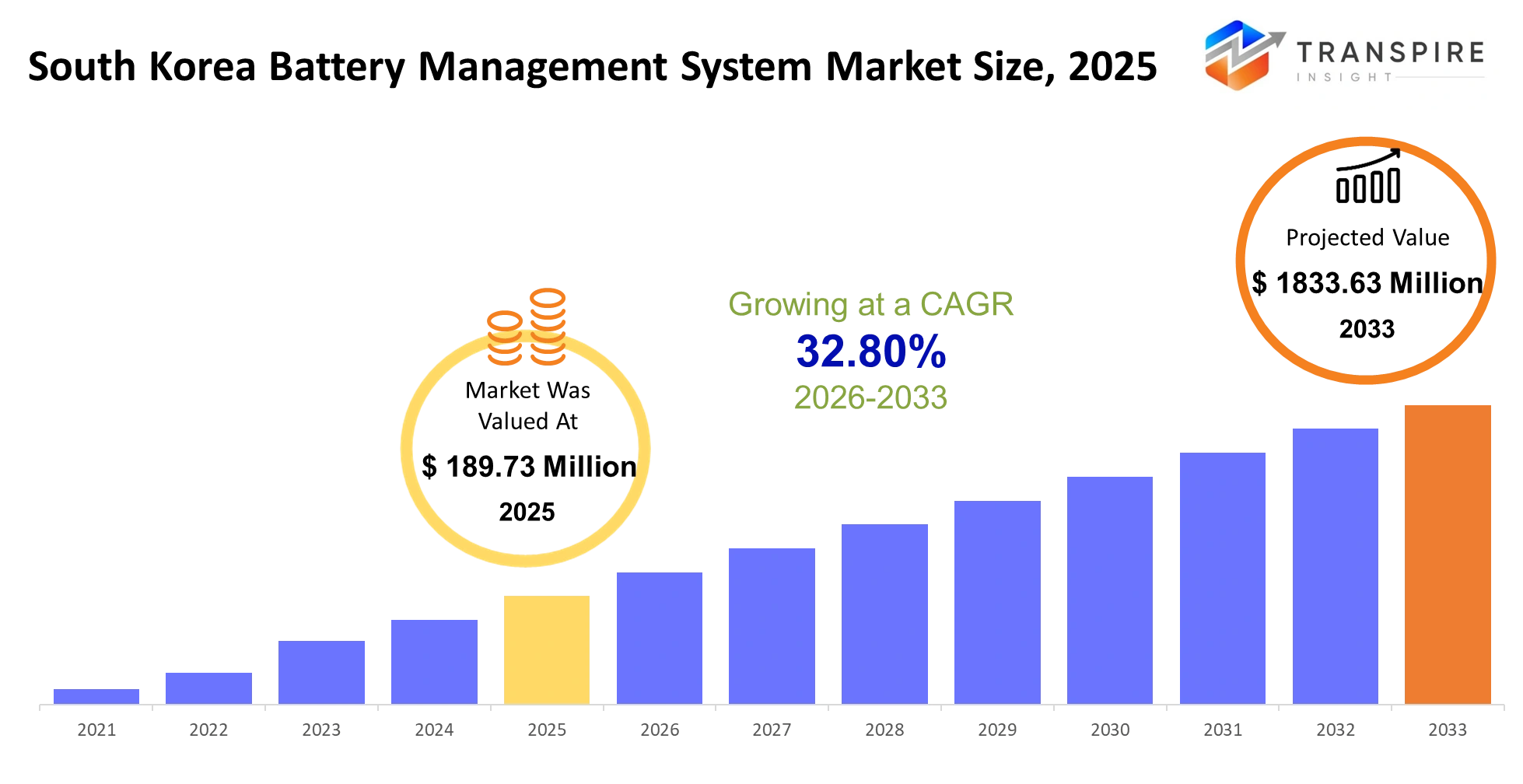
- South Korea Battery Management System Market Size 2025: USD 189.73 Million
- South Korea Battery Management System Market Size 2033: USD 1833.63 Million
- South Korea Battery Management System Market CAGR: 32.80%
- South Korea Battery Management System Market Segments: By Component (Battery ICs, Sensors, Communication Systems, Control Modules, Others); By Battery Type (Lithium-ion Batteries, Lead-acid Batteries, Solid-state Batteries, Others); By Application (Electric Vehicles, Energy Storage Systems, Consumer Electronics, Industrial Equipment, Others); By End User (Automotive OEMs, Battery Manufacturers, Electronics Companies, Others).
To learn more about this report,  Download Free Sample Report
South Korea Battery Management System Market Summary
The South Korea Battery Management System Market was valued at USD 189.73 Million in 2025. It is forecast to reach USD 1833.63 Million by 2033. That is a CAGR of 32.80% over the period.
In practice, battery management systems in South Korea pretty much act like that control layer that keeps electric vehicle packs, grid storage units and industrial batteries stable, safe , and efficient even when the demand is heavy or the load is really intense. They do the continual balancing of cell voltage , they handle thermal stress in real time , and they block those failure modes that could basically stop mobility fleets or mess up energy storage operations in data centers and manufacturing plants.
Over the past 3–5 years there’s been a noticeable structural shift. South Korea moved away from hardware-centric battery packs , and toward software-defined energy systems, where real-time diagnostics and cloud-connected monitoring are now the norm in high-value uses. The fast expansion of domestic EV production , led by Hyundai and Kia, is a big reason this transition happened. Then after 2020, global supply chain disruptions basically forced manufacturers to localize battery intelligence and strengthen their own reliability controls internally. Put together, this has accelerated adoption , because enterprises now value lifecycle efficiency and predictive safety more than just chasing simple capacity expansion or raw throughput.
Key Market Insights
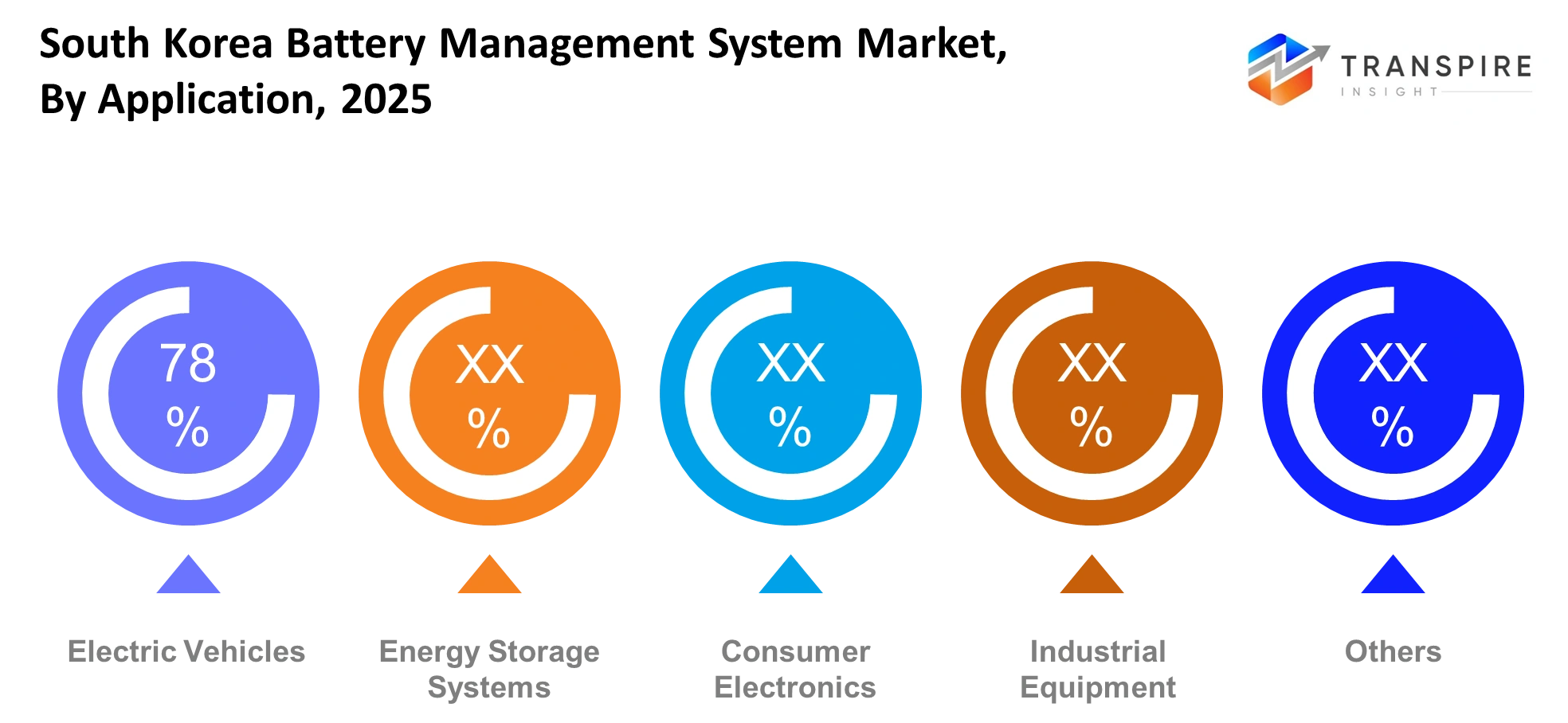
- South Korea Battery Management System Market looks like it’s mostly EV based, with EV application dominance at nearly 62% share in 2025 , mainly because Hyundai and Kia are pushing electrification at large scale, you know, the whole thing.
- Meanwhile Seoul and Gyeonggi region sits around 45% market concentration, it’s driven by dense EV manufacturing and then semiconductor ecosystem integration, also in 2025 there’s still momentum on that front.
- Chungcheong coastal zone feels like the fastest riser, with renewable linked storage capacity expected to grow more than 35% across 2026–2033 , kind of a strong run.
- Lithium-ion batteries stay in the lead, taking over 80% share in the South Korea Battery Management System Market , and that’s due to higher energy density and good EV compatibility, simple really.
- The solid-state battery segment is seeing the quickest growth outlook, moving above 28% CAGR through 2033, this is tied to safety focused R&D programs and all those careful experiments.
- For applications, electric vehicle use remains dominant at nearly 60% share , supported by the rising domestic EV production and export oriented platforms that are being built.
- Energy storage systems are the fastest growing application, growing fast as grid modernization ramps up and renewable integration targets get closer.
- On the end user side, automotive OEMs control the leading share at over 50% , backed by integrated battery platform strategies across multiple EV lineups.
- Battery manufacturers also look solid, they’re expanding by leaning into vertical integration , meaning cell production plus intelligent battery control systems under one roof.
- Companies keep strengthening their position using AI based predictive diagnostics, modular BMS design , and partnerships for global EV platforms.
- Strategic expansion is turning toward semiconductor-battery integration , enabling real time thermal control and improving EV battery lifecycle efficiency by more than 20%, which sounds promising.
What are the Key Drivers, Restraints, and Opportunities in the South Korea Battery Management System Market?
The main driver behind the South Korea Battery Management System Market is mostly that push for aggressive electrification of mobility, plus the supporting energy infrastructure. In practice , government-supported EV adoption targets, along with Hyundai and Kia scaling up their next-generation electric platforms, have basically compelled battery vendors to fold in more advanced management systems. These systems help with safety, they stretch the lifecycle, and they also optimize charging behavior. As a result, demand has gone up for high-precision monitoring, and for software-driven diagnostics that are installed at both the cell and pack level.
Now the biggest limiting factor is that integration gets messy, fast. There’s high complexity when hardware sensors have to work together with real-time software analytics, especially across multi-cell battery architectures. A lot of manufacturers still lean on older, fragmented setups that don’t sync thermal readings, voltage metrics, and state of charge data very well, in real time. That mismatch creates engineering bottlenecks , which then raises development costs and drags out deployment timelines. This hits mid-tier suppliers especially hard, because they often do not have vertically integrated battery ecosystems.
At the same time, there’s a promising opening showing up, mainly AI-enabled predictive battery intelligence , for grid-scale storage and EV fleet handling. South Korea’s renewable energy expansion, together with the growth of fast-charging networks, is producing huge volumes of operational data. Businesses that can translate that data into predictive degradation models, and into adaptive energy routing solutions, could gain stronger efficiency margins. This matters a lot for utility operators rolling out large-scale storage systems, including setups linked to offshore wind, and smart city infrastructure.
What Has the Impact of Artificial Intelligence Been on the South Korea Battery Management System Market?
Artificial intelligence is now more and more tucked into battery management architectures, to help with real time judgment calls across electric vehicles plus grid storage setups, particularly in South Korea. AI based control systems get used to fine tune cell balancing, shift thermal loads on the fly, and raise charging efficiency inside high density lithium ion packs. With big EV fleets, these systems seem to cut downtime a lot, because they keep re-calibrating performance thresholds from day to day usage patterns, and from what the environment is doing.
Alongside that, machine learning models are making predictive maintenance actually practical, they look at voltage swings, charge cycles, and degradation patterns to anticipate battery failure before it shows up. That improvement boosts operational uptime in both commercial EV fleets and stationary energy storage installations, mainly by lowering unexpected shutdowns and the number of maintenance visits. Some operators say they see clear gains in lifecycle efficiency, plus less cost, after optimizing charge discharge behavior over time.
Still, take up is not smooth all the way, there is a structural issue tied to messy real world data. Battery behavior changes a lot when temperature goes to extremes, and when usage conditions are unusual, so limited standardized datasets can hurt accuracy in edge cases. On top of that, the integration costs for AI capable hardware modules are high, which makes smaller manufacturers hesitate. As a result, broad deployment across the ecosystem moves slower than it might.
Key Market Trends
- South Korea Battery Management System Market kinda shifted from control-thing hardware centric units to more software defined systems somewhere between 2022, and 2025, and that helped operational efficiency a lot.
- Hyundai and Kia also moved harder into embedded BMS use after 2023, and in practice it now touches more than 70% of new EV platforms, with real time diagnostics capability which is pretty useful.
- Samsung SDI ,and LG Energy Solution rolled out AI based thermal monitoring systems in 2024, this improved battery safety too and also the lifecycle performance.
- Semiconductor providers like Infineon Technologies and Texas Instruments increased the integration of automotive grade chips while the analog systems were declining around 2025.
- Energy storage installations kept growing after 2023, largely because renewable grid policies pushed utility BMS adoption up quite a bit.
- SK On introduced modular battery platforms in 2025, which makes OEM integration faster, and reduces that overall system deployment complexity that usually shows up.
- After 2024, supply chain localization increased, lowering dependence on imported BMS components, and it strengthened domestic manufacturing resilience.
- Cloud connected BMS adoption spread further in 2025, letting fleet operators boost predictive maintenance, and improve operational visibility at the same time.
- Solid state battery pilot efforts expanded after 2024, and that means new calibration approaches were needed for next generation high density energy systems.
- Continental AG and Bosch went further on AI based analytics integration, which supports efficiency optimization in premium electric vehicle platforms.
South Korea Battery Management System Market Segmentation
By Component
Battery ICs still kind of hold the top spot in the South Korea Battery Management System Market, since precise monitoring of voltage current ,and temperature really stays critical for electric vehicle safety plus high-density energy storage setups. There’s also strong semiconductor integration inside automotive platforms, it helps adoption move forward especially when real-time control accuracy can make or break battery lifecycle outcomes. Sensors take the second-largest slice, because thermal and current sensing is becoming more important in fast-charging EV designs and in industrial storage environments. Communication systems keep getting a bigger role too, mostly from the rising need for cloud-connected diagnostics and fleet-level energy tracking. Control modules stay central for overall orchestration, while the rest of the components tend to back up auxiliary protection, plus redundancy-type functions.
On the growth side, battery IC momentum comes from EV platform standardization, where OEMs put in advanced chipsets to lower failure risk and support better energy efficiency. Sensor use is moving upward as thermal safety requirements get tighter and as higher energy density battery packs get used across mobility , and grid storage. Communication systems gain traction because remote diagnostics plus predictive maintenance platforms are becoming more common. Over the forecast period, battery ICs and communication systems are expected to start converging through integrated smart chip architectures, and that nudges developers toward heavily embedded, software-defined battery control solutions.
By Battery Type
Lithium-ion batteries pretty much run the South Korea Battery Management System Market because they have high energy density , a long lifecycle, and they fit well with electric vehicle platforms and grid-scale storage systems. There is also strong local manufacturing muscle, plus deep integration inside automotive supply chains, so that leadership stays solid. Lead-acid batteries are still around, but they keep losing share in a steady way, mostly in backup power systems and older industrial setups where cost efficiency matters more than top-tier performance. Solid-state batteries are turning into an emerging segment, mainly because of safety advantages and the next-generation EV development programs. Everything else stays kind of limited to niche industrial and specialty use cases.
Lithium-ion growth is pushed along by ongoing improvements in fast charging capability and by the need for extended cycle performance, especially across EV fleets and renewable energy storage. Lead-acid demand is stuck a bit, mostly due to technological substitution, even if replacement cycles in industrial backup systems still keep revenue fairly consistent. Solid-state batteries get more attention too, driven by national R&D funding and pilot programs that large automakers lead, all aimed at higher safety thresholds. During the forecast period, solid-state adoption is expected to speed up in premium EV segments , and that makes suppliers invest harder in advanced materials and in next-generation BMS compatibility frameworks.
By Application
Electric vehicles show up as the leading application segment, largely because EV production is scaling quickly, OEM integration is getting stronger and there are very strict safety requirements for those high capacity battery packs. The battery management systems really do the heavy lifting here, they help keep thermal stability, improve charging efficiency, and protect long term performance across both passenger and commercial EV setups. Energy storage systems come in next, the second largest piece, as renewable energy keeps moving into more national grids and industrial facilities. Consumer electronics stays relatively steady too, mostly from portable device demand, while industrial equipment and related uses continue expanding in robotics, automation, and similar environments.
The growth for EV applications gets pulled forward by aggressive electrification policies and also domestic manufacturing pushes from top automotive brands. Energy storage systems are growing faster because solar and wind are being added more, so there’s a need for smarter load balancing and predictive energy management. For consumer electronics, the demand is still stable, but it is gradually turning toward higher performance, compact battery systems. During the forecast period, energy storage systems are expected to shift into a main growth engine, which then encourages BMS developers to pursue scalable designs that can manage multi megawatt installations and those distributed energy networks.
To learn more about this report, Download Free Sample Report
By End User
Automotive OEMs seem to hold the biggest share in the South Korea Battery Management System Market, mostly because they can directly tuck battery systems into electric vehicle platforms, and they keep tight control on performance requirements. Because of that they often push “battery intelligence” pretty hard, so safety compliance is smoother, and the vehicle range can stay longer, in a more stable way. Battery manufacturers land as the second-largest segment , since they build and deliver integrated battery packs with embedded management systems, not just for automotive use but also for grid style applications. Electronics companies add a steady contribution too, mainly with compact energy storage use cases in consumer electronics and industrial devices, while other end users usually point to utility operators and industrial system integrators, who want reliable monitoring.
The demand from Automotive OEMs is largely pulled by big EV production volumes, plus the fact that they are leaning more and more on proprietary battery platforms for competitive differentiation. Battery manufacturers are also ramping up, using vertical integration strategies that mix cell production with in-pack control circuitry. Electronics companies still emphasize smaller form factors and energy efficient battery solutions for the next wave of devices. During the forecast period, battery manufacturers are expected to grow even more influential, as system-level integration keeps getting more important, which in turn drives deeper cooperation with semiconductor suppliers and wider automotive ecosystem partners.
What are the Key Use Cases Driving the South Korea Battery Management System Market?
So basically, the biggest way battery management systems get used in South Korea is for electric vehicle battery control ,where the systems kinda handle safety, charging efficiency, and thermal stability all at once across those high density lithium-ion packs. That’s mostly pushed by mass EV production from the major automotive brands and, well ,their need for steady results even during fast charging
Beyond that, there are more broad applications, like grid-scale energy storage systems and industrial backup power for semiconductor fabs and data centers. In those places they depend on careful energy balancing ,so they don’t run into downtime issues, and so they can also stabilize renewable integration across the wider national grid
On the new side, you’ll see emerging use cases such as battery swapping infrastructure for commercial fleets and AI optimized energy trading systems tied to smart grids. These are still forming, but they’re picking up momentum as South Korea keeps accelerating its digital energy transition
|
Report Metrics |
Details |
|
Market size value in 2025 |
USD 189.73 Million |
|
Market size value in 2026 |
USD 251.78 Million |
|
Revenue forecast in 2033 |
USD 1833.63 Million |
|
Growth rate |
CAGR of 32.80% from 2026 to 2033 |
|
Base year |
2025 |
|
Historical data |
2021 - 2024 |
|
Forecast period |
2026 - 2033 |
|
Report coverage |
Revenue forecast, competitive landscape, growth factors, and trends |
|
Regional scope |
South Korea |
|
Key company profiled |
LG Energy Solution, Samsung SDI, SK On, Hyundai Mobis, Panasonic, Bosch, Denso, CATL, Renesas Electronics, Texas Instruments, NXP Semiconductors, Analog Devices, Infineon Technologies, Continental AG, Toshiba. |
|
Customization scope |
Free report customization (country, regional & segment scope). Avail customized purchase options to meet your exact research needs. |
|
Report Segmentation |
By Component (Battery ICs, Sensors, Communication Systems, Control Modules, Others); By Battery Type (Lithium-ion Batteries, Lead-acid Batteries, Solid-state Batteries, Others); By Application (Electric Vehicles, Energy Storage Systems, Consumer Electronics, Industrial Equipment, Others); By End User (Automotive OEMs, Battery Manufacturers, Electronics Companies, Others). |
Which Regions are Driving the South Korea Battery Management System Market Growth?
The Seoul Capital Region, with Gyeonggi Province included, still feels like the main hub for the South Korea Battery Management System Market, mostly because it’s where there are so many EV leadership sites, plus battery R&D sites and semiconductor design facilities. Also the connections between automakers like Hyundai Motor Company and battery suppliers are pretty tight, so they can push out the newer battery control systems quicker than you might expect. On top of that, Seoul's mobility electrification programs, kind of government-backed, have made adoption move faster, across city EV fleets and smart freight logistics networks. And you get this dense mixture of software engineers and hardware manufacturers that basically keeps feeding incremental, and sometimes very fast, improvements in monitoring and thermal management.
Then there’s the Ulsan–Gyeongnam industrial strip, which works like a steady second pillar, mainly driven by big automotive production plus shipbuilding-linked electrification projects. Compared with the capital region, it’s more about endurance than pure idea-spinning, in the sense that it leans on longer OEM agreements and a fairly consistent rhythm of capital spending from well established industrial firms. Rather than chasing quick trials, they often emphasize dependable performance and lifecycle uniformity, which supports stable BMS integration across heavy-duty vehicles and even industrial energy setups. Because of that, it tends to stay a dependable revenue source, even when global supply chains get a little shaky.
Meanwhile, the Chungcheong area and the western coastal regions are starting to look like the fastest-growing cluster, mostly due to newer investments in renewable energy parks and large battery energy storage initiatives. New industrial zones, together with government-supported grid modernization, have helped demand jump for advanced battery management systems, especially for utility-scale use cases. It’s kind of building momentum in a way that makes these regions show up more and more often in new projects and procurement pipelines.
Who are the Key Players in the South Korea Battery Management System Market and How Do They Compete?
Competition in the South Korea Battery Management System Market is kinda moderately consolidated, with heavy vertical integration mostly driven by local battery and automotive giants. At the same time semiconductor and control-system vendors are chasing embedded architecture dominance, kinda quietly but persistently. The incumbents mostly defend their share with proprietary battery platforms, while the semiconductor players and big global electronics companies push on precision control, better efficiency, and software intelligence. Honestly the main fight isn’t just hardware cost anymore, it’s more about system-level optimization, whether data can be integrated cleanly, and how well safety certification actually performs.
LG Energy Solution competes by tightly linking cell chemistry with proprietary BMS algorithms, and then embedding that inside EV platforms directly, so it gets a strong grip on performance tuning. Samsung SDI leans into high-density battery systems, plus advanced thermal stability modules, which puts it in a good spot for premium EVs and also industrial use-cases. SK On keeps expanding through partnerships with global automakers, and it leans on scalable battery platforms for mass EV rollout.
On the semiconductor angle, Infineon Technologies and Texas Instruments go head to head by providing high-precision monitoring ICs that help with voltage accuracy and speed up fault detection. Renesas Electronics also keeps pressure on by offering automotive-grade chipsets, tuned specifically for functional safety certification, which then enables deeper integration into EV control systems. In the end, these firms seem to win by placing intelligence down at the chip level, so adoption moves faster across multiple OEM platforms, instead of getting stuck at just one buyer.
Company List
- LG Energy Solution
- Samsung SDI
- SK On
- Hyundai Mobis
- Panasonic
- Bosch
- Denso
- CATL
- Renesas Electronics
- Texas Instruments
- NXP Semiconductors
- Analog Devices
- Infineon Technologies
- Continental AG
- Toshiba
Recent Development News
In July 2025, LG Energy Solution signed a $4.3 billion lithium iron phosphate battery supply agreement with Tesla Energy. The deal strengthens LG Energy Solution’s position in energy storage-focused battery systems that rely heavily on advanced BMS integration for safety and lifecycle optimization.
Source: https://www.reuters.com
In December 2025, Samsung SDI secured a $1.36 billion energy storage system battery contract through its U.S. unit Samsung SDI America. The agreement involves supplying LFP-based ESS batteries, accelerating the company’s shift toward grid-scale systems where BMS software controls charge stability and thermal safety.
Source: https://www.reuters.com
In December 2025, SK On and Ford Motor agreed to dissolve their BlueOval SK battery joint venture in the United States. The restructuring reallocates production toward energy storage systems and standalone battery operations, increasing reliance on advanced battery management systems for grid applications and fleet optimization.
Source: https://www.reuters.com
What Strategic Insights Define the Future of the South Korea Battery Management System Market?
The South Korea Battery Management System Market is kind of structurally sliding toward fully software-defined energy ecosystems, where battery intelligence becomes, maybe just as critical as the battery hardware itself. It’s being pushed by the coming together of EV scale-up , grid decentralization, and a need for real-time energy optimization across both mobility lanes and infrastructure networks. Over the next 5–7 years, the control systems will increasingly decide competitiveness more than cell chemistry alone , kind of like it or not.
There’s also a less obvious risk that’s creeping in, which is the heavier reliance on tightly integrated domestic supply chains. That concentration puts more technological control in the hands of a few bigger players and it can make the whole setup more fragile if there’s a design bottleneck or, say, chip shortages. At the same time though, a meaningful emerging opportunity is showing up in AI-native battery orchestration platforms for utility-scale storage and for EV fleet coordination, especially in regions that lean heavily on renewables.
Because of that, market participants should really focus on modular, cross-platform BMS architectures that can connect across multiple OEM ecosystems, rather than optimizing only for a single platform. This approach helps with scaling and keeps long-term interoperability more intact, overall.
South Korea Battery Management System Market Report Segmentation
By Component
- Battery ICs
- Sensors
- Communication Systems
- Control Modules
- Others
By Battery Type
- Lithium-ion Batteries
- Lead-acid Batteries
- Solid-state Batteries
- Others
By Application
- Electric Vehicles
- Energy Storage Systems
- Consumer Electronics
- Industrial Equipment
- Others
By End User
- Automotive OEMs
- Battery Manufacturers
- Electronics Companies
- Others
Frequently Asked Questions
Find quick answers to common questions.
The estimated South Korea Battery Management System Market size for the market will be USD 1833.63 Million in 2033.
Key segments for the South Korea Battery Management System Market are By Component (Battery ICs, Sensors, Communication Systems, Control Modules, Others); By Battery Type (Lithium-ion Batteries, Lead-acid Batteries, Solid-state Batteries, Others); By Application (Electric Vehicles, Energy Storage Systems, Consumer Electronics, Industrial Equipment, Others); By End User (Automotive OEMs, Battery Manufacturers, Electronics Companies, Others).
Major South Korea Battery Management System Market players are LG Energy Solution, Samsung SDI, SK On, Hyundai Mobis, Panasonic, Bosch, Denso, CATL, Renesas Electronics, Texas Instruments, NXP Semiconductors, Analog Devices, Infineon Technologies, Continental AG, Toshiba.
The South Korea Battery Management System Market size is USD 189.73 Million in 2025.
The South Korea Battery Management System Market CAGR is 32.80% from 2026 to 2033.
- LG Energy Solution
- Samsung SDI
- SK On
- Hyundai Mobis
- Panasonic
- Bosch
- Denso
- CATL
- Renesas Electronics
- Texas Instruments
- NXP Semiconductors
- Analog Devices
- Infineon Technologies
- Continental AG
- Toshiba
Recently Published Reports
-
Apr 2026
Active Power Filter Market
Active Power Filter Market Size, Share & Analysis Report By Type (Shunt Active Power Filters, Series Active Power Filter, Hybrid Active Power Filter), By Application (Harmonics Mitigation, Reactive Power Compensation, Voltage Regulation, Power Factor Correction), By Phase (Single Phase, Three Phase), By End-User Industry (Manufacturing, Healthcare, Commercial, Automotive, Oil and Gas, Others), and Geography (North America, Europe, Asia-Pacific, Middle East and Africa, South and Central America), 2021 - 2031
-
Apr 2026
Electrical Transformer Market
Electrical Transformer Market Size, Share & Analysis Report By Core (Closed, Shell, and Berry), By Insulation (Gas, Oil, Solid, Air, and Other), By Phase (Single, and Three), By Rating (100 MVA to 500 MVA, 501 MVA to 800 MVA, and 801 MVA to 1200 MVA), and Geography (North America, Europe, Asia-Pacific, Middle East and Africa, South and Central America), 2021 – 2031
-
Apr 2026
Hydraulic Piston Pumps Market
Hydraulic Piston Pumps Market Size, Share & Analysis Report By Type (Axial Piston Pumps, Radial Piston Pumps), By Operating Pressure (Low Pressure, Medium Pressure, High Pressure), By Application (Construction, Mining, Agriculture, Automotive, Oil & Gas, Industrial Machinery, Others), By End-User (OEMs, Aftermarket), and Geography (North America, Europe, Asia-Pacific, Middle East and Africa, South and Central America), 2021 – 2031
-
Apr 2026
Laboratory Gas Generators Market
Laboratory Gas Generators Market Size, Share & Analysis Report By Product (Nitrogen Gas Generator, Hydrogen Gas Generator, Zero Air Gas Generator, Purge Gas Generator, TOC Gas Generators, Others), By Application (Gas Chromatography, Liquid Chromatography-mass Spectrometry (LC-MS), Gas Analyzers, Others), By End-user (Life Science, Chemical & Petrochemical, Food & Beverage, Others), and Geography (North America, Europe, Asia-Pacific, Middle East and Africa, South and Central America), 2021 – 2031