
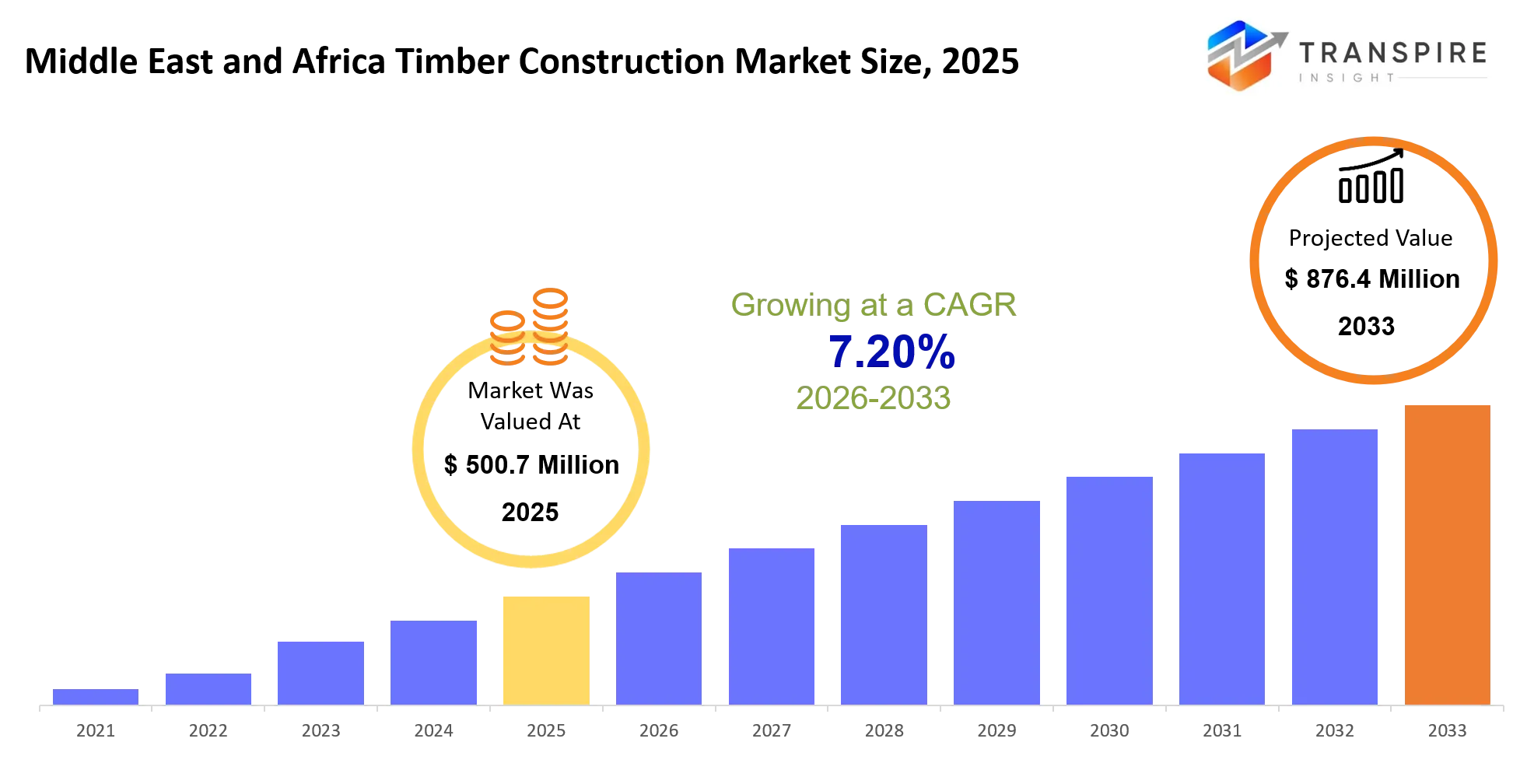
Middle East and Africa Timber Construction Market Size & Forecast:
- Middle East and Africa Timber Construction Market Size 2025: USD 500.7 Million
- Middle East and Africa Timber Construction Market Size 2033: USD 876.4 Million
- Middle East and Africa Timber Construction Market CAGR: 7.20%
- Middle East and Africa Timber Construction Market Segments: By Construction Type (Residential Buildings, Commercial Buildings, Industrial Buildings, Institutional Buildings, Others); By Material Type (Cross Laminated Timber, Glulam, Laminated Veneer Lumber, Sawn Timber, Others); By Application (Structural Framework, Roofing, Flooring, Interior Design, Others); By End User (Construction Companies, Developers, Government Projects, Others)
To learn more about this report,  Download Free Sample Report
Middle East and Africa Timber Construction Market Summary
The Middle East and Africa Timber Construction Market was valued at USD 500.7 Million in 2025. It is forecast to reach USD 876.4 Million by 2033. That is a CAGR of 7.20% over the period.
In the timber construction market , there is a big part to play in bringing faster, lighter, and lower carbon building solutions for residential , commercial , educational, and industrial projects all across the Middle East and Africa. When developers lean on engineered wood products like cross laminated timber (CLT) , glued laminated timber, or laminated veneer lumber, they can shave off construction timeframes , trim structural loads, and raise overall sustainability, while still keeping performance levels pretty steady.
In the last five years, the market has kind of realigned, toward mass timber and prefab construction systems, more than before, you know.Governments, developers, and investors have started to fold carbon reduction goals into building plans, so the engineered wood options get a wider push. At the same time , supply chain issues, plus sudden hikes in steel and cement pricing after global logistics disruptions, made many teams look for other construction materials. Because of this, many project developers have begun using timber systems to gain better cost control and to shorten delivery schedules. Overall, this shift is opening up fresh revenue avenues for manufacturers while also taking timber construction beyond the usual low-rise segment, and into offices, schools, institutional spaces , and mixed-use developments
Key Market Insights
- The Middle East and Africa Timber Construction Market is expected to grow from USD 500.7 million in 2025 to USD 876.4 million by 2033, give or take.
- In the Gulf states, nearly 40% of the regional revenue comes in, mainly because of big commercial and mixed-use developments happening at scale, all the time.
- Engineered wood products are really leading the pack , with about 45% share, largely due to structural strength and faster on-site work, which developers like a lot.
- Cross-laminated timber is the quickest moving product category, and it’s projected to keep climbing above 8% through 2033.
- When it comes to demand, commercial construction still brings in over 35% of the total market needs, since builders push hard for quick delivery schedules.
- For the residential side it remains the second-largest portion, backed by urban housing projects across Saudi Arabia, the UAE and South Africa.
- Also, educational plus institutional buildings are starting to show high-growth momentum. That’s mostly tied to sustainability oriented procurement policies.
- More and more, larger developers lean toward prefabricated timber systems , which can cut down on-site labor by as much as 30%.
- On top of that, digital design tools and Building Information Modeling are helping teams get the timber projects right, improving accuracy and lowering material waste overall.
- Companies such as Stora Enso, Binderholz, KLH Massivholz, Mayr-Melnhof Holz, and West Fraser are putting money into product innovation, prefabrication abilities, and wider regional expansion strategies.
What are the Key Drivers, Restraints, and Opportunities in the Middle East and Africa Timber Construction Market?
Market growth is largely driven by the movement toward low-carbon building , but also by the demand for quicker project delivery. In practice, Governments and big developers are starting to fold embodied carbon targets directly into procurement rules, especially for large urban developments, sometimes as a kind of baseline requirement. And at the same time, engineered timber components can be made off-site ahead of schedule, then assembled relatively quickly on location which can shave construction timelines by weeks or even a few months. So you end up with this dual effect , sustainability compliance plus earlier handover… and that tends to strengthen project economics while pushing adoption in commercial and institutional projects.
The biggest drag point , though, is the regional supply chain for engineered wood products, because it’s still not fully developed in many areas. A lot of high performance timber systems continue to depend on imported feedstocks and specialized manufacturing capacity that sits beyond the region. To build local production, you usually need serious capital funding, real technical knowhow, certification mechanisms, and access to sustainable forestry resources. All of that becomes a cluster of structural issues , which in turn pushes costs up, adds lead time, and generally makes market penetration slower, particularly in projects that are sensitive to price.
Now for the opportunity, mass timber could slot in very well with large scale smart city initiatives and mixed use developments. For example Saudi Arabia and the United Arab Emirates are putting billions into next-generation urban infrastructure, and they’re treating carbon outcomes and build efficiency as key scoring criteria. As the regulations get clearer, and as design knowhow keeps expanding, engineered timber solutions could turn into the go-to selection for schools, offices, hotels, and public facilities, basically creating a new growth pathway that could run strongly through 2033.
What Has the Impact of Artificial Intelligence Been on the Middle East and Africa Timber Construction Market?
Artificial intelligence is increasingly changing timber construction in a way that feels almost seamless, at least on paper, especially when it comes to design optimization, production planning, and asset management. For example, manufacturers often rely on AI based design software to fine tune structural layouts, cut down on material consumption , and raise load bearing performance before anything gets fabricated. Then machine learning models pore over project specifications plus manufacturing records, aiming to reduce waste and make production more efficient.
On the operations side, predictive analytics lets manufacturers guess equipment problems earlier, and that means maintenance can be scheduled before the whole line starts to wobble. In practice, that can lower unplanned downtime, boost production uptime and even nudge factory utilization upward. There is also AI driven Building Information Modeling platforms, which support more precise project scheduling. So contractors can align prefabricated timber deliveries with what’s happening on site, and (this part matters) reduce those expensive delays that show up out of nowhere.
Beyond that, more advanced digital technologies support quality control through automated inspection systems. These systems catch defects in engineered wood panels before shipment, which helps keep outcomes consistent and can reduce rework costs. Some manufacturers even claim material savings in the range of 10% to 15%, mostly from optimized cutting patterns mixed with smarter production planning.
Still, adoption isn’t exactly effortless. High implementation costs and the lack of locally relevant operational data keep getting in the way. A lot of timber construction projects in emerging markets don’t have the historical datasets needed to properly train advanced predictive models. As a result, deployment tends to move slowly, and smaller manufacturers often see a weaker immediate return on investment.
Key Market Trends
- Since 2021, it seems like cross-laminated timber adoption has been rising, as some developers look for a faster build and also lower structural weight, kinda at the same time.
- Prefabricated timber systems now end up cutting construction schedules around 20% to 30% compared to conventional methods, not always perfectly consistently but usually close.
- Commercial buildings have started to overtake a few traditional applications as developers chase carbon-efficient construction strategies, and it shows in a lot of tenders.
- Between 2022 and 2025, engineered wood use expanded across education, healthcare, and hospitality infrastructure projects, more or less everywhere people can see.
- By 2025, Digital Building Information Modeling adoption is reported to be above 60% among major timber engineering firms.
- Manufacturers are increasingly giving turnkey design-to-installation services instead of just supplying standalone material, which saves time but also changes responsibilities.
- Strategic partnerships between timber producers and construction companies helped speed up regional market penetration after 2023, at least that’s how it’s been described in multiple reports.
- Carbon accounting rules have nudged procurement decisions toward lower-embodied-carbon building materials, so the “cheapest” option is less straightforward now.
- Big urban developments in Saudi Arabia and the UAE are increasingly judging mass timber next to steel and concrete systems.
- Companies like Stora Enso, Binderholz, and KLH Massivholz expanded investment in prefabricated and modular timber solutions during 2025–2026, and it wasn’t small either.
Middle East and Africa Timber Construction Market Segmentation
By Construction Type
The construction type segment kind of mirrors the wide spectrum of building work that uses timber-based structural and architectural solutions. In particular residential buildings hold a meaningful chunk, because there is this growing curiosity about quick construction methods, lower structural load, and better energy behavior. Timber systems back up efficient housing development, and they also let builders keep an eye on schedules and material usage in a more practical way, most times.
Commercial buildings keep moving forward too, since offices, retail zones, and mixed-use setups are increasingly pulling in engineered wood for contemporary building plans. Industrial buildings also get solid value from timber use in warehouses , production sites, and storage structures, where prefabricated components speed up the actual setup. Institutional buildings remain pretty steady across schools, healthcare centers, and public infrastructure projects that want sustainability baked into the build process. The “others” group can cover recreation venues, hospitality assignments, and special purpose structures, designed to handle unusual architectural and operational needs.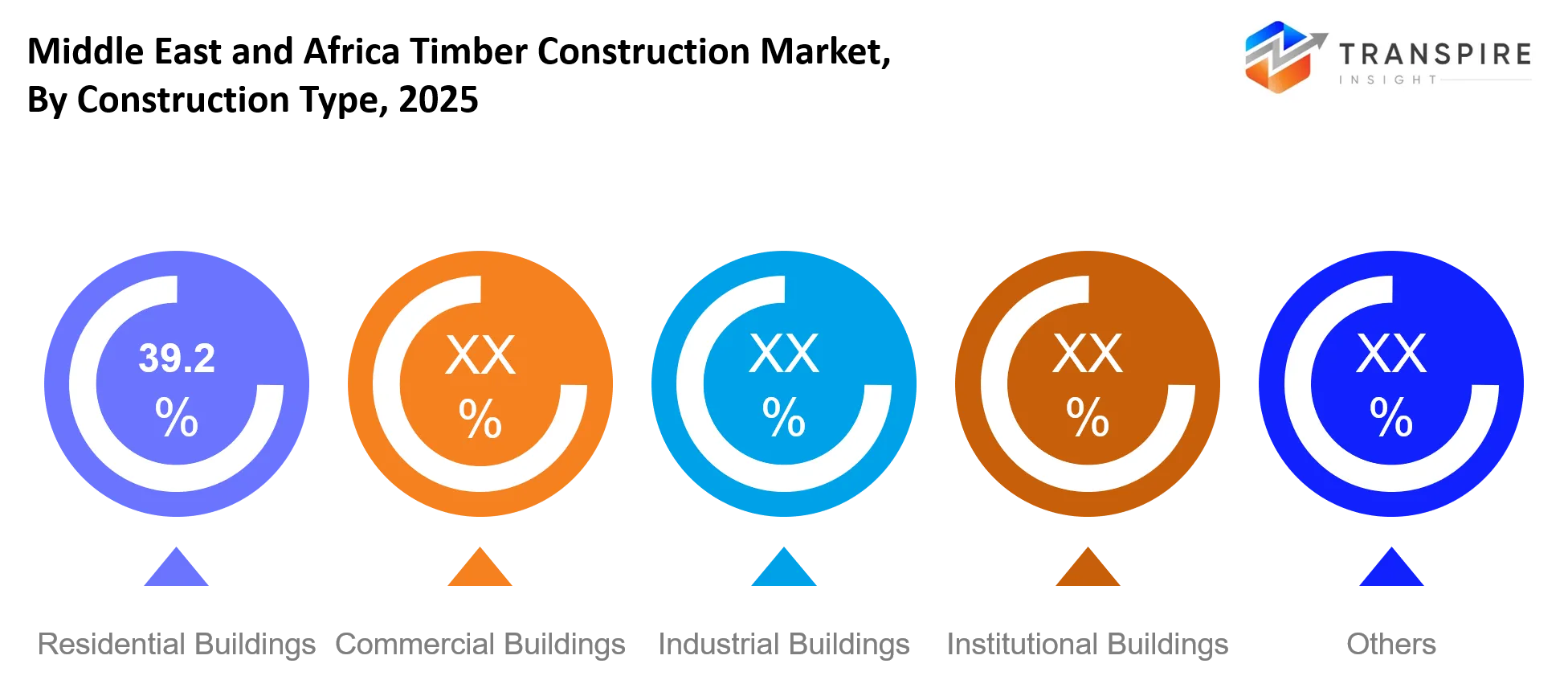
To learn more about this report, Download Free Sample Report
By Material Type
The material type segment kinda points to how engineered wood, and also traditional wood products, get used throughout today’s building work. Cross Laminated Timber is a big deal here, because its strong structural behavior and that steady dimensional stability help it handle bigger building scopes. People keep getting more comfortable with mass timber construction, so the interest and demand keeps climbing for this material, in commercial, also in institutional projects.
Glulam stays pretty common when the job needs long spans, and also that architectural flexibility, so it fits well with intricate structural layouts. Laminated Veneer Lumber is picked for high-strength uses, where consistency matters and load-bearing results have to stay reliable. Sawn Timber keeps showing up on more classic building sites, mainly because it’s widely available, and it feels familiar within construction practices. Others cover newer engineered wood products, made to boost durability, widen design latitude and improve structural efficiency in certain specialized environments where the requirements are a bit more particular.
By Application
The application segment really zooms in on the different ways timber products help building performance, and also construction efficiency in practice. For Structural Framework, it usually takes a big slice of demand, since engineered wood materials bring that needed strength, stability, and frankly a lower overall building weight. With broad adoption across residential, commercial, and institutional projects, the segment keeps moving forward, almost like it doesn’t slow down.
For Roofing applications, the lightweight timber parts make things easier during installation, and they also help with a more efficient load distribution. Flooring is still a key area, because wood-based materials keep delivering durability, that strong aesthetic value, and lots of design flexibility for multiple building categories. Interior Design applications are also growing, especially via decorative panels, wall systems, and architectural features that improve building appearance, in a very visible way. \
Then there are others that cover specialized uses like stair systems, façade components, and custom structural elements made around project-specific requirements.
By End User
The end user segment is basically the groups responsible for planning, developing, and carrying out timber construction projects. Construction Companies hold a leading share, because the way they execute the work, choose materials, and handle on-site installation, pretty much drives timber adoption throughout building developments. Also the growing use of prefabricated systems keeps nudging demand from this particular group, in a pretty steady way.
Developers then play a major role too, by folding timber solutions into residential, commercial, and mixed-use projects, which are often aimed at improving building efficiency and overall environmental results. Government Projects matter a lot as well, through their investments in schools, public buildings, transportation facilities, and community infrastructure, where sustainability goals increasingly shape purchasing choices. Other players include educational institutions, private organizations, and infrastructure operators, all of them looking for solid and long-lasting construction approaches that match long-term operating needs and broader development ambitions.
What are the Key Use Cases Driving the Middle East and Africa Timber Construction Market?
Commercial structures are the main thing that drives timber construction across the region. Office projects, retail hubs, and mixed use ventures are using engineered wood systems more and more, mostly because they can speed up the build schedule and also align with corporate sustainability goals. In practice, these kinds of projects create solid demand for mass timber parts, and for pre-made structural setups.
Right next door, there are also uses in schools, hospitality, and various institutional sites. Universities, school districts, hotels, and public infrastructure initiatives are bringing in timber elements in order to boost construction speed, and at the same time still satisfy the environmental performance needs. More and more, these groups lean toward modular building methods, so the disturbance on site stays smaller, kinda.
More recently, you see use cases like data centers, smart city efforts, and hybrid timber concrete systems. Developers are weighing engineered timber for specialized facilities, where the lower embodied carbon plus quicker assembly translate into noticeable benefits. And once building codes keep getting updated, these applications are expected to pull stronger commercial momentum during the forecast period.
|
Report Metrics |
Details |
|
Market size value in 2025 |
USD 500.7 Million |
|
Market size value in 2026 |
USD 538.6 Million |
|
Revenue forecast in 2033 |
USD 876.4 Million |
|
Growth rate |
CAGR of 7.20% from 2026 to 2033 |
|
Base year |
2025 |
|
Historical data |
2021 - 2024 |
|
Forecast period |
2026 - 2033 |
|
Report coverage |
Revenue forecast, competitive landscape, growth factors, and trends |
|
Regional scope |
Middle East and Africa (Saudi Arabia, United Arab Emirates, South Africa, Rest of Middle East and Africa) |
|
Key company profiled |
Stora Enso, Binderholz, KLH Massivholz, Mayr-Melnhof Holz, Canfor, West Fraser, UFP Industries, Weyerhaeuser, Sodra, Metsa Group, Setra Group, Hasslacher, Egger, Boise Cascade, Nordic Structures |
|
Customization scope |
Free report customization (country, regional & segment scope). Avail customized purchase options to meet your exact research needs. |
|
Report Segmentation |
By Construction Type (Residential Buildings, Commercial Buildings, Industrial Buildings, Institutional Buildings, Others); By Material Type (Cross Laminated Timber, Glulam, Laminated Veneer Lumber, Sawn Timber, Others); By Application (Structural Framework, Roofing, Flooring, Interior Design, Others); By End User (Construction Companies, Developers, Government Projects, Others) |
Which Regions are Driving the Middle East and Africa Timber Construction Market Growth?
The Gulf Cooperation Council region kind of leads the market, because of a big scale construction pipeline, solid investment capacity, and also these quite ambitious sustainability goals. Saudi Arabia and the United Arab Emirates keep rolling out major city development programs, where they focus on new, inventive building materials. With advanced infrastructure planning plus regulatory rules that really back the process, engineered timber systems are more easily taken up. And on top of that, there’s this growing sort of network—architects , consultants and project developers—who basically make regional leadership feel even stronger.
South Africa shows up as the second-largest contributor, and it’s different from the Gulf market in a few ways, mainly because it already has an established construction sector and a wider industrial base. Instead of leaning only on megaprojects, the momentum comes from steady commercial, residential, and institutional building activity. There’s also local know-how in sustainable building design, which helps market adoption to stick. Plus the demand stays fairly stable, so it becomes an important recurring revenue source for suppliers.
The remainder of Africa is emerging as the fastest-growing region, largely driven by faster urbanization and heavier infrastructure spending. A number of countries have raised their budgets for schools, healthcare facilities, and affordable housing projects, where prefabricated construction methods just feel practical. At the same time, better project financing and upgraded building standards have opened more doors for timber-related solutions. So for investors and newcomers, these developing markets carry meaningful long-term expansion potential roughly between 2026 and 2033.
Who are the Key Players in the Middle East and Africa Timber Construction Market and How Do They Compete?
Competition still feels fairly fragmented , in a way where global engineered wood manufacturers move alongside local distributors and project specialists. What mostly decides it, is technology capability plus product certifications , then manufacturing scale and project support services, kind of the whole bundle. More and more, firms try to win with integrated offerings that tie design backing, engineering know-how, prefabrication, and even logistics management together , so customers don’t have to piece everything themselves.
Stora Enso, for example , stands out with a wide mass timber selection and more advanced prefabricated building systems. They've been leaning harder into circular construction ideas , plus hybrid timber solutions , while also staying committed to engineered wood innovation.
Binderholz leans on vertical integration and broad project delivery support. Their b_project platform provides engineering, production, delivery and installation help , which makes the customer journey feel more streamlined , less messy for the client.
KLH Massivholz concentrates on specialized CLT knowledge and big structural use cases, while Mayr-Melnhof Holz puts a heavier emphasis on high performance engineered wood products for complicated building tasks. At the same time, West Fraser and Canfor lean on wide production networks and reliable raw material access, to keep pushing global expansion and stay competitive across markets.
Company List
- Stora Enso
- Binderholz
- KLH Massivholz
- Mayr-Melnhof Holz
- Canfor
- West Fraser
- UFP Industries
- Weyerhaeuser
- Sodra
- Metsa Group
- Setra Group
- Hasslacher
- Egger
- Boise Cascade
- Nordic Structures
Recent Development News
In June 2026, Stora Enso announced that its Ybbs mill delivered one million cubic meters of cross-laminated timber (CLT). The milestone strengthens supply capacity for global mass timber construction projects and highlights expanding adoption of engineered wood systems.https://www.woodandpanel.com
What Strategic Insights Define the Future of the Middle East and Africa Timber Construction Market?
The market is kinda moving, you know, structurally toward industrialized construction models that are built around prefabrication, engineered wood systems, and carbon-aware project delivery. The most powerful push behind this shift is the increasing embedding of sustainability metrics into procurement decisions, especially for commercial, institutional, and urban development jobs. Over the next five to seven years, timber construction is probably going to grow beyond those small niche uses and end up competing straight with traditional structural materials, in selected building types.
There’s also a quieter kind of risk, more or less hidden, tied to reliance on imported engineered wood products and concentrated manufacturing capacity. If something disrupts global timber supply chains, or if certification frameworks get shuffled, project economics could get squeezed and material availability might turn messy. Meanwhile, smart-city initiatives and big modular construction programs are showing up as a new opportunity, but they still feel underpenetrated across much of the region.
Market players should get into regional partnerships early, strengthen technical certification skills and also build localized prefabrication infrastructure. Firms that can offer an integrated design-to-installation ecosystem will be in a stronger place to grab durable value, as timber construction becomes more of a standard building option across the Middle East and Africa.
Middle East and Africa Timber Construction Market Report Segmentation
By Construction Type
- Residential Buildings
- Commercial Buildings
- Industrial Buildings
- Institutional Buildings
- Others
By Material Type
- Cross Laminated Timber
- Glulam
- Laminated Veneer Lumber
- Sawn Timber
- Others
By Application
- Structural Framework
- Roofing
- Flooring
- Interior Design
- Others
By End User
- Construction Companies
- Developers
- Government Projects
- Others
Frequently Asked Questions
Find quick answers to common questions.
The Expected Middle East and Africa Timber Construction Market size for the Market will be USD 876.4 Million in 2033.
Key Segments for the Middle East and Africa Timber Construction Market are By Construction Type (Residential Buildings, Commercial Buildings, Industrial Buildings, Institutional Buildings, Others); By Material Type (Cross Laminated Timber, Glulam, Laminated Veneer Lumber, Sawn Timber, Others); By Application (Structural Framework, Roofing, Flooring, Interior Design, Others); By End User (Construction Companies, Developers, Government Projects, Others)
Major Middle East and Africa Timber Construction Market Players are Stora Enso, Binderholz, KLH Massivholz, Mayr-Melnhof Holz, Canfor, West Fraser, UFP Industries, Weyerhaeuser, Sodra, Metsa Group, Setra Group, Hasslacher, Egger, Boise Cascade, Nordic Structures.
The Current Middle East and Africa Timber Construction Market size is USD 500.7 Million in 2025.
The Middle East and Africa Timber Construction Market CAGR is 7.20% from 2026 to 2033.
- Stora Enso
- Binderholz
- KLH Massivholz
- Mayr-Melnhof Holz
- Canfor
- West Fraser
- UFP Industries
- Weyerhaeuser
- Sodra
- Metsa Group
- Setra Group
- Hasslacher
- Egger
- Boise Cascade
- Nordic Structures
About the Authors

Kartik bhong
I am Kartik Bhong, a Senior Research Analyst at Transpire Insight, specializing in the Packaging, Manufacturing, and Construction industry. My work focuses on analyzing market trends, emerging technologies, industry regulations, and competitive landscapes to deliver accurate, data-driven insights. I am passionate about transforming complex industry information into clear, practical content that helps businesses, professionals, and decision-makers stay informed and make confident strategic decisions. Through continuous research and a strong commitment to accuracy, I strive to create reliable, well-researched content that reflects the latest developments across these dynamic industries and supports the vision of Transpire Insight in delivering valuable market intelligence.

Chakradhar Khansole
Chakradhar serves as the Research Director at Transpire Insight, bringing over 8 years of experience in technology, innovation, and strategic market intelligence. He specializes in transforming complex market data into actionable business insights that enable organizations to make informed, growth-oriented decisions. Recognized for his strategic vision and analytical expertise, Chakradhar leads high-impact research initiatives, delivering comprehensive market assessments, competitive intelligence, and forward-looking industry analysis.
Recently Published Reports
-
Apr 2026
Handling and Lifting Equipment Market
Handling and Lifting Equipment Market Size, Share & Analysis Report By Product (Cranes and Hoists, Forklifts, Conveyor Systems, Aerial Work Platforms, Others), By Application (E-Commerce, Automotive and Railway, Food and Beverages, Aviation, Others), and Geography (North America, Europe, Asia-Pacific, Middle East and Africa, South and Central America), 2021 - 2031
-
Apr 2026
HVAC Equipment Market
HVAC Equipment Market Size, Share & Analysis Report By Heating Equipment Type (Boilers and Furnaces, Heat Pumps, and Unitary Heaters), By Ventilation Equipment (Air Handling Units, Humidifiers and Dehumidifiers, Air Filters, and Fan Coiling Units), By Air Conditioning Equipment (Unitary Air Conditioners, Room Air Conditioners, Packaged Terminal Air Conditioners, and Chillers), By End User (Commercial, Residential, Industrial, and others), and Geography (North America, Europe, Asia-Pacific, Middle East and Africa, South and Central America), 2021 – 2031
-
Apr 2026
Refrigeration Valves Market
Refrigeration Valves Market Size, Share & Analysis Report By Type (Solenoid Valves, Expansion Valves, Check Valves, Service Valves, Others), By Application (Commercial Refrigeration, Industrial Refrigeration, Transport Refrigeration, Residential Refrigeration, Air Conditioning Systems), By End User (Food and Beverage Industry, Pharmaceutical Industry, HVAC Industry, Chemical Industry, Others), and Geography (North America, Europe, Asia-Pacific, Middle East and Africa, South and Central America), 2021 – 2031
-
Apr 2026
E-Commerce Packaging Materials Market
E-Commerce Packaging Materials Market By Material Type (Corrugated Boxes, Paper & Paperboard, Foam & Cushioning Materials, Plastic Packaging, Flexible Packaging, Protective Packaging, Others), By Product(Primary Packaging, Secondary Packaging, Tertiary Packaging), By Packaging Function (Protective Packaging, Branding & Presentation Packaging, Transit & Logistic Packaging, Sustainable Packaging, Tamper Evidence Packaging), By End-User (Retail & Consumer Goods, Electronic Appliances, Food & Beverages, Healthcare & Pharmaceutical, Fashion & Apparel, Home & Furnishing, Others); By Industry Analysis, Size, Share, Growth, Trends, and Forecasts 2021-2033