

France Wood And Timber Products Market Size & Forecast:
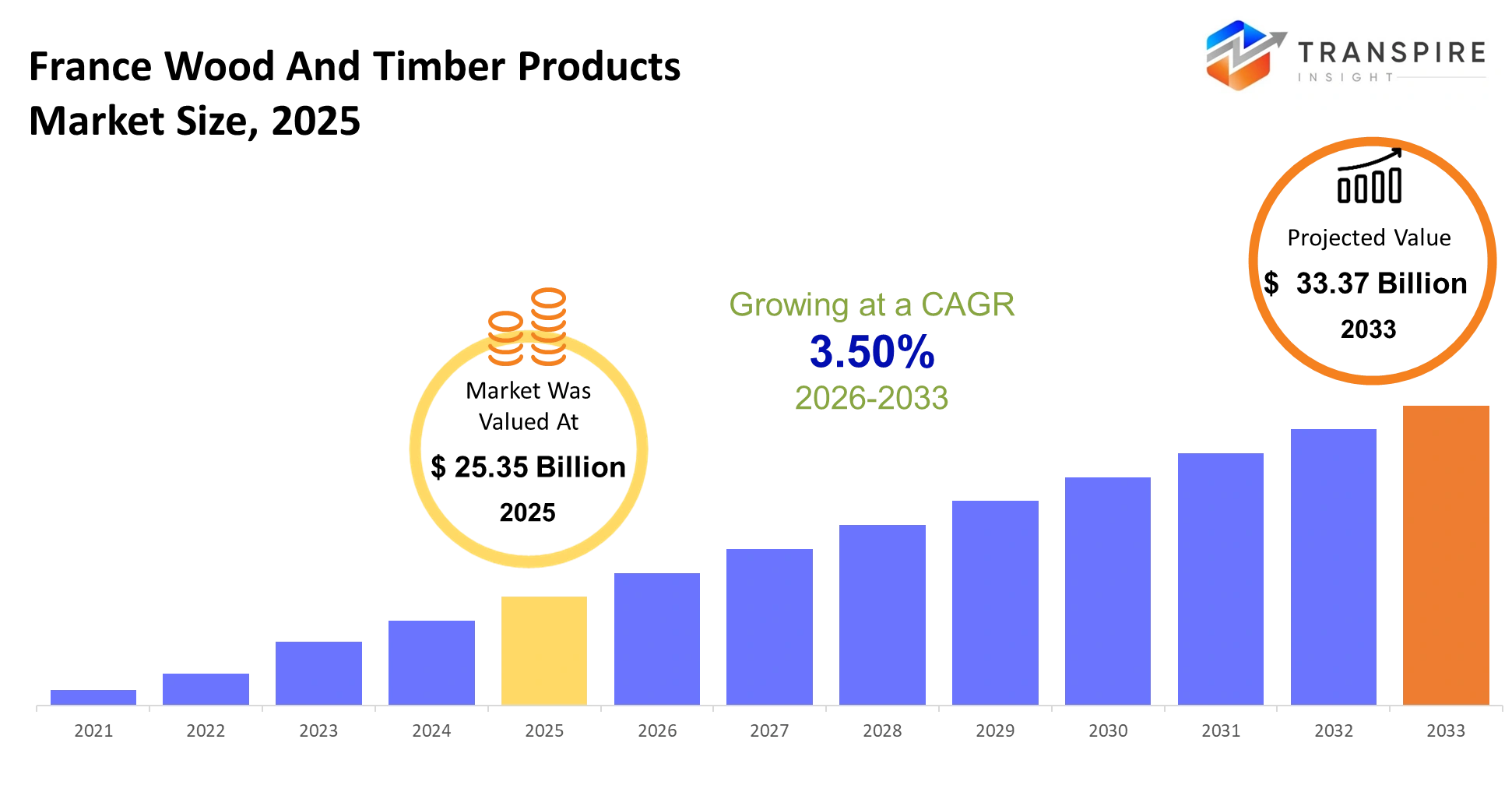
- France Wood And Timber Products Market Size 2025: USD 25.35 Billion
- France Wood And Timber Products Market Size 2033: USD 33.37 Billion
- France Wood And Timber Products Market CAGR: 3.50%
- France Wood And Timber Products Market Segments: By Type (Softwood, Hardwood, Engineered Wood, Others); By Application (Construction, Furniture, Packaging, Flooring, Others); By End-User (Construction Companies, Furniture Manufacturers, Retailers, Industrial Sector, Others); By Product (Lumber, Panels, Veneers, Others)
To learn more about this report,  Download Free Sample Report
France Wood And Timber Products Market Summary
The France Wood And Timber Products Market was valued at USD 25.35 Billion in 2025. It is forecast to reach USD 33.37 Billion by 2033. That is a CAGR of 3.50% over the period.
The France wood and timber products market provides construction materials which include structural timber and processed wood products used in building projects and furniture production and packaging and industrial logistics operations which require pallets and crates. The material serves as essential support for both home building projects and manufacturing operations because it provides essential durability and cost effectiveness and sustainable environmental performance.
The market has experienced a shift toward engineered wood products during the last three to five years because the RE2020 building standards in France now require better carbon performance than previous standards. The Russia-Ukraine conflict created supply disruptions that impacted softwood imports which caused buyers to search for new sources within Europe and establish domestic milling operations. The market pressures pushed companies to replace their traditional products with certified and engineered solutions which helped them achieve better value from timber resources while strengthening their complete supply operations throughout France.
Key Market Insights
- Northern France will contribute 34% of the total market share because of its active building projects and its extensive industrial wood processing operations which exist in the region.
- Between 2025 and 2033 Southern France experiences its most rapid growth because of two factors: residential renovation and infrastructure development required for tourism.
- Île-de-France leads the market for commercial timber because of its ongoing urban redevelopment projects which create new housing requirements.
- Engineered wood products lead the France Wood And Timber Products Market with approximately 38% share in 2025 because of their structural efficiency.
- The second largest market segment after hardwood includes softwood which people commonly use for building frameworks, furniture production and packaging purposes.
- The segment which experiences the most rapid growth at present shows strong market expansion because of its green building certifications and carbon-neutral construction targets.
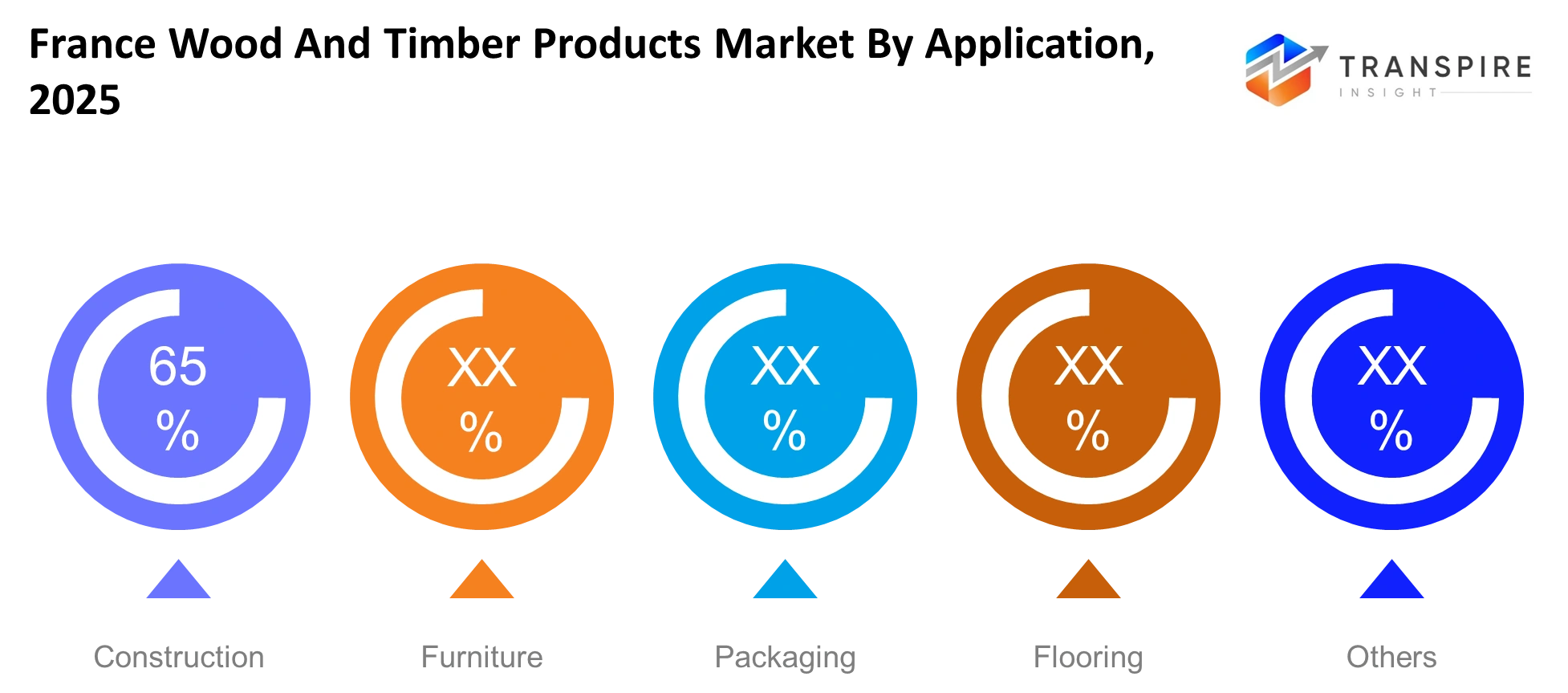
- The construction sector holds the largest market share at 52% which construction housing and infrastructure projects drive.
- The application segment which experiences the most rapid growth in furniture manufacturing supports the increasing need for sustainable and customized wood designs.
- The packaging market is expanding due to two factors: e-commerce logistics and the growth of export-oriented industrial operations.
- The France Wood And Timber Products Market identifies construction companies as its primary customer group which accounts for approximately 45% of the market.
- The industrial sector experiences its most rapid growth because businesses increasingly utilize wood materials for their sustainable packaging and logistics needs.
- Digital forestry tracking and sustainable sourcing investments help businesses improve their market position in the France Wood And Timber Products Market.
- EU supply network regional expansion enables companies to maintain raw material access during times of import fluctuations.
What are the Key Drivers, Restraints, and Opportunities in the France Wood And Timber Products Market?
The current development of The France Wood And Timber Products Market results from three main elements which include regulations that create pressure and limitations on materials that can be supplied and the new industrial practices that determine which materials should be used in construction and manufacturing projects.
The enforcement of France's RE2020 building regulation functions as the main driving force which requires construction materials to have reduced carbon intensity. The policy change has led to developers choosing engineered wood products like cross-laminated timber and glulam beams to replace high-emission concrete and steel in mid-rise residential and public infrastructure projects. The increasing trend of organizations choosing certified timber suppliers results in better financial outcomes for producers who meet regulations and manufacturers who operate their own supply chains.
The industry faces a critical challenge because it continues to rely heavily on imported softwood products which mainly come from Northern and Eastern European countries. The system which delivers essential resources faces major risks from geopolitical conflicts and freight market fluctuations and the temporary resource deficits which occurred after the Russia-Ukraine conflict caused trade and logistics problems. These restrictions create obstacles which make it more difficult to complete projects within their scheduled timeframes and result in unpredictable costs for materials required by construction and furniture manufacturing businesses.
The domestic production of engineered wood products will grow through EU-funded green construction initiatives which provide backing for domestic engineered wood manufacturing facilities. The establishment of automated timber processing facilities in Nouvelle-Aquitaine and other areas will enable companies to boost their operational output while decreasing their dependency on foreign timber resources. This transformation enables France to develop greater self-sufficiency while pursuing high-profit value-added opportunities which exist within The France Wood And Timber Products Market.
What Has the Impact of Artificial Intelligence Been on the France Wood And Timber Products Market?
The France Wood And Timber Products Market experiences gradual transformation through artificial intelligence and advanced digital systems which enhance all aspects of forestry operations and processing units and distribution networks. Modern sawmills implement computer vision systems to perform log scanning which detects internal defects before cutting. Automated grading systems enable sawmills to process logs through advanced grading. AI kiln drying systems create automatic temperature and humidity adjustments. These systems produce consistent wood quality while consuming less energy.
Machine learning models operate throughout saw blade and conveyor and milling machine equipment for predictive maintenance tasks. The systems analyze vibration and wear data to minimize unplanned equipment downtime and extend machinery lifespan while enhancing plant operational stability and uptime. The demand forecasting tools work to match inventory requirements of forestry suppliers and processors and construction clients. These tools help reduce storage costs while enhancing order fulfillment speed throughout the supply chain.
The technologies produce operational benefits which result in higher yield efficiency and reduced processing facility energy consumption and enhanced timber compliance traceability under sustainability standards. The high costs of integration together with the fragmented nature of small and medium-sized wood processors create challenges that hinder technology adoption. The limited digitization of upstream forestry operations prevents accurate AI model development because real-time environmental and logging data collection suffers from incomplete and inconsistent data capture.
Key Market Trends
- The adoption of engineered wood products in France rose more than 30 percent since 2022 because builders shifted away from carbon-intensive materials under RE2020 regulations.
- The import dependency on Russian and Eastern European softwood decreased significantly after 2022, which required companies to seek new timber sources from Nordic and domestic markets.
- The use of cross-laminated timber in urban housing projects increased after 2023 because it enabled construction teams to complete projects more quickly while achieving lower total emissions.
- Digital sawmill automation achieved a processing efficiency increase of almost 20 percent between 2021 and 2025, which resulted in better yield optimization and decreased material waste.
- Demand for certified sustainable timber products increased gradually as developers developed procurement policies that met EU green building certification standards.
- After 2023 furniture manufacturers started using locally produced engineered panels, which resulted in lower transportation expenses and better protection against supply chain interruptions.
- Construction companies started using modular timber systems in their mid-rise building projects, which resulted in faster project completion times and reduced need for workers.
- Renewable energy facilities for wood processing operations expanded throughout France, which resulted in decreased operational emissions and better regulatory compliance performance.
- Stora Enso and Metsä Group expanded their engineered wood supply agreements in France, which intensified market consolidation in the region between international manufacturers.
France Wood And Timber Products Market Segmentation
By Type
The engineered wood segment of France wood and timber products market leads its type-based section because of new carbon emission rules and the growing demand for sustainable building materials. The construction market has expanded this category as builders and developers select between mid-rise residential and public infrastructure projects which show better structural performance and predictable operational results. Softwood maintains a stable market position because it serves essential functions in framing and packaging and general construction with European supply chains providing continuous material access. Hardwood maintains a premium position but grows at a slower pace due to higher costs and limited supply flexibility while other niche materials serve specialized industrial and decorative uses.
The type segment of the construction market experiences growth because building regulations now require low-carbon construction standards and there is higher demand for prefabricated building systems. Engineered wood benefits most from this shift, as it reduces construction timelines and improves material efficiency compared to traditional timber categories. The new import disruption supply chain changes have prompted businesses to shift toward using processed wood products instead of exporting unprocessed timber. The forecast period will see engineered solutions achieve greater market penetration which will drive manufacturers to develop automated processing plants and certified timber sourcing networks for their operational needs in the French wood and timber products industry.
By Application
The application-based segment of the business exists because construction activities require building materials for their current operations which support ongoing housing projects and infrastructure renovations and urban renewal work. The furniture manufacturing industry serves as an important secondary application because consumers increasingly choose sustainable wood-based interior products which they can customize according to their needs.
E-commerce expansion together with industrial logistics development have made packaging increasingly essential while flooring and other application areas generate consistent but smaller market shares. The primary drivers of this segment include sustainability regulations from governmental authorities and the growing demand from users to obtain materials that can endure use while satisfying environmental protection standards. The construction industry increasingly adopts engineered timber solutions as building material because it helps them achieve their sustainability requirements while furniture manufacturers use certified wood to establish their brand value in high-end markets. The packaging industry has shifted toward using recyclable wood-based products which weigh less because these materials help to enhance distribution operations. The future expansion of the France wood and timber products market will depend on manufacturers' ability to create new products that meet both green building standards and circular economy requirements while urban development projects expand in major metropolitan areas.
To learn more about this report, Download Free Sample Report
By End-User
Construction companies lead the end-user segment because they demand residential housing and commercial buildings and infrastructure modernization projects on an ongoing basis. Furniture manufacturers form an important secondary market because design innovations and sustainable interior product preferences drive their business. Retailers and industrial sectors maintain constant growth through their distribution and packaging consumption while smaller end users show particular demand patterns.
The growth of this segment receives strong support from construction companies which require certified timber sources through their environmental compliance requirements. Furniture manufacturers are increasingly adopting engineered wood inputs to balance cost efficiency with design flexibility. Industrial users are now increasing their use of wood-based packaging because logistics networks are moving toward environmentally friendly materials. The France wood and timber products market will face increasing demand from major institutional buyers which will lead suppliers to create supply agreements and long-term contracts for material and pricing stability.
By Product
The lumber-based product segment exists because lumber is used throughout construction and industrial activities because it can be used for various purposes and is easy to obtain. Furniture and interior design applications prefer panels as their main material choice but veneers exist for specific high-value decorative and architectural applications. The other specialized products provide two different functions which include supporting industrial use cases and enabling customization through their specialized design. The market dynamics of this section develop because customers increasingly prefer engineered wood and wood-based products which provide better strength and consistent quality and meet all regulations than they do to raw timber.
The demand for panels increased because modular construction and prefabricated housing systems became more popular. The commercial and residential interior design market continues to drive demand for veneers which create premium decorative designs. The market for France wood and timber products will see growth through value-added processed products because manufacturers need advanced milling and precision cutting systems to achieve higher profit margins.
What are the Key Use Cases Driving the France Wood And Timber Products Market?
The French Wood And Timber Products Market mainly supports construction activities because residential housing development and urban redevelopment and public infrastructure projects continue to drive demand. The market demand specifically targets structural framing and roofing systems and engineered building components because these timber products offer lower carbon emissions and quicker installation times than steel and concrete. The strict RE2020 building regulations require construction materials to demonstrate measurable emissions reduction which leads to increased adoption of sustainable construction materials.
The secondary use cases of furniture manufacturing and industrial packaging continue to grow because furniture producers and logistics operators support this expansion. The growing trend among furniture manufacturers involves using engineered panels and certified hardwood materials to create modular designs that provide customizable sustainable interior design solutions. The industrial sectors that focus on e-commerce and export activities now prefer lightweight recyclable wood-based crates and pallets which help to enhance transport efficiency while decreasing environmental effects.
The construction industry currently explores modular prefabricated housing systems and hybrid timber-concrete systems for its mid-rise building projects. The construction applications currently exist in development but construction companies now show interest because they want to finish projects more efficiently while reducing their need for manpower. The use of engineered wood in commercial retrofitting projects is growing because building owners update their older facilities to meet current energy efficiency and sustainability standards.
|
Report Metrics |
Details |
|
Market size value in 2025 |
USD 25.35 Billion |
|
Market size value in 2026 |
USD 26.22 Billion |
|
Revenue forecast in 2033 |
USD 33.37 Billion |
|
Growth rate |
CAGR of 3.50% from 2026 to 2033 |
|
Base year |
2025 |
|
Historical data |
2021 - 2024 |
|
Forecast period |
2026 - 2033 |
|
Report coverage |
Revenue forecast, competitive landscape, growth factors, and trends |
|
Regional scope |
United States; Canada; Mexico; United Kingdom; Germany; France; Italy; Spain; Denmark; Sweden; Norway; China; Japan; India; Australia; South Korea; Thailand; Brazil; Argentina; South Africa; Saudi Arabia; United Arab Emirates |
|
Key company profiled |
Stora Enso, UPM, West Fraser, Weyerhaeuser, Georgia-Pacific, Canfor, Sappi, Metsä Group, Resolute Forest Products, Norbord, Kronospan, Egger, Boise Cascade, PotlatchDeltic, Interfor |
|
Customization scope |
Free report customization (country, regional & segment scope). Avail customized purchase options to meet your exact research needs. |
|
Report Segmentation |
By Type (Softwood, Hardwood, Engineered Wood, Others); By Application (Construction, Furniture, Packaging, Flooring, Others); By End-User (Construction Companies, Furniture Manufacturers, Retailers, Industrial Sector, Others); By Product (Lumber, Panels, Veneers, Others) |
Which Regions are Driving the France Wood And Timber Products Market Growth?
The wood and timber products market in France receives its main supply from Northern France because of its high construction activities and its established industrial wood processing facilities. The area achieves steady softwood and engineered wood supply through its position near major transportation networks and international shipping routes. The presence of numerous residential and commercial construction sites results from high urban population density in Lille and its metropolitan area. The organization of sawmill facilities and panel production sites together with their distribution centers creates an effective supply chain system that delivers materials required for large projects.
Île-de-France serves as a reliable area for high-value consumption because infrastructure development and commercial space restoration work continue throughout the area. This area uses fewer raw timber resources than Northern France because it supplies high-quality wood products needed for urban construction projects and institutional facilities and high-end interior design. France building regulations require construction projects to use certified wooden products and engineered wood materials which environmental codes maintain through their strict enforcement. The region built its reputation for reliable long-term demand because developers and public authorities have continuously invested in it.
The residential sector and tourism infrastructure and renovation activities all contribute to the rapid development of Southern France which now stands as the fastest-growing region. The timber industry in coastal and inland regions has experienced growth because recent investments improved transport links and modernized housing through new development projects. The transition to sustainable building practices in smaller cities has led to higher adoption of engineered wood systems.
Who are the Key Players in the France Wood And Timber Products Market and How Do They Compete?
The wood and timber products market in France shows moderate market consolidation at its highest level while its mid-sized processors and regional suppliers operate as independent entities. The timber market supplies high-value contracts to major forest and engineered wood companies, which operate their own facilities, while small timber mills use pricing strategies to provide service to their nearby customers. The market competition develops through three main factors which include engineered wood product certification requirements and innovations and supply chain standard performance.
Stora Enso and Metsä Group compete through deep specialization in engineered wood systems and large-scale sustainable forestry integration. Stora Enso establishes itself as a major player in Europe through cross-laminated timber and modular building solutions which support low-carbon construction projects. Metsä Group operates Nordic forestry businesses and high-capacity bioproduct mills which provide them with the ability to deliver consistent supply contracts to French construction and industrial clients. The companies develop their business through European builder partnerships and their construction of automated timber processing plants, which will enhance their production capacity.
Egger and Kronospan strengthen their position through cost-efficient panel production and high-volume industrial output. Egger creates engineered wood panels for furniture and interior design, which his advanced recycling-based production system uses to decrease its need for raw materials. Kronospan establishes market competitiveness through its extensive manufacturing facilities and its multiple production locations, which enable the company to maintain price stability during periods of supply market instability.
Company List
- Stora Enso
- UPM
- West Fraser
- Weyerhaeuser
- Georgia-Pacific
- Canfor
- Sappi
- Metsä Group
- Resolute Forest Products
- Norbord
- Kronospan
- Egger
- Boise Cascade
- PotlatchDeltic
- Interfor
Recent Development News
In February 2026, Stora Enso reported stronger performance in its wood products division for 2025, driven by higher sawn timber prices and improved sales volumes following acquisitions such as Junnikkala. The development reflects improving pricing conditions and consolidation in European timber supply chains, supporting more stable availability for downstream construction and industrial buyers in France.https://www.ttjonline.com
What Strategic Insights Define the Future of the France Wood And Timber Products Market?
The France Wood And Timber Products Market operates through its structural development toward engineered wood systems which offer higher value through certification. The building industry will experience a demand shift from raw timber to prefabricated modular materials during the next 5 to 7 years because national low-emission construction mandates drive builders to use performance-verified materials and institutional investors focus on green-certified assets.
The European supply base today faces an increasing risk because a few integrated producers control most of the European market. The system creates vulnerability to market price changes and supply disruptions which occur when Nordic or Central European production levels change. French builders and manufacturers face restricted operational capabilities because they rely on imported softwood supplies.
The emerging industrialized modular timber housing systems offer a business opportunity for medium-density suburban development. These systems are beginning to gain traction in regional planning projects but remain underpenetrated. Market participants should invest early in integrated engineered wood capacity and digitalized supply chains to secure long-term contracts with construction firms transitioning toward standardized low-carbon building formats within the France wood and timber products market.
France Wood And Timber Products Market Report Segmentation
By Type
- Softwood
- Hardwood
- Engineered Wood
- Others
By Application
- Construction
- Furniture
- Packaging
- Flooring
- Others
By End-User
- Construction Companies
- Furniture Manufacturers
- Retailers
- Industrial Sector
- Others
By Product
- Lumber
- Panels
- Veneers
- Others
Frequently Asked Questions
Find quick answers to common questions.
The confirmed 2033 market size figure in USD 33.37 Billion.
Key segments for the France Wood And Timber Products Market are By Type (Softwood, Hardwood, Engineered Wood, Others); By Application (Construction, Furniture, Packaging, Flooring, Others); By End-User (Construction Companies, Furniture Manufacturers, Retailers, Industrial Sector, Others); By Product (Lumber, Panels, Veneers, Others).
Major France Wood And Timber Products Market players are Stora Enso, UPM, West Fraser, Weyerhaeuser, Georgia-Pacific, Canfor, Sappi, Metsä Group, Resolute Forest Products, Norbord, Kronospan, Egger, Boise Cascade, PotlatchDeltic, Interfor.
The France Wood And Timber Products Market size is USD 25.35 Billion in 2025.
The France Wood And Timber Products Market CAGR is 3.50% from 2026 to 2033.
- Stora Enso
- UPM
- West Fraser
- Weyerhaeuser
- Georgia-Pacific
- Canfor
- Sappi
- Metsä Group
- Resolute Forest Products
- Norbord
- Kronospan
- Egger
- Boise Cascade
- PotlatchDeltic
- Interfor
Recently Published Reports
-
Apr 2026
Healthcare Polymer Packaging Market
Healthcare Polymer Packaging Market Size, Share & Analysis Report By Packaging Type (Syringes, IV Bottles and Pouches, Clamshells, Blisters, Bottles & Jars, Containers, Tubes, IV Parental Packaging, Others), By Type (Regulated, Non-regulated), By Polymer Type (LDPE (Low-Density Polyethylene), HDPE (High-Density Polyethylene), Homo-polymer (Homo), Random Copolymer (Random), Block Copolymer (Block), PET, Polystyrene, Polyvinyl Chloride, Polyamide/EVOH, Others), and Geography (North America, Europe, Asia-Pacific, Middle East and Africa, South and Central America), 2021 - 2031
-
Apr 2026
Hydrophilic Tape (Waterstop) Market
Hydrophilic Tape (Waterstop) Market Size, Share & Analysis Report By Type (Bentonite-Based Hydrophilic Tape, Rubber-Based Hydrophilic Tape), By Application (Residential Buildings, Commercial Buildings, Infrastructure Projects), and Geography (North America, Europe, Asia-Pacific, Middle East and Africa, South and Central America), 2021 - 2031
-
Apr 2026
Metalens Market
Metalens Market Size, Share & Analysis Report By Type (Visible Light Metalens, and Infrared Metalens), By Application (Consumer Electronics, Automotive Electronics, Industrial, Medical, and Others), and Geography (North America, Europe, Asia-Pacific, Middle East and Africa, South and Central America), 2021 - 2031
-
Apr 2026
PBT Resin Market
PBT Resin Market Size, Share & Analysis Report By Type (Reinforced PBT Resin, Unreinforced PBT Resin), By Processing Method (Injection Molding, Extrusion, Blow Molding, Others), By End-User (Automotive, Electrical & Electronics, Consumer Appliances, Industrial Machinery, Medical Devices, Packaging, Others), and Geography (North America, Europe, Asia-Pacific, Middle East and Africa, South and Central America), 2021 - 2031