
United Kingdom Body Temperature Kiosk Market Size & Forecast:
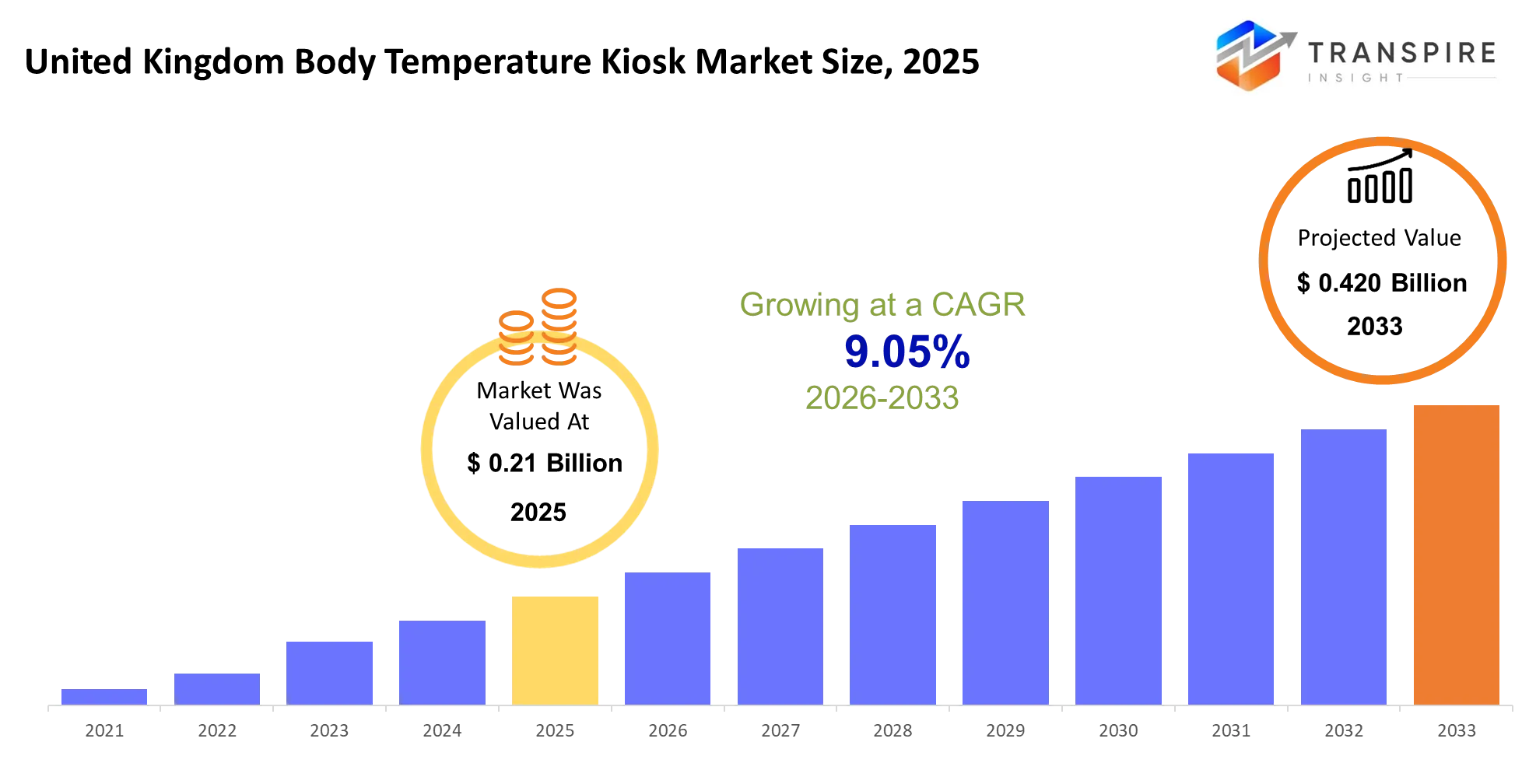
- United Kingdom Body Temperature Kiosk Market Size 2025: USD 0.21 Billion
- United Kingdom Body Temperature Kiosk Market Size 2033: USD 0.420 Billion
- United Kingdom Body Temperature Kiosk Market CAGR: 9.05%
- United Kingdom Body Temperature Kiosk Market Segments: By Product Type (Wall-mounted Kiosks, Standalone Kiosks, Portable Kiosks, AI-enabled Kiosks, Smart Kiosks, Contactless Kiosks, Facial Recognition Kiosks, Others); By Technology (Infrared Temperature Sensors, AI-enabled Thermal Screening, Facial Recognition Integration, IoT-enabled Systems, Cloud Connectivity, Thermal Imaging Systems, Touchless Systems, Others); By Application (Airports, Hospitals, Corporate Offices, Retail Stores, Educational Institutions, Factories, Government Buildings, Others); By End User (Healthcare Sector, Transportation Sector, Retail Sector, Government Institutions, Manufacturing Sector, Hospitality Sector, Education Sector, Others); By Connectivity (Cloud-connected Kiosks, Standalone Systems, IoT-enabled Kiosks, Wi‑Fi Enabled Systems, Bluetooth-enabled Systems, Mobile-integrated Systems, Edge-enabled Systems, Others)
To learn more about this report,  Download Free Sample Report
United Kingdom Body Temperature Kiosk Market Summary
The United Kingdom Body Temperature Kiosk Market was valued at USD 0.21 Billion in 2025. It is forecast to reach USD 0.420 Billion by 2033. That is a CAGR of 9.05% over the period.
The United Kingdom body temperature kiosk market basically works in high traffic places where rapid health screening is, kind of, a must, like hospitals, airports, logistics hubs, manufacturing plants, and also public transport facilities. These kiosks allow operators to spot elevated body temperatures quickly, and still not really slow down employee flow or visitor access, which became extra important in locations that run continuously and must follow strict safety rules all the time.
In the last five years, the market moved away from temporary pandemic-era screening hardware, and it now leans toward integrated access control and workforce management systems. Customers expect thermal screening kiosks to pair with facial recognition, attendance tracking, and building entry platforms, rather than just staying as stand alone devices. The COVID-19 outbreak was the big push, and it drove installations across commercial spaces and public infrastructure, even so the lasting impact looks wider, like more digitization of workplace safety arrangements. As organizations update facility management and automate compliance steps, kiosk vendors are earning money not only from devices, but also from software integration, upkeep agreements, and AI based monitoring features, all together with hardware sales.
Key Market Insights
- England kind of dominates the United Kingdom Body Temperature Kiosk Market, with close to 68% market share in 2025, mostly because the healthcare setup is dense and the transport links are well laid out.
- Scotland looks like the fastest mover through 2030 , pushed forward by smart public infrastructure modernization, plus added healthcare technology spend.
- London keeps a strong position too, for a simple reason: airports, railway hubs, and corporate campuses really do prioritize automated visitor screening systems , more often than not.
- When it comes to applications, healthcare facilities were in front, with nearly 39% market share in 2025. Hospitals need continuous infection-control monitoring , and they also need secure entry management so things stay controlled.
- Transportation and logistics came up as the fastest-growing application segment , since passenger flow monitoring matters, and workforce safety compliance also has to be met.
- On the manufacturing side , plants are increasing kiosk adoption to curb operational interruption , and to automate employee screening during those high-volume shift periods.
- For end users, hospitals and healthcare networks hold the leading slice at around 41% in 2025 within the UK Body Temperature Kiosk Market.
- Corporate offices and commercial complexes are the quicker-growth end-user category, as hybrid workplaces adopt integrated building security technologies.
- And finally, public sector institutions are increasing procurement budgets for smart screening systems that tie into digital access-control platforms.
What are the Key Drivers, Restraints, and Opportunities in the United Kingdom Body Temperature Kiosk Market?
The primary driver within the United Kingdom Body Temperature Kiosk Market is basically the institutional move toward automated infection-control and access governance systems across healthcare as well as transport infrastructure. This change really got traction during the COVID-19 period , when UK hospitals and airports rolled out thermal screening kiosks fast in order to manage entry points under fairly strict safety protocols. Even once the emergency approach eased, a lot of sites kept those setups and then turned them into more connected security checkpoints. So now vendors see a steady income stream from software integration , upkeep services, and multi-function kiosk upgrades rather than relying on one-time hardware sales
One major structural restraint is the restricted precision , plus the inconsistent day-to-day performance, of standalone infrared temperature screening when ambient conditions are changing. This drawback is not something you just fix, since environmental interference, calibration drift, and user-traffic variability all mess with results, independent of further hardware improvements. Therefore procurement teams in public healthcare and transport contexts tend to delay big replacement cycles and they confine deployments to higher-risk entry points only. That slows the full roll-out , and it also tends to dampen revenue growth potential across wider facility networks within the United Kingdom Body Temperature Kiosk Market.
The biggest opportunity seems to sit in the meeting of thermal kiosks, with AI enabled identity checks, and those centralized building management platforms. It is kinda gaining traction inside the more digitally mature hospital trusts and also in smart airport work like the Heathrow modernization programs, where these kiosks are getting tied in with facial recognition, staff rota planning, and real time space use analytics. Then as these setups mature into one combined security infrastructure, the United Kingdom Body Temperature Kiosk Market can move past just being standalone screening units, turning instead into organization wide intelligent entry ecosystems.
What Has the Impact of Artificial Intelligence Been on the United Kingdom Body Temperature Kiosk Market?
Artificial intelligence is getting increasingly built into thermal screening kiosks used across healthcare, transport, and industrial sites in the United Kingdom, so these setups shift from basic temperature scanners into sort of intelligent access-control nodes, not just something that beeps. On the automation side, AI-driven vision systems now handle real-time facial detection, queue flow regulation , and even device self-check diagnostics , cutting down the need for a lot of manual supervision at entry points. At the same time, operators rely on connected control systems to keep an eye on kiosk performance remotely across multiple sites, which improves centralized oversight for workforce screening and visitor access, even when people are not in the same place.
Predictive features are also showing up thanks to machine learning models that spot sensor drift, camera misalignment, and strange temperature readings before anything actually breaks. That in turn supports predictive maintenance scheduling, helping reduce unplanned downtime and prolong hardware lifecycle , especially in high-traffic hospital and airport environments. There’s also a throughput angle: the systems tune scan sensitivity and processing speed using congestion levels as the cue, so traffic doesn’t stall as much.
Operationally, organizations say they see more steady compliance tracking, quicker entry clearance, and reduced staffing demands for front-desk screening roles, all of which adds up to measurable efficiency gains across big facilities.
Still, adoption is held back by the high integration costs with legacy security infrastructure, plus inconsistent data availability across dispersed deployment locations. A lot of facilities also run into interoperability problems when they try to link AI-enabled kiosks with existing identity management and building automation platforms , which then slows down large-scale rollout.
Key Market Trends
- Since 2021 , the majority of deployments have slid away from stand alone temperature kiosks and toward more integrated access control systems, across UK healthcare and also parts of the transport infrastructure networks in general.
- AI enabled facial recognition integration then started moving faster and faster between 2023 and 2026, and in that period over 50% of brand new kiosks had biometric verification modules included, more or less by default.
- After COVID , UK hospitals increased their procurement share quite a bit , and that helped keep adoption steady since infection control workflows became kind of permanent operational norms inside NHS facilities.
- Meanwhile transport hubs like Heathrow, and the larger rail stations as well, pushed out kiosk deployment after 2022, mainly to streamline passenger screening and workforce entry compliance.
- On the other hand, emergency driven procurement dropped sharply after 2023, so vendor income shifted too, from one time hardware sales toward ongoing software and maintenance contracts, which is kinda the bigger pattern now.
- Interoperability issues with legacy security systems also slowed enterprise wide uptake , especially in public hospitals still using older access-control infrastructure.
- Chinese manufacturers, including Hikvision and Dahua, picked up market share by selling cost competitive AI kiosks, and that made competition with Western suppliers feel more intense.
- Finally, cloud connected kiosks with predictive maintenance capabilities helped improve uptime by about 15–20% in large facilities between 2024 and 2026, which is something many operators noticed.
United Kingdom Body Temperature Kiosk Market Segmentation
By Product Type:
Wall mounted kiosks, standalone kiosks, portable kiosks, AI enabled kiosks, smart kiosks, contactless kiosks, facial recognition kiosks, and others: it looks like wall mounted and standalone kiosks still dominate deployment in hospitals and transport hubs, mainly because they’re basically fixed to one entry point. Portable kiosks help with temporary screening needs, like at events or field operations , you know when you need something that can be relocated. Also there was a noticeable shift after 2022 , from basic thermal units to AI enabled and contactless setups, because facilities wanted quicker entry flow and less manual checking.
Facial recognition kiosks and smart kiosks are also getting chosen more often in corporate offices and government buildings. The product evolution seems to lean toward multi-function systems that merge temperature scanning with identity verification, plus automated access control. This kind of approach helps with operational consistency across busy locations, even when the foot traffic gets pretty chaotic.
By Technology:
Infrared temperature sensors, AI enabled thermal screening, facial recognition integration, IoT enabled systems, cloud connectivity, thermal imaging systems, touchless systems, and others: Infrared sensors are still widely used mostly due to their low cost and easy installation, especially in smaller facilities. But adoption has moved more toward AI enabled thermal screening after 2023, since expectations around accuracy went up, particularly in healthcare and transport environments.
IoT enabled and cloud connected systems grew too as organizations tried to centralize monitoring across multiple sites. Meanwhile, thermal imaging and touchless systems have helped improve reliability at crowded entrances , which in turn reduces bottlenecks and speeds up screening in high volume areas.
By Application:
Airports , hospitals, corporate offices , retail stores, educational institutions, factories, government buildings and others: Hospitals stand out as the biggest application area, partly because infection-control keeps needing constant attention and entry screening remains strict. Airports and transport hubs also ramped up their usage after pandemic era protocols stuck around and somehow became part of longer-term security habits.
Corporate offices and factories increased deployment as workforce safety policies shifted, moving toward automated entry systems in practice. Government buildings followed that direction too, adopting kiosks so visitor handling gets smoother and the manual screening burden drops across public facilities, in general.
By End User:
Healthcare sector, transportation sector, retail sector, government institutions, manufacturing sector, hospitality sector, education sector and others: The healthcare sector leads adoption because emergency departments and outpatient areas still rely on structured screening requirements. The transportation sector follows closely, mostly due to large passenger throughput that never really slows down.
Manufacturing and corporate sectors expanded their adoption after 2022 as employee safety monitoring got baked into access control systems. Education and hospitality sectors took kiosks more selectively, mainly for visitor management and controlled access points rather than full coverage everywhere.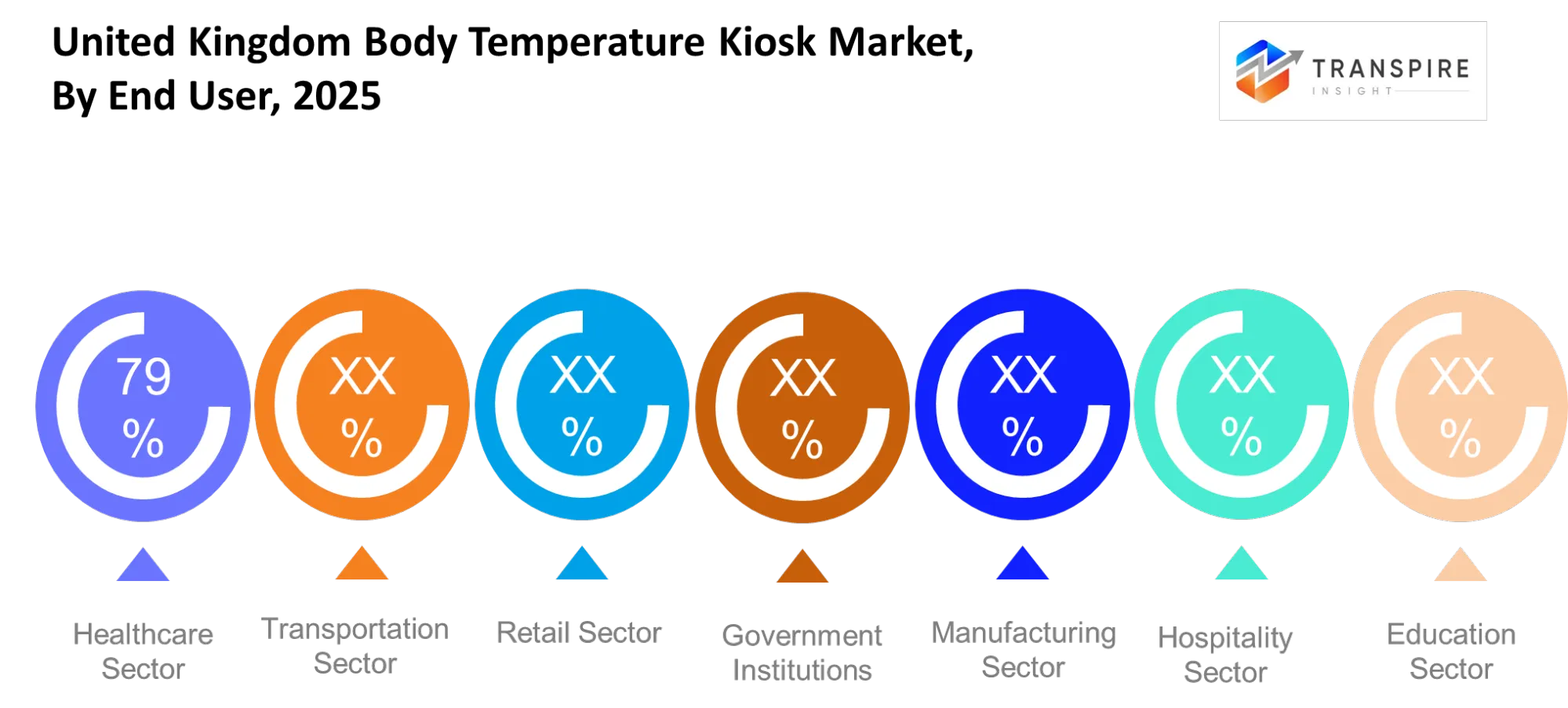
To learn more about this report, Download Free Sample Report
By Connectivity:
Cloud connected kiosks, standalone systems, IoT enabled kiosks, Wi-Fi enabled systems, Bluetooth enabled systems, mobile integrated systems, edge enabled systems, and other variants: Standalone systems were kinda dominant in the early installations, mostly because deployment felt easier and the integration requirements were lower. Still, after 2023 there was a noticeable shift toward cloud connected kiosks and IoT enabled kiosks, kinda like the momentum switched direction, not instantly but steadily.
Cloud connectivity also makes it possible to do centralized monitoring and maintenance across several locations, while edge enabled systems help with faster in the moment processing right at the entry points. Mobile integrated systems meanwhile picked up speed in workplaces that are more flexible, where access control has to adjust, basically dynamic authorization where things can change quickly, depending on who shows up and when.
What are the Key Use Cases Driving the United Kingdom Body Temperature Kiosk Market?
Hospitals and other healthcare facilities remain the main use case for body temperature kiosks in the United Kingdom, because controlled entry screening helps with infection control and overall patient safety protocols, kind of directly. In these places, they need ongoing monitoring at busy entrance points, and that’s what pushes steady rollouts across emergency wards, outpatient departments, and those visitor access corridors.
Then outside healthcare, airports, railway stations, and corporate offices are starting to adopt these systems more, to speed up passenger and employee movement while still meeting security rules. Manufacturing sites too are weaving in kiosks at shift start points to automate workforce temperature checks, and to cut down on the usual manual gate reviews, which helps a lot with daily workflow in big industrial spaces.
Newer use cases are gradually forming in education campuses and government service centers, where regulated visitor entry and digital identity validation matter more day by day. Meanwhile, smart city infrastructure efforts are testing linked kiosk setups with building management platforms, so it looks like adoption may stretch beyond the older security-only environments, not just there.
|
Report Metrics |
Details |
|
Market size value in 2025 |
USD 0.21 Billion |
|
Market size value in 2026 |
USD 0.229 Billion |
|
Revenue forecast in 2033 |
USD 0.420 Billion |
|
Growth rate |
CAGR of 9.05% from 2026 to 2033 |
|
Base year |
2025 |
|
Historical data |
2021 - 2024 |
|
Forecast period |
2026 - 2033 |
|
Report coverage |
Revenue forecast, competitive landscape, growth factors, and trends |
|
Regional scope |
Middle East and Africa (Saudi Arabia, United Arab Emirates, South Africa, Rest of Middle East and Africa) |
|
Key company profiled |
FLIR Systems, Hikvision, Dahua Technology, NEC Corporation, Omron Healthcare, Honeywell, Samsung Electronics, LG Electronics, ZKTeco, Kogniz, Telpo, Sunell, Athena Security, SenseTime, iProov |
|
Customization scope |
Free report customization (country, regional & segment scope). Avail customized purchase options to meet your exact research needs. |
|
Report Segmentation |
By Product Type (Wall-mounted Kiosks, Standalone Kiosks, Portable Kiosks, AI-enabled Kiosks, Smart Kiosks, Contactless Kiosks, Facial Recognition Kiosks, Others); By Technology (Infrared Temperature Sensors, AI-enabled Thermal Screening, Facial Recognition Integration, IoT-enabled Systems, Cloud Connectivity, Thermal Imaging Systems, Touchless Systems, Others); By Application (Airports, Hospitals, Corporate Offices, Retail Stores, Educational Institutions, Factories, Government Buildings, Others); By End User (Healthcare Sector, Transportation Sector, Retail Sector, Government Institutions, Manufacturing Sector, Hospitality Sector, Education Sector, Others); By Connectivity (Cloud-connected Kiosks, Standalone Systems, IoT-enabled Kiosks, Wi‑Fi Enabled Systems, Bluetooth-enabled Systems, Mobile-integrated Systems, Edge-enabled Systems, Others) |
Which Regions are Driving the United Kingdom Body Temperature Kiosk Market Growth?
England is essentially leading the United Kingdom Body Temperature Kiosk Market, mainly because it has a dense cluster of healthcare infrastructure, big transport hubs, and pretty strict public safety protocols. In practice, the NHS hospital networks have already standardized automated screening at entry points , so procurement tends to stay uniform for these kiosks. Also, the high passenger flow at airports like Heathrow and Gatwick really keeps deployment moving. On top of that, there is strong coordination between public health authorities and facility management systems, which helps the technology hang around longer across key infrastructure locations.
Scotland sits as a steady second region, backed by ongoing public healthcare spending and the gradual modernization of both regional hospitals and government facilities. Here, growth feels less powered by constant high-volume transport nodes, and more tied to phased upgrades in rural and semi-urban medical centers. National health programs keep funding consistent , so procurement cycles for screening technologies don’t bounce around much. That overall steadiness makes Scotland a dependable contributor to domestic demand, even if it doesn’t match the intensity scale seen in England.
Wales is showing the fastest growth momentum, and it seems tied to upgrades within healthcare digitization efforts plus higher investment in smart public service buildings. After 2023, new facility modernization projects have encouraged hospitals and administrative centers to adopt automated screening systems. Because the infrastructure base is smaller , the rollout can happen faster than in the bigger regions. For market entrants, Wales works like a favorable expansion zone where pilot deployments can scale relatively quickly into broader statewide procurement during 2026–2033.
Who are the Key Players in the United Kingdom Body Temperature Kiosk Market and How Do They Compete?
Competition in the United Kingdom Body Temperature Kiosk market is kind of moderately fragmented, with big global security firms going head to head against cost focused Asian manufacturers and sometimes, local resellers. Incumbents tend to defend their share by embedding kiosks into integrated access control systems, rather than selling standalone units. New entrants keep pushing price points, using low cost AI thermal devices. So now the race is more about software integration, interoperability, and after sales support across healthcare and transport networks , not just the sensor itself.
Honeywell International concentrates on integrated building security ecosystems, bundling temperature kiosks with enterprise access control platforms that get used in hospitals and airports. They stand out via compliance certification and long term service agreements, which help reduce downtime. FLIR Systems leans on its thermal imaging know how, providing high precision sensors that raise detection accuracy even with the variable UK climate. Axis Communications, meanwhile, highlights edge analytics integration, letting kiosks tie into surveillance infrastructure across transport hubs and corporate campuses.
Hikvision is expanding with cost competitive AI enabled kiosks aimed at public healthcare and transport buyers who want quick deployment, even with tighter budgets. Dahua Technology leans into scalable cloud monitoring tools that support multi site screening visibility for large facility operators. ZKTeco focuses on biometric access control integration, pairing facial recognition kiosks with workforce attendance systems. Overall these players gain traction through bundled hardware and software packages, plus regional distribution arrangements with UK channel integrators .
Company List
- FLIR Systems
- Hikvision
- Dahua Technology
- NEC Corporation
- Omron Healthcare
- Honeywell
- Samsung Electronics
- LG Electronics
- ZKTeco
- Kogniz
- Telpo
- Sunell
- Athena Security
- SenseTime
- iProov
Recent Development News
In May 2026, DNA Payments and OnePlusTwo announced a strategic partnership to expand self-service kiosk and integrated POS solutions across the UK hospitality and retail sector. The collaboration combines secure payment infrastructure with kiosk and ordering systems, strengthening adoption of automated kiosk-based checkout and service technologies in UK SMEs and accelerating deployment of integrated self-service ecosystems.
Source https://ffnews.com/
In April 2026, ClearCourse announced the acquisition of Kurve, a UK-based self-service kiosk and digital ordering technology provider. The acquisition strengthens ClearCourse’s hospitality technology portfolio by integrating kiosk-based ordering systems with payment and EPOS platforms, supporting broader deployment of automated self-service kiosks across UK hospitality venues.Source https://www.kioskmarketplace.com/
What Strategic Insights Define the Future of the United Kingdom Body Temperature Kiosk Market?
The United Kingdom Body Temperature Kiosk Market is sort of drifting toward integrated, software defined access ecosystems, where temperature checks become like a side activity rather than the main thing, inside larger identity and facility management platforms. The key reason behind this move is the push for enterprise wide digitization of building security, where organizations rather want one unified control system, over separate health screening gadgets. In the next 5 to 7 years, most of the demand should gather around AI enabled, cloud connected kiosks that get built into smart infrastructure across healthcare and transport networks.
There is also a less obvious risk, technology replacement, because increasingly capable computer vision tools built into surveillance cameras may start to mimic thermal screening work, without needing a dedicated kiosk for it. If that happens, incremental hardware demand in higher security settings could soften, and vendor margins might get squeezed bit by bit over time.
At the same time, a more promising opportunity is taking shape, tied to interoperability standards in public healthcare modernization programs. NHS linked sites are beginning to favor vendor neutral, API driven access systems, and that creates room for platform focused players who can tuck kiosks into wider digital health infrastructure. Market participants should really pivot from hardware centered selling toward software led subscription and integration offerings, just to keep long term competitiveness from slipping away.
United Kingdom Body Temperature Kiosk Market Report Segmentation
By Product Type
- Wall-mounted Kiosks
- Standalone Kiosks
- Portable Kiosks
- AI-enabled Kiosks
- Smart Kiosks
- Contactless Kiosks
- Facial Recognition Kiosks
By Technology
- Infrared Temperature Sensors
- AI-enabled Thermal Screening
- Facial Recognition Integration
- IoT-enabled Systems
- Cloud Connectivity
- Thermal Imaging Systems
- Touchless Systems
By Application
- Airports
- Hospitals
- Corporate Offices
- Retail Stores
- Educational Institutions
- Factories
- Government Buildings
By End User
- Healthcare Sector
- Transportation Sector
- Retail Sector
- Government Institutions
- Manufacturing Sector
- Hospitality Sector
- Education Sector
By Connectivity
- Cloud-connected Kiosks
- Standalone Systems
- IoT-enabled Kiosks
- Wi‑Fi Enabled Systems
- Bluetooth-enabled Systems
- Mobile-integrated Systems
- Edge-enabled Systems
Frequently Asked Questions
Find quick answers to common questions.
The United Kingdom Body Temperature Kiosk Market size is USD 0.420 Billion in 2033.
Key Segments for the United Kingdom Body Temperature Kiosk Market are By Product Type (Wall-mounted Kiosks, Standalone Kiosks, Portable Kiosks, AI-enabled Kiosks, Smart Kiosks, Contactless Kiosks, Facial Recognition Kiosks, Others); By Technology (Infrared Temperature Sensors, AI-enabled Thermal Screening, Facial Recognition Integration, IoT-enabled Systems, Cloud Connectivity, Thermal Imaging Systems, Touchless Systems, Others); By Application (Airports, Hospitals, Corporate Offices, Retail Stores, Educational Institutions, Factories, Government Buildings, Others); By End User (Healthcare Sector, Transportation Sector, Retail Sector, Government Institutions, Manufacturing Sector, Hospitality Sector, Education Sector, Others); By Connectivity (Cloud-connected Kiosks, Standalone Systems, IoT-enabled Kiosks, Wi‑Fi Enabled Systems, Bluetooth-enabled Systems, Mobile-integrated Systems, Edge-enabled Systems, Others).
Major United Kingdom Body Temperature Kiosk Market Players are FLIR Systems, Hikvision, Dahua Technology, NEC Corporation, Omron Healthcare, Honeywell, Samsung Electronics, LG Electronics, ZKTeco, Kogniz, Telpo, Sunell, Athena Security, SenseTime, iProov.
The Current United Kingdom Body Temperature Kiosk Market size is USD 0.21 Billion in 2025.
The United Kingdom Body Temperature Kiosk Market CAGR is 9.05% from 2026 to 2033.
- FLIR Systems
- Hikvision
- Dahua Technology
- NEC Corporation
- Omron Healthcare
- Honeywell
- Samsung Electronics
- LG Electronics
- ZKTeco
- Kogniz
- Telpo
- Sunell
- Athena Security
- SenseTime
- iProo
Recently Published Reports
-
Apr 2026
Fiber Optic Faceplates Market
Fiber Optic Faceplates Market Size, Share & Analysis Report By Type (< 300 mm2, 300-350 mm2, and > 350 mm2, By Application (Night Vision, Holographic Imaging, Medical, and Others), and Geography (North America, Europe, Asia-Pacific, Middle East and Africa, South and Central America), 2021 - 2031
-
Apr 2026
High Temperature Superconductors Market
High Temperature Superconductors Market Size, Share & Analysis Report By Type (1G HTS, and 2G HTS), By Application (Power Cable, Fault Current Limiter, and Transformer), and Geography (North America, Europe, Asia-Pacific, Middle East and Africa, South and Central America), 2021 - 2031
-
Apr 2026
Industrial Plugs and Socket Market
Industrial Plugs and Socket Market Size, Share & Analysis Report By Type (Industrial Plugs, Industrial Sockets), By Current (Up to 32 A, 32 to 125 A, Above 125 A), By Protection (Dustproof and Splash Proof, Waterproof, Explosion Proof), By End User (Heavy Industries, Oil and Gas, Chemicals and Pharmaceuticals, Power Generation, Others), and Geography (North America, Europe, Asia-Pacific, Middle East and Africa, South and Central America), 2021 - 2031
-
Apr 2026
InGaAs Avalanche Photodiodes Market
InGaAs Avalanche Photodiodes Market Size, Share & Analysis Report By Type (1100 - 1700 nm, and 1000 - 1600 nm), By Application (Missile Warning System, Muzzle Flash Detection, Wafer Defect Inspection, Laser Rangefinders, and Others), and Geography (North America, Europe, Asia-Pacific, Middle East and Africa, South and Central America), 2021 - 2031