

North America Terminal Sterilization Market Size & Forecast:
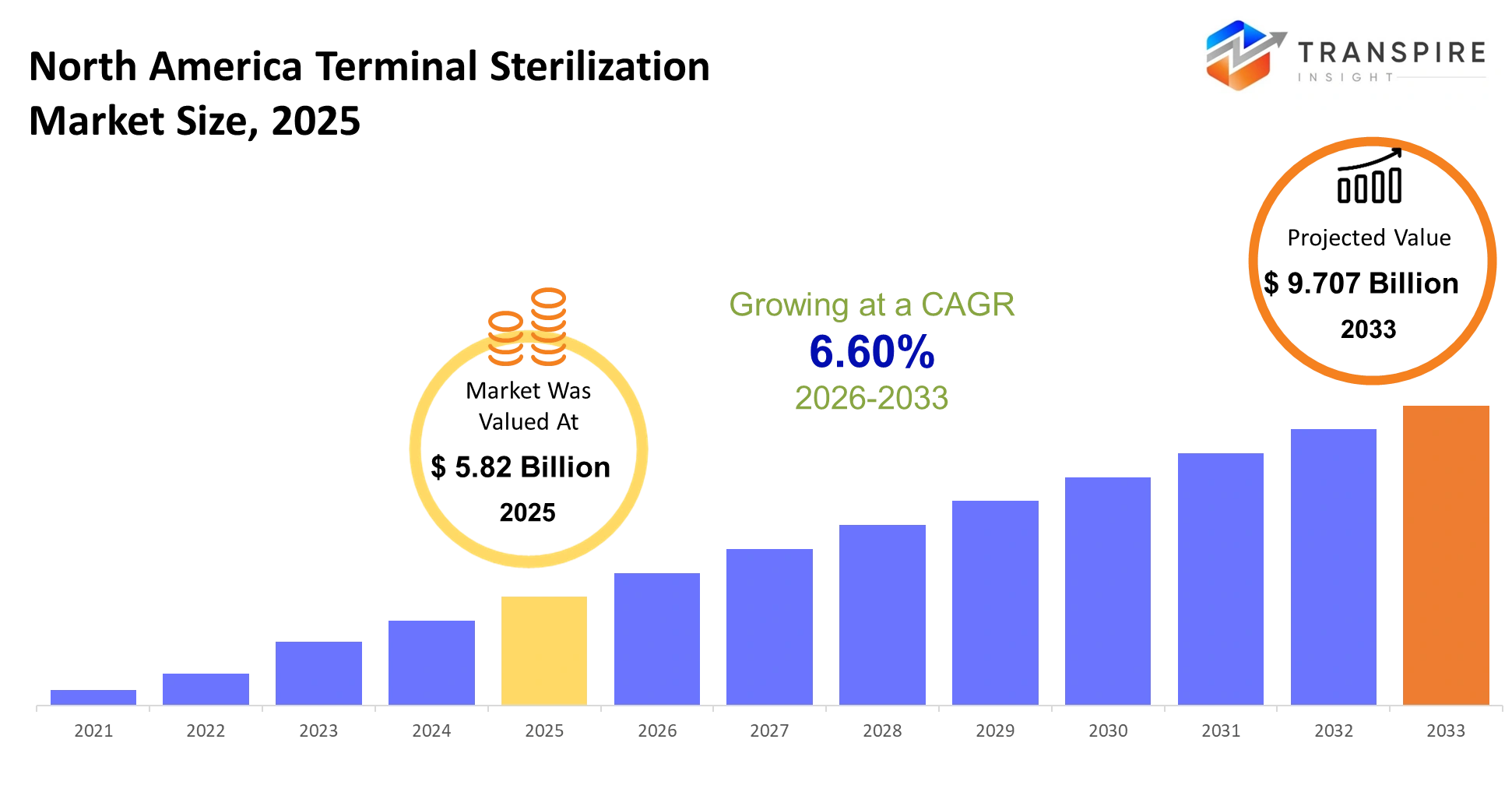
- North America Terminal Sterilization Market Size 2025: USD 5.82 Billion
- North America Terminal Sterilization Market Size 2033: USD 9.707 Billion
- North America Terminal Sterilization Market CAGR: 6.60%
- North America Terminal Sterilization Market Segments: By Type (Radiation Sterilization, Ethylene Oxide, Steam Sterilization, Dry Heat, Others), By Application (Medical Devices, Pharmaceuticals, Packaging, Food, Others), By End-User (Hospitals, Pharma, Medical Device Companies, Others), By Technology (Gamma, Electron Beam, Chemical, Others).
To learn more about this report,  Download Free Sample Report
North America Terminal Sterilization Market Summary:
The North America Terminal Sterilization Market size is estimated at USD 5.82 Billion in 2025 and is anticipated to reach USD 9.707 Billion by 2033, growing at a CAGR of 6.60% from 2026 to 2033.The North America Terminal Sterilization Market has a pretty vital role in making sure pre-packaged medical devices, pharmaceuticals, and biologics stay contamination free after final packaging, so that items arrive at hospitals and surgical centers kind of ready for immediate clinical use. In real life, terminal sterilization lowers infection risk, stretches shelf life, and also helps manufacturers stick to tough regulatory expectations plus supply chain dependability rules across these high-volume healthcare systems.
In the last five years, the market has moved away from being overly centered on conventional ethylene oxide processing toward a more blended set of sterilization platforms like vaporized hydrogen peroxide, electron beam, and some low temperature approaches. That change sped up once scrutiny on ethylene oxide emissions increased , and after temporary facility shutdowns in the United States highlighted how much the healthcare supply chain leaned on a narrow sterilization network. Then the COVID-19 pandemic came along and made the need for resilient, distributed sterilization capacity even stronger. Meanwhile biologics, combination devices, and minimally invasive surgical products have grown more involved, so manufacturers are putting money into specialized sterilization compatibility evaluations as well as outsourced processing relationships. All of this points toward higher value service demand, not just plain volume growth driven by throughput.
Key Market Insights
- North America Terminal Sterilization Market seems to ride on a couple of big things—more pharmaceutical manufacturing capacity, plus tougher contamination control requirements in hospitals, and surgical centers, like really strict stuff.
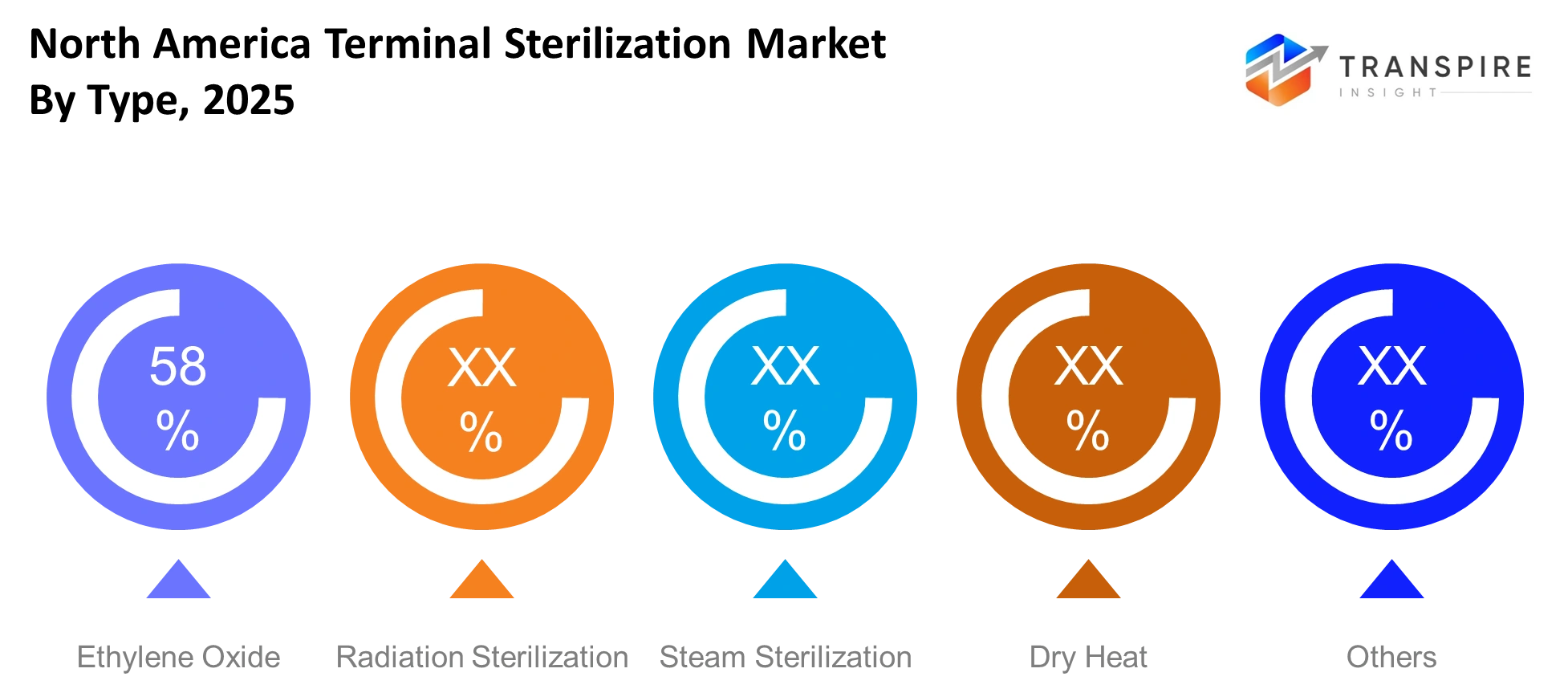
- Ethylene oxide sterilization still mostly leads the market, it’s expected to make up close to 45% market share in 2025, mainly because it works well with many materials and the compatibility runs deep.
- Low-temperature sterilization technologies are the fastest-growing portion through 2032, manufacturers are trying to go with safer methods and also more environmentally compliant processing alternatives, so there’s that push.
- Gamma radiation sterilization holds the second-largest market share, largely supported by its strong penetration in disposable medical devices, and because it fits well with high throughput packaging applications.
- For country dynamics, the United States takes the lead across North America, with more than 82% regional market share in 2025, and that’s tied to advanced healthcare infrastructure, and broad adoption.
- Canada is projected to grow the quickest over the forecast period, mostly due to pharmaceutical investments, and the expansion of contract sterilization facilities.
- When it comes to use cases, medical device sterilization stays in front as the top application segment, bringing in around 58% of total North America Terminal Sterilization Market revenue in 2025.
- Biologics along with combination drug-device products are showing rising demand too, because manufacturers need validated sterilization solutions that stay compatible with delicate therapeutic materials, even when sensitivity is high.
- On end users, hospitals and large healthcare systems take the dominant share, since infection prevention protocols end up directly shaping whether sterilization services get adopted.
- Contract sterilization providers are also growing fast as manufacturers outsource operations to gain scalability, and to improve regulatory compliance efficiency, it’s kind of the practical route for many of them.
What are the Key Drivers, Restraints, and Opportunities in the North America Terminal Sterilization Market?
The strongest force driving the North America Terminal Sterilization Market, seems to be the steady push toward higher value medical device and biologics manufacturing throughout the United States and Canada, and that’s not just a trend it also kind of sticks. After COVID-19 the issue got more visible, because the pandemic showed how fragile sterile supply continuity can get, so many healthcare manufacturers, started localizing production. Meanwhile the FDA validation expectations got stricter, so there’s more pressure to use terminal sterilization processes that still lock in sterility after the final packaging stage. And since minimally invasive surgical devices, prefilled syringes, and combination products are becoming more involved, manufacturers often hand off sterilization to specialized partners that run validated multi-technology platforms. In practice this boosts recurring service revenue, and it tends to stretch long term processing contracts too.
Ethylene oxide regulatory pressure is still the biggest kind of structural obstacle for the market. Environmental compliance rules, emissions monitoring systems, and community pushback, have all slowed down facility expansions while also raising operating costs across North America. Even so, ethylene oxide stays important for sterilizing heat-sensitive materials, which means the industry can’t just swap out existing capacity quickly, without risking disruption across medical device supply chains. So overall this limitation, dampens revenue growth by keeping throughput from scaling up, and by dragging out turnaround times for manufacturers.
Low temperature sterilization approaches show the most obvious “later on” growth path, you know, the long term kind of thing. The investments around vaporized hydrogen peroxide, and also the electron beam setups, are slowly getting more serious momentum as pharmaceutical companies push temperature sensitive biologics and those fancier drug device integrations. A few contract sterilization providers are widening their coverage too, across the Midwest and through the Southeastern United States, mostly where the medical manufacturing hubs keep getting more mature, and kinda clustered.
What Has the Impact of Artificial Intelligence Been on the North America Terminal Sterilization Market?
Artificial intelligence, plus more advanced digital tools, are kind of quietly reshaping terminal sterilization work more and more, mostly because they make process validation feel smoother, they boost equipment dependability, and they improve regulatory traceability. Sterilization providers now, pretty often, lean on AI-enabled control setups to automate chamber cycle monitoring, manage gas concentration levels, balance humidity, and even handle pressure calibration across ethylene oxide and vaporized hydrogen peroxide systems. In the real world this ends up reducing the amount of manual step-in work, and it also assists operators in keeping sharper sterilization margins during those high-volume production runs where every minute is, honestly, pricey.
Machine learning is also appearing for predictive maintenance at radiation sterilization sites, since surprise downtime can spill over into medical device supply chains. These predictive analytics tools sift through temperature fluctuations, valve response tendencies, sensor drift patterns and equipment vibration signals. And yeah, in a bunch of cases, it’s the “early notice” aspect that matters, even when the readings look subtle at first.Then they can flag likely component failures before the actual breakdown moment happens. A handful of larger sterilization operators have described, in a somewhat directional way, better equipment uptime and quicker batch turnaround after adding digital monitoring into daily facility routines. There’s more too—AI-driven analytics can help with emissions forecasting and environmental compliance by tuning ethylene oxide abatement systems and noticing abnormal release patterns in real time.
Still, AI adoption hits a major wall sometimes, because many older sterilization facilities run on a patchwork infrastructure with incompatible data systems. Bringing modern analytics into validated, regulation-heavy settings often involves costly software retrofits, long qualification cycles, and a lot of operator training before a facility can fully use the automation promise.
Key Market Trends
- Since 2021, a bunch of United States ethylene oxide facility shutdowns sort of pushed manufacturers into diversifying sterilization sourcing, across radiation and vaporized hydrogen peroxide, platforms too. And ya know, it wasn’t just a small shift.
- Medical device companies have also been more likely to outsource sterilization operations after pandemic disruptions showed weaknesses in their captive in-house processing setup, especially around batch turnaround reliability, and overall resilience.
- From 2020 to 2025 demand for low-temperature sterilization systems increased pretty fast , mainly because biologics and combination devices turned out to be much more sensitive to heat exposure than people expected at first.
- On top of that , regulatory scrutiny coming from the U.S. Environmental Protection Agency made operators invest heavily in emissions abatement systems and real-time monitoring tech, like seriously.
- Big providers such as Steris plc and Sotera Health, expanded regional processing capacity, with the idea of cutting customer reliance on a few very concentrated sterilization hubs.
- After 2022, AI-enabled process validation tools showed up and helped sterilization operators reduce chamber deviations, and improve batch release consistency across high volume facilities.
- Contract sterilization partnerships also grew, because pharmaceutical manufacturers started prioritizing faster product launches , while trying to reduce capital spending on dedicated sterilization infrastructure.
- Electron beam sterilization adoption strengthened too, mostly since operators were looking for shorter cycle times, and lower residual exposure risk, compared with conventional ethylene oxide processing.
- In Canada, sterilization investments rose after 2023, as pharmaceutical packaging and biologics manufacturing activity expanded across Ontario and Quebec production clusters, all moving in that direction together.
- Healthcare manufacturers sort of shifted their procurement strategies toward multi technology sterilization providers who can handle regulatory compliance, emissions control and also contingency processing when disruptions happen. It’s not only one thing , more like they’re looking for a full spectrum capability across several technologies, and it matters for the whole approvals cycle.
North America Terminal Sterilization Market Segmentation
By Type
Ethylene oxide sterilization is still basically sitting in the top position in the type segment , mostly because it works broadly with heat sensitive medical devices plus various complex polymer materials and also prefilled drug delivery systems . Then there is radiation sterilization, like gamma or electron beam , which follows close behind, since it can push through high volumes pretty efficiently for disposable healthcare items and even packaged surgical supplies . Steam sterilization still keeps a solid foothold in hospital practice, especially when reusable instruments need a quick turnaround and the operating costs stay low .
Dry heat, along with some other sterilization options, ends up taking smaller shares, largely due to limited material compatibility, and processing cycles that tend to run slower.On top of that, regulatory pressure tied to ethylene oxide emissions is already starting to change where people invest , especially in the United States , where operators deal with stricter environmental compliance needs. So, as a result , manufacturers are kind of leaning more and more toward hybrid sterilization portfolios, like mixing chemical methods and radiation approaches into one same overall plan . In the future, the strongest growth is going to likely happen for operators who can handle regulatory compliance, throughput efficiency, and fitment with newer biologics plus minimally invasive medical technologies, all while not taking shortcuts.
To learn more about this report, Download Free Sample Report
By Application
Medical devices are the big application segment, mostly because terminal sterilization is still kind of a must for surgical kits, catheters, implants, and disposable diagnostic products that get sent into big healthcare networks. For pharma it keeps gaining momentum too, since injectable biologics, combo therapies, and prefilled syringes need validated sterile packaging before they move into commercial distribution . Packaging sterilization is also growing, manufacturers are focusing on keeping shelf life more stable and lowering contamination risk while things are in transit and storage.
Food and specialty uses still sit with smaller market participation, partly because industrial uptake is more limited, and the processing limits feel stricter. In medical devices, growth trends tend to follow outpatient surgery expansion and higher procedure volumes across North America. On the pharmaceutical side, sterilization demand is rising faster because biologic treatments need very controlled conditions after packaging is done, sort of post packaging processing environments. Looking ahead, investment will probably cluster around facilities that can handle mixed applications under one unified validation approach, this could make it easier for integrated sterilization service providers to stand out and compete.
By End-User
Hospitals still show up as the biggest end-user bucket , mainly because surgical departments, infection prevention programs, and central sterile processing units need a pretty steady supply of validated sterilization capability. Medical device manufacturers land in the second slot too, since big production runs plus tight regulatory acceptance routes tend to lock them in with contract sterilization providers, it’s almost long-term by default. Pharmaceutical companies are looking like the quickest-growing group, because biologics manufacturing is expanding, along with cell therapies and injectable drug output across the United States and Canada.
Smaller health facilities and research organizations take up a smaller portion overall, not because they never need it, but because lower throughput makes a dedicated outsourcing partnership less urgent. What’s interesting is that hospital demand still leans hard toward rapid turnaround and steady contamination control , while pharma buyers care more about process validation and full traceability. Going forward, the market direction seems to favor deeper, ongoing cooperation between sterilization providers and healthcare manufacturers via multi-year agreements, digital monitoring integration, and even dedicated processing infrastructure built for more sensitive therapeutic products.
By Technology
Gamma sterilization tech keeps sort of leading the whole technology segment, mostly because it has that strong reach in single-use medical devices, and for big scale batch processing stuff too. Then you’ve got electron beam systems, and they're really picking up speed , since some manufacturers want shorter cycle times, less worry about residual exposure, plus better operational flexibility for high-throughput production environments.Chemical sterilization is still there in a pretty meaningful way, especially ethylene oxide, and also vaporized hydrogen peroxide systems. This is because they tend to work well with temperature-sensitive devices, and with those newer advanced polymer materials. Meanwhile, other options like dry heat and ozone-based systems stay in the smaller lane, largely due to limited scale-up potential, and narrower industrial use cases.
What’s also changing is where investment flows. People increasingly back digitally integrated sterilization platforms, with automated monitoring, emissions control, and predictive maintenance features, rather than just basic capacity. As a result, selection of technology is slowly moving away from purely cost driven decisions , toward things like risk mitigation, environmental compliance , and even supply chain resilience.Looking ahead, the competitive edge probably comes from multi-technology processing networks that can handle evolving medical product designs, and keep up with tighter regulatory expectations across North America.
What are the Key Use Cases Driving the North America Terminal Sterilization Market?
Medical device sterilization still stays kind of the main use case powering market adoption through North America. Surgical kits, catheters, implants and disposable diagnostic items, really do need a validated sterilization process after packaging, otherwise they can’t stay compliant with FDA safety expectations. At the same time, you want them to follow hospital infection control routines, like it’s supposed to—no shortcuts, you know. That, well, keeps the whole process running at high volume, continuously.
On the pharma and biologics side, demand is moving up steadily too, especially with injectable drug manufacturers and contract development organizations. Prefilled syringes and these combo drug-device setups are getting more common, plus temperature-sensitive therapies. A lot of that relies on low-temperature sterilization approaches so the product stability survives through commercial shipping and distribution.
Then there are the newer emerging situations, like support for cell therapy packaging, wearable drug delivery systems, and advanced home healthcare devices. Since outpatient treatments are rising, and care is becoming more decentralized, there is a new pull for compact sterilization systems that are very controlled, built for the sensitive next-generation medical products we keep seeing.
|
Report Metrics |
Details |
|
Market size value in 2025 |
USD 5.82 Billion |
|
Market size value in 2026 |
USD 6.204 Billion |
|
Revenue forecast in 2033 |
USD 9.707 Billion |
|
Growth rate |
CAGR of 6.60% from 2026 to 2033 |
|
Base year |
2025 |
|
Historical data |
2021 - 2024 |
|
Forecast period |
2026 - 2033 |
|
Report coverage |
Revenue forecast, competitive landscape, growth factors, and trends |
|
Country scope |
North America (Canada, The United States, and Mexico) |
|
Key company profiled |
Steris, Getinge, 3M, Cantel Medical, Belimed, ASP, Matachana, MMM Group, Tuttnauer, Fedegari, Steelco, Andersen Products, E-BEAM Services, Nordion, Sterigenics |
|
Customization scope |
Free report customization (country, regional & segment scope). Avail customized purchase options to meet your exact research needs. |
|
Report Segmentation |
By Type (Radiation Sterilization, Ethylene Oxide, Steam Sterilization, Dry Heat, Others), By Application (Medical Devices, Pharmaceuticals, Packaging, Food, Others), By End-User (Hospitals, Pharma, Medical Device Companies, Others), By Technology (Gamma, Electron Beam, Chemical, Others) |
Which Regions are Driving the North America Terminal Sterilization Market Growth?
The United States still feels like the dominant regional market, mainly because it has this huge-scale medical device manufacturing base, an advanced pharmaceutical production network , plus very strict FDA sterilization validation standards, you know the kind that leaves little room for error. Strong regulatory enforcement has pushed healthcare manufacturers to depend on pretty specialized terminal sterilization providers, ones that already show proven compliance infrastructure, not just promises. Also the country sort of benefits from a dense ecosystem of contract sterilization facilities, logistics providers, biologics manufacturers , and surgical device companies, kinda clustered across the Midwest and the East Coast. Ongoing investment in emissions control systems and low temperature sterilization technologies keeps strengthening the United States position as the operational center of the regional industry, even when demand swings.
Canada lands as the second-largest regional contributor, but the growth story is a bit different, because expansion there leans more on stable pharmaceutical investment and public healthcare procurement consistency, rather than on large-scale manufacturing volume, if that makes sense. Canadian healthcare systems keep a predictable demand for sterile medical packaging, injectable therapies, and outsourced sterilization services across urban hospital networks. Regulatory alignment with international medical device standards has also nudged multinational sterilization operators to broaden their service capabilities in Ontario and Quebec. This steadier investment setting supports reliable long-term revenue generation , even without the manufacturing scale the United States has.
Mexico is kind of emerging as the fastest growing regional market because there is this rapid build up of medical device assembly, and also nearshoring activity tied to North American healthcare supply chains. In the last few years, global makers were shifting production capacity closer to the United States, to cut down logistics disruptions and to make inventory response more reactive after those pandemic related supply shocks.
You can also see industrial clusters in Baja California and Nuevo León pulling in investments, especially around sterilization infrastructure, linked with export oriented medical manufacturing sites. That whole momentum is making entry opportunities look pretty attractive for contract sterilization providers, automation firms and even equipment suppliers trying to plan long term expansion between 2026 and 2033.
Who are the Key Players in the North America Terminal Sterilization Market and How Do They Compete?
The competitive landscape of the North America Terminal Sterilization Market stays sort of moderately consolidated, large scale sterilization infrastructure, regulatory validation obligations, and environmental compliance costs all make entry barriers feel pretty high. Lately, the fight seems to be less about plain price, and more about technology diversification turnaround dependability, emissions management, and being close, like geographically, to medical manufacturing hubs. The established operators keep protecting their market position using long term customer agreements, plus multi technology processing know-how. Meanwhile smaller players tend to lean into specialized low temperature sterilization platforms for biologics and these advanced drug device type products. Also, the regulatory eye on ethylene oxide emissions has moved the “edge” toward firms that can put money into advanced abatement equipment, and into digitally monitored processing environments, more or less as a standard expectation.
Steris plc stands out with a wide range of offerings, basically contract sterilization services alongside infection prevention products, and it also wraps in integrated compliance support for healthcare manufacturers. They have pushed extra capacity near big United States medical device production corridors, while they are investing a lot in vaporized hydrogen peroxide approaches so they are not so dependent on traditional ethylene oxide work. Sotera Health competes using big gamma and electron beam processing assets, built to handle high volume medical device output. With strong operational scale and a broad geographic spread, they can deliver quicker customer turnaround during those awkward supply chain disruptions and delays.
Getinge AB sort of leans into advanced low- temperature sterilization systems plus digital monitoring tech, tuned for hospitals and pharmaceutical cleanroom setups. It’s basically that kind of specialization that helps them stay well positioned in sensitive biologics, also reusable surgical instrument scenarios where validation exactness matters more than just pushing processing volume. 3M on the other hand keeps its competitive edge with sterilization assurance products, chemical indicators, and process validation tools that slide into everyday hospital and pharmaceutical workflows, you know, without much friction. Andersen Sterilizers aims at a more niche demand curve, for compact ethylene oxide sterilization systems—mostly used by smaller healthcare facilities and laboratory environments. That gives them a bit more flexibility in segments that are often underserved, compared with the big contract sterilization operators.
Company List
- Steris
- Getinge
- 3M
- Cantel Medical
- Belimed
- ASP
- Matachan
- MMM Group
- Tuttnauer
- Fedegari
- Steelco
- Andersen Products
- E-BEAM Services
- Nordion
- Sterigenics
Recent Development News
In May 2026, Sotera Health Reports Strong Q1 2026 Growth and Leadership Transition: Sotera Health announced a 10% year-over-year increase in Q1 2026 revenue, supported by growth in its Sterigenics and Nordion sterilization businesses. The company also confirmed a planned CEO transition while reaffirming its 2026 financial outlook, signaling continued expansion in North America’s terminal sterilization sector.
Source: https://www.globenewswire.com
In May 2026, STERIS Posts Higher Fiscal 2026 Revenue Driven by Sterilization Demand: STERIS reported a 9% increase in full-year fiscal 2026 revenue, reflecting sustained demand for sterilization and infection prevention systems across healthcare and life sciences markets in North America. The company also approved a new $1 billion share repurchase program alongside its earnings release.
Source: https://www.nasdaq.com
What Strategic Insights Define the Future of the North America Terminal Sterilization Market?
The North America Terminal Sterilization Market is kind of structurally moving toward distributed multi technology sterilization networks , meant to help biologics manufacturing, advanced medical devices, and more resilient regional supply chains. What’s really pushing this shift is the healthcare industry backing away from concentrated single-method sterilization reliance after pandemic-era disruptions , plus the added pressure from stricter environmental oversight tied to ethylene oxide emissions. Over the next five to seven years , the competitive edge will depend more and more on low temperature processing know-how, digital validation systems, and being close to pharmaceutical manufacturing hubs across the United States and Mexico.
There’s also a sneaky risk that people don’t always flag early, which is market concentration inside radiation sterilization infrastructure and isotope supply chains. If there’s heavy dependence on cobalt-60 availability , it could easily turn into a bottleneck that limits expansion capacity even when demand keeps rising for gamma based sterilization services. At the same time, some opportunities are showing up around sterilization platforms built for cell therapies, wearable drug delivery systems, and personalized biologics packaging , all of which lean on smaller , more precision controlled processing environments.
Market participants should therefore prioritize investment into modular sterilization facilities with flexible technology integration, rather than just extending single method processing capacity by itself.
North America Terminal Sterilization Market Report Segmentation
By Type
- Radiation Sterilization
- Ethylene Oxide
- Steam Sterilization
- Dry Heat
- Others
By Application
- Medical Devices
- Pharmaceuticals
- Packaging
- Food
- Others
By End-User
- Hospitals
- Pharma
- Medical Device Companies
- Others
By Technology
- Gamma
- Electron Beam
- Chemical
- Others
Frequently Asked Questions
Find quick answers to common questions.
The approximate North America Terminal Sterilization Market size for the market will be USD 9.707 Billion in 2033.
The key segments of the North America Terminal Sterilization Market are By Type (Radiation Sterilization, Ethylene Oxide, Steam Sterilization, Dry Heat, Others), By Application (Medical Devices, Pharmaceuticals, Packaging, Food, Others), By End-User (Hospitals, Pharma, Medical Device Companies, Others), By Technology (Gamma, Electron Beam, Chemical, Others).
Major players in the North America Terminal Sterilization Market are Steris, Getinge, 3M, Cantel Medical, Belimed, ASP, Matachana, MMM Group, Tuttnauer, Fedegari, Steelco, Andersen Products, E-BEAM Services, Nordion, Sterigenics.
The current market size of the North America Terminal Sterilization Market is USD 5.82 Billion in 2025.
The North America Terminal Sterilization Market CAGR is 6.60%.
- Steris
- Getinge
- 3M
- Cantel Medical
- Belimed
- ASP
- Matachan
- MMM Group
- Tuttnauer
- Fedegari
- Steelco
- Andersen Products
- E-BEAM Services
- Nordion
- Sterigenics
Recently Published Reports
-
May 2026
Biosimilars Market
Biosimilars Market By Product Type (Monoclonal Antibodies, Recombinant Hormones, Erythropoietin, G-CSF, Others), By Indication (Oncology, Autoimmune Diseases, Blood Disorders, Diabetes, Others), By Manufacturing Type (In-House Manufacturing, Contract Manufacturing), By Distribution Channel (Hospital Pharmacies, Retail Pharmacies, Online Pharmacies), By Industry Analysis, Size, Share, Growth, Trends, and Forecasts 2021-2033
-
Apr 2026
Gastrointestinal Endoscopy Market
Gastrointestinal Endoscopy Market By Type (Rigid Gastrointestinal Endoscope, Flexible Gastrointestinal Endoscopes, Disposable Gastrointestinal Endoscope), By Procedure Type (Colonoscopy, Gastroscopy, Duodenoscopy, Enteroscopy, Flexible Sigmoidoscopy, Others), By Application (Diagnosis, Treatment), By End-Users (Hospitals, Ambulatory Surgical Centers, Specialty Clinics, Laboratories, Others), By Industry Analysis, Size, Share, Growth, Trends, and Forecasts 2021-2033
-
Apr 2026
Rare Inherited Metabolic Disorder Drug Market
Rare Inherited Metabolic Disorder Drug Market By Drug Class (Enzyme Replacement Drugs, Gene Therapy Drugs, Substrate Reduction Drugs, Small Module Drugs, Protein Drugs), By Route of Administration(Parenteral, Oral, Intrathecal), By Clinical Development (Marketed Drugs, Late Stage Clinical Phase III, Early Stage Clinical Phase I-II, Preclinical Candidates), By Indication (Lysosomal Storage Disorders, Urea Cycle Disorders, Amino Acid Metabolic Disorders, organic Acidemias, Peroximal Disorders), By Industry Analysis, Size, Share, Growth, Trends, and Forecasts 2021-2033
-
Jan 2026
Pharmaceutical Cleanroom Technology Market
Pharmaceutical Cleanroom Technology Market By Product (Equipment, Consumables, Services); By Cleanroom Type (Standard Cleanrooms, Modular Cleanrooms); By End Use (Pharmaceutical Companies, Biotechnology Companies), By Industry Analysis, Size, Share, Growth, Trends, and Forecasts 2021-2033