

United States Animal Hospitals And Veterinary Clinics Market Size & Forecast:
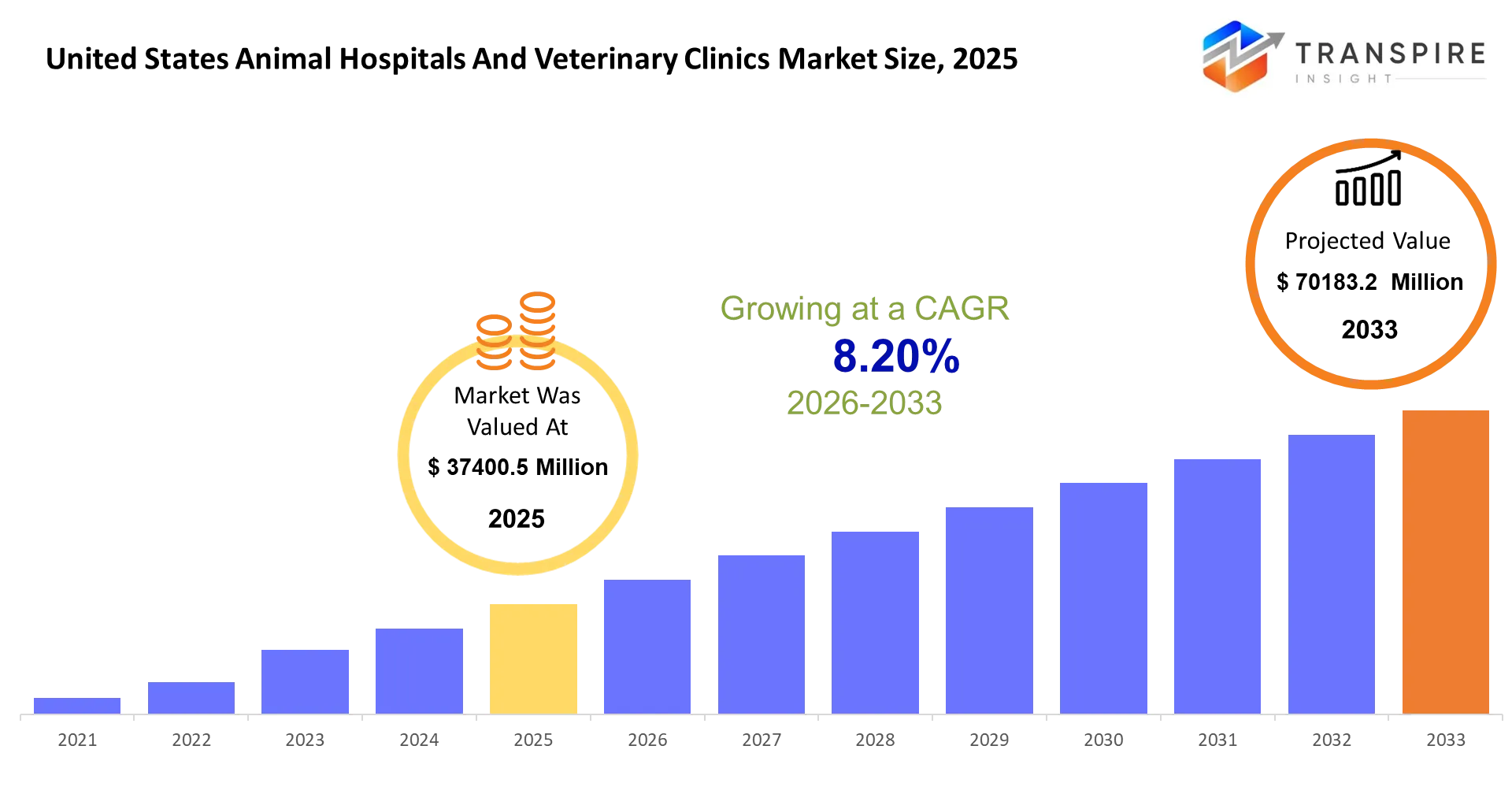
- United States Animal Hospitals And Veterinary Clinics Market Size 2025: USD 37400.5 Million
- United States Animal Hospitals And Veterinary Clinics Market Size 2033: USD 70183.2 Million
- United States Animal Hospitals And Veterinary Clinics Market CAGR: 8.20%
- United States Animal Hospitals And Veterinary Clinics Market Segments: By Service Type (Surgical Services, Diagnostic Services, Preventive Care, Emergency Care, Dental Care, Others); By Animal Type (Companion Animals, Livestock Animals, Exotic Animals, Equine Animals, Others); By Facility Type (Animal Hospitals, Veterinary Clinics, Specialty Veterinary Centers, Mobile Veterinary Services, Others); By End User (Pet Owners, Livestock Farmers, Animal Shelters, Research Institutes, Others)
To learn more about this report,  Download Free Sample Report
United States Animal Hospitals And Veterinary Clinics Market Summary
The United States Animal Hospitals And Veterinary Clinics Market was valued at USD 37400.5 Million in 2025. It is forecast to reach USD 70183.2 Million by 2033. That is a CAGR of 8.20% over the period.
In the United States, the animal hospitals and veterinary clinics market seems to sit right in the middle of how people do pet ownership and also keep livestock health running. You know, these places do a lot more than just treat sick animals, kind of. They handle preventive care plus surgical procedures, they also run diagnostics, keep an eye on long-term conditions, manage urgent emergency care, and coordinate vaccination efforts that protect animal wellbeing and, at the same time, help food supply stay reliable. Over the past five years, the market has moved away from only basic care delivery toward services that lean on tech and specialties. Corporate buyouts and mergers, AI supported diagnostic work, tele-veterinary consultations, and newer imaging systems have really reshaped clinic operations—and what clinics can charge for.
Around the COVID 19 era, one big change kinda showed up, pet adoption climbed fast but staffing shortages made it hard for the clinics to keep up with day to day capacity. That gap between demand and supply made providers reconsider how they run things, so they started leaning into workflow automation, digital booking, and those specialty services that typically create better margins, in order to hold profitability steady. At the same time, inflation pushed up the prices on pharmaceuticals and medical equipment, which then nudged treatment costs higher, a little more each month.So clinics began using subscription wellness plans, and payment models tied to pet insurance. The result is a broader set of recurring revenue streams, and, if it works as intended, stronger client loyalty across companion animal care networks.
Key Market Insights
- The Southern United States kinda dominated the United States Animal Hospitals and Veterinary Clinics market with almost 38% market share in 2025 because of higher pet ownership rates and the sort of demand that follows.
- The Western states are showing the fastest-growing momentum through 2030, backed by premium veterinary spending plus the expansion of specialty animal care infrastructure, like new practice facilities and more targeted services.
- Even so, urban metropolitan areas keep picking up major share too, since multi location veterinary chains are strengthening access to services, and they’re also improving emergency care availability.
- General veterinary services were the biggest piece of the overall industry size landscape, taking in over 45% revenue share in 2025, mostly due to recurring preventive healthcare visits that happen on a regular schedule.
- Surgical services and diagnostic imaging services also captured the second-largest market share as clinics broaden their advanced treatment options, and push more high-margin procedures, along with faster diagnostics.
- Tele-veterinary and remote consultation services are sort of the fastest-growing segment during the forecast period because digital healthcare adoption, and also staffing optimization, keeps speeding things up.
- Companion animal healthcare made up nearly 72% share of the United States Animal Hospitals And Veterinary Clinics Market in 2025, since pet owners spend more on premium care.
- Independent veterinary clinics kept the leading market share in 2025 , mostly owing to solid local client ties and that community-based service delivery approach.
- Corporate veterinary hospital networks are the fastest-growing end-user category through 2030 , driven by acquisition-led strategic expansion across regional markets.
- Specialty animal hospitals gained notable share , as pet owners are increasingly looking for oncology, orthopedics, cardiology, and emergency treatment know-how.
What are the Key Drivers, Restraints, and Opportunities in the United States Animal Hospitals And Veterinary Clinics Market?
The most powerful force pushing the United States Animal Hospitals and Veterinary Clinics Market is that shift toward more advanced care for companion animals, and also the reality that people tend to have a little more discretionary money for pets once the pandemic period kind of cooled off. In practice, veterinary clinics are no longer only doing vaccines and routine checkups, you know. Pet owners now more often agree to higher value interventions, like cancer care, orthopedic surgery, MRI based diagnostics, and ongoing chronic condition management.This whole shift was sort of sparked by the quick ramp up in pet insurance coverage and also financing programs, which in turn reduced those out-of-pocket cost obstacles for the more complicated treatments. So clinics end up making more revenue per individual visit, while specialty hospitals see better margins from broader service portfolios and also from recurring follow-up care.The biggest structural hurdle is pretty direct: a nationwide shortage of licensed veterinarians along with trained veterinary technicians.
Training capacity hasn’t really expanded quickly enough to match the way patient volume keeps growing, and on top of that the burnout levels are still pretty high, especially in emergency plus specialty care spaces. That kind of mismatch , it limits appointment access, it ends up stretching treatment wait periods, and then it drives labor costs upward across the whole industry. Smaller independent clinics often have trouble competing with corporate hospital networks that can offer higher salaries, newer equipment, and broader capabilities, which can stall service growth in underserved regions and delay revenue coming in.
Opportunity: AI enabled diagnostics, and tele-veterinary infrastructure kinda represent the next major growth thing. Veterinary groups are putting money into cloud based imaging analysis, remote consultation platforms and automated workflow systems to boost clinical efficiency, smoother patient flow, you know. In rural regions, and also in secondary cities, there’s more momentum now because digital care models let specialists reach out without needing the full scale hospital build. It is a practical way to extend access, at a lower setup cost.
What Has the Impact of Artificial Intelligence Been on the United States Animal Hospitals And Veterinary Clinics Market?
Artificial intelligence and advanced digital technologies are basically changing how animal hospitals and veterinary clinics work, mostly because they speed up diagnosing, make operations more efficient, and boost the accuracy of patient monitoring. A lot of veterinary networks are now leaning on AI assisted imaging platforms to comb through X-rays, ultrasounds, and CT scans, so clinicians can spot fractures, tumors and cardiac issues quicker than those older, manual review routines. Then there are automated scheduling systems paired with cloud based practice management software, which helps with appointment allocation, billing, inventory tracking, and medical record keeping, so the paperwork load feels lighter and patient flow moves better across multi-location hospital chains.
At the same time machine learning is strengthening predictive care, not just reactive medicine. Clinics and providers use data driven analytics to watch how chronic diseases progress, anticipate surgical complications, and catch the early signals of diabetes arthritis or kidney disease in companion animals. Many teams also adopt wearable pet health devices that sync with mobile applications, and in practice they can track activity levels, heart rate variability, plus recovery patterns in real time. That ends up improving treatment personalization and also follow-up adherence, even when the visit rhythm is tight. Overall these systems reduce the number of emergency admissions, shorten the time it takes to reach a diagnosis, and lift clinic productivity while supporting recurring revenue through preventive care programs.
However, AI adoption still hits some walls , because the cost of integrating everything is high, and the clinical data systems are kinda scattered. Smaller independent clinics often don’t have the capital, nor the standardized datasets needed, to put those advanced diagnostic algorithms to work properly. This becomes even harder across different animal species, and when treatment conditions vary a lot, you know.
Key Market Trends
- Since 2021, corporate consolidators like Mars Veterinary Health and National Veterinary Associates have accelerated acquisitions, kind of reshaping the way independent clinics compete across metro areas , a lot faster than before.
- After 2020, tele-veterinary consultations expanded sharply, and many clinics that already had multiple locations kept those hybrid setups for follow-up care and preventive visits, even if patients only used them “sometimes”.
- From 2022 to 2025, AI-assisted radiology platforms saw broader adoption, so veterinarians could trim diagnostic turnaround windows and also raise imaging precision, in a fairly noticeable way.
- Emergency and specialty hospitals started bumping up their service pricing as early as 2023, mostly because veterinarian shortages stayed pretty stubborn , and pharmaceutical procurement costs kept climbing right behind them.
- Pet insurance enrollment rose steadily after 2021, which then supported higher acceptance rates for orthopedic surgery, oncology care, and the chronic disease management plans you usually see on the long run.
- Veterinary groups also leaned further into subscription based wellness programs over time, creating recurring monthly revenue streams and generally improving long term customer retention, which sounds simple but it matters a whole lot more than people think.
- Meanwhile, independent rural clinics faced more operational pressure as labor costs climbed quicker than patient capacity could expand between 2022 and 2025, it became a squeeze pretty fast.
- Cloud-based practice management systems replaced older software across larger hospital networks , improving appointment coordination, billing automation, and easier access to patient records.
- Wearable pet health monitoring devices came up as a preventive care option after 2023, enabling clinics to watch recovery trajectories and chronic conditions remotely, without waiting for the next appointment.
- Lastly, specialty referral centers expanded aggressively across Southern and Western states , as higher-income pet owners chased advanced diagnostics and minimally invasive procedures, it was not a slow trend, more like a push.
United States Animal Hospitals And Veterinary Clinics Market Segmentation
By Service Type:
Surgical services take up a major share in the United States Animal Hospitals and Veterinary Clinics Market, mostly because demand for treatment keeps rising, for injuries, fractures, tumor removals, and reproductive procedures in pets, but also in livestock animals. More pet adoptions and a growing readiness to spend on advanced medical care keep fueling the need for soft tissue surgeries as well as orthopedic procedures across animal hospitals and those specialty veterinary centers. On top of that, improved surgical equipment, plus better monitoring systems, have made procedure success rates higher.
Diagnostic services keep climbing too, driven by wider use of imaging systems, blood testing, pathology examinations and early disease screening. Preventive care—like vaccination, routine wellness checkups, parasite management, and nutritional direction—still matters a lot for long term animal wellbeing. Emergency care and dental care are getting extra attention as well, since people are more aware about immediate treatment requirements and oral health issues in companion animals. Then there are other types of support, including rehabilitation, grooming help, and teleconsultation, and these things also move market growth forward, bit by bit, even if not everyone notices right away.
By Animal Type:
Companion animals are showing up as the leading chunk of the market, like dogs and cats keep getting more healthcare attention in a lot of urban, and suburban households. People are getting more emotionally bonded to their pets, and they also spend more money on regular checkups, surgeries, vaccinations and chronic disease care. All of that keeps nudging demand upward. At the same time, veterinary clinics and hospitals are stretching into more specialized treatment programs, especially ones designed for older pets and those lifestyle-related health issues.
Livestock animals still matter a great deal too, mainly because disease prevention and productivity management keep becoming more important in cattle, poultry and swine farming. Meanwhile, exotic animals and equine animals basically need a specific kind of veterinary know-how, which helps drive growth for specialty veterinary centers with advanced treatment capabilities. There are also other animal groups, including rescue and rehabilitation animals, and they create additional service demand. This often happens via nonprofit organizations and regional animal care facilities that operate across the country.
To learn more about this report, Download Free Sample Report
By Facility Type:
Animal hospitals make up a big portion of the market, mainly because service is widely available, they have pretty advanced treatment infrastructure, and they can handle complicated medical cases without too much trouble. A lot of hospitals provide surgical procedures, emergency care, diagnostics, rehabilitation, and inpatient monitoring , all in one kind of place. There is also a growing preference for integrated treatment services and more investments in veterinary healthcare infrastructure, this kind of thing keeps pushing the expansion of animal hospitals across the United States.
Veterinary clinics still matter a lot for everyday care and for treatment that’s based in the community, mostly due to affordability, and because people can actually reach them easily. Meanwhile, specialty veterinary centers are steadily growing, since demand is increasing for things like oncology, cardiology, neurology, and orthopedic treatment , for animals. Mobile veterinary services are getting more popular too especially in rural areas and with busy pet owners who want a convenient home based care option. Then there are other kinds of providers like nonprofit shelters and academic veterinary centers, they also support overall market growth.
By End User:
Pet owners basically make up the biggest end user chunk , mostly because healthcare spending on companion animals keeps climbing and people are also getting more aware about preventive care. You see demand getting higher for routine checkups, vaccination programs, emergency aid, and even advanced surgeries among households that keep pets. Plus, more pet insurance plans are showing up along with flexible payment services, so more people end up using veterinary hospitals and clinics all over the country , not just in the main cities.
Livestock farmers are also quite reliant on veterinary services for disease control, breeding assistance, vaccination campaigns and overall productivity gains in farm animals. Animal shelters, on the other hand, need healthcare for rescued and abandoned animals , which means treatment, sterilization, and rehabilitation support. Then there are research institutes that add to the market pull through veterinary care for laboratory animals and continuous animal health studies , often centered on disease prevention, vaccine development, and medical innovation.
What are the Key Use Cases Driving the United States Animal Hospitals And Veterinary Clinics Market?
Companion animal preventive healthcare still seems to be the main thing people use most in animal hospitals and veterinary clinics, like it’s the default, almost always. Routine vaccinations, annual wellness checkups , dental procedures, and chronic disease monitoring end up pulling the highest patient volumes because pet owners are gradually thinking of animals as long-term household dependents, so they are looking for steady, ongoing medical care not just one time visits.
Specialty and emergency care applications are also growing, especially across corporate veterinary hospital networks and referral centers. Orthopedic surgery, oncology treatment, and more advanced diagnostic imaging have really gotten momentum as pet insurance adoption improved, which in turn makes reimbursement access feel more reachable for those high-cost procedures. For livestock, healthcare services have expanded too in commercial farming areas, where producers want disease surveillance, reproductive management, and help that keeps them in regulatory compliance, kinda all in one suite.
Newer use cases are starting to pop up as well, for example AI-assisted diagnostics and remote pet health monitoring via wearable devices that connect back to veterinary platforms. Tele-veterinary follow up care is gaining interest, and so are data-driven preventive treatment programs, with long-term promise , especially in underserved suburban and rural markets where specialist availability is limited and schedules can be tight.
|
Report Metrics |
Details |
|
Market size value in 2025 |
USD 37400.5 Million |
|
Market size value in 2026 |
USD 40430.9 Million |
|
Revenue forecast in 2033 |
USD 70183.2 Million |
|
Growth rate |
CAGR of 8.20% from 2026 to 2033 |
|
Base year |
2025 |
|
Historical data |
2021 - 2024 |
|
Forecast period |
2026 - 2033 |
|
Report coverage |
Revenue forecast, competitive landscape, growth factors, and trends |
|
Geographic scope |
United States of America |
|
Key company profiled |
Mars Veterinary Health, VCA Animal Hospitals, Banfield Pet Hospital, BluePearl Specialty and Emergency Pet Hospital, National Veterinary Associates, Ethos Veterinary Health, Petco Veterinary Services, VetCor, Pathway Vet Alliance, Heartland Veterinary Partners, Southern Veterinary Partners, AmeriVet, Thrive Pet Healthcare, MedVet, VetPartners |
|
Customization scope |
Free report customization (country, regional & segment scope). Avail customized purchase options to meet your exact research needs. |
|
Report Segmentation |
By Service Type (Surgical Services, Diagnostic Services, Preventive Care, Emergency Care, Dental Care, Others); By Animal Type (Companion Animals, Livestock Animals, Exotic Animals, Equine Animals, Others); By Facility Type (Animal Hospitals, Veterinary Clinics, Specialty Veterinary Centers, Mobile Veterinary Services, Others); By End User (Pet Owners, Livestock Farmers, Animal Shelters, Research Institutes, Others) |
Which Regions are Driving the United States Animal Hospitals And Veterinary Clinics Market Growth?
The Southern United States stays, sort of, the top region for animal hospitals and veterinary clinics, mainly because it mixes high pet ownership with a big suburban population base and yeah, more and more livestock operations that need attention. Places like Texas, Florida, and Georgia back pretty dense maps of veterinary hospitals, emergency clinics, and specialty care centers. These networks keep patient flow steady through the whole year, not just in short bursts. On top of that, the region runs with comparatively lower operating expenses than coastal urban markets, so corporate veterinary groups can push expansion faster using acquisitions and multi-site networks. There’s also strong agricultural activity, which keeps boosting demand for livestock care, disease prevention programs, and reproductive veterinary services across commercial farming communities, all the way down to local practices.
Meanwhile, the Midwest looks more like a steadier, diversified driver of market revenue rather than some high growth expansion corridor. Unlike the South, it leans on long standing veterinary infrastructure tied to dairy, poultry, and livestock management, while also backing companion animal healthcare services. The economic durability in farming states like Iowa, Minnesota, and Wisconsin helps keep veterinary spending coming back again and again, even when consumers feel uncertain. Veterinary schools, research institutions, and training hubs throughout the region also create a dependable flow of new professionals.So clinics can keep operating without too much disruption, even while national staffing shortages keep showing up.
The Western United States is kind of emerging as the quickest growing region lately, because there’s this rising demand for premium companion animal healthcare, and also rapid adoption of advanced veterinary technologies. California , Colorado, and Washington saw quite a bit of investment in specialty hospitals , AI-assisted diagnostics, and tele-veterinary platforms after 2022, even as higher income households began spending more on complicated pet treatments. Venture capital funding in digital pet healthcare and wearable monitoring tech also picked up pretty fast, which boosted regional innovation efforts. And all that momentum is now making it a really interesting place for investors and hospital operators who want to expand into specialty services preventive healthcare programs and technology enabled veterinary care models, moving through the 2026–2033 period.
Who are the Key Players in the United States Animal Hospitals And Veterinary Clinics Market and How Do They Compete?
The United States animal hospitals and veterinary clinics market is still kinda moderately fragmented, but after 2020 the consolidation move really sped up, mostly because corporate hospital networks expanded via acquisitions. You can still see independent clinics taking a meaningful chunk of local service delivery, especially in suburban and rural areas, even if it is not as dominant as before. At the same time, bigger operators are increasingly steering the more specialized stuff , like emergency treatment and advanced diagnostics, and also a lot of specialty care.
Competition is also different now because it’s not just price, not really. Veterinary labor shortages and equipment costs really block the ability to run aggressive discounting strategies, so companies lean more into other differentiators. They tend to compete via specialty service depth, digital healthcare integration, broader geographic coverage, and the capability to deliver a steady patient experience across many locations and multi-site networks. In other words, it feels like consistency and access matter more than cheap rates.
Mars Veterinary Health actually strengthened its position with a scale based expansion model, mixing general practice clinics with specialty and emergency hospitals. Their ownership of Banfield Pet Hospital plus BluePearl Specialty and Emergency Pet Hospital helps them keep patients across multiple stages of care, from preventive treatment all the way to advanced surgery, and oncology services too. That integrated referral ecosystem boosts patient retention while also supporting higher revenue per visit. On top of that, the company invests a lot in digital scheduling systems, AI assisted diagnostics, and centralized procurement networks, which helps lower operational costs across its nationwide footprint.
VCA Animal Hospitals kinda stands apart thanks to technology enabled clinical workflows plus big metropolitan coverage, especially in high income city markets. They also went ahead and expanded their specialty referral centers and emergency care facilities, to catch that interest for more advanced procedures, like cardiology, orthopedic surgery , and stuff in that lane. On the other side National Veterinary Associates uses a decentralized acquisition strategy, which keeps the local clinic branding fairly intact, while still offering operational support , staffing resources, and that purchasing scale advantage. In practice this seems to help hold onto community trust while boosting profitability, and it speeds up how fast they can expand into more underserved regional markets.
Company List
- Mars Veterinary Health
- VCA Animal Hospitals
- Banfield Pet Hospital
- BluePearl Specialty and Emergency Pet Hospital
- National Veterinary Associates
- Ethos Veterinary Health
- Petco Veterinary Services
- VetCor
- Pathway Vet Alliance
- Heartland Veterinary Partners
- Southern Veterinary Partners
- AmeriVet
- Thrive Pet Healthcare
- MedVet
- VetPartners
Recent Development News
In April 2026, Chewy announced acquisition of Modern Animal. The deal expanded Chewy’s veterinary footprint from 18 to 47 clinics nationwide and strengthened its integrated pet healthcare ecosystem across in-person care, virtual care, and pharmacy services.
Source https://investor.chewy.com/
In March 2026, Zoetis announced acquisition of Neogen’s animal genomics business for $160 million. The acquisition strengthened Zoetis’ precision animal health capabilities by expanding genomic technologies and predictive care solutions for livestock and companion animals.
Source https://www.nasdaq.com/
What Strategic Insights Define the Future of the United States Animal Hospitals And Veterinary Clinics Market?
The United States animal hospitals and veterinary clinics market is sort of structurally moving toward a hybrid care ecosystem, that kinda blends specialty treatment, preventive healthcare subscriptions, and AI-supported clinical workflows. The underlying force behind this shift is basically how pets are turning into long-term healthcare consumers, and that’s nudging clinics to run more like integrated outpatient medical networks, not standalone service providers, at all. Over the next five to seven years, revenue concentration is likely to increase around multi-location operators who can scale diagnostics, tele-veterinary platforms, and specialist staffing across regional networks too.
One hidden risk is market concentration pressure, from accelerated corporate acquisitions. As independent clinics thin out, larger networks may get regulatory scrutiny about pricing practices, labor conditions, and regional service dominance, especially in urban markets where provider alternatives are kinda limited. At the same time wearable pet monitoring systems and predictive health analytics are an emerging opportunity, but they’re still underpenetrated outside premium metropolitan markets.
Market participants should prioritize investments in technology-enabled preventive care and regional specialty hubs, rather than only leaning on traditional clinic expansion. Operational efficiency and recurring care models will more and more decide long-term profitability, even when growth looks steady on paper.
United States Animal Hospitals And Veterinary Clinics Market Report Segmentation
By Service Type
- Surgical Services
- Diagnostic Services
- Preventive Care
- Emergency Care
- Dental Care
By Animal Type
- Companion Animals
- Livestock Animals
- Exotic Animals
- Equine Animals
By Facility Type
- Animal Hospitals
- Veterinary Clinics
- Specialty Veterinary Centers
- Mobile Veterinary Services
By End User
- Pet Owners
- Livestock Farmers
- Animal Shelters
- Research Institutes
Frequently Asked Questions
Find quick answers to common questions.
The United States Animal Hospitals And Veterinary Clinics Market size is USD 70183.2 Million in 2033.
Key Segments for the United States Animal Hospitals And Veterinary Clinics Market are By Service Type (Surgical Services, Diagnostic Services, Preventive Care, Emergency Care, Dental Care, Others); By Animal Type (Companion Animals, Livestock Animals, Exotic Animals, Equine Animals, Others); By Facility Type (Animal Hospitals, Veterinary Clinics, Specialty Veterinary Centers, Mobile Veterinary Services, Others); By End User (Pet Owners, Livestock Farmers, Animal Shelters, Research Institutes, Others).
Major United States Animal Hospitals And Veterinary Clinics Market players are Mars Veterinary Health, VCA Animal Hospitals, Banfield Pet Hospital, BluePearl Specialty and Emergency Pet Hospital, National Veterinary Associates, Ethos Veterinary Health, Petco Veterinary Services, VetCor, Pathway Vet Alliance, Heartland Veterinary Partners, Southern Veterinary Partners, AmeriVet, Thrive Pet Healthcare, MedVet, VetPartners.
The Current United States Animal Hospitals And Veterinary Clinics Market size is USD 37400.5 Million in 2025.
The United States Animal Hospitals And Veterinary Clinics Market CAGR is 8.20% from 2026 to 2033.
- Mars Veterinary Health
- VCA Animal Hospitals
- Banfield Pet Hospital
- BluePearl Specialty and Emergency Pet Hospital
- National Veterinary Associates
- Ethos Veterinary Health
- Petco Veterinary Services
- VetCor
- Pathway Vet Alliance
- Heartland Veterinary Partners
- Southern Veterinary Partners
- AmeriVet
- Thrive Pet Healthcare
- MedVet
- VetPartners
Recently Published Reports
-
May 2026
Biosimilars Market
Biosimilars Market By Product Type (Monoclonal Antibodies, Recombinant Hormones, Erythropoietin, G-CSF, Others), By Indication (Oncology, Autoimmune Diseases, Blood Disorders, Diabetes, Others), By Manufacturing Type (In-House Manufacturing, Contract Manufacturing), By Distribution Channel (Hospital Pharmacies, Retail Pharmacies, Online Pharmacies), By Industry Analysis, Size, Share, Growth, Trends, and Forecasts 2021-2033
-
Apr 2026
Gastrointestinal Endoscopy Market
Gastrointestinal Endoscopy Market By Type (Rigid Gastrointestinal Endoscope, Flexible Gastrointestinal Endoscopes, Disposable Gastrointestinal Endoscope), By Procedure Type (Colonoscopy, Gastroscopy, Duodenoscopy, Enteroscopy, Flexible Sigmoidoscopy, Others), By Application (Diagnosis, Treatment), By End-Users (Hospitals, Ambulatory Surgical Centers, Specialty Clinics, Laboratories, Others), By Industry Analysis, Size, Share, Growth, Trends, and Forecasts 2021-2033
-
Apr 2026
Rare Inherited Metabolic Disorder Drug Market
Rare Inherited Metabolic Disorder Drug Market By Drug Class (Enzyme Replacement Drugs, Gene Therapy Drugs, Substrate Reduction Drugs, Small Module Drugs, Protein Drugs), By Route of Administration(Parenteral, Oral, Intrathecal), By Clinical Development (Marketed Drugs, Late Stage Clinical Phase III, Early Stage Clinical Phase I-II, Preclinical Candidates), By Indication (Lysosomal Storage Disorders, Urea Cycle Disorders, Amino Acid Metabolic Disorders, organic Acidemias, Peroximal Disorders), By Industry Analysis, Size, Share, Growth, Trends, and Forecasts 2021-2033
-
Jan 2026
Pharmaceutical Cleanroom Technology Market
Pharmaceutical Cleanroom Technology Market By Product (Equipment, Consumables, Services); By Cleanroom Type (Standard Cleanrooms, Modular Cleanrooms); By End Use (Pharmaceutical Companies, Biotechnology Companies), By Industry Analysis, Size, Share, Growth, Trends, and Forecasts 2021-2033