
Europe Medical Cyclotron Market Size & Forecast:
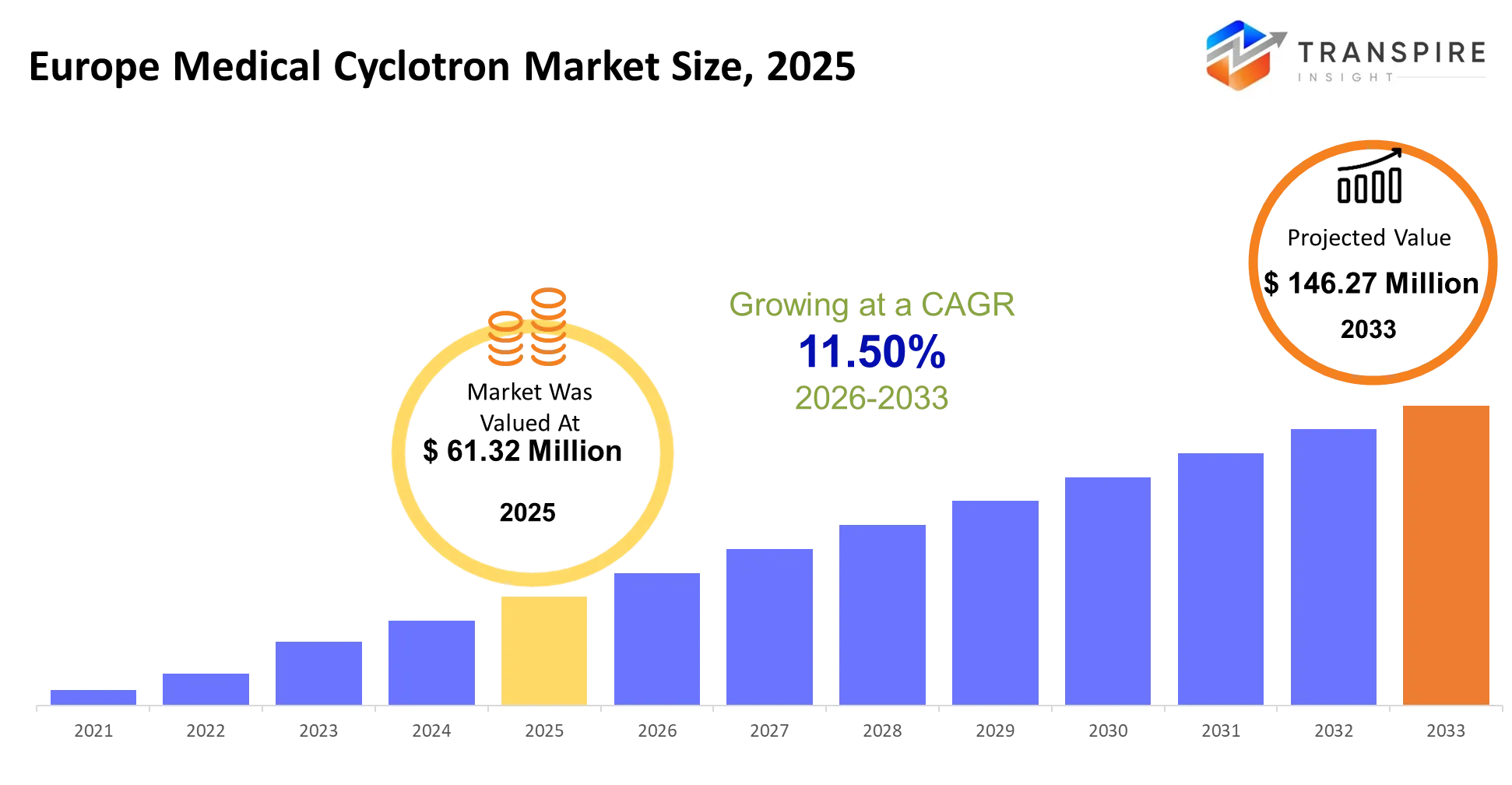
- Europe Medical Cyclotron Market Size 2025: USD 61.32 Million
- Europe Medical Cyclotron Market Size 2033: USD 146.27 Million
- Europe Medical Cyclotron Market CAGR: 11.50%
- Europe Medical Cyclotron Market Segments: By Type (Fixed Cyclotron, Compact Cyclotron, Superconducting Cyclotron, Others); By Application (Radioisotope Production, Cancer Therapy, PET Imaging, Research, Others); By End-User (Hospitals, Diagnostic Centers, Research Institutes, Pharma Companies, Others); By Energy (Low Energy, Medium Energy, High Energy, Others)
To learn more about this report,  Download Free Sample Report
Europe Medical Cyclotron Market Summary
The Europe Medical Cyclotron Market was valued at USD 61.32 Million 2025. It is forecast to reach USD 146.27 Million by 2033. That is a CAGR of 11.50% over the period.
European medical cyclotrons function as essential nuclear medicine facilities because they produce short-lived radioisotopes which hospitals use for daily PET scans that detect cancer and cardiac conditions and neurological disorders. The system provides operational advantages because it allows emergency situations to receive rapid access to local isotope resources when delivery times and delivery windows are restricted.
The market has moved toward compact hospital-based cyclotrons which decrease the need for centralized cyclotron production during the last two years. The structural transformation started to gain speed during COVID-19 because international shipping delays revealed weaknesses in isotope distribution systems that prompted medical organizations to build production facilities at their locations.
Organizations now make purchasing choices which prefer dependable systems that operate independently rather than systems with greater operational capacity. Hospitals drive their growth by increasing their diagnostic capabilities which allows them to maintain uninterrupted supply chains that result in ongoing equipment deployments and service agreements which depend on clinical operational needs.
Key Market Insights
- The Europe Medical Cyclotron Market in Western Europe generates 55% of market share because Western European countries possess sophisticated healthcare systems.
- Eastern Europe represents the fastest-growing region, with a projected growth rate above 8% through 2030, supported by healthcare modernization investments.
- The market for low-energy cyclotrons which provide more than 60% of market share in 2024 exists because hospitals use these devices to produce PET isotopes.
- High-energy cyclotrons hold the second-largest share which research institutions and large-scale isotope production facilities support.
- The demand for compact cyclotrons exists because customers require these devices to provide on-site installation services which operate between 2025 and 2030.
- The European market shows high demand for oncology imaging applications which generate 70% of total demand because cancer diagnostics have increased throughout Europe.
- The application of neurology imaging has expanded through the growing demand for early detection of Alzheimer's and Parkinson's diseases.
- The hospital sector will make up more than 65% of the market share in 2024 because hospitals need in-house isotope production to ensure their operations run smoothly and control their expenses.
- The diagnostic imaging center sector represents the fastest-growing market area which experiences rapid growth because more outpatient facilities use PET scans.
- Advanced AI-enabled monitoring systems and remote diagnostics create advanced technologies which enable companies to increase their system uptime and gain competitive advantages.
What are the Key Drivers, Restraints, and Opportunities in the Europe Medical Cyclotron Market?
The Europe Medical Cyclotron Market experiences growth because of an important change which brings decentralized production of radiopharmaceuticals to Europe. The transition started to develop after Europe experienced multiple isotope shortages which proved the weaknesses of its reactor-based nuclear supply systems. The government and hospital networks established funding for cyclotron systems which would be installed at their facilities to guarantee continuous access to medical isotopes needed for PET imaging. The shift results in increased equipment sales and long-term service agreements while hospitals now use their diagnostic capacity through internal resources instead of needing to transport equipment across borders.
High capital intensity remains the most persistent structural barrier. The complete cyclotron system which includes all necessary shielding components and compliance with safety rules needs multiple million euro investments plus expert personnel development. The safety regulations include these operational restrictions because their safety requirements need immediate execution to maintain operational safety. The delayed adoption process used by smaller hospitals and developing healthcare systems results in restricted market access which hampers revenue growth despite existing high clinical demand.
The expansion of theranostics presents a clear growth pathway for the Europe Medical Cyclotron Market. Advanced cyclotron systems are now being developed because targeted cancer treatments use both Gallium-68 and Copper-64 radioisotopes which are becoming more popular. Eastern European countries are developing their nuclear medicine facilities which will help create better environments for new medical equipment installations. The combination of medical treatment breakthroughs and local funding makes possible new business opportunities which exist outside of standard medical imaging tests.
What Has the Impact of Artificial Intelligence Been on the Europe Medical Cyclotron Market?
The use of artificial intelligence together with advanced digital systems has become a standard practice in European cyclotron operations which now support automated operations that rely on data analysis. The current control systems use artificial intelligence technology to perform automatic beam adjustment procedures together with target loading tasks and radiation safety assessments which lead to less need for human operators to work and create uniformity in the isotope production process. The facilities use digital monitoring systems to maintain real-time observation of vacuum levels and magnet operations and cooling system functions which helps establish consistent production outcomes.
The field of predictive maintenance increasingly utilizes machine learning models to enhance its capabilities. The models use historical performance data together with sensor data to predict component degradation which includes ion source degradation and RF system instability for a period of several days. This enables operators to plan their maintenance activities before breakdowns occur which leads to a 10 to 15 percent increase in operational availability and a decrease in unplanned outages that affect isotope distribution.
The technologies decrease energy use during each production cycle while their automated reporting system and traceability functions enhance their ability to meet regulatory requirements. The process of implementation faces obstacles because organizations need to spend large amounts of money for system integration while they deal with the shortage of common training databases. The majority of facilities continue to use outdated technology which prevents them from achieving complete AI-based optimization without first updating their fundamental systems.
Key Market Trends
- Hospitals have shifted from centralized isotope sourcing to on-site cyclotron installations since 2020 which helps them reduce their need for international transport while maintaining their diagnostic services.
- The adoption of compact cyclotrons has increased by more than 30 percent since 2021 because space-efficient systems allow mid-sized hospitals to establish their own production facilities.
- Governments increased funding for nuclear medicine infrastructure post-COVID-19 because Germany and France built more domestic isotope production facilities to prevent future supply shortages.
- Buyers now prioritize lifecycle service contracts which have become standard practice for more than 60 percent of recent installations that include both long-term maintenance and uptime guarantees.
- The implementation of AI-driven predictive maintenance has grown at a steady pace since 2022 which allows operators to decrease unexpected shutdowns by 15 percent in facilities that operate at high capacity.
- The demand for theranostic isotopes such as Gallium-68 has reached new heights since 2021 which has forced manufacturers to create cyclotron systems that can produce multiple isotopes.
- Eastern Europe has become a major area for business growth because Poland and Hungary have increased their healthcare spending while they bring new cyclotron facilities into operation.
- The need for radiation safety and traceability, which regulatory bodies have increased their surveillance over, has led facilities to implement systems that use automated compliance and digital monitoring.
- Equipment manufacturers and hospital networks have formed more strategic partnerships which enable both parties to use shared infrastructure while they enter new markets at a faster pace.
Europe Medical Cyclotron Market Segmentation
By Type:
The market maintains its strong demand for fixed cyclotrons because these systems produce nearly 40% of all active installations in large-scale isotope production facilities. The systems prove their value for centralized distribution networks through their high output capacity and dependable performance which Western European infrastructure systems need for bulk production operations. Hospitals now use compact cyclotrons which have achieved 30% market share to establish nearby production facilities that minimize transportation hazards and shipment delays. Superconducting cyclotrons represent an advanced technological field which research institutions and top medical facilities use for their operations.
The demand for compact systems has increased because hospitals need to produce their own isotopes which they require to maintain operations after supply interruptions between 2020 and 2022. The fixed systems experience limited growth because they need large initial investments and their operations depend on centralized distribution networks. Superconducting systems achieve high accuracy and efficiency but their development costs and technical difficulties limit their use. Compact systems will see increased demand in the future which will lead manufacturers to develop modular systems that provide economical growth solutions for mid-sized healthcare organizations.
By Application:
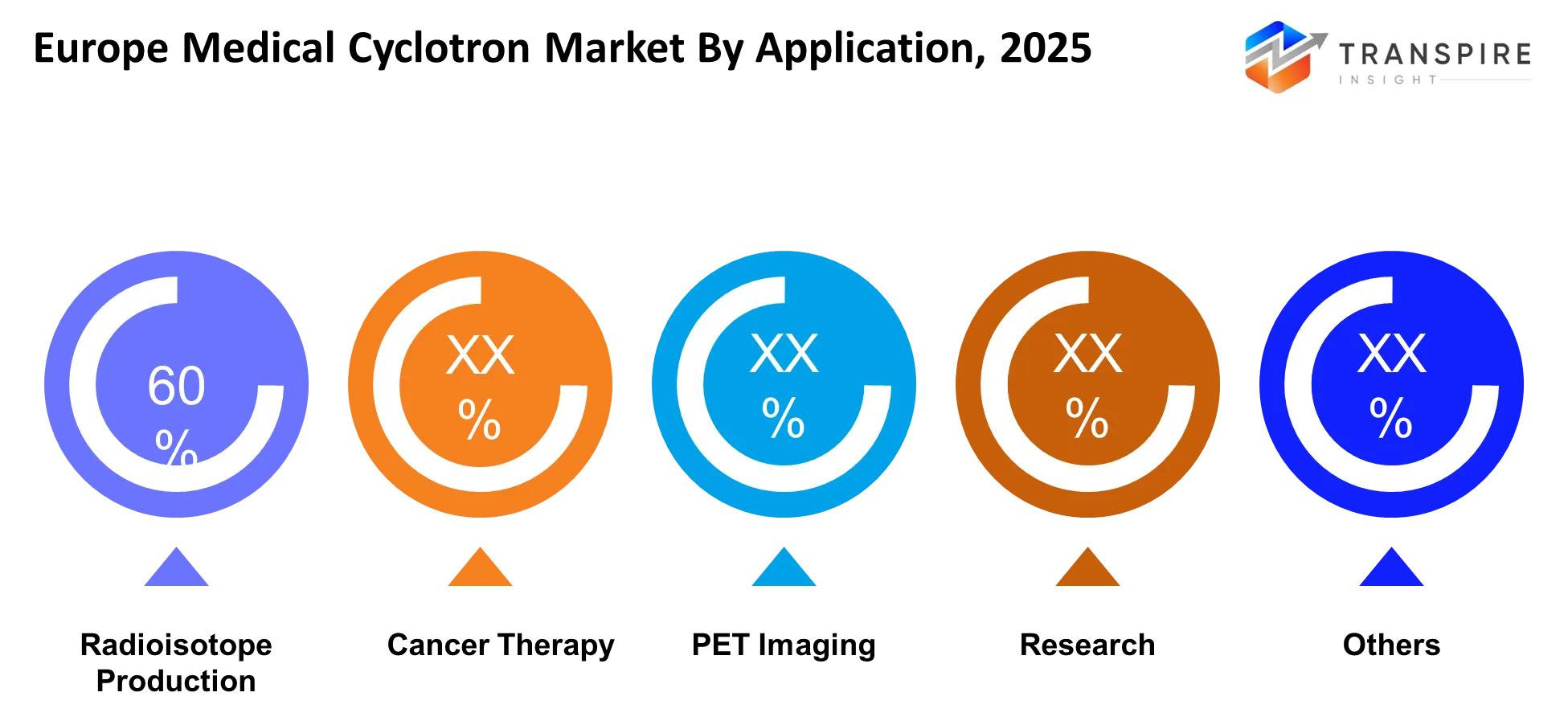
The application of PET imaging leads to its dominant market share because it accounts for more than 60% of total cyclotron usage which essential for cancer diagnosis. The production of radioisotopes creates essential support for this segment because it provides necessary materials for hospitals and imaging centers to conduct their daily medical activities. The development of cancer therapy applications progresses at a continuous pace because targeted radionuclide treatments have become more common which requires advanced isotopes. Research applications maintain a smaller but stable share, supported by academic and pharmaceutical innovation pipelines.
The clinical adoption of theranostics which combines diagnostic and therapeutic pathways has created new opportunities for cancer treatment development. The adoption of PET imaging has created new opportunities for early detection testing because European healthcare systems now follow standardized detection protocols. Research demand remains steady but does not scale at the same pace due to funding limitations and longer project cycles. Future expansion will likely focus on therapeutic isotope production which will lead to system upgrades that enable the processing of multiple isotopes used in diagnostics.
To learn more about this report, Download Free Sample Report
By End-User:
The hospital sector serves as the primary end-user market because it accounts for approximately 65% of system installations which support both diagnostic and treatment processes. Diagnostic centers follow as the second-largest segment, benefiting from increasing outpatient imaging volumes and referral networks. The research institutes and pharmaceutical companies maintain minor market shares yet they drive innovation and develop new isotopes. The adoption of new technologies depends on the existing infrastructure, available funding, and the level of clinical demand which exists within the organization.
The hospital needs to develop on-site isotope production capacity because this requirement helps them manage high patient volumes while decreasing their reliance on outside vendors. The demand for specialized imaging services which patients can access from non-hospital facilities has led to the rapid expansion of diagnostic centers. Research institutes focus on advanced isotope development while pharmaceutical companies invest in clinical trials and drug development pipelines. Future growth will lead to diagnostic centers and pharmaceutical companies increasing their investment which will create demand for flexible cyclotron systems that can perform multiple functions.
By Energy:
The market for low-energy cyclotrons exceeds 50% market share because this technology effectively produces Fluorine-18 which functions as a standard PET isotope. The medium-energy systems maintain a moderate market share because they provide clinical and research users with access to multiple isotopes. High-energy cyclotrons occupy a smaller segment because they operate in research facilities that require specialized production environments. The selection of energy type determines both the expenses and difficulties of operating the system while restricting its potential uses.
The hospital-based public healthcare system keeps expanding its low-energy system installations because these systems require minimal installation expenses and work well in hospital environments. The facilities using medium-energy cyclotrons can produce multiple isotopes because this system allows them to produce different isotopes without making operational processes more complex. The large capital costs and need for specialized infrastructure make high-energy systems difficult to implement. The healthcare industry will need medium-energy platforms because healthcare providers want equipment which enables them to perform both diagnostic testing and create new therapeutic isotopes in one system.
What are the Key Use Cases Driving the Europe Medical Cyclotron Market?
The primary application of PET imaging drives its European adoption because hospitals need continuous access to Fluorine-18 short-lived isotopes for their cancer detection testing. The high volume of patients combined with the urgent need for diagnostic tests creates a requirement for cyclotron facilities located at or close to medical facilities which guarantees ongoing access to scanning services while decreasing the need for outside supply chains.
Therapeutic isotope production together with advanced neurology imaging makes it possible to develop new applications that extend current system capabilities. Pharmaceutical companies and research institutes increasingly use cyclotrons to produce isotopes like Gallium-68 for targeted cancer therapies while diagnostic centers are scaling neurological scans for conditions such as Alzheimer’s supported by improved tracer availability.
New use cases have developed for personalized radiopharmaceutical development together with clinical trial isotope production needs. The increasing funding of theranostics together with precision medicine research has led medical facilities to implement flexible cyclotron systems which enable them to create small quantities of valuable isotopes needed for developing next-generation treatments.
|
Report Metrics |
Details |
|
Market size value in 2025 |
USD 61.32 Million |
|
Market size value in 2026 |
USD 68.25 Million |
|
Revenue forecast in 2033 |
USD 146.27 Million |
|
Growth rate |
CAGR of 11.50% from 2026 to 2033 |
|
Base year |
2025 |
|
Historical data |
2021 - 2024 |
|
Forecast period |
2026 - 2033 |
|
Report coverage |
Revenue forecast, competitive landscape, growth factors, and trends |
|
Regional scope |
Europe (Germany, United Kingdom, France, Italy, Spain, Rest of Europe) |
|
Key company profiled |
IBA, GE Healthcare, Siemens Healthineers, Sumitomo Heavy Industries, Advanced Cyclotron Systems, Best Cyclotron Systems, ACSI, Toshiba, Hitachi, Varian, Eckert & Ziegler, SHI, ScandiNova, Ion Beam Applications, Canon Medical |
|
Customization scope |
Free report customization (country, regional & segment scope). Avail customized purchase options to meet your exact research needs. |
|
Report Segmentation |
By Type (Fixed Cyclotron, Compact Cyclotron, Superconducting Cyclotron, Others); By Application (Radioisotope Production, Cancer Therapy, PET Imaging, Research, Others); By End-User (Hospitals, Diagnostic Centers, Research Institutes, Pharma Companies, Others); By Energy (Low Energy, Medium Energy, High Energy, Others) |
Which Regions are Driving the Europe Medical Cyclotron Market Growth?
North America controls the market because its strong regulatory system together with its early policy implementation created a market advantage that other regions could not match. The United States and Canada enforce compliance standards which require operators to enhance their systems while achieving minimum operational performance requirements. The area possesses advanced port facilities together with a vast fleet of modern vessels which can adopt new technologies rapidly. The combination of service providers with technology companies and regulatory organizations creates a complete ecosystem that continues to support its existing market dominance.
The European market operates as a steady economic force which provides consistent growth across its member countries through shared governmental policies that allow for various national methods of development. The region depends on international maritime organizations together with regional treaties to achieve its planned growth through gradual regulatory adjustments. European shipowners focus on long-term projects to achieve sustainable results which create steady market demand throughout the years. Europe establishes itself as a reliable financial structure which supports worldwide market growth because it maintains steady policy frameworks and fiscal responsibility.
The Asia-Pacific region emerged as the fastest expanding area because of its recent extensive improvements to port facilities and its comprehensive initiatives for upgrading its fleet. The governments of major maritime countries have developed new financial incentives together with mandatory regulations which promote quick adoption of cutting-edge technologies. The region experiences growth through increasing trade volumes combined with additional shipbuilding operations, which creates new economic opportunities. The period from 2026 to 2033 will create strong market entry points, which will benefit investors who specialize in infrastructure development and advanced maritime technology.
Who are the Key Players in the Europe Medical Cyclotron Market and How Do They Compete?
The Europe medical cyclotron market experiences moderate consolidation because specialized manufacturers control technology standards while smaller companies operate in particular market segments through their installation and service contracts. The existing companies maintain their market position through enduring hospital relationships and complete service solutions which they provide instead of competing on price. The primary basis of competition centers on technology reliability, isotope production efficiency, and the ability to provide end-to-end solutions that include installation, maintenance, and regulatory support. The decision to buy products depends on two factors which are the distance to major healthcare centers and the ability to meet European radiation safety requirements.
IBA Radiopharma Solutions concentrates on developing new technologies by creating high-current cyclotrons which increase isotope production for use at major diagnostic facilities. The company differentiates itself through digital monitoring systems that allow predictive maintenance, reducing downtime for critical imaging services. The organization creates new growth opportunities by entering into strategic partnerships with hospital networks and radiopharmaceutical distributors throughout Western Europe. Siemens Healthineers uses its complete imaging system to connect cyclotron production with diagnostic systems which enables a streamlined operational process. The company provides system-level integration which benefits large hospital groups that require complete infrastructure solutions, and it expands its business through bundled equipment contracts and service agreements.
GE HealthCare uses its service-based model to deliver operational support throughout system lifecycles which protects equipment availability for customers who need continuous operations. The company achieves its unique market position by using cyclotron technology together with its extensive network of radiopharmacy facilities to deliver isotopes to multiple areas at high speed. Advanced Cyclotron Systems Inc. focuses on specialized markets by providing small cyclotron systems that meet the space needs of hospitals and research facilities which have limited available area. The company expands by entering underserved Central and Eastern European markets, where demand for localized isotope production is rising.
Company List
- IBA
- GE Healthcare
- Siemens Healthineers
- Sumitomo Heavy Industries
- Advanced Cyclotron Systems
- Best Cyclotron Systems
- ACSI
- Toshiba
- Hitachi
- Varian
- Eckert & Ziegler
- SHI
- ScandiNova
- Ion Beam Applications
- Canon Medical
Recent Development News
In April 2026, Ion Beam Applications SA announced the acquisition of a minority stake in a European radiopharmaceutical startup to expand its medical cyclotron-based isotope production capabilities. https://iba-worldwide.com
In March 2026, GE HealthCare completed the acquisition of a specialized cyclotron service provider in Europe to strengthen its PET tracer production and maintenance services network. https://www.gehealthcare.com
What Strategic Insights Define the Future of the Europe Medical Cyclotron Market?
The Europe medical cyclotron market is moving toward a more decentralized production model which allows hospitals and regional hubs to produce isotopes at their facilities instead of needing to obtain them through international shipping. The increasing demand for short-lived isotopes in clinical applications together with the requirement to maintain supply chain stability for nuclear medicine drive this transformation. The growth of precision oncology will create a greater need for these mini cyclotron systems which deliver production capabilities exactly when needed. The present operational framework of radiopharmaceutical networks will undergo fundamental changes during the next five to seven years because of this structural transition.
The upcoming demand for production capacity will face limitations because of two factors which include restrictions on enriched target material supply and complicated rules regarding their safe transport and handling. The market is developing an opportunity for alpha-emitting isotopes which include Astatine-211 because current infrastructure investments are not yet established while interest in clinical applications is growing. Companies which develop cyclotron facilities through specialized investments while obtaining upstream material agreements will gain an advantage in this niche market. The best approach for market players involves creating integrated production and distribution systems through partnerships with regional healthcare organizations instead of competing through individual equipment sales.
Europe Medical Cyclotron Market Report Segmentation
By Type
- Fixed Cyclotron
- Compact Cyclotron
- Superconducting Cyclotron
- Others
By Application
- Radioisotope Production
- Cancer Therapy
- PET Imaging
- Research
- Others
By End-User
- Hospitals
- Diagnostic Centers
- Research Institutes
- Pharma Companies
- Others
By Energy
- Low Energy
- Medium Energy
- High Energy
- Others
Frequently Asked Questions
Find quick answers to common questions.
The Europe Medical Cyclotron Market size is USD 146.27 Million in 2033.
Key segments for the Europe Medical Cyclotron Market are By Type (Fixed Cyclotron, Compact Cyclotron, Superconducting Cyclotron, Others); By Application (Radioisotope Production, Cancer Therapy, PET Imaging, Research, Others); By End-User (Hospitals, Diagnostic Centers, Research Institutes, Pharma Companies, Others); By Energy (Low Energy, Medium Energy, High Energy, Others).
Major Europe Medical Cyclotron Market players are IBA, GE Healthcare, Siemens Healthineers, Sumitomo Heavy Industries, Advanced Cyclotron Systems, Best Cyclotron Systems, ACSI, Toshiba, Hitachi, Varian, Eckert & Ziegler, SHI, ScandiNova, Ion Beam Applications, Canon Medical
The Europe Medical Cyclotron Market size is USD 61.32 Million in 2025.
The Europe Medical Cyclotron Market CAGR is 11.50% from 2026 to 2033.
- IBA
- GE Healthcare
- Siemens Healthineers
- Sumitomo Heavy Industries
- Advanced Cyclotron Systems
- Best Cyclotron Systems
- ACSI
- Toshiba
- Hitachi
- Varian
- Eckert & Ziegler
- SHI
- ScandiNova
- Ion Beam Applications
- Canon Medical
Recently Published Reports
-
Apr 2026
AI in Diabetic Retinopathy Market
AI in Diabetic Retinopathy Market Size, Share & Analysis Report By Type (Screening AI Systems, Diagnostic AI Systems, and Predictive AI Models), By Application Segment (Hospitals, Ophthalmology Clinics, Diagnostic Centers, and Research and Development), and Geography (North America, Europe, Asia-Pacific, Middle East and Africa, South and Central America), 2021 - 2031
-
Apr 2026
Psychometric Tests Market
Psychometric Tests Market Size, Share & Analysis Report By Type (Personality Tests, Ability/Aptitude Tests, Skill/Knowledge Tests, and Others), By Application (Talent Acquisition and Talent Management), and Geography (North America, Europe, Asia-Pacific, Middle East and Africa, South and Central America), 2021 – 2031
-
Apr 2026
Rare Biological Sample Collection Market
Rare Biological Sample Collection Market Size, Share & Analysis Report By Type (Isolation Kits & Reagent, Blood Collection Tubes, and Others), By Application (Oncology, Transcriptomics, Pharmacogenomics, and Others), and Geography (North America, Europe, Asia-Pacific, Middle East and Africa, South and Central America), 2021 – 2031
-
Apr 2026
Patient Lift Pendant Market
Patient Lift Pendant Market By Product Type (Wired Pendants, Wireless, Programmable), By Operation Type(Manual, Electric), By End-Users (Healthcare Professionals, Patients), By Application (Hospitals, Homecare, Rehabilitation Centers, Others), By Industry Analysis, Size, Share, Growth, Trends, and Forecasts 2021-2033
Our Clients
.jpg)