
Japan Smart Air Conditioning Systems Market Size & Forecast:
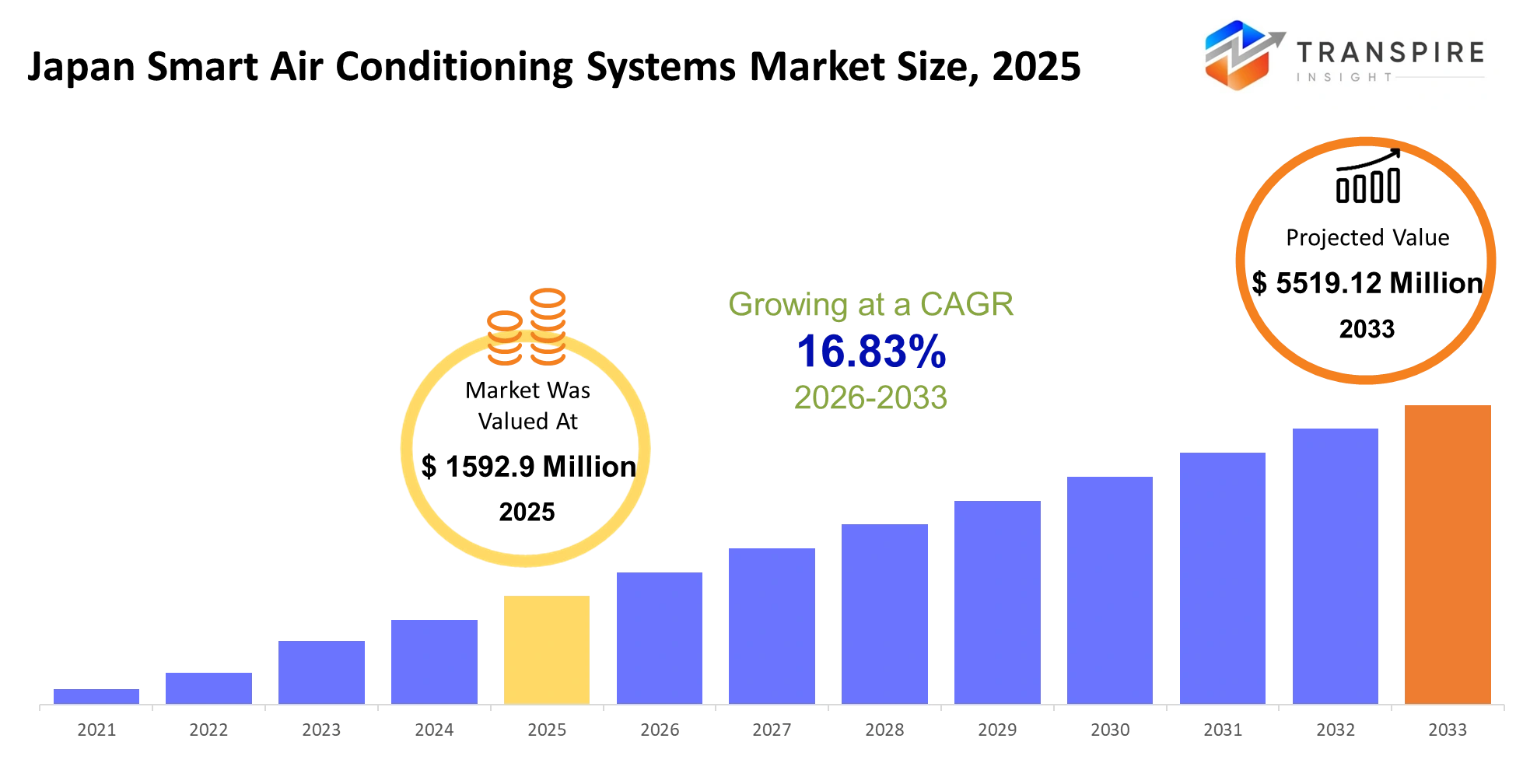
- Japan Smart Air Conditioning Systems Market Size 2025: USD 1592.9 Million
- Japan Smart Air Conditioning Systems Market Size 2033: USD 5519.12 Million
- Japan Smart Air Conditioning Systems Market CAGR: 16.83%
- Japan Smart Air Conditioning Systems Market Segments: By Type (Split AC, Window AC, Central AC, Portable AC, Others); By Application (Residential, Commercial, Industrial, Smart Homes, Others); By End-User (Households, Enterprises, Commercial Buildings, Industrial Sector, Others); By Technology (IoT-enabled, AI-enabled, Energy Efficient Systems, Others).
To learn more about this report,  Download Free Sample Report
Japan Smart Air Conditioning Systems Market Summary
The Japan Smart Air Conditioning Systems Market was valued at USD 1592.9 Million in 2025. It is forecast to reach USD 5519.12 Million by 2033. That is a CAGR of 16.83% over the period.
The Japan Smart Air Conditioning Systems Market optimizes indoor climate management for commercial spaces through system components that adjust cooling and airflow based on occupancy and weather and energy consumption patterns which help to decrease electricity waste while delivering operational comfort and equipment stability. The market has experienced a transition from traditional timer-based HVAC control methods to current IoT-based systems that utilize sensors and work together with building energy management systems.
Operators in Japan have been compelled to upgrade their old HVAC systems through better control systems because of the country's more demanding carbon neutrality objectives and its more rigorous building efficiency standards. The combination of energy price fluctuations that began after 2022 and multiple heatwaves showed how much it costs to operate inefficient cooling systems in urban areas with high population density. The need for operating cost savings and the ability to manage grid electricity demand have become the main factors driving adoption because they result in faster product replacement and create ongoing software-based income opportunities for manufacturers and service providers.
Key Market Insights
- The Kanto region holds control over the Japan Smart Air Conditioning Systems Market because its commercial infrastructure development and smart building implementation enable it to achieve nearly 38% market share in 2025.
- The Kansai region experiences its fastest growth period between 2025 and 2030 because industrial modernization and smart city development projects progress throughout this time.
- The Japan Smart Air Conditioning Systems Market displays its highest market share through smart thermostats and IoT-enabled controllers which take up approximately 42% of total market share.
- The need for cost optimization drives the development of AI-based predictive maintenance solutions which represent the fastest-growing market segment from 2024 until 2030.
- The commercial building sector maintains its leading position in operating system usage because offices, malls and transport hubs together account for approximately 55% of total system usage.
- The application of industrial automation systems functions as the most rapidly developing sector which implements real-time climate optimization technology.
- The Japan Smart Air Conditioning Systems Market sees commercial real estate operators as its leading market share holders with a market share of approximately 48 percent.
- The smart factory transformation projects drive industrial manufacturing to become the most rapidly developing end-user segment.
- Healthcare facilities and data centers now represent emerging user groups that need precise temperature management and ongoing system surveillance.
- The two primary methods for capturing demand from outdated infrastructure maintenance needs involve expanding into new areas and implementing retrofitting solutions.
What are the Key Drivers, Restraints, and Opportunities in the Japan Smart Air Conditioning Systems Market?
The Japan Smart Air Conditioning Systems Market exists because Japanese cities need to fulfill two requirements which include energy efficiency standards and their increasing operational expenses. Japanese energy performance standards for buildings and corporate decarbonization requirements compel facility operators to install advanced HVAC systems which use smart sensor technology. The implementation of this solution brings actual financial benefits because commercial buildings and manufacturing facilities achieve electricity savings through real-time load optimization and AI-based temperature control systems which boost operating profits and fast-track revenue growth for solution providers who offer retrofit solutions.
The primary factor preventing progress in Japan requires building owners to spend money for initial system integration while dealing with challenging requirements to modernize their existing buildings. The wiring and sensor networks and control systems required for digital infrastructure do not exist in many commercial buildings which were constructed before the current digital era. The existing design of the system causes two problems for businesses because it takes extra time to implement the system and requires small and mid-sized property owners to spend more time to recover their investments which leads to decreased immediate adoption rates although the system provides evident long-term efficiency advantages.
The first opportunity for development in Japan smart city initiatives and digital building systems at their two largest cities Tokyo and Osaka. The 5G building management systems which operationalize real-time occupancy monitoring and weather forecasting data enable building operators to forecast upcoming climate conditions. The various design aspects of large-scale redevelopment zones now incorporate AI energy systems which enable Daikin Industries and Mitsubishi Electric to transition from hardware sales to their new software and energy management service business model.
What Has the Impact of Artificial Intelligence Been on the Japan Smart Air Conditioning Systems Market?
Japan Smart Air Conditioning Systems Market receives transformation through artificial intelligence which enables standard HVAC systems to function as autonomous climate control systems that use data for operational control. AI-based building management systems in contemporary commercial structures maintain optimal cooling levels by using occupancy sensors and weather predictions and current electricity rates for their automated operations. The system achieves better responsiveness through automated operations because it needs less manual work to manage energy needs which change throughout the day in populated city areas.
Predictive maintenance through machine learning models operates in smart air conditioning systems from smart air conditioning systems through to advanced machine learning models. The models use compressor vibration data and refrigerant flow information together with past failure records to find unexpected system behavior which leads to equipment failures. The result of this system shows that facility operators experience decreased unexpected shutdowns, while equipment performance improves, through about 15-20% reduction in maintenance-related downtime at certain installations. The energy optimization algorithms perform independent system evaluations which enable better cooling distribution throughout extensive office buildings and industrial operations resulting in higher efficiency and lower peak energy usage.
The AI adoption process encounters a fundamental restriction because existing HVAC systems require complicated integration work for their implementation. The absence of standardized IoT systems in buildings results in both data collection problems and lower model performance because of inconsistent real-time monitoring. The advanced climate automation systems in Japan face deployment challenges because their implementation process requires expensive retrofitting work for existing commercial buildings that use outdated technology.
Key Market Trends
- The adoption of AI-enabled HVAC systems in Japan commercial buildings increased after 2022 because the system replaced existing manual controls with automatic load-balancing technology.
- The period from 2023 to 2025 saw stricter energy regulations which required facility operators to install intelligent sensors and control systems in their existing air conditioning equipment.
- The use of IoT platforms grew substantially because more than 40% of 2025 installations established links with centralized building management systems.
- The rising electricity price fluctuations during the period from 2022 to 2024 led customers to switch from comfort-based cooling solutions toward systems which optimize energy consumption in real time.
- The use of predictive maintenance solutions throughout large facilities led to a reduction of unplanned HVAC system outages by 18% in digitally enhanced buildings.
- Daikin Industries and Panasonic developed new subscription energy management services which depend on software because both companies expanded their software-based business operations beyond their traditional hardware products.
- The smart city initiatives in Tokyo and Osaka led to faster implementation of complete climate control systems in all newly constructed commercial areas.
- The need for building retrofits increased because more than 60 percent of Japan's commercial buildings needed HVAC system upgrades to meet the new energy efficiency regulations.
Japan Smart Air Conditioning Systems Market Segmentation
By Type :
Split AC systems remain the best choice for residential and small commercial spaces because they can be installed anywhere and their cooling efficiency meets all requirements. Window AC units remain available to customers who need basic cooling solutions at low prices. Central AC systems have become essential for large buildings which need to maintain consistent temperature throughout their entire space. Portable AC units deliver cooling solutions to people who need temperature control in their limited living areas.
The characteristics of different system types develop through their specific space requirements and installation expenses and their power consumption methods. Smart upgrades across these types support remote operation and temperature automation. The need for compact and efficient systems drives product selection in Japanese urban households and small offices which exist within the Smart Air Conditioning Systems Market.
By Application :
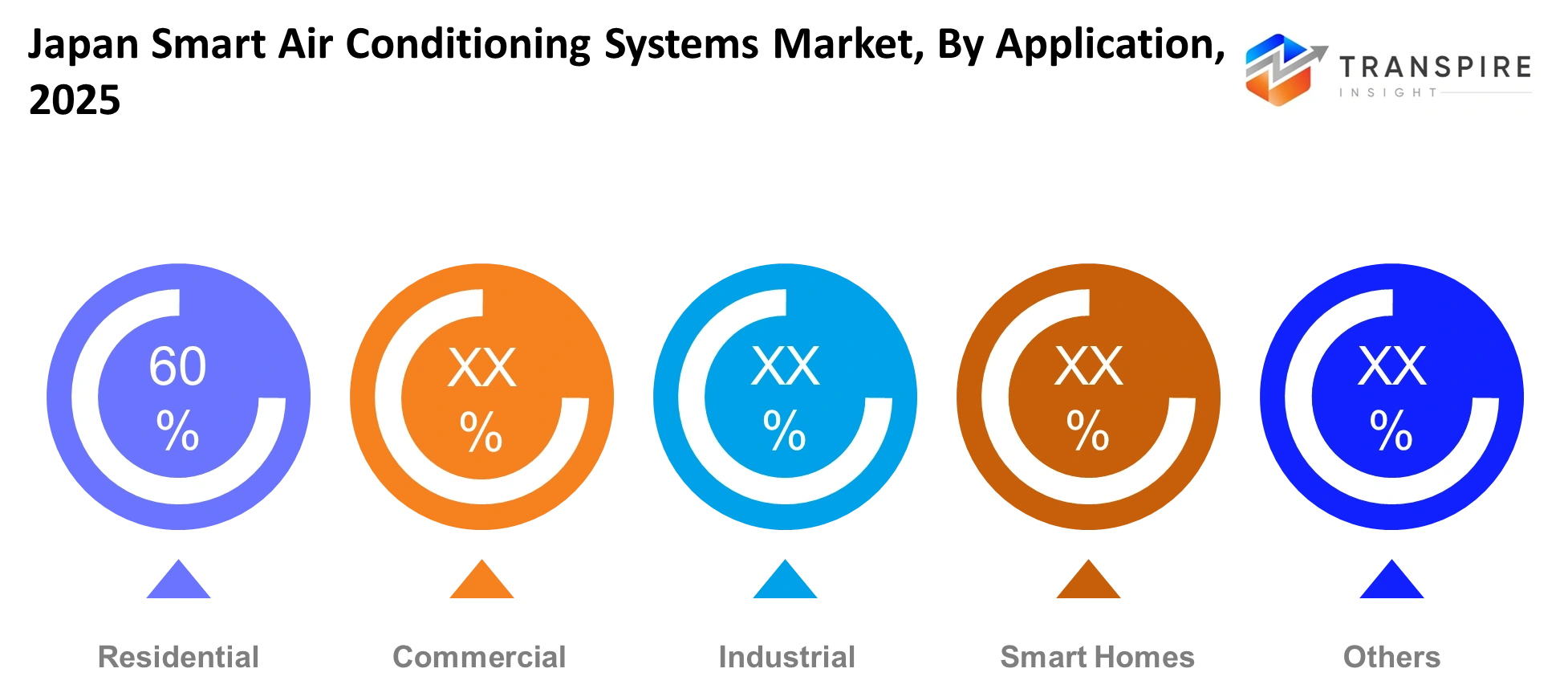
The residential market demands strong product availability because urban housing developments increase while people seek modern comfort solutions. Commercial spaces such as offices and retail stores and hospitality buildings use smart cooling systems to achieve better energy management. Industrial usage supports controlled environments in production and storage areas.
Smart home systems drive the increase in demand for air conditioning products which connect to other devices and use user behavior and occupancy data to control temperature. Other applications include public infrastructure spaces requiring consistent cooling performance. The Smart Air Conditioning Systems Market in Japan expands because of rising automation and digital control capabilities which enable new applications to enter the market.
To learn more about this report, Download Free Sample Report
By End-User :
Households represent a major end-user group that requires home comfort solutions while smart home technology usage increases. Enterprises improve operational efficiency and reduce energy expenses through their implementation of centralized cooling management systems. Commercial buildings depend on sophisticated systems to achieve both indoor air quality standards and steady temperature control.
The industrial sector uses controlled environments to ensure process stability and equipment safety. Educational and healthcare buildings are among the institutional facilities that make up the other end-user category. The Japanese Smart Air Conditioning Systems Market shows increased user adoption of automated temperature control systems because of growing market demand for these systems.
By Technology :
Remote monitoring and control of IoT-enabled systems become possible through connected devices which enhance user convenience and enable energy usage monitoring. The AI-enabled system improves performance by automatically adjusting cooling output based on its learned usage patterns. Energy-efficient systems achieve their cooling efficiency targets by decreasing electricity usage yet sustaining their maximum cooling output.
Smart sensors work together with each other to create a system that enables real-time temperature control and predictive maintenance capabilities. Applied technological progress results in better operational efficiency while decreasing environmental damage. The Japanese Smart Air Conditioning Systems Market sees increased technology adoption because of ongoing digital control system innovations.
What are the Key Use Cases Driving the Japan Smart Air Conditioning Systems Market?
The Japan Smart Air Conditioning Systems Market shows commercial buildings as its primary application because office buildings shopping malls and transportation terminals implement advanced HVAC technology to maintain comfortable indoor conditions while decreasing their maximum energy usage. The market exists because building energy standards require businesses to implement effective solutions for handling changing occupancy patterns which occur in cities with high population density.
Industrial manufacturing and healthcare facilities are developing new applications that operate within their existing spaces. Smart air conditioning systems enable factories to create controlled production environments which support their manufacturing needs while hospitals use the technology to establish temperature-controlled areas that protect vital medical equipment in critical care units. Both segments prioritize operational continuity and energy efficiency, especially as Japan’s industrial operators face rising utility costs.
New applications have developed through the establishment of data centers and temperature-controlled smart logistics warehouses, which depend on precise climatic conditions to sustain their operations. New smart city districts experience increasing adoption of AI-driven building management system integration which occurs throughout Tokyo redevelopment areas that utilize climate control systems as part of their digital infrastructure design process.
|
Report Metrics |
Details |
|
Market size value in 2025 |
USD 1592.9 Million |
|
Market size value in 2026 |
USD 1857.4 Million |
|
Revenue forecast in 2033 |
USD 5519.12 Million |
|
Growth rate |
CAGR of 16.83% from 2026 to 2033 |
|
Base year |
2025 |
|
Historical data |
2021 - 2024 |
|
Forecast period |
2026 - 2033 |
|
Report coverage |
Revenue forecast, competitive landscape, growth factors, and trends |
|
Country scope |
Japan |
|
Key company profiled |
Daikin, Mitsubishi Electric, Panasonic, LG, Samsung, Carrier, Hitachi, Toshiba, Fujitsu, Blue Star, Voltas, Haier, Midea, Johnson Controls, Trane. |
|
Customization scope |
Free report customization (country, regional & segment scope). Avail customized purchase options to meet your exact research needs. |
|
Report Segmentation |
By Type (Split AC, Window AC, Central AC, Portable AC, Others); By Application (Residential, Commercial, Industrial, Smart Homes, Others); By End-User (Households, Enterprises, Commercial Buildings, Industrial Sector, Others); By Technology (IoT-enabled, AI-enabled, Energy Efficient Systems, Others). |
Which Regions are Driving the Japan Smart Air Conditioning Systems Market Growth?
The Tokyo metropolitan area controls the Japanese Smart Air Conditioning Systems Market because it has numerous commercial buildings and tall office buildings and transportation facilities which need constant climate control. Building operators have been pushed to implement AI-driven HVAC systems because of strict energy efficiency standards and their commitment to achieving carbon neutrality. The area gains advantages from its active technological ecosystem which includes technology companies and construction companies and building management system integrators who help with project implementation. The development of extensive smart building initiatives in central Tokyo demonstrates the early implementation of innovative air conditioning systems. This combination of regulatory pressure and infrastructure density sustains its dominant position.
Kansai region represents a stable secondary hub, supported by its diversified industrial base in Osaka, Kyoto, and surrounding manufacturing zones. The energy needs of Tokyo which depend on high service requirements differ from Kansai which needs energy solutions used by industrial plants and mid-sized businesses to maintain stable energy expenses. The local power companies have developed incremental energy efficiency programs which enable controlled progress toward better HVAC systems without enforcing strict rules. The continuous industrial investments made by automotive and electronics manufacturers create stable demand patterns for their operations. The business generates a stable income stream which remains intact despite ongoing technological advancements.
The Chubu region has become the fastest expanding market because of new industrial investments which support Nagoya’s automotive manufacturing sector. The recent factory upgrades together with the smart production line expansions have installed climate control systems which meet precision engineering standards. The HVAC modernization process for existing plants has gained momentum because of the industrial decarbonization programs which governments launched after 2023. The market shift provides investors together with new market entrants an opportunity which will remain until 2033 because manufacturers are now focusing on energy-efficient infrastructure upgrades together with the implementation of scalable smart building systems.
Who are the Key Players in the Japan Smart Air Conditioning Systems Market and How Do They Compete?
The Japanese smart air conditioning systems market operates with strong market control because only a limited number of local companies who possess both manufacturing strength and preexisting building system connections are able to enter the market. Businesses use inverter efficiency and AI climate control systems and IoT building management system connections and their post-sale support systems as their main competition factors instead of engaging in price competition. The market consists of established companies which protect their existing systems in residential and commercial properties while new digital-first companies bring minimal change through their software-based energy optimization solutions.
Daikin develops its technology through its high-efficiency inverter compressors and cloud-based HVAC control systems which help reduce energy consumption in large commercial buildings. The company achieves its unique market position through its heat pump system which establishes operational systems with global service centers for customers who need ongoing maintenance after purchase. Mitsubishi Electric develops advanced climate control systems for commercial buildings and transit systems by utilizing sensor technology for zoning and building automation system integration. The two companies develop their business through joint ventures with facility management companies and their partnerships with smart building platforms in both Asia and Europe.
Panasonic develops residential smart AC products which use IoT sensors and energy-efficient nanoe air purification technology to enhance its home appliance product ecosystem. Toshiba Carrier develops commercial units at competitive prices through its modular systems which allow for easy installation in existing buildings. Fujitsu General increases its presence in special residential markets through its compact inverter systems and partnerships with local distribution companies.
Company List
- Daikin
- Mitsubishi Electric
- Panasonic
- LG
- Samsung
- Carrier
- Hitachi
- Toshiba
- Fujitsu
- Blue Star
- Voltas
- Haier
- Midea
- Johnson Controls
- Trane
Recent Development News
In October 2025, Mitsubishi Heavy Industries Thermal Systems announced the launch of new 2026 models of its S Series residential air-conditioners. The updated units feature enhanced energy efficiency compliance with Japan’s fiscal 2027 standards and are designed to reduce power consumption while improving cooling performance in large residential spaces.
Source: https://www.jcnnewswire.com/
In December 2025, Panasonic announced the launch of its next-generation ‘Eolia X Series’ smart air conditioners for the Japanese market. The system incorporates upgraded compressor technology and AI-based energy-saving control designed to optimize cooling efficiency and reduce power consumption during continuous usage.Source
S0urce: https://news.panasonic.com/
What Strategic Insights Define the Future of the Japan Smart Air Conditioning Systems Market?
The Japan Smart Air Conditioning Systems Market is moving toward software-defined HVAC systems which result in energy optimization and building automation and building systems intelligence becoming more important than the value of separate equipment sales. The next 5-7 years will see smart grid and carbon accounting system integration become the main technology which facility operators will use to achieve their goals of reducing emissions while maintaining cost savings. The shift to data-driven service models has created new revenue streams which equipment demand now evolves into recurring revenue streams that encompass the entire value chain.
Organizations building industrial systems on high-tech digital frameworks need to protect themselves against the hidden risks that come from their reliance on sophisticated digital networks in their outdated facilities because these networks make their systems more vulnerable to cyberattacks and operational problems. The increase in HVAC system connections to building control systems means that any software or data showdowns will create operational barriers for companies working in highly monitored commercial spaces.
The Tokyo and Osaka smart building energy trading markets present a new business opportunity to integrate AI energy trading with building systems. Building systems currently use this feature but it will become more important when Japan expands its demand response energy market operations. Organizations participating in market activities need to focus on platform-based solutions which bring together HVAC equipment and predictive analytics and energy management systems because these solutions will generate enduring revenue through service contracts.
Japan Smart Air Conditioning Systems Market Report Segmentation
By Type
- Split AC
- Window AC
- Central AC
- Portable AC
By Application
- Residential
- Commercial
- Industrial
- Smart Homes
By End-User
- Households
- Enterprises
- Commercial Buildings
- Industrial Sector
By Technology
- IoT-enabled
- AI-enabled
- Energy Efficient Systems
Frequently Asked Questions
Find quick answers to common questions.
The Japan Smart Air Conditioning Systems Market size is USD 5519.12 Million in 2033.
Key segments for the Japan Smart Air Conditioning Systems Market are By Type (Split AC, Window AC, Central AC, Portable AC, Others); By Application (Residential, Commercial, Industrial, Smart Homes, Others); By End-User (Households, Enterprises, Commercial Buildings, Industrial Sector, Others); By Technology (IoT-enabled, AI-enabled, Energy Efficient Systems, Others).
Major Japan Smart Air Conditioning Systems Market players are Daikin, Mitsubishi Electric, Panasonic, LG, Samsung, Carrier, Hitachi, Toshiba, Fujitsu, Blue Star, Voltas, Haier, Midea, Johnson Controls, Trane.
The Japan Smart Air Conditioning Systems Market size is USD 1592.9 Million in 2025.
The Japan Smart Air Conditioning Systems Market CAGR is 16.83% from 2026 to 2033.
- Daikin
- Mitsubishi Electric
- Panasonic
- LG
- Samsung
- Carrier
- Hitachi
- Toshiba
- Fujitsu
- Blue Star
- Voltas
- Haier
- Midea
- Johnson Controls
- Trane
Recently Published Reports
-
Apr 2026
Fiber Optic Faceplates Market
Fiber Optic Faceplates Market Size, Share & Analysis Report By Type (< 300 mm2, 300-350 mm2, and > 350 mm2, By Application (Night Vision, Holographic Imaging, Medical, and Others), and Geography (North America, Europe, Asia-Pacific, Middle East and Africa, South and Central America), 2021 - 2031
-
Apr 2026
High Temperature Superconductors Market
High Temperature Superconductors Market Size, Share & Analysis Report By Type (1G HTS, and 2G HTS), By Application (Power Cable, Fault Current Limiter, and Transformer), and Geography (North America, Europe, Asia-Pacific, Middle East and Africa, South and Central America), 2021 - 2031
-
Apr 2026
Industrial Plugs and Socket Market
Industrial Plugs and Socket Market Size, Share & Analysis Report By Type (Industrial Plugs, Industrial Sockets), By Current (Up to 32 A, 32 to 125 A, Above 125 A), By Protection (Dustproof and Splash Proof, Waterproof, Explosion Proof), By End User (Heavy Industries, Oil and Gas, Chemicals and Pharmaceuticals, Power Generation, Others), and Geography (North America, Europe, Asia-Pacific, Middle East and Africa, South and Central America), 2021 - 2031
-
Apr 2026
InGaAs Avalanche Photodiodes Market
InGaAs Avalanche Photodiodes Market Size, Share & Analysis Report By Type (1100 - 1700 nm, and 1000 - 1600 nm), By Application (Missile Warning System, Muzzle Flash Detection, Wafer Defect Inspection, Laser Rangefinders, and Others), and Geography (North America, Europe, Asia-Pacific, Middle East and Africa, South and Central America), 2021 - 2031