

North America Pharmacokinetics Services Market Size & Forecast
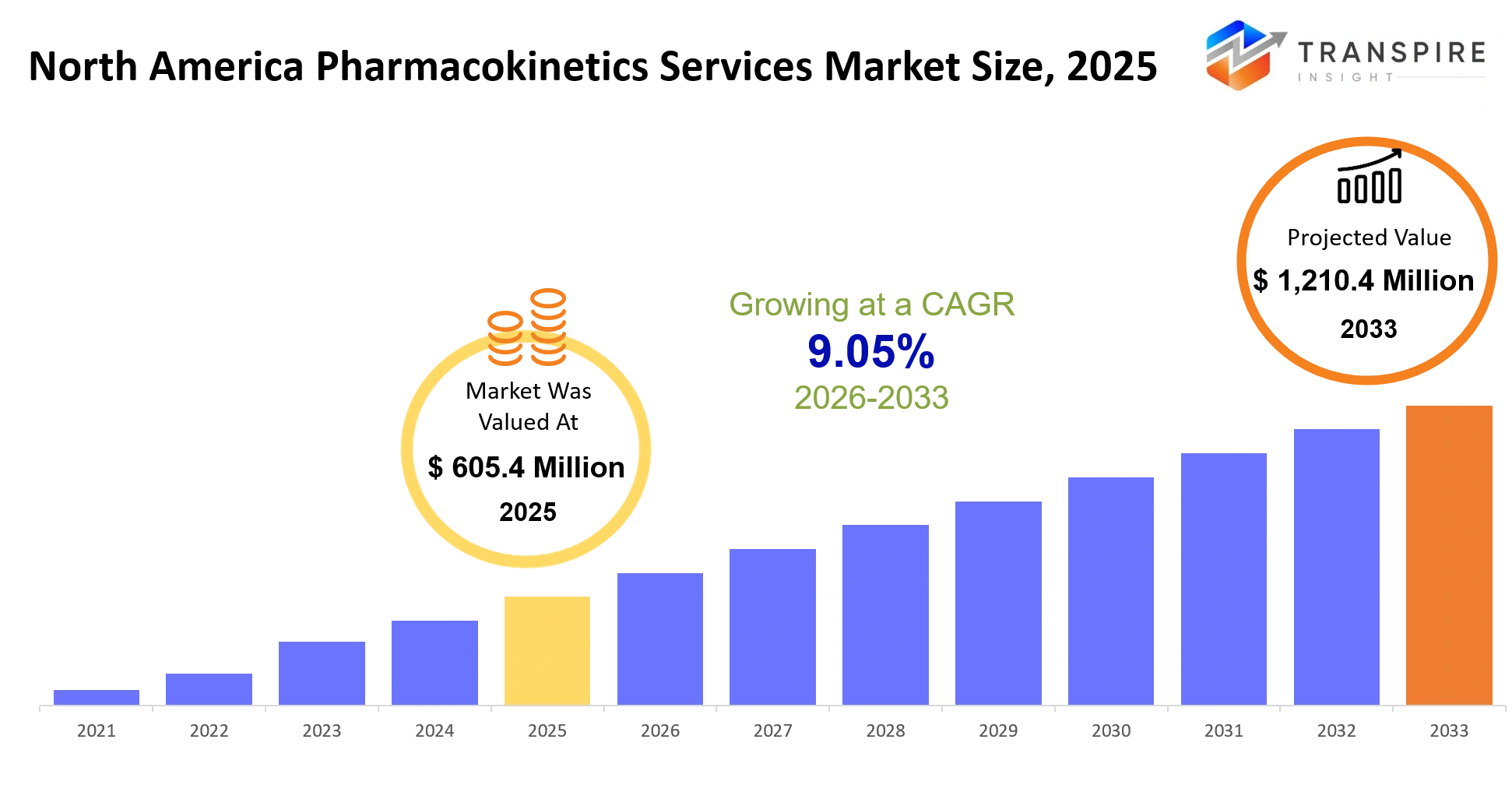
- North America Pharmacokinetics Services Market Size 2025: USD 605.4 Million
- North America Pharmacokinetics Services Market Size 2033: USD 1,210.4 Million
- North America Pharmacokinetics Services Market CAGR: 9.05%
- North America Pharmacokinetics Services Market Segments: By Service Type (Bioanalytical Services, Method Development, Clinical Pharmacokinetics, Non-Clinical Pharmacokinetics, Data Analysis Services, Regulatory Support, Sample Analysis, Others); By Application (Oncology, CNS Disorders, Cardiovascular Diseases, Infectious Diseases, Metabolic Disorders, Rare Diseases, Immunology, Others); By Molecule Type (Small Molecules, Biologics, Biosimilars, Cell Therapies, Gene Therapies, Peptides, Vaccines, Others); By End User (Pharmaceutical Companies, Biotechnology Companies, CROs, Academic Institutes, Research Laboratories, Government Institutes, Medical Device Companies, Others); By Phase (Preclinical Studies, Phase I, Phase II, Phase III, Phase IV, Translational Research, Exploratory Studies, Others).
North America Pharmacokinetics Services Market Summary
Pharmacokinetics services kind of track how a drug candidate moves inside the human body, from start to finish. In practice, researchers measure things like how fast absorption happens, the way it travels through tissues, what metabolism is doing, and how long excretion takes, so they can forecast both efficacy and safety once the therapeutic doses start to matter. In North America, the market basically covers bioanalytical testing, support for clinical study conduct, data analysis, and regulatory filing assistance. Most of that work is outsourced by pharma and biotech firms to specialized contract research organizations, since they want speed and consistency. The market, currently valued at USD 605.4 Million in 2025, is on course for something like USD 1,210.4 Million by 2033.
Now, structural changes are reshaping it in a pretty fundamental way, pushing the focus away from small-molecule drug development toward biologics and other advanced modalities. Small molecules, which were the majority of preclinical and clinical trials up until 2015 , tended to follow pharmacokinetic behavior that’s fairly established and predictable. But biologics, biosimilars, cell therapies, and gene therapies work with very different mechanics, especially around absorption, distribution, and clearance, so they can’t just be handled with a “standard” workflow. Instead you need specialized testing infrastructure, very particular assay development know-how, and a deep command of regulations, including the details people miss when they move too quickly. Contract research organizations that put money into immunoassay platforms, bioanalytical mass spectrometry, and next-generation sequencing capabilities basically pulled ahead of competitors. Smaller rivals were then left with only two real paths, either consolidate or exit.
And what really made this shift happen faster in the real world was the FDA’s guidance documents on pharmacokinetics for gene therapies and cell therapies, published in 2019 and 2020 .
Key North America Pharmacokinetics Services Market Insights
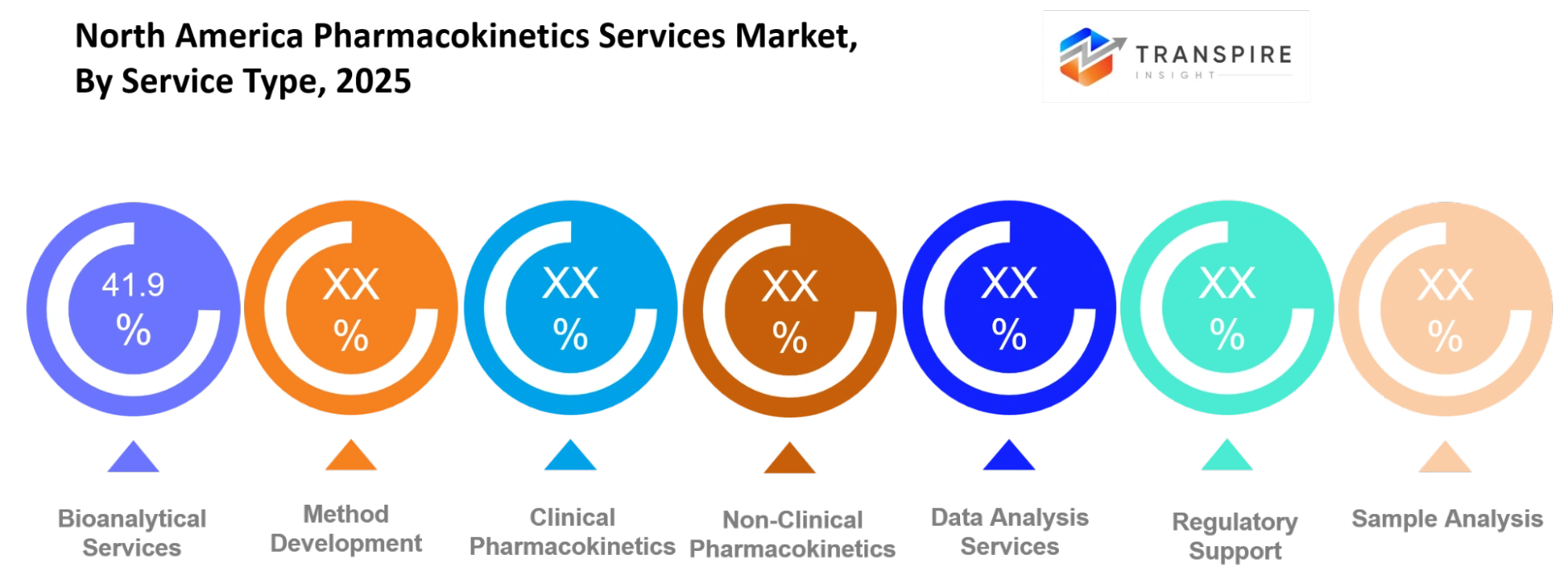
- Bioanalytical services kind of dominates the market, honestly—they still land at 41. 9% of our total revenue in 2025. That includes sample analysis, assay development and bioanalytical method validation, which in turn supports both clinical and preclinical programs across pretty much every modality you can think of.
- North America keeps around 38% of our global pharmacokinetics services revenue, with the United States as the center point, and there’s a reason for that. About 75% of all global biotech headquarters sit there, and nearly 90% of phase I through phase III trial volume plays out in that same region.
- In 2025, pharma companies account for 52% of contract research organization revenue, while biotechs are at 35% . This makes the direction pretty clear—industry consolidation. You know, larger pharma ends up buying pipeline assets, then later hands off their pharmacokinetics work to contractors.
- Clinical pharmacokinetics services are, arguably, the fastest-growing slice. They’re projected to expand at an 11. 2% CAGR all the way through 2033, and it seems driven by drug complexity and the rising need for PK/PD modeling across different populations. That covers pediatrics, geriatrics and patients dealing with liver function impairments , too.
- When you look at pharmacokinetics services by therapeutic type, small-molecule programs generate 48% of the 2025 revenue. Still, biologics and gene therapies are growing at a rate that’s about 18% higher. So it suggests a shift in portfolio diversity among pharma and biotech clients, not just one steady lane.
- For study timing, Phase I and Phase II studies make up roughly 58% of North America’s pharmacokinetics services volume, while Phase IV and translational research are growing faster. Companies are pushing their pharmacokinetics analysis further into post-approval monitoring, and leaning into biomarker-driven development strategies as a kind of follow-on step.
What are the Key Drivers, Restraints, and Opportunities in the North America Pharmacokinetics Services Market?
Mostly, there’s this sort of structural need for pharmacokinetics know-how early in biotech programs. A lot of biotech firms, when they’re working on their first drug candidate, just don’t keep in-house pharmacokinetics specialists, so they can’t really justify that capital spend for bioanalytical laboratory setup, especially not for one single program. Then when you outsource to contract research organizations, per program costs tend to come down, and your time to clinic kind of moves faster too, plus the technical risk feels like it shifts away from you in a practical way. Also, the overall number of biotech companies keeps climbing, particularly in cell therapy and gene therapy lanes, and it creates a steady demand for pharmacokinetics services that’s growing faster than what pharma can take in internally. On average, a biotech company that starts Phase I will run pharmacokinetics studies on about 3 to 5 preclinical programs before it chooses just one program for clinical development, so you end up with recurring service income over multiple years.
The main structural snag is mostly the huge capital expense and the very specific skills needed to run a fully compliant bioanalytical lab. To meet FDA expectations around bioanalytical method validation, quality control, and chain of custody paperwork, you need really expensive equipment like liquid chromatography–tandem mass spectrometry platforms (these often land around $250,000 to $500,000 per unit, once you account for setup). And on top of that, you need highly trained analytical chemists with advanced degrees. There’s also a minimum economic scale to keep a viable pharmacokinetics CRO going, it’s roughly $8 to $12 million in annual revenue. Because of that mix, talent plus the capital wall, a fair bit of market consolidation already happened, so now there’s space for only about 15 to 20 major CROs across North America.
The clearest forward opening is really integrated pharmacokinetics and pharmacodynamics modeling that can anticipate clinical outcomes without needing to run full-scale dose escalation experiments. Machine learning, when used on historical data sets that cover small-molecule pharmacokinetics plus efficacy results, can trim the number of pharmacokinetics sampling events per study by 25 to 40% , which in turn lowers both the calendar time and the overall bill. Contract research organizations that build their own proprietary forecast models and then fold those into their service bundles will likely see materially higher profit margins. Some providers are already moving in that direction,by picking up clinical pharmacology modeling companies, and signing collaborations with leading academic medical centers. Also, the regulatory route for model-based pharmacokinetics guidance is pretty settled, especially with the FDA involved , so commercialization should have a clear lane.
What Has the Impact of Artificial Intelligence Been on the North America Pharmacokinetics Services Market?
Artificial intelligence kinda really changes pharmacokinetics services via three things: building bioanalytical assays, looking through clinical data, and then handling regulatory submissions. For assay development, machine learning algorithms that are trained on old immunoassay, and chromatography records can sort of predict the best assay parameters. That means fewer experimental loops, dropping that “confirm the method” process from like 12–15 rounds down to 6–8 rounds. So yeah, it often reduces assay development timeframes by around 35 to 45% and also cuts costs, in the same rough proportion too.
For the clinical data side, AI used on pharmacokinetics–pharmacodynamics datasets spots population subgroups with very different drug metabolism patterns. These can be kind of invisible when someone only uses traditional statistics. The algorithms also uncover non linear relationships between dose exposure and clinical outcomes, and they can steer dosing choices especially for patients with liver or kidney concerns. Plus, they point out possible threats from drug–drug interactions. Because more clients now want this sort of analysis included in their regulatory submissions, pharmacokinetics contract research organizations end up expanding their work beyond just “run and analyze samples”, and move toward clinical decision support. It’s like the whole service scope widens.
Then, for regulatory submissions, natural language processing together with machine learning helps a lot with arranging pharmacokinetics information into the format demanded for regulatory common technical documents. It can also reference prior studies and flag inconsistencies between preclinical and clinical datasets. Overall, these tools save time while assembling pharmacokinetics sections of regulatory applications, by something like 20 to 30%.
Key Market Trends
- Bioanalytical services will end up taking something like 41. 9 percent of total market revenue in 2025, this is supported especially by immunoassay and liquid chromatography-mass spectrometry testing which in practice validates drug concentrations found in blood and tissue samples across both preclinical and clinical work, kinda all the way through.
- Method Development services are also moving forward quickly, expanding around 10. 8 percent CAGR by 2033, and the reason is that newer treatments such as biosimilars, cell therapies, and gene therapies require more involved analytical approaches, so the more standard generic pharmacokinetics contract research organization platforms can’t really cover it.
- Clinical pharmacokinetics services grew roughly 11. 2 percent in 2024, driven by population pharmacokinetics needs, pediatric programs, and post-approval comparative bioavailability studies. Those are required , mandated by the FDA for generic drug approvals, so teams have to keep delivering.
- Data Analysis and Modeling is the one that looks the most accelerated, 12. 4 percent CAGR, basically showing rising demand for noncompartmental analysis, compartmental modeling, and physiologically-based pharmacokinetics simulations that can predict dose exposure linkages, more or less before things are finalized.
- Non-Clinical Pharmacokinetics services rose 8. 9 percent in 2024, which keeps pace with the sheer volume of preclinical development projects. Still , it’s growing a bit slower than the clinical side, because contract research organizations are reshuffling capacity toward later-stage programs that often bring more profit.
- And on the broader front, pharmaceutical companies have really been turning up their outsourcing of pharmacokinetics work, moving it from 38 percent of development projects in 2020 to about 54 percent in 2025. That suggests their choice to divest internal bioanalytical know-how and redirect budget towards drug discovery and clinical activities, rather than keep everything in-house
North America Pharmacokinetics Services Market Segmentation
By Service Type
Bioanalytical Services really stand out, they form 41. 9% of the market’s revenue. This kind of sector covers everything from sample preparation, all the way through analytical method development and bioanalytical testing that tracks drug levels across both preclinical and clinical studies. Its big footprint comes from being a sort of key foundation for the rest of the pharmacokinetics work that follows. Bioanalytical contract research organizations put real money into liquid chromatography-mass spectrometry equipment and solid quality assurance frameworks, to align with FDA requirements.
Method Development shows up as the second largest service category, roughly 18% of the market’s revenue. This service basically focuses on inventing and validating bioanalytical assays for specific drug candidates, disease targets, and regulatory expectations. The momentum is driven by the rising intricacy of newer modalities, especially biologics and gene therapies, which really do need more specialized analytical techniques.
Clinical Pharmacokinetics services are also pushing forward at a 11. 2% CAGR through 2033. These services include population pharmacokinetics modeling, dose optimization across different patient groups, and assessing drug–drug or drug-related interactions. A big part of the rise is tied to stronger regulatory expectations for pharmacokinetics data, across a broad range of patient populations.
By Application
Cancer (oncology) seems to take the lead as the biggest application area, accounting for 28% of pharmacokinetics services revenue, which is pretty consistent. Cancer drug development still requires broad pharmacokinetics checks, like figuring out what exposure is enough and getting the best possible dose for patients with different metabolic profiles. This segment keeps expanding at a 9. 8% CAGR through 2033, mainly because immunotherapy and targeted therapy programs keep getting built out more.
Next up are Central Nervous System disorders, they land in second place, contributing 19% of the revenue. The reason is largely that you have to judge how well medicines manage to cross the blood brain barrier. These CNS efforts typically call for specialized bioanalytical approaches and modeling of drug concentrations across different patient groups, so the service expenses tend to be higher, than you might expect.
Cardiovascular disease, infectious diseases, and metabolic disorders together represent 38% of the market revenue. They are also moving forward at about 7. 5% to 8. 5% CAGR, pushed by population health shifts, an aging society, and the ongoing arrival of generic drugs that still require bioavailability studies, even if the compounds are “older” in a sense.
By Molecule Type
Small Molecules are about 48 percent of the pharmacokinetics services revenue, and in a way it is really just a mirror of the sheer volume of ongoing small-molecule development programs. The growth rate stays pretty steady around 7.2 percent CAGR, because small-molecule development is hitting that more mature stage. At the same time, bioanalytical testing for small molecules is starting to feel almost commodity-like, so many contract research organizations provide services that look nearly identical, with similar turnaround and the same basic toolset.
Biologics make up 24 percent of market revenue, and they are growing faster at 14.3 percent CAGR by 2033. Biologics pharmacokinetics can need more specialized methods, think immunoassay development and protein quantitation, not just the usual assays. Overall, this segment’s pace is outstripping small molecules, since pharma companies are rebalancing their pipelines and leaning more heavily toward biologic therapeutics.
Then there is the group of Biosimilars, Cell Therapies, Gene Therapies, Peptides, and Vaccines, which combined reach 28 percent of revenue. Gene therapies and cell therapies are also the speediest subsegments, hovering around 18 to 22 percent CAGR, mostly because newer modalities keep moving into clinical development. FDA guidance is also pushing demand for specialized biodistribution and pharmacokinetics work, and that is a major part of the story.
By End User
Pharmaceutical Companies account for 52 percent of pharmacokinetics contract research organization revenue in 2025- and yeah it really does seem like a mirror of how many clinical programs are winding up in late stage development. also, pharmaceutical client concentration has been creeping higher too, because consolidation basically shrinks the count of firms sending work out for contracting, which is kind of the whole point.
Biotechnology Companies bring in 35 percent of revenue, and they’re forecast to grow 12.1 percent CAGR by 2033. Biotechs kind of lean heavily on pharmacokinetics contract research organization services, since many don’t have the proper in-house analytical chemistry, plus the bioanalytical infrastructure they would need to do it themselves.
Then there are Contract Research Organizations, Academic Institutes, Government Institutes, and Medical Device Companies altogether, they add up to 13 percent of revenue. The academic and government side is growing the fastest, around 11.8 percent CAGR, mainly because expanded NIH funding is pushing translational pharmacokinetics research forward.
By Phase
Preclinical Studies account for 18 percent of the pharmacokinetics services volume, kind of laying down the groundwork for investigational new drug applications. This part is expanding at an 8. 2 percent CAGR because biotechnology companies are pushing preclinical pharmacokinetics characterization even further, basically before they start phase I.
Phase I and Phase II, together they’re about 58 percent of pharmacokinetics services volume and they are projected to grow at 9. 8 percent CAGR by 2033. These phases require very intensive pharmacokinetics profiling ,think dose escalation , food effect work , and also dose-exposure-response modeling.
Phase III comes in at 16 percent of volume and is growing at 7. 9 percent CAGR, as pharmaceutical companies run comparative bioavailability studies and population pharmacokinetics evaluations. Meanwhile, Phase IV and Translational Research are 8 percent of volume but are still growing at 11. 2 percent CAGR, which is really showing up as post-approval pharmacokinetics monitoring, plus precision medicine applications too.
What are the Key Use Cases Driving the North America Pharmacokinetics Services Market?
The main, use case is sort of bioavailability and bioequivalence testing, for generic drug development. Generic manufacturers who submit abbreviated new drug applications to FDA have to run bioavailability studies, comparing their generic formulation to the reference brand formulation. Pharmacokinetics contract research organizations then step in, they provide the bioanalytical testing and statistical analysis, showing that the products are bioequivalent. This use case, just keeps generating high volume work, from dozens of generic manufacturers every year.
Clinical pharmacokinetics characterization in early development programs is the second big use case. Biotechnology and pharmaceutical companies run phase I dose escalation studies to figure out the maximum tolerated dose, and also the pharmacokinetically active dose ranges. Those studies, require very intensive blood sampling,bioanalytical analysis, and population pharmacokinetics modeling… all of it is delivered by specialized contract research organizations.
The emerging use case , getting more attention for 2026 to 2033 is pharmacokinetics-guided therapeutic drug monitoring, in post approval settings. As precision medicine grows, even more clinicians are using pharmacokinetics-guided dosing to tune treatment plans for each individual patient, especially when metabolism patterns vary. That, in practice, produces a lot of demand for quick bioanalytical testing results and software platforms that estimate the right dose using each patient’s pharmacokinetics, which in turn creates new service revenue streams for contract research organizations that can offer an integrated clinical laboratory + advisory model.
|
Report Metrics |
Details |
|
Market size value in 2025 |
USD 605.4 Million |
|
Market size value in 2026 |
USD 660.2 Million |
|
Revenue forecast in 2033 |
USD 1,210.4 Million |
|
Growth rate |
CAGR of 9.05% from 2026 to 2033 |
|
Base year |
2025 |
|
Historical data |
2021 - 2024 |
|
Forecast period |
2026 - 2033 |
|
Report coverage |
Revenue forecast, competitive landscape, growth factors, and trends |
|
Regional scope |
United States, Canada |
|
Key companies profiled |
Labcorp Drug Development, IQVIA, Charles River Laboratories, ICON plc, Syneos Health, Medpace, Thermo Fisher Scientific, Evotec, SGS, Eurofins Scientific, PPD, Frontage Laboratories, Altasciences, WuXi AppTec, Parexel. |
|
Customization scope |
Free report customization (country, regional & segment scope). Avail customized purchase options to meet your exact research needs. |
|
Report Segmentation |
By Service Type (Bioanalytical Services, Method Development, Clinical Pharmacokinetics, Non-Clinical Pharmacokinetics, Data Analysis Services, Regulatory Support, Sample Analysis, Others); By Application (Oncology, CNS Disorders, Cardiovascular Diseases, Infectious Diseases, Metabolic Disorders, Rare Diseases, Immunology, Others); By Molecule Type (Small Molecules, Biologics, Biosimilars, Cell Therapies, Gene Therapies, Peptides, Vaccines, Others); By End User (Pharmaceutical Companies, Biotechnology Companies, CROs, Academic Institutes, Research Laboratories, Government Institutes, Medical Device Companies, Others); By Phase (Preclinical Studies, Phase I, Phase II, Phase III, Phase IV, Translational Research, Exploratory Studies, Others). |
Which Regions are Driving the North America Pharmacokinetics Services Market Growth?
The United States really holds sway over North American pharmacokinetics services, like it’s about 87% of the market’s revenue in 2025. US leadership basically mirrors how tightly pharmaceutical and biotech companies are clustered across Massachusetts, California, New Jersey, and North Carolina, plus the whole FDA and NIH regulatory backbone, and yes, the largest clinical trial set-up worldwide. FDA guidelines on pharmacokinetics sort of act as a baseline standard that other regulatory bodies lean on, so the US ends up as the primary market for all kinds of new pharmacokinetics service offerings. Meanwhile 75% of the global biotech firms that have US operations keep generating steady demand for pharmacokinetics contract research organisation services across pre-clinical, clinical, and post-approval phases. US contract research organisations also have substantial influence over pricing, since FDA compliance expectations are even stricter than what you’ll find in most other regions.
Canada brings in roughly 13% of North America’s pharmacokinetics services revenue. This is driven by a smaller but still comparatively larger biotech environment centered in Ontario and British Columbia. Canadian contract research organisations gain traction from lower operating costs and very skilled chemists, which lets them undercut US prices by about 15 to 25 percent for similar work. Their regulatory structures for bioanalytical testing feel quite comparable to FDA standards, so international clients typically face very little extra compliance overhead. Canada’s growth is fairly steady too, projected around 8. 2% CAGR by 2033, partly because pharmaceutical companies start spreading clinical trial locations across North America, so subject recruitment happens more efficiently.
Who are the Key Players in the North America Pharmacokinetics Services Market and How Do They Compete?
North America’s pharmacokinetics services market is kind of stuck under a pretty tight grip from the top tier, where IQVIA, Charles River Laboratories, and Labcorp Drug Development together account for about 42% of the market income. These big three keep fighting for position by bundling their offerings , plus having a broad footprint across the region and doing vertical integration across their preclinical and clinical development tracks. After them , the market kind of spreads out across mid-tier providers like ICON plc, Syneos Health, and Medpace they compete mostly on specialized know-how, quicker turnaround, and these more personal service partnerships that feel a bit more tailored than the giants.
Also, the consolidation trend seems to be accelerating , because larger contract research organizations are buying up smaller bioanalytical and clinical pharmacology firms, so they can meaningfully grow their service toolbox and expand how much they can deliver.
IQVIA plays the lead by offering very comprehensive packages—bringing pharmacokinetics testing together with patient recruitment, data management, and regulatory consulting, all under a single vendor agreement. Charles River Laboratories leans into its geographic coverage, with testing facilities placed around North America , and it has fully integrated toxicology and pharmacokinetics programs that support both discovery and development stages without much switching between modes. Labcorp Drug Development tends to differentiate by pushing fast results and strong cost-effectiveness, using automated bioanalytical platforms that really boost throughput while still aiming to keep the quality steady. And then there are the more specialized, boutique contract research organizations, for example Syneos Health , which focus on less common investigation areas like gene therapy pharmacokinetics and cell therapy biodistribution analysis, often charging higher prices because their regulatory know-how goes deep.
North America Pharmacokinetics Services Market Companies
- Labcorp Drug Development
- IQVIA
- Charles River Laboratories
- ICON plc
- Syneos Health
- Medpace
- Thermo Fisher Scientific
- Evotec
- SGS
- Eurofins Scientific
- PPD
- Frontage Laboratories
- Altasciences
- WuXi AppTec
- Parexel
Recent Developments
In March 2026, Charles River Laboratories completed the acquisition of a specialized cell therapy pharmacokinetics testing laboratory based in Massachusetts, expanding its biodistribution analysis capability for CAR-T and stem cell therapeutic programs. The acquisition strengthens Charles River's position in the fastest-growing pharmacokinetics segment and provides direct access to cell therapy development programs.
Source: https://www.criver.com
In January 2026, Evotec established a dedicated Gene Therapy Pharmacokinetics Center of Excellence in the United States, consolidating biodistribution analysis expertise and regulatory consulting capabilities into a specialized service unit targeting the rapidly expanding gene therapy development market.
Source: https://www.evotec.com
What Strategic Insights Define the Future of the North America Pharmacokinetics Services Market?
Over the next five to seven years, the North American pharmacokinetics services market is going to move away from generic bioanalytical testing and more towards some specialized advisory stuff that actually steers your clients decision making process , if you think about it. The main reason behind this shift is that therapeutic complexity keeps climbing: early stage biotech firms usually don’t have the internal know-how to interpret pharmacokinetics data across different disease types and treatment methods. So there is a pretty clear pull for contract research organizations that can handle both testing and regulatory guidance at the same time. Also, the contract research organizations that build and use their own proprietary pharmacokinetics-pharmacodynamics models, then weave those into client reports, should see stronger margins than the ones that just do pure testing.
What growth rates don’t really reveal is the risk from technology substitution. Like, if microfluidic platforms and very advanced analytical chemistry equipment mature faster than contract research organization infrastructure, then new players with leaner operations might come in and shake up the established positions that still lean on older bioanalytical facilities. And there’s another twist: pharmaceutical companies are also starting to strengthen internal pharmacokinetics capabilities, by hiring key personnel and picking up smaller boutique consulting companies. In that case, the overall demand growth for contract research organizations could land below the market projections, not because the need disappears but because the work is absorbed in-house.
One opportunity that doesn’t show up in many market analyses yet is how to connect pharmacokinetics data with real world evidence platforms.
North America Pharmacokinetics Services Market Report Segmentation
By Service Type
- Bioanalytical Services
- Method Development
- Clinical Pharmacokinetics
- Non-Clinical Pharmacokinetics
- Data Analysis Services
- Regulatory Support
- Sample Analysis
- Others
By Application
- Oncology
- CNS Disorders
- Cardiovascular Diseases
- Infectious Diseases
- Metabolic Disorders
- Rare Diseases
- Immunology
- Others
By Molecule Type
- Small Molecules
- Biologics
- Biosimilars
- Cell Therapies
- Gene Therapies
- Peptides
- Vaccines
- Others
By End User
- Pharmaceutical Companies
- Biotechnology Companies
- CROs
- Academic Institutes
- Research Laboratories
- Government Institutes
- Medical Device Companies
- Others
By Phase
- Preclinical Studies
- Phase I
- Phase II
- Phase III
- Phase IV
- Translational Research
- Exploratory Studies
- Others
Frequently Asked Questions
Find quick answers to common questions.
The North America Pharmacokinetics Services Market size is expected to reach USD 1,210.4 Million by 2033.
The key segments are By Service Type (Bioanalytical Services, Method Development, Clinical Pharmacokinetics, Non-Clinical Pharmacokinetics, Data Analysis Services, Regulatory Support, Sample Analysis, Others); By Application (Oncology, CNS Disorders, Cardiovascular Diseases, Infectious Diseases, Metabolic Disorders, Rare Diseases, Immunology, Others); By Molecule Type (Small Molecules, Biologics, Biosimilars, Cell Therapies, Gene Therapies, Peptides, Vaccines, Others); By End User (Pharmaceutical Companies, Biotechnology Companies, CROs, Academic Institutes, Research Laboratories, Government Institutes, Medical Device Companies, Others); By Phase (Preclinical Studies, Phase I, Phase II, Phase III, Phase IV, Translational Research, Exploratory Studies, Others).
Major players include Labcorp Drug Development, IQVIA, Charles River Laboratories, ICON plc, Syneos Health, Medpace, Thermo Fisher Scientific, Evotec, SGS, Eurofins Scientific, PPD, Frontage Laboratories, Altasciences, WuXi AppTec, and Parexel.
The North America Pharmacokinetics Services Market size is USD 605.4 Million in 2025.
The North America Pharmacokinetics Services Market CAGR is 9.05% from 2026 to 2033.
- Labcorp Drug Development
- IQVIA
- Charles River Laboratories
- ICON plc
- Syneos Health
- Medpace
- Thermo Fisher Scientific
- Evotec
- SGS
- Eurofins Scientific
- PPD
- Frontage Laboratories
- Altasciences
- WuXi AppTec
- Parexel
About the Authors

Pankaj Ghogare Patil
I am Pankaj Ghogare Patil, a Senior Research Analyst at Transpire Insight, specializing in the Pharmaceutical, Chemicals & Materials, Healthcare IT, and Biotechnology industry. My expertise lies in conducting comprehensive market research, analyzing industry trends, evaluating competitive landscapes, and translating complex data into actionable insights. At Transpire Insight, I closely follow emerging technologies, regulatory developments, and market innovations to create accurate, well-researched, and informative content that helps businesses and professionals make informed decisions. I am committed to producing credible, evidence-based articles that reflect industry best practices while making technical topics accessible and valuable for a broad audience.

Chakradhar Khansole
Chakradhar serves as the Research Director at Transpire Insight, bringing over 8 years of experience in technology, innovation, and strategic market intelligence. He specializes in transforming complex market data into actionable business insights that enable organizations to make informed, growth-oriented decisions. Recognized for his strategic vision and analytical expertise, Chakradhar leads high-impact research initiatives, delivering comprehensive market assessments, competitive intelligence, and forward-looking industry analysis.
Recently Published Reports
-
Jul 2026
Alopecia Treatment Market
Alopecia Treatment Market Size, Share & Analysis Report By Disease Type (Alopecia Areata, Cicatricial Alopecia, Traction Alopecia, Alopecia Totalis, Androgenetic Alopecia, Alopecia Universalis, and Other Disease Types), By Treatment Type (Topical Treatments, Oral Medications, Injectable Therapies, and Hair Transplantation), By Gender (Male, and Female), By Distribution Channel (Hospitals and Clinics, Retail Pharmacies, and Online Retailers), and Geography (North America, Europe, Asia-Pacific, Middle East and Africa, South and Central America), 2021 - 2031
-
Jul 2026
Medical Ultrasound Probe Market
Medical Ultrasound Probe Market Size, Share & Analysis Report By Type (Linear Type, Convex Type, Endocavitary Probe, Phased Array/Cardiac Probe, Transesophageal (TEE) Probe, and Others), By Application (Ophthalmology, Cardiology, Musculoskeletal, Oncology, Obstetrics & Gynecology, General Imaging, and Others), By End User (Hospitals & Clinics, Diagnostic Centers, Ambulatory Surgical Centers, and Others), and Geography (North America, Europe, Asia-Pacific, Middle East and Africa, South and Central America), 2021 – 2031
-
May 2026
Biosimilars Market
Biosimilars Market By Product Type (Monoclonal Antibodies, Recombinant Hormones, Erythropoietin, G-CSF, Others), By Indication (Oncology, Autoimmune Diseases, Blood Disorders, Diabetes, Others), By Manufacturing Type (In-House Manufacturing, Contract Manufacturing), By Distribution Channel (Hospital Pharmacies, Retail Pharmacies, Online Pharmacies), By Industry Analysis, Size, Share, Growth, Trends, and Forecasts 2021-2033
-
Apr 2026
Gastrointestinal Endoscopy Market
Gastrointestinal Endoscopy Market By Type (Rigid Gastrointestinal Endoscope, Flexible Gastrointestinal Endoscopes, Disposable Gastrointestinal Endoscope), By Procedure Type (Colonoscopy, Gastroscopy, Duodenoscopy, Enteroscopy, Flexible Sigmoidoscopy, Others), By Application (Diagnosis, Treatment), By End-Users (Hospitals, Ambulatory Surgical Centers, Specialty Clinics, Laboratories, Others), By Industry Analysis, Size, Share, Growth, Trends, and Forecasts 2021-2033